The main tag of Forex News Today Articles.
You can use the search box below to find what you need.
[wd_asp id=1]

10 02, 2025

Euro recovery attempts to remain limited in near term

By |2025-02-10T12:27:30+02:00February 10, 2025|Forex News, News|0 Comments

  • EUR/USD trades above 1.0300 in the European morning on Monday.
  • US President Trump’s tariff threats could limit the Euro’s upside.
  • ECB President Christine Lagarde will speak before the European Parliament later in the day.

EUR/USD holds steady above 1.0300 after starting the week under modest bearish pressure. The near-term technical outlook suggests that buyers remain hesitant.

Euro PRICE Today

The table below shows the percentage change of Euro (EUR) against listed major currencies today. Euro was the weakest against the Australian Dollar.

  USD EUR GBP JPY CAD AUD NZD CHF
USD   0.13% -0.07% 0.49% 0.41% -0.01% 0.05% 0.13%
EUR -0.13%   -0.14% 0.49% 0.40% -0.15% 0.00% 0.07%
GBP 0.07% 0.14%   0.45% 0.50% -0.01% 0.14% 0.21%
JPY -0.49% -0.49% -0.45%   -0.11% -0.43% -0.43% -0.35%
CAD -0.41% -0.40% -0.50% 0.11%   -0.40% -0.39% -0.32%
AUD 0.01% 0.15% 0.01% 0.43% 0.40%   0.16% 0.22%
NZD -0.05% -0.01% -0.14% 0.43% 0.39% -0.16%   0.07%
CHF -0.13% -0.07% -0.21% 0.35% 0.32% -0.22% -0.07%  

The heat map shows percentage changes of major currencies against each other. The base currency is picked from the left column, while the quote currency is picked from the top row. For example, if you pick the Euro from the left column and move along the horizontal line to the US Dollar, the percentage change displayed in the box will represent EUR (base)/USD (quote).

January labor market data and US President Donald Trump’s comments on trade policy helped the US Dollar (USD) gather strength heading into the weekend, causing EUR/USD to push lower late Friday.

The Bureau of Labor Statistics (BLS) reported that Nonfarm Payrolls (NFP) rose by 143,000 in January, missing the market expectation for an increase of 170,000. On a positive note, November’s increase of 256,000 were revised higher to 307,000, while the Unemployment Rate edged lower to 4.1% from 4% in December. In the meantime, US President Donald Trump said that he will announce “reciprocal tariffs” on many countries this Tuesday or Wednesday. Additionally, Trump announced over the weekend that he plans to impose 25% tariffs on all steel and aluminum imports into the US.  

French Foreign Minister Jean-Noel Barrot responded to Trump early Monday, noting that France and its European partners should not hesitate to defend their interests in the face of the US tariff threats.

The economic calendar will not feature any high-tier data releases on Monday. Later in the day, European Central Bank (ECB) President Christine Lagarde will brief the European Parliament on the state of European and global economic affairs and the ECB’s activities. 

The uncertainty surrounding EU-US trade relations could make it difficult for the Euro to find demand in the near term.

EUR/USD Technical Analysis

The Relative Strength Index (RSI) indicator on the 4-hour chart stays below 40, highlighting the bearish stance. On the downside, 1.0290-1.0300 (Fibonacci 23.6% retracement of the latest downtrend, round level) aligns as first support area before 1.0250 (static level) and 1.0200 (round level, static level).

In case EUR/USD rises above 1.0350-1.0360 (Fibonacci 38.2% retracement, 200-period Simple Moving Average) and flips that area into support, technical buyers could take action. In this scenario, 1.0400 (Fibonacci 50% retracement) and 1.0440 (Fibonacci 61.8% retracement) could be seen as next resistance levels.

Euro FAQs

The Euro is the currency for the 19 European Union countries that belong to the Eurozone. It is the second most heavily traded currency in the world behind the US Dollar. In 2022, it accounted for 31% of all foreign exchange transactions, with an average daily turnover of over $2.2 trillion a day. EUR/USD is the most heavily traded currency pair in the world, accounting for an estimated 30% off all transactions, followed by EUR/JPY (4%), EUR/GBP (3%) and EUR/AUD (2%).

The European Central Bank (ECB) in Frankfurt, Germany, is the reserve bank for the Eurozone. The ECB sets interest rates and manages monetary policy. The ECB’s primary mandate is to maintain price stability, which means either controlling inflation or stimulating growth. Its primary tool is the raising or lowering of interest rates. Relatively high interest rates – or the expectation of higher rates – will usually benefit the Euro and vice versa. The ECB Governing Council makes monetary policy decisions at meetings held eight times a year. Decisions are made by heads of the Eurozone national banks and six permanent members, including the President of the ECB, Christine Lagarde.

Eurozone inflation data, measured by the Harmonized Index of Consumer Prices (HICP), is an important econometric for the Euro. If inflation rises more than expected, especially if above the ECB’s 2% target, it obliges the ECB to raise interest rates to bring it back under control. Relatively high interest rates compared to its counterparts will usually benefit the Euro, as it makes the region more attractive as a place for global investors to park their money.

Data releases gauge the health of the economy and can impact on the Euro. Indicators such as GDP, Manufacturing and Services PMIs, employment, and consumer sentiment surveys can all influence the direction of the single currency. A strong economy is good for the Euro. Not only does it attract more foreign investment but it may encourage the ECB to put up interest rates, which will directly strengthen the Euro. Otherwise, if economic data is weak, the Euro is likely to fall. Economic data for the four largest economies in the euro area (Germany, France, Italy and Spain) are especially significant, as they account for 75% of the Eurozone’s economy.

Another significant data release for the Euro is the Trade Balance. This indicator measures the difference between what a country earns from its exports and what it spends on imports over a given period. If a country produces highly sought after exports then its currency will gain in value purely from the extra demand created from foreign buyers seeking to purchase these goods. Therefore, a positive net Trade Balance strengthens a currency and vice versa for a negative balance.
 

Source link

10 02, 2025

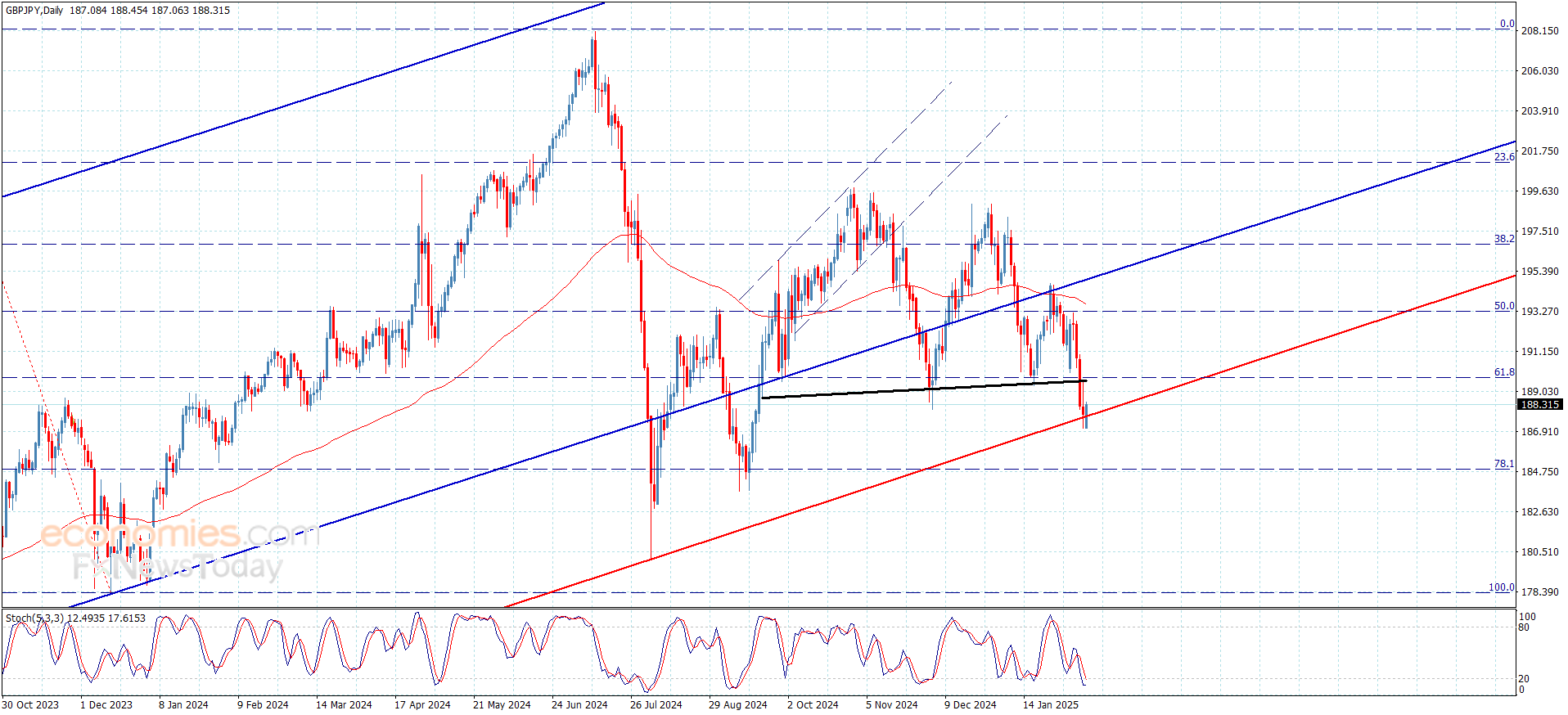
The GBPJPY fails to resume the positivity – Forecast today – 10-2-2025

By |2025-02-10T10:25:36+02:00February 10, 2025|Forex News, News|0 Comments

Copper price formed strong bullish rally after confirming breaching 4.3300$ barrier, surpassing the first main target at 4.5400$ to settle above 50% Fibonacci correction level.


Also, the major indicators provide the positive momentum to assist to renew the bullish attempts, to expect achieving additional gains by rallying towards 4.6800$ soon, followed by reaching 4.8100$ on the medium term basis.


The expected trading range for today is between 4.5000$ and 4.6800$


Trend forecast: Bullish


Source link

10 02, 2025

The EURJPY suffers additional losses – Forecast today – 10-2-2025

By |2025-02-10T08:25:07+02:00February 10, 2025|Forex News, News|0 Comments

The EURJPY pair continue to form negative trades by crawling below 157.25 recently, to notice surpassing the negative target at 156.20 and suffering additional losses by touching 155.60 this morning.


The correctional bullish rebound towards 156.65 won’t affect the main bearish track that depends on 160.25 level forming the major barrier, also, the major indicators continue to provide the negative momentum to force the price to form new negative waves and target 155.10 followed by reaching the historical support at 154.40.


The expected trading range for today is between 155.10 and 157.30


Trend forecast: Bearish


Source link

10 02, 2025

GBP/USD Forecast: Dollar Survives US Jobs Test, Pound Blocked at $1.2500

By |2025-02-10T00:18:18+02:00February 10, 2025|Forex News, News|0 Comments

February 9, 2025 – Written by David Woodsmith

The dollar dipped in immediate reaction to the latest US employment report, but quickly regained ground amid firmer underlying data and a smaller than expected benchmark revision.

At this stage, markets do not expect US interest rates will be cut below UK rates over the remainder of this year.

The Pound to Dollar (GBP/USD) exchange rate spiked to near 1.2500 before a rapid retreat to 1.2425.

The Pound to Euro (GBP/EUR) exchange rate settled just below the 1.2000 level amid position adjustment into the weekend.

US non-farm payrolls increased 143,000 for January compared with consensus forecasts of around 170,000, although there was a significant upward revision to the December gain to 307,000 compared with the flash reading of 256,000.

The unemployment rate edged lower to 4.0% from 4.1% previously.

Average hourly earnings increased 0.5% on the month compared with expectations of 0.3% with the annual increase holding at 4.1%.

Advertisement


The BLS also announced annual benchmark revisions with a decline in payrolls of 598,000 over the year, although this was below market expectations of around 800,000.

According to Peter Cardillo, Chief Market Economist at Spartan Capital Securities; “Basically, it’s a report that raises inflation and inflation fears. It means the Fed will probably continue with its wait-and-see attitude, and that wait-and-see might actually have to be longer than perhaps what the market is expecting.”

Markets consider that the chances of a rate cut by June are only just above 50% with the most likely outcome only one cut this year.

MUFG commented; “if there is a knee-jerk drop in yields and the dollar on a weaker print, the one-off risks that may have impacted the data and the FOMC’s strong stance for a pause suggests to us that the move could quickly reverse.”

Domestically, Bank of England MPC member Pill stated that there is an on-going disinflation process in the UK, but added that pay disinflation was not as strong as thought in November.

As far as inflation is concerned, Pill stated that he was optimistic that an upward blip in inflation this year will not lead to second-round effects, but he did state that the bank needed to be vigilant.

He pointed to stagflation risks with comments that underlying pressures remain elevated, but that activity is weaker than expected.

Pill sees scope for gradual and careful rate cuts and he stated that this acts against cutting rates by 50 basis-point increments.

Following Pill’s comments, markets were slightly more cautious over the outlook for three rate cuts this year.

Scotiabank still expressed some reservations over the UK outlook; “BoE forecasts for weak growth and higher inflation may add to concerns that Chancellor Reeves fiscal plans may be disrupted by the sluggish economy.”

Like this piece? Please share with your friends and colleagues:


International Money Transfer? Ask our resident FX expert a money transfer question or try John’s new, free, no-obligation personal service! ,where he helps every step of the way,
ensuring you get the best exchange rates on your currency requirements.

TAGS: Pound Dollar Forecasts

Source link

9 02, 2025

Japanese Yen Forecast: Will US CPI and Powell’s Testimony Push USD/JPY Below 150?

By |2025-02-09T08:08:57+02:00February 9, 2025|Forex News, News|0 Comments

Key Economic Data Fuels BoJ Rate Hike Speculation

Economic data from Japan, including wage growth and household spending, have intensified market expectations for a BoJ policy move. Traders should now turn their attention to upcoming data releases, including machine tool orders and producer prices, which may offer more clues on Japan’s economic outlook.

On February 12, machine tool orders will provide insights into Japan’s industrial demand environment. Economists forecast orders to rise 1.6% year-on-year in January, down from 11.2% in December.

A smaller-than-expected increase may signal a pullback in business investment and industrial production. Downward trends could indicate weaker employment across the manufacturing sector, potentially affecting wage growth. Softer wage growth could curb consumer spending and dampen demand-driven inflationary pressures.

Conversely, larger-than-expected demand for tools could suggest robust production, supporting the labor market and wage growth, a key metric for the BoJ.

Japan Producer Prices and the BoJ Rate Path

While economists consider machine tool orders a barometer of Japan’s manufacturing sector, producer prices will likely impact the USD/JPY pair more. Producer prices are a leading indicator of inflation since producers adjust prices according to demand.

Economists expect producer prices to rise 4% year-on-year in January, up from 3.8% in December.

Source link

9 02, 2025

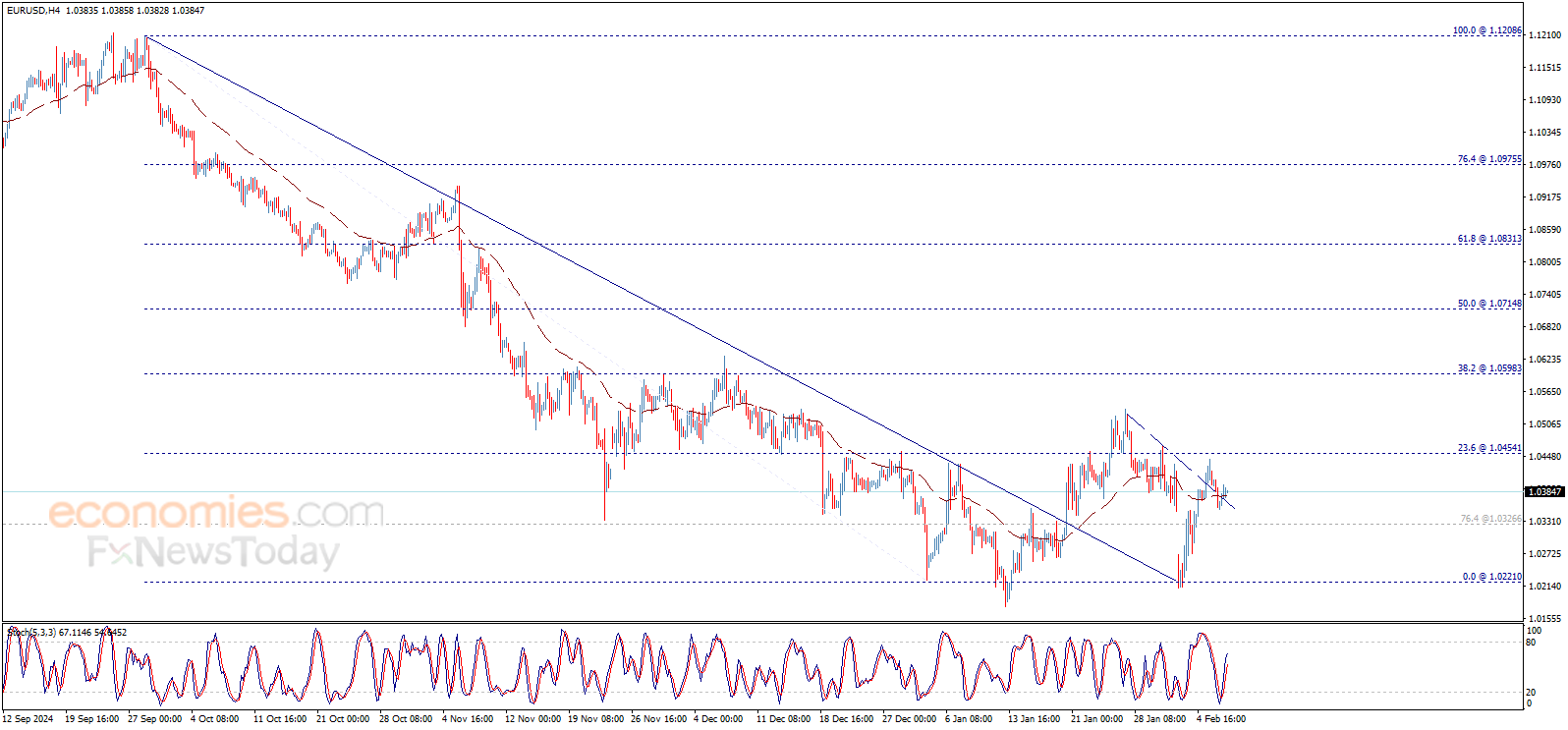
The EURUSD price attempts positively – Forecast today

By |2025-02-09T06:08:07+02:00February 9, 2025|Forex News, News|0 Comments

The GBPCAD price lost the positive momentum recently after reaching 1.8160 level, to activate the correctional bearish track and achieve some gains by declining towards 1.7850, approaching the additional support at 1.7800.


Note that holding within the bullish channel and the consolidation of the MA55 near the mentioned additional support line will reinforce the chances of renewing the bullish attempts, to expect rallying towards 1.7980 soon, followed by attempting to renew the pressure on 1.8070 obstacle.


The expected trading range for today is between 1.7865 and 1.7980


Trend forecast: Bullish


Source link

9 02, 2025

GBP/USD Weekly Forecast: Pound Finds Breather on Tariff Relief

By |2025-02-09T00:04:37+02:00February 9, 2025|Forex News, News|0 Comments

  • The dollar collapsed when a 25% tariff meant for Canada and Mexico failed to take off.
  • The Bank of England lowered borrowing costs.
  • Data on Friday showed a mixed picture of the US labor sector.

The GBP/USD weekly forecast indicates a brief respite for the pound as Trump’s policies weaken the dollar.

Ups and downs of GBP/USD 

The GBP/USD pair had a bullish week despite a rate cut by the Bank of England. The rally came from a decline in the dollar after Trump paused tariffs on Canadian and Mexican goods. 

Are you interested in learning more about STP brokers? Check our detailed guide-

On Tuesday, the dollar collapsed when a 25% tariff meant for Canada and Mexico failed to take off. The two countries negotiated better trade deals, giving them more time. Meanwhile, the Bank of England lowered borrowing costs but emphasized the need for caution due to high inflation. Finally, data on Friday showed a mixed picture of the US labor sector, with both jobs and the unemployment rate easing.

Next week’s key events for GBP/USD

GBP/USD Weekly Forecast: Pound Finds Breather on Tariff Relief

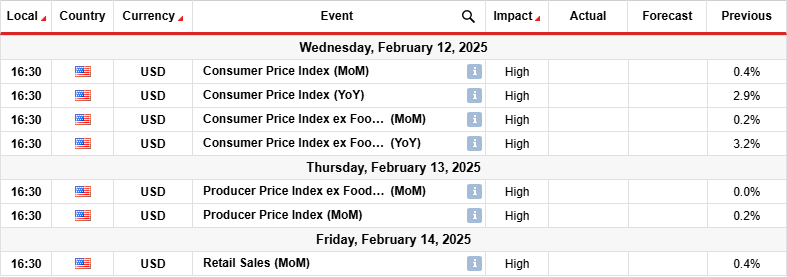
Next week, market participants will focus on inflation and retail sales data from the US. Meanwhile, the UK will release figures on manufacturing production and GDP. The US consumer inflation report will shape the outlook for Fed rate cuts. 

In the previous month, the core CPI figure missed forecasts, indicating soft underlying price pressures. As a result, the dollar fell as rate cut expectations rose. Another month of cooler-than-expected inflation might further weigh on the dollar. 

Meanwhile, the UK GDP report will show the state of the UK economy, which has been slowing down. 

GBP/USD weekly technical forecast: Price briefly retreats after channel breakout

GBP/USD weekly technical forecastGBP/USD weekly technical forecast
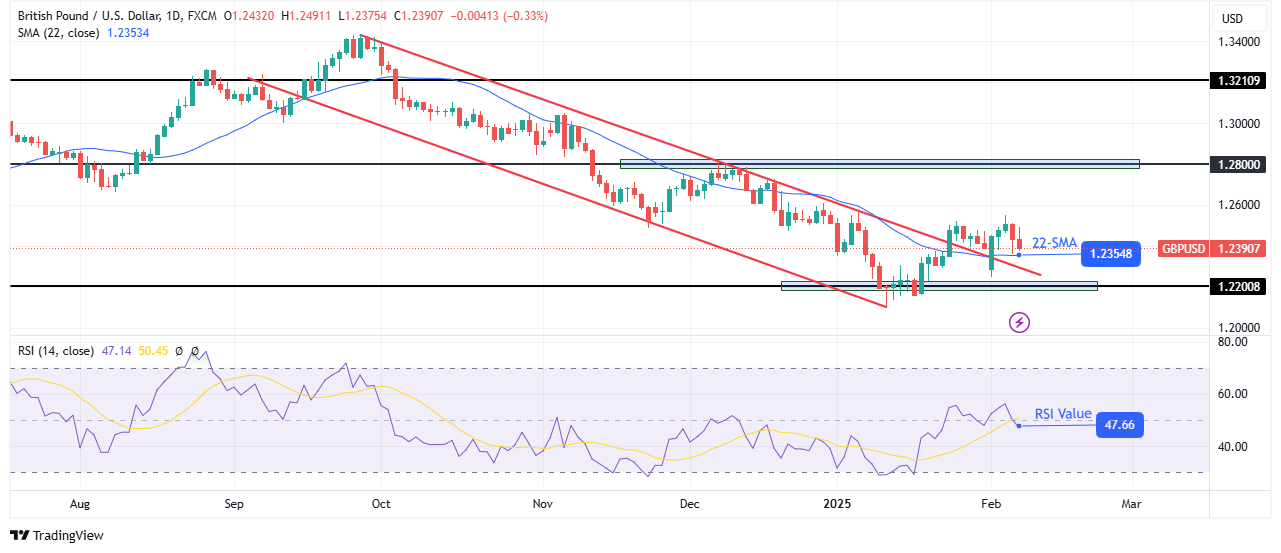
GBP/USD daily chart

On the technical side, the GBP/USD price has broken out of its bearish channel, indicating a bullish shift in sentiment. The price now trades slightly above the 22-SMA, showing bulls are in the lead. However, the RSI remains slightly below 50, a sign that bearish momentum is still strong. 

Are you interested in learning more about making money with forex? Check our detailed guide-

GBP/USD has maintained a strong downtrend, making lower highs and lows and breaking past key support levels. However, bears paused when the price hit the 1.2200 support level. Here, price action showed small-bodied candles with large wicks, indicating indecision. 

After that, bulls took charge by breaking above the channel resistance and the 22-SMA resistance. The price is currently retesting the SMA as support. If bulls remain in the lead, the price will climb to the 1.2800 resistance. A break above this resistance would confirm a new bullish trend.

Looking to trade forex now? Invest at eToro!

68% of retail investor accounts lose money when trading CFDs with this provider. You should consider whether you can afford to take the high risk of losing your money.

Source link

8 02, 2025

USD/JPY Weekly Forecast: BoJ Rate Hike Bets Boost Yen

By |2025-02-08T21:24:23+02:00February 8, 2025|Forex News, News|0 Comments

  • Japan released data showing solid wage growth.
  • A pause in US tariffs weakened the greenback.
  • US employment figures revealed a drop in job growth and lower unemployment.

The USD/JPY weekly forecast is bearish amid increasing bets for a Bank of Japan rate hike, boosting the yen.

Ups and downs of USD/JPY

The USD/JPY pair ended the week lower as the yen rallied against the dollar due to a surge in BoJ rate hike expectations. At the same time, a pause in US tariffs weakened the greenback. 

Are you interested in learning more about STP brokers? Check our detailed guide-

BoJ rate hike bets rose after Japan released data showing solid wage growth. 

Meanwhile, the dollar eased as market participants became more convinced that Trump’s tariffs were just a negotiation tactic. He paused tariffs on Canada and Mexico, plunging the dollar. Additionally, employment figures revealed a drop in job growth and lower unemployment, painting a mixed picture of the labor sector.

Next week’s key events for USD/JPY

USD/JPY Weekly Forecast: BoJ Rate Hike Bets Boost Yen

Next week, traders will focus on data from the US, including consumer inflation, producer inflation and retail sales. The inflation figures will show the state of price pressures, shaping the outlook for Fed rate cuts. 

Last month, inflation came in at 2.9%, nearing the Fed’s 2% target. However, policymakers have remained cautious because it has paused near this level. As a result, the central bank has been waiting for more progress before signaling further rate cuts. Meanwhile, the retail sales report will show the state of consumer spending in the US.

USD/JPY weekly technical forecast: Price targets the 150.06 support

USD/JPY weekly technical forecastUSD/JPY weekly technical forecast
USD/JPY daily chart

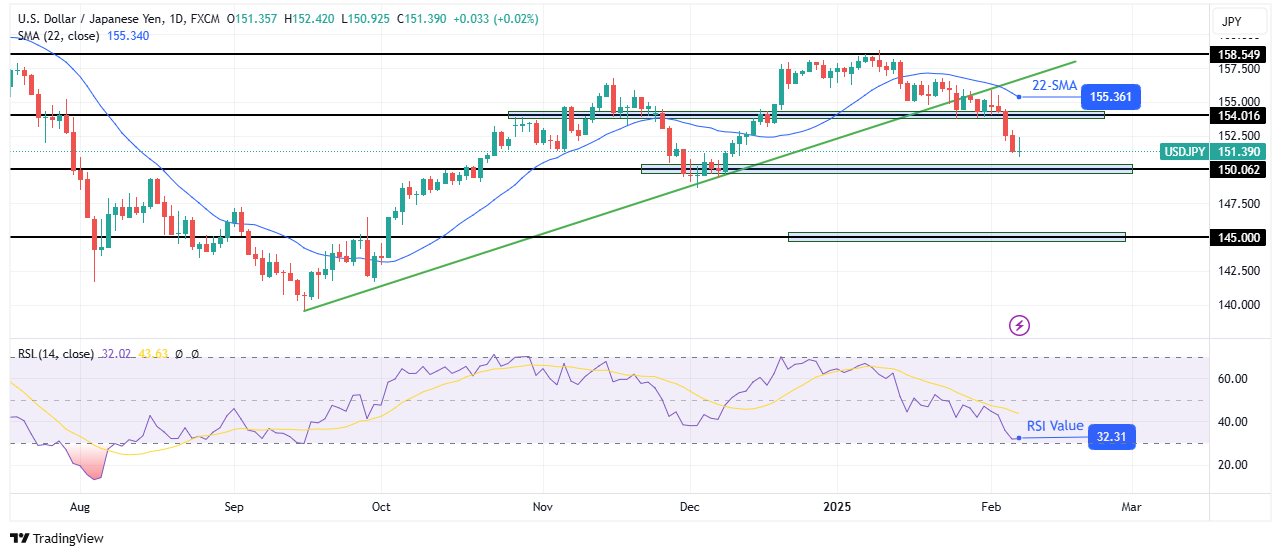
On the technical side, the USD/JPY price is approaching the 150.06 support level after breaking below its bullish trendline. The price trades far below the 22-SMA, showing a strong lead for bears. At the same time, the RSI trades near the oversold region, indicating solid bearish momentum. 

Are you interested in learning more about making money with forex? Check our detailed guide-

Bulls paused the previous move when the price got to the 158.54 resistance level. Moreover, although the price made higher highs and lows, it broke below the 22-SMA, indicating a corrective move. At the same time, the RSI failed to enter the overbought region, a sign that either bulls were holding back, or bears were strong too. 

After the corrective move, USD/JPY might make an impulsive leg. Therefore, the price might break below the 150.06 support to reach the 145.00 support. However, the price might retest the 22-SMA as resistance before continuing lower.

Looking to trade forex now? Invest at eToro!

68% of retail investor accounts lose money when trading CFDs with this provider. You should consider whether you can afford to take the high risk of losing your money.

Source link

7 02, 2025

Pound Sterling sellers hesitate ahead of US NFP data

By |2025-02-07T17:09:41+02:00February 7, 2025|Forex News, News|0 Comments

  • GBP/USD stabilizes above 1.2400 after closing in the red on Thursday.
  • The BoE cut the policy rate by 25 bps as expected but the vote-split weighed on Pound Sterling.
  • January Nonfarm Payrolls data from the US could drive the USD’s valuation in the American session.

GBP/USD lost its traction and dropped to a multi-day low below 1.2400 on Thursday following the Bank of England’s (BoE) monetary policy announcements. After staging a rebound in the American session, the pair seems to have stabilized above 1.2400 early Friday.

British Pound PRICE This week

The table below shows the percentage change of British Pound (GBP) against listed major currencies this week. British Pound was the strongest against the US Dollar.

  USD EUR GBP JPY CAD AUD NZD CHF
USD   -0.21% -0.38% -2.12% -2.67% -1.24% -1.55% -1.06%
EUR 0.21%   0.23% -0.63% -1.19% -0.58% -0.05% 0.44%
GBP 0.38% -0.23%   -1.93% -1.41% -0.80% -0.27% 0.22%
JPY 2.12% 0.63% 1.93%   -0.56% 1.05% 1.50% 1.72%
CAD 2.67% 1.19% 1.41% 0.56%   0.37% 1.16% 1.66%
AUD 1.24% 0.58% 0.80% -1.05% -0.37%   0.53% 1.02%
NZD 1.55% 0.05% 0.27% -1.50% -1.16% -0.53%   0.49%
CHF 1.06% -0.44% -0.22% -1.72% -1.66% -1.02% -0.49%  

The heat map shows percentage changes of major currencies against each other. The base currency is picked from the left column, while the quote currency is picked from the top row. For example, if you pick the British Pound from the left column and move along the horizontal line to the US Dollar, the percentage change displayed in the box will represent GBP (base)/USD (quote).

The BoE lowered the policy rate by 25 basis points (bps) at the February policy meeting, as widely anticipated. Two members of the Monetary Policy Committee (MPC), however, unexpectedly voted in favor of a 50 bps cut, triggering a Pound Sterling selloff with the immediate reaction. 

In the post-meeting press conference, “we must judge in future meetings whether underlying inflation pressures are easing enough to allow further cuts” BoE Governor Andrew Bailey said and helped GBP/USD find a foothold.

The US Bureau of Labor Statistics will publish the employment report for January later in the day. Nonfarm Payrolls (NFP) are forecast to rise by 170,000, following the 256,000 increase recorded in December. In the same period, the Unemployment Rate is seen holding steady at 4.1%.

A positive surprise, with an NFP reading above 200,000, could boost the USD in the American session and force GBP/USD to stretch lower. On the other hand, a print below 150,000 could revive expectations for a Federal Reserve (Fed) rate cut in March and open the door for a leg higher in the pair.

GBP/USD Technical Analysis

Despite Thursday’s pullback, the Relative Strength Index (RSI) indicator on the 4-hour chart stays near 50 and GBP/USD holds above the ascending trend line, reflecting sellers’ hesitancy.

GBP/USD could face immediate resistance at 1.2450 (Fibonacci 50% retracement of the latest downtrend) ahead of 1.2500 (static level, round level) and 1.2530 (Fibonacci 61.8% retracement). On the downside, the 200-period Simple Moving Average (SMA) could act as first support at 1.2400 before 1.2370 (Fibonacci 38.2% retracement, ascending trend line, 100-period SMA) and 1.2300 (static level, round level).

Nonfarm Payrolls FAQs

Nonfarm Payrolls (NFP) are part of the US Bureau of Labor Statistics monthly jobs report. The Nonfarm Payrolls component specifically measures the change in the number of people employed in the US during the previous month, excluding the farming industry.

The Nonfarm Payrolls figure can influence the decisions of the Federal Reserve by providing a measure of how successfully the Fed is meeting its mandate of fostering full employment and 2% inflation. A relatively high NFP figure means more people are in employment, earning more money and therefore probably spending more. A relatively low Nonfarm Payrolls’ result, on the either hand, could mean people are struggling to find work. The Fed will typically raise interest rates to combat high inflation triggered by low unemployment, and lower them to stimulate a stagnant labor market.

Nonfarm Payrolls generally have a positive correlation with the US Dollar. This means when payrolls’ figures come out higher-than-expected the USD tends to rally and vice versa when they are lower. NFPs influence the US Dollar by virtue of their impact on inflation, monetary policy expectations and interest rates. A higher NFP usually means the Federal Reserve will be more tight in its monetary policy, supporting the USD.

Nonfarm Payrolls are generally negatively-correlated with the price of Gold. This means a higher-than-expected payrolls’ figure will have a depressing effect on the Gold price and vice versa. Higher NFP generally has a positive effect on the value of the USD, and like most major commodities Gold is priced in US Dollars. If the USD gains in value, therefore, it requires less Dollars to buy an ounce of Gold. Also, higher interest rates (typically helped higher NFPs) also lessen the attractiveness of Gold as an investment compared to staying in cash, where the money will at least earn interest.

Nonfarm Payrolls is only one component within a bigger jobs report and it can be overshadowed by the other components. At times, when NFP come out higher-than-forecast, but the Average Weekly Earnings is lower than expected, the market has ignored the potentially inflationary effect of the headline result and interpreted the fall in earnings as deflationary. The Participation Rate and the Average Weekly Hours components can also influence the market reaction, but only in seldom events like the “Great Resignation” or the Global Financial Crisis.


Source link

7 02, 2025

Soc Gen Monthly Forecast Update

By |2025-02-07T15:08:42+02:00February 7, 2025|Forex News, News|0 Comments

Image: © Mohamed Yahya, Reproduced under CC licensing


Société Générale’s latest monthly FX market assessment sees the U.S. dollar increasingly fragile due to policy uncertainty, high valuation, and evolving trade risks.

The Japanese yen stands out as the top-performing G10 currency, benefitting from the Bank of Japan’s tightening cycle, while emerging market (EM) currencies appear positioned for a comeback after a turbulent 2024.


1. USD Outlook: Still Strong but More Fragile

Key Change: While the US dollar remains strong, it has become more volatile due to policy uncertainty and high valuation.

Drivers include growth and interest rate differentials that still support the USD, but not as strongly as in 2022-2024. U.S. trade and geopolitical risks (tariffs, negotiations) are now mostly priced in, limiting further upside.

That being said, Soc Gen sees no clear catalysts for a sharp USD reversal yet.

GBP/EUR investment bank consensus forecast for 2025. See the median, mean, highest and lowest point targets, giving a highly accurate forecasting resource. Request it Now.


2. JPY Forecast: Stronger Due to BoJ Tightening

The Japanese yen (JPY) is the only G10 currency with a clear positive shift. The Bank of Japan (BoJ) is tightening monetary policy while other central banks consider rate cuts, potentially allowing USD/JPY to fall into the 140-150 range in H1 2025, from recent highs near 159.

Longer-term, a return to USD/JPY 100 is possible but could take over a decade.


3. EUR/USD Volatility Rising

Key Change:

EUR/USD volatility is expected to stay high due to US protectionism and potential “currency war” escalation. Tariff risks impacting European exports and the ECB’s monetary response must also be considered says Soc Gen.


4. European Currencies: SEK and CHF Could Outperform

Key Changes:

SEK (Swedish krone) could outperform as a European equity recovery takes hold.

CHF (Swiss franc) weakening as risk appetite returns and the SNB intervenes to manage currency strength.

EUR/GBP expected to range between 0.83-0.87 in 2025 as GBP shorts increase.


5. EM Currencies: Turning Point for Recovery

A stronger EM FX performance is expected in 2025 after a difficult Q4 2024.

Peak uncertainty and market pain may be behind us, says Soc Gen, and as more tariff hurdles are resolved, market fears will ease. A more favorable US interest rate environment and improved growth outlook will also offer some support.

The Mexican peso is tipped to be the first to recover, followed by Brazilian real.


6. Tariff Impact on AUD, NZD, and CAD

The Australian, New Zealand, and Canadian dollars are under pressure due to US tariff threats. Soc Gen says US trade tensions are set to disproportionately affect these economies. CAD has broken above 1.45 against USD due to US-Canada tariff risks. AUD/USD will remain under pressure until geopolitical risks ease.


7. Emerging Market Currencies:

Latin America:

The Mexican peso is positioned for a recovery, as tariff fears ease.

The Brazilian real is rebounding due to reduced concerns over fiscal policy credibility.

Asia:

The Chinese yuan remains weak due to US tariff escalation and moderate Chinese retaliation.

The Indian rupee is one of the weakest EM performers, facing structural slowdowns and portfolio outflows.

CEEMEA:

The Turkish lira will see controlled depreciation, but total returns remain attractive.

The South African rand faces risks from Trump’s social media threats and potential removal from AGOA trade deal.


8. FX Forecast Adjustments

EUR/USD: Expected to remain between 1.01 and 1.07 in H1 2025.

USD/JPY: Forecasted to drop into the 140-150 range in H1.

USD/CAD: Trading above 1.45, reflecting trade risks.

EUR/GBP: Expected to stabilize between 0.83-0.87.

MXN, BRL, TRY: Emerging markets currencies expected to rebound.


9. Summary of Major Forecast Changes

USD remains strong but faces more volatility and fragility.

JPY is the most positively revised G10 currency due to BoJ tightening.

Emerging Market FX (especially MXN, BRL) expected to recover.

EUR/USD volatility to increase due to tariff risks and US monetary policy.

Tariffs are weighing on AUD, NZD, CAD.

SEK could outperform in Europe, while CHF weakens.

TRY depreciation will be gradual, while ZAR faces downside risks.

Source link

Go to Top