The main tag of Forex News Today Articles.
You can use the search box below to find what you need.
[wd_asp id=1]

17 03, 2025

Pound Sterling stabilizes as market focus shifts to Fed and BoE

By |2025-03-17T14:00:01+02:00March 17, 2025|Forex News, News|0 Comments

  • GBP/USD trades in a narrow channel above 1.2900 on Monday.
  • The Fed and the BoE will announce monetary policy decisions later this week.
  • The pair clings to a slightly bullish bias in the near term.

Although GBP/USD registered modest losses on Thursday and Friday, the pair managed to end the previous week in positive territory. Early Monday, the pair moves sideways at around 1.2950.

British Pound PRICE Last 7 days

The table below shows the percentage change of British Pound (GBP) against listed major currencies last 7 days. British Pound was the strongest against the Japanese Yen.

  USD EUR GBP JPY CAD AUD NZD CHF
USD   -0.42% -0.18% 0.61% -0.07% -0.57% -0.97% 0.38%
EUR 0.42%   0.21% 1.04% 0.36% -0.06% -0.57% 0.68%
GBP 0.18% -0.21%   0.73% 0.12% -0.27% -0.84% 0.54%
JPY -0.61% -1.04% -0.73%   -0.67% -1.10% -1.64% -0.16%
CAD 0.07% -0.36% -0.12% 0.67%   -0.54% -0.90% 0.42%
AUD 0.57% 0.06% 0.27% 1.10% 0.54%   -0.51% 0.79%
NZD 0.97% 0.57% 0.84% 1.64% 0.90% 0.51%   1.43%
CHF -0.38% -0.68% -0.54% 0.16% -0.42% -0.79% -1.43%  

The heat map shows percentage changes of major currencies against each other. The base currency is picked from the left column, while the quote currency is picked from the top row. For example, if you pick the British Pound from the left column and move along the horizontal line to the US Dollar, the percentage change displayed in the box will represent GBP (base)/USD (quote).

During the European trading hours, US stock index futures lose about 0.5% on the day, pointing to a cautious market stance. Nevertheless, GBP/USD’s downside remains supported for now, with investors refraining from taking large positions in anticipation of this week’s key macroeconomic events.

On Wednesday, the Federal Reserve (Fed) will release the interest rate decision and publish the revised Summary of Economic Projections (SEP), the so-called dot plot. On Thursday, the Bank of England (BoE) is expected to maintain its monetary policy settings following the March meeting.

Ahead of the Fed and the BoE announcements, the US economic calendar will feature Retail Sales data for February on Monday. Investors expect Retail Sales to grow by 0.7% on a monthly basis, following the 0.9% contraction reported in January. A big negative surprise in this data could weigh on the USD with the immediate reaction and help GBP/USD edge higher. A bearish action in Wall Street, however, could support the USD later in the day and make it difficult for the pair to gather bullish momentum.

GBP/USD Technical Analysis

GBP/USD remains within the upper half of the ascending regression channel and the Relative Strength Index (RSI) indicator on the 4-hour chart holds slightly above 50, reflecting a lack of seller interest.

On the downside, 1.2920 (50-period Simple Moving Average (SMA), mid-point of the ascending channel) aligns as immediate support before 1.2870 (static level) and 1.2790-1.2780 (100-period SMA, lower limit of the ascending channel).

Looking north, resistance could be spotted at 1.2970 (static level), 1.3000 (static level, round level) and 1.3060 (upper limit of the ascending channel).

Pound Sterling FAQs

The Pound Sterling (GBP) is the oldest currency in the world (886 AD) and the official currency of the United Kingdom. It is the fourth most traded unit for foreign exchange (FX) in the world, accounting for 12% of all transactions, averaging $630 billion a day, according to 2022 data. Its key trading pairs are GBP/USD, also known as ‘Cable’, which accounts for 11% of FX, GBP/JPY, or the ‘Dragon’ as it is known by traders (3%), and EUR/GBP (2%). The Pound Sterling is issued by the Bank of England (BoE).

The single most important factor influencing the value of the Pound Sterling is monetary policy decided by the Bank of England. The BoE bases its decisions on whether it has achieved its primary goal of “price stability” – a steady inflation rate of around 2%. Its primary tool for achieving this is the adjustment of interest rates. When inflation is too high, the BoE will try to rein it in by raising interest rates, making it more expensive for people and businesses to access credit. This is generally positive for GBP, as higher interest rates make the UK a more attractive place for global investors to park their money. When inflation falls too low it is a sign economic growth is slowing. In this scenario, the BoE will consider lowering interest rates to cheapen credit so businesses will borrow more to invest in growth-generating projects.

Data releases gauge the health of the economy and can impact the value of the Pound Sterling. Indicators such as GDP, Manufacturing and Services PMIs, and employment can all influence the direction of the GBP. A strong economy is good for Sterling. Not only does it attract more foreign investment but it may encourage the BoE to put up interest rates, which will directly strengthen GBP. Otherwise, if economic data is weak, the Pound Sterling is likely to fall.

Another significant data release for the Pound Sterling is the Trade Balance. This indicator measures the difference between what a country earns from its exports and what it spends on imports over a given period. If a country produces highly sought-after exports, its currency will benefit purely from the extra demand created from foreign buyers seeking to purchase these goods. Therefore, a positive net Trade Balance strengthens a currency and vice versa for a negative balance.


Source link

17 03, 2025

EUR/USD Forecast: Germany’s Spending Plans Fuel Optimism

By |2025-03-17T11:59:02+02:00March 17, 2025|Forex News, News|0 Comments

  • The EUR/USD forecast shows a strong euro amid optimism over Germany’s fiscal plans.
  • German parties agreed to change the government’s borrowing limits.
  • Data on Friday revealed a sharp drop in US consumer confidence.

The EUR/USD forecast shows optimism over Germany’s fiscal plans, likely boosting the Eurozone economy. As a result, the euro has held near its recent five-month peak. On the other hand, the dollar remains subdued amid fears of a US recession due to Trump’s trade policies. 

-Are you interested in learning about the forex indicators? Click here for details-

On Friday, reports revealed that German parties had agreed to change the government’s borrowing limits. Therefore, the 500 billion euro fund proposal might come to life, boosting defense and infrastructure. This, in turn, will support the Eurozone economy and strengthen the euro. 

Meanwhile, the dollar remained weak due to fears of the US recession and downbeat economic data. Trump’s aggressive trade policy changes have raised fears of a sharp slowdown in the US economy. Trump’s tariffs have ignited trade wars that will likely reduce trade in the global economy. Moreover, experts believe these duties will increase inflation, forcing central banks to keep interest rates elevated. 

Therefore, policymakers will likely remain cautious despite soft inflation numbers. Notably, data on Friday revealed a sharp drop in consumer confidence. The lack of confidence in the economy proves investors are worried about the impact of Trump’s tariffs. At the same time, inflation expectations jumped.

EUR/USD key events today

  • US core retail sales m/m
  • US retail sales m/m

EUR/USD technical forecast: Bulls battle to keep control at the 30-SMA

EUR/USD Forecast: Germany’s Spending Plans Fuel Optimism
EUR/USD 4-hour chart

On the technical side, the EUR/USD price has recovered to retest the 1.0901 resistance level. As a result, it has broken back above the 30-SMA, showing bulls are struggling to keep control. At the same time, the RSI trades above 50, suggesting strong bullish momentum.

-Are you interested in learning about the best AI trading forex brokers? Click here for details-

Previously, the RSI had made a bearish divergence that signaled a likely reversal. This allowed bears to return and push the price below the 30-SMA. However, they have failed to make a significant swing below the SMA. If bulls regain momentum, the price will break above 1.0901 to seek new highs. This would allow EUR/USD to go beyond the 1.1001 key psychological level. 

On the other hand, if bears are ready to take charge, the price will stay below 1.0901. Moreover, it might drop to retest the 1.0701 key level.

Looking to trade forex now? Invest at eToro!

68% of retail investor accounts lose money when trading CFDs with this provider. You should consider whether you can afford to take the high risk of losing your money.

Source link

16 03, 2025

GBP to USD Exchange Rate | British Pound Sterling to US Dollar

By |2025-03-16T13:48:14+02:00March 16, 2025|Forex News, News|0 Comments

Risk Disclosure: Trading in financial instruments and/or cryptocurrencies involves high risks including the risk of losing some, or all, of your investment amount, and may not be suitable for all investors. Prices of cryptocurrencies are extremely volatile and may be affected by external factors such as financial, regulatory or political events. Trading on margin increases the financial risks.

Before deciding to trade in financial instrument or cryptocurrencies you should be fully informed of the risks and costs associated with trading the financial markets, carefully consider your investment objectives, level of experience, and risk appetite, and seek professional advice where needed.

Fusion Media would like to remind you that the data contained in this website is not necessarily real-time nor accurate. The data and prices on the website are not necessarily provided by any market or exchange, but may be provided by market makers, and so prices may not be accurate and may differ from the actual price at any given market, meaning prices are indicative and not appropriate for trading purposes. Fusion Media and any provider of the data contained in this website will not accept liability for any loss or damage as a result of your trading, or your reliance on the information contained within this website.

It is prohibited to use, store, reproduce, display, modify, transmit or distribute the data contained in this website without the explicit prior written permission of Fusion Media and/or the data provider. All intellectual property rights are reserved by the providers and/or the exchange providing the data contained in this website.

Fusion Media may be compensated by the advertisers that appear on the website, based on your interaction with the advertisements or advertisers.

© 2007-2025 Fusion Media Limited. All Rights Reserved.


Source link

15 03, 2025

USD/JPY Weekly Forecast: Japan’s Economy Fears Tariff Impact

By |2025-03-15T13:34:46+02:00March 15, 2025|Forex News, News|0 Comments

  • The USD/JPY weekly forecast indicates rising economic uncertainty in Japan.
  • Trump imposed a tariff on steel and aluminum imports.
  • Tariff fears overshadowed a downbeat US inflation report.

The USD/JPY weekly forecast turns positive as fears of the impact of Trump’s tariffs on Japan’s economy rise.

Ups and downs of USD/JPY

The USD/JPY price had a slightly bullish week as the dollar recovered with Treasury yields. Meanwhile, the yen gave up some gains as market participants worried about the impact of Trump’s tariffs on Japan. 

-Are you interested in learning about the forex indicators? Click here for details-

Trump imposed a tariff on steel and aluminum imports, igniting trade wars with Canada and the Eurozone. This escalated fears of a global economic slowdown. As a result, traders sought safety in US Treasuries. Meanwhile, the tariff fears overshadowed a downbeat US inflation report. 

On the other hand, the yen eased as market participants focused on the vulnerable export-reliant Japanese economy. Trump’s tariffs might hurt the economy.

Next week’s key events for USD/JPY

USD/JPY Weekly Forecast: Japan’s Economy Fears Tariff Impact

Next week, market participants will focus on monetary policy meetings by the Bank of Japan and the Fed. Moreover, the US will release its retail sales report, showing the state of consumer spending. 

Economists believe both the Bank of Japan and the Fed will keep interest rates unchanged. However, BoJ policymakers might maintain a hawkish tone, signaling future hikes. Meanwhile, the Fed might remain cautious due to uncertainty regarding Trump’s tariffs.

USD/JPY weekly technical forecast: Eying 149.00 key level

USD/JPY weekly forecastUSD/JPY weekly forecast
USD/JPY daily chart

On the technical side, the USD/JPY price is climbing after meeting the 0.618 Fib retracement. However, the price is still below the 22-SMA. At the same time, the RSI trades below 50, supporting strong bearish momentum. Since the price broke below the 22-SMA, it has maintained its position below this line, indicating a strong downtrend. Furthermore, the price has consistently made lower highs and lows. 

-Are you interested in learning about the best AI trading forex brokers? Click here for details-

The downtrend recently made a milestone move by breaking below the 149.00 support level. After the break, the price has risen to retest this level as resistance. If it holds firm, bears might resume the downtrend. However, the price would have to break below the 0.618 Fib retracement. This would allow USD/JPY to target the 142.00 support level. 

On the other hand, if bears fail to break below the 0.618 Fib, bulls might push the price back above 149.00. A break above the SMA would signal a likely reversal.

Looking to trade forex now? Invest at eToro!

68% of retail investor accounts lose money when trading CFDs with this provider. You should consider whether you can afford to take the high risk of losing your money.

Source link

14 03, 2025

GBP/USD Weekly Forecast: Recession Concerns Weigh on Dollar

By |2025-03-14T23:26:56+02:00March 14, 2025|Forex News, News|0 Comments

  • The GBP/USD weekly forecast shows escalating fears of a US recession.
  • Downbeat US inflation figures increased expectations for Fed rate cuts.
  • Data on Friday revealed an unexpected contraction in the UK economy.

The GBP/USD weekly forecast is positive despite the paused rally, as escalating US recession fears weigh on the greenback. 

Ups and downs of GBP/USD 

The GBP/USD price had a slightly bullish week as the dollar fell due to fears of the US recession. Meanwhile, a downbeat UK GDP report kept a lid on gains. 

-Are you interested in learning about the best AI trading forex brokers? Click here for details-

This week, Trump imposed a 25% tariff on steel and aluminum imports. This tariff affected the Eurozone and Canada, who responded immediately. The trade wars dimmed the outlook for the global economy and increased US recession fears. Meanwhile, downbeat US inflation figures increased expectations for Fed rate cuts. 

On the other hand, the pound fell after data on Friday revealed an unexpected contraction in the UK economy. This put pressure on the BoE to lower borrowing costs.

Next week’s key events for GBP/USD

Next week, the US will release its retail sales report. Meanwhile, the UK will release employment data. Moreover, market participants will focus on the Fed and Bank of England policy meetings. 

Market participants expect the Fed to keep interest rates unchanged. However, traders will focus on the messaging during the meeting for clues on future moves. Similarly, investors expect the Bank of England to hold rates on Thursday. The tone at the meeting will also give clues about future policy moves.

GBP/USD weekly technical forecast: Uptrend meets solid resistance zone

GBP/USD weekly technical forecastGBP/USD Weekly Forecast: Recession Concerns Weigh on Dollar
GBP/USD daily chart

On the technical side, the GBP/USD price has reached a solid resistance zone comprising the 1.3000 key psychological level and the 0.618 Fib retracement. The bullish bias is strong, with the price far above the 22-SMA and the RSI near the overbought region. 

-Are you interested in learning about the forex indicators? Click here for details-

Moreover, the price has maintained a bullish trend, making higher highs and lows and keeping above the 22-SMA. Therefore, bulls might be strong enough to break above the current resistance zone. However, the price needs a pause or pullback to the SMA after a sharp swing. If this happens, the price will fall to the 22-SMA before bouncing to retest the resistance zone. 

A break above this zone will clear the path for GBP/USD to retest the 1.3401 resistance. However, if the zone holds firm, bears might overpower bulls to push the price below the 22-SMA. This would allow the price to revisit the 1.2604 support level.

Looking to trade forex now? Invest at eToro!

68% of retail investor accounts lose money when trading CFDs with this provider. You should consider whether you can afford to take the high risk of losing your money.

Source link

14 03, 2025

The EURUSD price forecast update

By |2025-03-14T19:25:12+02:00March 14, 2025|Forex News, News|0 Comments

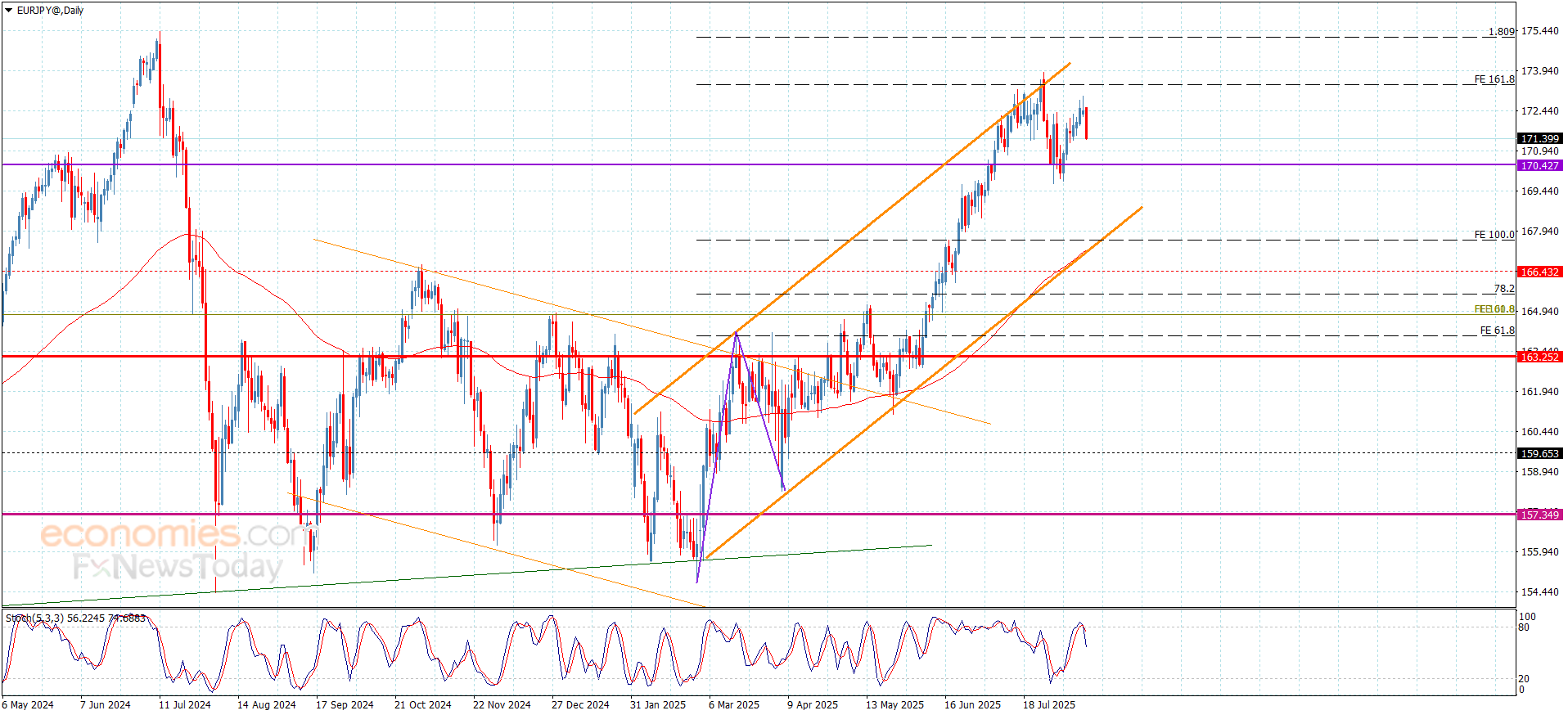
The EURJPY pair formed new decline yesterday to achieve the first negative target at 160.00, forming new additional support line, to push it to form temporary positive rebound and settle near 161.05.


Now, stochastic attempt to provide the negative momentum and the stability of 161.60 barrier allow us to keep the negative overview, waiting to attack 160.00 level again, while breaking it will open the way to target new negative stations that might extend towards 159.30 and 158.85 levels.


The expected trading range for today is between 160.00 and 161.60


Trend forecast: Bearish


Source link

14 03, 2025

Pound Sterling struggles to benefit from upbeat mood after weak UK data

By |2025-03-14T17:23:45+02:00March 14, 2025|Forex News, News|0 Comments

  • GBP/USD stays below 1.2950 after posting small losses on Thursday.
  • Disappointing macroeconomic data releases from the UK make it difficult for Pound Sterling to gather strength.
  • The near-term technical outlook highlights a loss of bullish momentum.

After closing marginally lower on Thursday, GBP/USD stays on the back foot and trades below 1.2950 in the European session on Friday. Although the near-term technical outlook is yet to point to a buildup of bearish momentum, the pair could have a difficult time staging a rebound after disappointing data releases from the UK.

British Pound PRICE This week

The table below shows the percentage change of British Pound (GBP) against listed major currencies this week. British Pound was the weakest against the Euro.

  USD EUR GBP JPY CAD AUD NZD CHF
USD   -0.37% -0.12% 0.55% 0.37% 0.01% -0.09% 0.51%
EUR 0.37%   0.22% 0.92% 0.76% 0.47% 0.25% 0.77%
GBP 0.12% -0.22%   0.65% 0.50% 0.26% -0.02% 0.62%
JPY -0.55% -0.92% -0.65%   -0.18% -0.47% -0.72% 0.04%
CAD -0.37% -0.76% -0.50% 0.18%   -0.40% -0.46% 0.11%
AUD -0.01% -0.47% -0.26% 0.47% 0.40%   -0.22% 0.35%
NZD 0.09% -0.25% 0.02% 0.72% 0.46% 0.22%   0.68%
CHF -0.51% -0.77% -0.62% -0.04% -0.11% -0.35% -0.68%  

The heat map shows percentage changes of major currencies against each other. The base currency is picked from the left column, while the quote currency is picked from the top row. For example, if you pick the British Pound from the left column and move along the horizontal line to the US Dollar, the percentage change displayed in the box will represent GBP (base)/USD (quote).

The data published by the UK’s Office for National Statistics (ONS) showed early Friday that the UK’s Gross Domestic Product (GDP) contracted by 0.1% on a monthly basis in January. This reading followed the 0.4% growth recorded in December and came in below the market expectation for an expansion of 0.1%.

The ONS further reported that Industrial Production and Manufacturing Production fell by 0.9% and 1.1%, respectively, on a monthly basis. Both of these prints came in worse than analysts’ estimates, weighing on Pound Sterling.

The US economic calendar will feature the University of Michigan’s preliminary Consumer Sentiment Index data for March. A noticeable deterioration in consumer confidence could cause the US Dollar to come under pressure and allow GBP/USD to limit its losses.

Meanwhile, US stock index futures rise between 0.5% and 0.1% in the European session on Friday. So far, Pound Sterling has failed to benefit from improving risk mood. Nevertheless, a risk rally in the American session could hurt the USD and support GBP/USD.

GBP/USD Technical Analysis

GBP/USD’s last candle on the 4-hour chart closed below the 20-period Simple Moving Average (SMA). Additionally, the Relative Strength Index (RSI) indicator retreated to 50, reflecting a lack of buyer interest.

On the downside, 1.2900 (round level, static level, mid-point of the ascending regression channel) aligns as first support before 1.2850 (static level) and 1.2800 (200-day SMA). Looking north, resistances could be spotted at 1.2970 (static level), 1.3000 (round level, static level) and 1.3040 (upper limit of the ascending channel).

Pound Sterling FAQs

The Pound Sterling (GBP) is the oldest currency in the world (886 AD) and the official currency of the United Kingdom. It is the fourth most traded unit for foreign exchange (FX) in the world, accounting for 12% of all transactions, averaging $630 billion a day, according to 2022 data. Its key trading pairs are GBP/USD, also known as ‘Cable’, which accounts for 11% of FX, GBP/JPY, or the ‘Dragon’ as it is known by traders (3%), and EUR/GBP (2%). The Pound Sterling is issued by the Bank of England (BoE).

The single most important factor influencing the value of the Pound Sterling is monetary policy decided by the Bank of England. The BoE bases its decisions on whether it has achieved its primary goal of “price stability” – a steady inflation rate of around 2%. Its primary tool for achieving this is the adjustment of interest rates. When inflation is too high, the BoE will try to rein it in by raising interest rates, making it more expensive for people and businesses to access credit. This is generally positive for GBP, as higher interest rates make the UK a more attractive place for global investors to park their money. When inflation falls too low it is a sign economic growth is slowing. In this scenario, the BoE will consider lowering interest rates to cheapen credit so businesses will borrow more to invest in growth-generating projects.

Data releases gauge the health of the economy and can impact the value of the Pound Sterling. Indicators such as GDP, Manufacturing and Services PMIs, and employment can all influence the direction of the GBP. A strong economy is good for Sterling. Not only does it attract more foreign investment but it may encourage the BoE to put up interest rates, which will directly strengthen GBP. Otherwise, if economic data is weak, the Pound Sterling is likely to fall.

Another significant data release for the Pound Sterling is the Trade Balance. This indicator measures the difference between what a country earns from its exports and what it spends on imports over a given period. If a country produces highly sought-after exports, its currency will benefit purely from the extra demand created from foreign buyers seeking to purchase these goods. Therefore, a positive net Trade Balance strengthens a currency and vice versa for a negative balance.


Source link

14 03, 2025

Euro stabilizes but could struggle to attract buyers

By |2025-03-14T15:22:39+02:00March 14, 2025|Forex News, News|0 Comments

  • EUR/USD holds steady at around 1.0850 in the European session on Friday.
  • The technical outlook shows no signs of a buildup in directional momentum.
  • UoM Consumer Sentiment Index data will be featured in the US economic calendar.

EUR/USD seems to have entered a consolidation phase at around 1.0850 after closing the previous two days in negative territory. The pair’s near-term technical outlook fails to provide a directional clue.

Euro PRICE This week

The table below shows the percentage change of Euro (EUR) against listed major currencies this week. Euro was the weakest against the New Zealand Dollar.

  USD EUR GBP JPY CAD AUD NZD CHF
USD   -0.16% -0.01% 0.66% 0.37% 0.05% -0.05% 0.51%
EUR 0.16%   0.11% 0.79% 0.54% 0.29% 0.09% 0.55%
GBP 0.01% -0.11%   0.63% 0.41% 0.18% -0.07% 0.52%
JPY -0.66% -0.79% -0.63%   -0.28% -0.54% -0.77% -0.06%
CAD -0.37% -0.54% -0.41% 0.28%   -0.37% -0.42% 0.11%
AUD -0.05% -0.29% -0.18% 0.54% 0.37%   -0.20% 0.32%
NZD 0.05% -0.09% 0.07% 0.77% 0.42% 0.20%   0.64%
CHF -0.51% -0.55% -0.52% 0.06% -0.11% -0.32% -0.64%  

The heat map shows percentage changes of major currencies against each other. The base currency is picked from the left column, while the quote currency is picked from the top row. For example, if you pick the Euro from the left column and move along the horizontal line to the US Dollar, the percentage change displayed in the box will represent EUR (base)/USD (quote).

The US Dollar (USD) held its ground on Thursday as safe-haven flows continued to dominate the action in financial markets. Additionally, the data published by the US Department of Labor showed that the number of first-time applications for unemployment benefits declined slightly to 220,000 from 222,000 in the previous week.

Meanwhile, US President Donald Trump said in a social media post on Thursday that he would seek to impose 200% tariffs on European wine and champagne imports. In response, French Finance Minister Eric Lombard said Trump’s threat to augment tariffs on French liquor imports were not surprising and called his actions an “idiotic war.”

In the second half of the day, the University of Michigan will publish the preliminary Consumer Sentiment Index data for March. A noticeable deterioration in consumer confidence could hurt the USD ahead of the weekend and help EUR/USD keep its footing. 

Investors could also react to changes in risk perception. At the time of press, US stock index futures were up between 0.6% and 1%. A bullish action in Wall Street could make it difficult for the USD to outperform its rivals and open the door for a rebound in EUR/USD. 

EUR/USD Technical Analysis

EUR/USD retreated below the lower limit of the ascending regression channel and the Relative Strength Index fell slightly below 50, reflecting a lack of buyer interest. On the downside, 1.0800 (static level, round level) could be seen as next support before 1.0730 (200-day SMA). 

In case EUR/USD holds steady above 1.0850 (static level), it could face next resistance at 1.0900 (round level, static level) ahead of 1.0940 (static level).

Euro FAQs

The Euro is the currency for the 19 European Union countries that belong to the Eurozone. It is the second most heavily traded currency in the world behind the US Dollar. In 2022, it accounted for 31% of all foreign exchange transactions, with an average daily turnover of over $2.2 trillion a day. EUR/USD is the most heavily traded currency pair in the world, accounting for an estimated 30% off all transactions, followed by EUR/JPY (4%), EUR/GBP (3%) and EUR/AUD (2%).

The European Central Bank (ECB) in Frankfurt, Germany, is the reserve bank for the Eurozone. The ECB sets interest rates and manages monetary policy. The ECB’s primary mandate is to maintain price stability, which means either controlling inflation or stimulating growth. Its primary tool is the raising or lowering of interest rates. Relatively high interest rates – or the expectation of higher rates – will usually benefit the Euro and vice versa. The ECB Governing Council makes monetary policy decisions at meetings held eight times a year. Decisions are made by heads of the Eurozone national banks and six permanent members, including the President of the ECB, Christine Lagarde.

Eurozone inflation data, measured by the Harmonized Index of Consumer Prices (HICP), is an important econometric for the Euro. If inflation rises more than expected, especially if above the ECB’s 2% target, it obliges the ECB to raise interest rates to bring it back under control. Relatively high interest rates compared to its counterparts will usually benefit the Euro, as it makes the region more attractive as a place for global investors to park their money.

Data releases gauge the health of the economy and can impact on the Euro. Indicators such as GDP, Manufacturing and Services PMIs, employment, and consumer sentiment surveys can all influence the direction of the single currency. A strong economy is good for the Euro. Not only does it attract more foreign investment but it may encourage the ECB to put up interest rates, which will directly strengthen the Euro. Otherwise, if economic data is weak, the Euro is likely to fall. Economic data for the four largest economies in the euro area (Germany, France, Italy and Spain) are especially significant, as they account for 75% of the Eurozone’s economy.

Another significant data release for the Euro is the Trade Balance. This indicator measures the difference between what a country earns from its exports and what it spends on imports over a given period. If a country produces highly sought after exports then its currency will gain in value purely from the extra demand created from foreign buyers seeking to purchase these goods. Therefore, a positive net Trade Balance strengthens a currency and vice versa for a negative balance.


Source link

14 03, 2025

The EURJPY touches the first negative target – Forecast today – 14-3-2025

By |2025-03-14T13:21:59+02:00March 14, 2025|Forex News, News|0 Comments

The EURJPY pair formed new decline yesterday to achieve the first negative target at 160.00, forming new additional support line, to push it to form temporary positive rebound and settle near 161.05.


Now, stochastic attempt to provide the negative momentum and the stability of 161.60 barrier allow us to keep the negative overview, waiting to attack 160.00 level again, while breaking it will open the way to target new negative stations that might extend towards 159.30 and 158.85 levels.


The expected trading range for today is between 160.00 and 161.60


Trend forecast: Bearish


Source link

14 03, 2025

GBP/USD Price Analysis: Economic Contraction Weakens Pound

By |2025-03-14T11:20:48+02:00March 14, 2025|Forex News, News|0 Comments

  • The GBP/USD price analysis indicates a weaker UK economy.
  • Data revealed a 0.1% contraction in the UK economy. 
  • Market participants expect the Bank of England to keep rates unchanged next week.

The GBP/USD price analysis indicates a weaker UK economy after data revealed an unexpected contraction. Meanwhile, market participants are grappling with the escalating global trade tensions as Trump continues his aggressive policy changes. 

Are you interested to learn more about forex options trading? Check our detailed guide-

The pound pulled back on Friday after data revealed a 0.1% contraction in the UK economy. This followed an expansion of 0.4%. Economists had expected the GDP to increase by 0.1%. The poor report might increase pressure on the Bank of England to lower borrowing costs. However, market participants expect the central bank to keep rates unchanged next week.

The BoE and other major central banks will likely proceed with caution due to uncertainty regarding the impact of Trump’s tariff. The US president has attacked many of its major trading partners with tariffs, igniting trade wars. The UK is yet to feel the pain of these tariffs like Canada and the Eurozone. However, Trump is not done. He intends to keep imposing tariffs that will affect more countries.

Meanwhile, data from the US on Thursday was mixed. Wholesale inflation came in lower than expected. On the other hand, unemployment claims missed forecasts, indicating increased demand for labor. Nevertheless, Fed rate cut expectations have risen significantly due to recent downbeat economic data.

GBP/USD key events today

  • Prelim UoM Consumer Sentiment
  • Prelim UoM Inflation Expectations

GBP/USD technical price analysis: Bearish RSI divergence 

GBP/USD Price Analysis: Economic Contraction Weakens Pound
GBP/USD 4-hour chart

On the technical side, the GBP/USD price has paused its steep rally near the 1.2951 resistance level. Although the price trades above the 30-SMA, it seems ready to break below. Meanwhile, the RSI has made a bearish divergence, indicating weaker bullish momentum. 

Are you interested to learn more about Thailand forex brokers? Check our detailed guide-

The price has maintained a bullish trend, trading mostly above the 30-SMA. However, every now and then, the price has broken below the SMA for a deeper pullback. With this, the uptrend has created a solid support trendline. 

Therefore, a break below the SMA would not necessarily indicate a reversal. Instead, the price might need a deeper pullback. A retest of the support trendline will allow bulls to regain momentum and seek new highs. The trend will only reverse when the price breaks below this trendline.

Looking to trade forex now? Invest at eToro!

67% of retail investor accounts lose money when trading CFDs with this provider. You should consider whether you can afford to take the high risk of losing your money.

Source link

Go to Top