The main tag of Forex News Today Articles.
You can use the search box below to find what you need.
[wd_asp id=1]

31 01, 2025

The EURGBP tests the support – Forecast today – 31-1-2025

By |2025-01-31T13:38:52+02:00January 31, 2025|Forex News, News|0 Comments

The EURGBP price formed some correctional negative waves recently, achieving the target mentioned in our previous report by reaching 0.8355 to test the major support line that appears on the chart.


Now, stochastic exit from the oversold areas will motivate the price to form bullish waves to expect targeting 0.8400 followed by 0.8435 levels soon, while breaking the current support will confirm postponing the positivity to force the price to suffer additional losses by crawling towards 0.8345 before any attempt to achieve the previously mentioned gains.


The expected trading range for today is between 0.8350 and 0.8400


Trend forecast: Bullish


Source link

31 01, 2025

Pound Sterling drops below key technical level

By |2025-01-31T11:36:34+02:00January 31, 2025|Forex News, News|0 Comments

  • GBP/USD trades near 1.2400 in the European session on Friday.
  • The technical outlook highlights a buildup of bearish momentum.
  • The pair could face next support at 1.2370.

GBP/USD struggles to hold its ground and retreats toward 1.2400 after closing in negative territory on Thursday. The pair’s technical outlook suggests that sellers could look to retain control in the near term.

British Pound PRICE This week

The table below shows the percentage change of British Pound (GBP) against listed major currencies this week. British Pound was the weakest against the Japanese Yen.

  USD EUR GBP JPY CAD AUD NZD CHF
USD   1.20% 0.60% -0.71% 0.85% 1.48% 0.99% 0.67%
EUR -1.20%   -0.52% -1.76% -0.22% 0.28% -0.09% -0.43%
GBP -0.60% 0.52%   -1.53% 0.32% 0.81% 0.45% 0.10%
JPY 0.71% 1.76% 1.53%   1.62% 2.39% 1.95% 1.53%
CAD -0.85% 0.22% -0.32% -1.62%   0.42% 0.13% -0.22%
AUD -1.48% -0.28% -0.81% -2.39% -0.42%   -0.33% -0.66%
NZD -0.99% 0.09% -0.45% -1.95% -0.13% 0.33%   -0.57%
CHF -0.67% 0.43% -0.10% -1.53% 0.22% 0.66% 0.57%  

The heat map shows percentage changes of major currencies against each other. The base currency is picked from the left column, while the quote currency is picked from the top row. For example, if you pick the British Pound from the left column and move along the horizontal line to the US Dollar, the percentage change displayed in the box will represent GBP (base)/USD (quote).

The US Dollar (USD) struggled to gather following mixed macroeconomic data releases on Thursday. Later in the American session, however, the cautious market stance didn’t allow GBP/USD to edge higher.

The US Bureau of Economic Analysis (BEA) reported on Thursday that the US’ Gross Domestic Product grew at an annual rate of 2.3% in the fourth quarter, below the 3.1% expansion recorded in the third quarter and the market estimate of 2.6%. Other data from the US showed that weekly Initial Jobless Claims in the US declined to 207,000 in the week ending January 25 from 223,000 in the previous week. 

Meanwhile, US President Donald Trump reiterated late Thursday that the US is set to impose a flat 25% import tax “because of fentanyl” on all goods crossing the border into the US from Canada or Mexico. 

In the second half of the day, the BEA will publish Personal Consumption Expenditures (PCE) Price Index data for December. On a monthly basis, the core PCE Price Index is expected to rise 0.2%. A reading of 0.3%, or higher, could lift the USD and force GBP/USD to push lower heading into the weekend.

GBP/USD Technical Analysis

GBP/USD stays below the 200-period SMA and the Fibonacci 50% retracement of the latest downtrend, currently located in the 1.2440-1.2420 area, and the Relative Strength Index (RSI) indicator on the four-hour chart drops toward 40, reflecting a buildup of bearish momentum.

On the downside, 1.2400 (static level, round level) could be seen as immediate support before 1.2370 (Fibonacci 38.2% retracement) and 1.2315 (100-period SMA). Looking north, resistances align at 1.2420-1.2440, 1.2500 (round level, static level) and 1.2530 (Fibonacci 61.8% retracement).

Pound Sterling FAQs

The Pound Sterling (GBP) is the oldest currency in the world (886 AD) and the official currency of the United Kingdom. It is the fourth most traded unit for foreign exchange (FX) in the world, accounting for 12% of all transactions, averaging $630 billion a day, according to 2022 data. Its key trading pairs are GBP/USD, also known as ‘Cable’, which accounts for 11% of FX, GBP/JPY, or the ‘Dragon’ as it is known by traders (3%), and EUR/GBP (2%). The Pound Sterling is issued by the Bank of England (BoE).

The single most important factor influencing the value of the Pound Sterling is monetary policy decided by the Bank of England. The BoE bases its decisions on whether it has achieved its primary goal of “price stability” – a steady inflation rate of around 2%. Its primary tool for achieving this is the adjustment of interest rates. When inflation is too high, the BoE will try to rein it in by raising interest rates, making it more expensive for people and businesses to access credit. This is generally positive for GBP, as higher interest rates make the UK a more attractive place for global investors to park their money. When inflation falls too low it is a sign economic growth is slowing. In this scenario, the BoE will consider lowering interest rates to cheapen credit so businesses will borrow more to invest in growth-generating projects.

Data releases gauge the health of the economy and can impact the value of the Pound Sterling. Indicators such as GDP, Manufacturing and Services PMIs, and employment can all influence the direction of the GBP. A strong economy is good for Sterling. Not only does it attract more foreign investment but it may encourage the BoE to put up interest rates, which will directly strengthen GBP. Otherwise, if economic data is weak, the Pound Sterling is likely to fall.

Another significant data release for the Pound Sterling is the Trade Balance. This indicator measures the difference between what a country earns from its exports and what it spends on imports over a given period. If a country produces highly sought-after exports, its currency will benefit purely from the extra demand created from foreign buyers seeking to purchase these goods. Therefore, a positive net Trade Balance strengthens a currency and vice versa for a negative balance.


Source link

31 01, 2025

The USDJPY price touches the first target – Forecast today

By |2025-01-31T09:35:14+02:00January 31, 2025|Forex News, News|0 Comments

The EURUSD price trades negatively since yesterday, and by taking a deeper look at the chart, we find that the price formed head and shoulders’ pattern that its confirmation line located at the current areas around 1.0385$, thus, breaking this level will push the price to continue the decline and achieve our negative targets that start at 1.0325$ and extend to 1.0220$ after breaking the previous level.


Therefore, we will continue to suggest the bearish trend for the upcoming period, taking into consideration that breaching 1.0455$ will stop the expected decline and lead the price to achieve bullish correction on the intraday and short-term basis.


The expected trading range for today is between 1.0300$ support and 1.0455$ resistance


Trend forecast: Bearish


Source link

31 01, 2025

Stuck in a Range (Video)

By |2025-01-31T07:33:35+02:00January 31, 2025|Forex News, News|0 Comments

  • The euro has gone back and forth pretty significantly during the trading session on Thursday, as we have seen a lot of noise, mainly due to the idea of the ECB out there cutting rates.
  • The noise around the press conference kind of left people wondering if they are really going to continue to cut or are they in a wait and see mode? And they may very well be in a wait and see mode.

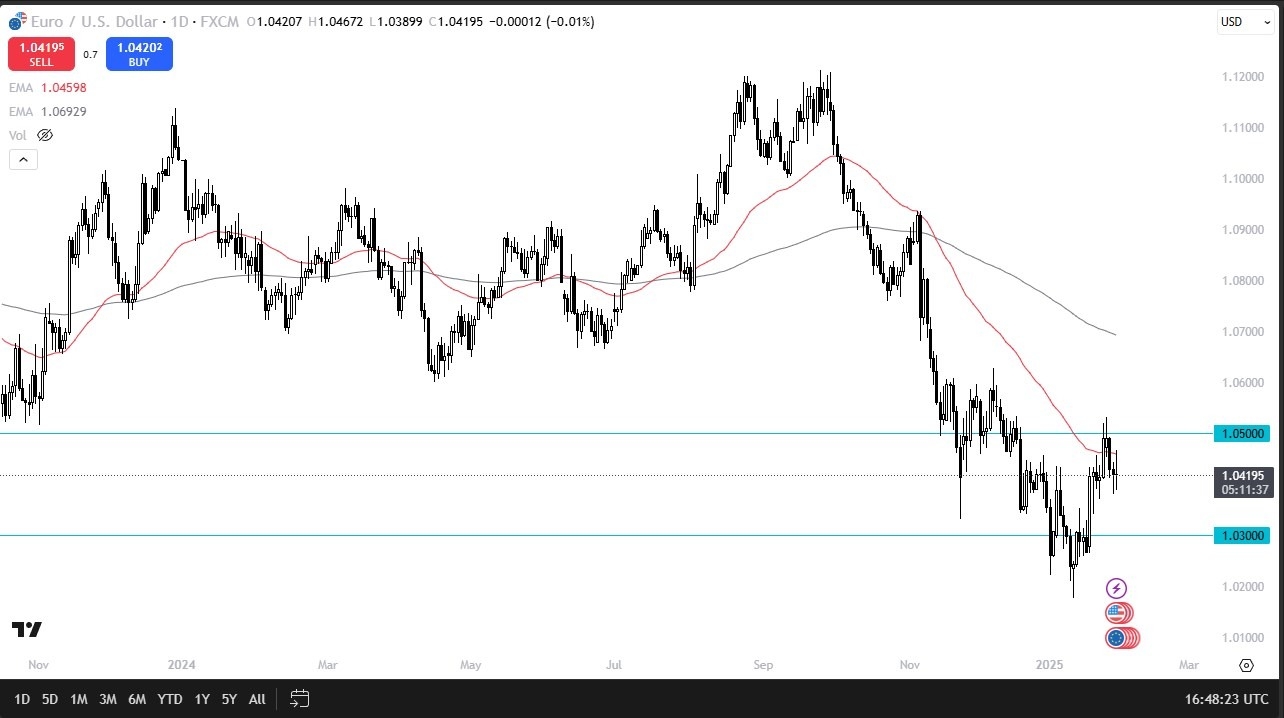
One thing is for sure, the Jerome Powell press conference the previous day did not help this situation. So, I think we’re settling into a trading range in between the 1.05 level and the 1.03 level below. All things being equal, this is a market that I prefer to be short of instead of long, but I also recognize that it’s not always going to be moving. And right now, it’s just not moving. It’s a lot of back and forth Brownian motion.

Looking to Fade this Market on Rallies

I like the idea of fading a short-term rally anywhere near the 1.05 level that shows signs of exhaustion and that resistance extends all the way to the 1.06 level. If we were to break down below the 1.03 level, then it opens up the possibility of 1.02 and then maybe even lower than that down to the parity level, which I do think we get to sooner or later, because despite the fact that the Fed really didn’t do much, there is a very real world in which the Federal Reserve does not cut interest rates at all in 2025. At this point in time, I think it’s going to come down to European data, but for what it’s worth, the advanced GDP numbers in the United States came in cooler than anticipated. So that’s part of the confusion as well.

Ready to trade our EUR/USD daily forecast? Here’s a list of some of the top forex brokers in Europe to check out.

Source link

31 01, 2025

Pound Sterling struggles to find direction after Fed

By |2025-01-31T01:30:41+02:00January 31, 2025|Forex News, News|0 Comments

  • GBP/USD extends sideways action near 1.2450, remains directionless on Thursday.
  • The Fed left the monetary policy settings unchanged, as anticipated.
  • The US BEA will publish the first estimate of the fourth-quarter GDP data.

GBP/USD struggles to find direction and fluctuates in a tight band at around 1.2450 after closing virtually unchanged on Wednesday. The Federal Reserve’s (Fed) monetary policy announcements fail to influence the US Dollar’s (USD) valuation in a noticeable way as market focus shifts to US growth data.

British Pound PRICE This week

The table below shows the percentage change of British Pound (GBP) against listed major currencies this week. British Pound was the strongest against the Australian Dollar.

  USD EUR GBP JPY CAD AUD NZD CHF
USD   0.87% 0.32% -0.79% 0.30% 1.35% 0.98% 0.26%
EUR -0.87%   -0.47% -1.49% -0.42% 0.49% 0.24% -0.50%
GBP -0.32% 0.47%   -1.33% 0.06% 0.96% 0.73% -0.06%
JPY 0.79% 1.49% 1.33%   1.15% 2.34% 2.03% 1.17%
CAD -0.30% 0.42% -0.06% -1.15%   0.85% 0.67% -0.11%
AUD -1.35% -0.49% -0.96% -2.34% -0.85%   -0.21% -0.95%
NZD -0.98% -0.24% -0.73% -2.03% -0.67% 0.21%   -0.99%
CHF -0.26% 0.50% 0.06% -1.17% 0.11% 0.95% 0.99%  

The heat map shows percentage changes of major currencies against each other. The base currency is picked from the left column, while the quote currency is picked from the top row. For example, if you pick the British Pound from the left column and move along the horizontal line to the US Dollar, the percentage change displayed in the box will represent GBP (base)/USD (quote).

The Fed said late Wednesday that it left the policy rate unchanged at 4.25%-4.5%. In the policy statement, the Fed removed the language suggesting inflation had “made progress” toward its 2% target and said the pace of price increases “remains elevated” instead.

In the post-meeting press conference, Fed Chairman Jerome Powell acknowledged that there was elevated uncertainty because of significant policy shifts. “We don’t need to be in a hurry to make any adjustments,” he repeated. Although the USD edged higher with the immediate reaction, it struggled to preserve its strength as the Fed event offered little to nothing new on the rate outlook.

On Thursday, the US Bureau of Economic Analysis (BEA) will release its first estimate of the fourth-quarter Gross Domestic Product (GDP) data. Investors expect the US economy to grow at an annualized rate of 2.6% following the 3.1% growth recorded in the third quarter. A weaker-than-forecast print could weigh on the USD and help GBP/USD gain traction. On the flip side, a GDP print at or above the market consensus could force GBP/USD to stay on the back foot.

GBP/USD Technical Analysis

The Relative Strength Index (RSI) indicator on the 4-hour chart holds slightly above 50 but moves sideways, suggesting that the bullish bias remains intact, while lacking momentum. 

GBP/USD was last seen trading at around 1.2450, where the Fibonacci 50% retracement level of the latest downtrend and the 200-period Simple Moving Average (SMA) align. In case GBP/USD confirms 1.2450 as resistance, 1.2400 (static level, round level) could be seen as next support before 1.2370 (Fibonacci 38.2% retracement) and 1.2310 (100-period SMA). Looking north, resistances could be spotted at 1.2500 (round level, static level) and 1.2530 (Fibonacci 61.8% retracement).

Pound Sterling FAQs

The Pound Sterling (GBP) is the oldest currency in the world (886 AD) and the official currency of the United Kingdom. It is the fourth most traded unit for foreign exchange (FX) in the world, accounting for 12% of all transactions, averaging $630 billion a day, according to 2022 data. Its key trading pairs are GBP/USD, also known as ‘Cable’, which accounts for 11% of FX, GBP/JPY, or the ‘Dragon’ as it is known by traders (3%), and EUR/GBP (2%). The Pound Sterling is issued by the Bank of England (BoE).

The single most important factor influencing the value of the Pound Sterling is monetary policy decided by the Bank of England. The BoE bases its decisions on whether it has achieved its primary goal of “price stability” – a steady inflation rate of around 2%. Its primary tool for achieving this is the adjustment of interest rates. When inflation is too high, the BoE will try to rein it in by raising interest rates, making it more expensive for people and businesses to access credit. This is generally positive for GBP, as higher interest rates make the UK a more attractive place for global investors to park their money. When inflation falls too low it is a sign economic growth is slowing. In this scenario, the BoE will consider lowering interest rates to cheapen credit so businesses will borrow more to invest in growth-generating projects.

Data releases gauge the health of the economy and can impact the value of the Pound Sterling. Indicators such as GDP, Manufacturing and Services PMIs, and employment can all influence the direction of the GBP. A strong economy is good for Sterling. Not only does it attract more foreign investment but it may encourage the BoE to put up interest rates, which will directly strengthen GBP. Otherwise, if economic data is weak, the Pound Sterling is likely to fall.

Another significant data release for the Pound Sterling is the Trade Balance. This indicator measures the difference between what a country earns from its exports and what it spends on imports over a given period. If a country produces highly sought-after exports, its currency will benefit purely from the extra demand created from foreign buyers seeking to purchase these goods. Therefore, a positive net Trade Balance strengthens a currency and vice versa for a negative balance.


Source link

30 01, 2025

EUR/USD, USD/JPY and AUD/USD Forecast – US Dollar Mixed Against Other Major Currencies

By |2025-01-30T23:29:42+02:00January 30, 2025|Forex News, News|0 Comments

Important DisclaimersThe content provided on the website includes general news and publications, our personal analysis and opinions, and contents provided by third parties, which are intended for educational and research purposes only. It does not constitute, and should not be read as, any recommendation or advice to take any action whatsoever, including to make any investment or buy any product. When making any financial decision, you should perform your own due diligence checks, apply your own discretion and consult your competent advisors. The content of the website is not personally directed to you, and we does not take into account your financial situation or needs.The information contained in this website is not necessarily provided in real-time nor is it necessarily accurate. Prices provided herein may be provided by market makers and not by exchanges.Any trading or other financial decision you make shall be at your full responsibility, and you must not rely on any information provided through the website. FX Empire does not provide any warranty regarding any of the information contained in the website, and shall bear no responsibility for any trading losses you might incur as a result of using any information contained in the website.The website may include advertisements and other promotional contents, and FX Empire may receive compensation from third parties in connection with the content. FX Empire does not endorse any third party or recommends using any third party’s services, and does not assume responsibility for your use of any such third party’s website or services.FX Empire and its employees, officers, subsidiaries and associates, are not liable nor shall they be held liable for any loss or damage resulting from your use of the website or reliance on the information provided on this website.Risk DisclaimersThis website includes information about cryptocurrencies, contracts for difference (CFDs) and other financial instruments, and about brokers, exchanges and other entities trading in such instruments. Both cryptocurrencies and CFDs are complex instruments and come with a high risk of losing money. You should carefully consider whether you understand how these instruments work and whether you can afford to take the high risk of losing your money.FX Empire encourages you to perform your own research before making any investment decision, and to avoid investing in any financial instrument which you do not fully understand how it works and what are the risks involved.

Source link

30 01, 2025

Pound to Euro Forecast Today: GBP/EUR Steady Ahead of ECB

By |2025-01-30T21:28:04+02:00January 30, 2025|Forex News, News|0 Comments

January 30, 2025 – Written by Tim Boyer

The Pound Sterling (GBP) held firm near its recent highs against the Euro (EUR) on Wednesday morning, with investors adopting a wait-and-see approach ahead of key events later this week.

At the time of writing, Pound Euro (GBP/EUR) exchange rate was trading at approximately €1.1937, showing little movement from Wednesday’s opening levels.

The Euro (EUR) remained flat on Wednesday as market participants refrained from making any aggressive bets ahead of the European Central Bank’s (ECB) latest interest rate decision.

The ECB is widely expected to cut interest rates by 25 basis points when it concludes its first policy meeting of 2025 on Thursday.

While the rate cut itself appears largely priced in, the Euro’s performance will likely hinge on the bank’s forward guidance.

Should ECB officials hint at further monetary easing in the months ahead, the single currency could face additional downside pressure.

Conversely, if policymakers suggest that they would prefer to hold off from further cuts for now, it may help stem losses in EUR exchange rates.

Advertisement


All eyes will be on ECB President Christine Lagarde’s comments, with investors seeking clarity on the central bank’s assessment of the Eurozone economy and its resilience amid ongoing global trade tensions.

The Pound (GBP) traded in a narrow range on Wednesday as UK Chancellor Rachel Reeves outlined her ambitious plans for boosting economic growth.

In her latest speech, Reeves unveiled proposals to establish a high-tech hub between Oxford and Cambridge, dubbed ‘Europe’s Silicon Valley,’ alongside renewed government backing for Heathrow’s third runway.

The government estimates these initiatives could contribute £78bn to the UK economy over the next decade.

However, Sterling’s reaction has been muted, with businesses seeming unconvinced as they still face the increased tax burden of Reeves’s previous Budget.

GBP/EUR Exchange Rate Forecast: Eurozone GDP Weakness to Weigh on the Euro?

The ECB’s policy decision is expected to dominate the movement in the Pound to Euro exchange rate on Thursday.

However, before the ECB announcement, the Euro could come under pressure from the Eurozone’s fourth-quarter GDP figures.

Economists predict growth slowed sharply, dropping from 0.4% to just 0.1%. Signs of a stalling Eurozone economy could amplify expectations for extended ECB easing, potentially dragging the Euro lower.

Meanwhile, the absence of major UK economic data through the second half of the week may leave the Pound’s movements tied to broader market sentiment.

Like this piece? Please share with your friends and colleagues:


International Money Transfer? Ask our resident FX expert a money transfer question or try John’s new, free, no-obligation personal service! ,where he helps every step of the way,
ensuring you get the best exchange rates on your currency requirements.

TAGS: Pound Euro Forecasts

Source link

30 01, 2025

GBP/USD Signal Today 30/01: Under Pressure (Chart)

By |2025-01-30T19:26:29+02:00January 30, 2025|Forex News, News|0 Comments

Bearish view

  • Sell the GBP/USD pair and set a take-profit at 1.2350.
  • Add a stop-loss at 1.2600.
  • Timeline: 1-2 days.

Bullish view

  • Set a buy-stop at 1.2450 and a take-profit at 1.2525.
  • Add a stop-loss at 1.2350.

The GBP/USD pair was flat after the Federal Reserve left interest rates unchanged in its first interest rates of the year. It was trading at 1.2440 on Thursday morning ahead of the upcoming US GDP data.

Federal Reserve rates and US GDP data

The GBP/USD pair wavered after the Federal Reserve made its first interest rate decision of the year. In, the Federal Open Market Committee (FOMC) decided to leave interest rates unchanged at 4.50%.

The committee tweaked its statement by removing any mention of progress on inflation. This was likely a reaction to a recent report that showed that the headline Consumer Price Index (CPI) rose from 2.7% to 2.9% in December.

The Fed expects the headline inflation to take a longer period before moving back to the 2.0% target. The top inflation risks are the recent wildfires in Los Angeles that hav made most things, including housing and insurance expensive. There are also concerns that some of Donald Trump’s policies like mass deportations, tariffs, and tax cuts will lead to high inflation.

The Fed maintained the view that the economy was solid and that the labor market was making progress. As such, most analysts anticipate that the Fed will hold interest rates steady and then cut in July.

The next important GBP/USD news will be the upcoming US GDP data, which will shed more color on the state of the economy. Economists expect the data to show that the US capped a good year, growing by 2.7% in the fourth quarter.

The GBP/USD pair may remain under pressure now that analysts expect the Bank of England to be more aggressive in cutting rates this year since the economy is slowing.

GBP/USD technical analysis

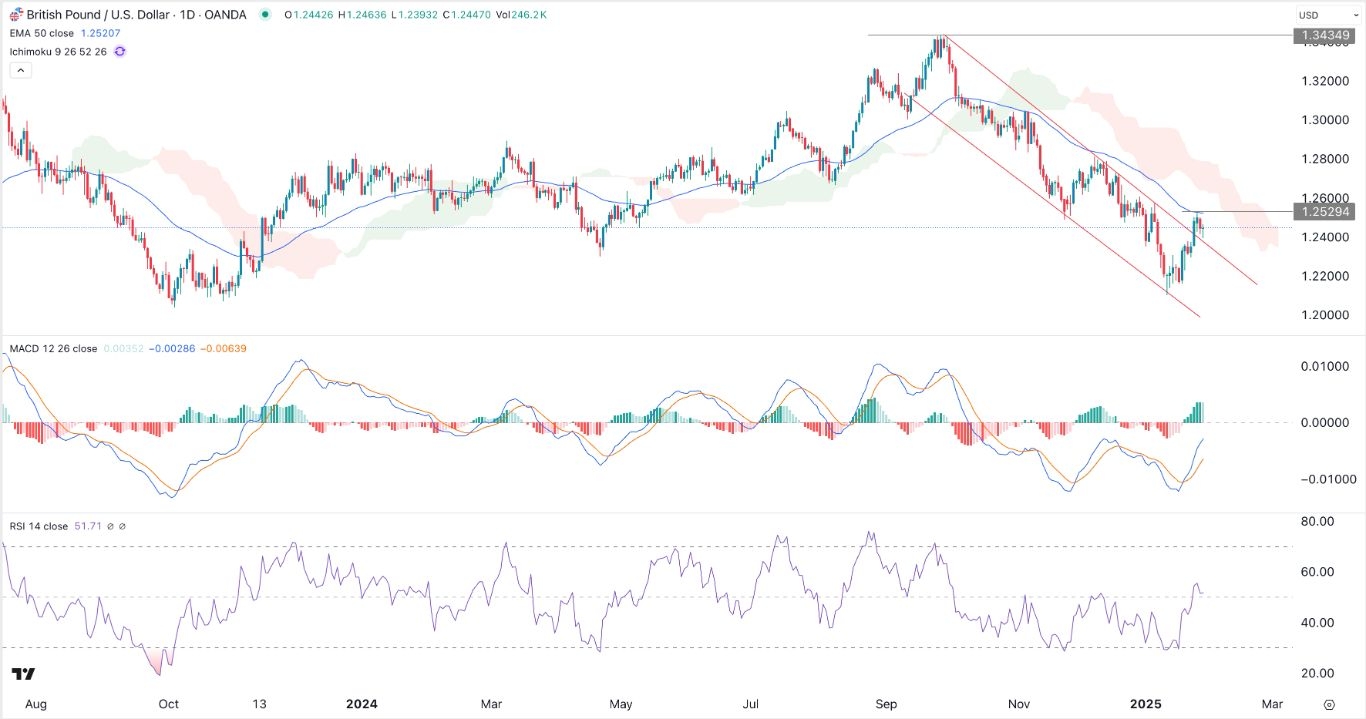
The daily chart shows that the GBP/USD pair peaked at 1.3435 in September and has now dropped to 1.2450. Its recent rebound found substantial resistance point at the 50-day Exponential Moving Average (EMA).

The pair has moved slightly above the upper side of the descending channel pattern. It has also dropped below the Ichimoku cloud indicator. The Relative Strength Index and the MACD indicators have pointed upwards.

Therefore, the pair will likely resume the downward trend, and possibly retest the key support at 1.2350. A move above the 50-day moving average will point to more gains and invalidate the bearish view.

Ready to trade our free trading signals? We’ve made a list of the best UK forex brokers worth using.

Source link

30 01, 2025

USD/JPY Analysis Today 30/01: Buy Strategy Remains (Chart)

By |2025-01-30T17:25:48+02:00January 30, 2025|Forex News, News|0 Comments

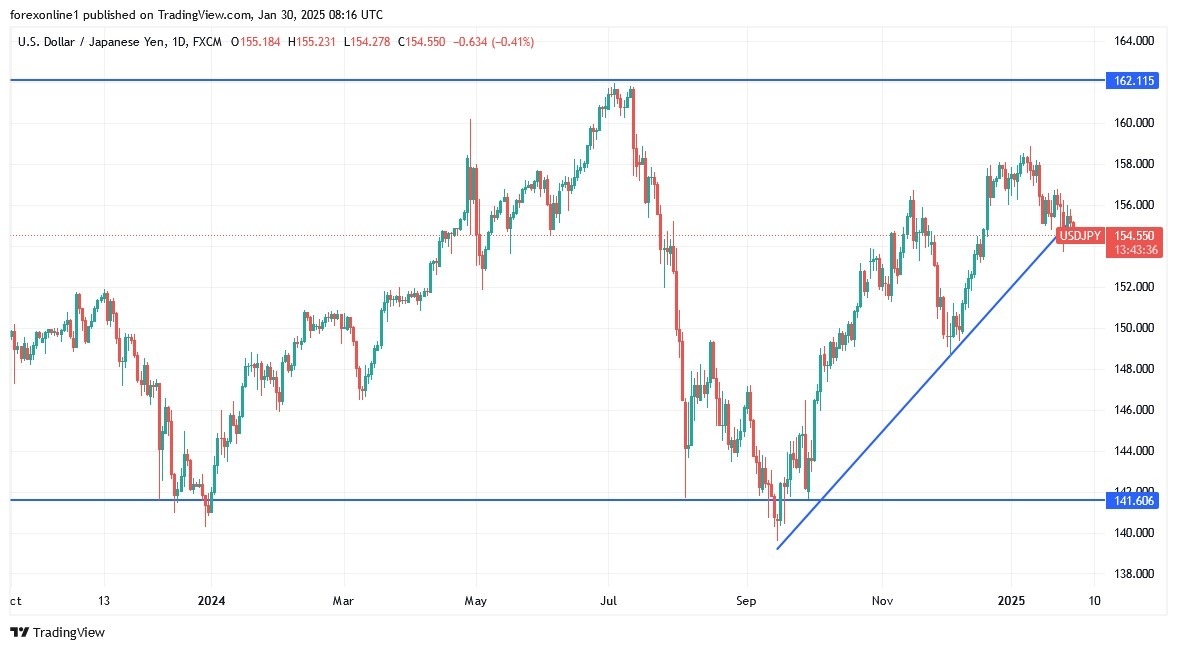
  • For two consecutive days, the USD/JPY currency pair has been attempting to recover from recent selloffs that pushed it towards the support level of 153.71.
  • Meanwhile, its recent gains extended to the resistance level of 155.80 before settling around 155.25 at the time of writing this analysis.
  • Obviously, this is after interacting with the US Federal Reserve’s announcement to keep US interest rates unchanged as expected.

The Japanese Yen is still affected by central bank policies

According to Forex market trading, the Japanese Yen had recorded gains against the rest of the other major currencies, the highest for the Japanese currency in five weeks, and its gains came as the stricter policy by the Bank of Japan this year regained the spotlight after the US Federal Reserve fixed the interest rate. The minutes of the Bank of Japan’s December meeting recently revealed that the Japanese central bank is maintaining a cautious stance on monetary policy adjustments, based on inflation trends, wage growth and global economic risks.

However, the Bank of Japan raised the interest rate, and revised inflation forecasts higher at its January meeting, supporting market bets that the Japanese central bank is scheduled to continue tightening policy this year. In return, Asian currencies also received support from easing concerns about tariffs by the new US presidential administration amid conflicting comments on trade restrictions by government officials.

Trading Tips:

We still recommend buying the dollar/Japanese yen from every downward level as Trump’s policies may ultimately benefit the US dollar.

US Stocks Halt Recent Losses

During yesterday’s trading session, according to stock trading companies’ platforms, US stock indices pared their losses after the Federal Reserve left US interest rates unchanged, as expected. Meanwhile, the markets awaited a set of key earnings and continued to assess the impact of potential tariffs on major trading partners. By trade, the S&P 500 closed down 0.5%, the Nasdaq 100 fell 0.5%. Also, the Dow Jones Industrial Average ended down 0.3%, with the S&P 500 and Nasdaq 100 paring their losses by 0.8% in the afternoon.

For its part, the US Federal Reserve indicated that growth remained steady and that the labour market was stable at strong levels, while its statement lacked a previous paragraph that referred to progress in declining inflation. Nvidia shares remained in the spotlight with a 4% decline, extending their volatile momentum after claims of effective AI models from China risked the urgent need for more AI infrastructure. Meanwhile, the performance of Microsoft, Meta, and Tesla shares was mixed before their earnings after the closing bell. On a more positive note, T-Mobile US shares rose 6.3% after reporting stronger-than-expected earnings.

USD/JPY Technical Analysis and Expectations Today:

According to trading on the daily chart, the USD/JPY currency pair is trying to stop the downward correction path. Meanwhile, the strong control for the bulls will not return without returning to the vicinity of the resistance levels of 156.80 and 158.00, respectively. The last level will stimulate the move towards the psychological resistance of 160.00, with which the talk about the imminent Japanese intervention in the forex markets increases, in addition to the movement of technical indicators towards strong overbought levels. In return, and in the same time frame, the support level of 153.20 will remain the most important for strong control of the bears over the direction. The USD/JPY price today will be affected by the announcement of the US economic growth reading and the number of weekly jobless claims, in addition to the extent of investors’ appetite for risk or not.

Want to trade our USD/JPY forex analysis and predictions? Here’s a list of forex brokers in Japan to check out.

Source link

30 01, 2025

Euro could break out of range on ECB policy announcements

By |2025-01-30T15:25:14+02:00January 30, 2025|Forex News, News|0 Comments

  • EUR/USD extends its sideways grind above 1.0420 in the European session on Thursday.
  • The Fed left monetary policy settings unchanged as expected.
  • The ECB is widely anticipated to lower key rates by 25 bps.

EUR/USD continues to move sideways in a narrow channel above 1.0400 in the European session on Thursday after closing marginally lower on Wednesday. Investors await the European Central Bank’s (ECB) policy announcements and the Gross Domestic Product (GDP) data from the US.

Euro PRICE This week

The table below shows the percentage change of Euro (EUR) against listed major currencies this week. Euro was the weakest against the Japanese Yen.

  USD EUR GBP JPY CAD AUD NZD CHF
USD   0.71% 0.23% -0.73% 0.34% 1.36% 1.04% 0.13%
EUR -0.71%   -0.41% -1.30% -0.23% 0.64% 0.44% -0.48%
GBP -0.23% 0.41%   -1.21% 0.18% 1.05% 0.87% -0.07%
JPY 0.73% 1.30% 1.21%   1.13% 2.29% 2.02% 1.02%
CAD -0.34% 0.23% -0.18% -1.13%   0.82% 0.69% -0.24%
AUD -1.36% -0.64% -1.05% -2.29% -0.82%   -0.16% -1.07%
NZD -1.04% -0.44% -0.87% -2.02% -0.69% 0.16%   -1.14%
CHF -0.13% 0.48% 0.07% -1.02% 0.24% 1.07% 1.14%  

The heat map shows percentage changes of major currencies against each other. The base currency is picked from the left column, while the quote currency is picked from the top row. For example, if you pick the Euro from the left column and move along the horizontal line to the US Dollar, the percentage change displayed in the box will represent EUR (base)/USD (quote).

The Federal Reserve (Fed) announced late Wednesday that it maintained the policy rate unchanged at 4.25%-4.5%. In its policy statement, the Fed removed the language suggesting inflation had “made progress” toward its 2% target and said the pace of price increases “remains elevated” instead. In the post-meeting press conference, Fed Chairman Jerome Powell said that there was elevated uncertainty because of significant policy shifts. “We don’t need to be in a hurry to make any adjustments,” he noted.

The US Dollar managed to stay resilient against its rivals after the Fed event but failed to gather bullish momentum. Later in the day, the US Bureau of Economic Analysis (BEA) will publish its first estimate of the fourth-quarter Gross Domestic Product (GDP) data. Markets expect the US economy to expand at an annualized rate of 2.6% following the 3.1% growth recorded in the third quarter. A weaker-than-forecast print could hurt the USD with the immediate reaction. 

The ECB is widely anticipated to cut key rates by 25 basis points. In case ECB President Christine Lagarde adopts a cautious tone regarding further policy easing, citing doubts over the continuation of the disinflation, the Euro could gather strength. If Lagarde acknowledges the worsening growth outlook and reiterates the confidence in inflation stabilizing at around their target level, the Euro could come under renewed bearish pressure.

EUR/USD Technical Analysis

The near-term technical outlook fails to provide a directional clue, with the Relative Strength Index (RSI) indicator on the 4-hour chart moving sideways slightly below 50.

On the downside, first support could be seen at 1.0380-1.0390 (200-period Simple Moving Average, Fibonacci 50% retracement of the latest downtrend) before 1.0340-1.0350 (Fibonacci 38.2% retracement, 100-period SMA) and 1.0300 (static level, round level). If EUR/USD stabilizes above 1.0440 (Fibonacci 61.8% retracement), next resistance could be spotted at 1.0500-1.0510 (round level, Fibonacci 78.6% retracement) ahead of 1.0540 (static level) and 1.0600 (beginning point of the downtrend).

ECB FAQs

The European Central Bank (ECB) in Frankfurt, Germany, is the reserve bank for the Eurozone. The ECB sets interest rates and manages monetary policy for the region. The ECB primary mandate is to maintain price stability, which means keeping inflation at around 2%. Its primary tool for achieving this is by raising or lowering interest rates. Relatively high interest rates will usually result in a stronger Euro and vice versa. The ECB Governing Council makes monetary policy decisions at meetings held eight times a year. Decisions are made by heads of the Eurozone national banks and six permanent members, including the President of the ECB, Christine Lagarde.

In extreme situations, the European Central Bank can enact a policy tool called Quantitative Easing. QE is the process by which the ECB prints Euros and uses them to buy assets – usually government or corporate bonds – from banks and other financial institutions. QE usually results in a weaker Euro. QE is a last resort when simply lowering interest rates is unlikely to achieve the objective of price stability. The ECB used it during the Great Financial Crisis in 2009-11, in 2015 when inflation remained stubbornly low, as well as during the covid pandemic.

Quantitative tightening (QT) is the reverse of QE. It is undertaken after QE when an economic recovery is underway and inflation starts rising. Whilst in QE the European Central Bank (ECB) purchases government and corporate bonds from financial institutions to provide them with liquidity, in QT the ECB stops buying more bonds, and stops reinvesting the principal maturing on the bonds it already holds. It is usually positive (or bullish) for the Euro.


Source link

Go to Top