The main tag of Forex News Today Articles.
You can use the search box below to find what you need.
[wd_asp id=1]

31 07, 2025

Looks to build on strength above 200-day SMA post-BoJ, ahead of US PCE data

By |2025-07-31T21:49:42+03:00July 31, 2025|Forex News, News|0 Comments

  • USD/JPY reverses an intraday dip led by upbeat data from Japan and the BoJ’s hawkish pause.
  • The uncertainty over the timing of the next BoJ interest rate hike continues to undermine the JPY.
  • Reduced bets for a September rate cut by the Fed act as a tailwind for the USD and spot prices.

The USD/JPY pair attracted fresh buyers following an intraday slide to the 148.60-148.55 region and touched its highest level since early April during the first half of the European session on Thursday. The Japanese Yen (JPY) struggles to capitalize on its gains, led by the upbeat domestic macro data and the Bank of Japan’s (BoJ) hawkish pause. This, along with the underlying US Dollar (USD) bullish sentiment, turns out to be a key factors acting as a tailwind for the currency pair.

A preliminary government report showed that Industrial Production in Japan unexpectedly rose 1.7% from the previous month in June, signaling resilience among manufacturers despite headwinds from US trade tariffs. A separate report revealed that Retail Sales in Japan grew for the 39th consecutive month, by 2.0% year-on-year in June, compared to the previous month’s downwardly revised reading of 1.9% and better than market expectations. The latter suggested that private consumption in Japan remained strong, which, along with the US-Japan trade deal, keeps hopes alive for the BoJ rate hike later this year.

In fact, BoJ Governor Kazuo Ueda, speaking to reporters during the post-meeting press conference, said that Japan’s economy is recovering moderately and that the US-Japan trade deal reduces uncertainty over the economic outlook. Earlier, the central bank, as was expected, decided to maintain the status quo at the end of the July meeting. In the accompanying policy statement, the BoJ reiterated that it will continue to raise the policy rate if the economy and prices move in line with the forecast. Adding to this, an upward revision of the BoJ’s inflation forecast revived bets for a further monetary policy tightening by the year-end.

The initial market reaction, however, turns out to be limited amid the growing acceptance that signs of cooling inflation in Japan and political uncertainty would complicate the BoJ’s policy normalization path. The ruling Liberal Democratic Party’s loss in the July 20 polls fueled concerns about Japan’s fiscal health amid calls from the opposition to boost spending and cut taxes. This suggests that prospects for BoJ rate hikes could be delayed for a bit longer. Meanwhile, the Federal Reserve (Fed) Chair Jerome Powell tempered hopes for an immediate rate cut, which favours the USD bulls and supports the USD/JPY pair.

In fact, Powell said it was too soon to say whether the Fed would cut rates at its next meeting and that the current modestly restrictive monetary policy has not been holding back the economy. Earlier on Wednesday, the US central bank left interest rates unchanged in a split decision that saw two governors dissenting for the first time since 1993. The market focus now shifts to the release of the US Personal Consumption Expenditure (PCE) Price Index later during the North American session. The crucial inflation data will influence the USD and produce short-term trading opportunities around the USD/JPY pair.

USD/JPY daily chart

Technical Outlook

The USD/JPY pair is now looking to build on the momentum beyond the 200-day Simple Moving Average (SMA) and could aim to reclaim the 150.00 psychological mark amid positive oscillators on the daily chart. The momentum could extend further towards the next relevant hurdle near the 150.40 area before spot prices eventually climb to the 151.00 round figure.

On the flip side, the 149.00 mark now seems to protect the immediate downside. Any further corrective slide might continue to attract dip-buyers and find decent support near the 148.55 region. A convincing break below the latter, however, could drag the USD/JPY pair to the 148.00 mark and the overnight swing low, around the 147.80 area. Some follow-through selling would expose the 147.00 mark and the 100-day SMA, currently pegged near the 146.70 region. The latter coincides with last week’s swing low, which, if broken, might shift the near-term bias in favor of bearish traders.

Source link

31 07, 2025

EUR/USD, USD/JPY and AUD/USD Forecast – US Dollar Continues to Threaten Other Currencies

By |2025-07-31T19:47:23+03:00July 31, 2025|Forex News, News|0 Comments

Scan QR code to install app

Important DisclaimersThe content provided on the website includes general news and publications, our personal analysis and opinions, and contents provided by third parties, which are intended for educational and research purposes only. It does not constitute, and should not be read as, any recommendation or advice to take any action whatsoever, including to make any investment or buy any product. When making any financial decision, you should perform your own due diligence checks, apply your own discretion and consult your competent advisors. The content of the website is not personally directed to you, and we does not take into account your financial situation or needs.The information contained in this website is not necessarily provided in real-time nor is it necessarily accurate. Prices provided herein may be provided by market makers and not by exchanges.Any trading or other financial decision you make shall be at your full responsibility, and you must not rely on any information provided through the website. FX Empire does not provide any warranty regarding any of the information contained in the website, and shall bear no responsibility for any trading losses you might incur as a result of using any information contained in the website.The website may include advertisements and other promotional contents, and FX Empire may receive compensation from third parties in connection with the content. FX Empire does not endorse any third party or recommends using any third party’s services, and does not assume responsibility for your use of any such third party’s website or services.FX Empire and its employees, officers, subsidiaries and associates, are not liable nor shall they be held liable for any loss or damage resulting from your use of the website or reliance on the information provided on this website.Risk DisclaimersThis website includes information about cryptocurrencies, contracts for difference (CFDs) and other financial instruments, and about brokers, exchanges and other entities trading in such instruments. Both cryptocurrencies and CFDs are complex instruments and come with a high risk of losing money. You should carefully consider whether you understand how these instruments work and whether you can afford to take the high risk of losing your money.FX Empire encourages you to perform your own research before making any investment decision, and to avoid investing in any financial instrument which you do not fully understand how it works and what are the risks involved.

Source link

31 07, 2025

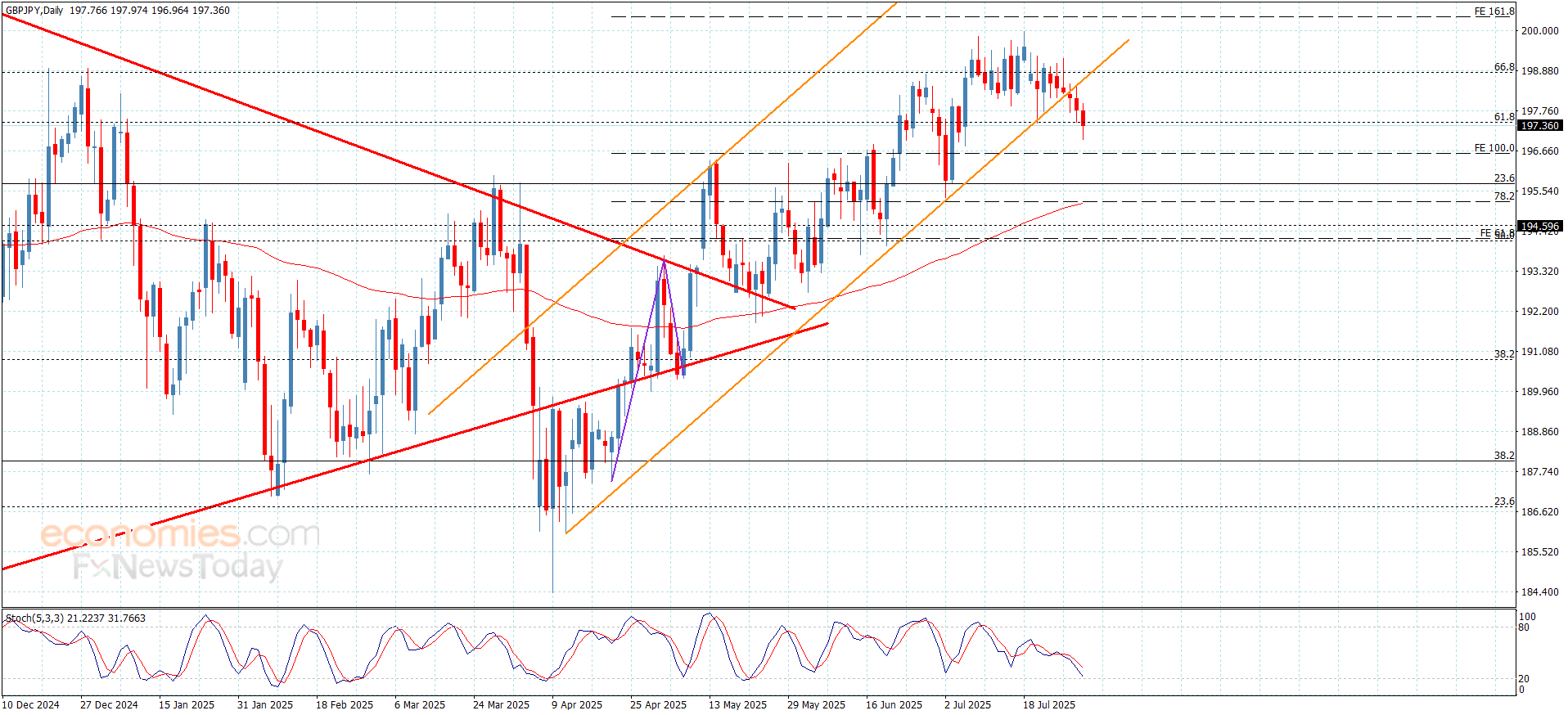
The GBPJPY achieves some negative targets– Forecast today – 31-7-2025

By |2025-07-31T17:45:56+03:00July 31, 2025|Forex News, News|0 Comments

Copper price is under strong bearish pressure to push it to decline below the support at $5.3200, to lose most of its previous gains to reach $4.3900, to face the moving average of 55.


Despite the main stability within the main bullish channel’s levels, the contradiction between the main indicators may increase the chances for suffering extra losses by targeting 161%Fibonacci extension level at $4.2650, while renewing the bullish attempts requires stepping above $4.7400 level, providing chance for recording gains again.


The expected trading range for today is between $4.2600 and $4.5200


Trend forecast: Fluctuated within the bullish track


Source link

31 07, 2025

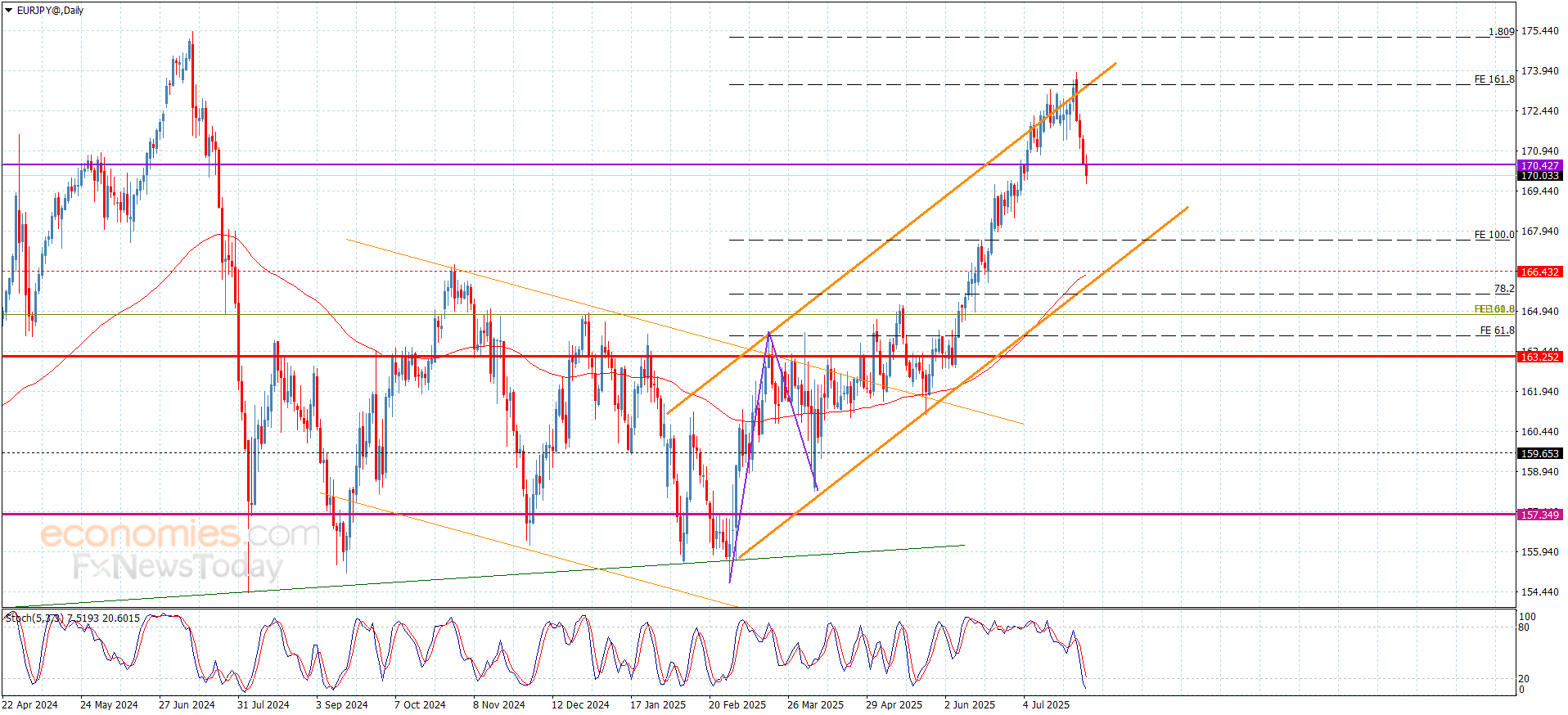
The EURJPY resumes the decline– Forecast today – 31-7-2025

By |2025-07-31T15:45:22+03:00July 31, 2025|Forex News, News|0 Comments

Copper price is under strong bearish pressure to push it to decline below the support at $5.3200, to lose most of its previous gains to reach $4.3900, to face the moving average of 55.


Despite the main stability within the main bullish channel’s levels, the contradiction between the main indicators may increase the chances for suffering extra losses by targeting 161%Fibonacci extension level at $4.2650, while renewing the bullish attempts requires stepping above $4.7400 level, providing chance for recording gains again.


The expected trading range for today is between $4.2600 and $4.5200


Trend forecast: Fluctuated within the bullish track


Source link

31 07, 2025

Pound Sterling recovery unlikely to go beyond technical correction

By |2025-07-31T13:43:48+03:00July 31, 2025|Forex News, News|0 Comments

  • GBP/USD clings to small gains near 1.3250 in the European session.
  • The US Dollar’s rally takes a break ahead of macroeconomic data releases.
  • The technical outlook suggests bearish bias remains intact with a chance of a correction.

GBP/USD lost about 0.8% on Wednesday and touched its lowest level since mid-May, closing the fifth consecutive trading day in negative territory. The pair struggles to gather recovery momentum and trades at around 1.3250 in the European session on Thursday.

British Pound PRICE This week

The table below shows the percentage change of British Pound (GBP) against listed major currencies this week. British Pound was the weakest against the US Dollar.

USD EUR GBP JPY CAD AUD NZD CHF
USD 2.73% 1.40% 1.27% 0.98% 1.86% 1.73% 1.97%
EUR -2.73% -1.32% -1.40% -1.72% -0.85% -0.98% -0.75%
GBP -1.40% 1.32% -0.26% -0.40% 0.47% 0.35% 0.57%
JPY -1.27% 1.40% 0.26% -0.29% 0.55% 0.44% 0.84%
CAD -0.98% 1.72% 0.40% 0.29% 0.86% 0.75% 0.98%
AUD -1.86% 0.85% -0.47% -0.55% -0.86% -0.12% 0.10%
NZD -1.73% 0.98% -0.35% -0.44% -0.75% 0.12% 0.23%
CHF -1.97% 0.75% -0.57% -0.84% -0.98% -0.10% -0.23%

The heat map shows percentage changes of major currencies against each other. The base currency is picked from the left column, while the quote currency is picked from the top row. For example, if you pick the British Pound from the left column and move along the horizontal line to the US Dollar, the percentage change displayed in the box will represent GBP (base)/USD (quote).

Robust macroeconomic data releases from the United States (US) and the Federal Reserve’s (Fed) cautious tone on policy-easing fuelled a bullish rally in the US Dollar (USD) midweek, causing GBP/USD to decline sharply.

The US Bureau of Economic Analysis’ (BEA) first estimate showed that the United States’ (US) economy staged an impressive comeback following the 0.5% contraction seen in the first quarter. The Gross Domestic Product (GDP) grew at an annual rate of 3% in the second quarter, surpassing the market expectation of 2.4%. Additionally, ADP Employment Change came in at 104,000 in July, beating analysts’ estimate of 78,000 by a wide margin.

Later in the day, the Fed announced that it maintained the policy rate at the range of 4.25%-4.5% in a widely expected decision. The policy statement showed that Governor Christopher Waller and Governor Michelle Bowman dissented, preferring a 25 basis points (bps) rate cut, which was also anticipated.

In the post-meeting press conference, Fed Chairman Jerome Powell refrained from confirming a rate cut at the next meeting in September, citing heathy conditions in the labor market and explaining that the current policy stance as being appropriate to guard against inflation risks. Moreover, Powell said that the policy was not holding back the economy despite being still modestly restrictive.

According go the CME FedWatch Tool, the probability of a 25 basis points Fed rate cut in September dropped toward 40% from above-60% before the Fed event. In turn, US Treasury bond yields pushed higher and the USD outperformed its rivals during the American trading hours.

The BEA will release Personal Consumption Expenditures (PCE) Price Index data for June on Thursday. Powell said that they expect the annual PCE inflation and Core PCE inflation to come in at 2.5% and 2.7%, respectively. Weekly Initial Jobless Claims will also be featured in the US economic calendar. Ahead of Friday’s critical July employment report, investors could remain hesitant to take large positions based on this data.

It’s important to note that month-end flows on the last day of July could ramp up volatility toward the end of the European session and trigger irregular movements in the pair.

GBP/USD Technical Analysis

The Relative Strength Index (RSI) indicator on the 4-hour chart stays below 30 after the short-lasting recovery attempt, suggesting that GBP/USD remains technically oversold.

On the upside, 1.3300 (Fibonacci 78.6% retracement of the latest uptrend) aligns as the first resistance level before 1.3330 (static level) and 1.3400 (Fibonacci 61.8% retracement). Looking south, support levels could be seen at 1.3230 (static level), 1.3200 (static level, round level) and 1.3160 (beginning point of the uptrend).

Pound Sterling FAQs

The Pound Sterling (GBP) is the oldest currency in the world (886 AD) and the official currency of the United Kingdom. It is the fourth most traded unit for foreign exchange (FX) in the world, accounting for 12% of all transactions, averaging $630 billion a day, according to 2022 data.
Its key trading pairs are GBP/USD, also known as ‘Cable’, which accounts for 11% of FX, GBP/JPY, or the ‘Dragon’ as it is known by traders (3%), and EUR/GBP (2%). The Pound Sterling is issued by the Bank of England (BoE).

The single most important factor influencing the value of the Pound Sterling is monetary policy decided by the Bank of England. The BoE bases its decisions on whether it has achieved its primary goal of “price stability” – a steady inflation rate of around 2%. Its primary tool for achieving this is the adjustment of interest rates.
When inflation is too high, the BoE will try to rein it in by raising interest rates, making it more expensive for people and businesses to access credit. This is generally positive for GBP, as higher interest rates make the UK a more attractive place for global investors to park their money.
When inflation falls too low it is a sign economic growth is slowing. In this scenario, the BoE will consider lowering interest rates to cheapen credit so businesses will borrow more to invest in growth-generating projects.

Data releases gauge the health of the economy and can impact the value of the Pound Sterling. Indicators such as GDP, Manufacturing and Services PMIs, and employment can all influence the direction of the GBP.
A strong economy is good for Sterling. Not only does it attract more foreign investment but it may encourage the BoE to put up interest rates, which will directly strengthen GBP. Otherwise, if economic data is weak, the Pound Sterling is likely to fall.

Another significant data release for the Pound Sterling is the Trade Balance. This indicator measures the difference between what a country earns from its exports and what it spends on imports over a given period.
If a country produces highly sought-after exports, its currency will benefit purely from the extra demand created from foreign buyers seeking to purchase these goods. Therefore, a positive net Trade Balance strengthens a currency and vice versa for a negative balance.

Source link

31 07, 2025

200+ pips surge – Key levels and scenarios to watch [Video]

By |2025-07-31T11:42:53+03:00July 31, 2025|Forex News, News|0 Comments

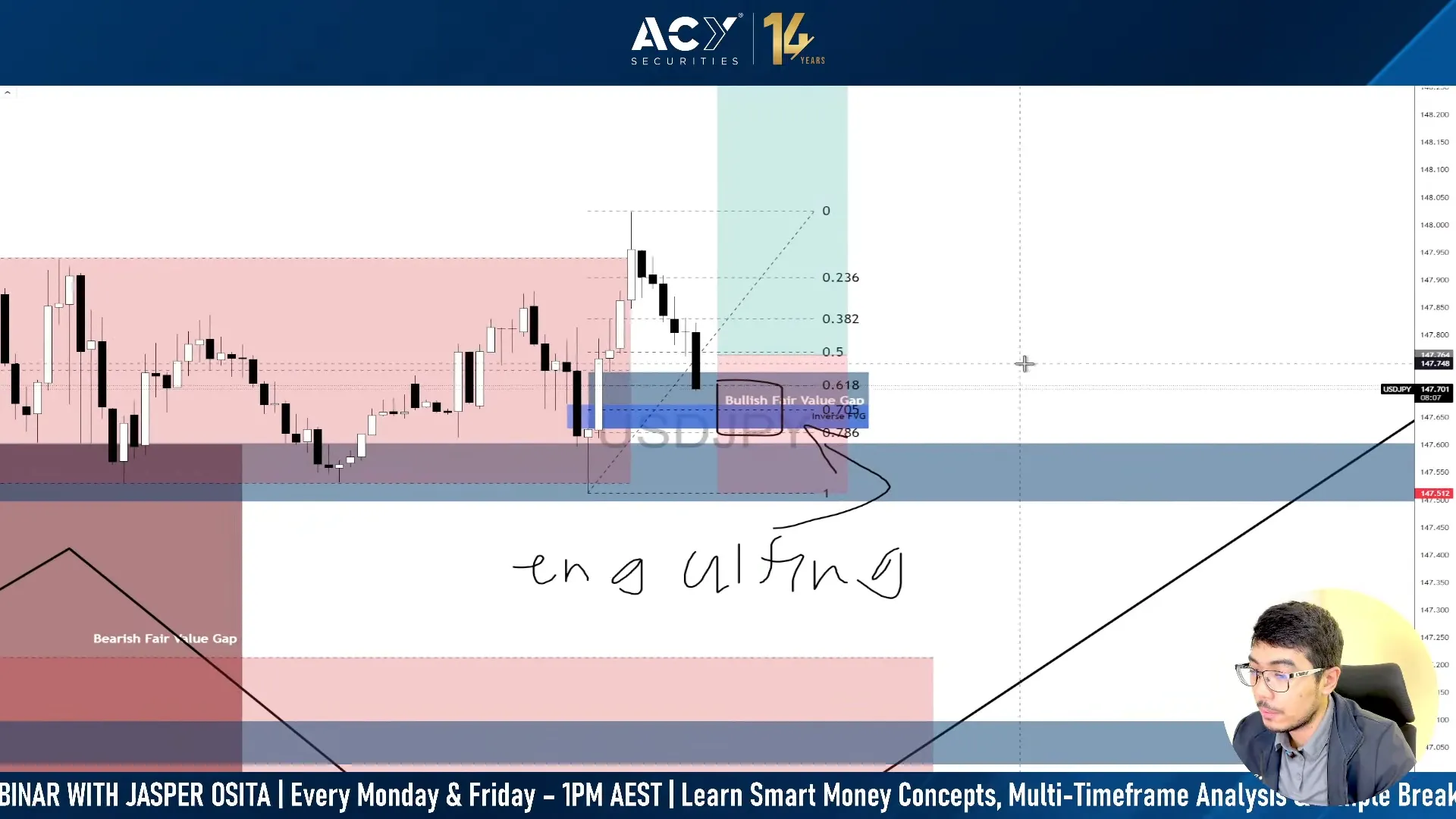
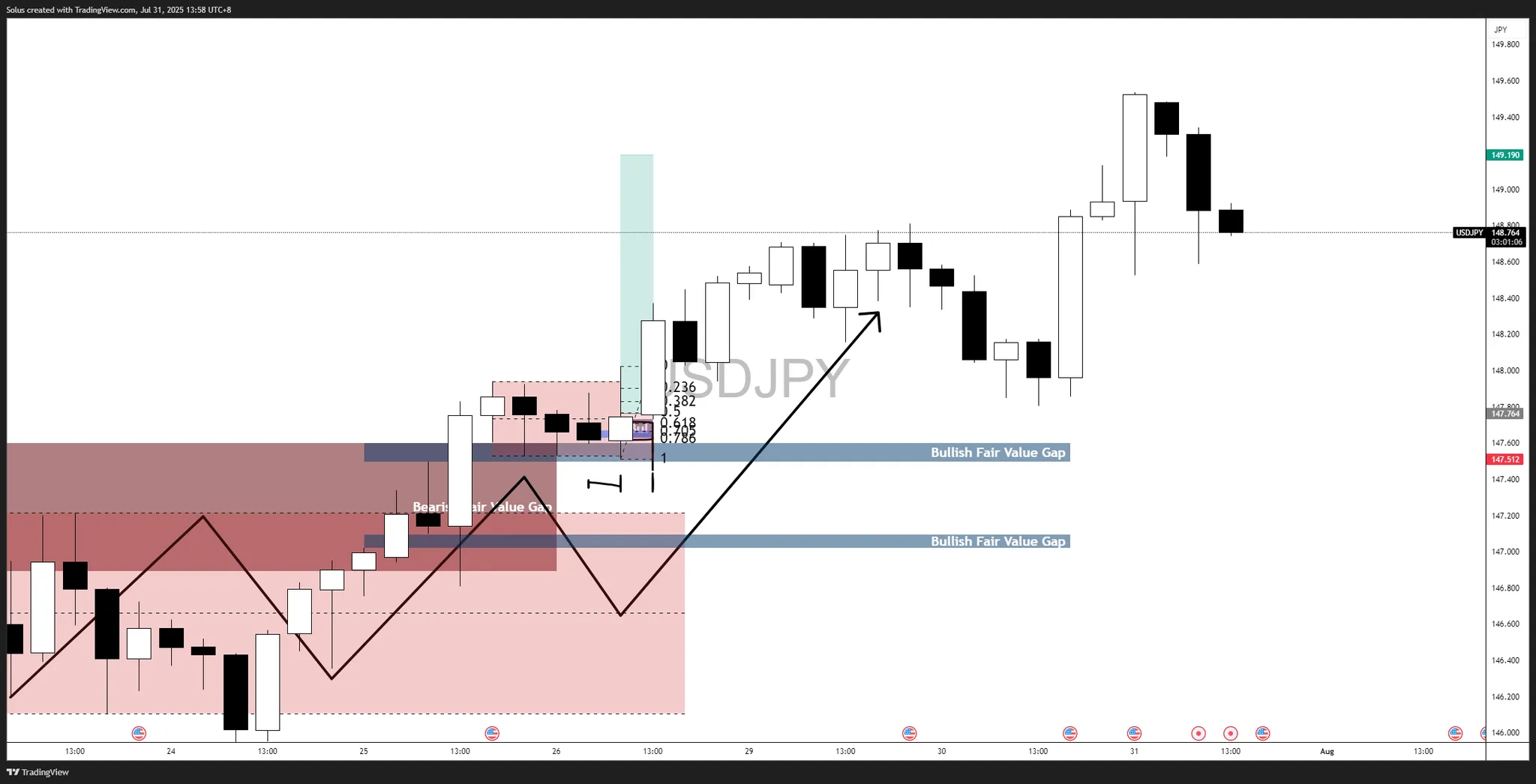
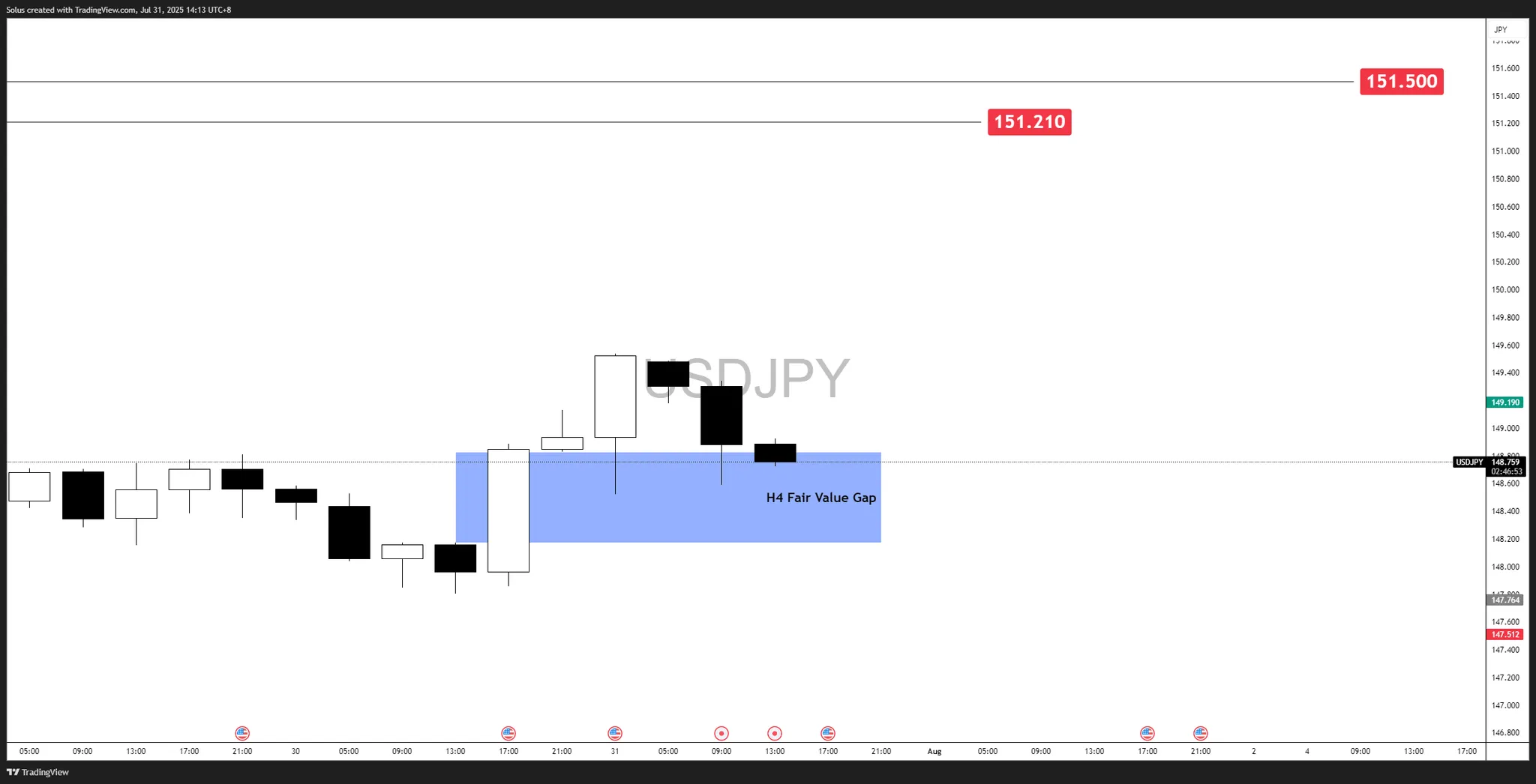
  • USD/JPY surged over 200 pips after perfectly respecting the 4-hour Fair Value Gap (FVG) at 147.50–147.60 and triggering a clean M15 confirmation entry.
  • The Fed’s pause on rate cuts, coupled with a still-cautious BOJ, reinforced dollar strength and provided the macro tailwind for the move.
  • Price is now anchored at a new 4-hour FVG (148.173–148.828) as the market awaits NFP, which could trigger the next leg toward 151.20–151.50 or break lower into deeper retracement zones.

USD/JPY surges 200+ pips

This week’s USD/JPY price action perfectly validated the top-down approach we discussed during the webinar. Check the video below for reference:

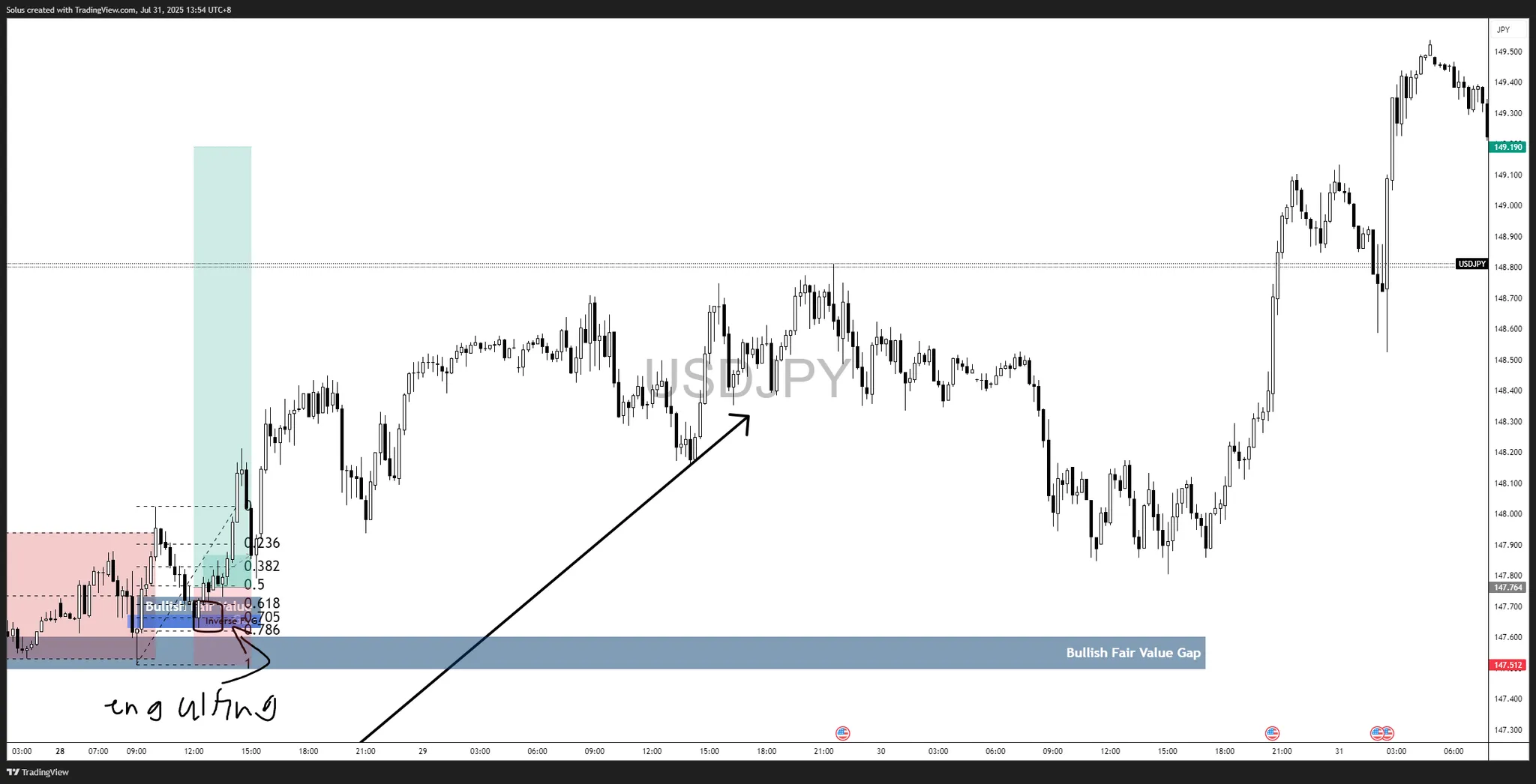
We began our analysis on the 4-hour chart, identifying a key Bullish Fair Value Gap (FVG) around the 147.50–147.60 zone. With the 4-hour timeframe providing the directional bias, we then dropped down to the 15-minute chart to refine our entry.

The plan was straightforward:

  1. Wait for price to retrace into the 4-hour Bullish FVG.
  2. Use the M15 chart to identify a confirmation trigger before entry.
  3. Target the next liquidity cluster above 149.00.

What followed was a textbook Smart Money Concepts execution:

  • Price retraced into the 61.8–78.6% Fibonacci confluence and the 4-hour FVG (chart reference).
  • On the M15 chart, a bullish engulfing candle formed right at the zone, validating the setup.
  • USD/JPY then surged higher, clearing intermediate highs and tagging 149.19, exactly in line with our higher-timeframe targets.

This is the power of starting with a strong anchor timeframe and only dropping lower to fine-tune the entry.

What’s moved the USD/JPY?

The macro backdrop added conviction to our bullish bias:

  • Fed’s pause strengthens the dollar: As highlighted in the webinar, the Federal Reserve’s decision to pause further rate cuts was net positive for the U.S. dollar. With no additional liquidity entering the market, dollar demand firmed up, pushing USD/JPY higher.
  • BOJ’s subtle shift not enough: Although the Bank of Japan kept rates at 0.5% and raised inflation forecasts, the divergence with the Fed still favored the dollar. The market interpreted the BOJ’s stance as cautious, not aggressively hawkish.
  • Fading risk-off events: Initial safe-haven yen buying on tsunami alerts from the Kamchatka earthquake quickly reversed as fears subsided, allowing the broader bullish narrative to dominate.
  • Positive trade sentiment: Improved U.S.–Japan trade outlooks further reinforced dollar demand and risk-on sentiment.

Technical outlook

USD/JPY is currently testing the newly created 4-hour Fair Value Gap (FVG) zone at 148.173–148.828, which remains the key support area in the short term. Price has already respected this zone once, and it is now serving as a base for the next potential leg higher.

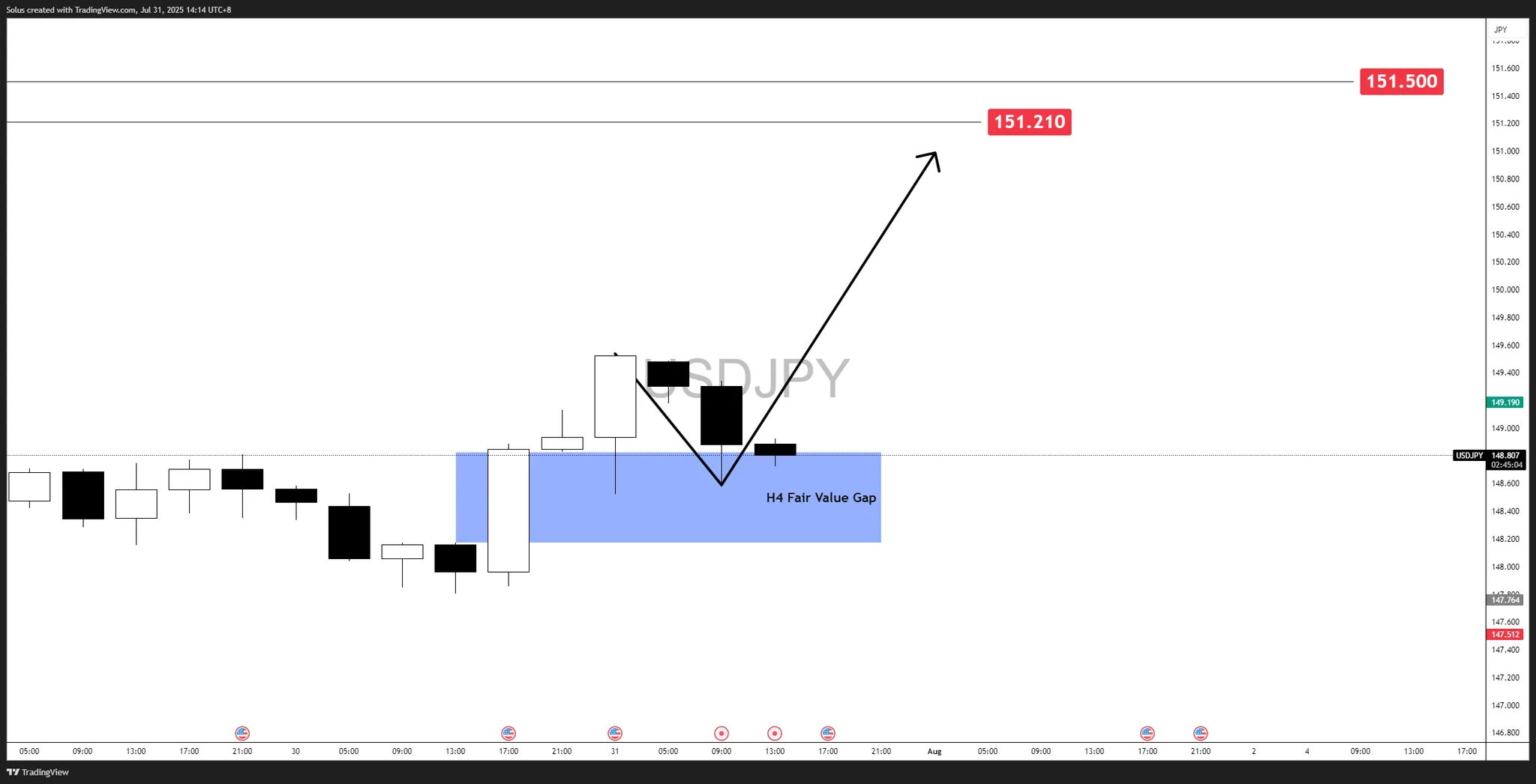
Bullish scenario: Continuation from the FVG

If price holds its ground at the 4-hour Fair Value Gap (FVG) zone at 148.173–148.828, and price uses this area as a launchpad for the next upward leg. This scenario aligns with the existing bullish structure and broader dollar strength.

  • A confirmed rejection from the FVG with a strong bullish candle closing above 149.00 would validate upside continuation.

Targets:

  • First target: 151.20, which aligns with prior higher timeframe liquidity.
  • Extended target: 151.50, a major psychological and liquidity level.

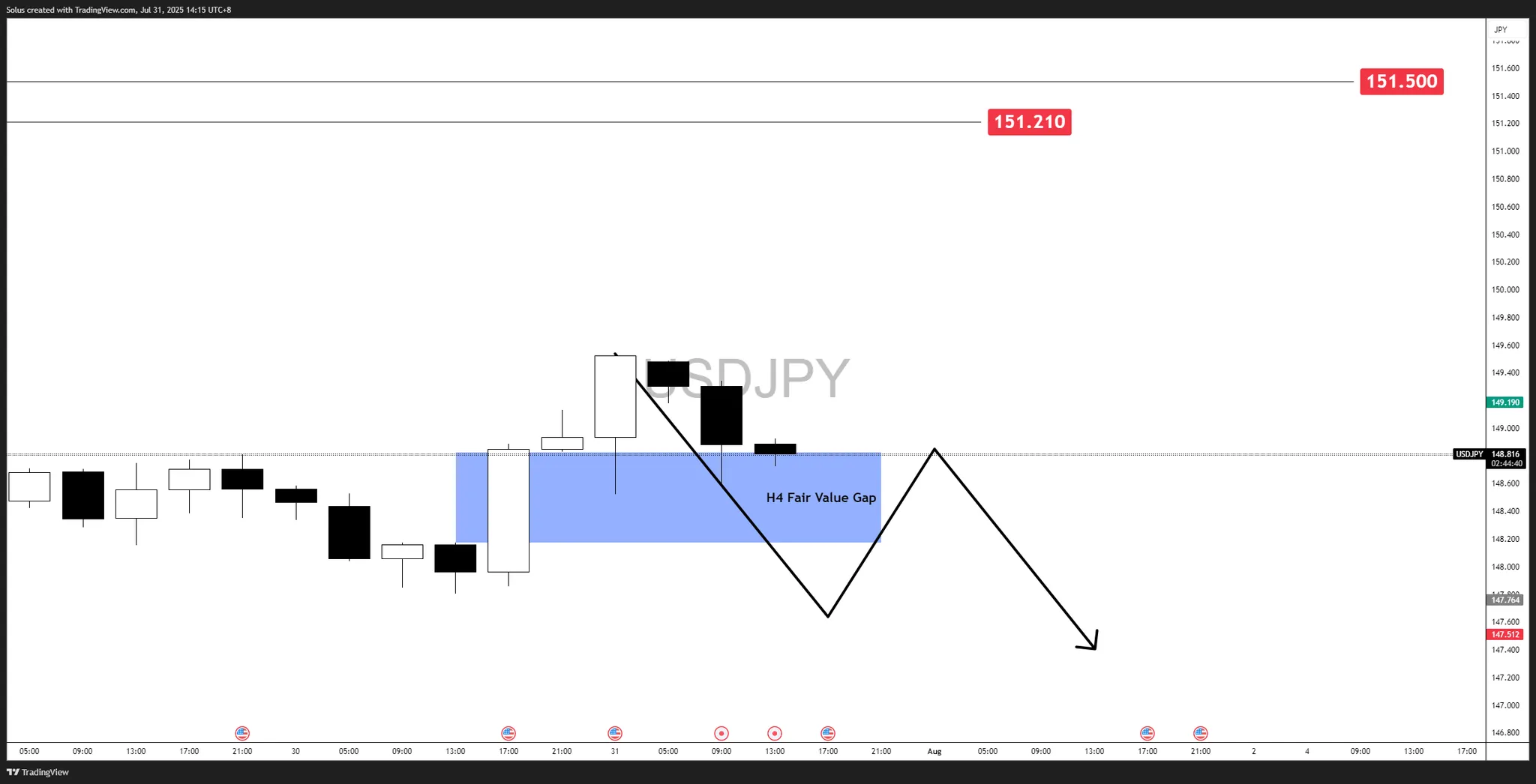
Bearish scenario: Breakdown of FVG support

If buyers fail to hold the 4-hour FVG zone, it would signal a potential shift in short-term sentiment. Price breaking below 148.00 could trigger a deeper retracement, erasing the recent bullish momentum.

  • A decisive 4-hour or daily candle close below 148.00 would confirm breakdown and invalidate the bullish continuation thesis.

Targets:

  • First target: 147.50, which is the prior swing low.
  • Extended target: 147.00.

Final takeaway

The deciding factor for which scenario plays out on USD/JPY will ultimately come down to the U.S. dollar’s strength or weakness. With the NFP report due tomorrow, another round of volatility is possible, and traders should be prepared for sharp swings as the market reprices expectations.

To stay on the right side of the move, use the same process we followed in the recent setup:

  • Anchor your directional bias on the 4-hour chart.
  • Drop down to the M15 timeframe for confirmation at the key FVG zone or breakout levels.
  • Only act when price provides a clear signal, rather than pre-empting the move.

By aligning higher timeframe structure with lower timeframe confirmation, you avoid being caught in the noise and can execute with conviction when the market shows its hand.

Source link

31 07, 2025

Forecast update for EURUSD -30-07-2025

By |2025-07-31T03:35:59+03:00July 31, 2025|Forex News, News|0 Comments

Natural gas prices provided a new positive close above $3.050 level, forming the neckline of the head and shoulders pattern that appears in the above image, taking advantage of stochastic exit from the oversold level and providing positive momentum again.


The price success to settle above $3.050 will decrease the risk of moving to a new bearish station, providing chances to begin recording some of the gains by its rally to $3.320 and $3.450, while breaking the neckline and holding below it will force it to suffer big losses by reaching $2.710 initially.


The expected trading range for today is between $3.10 and 3.320


Trend forecast: Bullish by the stability of $3.050


Source link

31 07, 2025

Pound to Euro Forecast: GBP Eyes 1.16 as Trade Tensions Weigh on EUR

By |2025-07-31T01:34:47+03:00July 31, 2025|Forex News, News|0 Comments

The Pound-to-Euro exchange rate (GBP/EUR) has maintained highs at around 1.156 on Wednesday, after the single currency lost further ground in global markets, which has helped underpin the Pound.

The Euro attempted to stabilise during the European trading with GBP/EUR trading around 1.1535.

According to SocGen: “If a short-term pullback develops, the lower limit of an ascending channel near 0.8660/0.8645 could be an important support zone.

This would imply GBP/EUR resistance in the 1.1550 – 1.1570 zone.

ING considers that there has been substantial position adjustment; “it could be seen as the UK having a better deal than the EU when it comes to trade. In reality, however, it was probably all to do with positioning, where opposing fiscal and monetary prospects between the eurozone and the UK had made long EUR/GBP one of the conviction trades this summer.”

Although there was immediate relief that the EU secured a trade deal with the US and avoided a trade war, there have also been notable concerns that the EU will be negatively impacted by the arrangement.

National Australia Bank head of FX research Ray Attrill commented; “It hasn’t taken long for markets to conclude that this relatively good news is still, in absolute terms, bad news as far as the near-term implications for euro zone growth are concerned.”


He added; “The deal has been roundly condemned by France while others – including German Chancellor Merz – are playing up the negative consequences for exporters, and with that, economic growth.”

According to Clemens Fuest, president of the IFO economic research institute; ‘The trade deal is a humiliation for the EU, but it reflects the imbalance of power.”

He added; “The Europeans need to wake up, focus more on economic strength and reduce their military and technological dependence on the US.”

Rabobank noted a newswire report; “According to Bloomberg, Wolfgang Niedermark of the BDI industry federation has wailed that “the EU is accepting painful tariffs. Even a 15% tariff will have immense negative consequences for Germany’s export-oriented industry.”

The bank added; “Prior to Trump’s inauguration, economists were talking about “worst case scenarios” that included horrific outcomes like a 5% universal tariff, and 15% on Chinese goods. After witnessing 145% tariffs on China and Liberation Day “reciprocal tariffs,” it’s easy to shrug off the current developments. But the actual tariff levels still matter.”

There is, therefore, a risk of wider complacency over the impacts on the US and global economy.

Domestically, mortgage approvals increased to 64,200 for June from a revised 63,300 the previous month and above consensus forecasts of 63,000.


Approvals for re-mortgaging increased to the highest level since October 2022.

There was also a surge in net lending to £6.76bn for June from £2.90bn the previous month with a stronger increase in consumer credit growth.

The British Retail Consortium (BRC) reported that shop prices increased 0.7% in the year to July from 0.4% previously.

Food prices increased 4.0% from 3.4% previously.

Mike Watkins, Head of Retailer and Business Insight, NIQ, commented; “Consumers’ household budgets are coming under pressure with the food retailers now seeing price increases above CPI.”

The data should not encourage a faster rate of interest rate cuts by the Bank of England.

International Money Transfer? Ask our resident FX expert a money transfer question or try John’s new, free, no-obligation personal service! ,where he helps every step of the way,
ensuring you get the best exchange rates on your currency requirements.

Source link

30 07, 2025

EUR/USD, USD/JPY and AUD/USD Forecast – US Dollar Strengthens Before the FOMC Announcement

By |2025-07-30T21:31:56+03:00July 30, 2025|Forex News, News|0 Comments

Scan QR code to install app

Important DisclaimersThe content provided on the website includes general news and publications, our personal analysis and opinions, and contents provided by third parties, which are intended for educational and research purposes only. It does not constitute, and should not be read as, any recommendation or advice to take any action whatsoever, including to make any investment or buy any product. When making any financial decision, you should perform your own due diligence checks, apply your own discretion and consult your competent advisors. The content of the website is not personally directed to you, and we does not take into account your financial situation or needs.The information contained in this website is not necessarily provided in real-time nor is it necessarily accurate. Prices provided herein may be provided by market makers and not by exchanges.Any trading or other financial decision you make shall be at your full responsibility, and you must not rely on any information provided through the website. FX Empire does not provide any warranty regarding any of the information contained in the website, and shall bear no responsibility for any trading losses you might incur as a result of using any information contained in the website.The website may include advertisements and other promotional contents, and FX Empire may receive compensation from third parties in connection with the content. FX Empire does not endorse any third party or recommends using any third party’s services, and does not assume responsibility for your use of any such third party’s website or services.FX Empire and its employees, officers, subsidiaries and associates, are not liable nor shall they be held liable for any loss or damage resulting from your use of the website or reliance on the information provided on this website.Risk DisclaimersThis website includes information about cryptocurrencies, contracts for difference (CFDs) and other financial instruments, and about brokers, exchanges and other entities trading in such instruments. Both cryptocurrencies and CFDs are complex instruments and come with a high risk of losing money. You should carefully consider whether you understand how these instruments work and whether you can afford to take the high risk of losing your money.FX Empire encourages you to perform your own research before making any investment decision, and to avoid investing in any financial instrument which you do not fully understand how it works and what are the risks involved.

Source link

30 07, 2025

Pound Sterling recovery to remain shallow ahead of Fed

By |2025-07-30T17:29:48+03:00July 30, 2025|Forex News, News|0 Comments

  • GBP/USD trades in positive territory above 1.3350 on Wednesday.
  • Markets await key data releases from the US and Fed policy announcements.
  • The near-term technical outlook is yet to point to a buildup of recovery momentum.

After touching its lowest level since mid-May near 1.3300 on Tuesday, GBP/USD stages a correction and trades above 1.3350 in the European session on Wednesday. High-tier macroeconomic data releases from the US and the Federal Reserve’s monetary policy announcements could trigger the next big action in the pair.

British Pound PRICE This week

The table below shows the percentage change of British Pound (GBP) against listed major currencies this week. British Pound was the weakest against the US Dollar.

USD EUR GBP JPY CAD AUD NZD CHF
USD 1.86% 0.45% 0.30% 0.58% 1.23% 1.08% 1.07%
EUR -1.86% -1.40% -1.51% -1.27% -0.61% -0.76% -0.78%
GBP -0.45% 1.40% -0.28% 0.14% 0.80% 0.65% 0.62%
JPY -0.30% 1.51% 0.28% 0.28% 0.88% 0.76% 0.92%
CAD -0.58% 1.27% -0.14% -0.28% 0.62% 0.51% 0.48%
AUD -1.23% 0.61% -0.80% -0.88% -0.62% -0.15% -0.18%
NZD -1.08% 0.76% -0.65% -0.76% -0.51% 0.15% -0.03%
CHF -1.07% 0.78% -0.62% -0.92% -0.48% 0.18% 0.03%

The heat map shows percentage changes of major currencies against each other. The base currency is picked from the left column, while the quote currency is picked from the top row. For example, if you pick the British Pound from the left column and move along the horizontal line to the US Dollar, the percentage change displayed in the box will represent GBP (base)/USD (quote).

Mixed macroeconomic data releases from the US limited the US Dollar’s gains on Tuesday and helped GBP/USD hold its ground. Additionally, investors seem to be stepping aside before committing to additional USD longs. JOLTS Job Openings declined to 7.43 million in June from 7.77 in May, falling short of the market expectation of 7.55, while the Conference Board’s Consumer Confidence Index improved to 97.2 in July from 95.2 in June.

The US economic calendar will offer ADP Employment Change data for July and the first estimate of the second-quarter Gross Domestic Product (GDP) growth on Wednesday. Markets expect private sector payrolls to rise by 78,000 following the 33,000 decline reported in June. A significant positive surprise, with a reading above 100,000, could boost the USD with the immediate reaction.

The US’ GDP is forecast to rebound and grew at an annual rate of 2.4% following the 0.5% contraction recorded in the first quarter. A reading near the market consensus, if combined with an upbeat ADP print, could help the USD gather strength heading into the Fed event. Conversely, GBP/USD could keep its footing if these data miss analysts’ estimates.

Later in the day, the Fed is widely anticipated to leave the policy rate unchanged at the range of 4.25%-4.5%. Earlier in the month, Governors Christopher Waller and Michelle Bowman both voiced their support for a 25 basis points rate cut in July. Hence, it wouldn’t be a big surprise if they were to vote in favor of a reduction in the policy rate. However, if the policy statement shows that there were other policymakers who voted for a rate cut, the USD could come under selling pressure in the late American session.

On the other hand, GBP/USD could turn south if Fed Chairman Jerome Powell avoids signalling a rate cut in September and repeats the need for patience, citing the uncertainty surrounding the inflation outlook despite the recently-announced trade deals with Japan and the EU. According to the CME FedWatch Tool, markets are currently pricing in about a 63% probability of a rate cut at the next meeting in September.

GBP/USD Technical Analysis

The Relative Strength Index (RSI) indicator on the 4-hour chart stays below 40 and GBP/USD is yet to make a 4-hour close above the 20-period Simple Moving Average (SMA), highlighting a lack of buyer interest.

On the downside, 1.3330 (static level) aligns as an interim support level before 1.3300 (Fibonacci 78.6% retracement of the latest uptrend) and 1.3250 (static level). Looking north, resistance levels could be spotted at 1.3400 (Fibonacci 61.8% retracement), 1.3470 (Fibonacci 50% retracement, 100-period SMA) and 1.3500 (round level, static level).

Pound Sterling FAQs

The Pound Sterling (GBP) is the oldest currency in the world (886 AD) and the official currency of the United Kingdom. It is the fourth most traded unit for foreign exchange (FX) in the world, accounting for 12% of all transactions, averaging $630 billion a day, according to 2022 data.
Its key trading pairs are GBP/USD, also known as ‘Cable’, which accounts for 11% of FX, GBP/JPY, or the ‘Dragon’ as it is known by traders (3%), and EUR/GBP (2%). The Pound Sterling is issued by the Bank of England (BoE).

The single most important factor influencing the value of the Pound Sterling is monetary policy decided by the Bank of England. The BoE bases its decisions on whether it has achieved its primary goal of “price stability” – a steady inflation rate of around 2%. Its primary tool for achieving this is the adjustment of interest rates.
When inflation is too high, the BoE will try to rein it in by raising interest rates, making it more expensive for people and businesses to access credit. This is generally positive for GBP, as higher interest rates make the UK a more attractive place for global investors to park their money.
When inflation falls too low it is a sign economic growth is slowing. In this scenario, the BoE will consider lowering interest rates to cheapen credit so businesses will borrow more to invest in growth-generating projects.

Data releases gauge the health of the economy and can impact the value of the Pound Sterling. Indicators such as GDP, Manufacturing and Services PMIs, and employment can all influence the direction of the GBP.
A strong economy is good for Sterling. Not only does it attract more foreign investment but it may encourage the BoE to put up interest rates, which will directly strengthen GBP. Otherwise, if economic data is weak, the Pound Sterling is likely to fall.

Another significant data release for the Pound Sterling is the Trade Balance. This indicator measures the difference between what a country earns from its exports and what it spends on imports over a given period.
If a country produces highly sought-after exports, its currency will benefit purely from the extra demand created from foreign buyers seeking to purchase these goods. Therefore, a positive net Trade Balance strengthens a currency and vice versa for a negative balance.

Source link

Go to Top