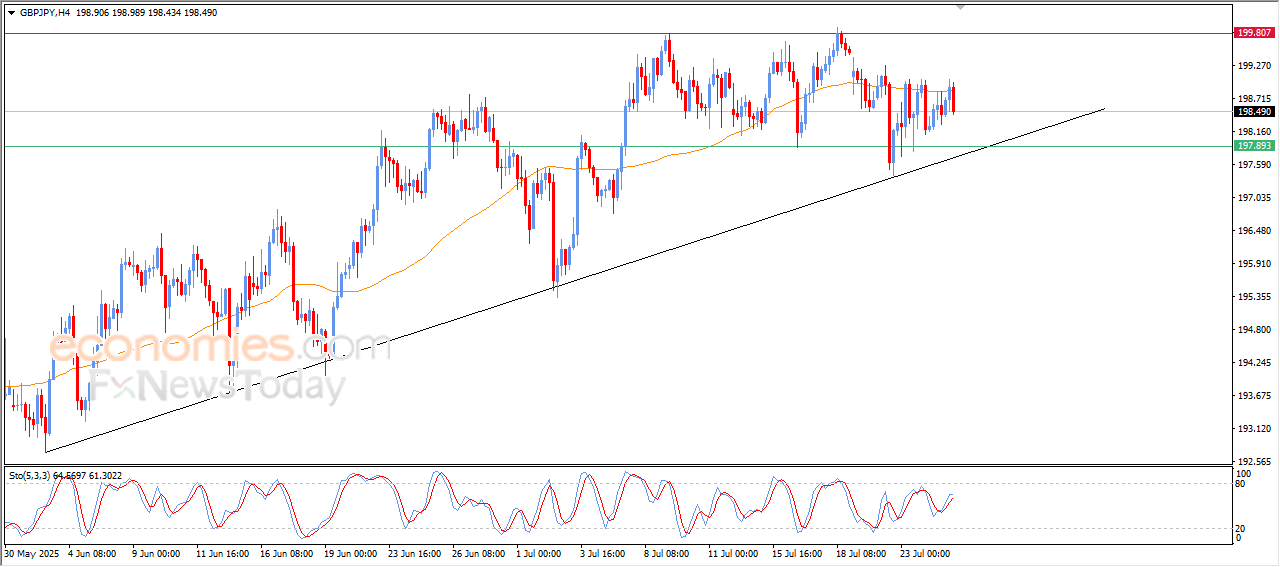
The GBPJPY pair reacted to stochastic positivity by forming correctional bullish rebound and approach the minor bearish channel’s resistance line at 190.45, while the upcoming scenario depends on the strength of this resistance, as its stability allows us to expect renewing the negative attempts by crawling towards 188.75 followed by reaching 187.90.
On the other hand, facing strong positive pressures and rallying above the current resistance will cancel the bearish overview to start forming bullish waves, expecting to target 190.80 as a first station, followed by reaching the MA55 at 192.60.
The expected trading range for today is between 188.75 and 190.50
The GBPJPY pair reacted to stochastic positivity by forming correctional bullish rebound and approach the minor bearish channel’s resistance line at 190.45, while the upcoming scenario depends on the strength of this resistance, as its stability allows us to expect renewing the negative attempts by crawling towards 188.75 followed by reaching 187.90.
On the other hand, facing strong positive pressures and rallying above the current resistance will cancel the bearish overview to start forming bullish waves, expecting to target 190.80 as a first station, followed by reaching the MA55 at 192.60.
The expected trading range for today is between 188.75 and 190.50
The AUDCAD price started to activate the previously waited negative track by crawling below 50% Fibonacci correction level at 0.9030 yesterday, surpassing the EMA50 to start targeting the negative stations by reaching 0.8970.
We notice stochastic attempt to crawl towards the oversold areas to increase the chances of gathering the negative momentum to ease the mission of targeting the target at 0.8940, while surpassing it will extend trades towards 0.8900 direct, to form the next main target for the current trades.
The expected trading range for today is between 0.8940 and 0.9010
The AUDCAD price started to activate the previously waited negative track by crawling below 50% Fibonacci correction level at 0.9030 yesterday, surpassing the EMA50 to start targeting the negative stations by reaching 0.8970.
We notice stochastic attempt to crawl towards the oversold areas to increase the chances of gathering the negative momentum to ease the mission of targeting the target at 0.8940, while surpassing it will extend trades towards 0.8900 direct, to form the next main target for the current trades.
The expected trading range for today is between 0.8940 and 0.9010
Pound Sterling underperforms US Dollar as Trump’s fresh tariffs dampen market mood
The Pound Sterling (GBP) extends its downside move to near 1.2570 against the US Dollar (USD) in Friday’s European session. The GBP/USD pair faces pressure as the US Dollar gains further amid a risk-off market mood. The US Dollar Index (DXY), which tracks the Greenback’s value against six major currencies, moves higher to 107.45.
Market participants are cautious as President Donald Trump has announced more levies on China and provided more clarification on the timeline for 25% import duties on Canada and Mexico and reciprocal tariffs. Read more…
GBP/USD Forecast: Pound Sterling could struggle to gather bullish momentum
GBP/USD seems to have entered a consolidation phase near 1.2600 after losing more than 0.5% on Thursday as investors move to the sidelines while waiting for January inflation data from the US.
The US Dollar (USD) benefited from safe-haven flows in the American session on Thursday and gathered strength against its major rivals. Read more…
EUR/JPY surges to near 157.00 as soft Tokyo CPI data sends the Yen on the backfoot.
Moderate Tokyo CPI growth is expected to weigh on BoJ hawkish bets.
Steady German HICP growth is unlikely to restrict the ECB from easing monetary policy further.
The EUR/JPY pair rallies to near 157.00 in the North American session on Friday. The pair strengthens as the Japanese Yen (JPY) is underperforming across the board after the release of the soft Tokyo Consumer Price Index (CPI) data for February.
Japanese Yen PRICE Today
The table below shows the percentage change of Japanese Yen (JPY) against listed major currencies today. Japanese Yen was the strongest against the New Zealand Dollar.
USD
EUR
GBP
JPY
CAD
AUD
NZD
CHF
USD
-0.08%
0.06%
0.66%
-0.16%
0.31%
0.52%
0.31%
EUR
0.08%
0.15%
0.75%
-0.06%
0.40%
0.62%
0.40%
GBP
-0.06%
-0.15%
0.59%
-0.22%
0.25%
0.46%
0.24%
JPY
-0.66%
-0.75%
-0.59%
-0.80%
-0.35%
-0.14%
-0.35%
CAD
0.16%
0.06%
0.22%
0.80%
0.46%
0.68%
0.46%
AUD
-0.31%
-0.40%
-0.25%
0.35%
-0.46%
0.21%
-0.00%
NZD
-0.52%
-0.62%
-0.46%
0.14%
-0.68%
-0.21%
-0.22%
CHF
-0.31%
-0.40%
-0.24%
0.35%
-0.46%
0.00%
0.22%
The heat map shows percentage changes of major currencies against each other. The base currency is picked from the left column, while the quote currency is picked from the top row. For example, if you pick the Japanese Yen from the left column and move along the horizontal line to the US Dollar, the percentage change displayed in the box will represent JPY (base)/USD (quote).
Statistics Bureau of Japan reported that the Tokyo headline CPI decelerated significantly to 2.9% from 3.4% in January. In the same period, the Tokyo CPI ex. Fresh Food rose by 2.2%, slower than estimates of 2.3% and the former release of 2.5%. Soft Tokyo CPI data is likely to weigh on market expectations that the Bank of Japan (BoJ) will raise interest rates again this year.
Meanwhile, the Euro (EUR) outperforms its major peers despite fears that United States (US) President Donald Trump’s tariff agenda will be unfavorable for the Eurozone economy. On Wednesday, Trump threatened to impose 25% tariffs on cars and other things imported from the Eurozone sooner.
On the domestic front, hotter-than-expected flash German Harmonized Index of Consumer Prices (HICP) data for February is unlikely to ease market expectations that the European Central Bank (ECB) will reduce its Deposit Facility rate by 25 basis points (bps) to 2.5% in the policy meeting on Thursday.
German HICP rose steadily by 2.8%, faster than estimates of 2.7% on year. Month-on-month HICP grew at a faster pace of 0.6% than expectations of 0.5%. In January, the underlying inflation data deflated by 0.2%.
EUR/JPY recovers strongly after revisiting an almost seven-month low of 155.15 on Friday. However, the near-term outlook of the cross is still bearish as the 20-day Exponential Moving Average (EMA) is sloping downwards to near 158.00.
The 14-day Relative Strength Index (RSI) bounced back to the 40.00-60.00 range, which indicates that bearish momentum has ended. However, the negative bias remains intact.
More recovery in the EUR/JPY pair above the February 25 high of 157.30 would allow it to gain further towards the 20-day EMA around 158.00, followed by the February 19 high of 159.14.
On the flip side, a downside move by the pair below the intraday low of 154.80 would expose it to the August 5 low of 154.40 and the 19-month low of 153.17.
EUR/JPY daily chart
Japanese Yen FAQs
The Japanese Yen (JPY) is one of the world’s most traded currencies. Its value is broadly determined by the performance of the Japanese economy, but more specifically by the Bank of Japan’s policy, the differential between Japanese and US bond yields, or risk sentiment among traders, among other factors.
One of the Bank of Japan’s mandates is currency control, so its moves are key for the Yen. The BoJ has directly intervened in currency markets sometimes, generally to lower the value of the Yen, although it refrains from doing it often due to political concerns of its main trading partners. The BoJ ultra-loose monetary policy between 2013 and 2024 caused the Yen to depreciate against its main currency peers due to an increasing policy divergence between the Bank of Japan and other main central banks. More recently, the gradually unwinding of this ultra-loose policy has given some support to the Yen.
Over the last decade, the BoJ’s stance of sticking to ultra-loose monetary policy has led to a widening policy divergence with other central banks, particularly with the US Federal Reserve. This supported a widening of the differential between the 10-year US and Japanese bonds, which favored the US Dollar against the Japanese Yen. The BoJ decision in 2024 to gradually abandon the ultra-loose policy, coupled with interest-rate cuts in other major central banks, is narrowing this differential.
The Japanese Yen is often seen as a safe-haven investment. This means that in times of market stress, investors are more likely to put their money in the Japanese currency due to its supposed reliability and stability. Turbulent times are likely to strengthen the Yen’s value against other currencies seen as more risky to invest in.
I’ve taken profit twice on last week’s short from 0.6370, another profitable trade I shared with VIP Discord members in real time.
Although we could get a bounce from the 0.6200 point of control, my next target for AUDUSD is the 0.6130 range lows.
That’s especially the case given what we saw from the US dollar and stocks last week.
Another support to keep an eye on is the AUDUSD yearly open at 0.6186.
Buyers may look to defend that region next week, with resistance coming in near 0.6255.
There’s also a broadening wedge since December that points to a potential retest of 0.6000 in the coming weeks, which is the 2008 great financial crisis low.
Weekly Forex Forecast for DXY, EURUSD, GBPUSD, USDJPY, and AUDUSD (March 3-7, 2025) 10
Natural gas price touched 4.186$ level yesterday followed by surrendering to stochastic intraday negativity, to notice retesting 3.950$ support line and settling above it to confirm keeping the previously suggested bullish bias.
Now, stochastic attempt to gather the positive momentum will increase the chances of rallying towards 4.240$ to form the first target for the current trades, while surpassing it might extend trades towards 4.500$ recorded high direct.
The expected trading range for today is between 3.900$ and 4.240$
GBP/USD fluctuates near 1.2600 in the European session on Friday.
Market participants await January PCE inflation data from the US.
US President Trump hinted that they could refrain from imposing tariffs on UK imports.
GBP/USD seems to have entered a consolidation phase near 1.2600 after losing more than 0.5% on Thursday as investors move to the sidelines while waiting for January inflation data from the US.
The US Dollar (USD) benefited from safe-haven flows in the American session on Thursday and gathered strength against its major rivals.
British Pound PRICE This week
The table below shows the percentage change of British Pound (GBP) against listed major currencies this week. British Pound was the weakest against the US Dollar.
USD
EUR
GBP
JPY
CAD
AUD
NZD
CHF
USD
0.59%
0.23%
0.83%
1.49%
2.23%
2.44%
0.36%
EUR
-0.59%
-0.44%
0.09%
0.71%
1.62%
1.66%
-0.40%
GBP
-0.23%
0.44%
0.59%
1.15%
2.08%
2.10%
0.04%
JPY
-0.83%
-0.09%
-0.59%
0.64%
1.47%
1.67%
-0.38%
CAD
-1.49%
-0.71%
-1.15%
-0.64%
0.68%
0.94%
-1.10%
AUD
-2.23%
-1.62%
-2.08%
-1.47%
-0.68%
0.03%
-1.99%
NZD
-2.44%
-1.66%
-2.10%
-1.67%
-0.94%
-0.03%
-2.02%
CHF
-0.36%
0.40%
-0.04%
0.38%
1.10%
1.99%
2.02%
The heat map shows percentage changes of major currencies against each other. The base currency is picked from the left column, while the quote currency is picked from the top row. For example, if you pick the British Pound from the left column and move along the horizontal line to the US Dollar, the percentage change displayed in the box will represent GBP (base)/USD (quote).
US President Donald Trump said on Thursday that the 25% tariff package on Mexican and Canadian imports will come into effect on March 4 as planned, rather than April 2nd that he mentioned a day earlier. Additionally, Trump reiterated that another 10% tariff will be imposed on Chinese imports on that same date.
On a positive note, however, “I think there’s a very good chance that in the case of these two great, friendly countries, I think we could very well end up with a real trade deal where the tariffs wouldn’t be necessary. We’ll see,” Trump said following his meeting with British Prime Minister Keir Starmer.
Meanwhile, Bank of England (BoE) Deputy Governor Dave Ramsden said early Friday that a gradual and careful approach is needed to rate cuts, helping Pound Sterling hold its ground.
In the second half of the day, the US Bureau of Economic Analysis (BEA) will publish the Personal Consumption Expenditure (PCE) Price Index data for January. In case the reports shows a monthly core PCE Price Index increase of 0.4%, or higher, the USD could preserve its strength heading into the weekend and make it difficult for GBP/USD to stage a rebound. It’s also worth mentioning that month-end flows on the last trading day of February could ramp up market volatility toward the end of the European session and cause irregular movements in the pair.
GBP/USD Technical Analysis
GBP/USD closed below the 100-day Simple Moving Average (SMA), currently located at 1.2640, on Thursday and the Relative Strength Index (RSI) indicator on the 4-hour chart declined below 50, highlighting a loss of bullish momentum.
On the downside, 1.2560 (100-period SMA) aligns as first support before 1.2530 (Fibonacci 50% retracement of the latest downtrend) and 1.2500 (round level, static level). Looking north, resistances could be spotted at 1.2640 (100-day SMA) and 1.2700-1.2710 (round level, static level).
Pound Sterling FAQs
The Pound Sterling (GBP) is the oldest currency in the world (886 AD) and the official currency of the United Kingdom. It is the fourth most traded unit for foreign exchange (FX) in the world, accounting for 12% of all transactions, averaging $630 billion a day, according to 2022 data. Its key trading pairs are GBP/USD, also known as ‘Cable’, which accounts for 11% of FX, GBP/JPY, or the ‘Dragon’ as it is known by traders (3%), and EUR/GBP (2%). The Pound Sterling is issued by the Bank of England (BoE).
The single most important factor influencing the value of the Pound Sterling is monetary policy decided by the Bank of England. The BoE bases its decisions on whether it has achieved its primary goal of “price stability” – a steady inflation rate of around 2%. Its primary tool for achieving this is the adjustment of interest rates. When inflation is too high, the BoE will try to rein it in by raising interest rates, making it more expensive for people and businesses to access credit. This is generally positive for GBP, as higher interest rates make the UK a more attractive place for global investors to park their money. When inflation falls too low it is a sign economic growth is slowing. In this scenario, the BoE will consider lowering interest rates to cheapen credit so businesses will borrow more to invest in growth-generating projects.
Data releases gauge the health of the economy and can impact the value of the Pound Sterling. Indicators such as GDP, Manufacturing and Services PMIs, and employment can all influence the direction of the GBP. A strong economy is good for Sterling. Not only does it attract more foreign investment but it may encourage the BoE to put up interest rates, which will directly strengthen GBP. Otherwise, if economic data is weak, the Pound Sterling is likely to fall.
Another significant data release for the Pound Sterling is the Trade Balance. This indicator measures the difference between what a country earns from its exports and what it spends on imports over a given period. If a country produces highly sought-after exports, its currency will benefit purely from the extra demand created from foreign buyers seeking to purchase these goods. Therefore, a positive net Trade Balance strengthens a currency and vice versa for a negative balance.
The GBPCHF price formed minor bullish channel recently to settle above it support line at 1.1290 now, noticing recording some gains by rallying towards 1.1350.
The frequent stability within the bullish channel and stochastic attempt to gather the positive momentum will increase the chances of recording additional gains, to expect rallying towards 1.1390 followed by starting to renew the pressure on 1.1425 barrier.
The expected trading range for today is between 1.1320 and 1.1390