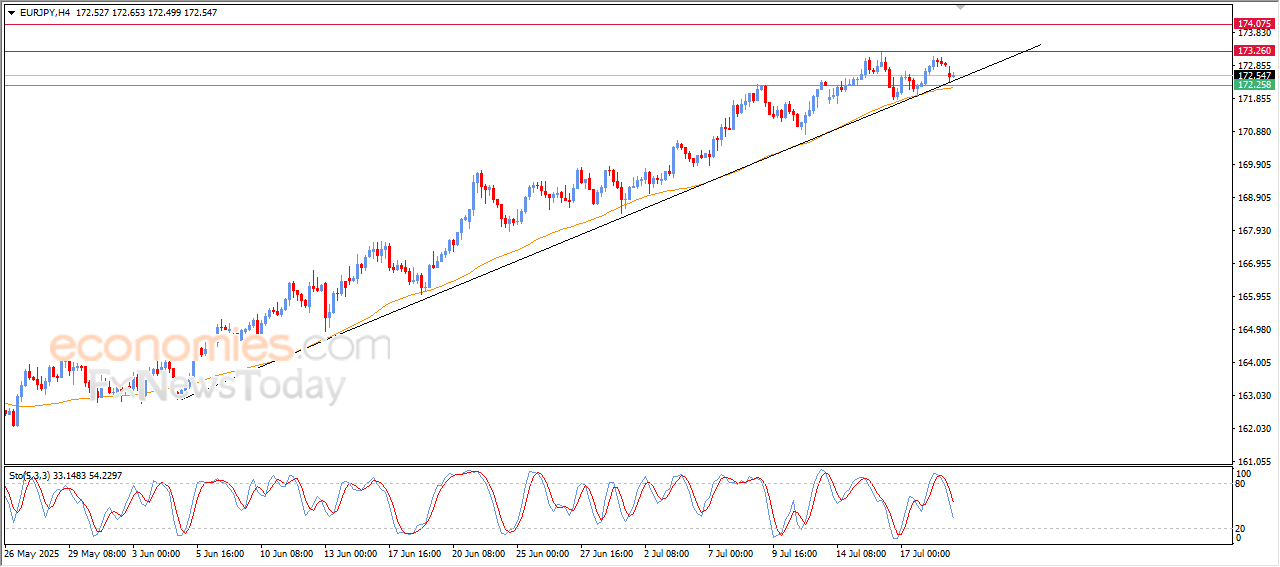
The EURJPY pair lost the negative momentum to provide sideways fluctuation by settling near 156.85.
We remind you that the negative scenario will remain valid due to the consolidation within the bearish channel, in addition to 158.90 level that forms major barrier, which allow us to wait to gather the negative momentum again to ease the mission of targeting the negative stations by moving towards 155.30 level first, while breaking this obstacle might extend losses towards 153.90 to form the next main target for the negative trades.
The expected trading range for today is between 155.30 and 157.60
Dell Technologies’ stock price (DELL) fell in the intraday levels, while hurt by exiting a descending price channel that guided recent short-term trading, as it also leaned on the support of the 50-day SMA, while trying to gather positive momentum to rise anew, as it also tries to vent off overbought saturation in the RSI with negative signals coming out of it.
Therefore we expect the stock to return higher, targeting the first resistance at $127.00, provided the support of $104.66 holds on.
BofA remains structurally bearish on JPY, raising their USD/JPY forecast to 165 (previously 160) and expecting the 10-year JGB yield to reach 1.65%. They see continued JPY weakness driven by accelerating Japanese outward investment, as households shift wealth away from yen deposits into foreign assets amid persistent inflation.
Key Points:
1️⃣ Higher USD/JPY Forecast 📈
New target:165 by year-end (previously 160).
Consensus remains lower at 148 (Bloomberg median).
JGB yields forecasted at 1.65% (up from 1.4%).
2️⃣ BoJ Terminal Rate Revised Upwards 🏦
New BoJ terminal rate forecast: 1.5% (previously 1.0%).
However, still distant from positive real interest rates.
3️⃣ Accelerating Outward Investment 🌏
NISA scheme (2024 upgrade) has accelerated household shifts into foreign assets.
Japanese investors seek protection from rising domestic inflation.
Toshins (Japanese mutual funds) inflows into foreign assets indicate continued rebalancing away from JPY.
Conclusion:
BofA reinforces its structurally bearish JPY stance, forecasting USD/JPY at 165 by year-end. Japanese households’ portfolio rebalancing and lack of positive real rates will likely drive continued JPY weakness.
For bank trade ideas, check out eFX Plus. For a limited time, get a 7 day free trial, basic for $79 per month and premium at $109 per month. Get it here.
Important DisclaimersThe content provided on the website includes general news and publications, our personal analysis and opinions, and contents provided by third parties, which are intended for educational and research purposes only. It does not constitute, and should not be read as, any recommendation or advice to take any action whatsoever, including to make any investment or buy any product. When making any financial decision, you should perform your own due diligence checks, apply your own discretion and consult your competent advisors. The content of the website is not personally directed to you, and we does not take into account your financial situation or needs.The information contained in this website is not necessarily provided in real-time nor is it necessarily accurate. Prices provided herein may be provided by market makers and not by exchanges.Any trading or other financial decision you make shall be at your full responsibility, and you must not rely on any information provided through the website. FX Empire does not provide any warranty regarding any of the information contained in the website, and shall bear no responsibility for any trading losses you might incur as a result of using any information contained in the website.The website may include advertisements and other promotional contents, and FX Empire may receive compensation from third parties in connection with the content. FX Empire does not endorse any third party or recommends using any third party’s services, and does not assume responsibility for your use of any such third party’s website or services.FX Empire and its employees, officers, subsidiaries and associates, are not liable nor shall they be held liable for any loss or damage resulting from your use of the website or reliance on the information provided on this website.Risk DisclaimersThis website includes information about cryptocurrencies, contracts for difference (CFDs) and other financial instruments, and about brokers, exchanges and other entities trading in such instruments. Both cryptocurrencies and CFDs are complex instruments and come with a high risk of losing money. You should carefully consider whether you understand how these instruments work and whether you can afford to take the high risk of losing your money.FX Empire encourages you to perform your own research before making any investment decision, and to avoid investing in any financial instrument which you do not fully understand how it works and what are the risks involved.
GBP/USD stays below 1.2650 after posting small losses on Monday.
Dovish BoE commentary makes it difficult for Pound Sterling to gather strength.
The pair could extend its correction if it breaks below 1.2600.
GBP/USD turned south after advancing to a multi-month high at the weekly opening and closed marginally lower on Monday. The pair stays relatively quiet below 1.2650, while the technical outlook points to a loss of bullish momentum.
British Pound PRICE Last 7 days
The table below shows the percentage change of British Pound (GBP) against listed major currencies last 7 days. British Pound was the strongest against the Canadian Dollar.
USD
EUR
GBP
JPY
CAD
AUD
NZD
CHF
USD
0.13%
0.05%
-1.29%
0.53%
0.35%
0.24%
-0.48%
EUR
-0.13%
-0.09%
-1.42%
0.40%
0.22%
0.11%
-0.61%
GBP
-0.05%
0.09%
-1.32%
0.49%
0.31%
0.19%
-0.53%
JPY
1.29%
1.42%
1.32%
1.85%
1.66%
1.54%
0.81%
CAD
-0.53%
-0.40%
-0.49%
-1.85%
-0.19%
-0.29%
-1.01%
AUD
-0.35%
-0.22%
-0.31%
-1.66%
0.19%
-0.11%
-0.82%
NZD
-0.24%
-0.11%
-0.19%
-1.54%
0.29%
0.11%
-0.71%
CHF
0.48%
0.61%
0.53%
-0.81%
1.01%
0.82%
0.71%
The heat map shows percentage changes of major currencies against each other. The base currency is picked from the left column, while the quote currency is picked from the top row. For example, if you pick the British Pound from the left column and move along the horizontal line to the US Dollar, the percentage change displayed in the box will represent GBP (base)/USD (quote).
The upbeat market mood made it difficult for the US Dollar (USD) to find demand early Monday and helped GBP/USD push higher. In the second half of the day, the negative shift seen in risk sentiment supported the USD and weighed on the pair.
Meanwhile, Bank of England (BoE) Monetary Policy Committee (MPC) external member Swati Dhingra, who voted in favor of a 50 basis points (bps) rate cut at the February meeting, said on Monday that the monetary policy restrictiveness is still at a high level. “If you can cut rates by 25 bps at a quarterly pace, you’ll still be in restrictive territory all this year,” she added.
On Tuesday, the US economic calendar will feature regional manufacturing surveys and the Conference Board’s (CB) Consumer Confidence Index data for February. Additionally, US President Donald Trump is expected to sign executive orders later in the American session.
In case safe-haven flows dominate the action in the financial markets later in the day, the USD could hold its ground and cause GBP/USD to extend its correction. As of writing, US stock index futures were trading mixed, pointing to a cautious stance.
GBP/USD Technical Analysis
GBP/USD faces interim support at 1.2600 (static level, round level). If the pair drops below this level and confirms it as resistance, additional losses toward 1.2530 (100-period Simple Moving Average (SMA) on the 4-hour chart, Fibonacci 61.8% retracement of the latest downtrend) and 1.2500 (round level, static level) could be seen.
On the upside, resistances are located at 1.2650 (Fibonacci 78.6% retracement, 100-day SMA), 1.2700-1.2710 (round level, static level) and 1.2750 (static level).
Pound Sterling FAQs
The Pound Sterling (GBP) is the oldest currency in the world (886 AD) and the official currency of the United Kingdom. It is the fourth most traded unit for foreign exchange (FX) in the world, accounting for 12% of all transactions, averaging $630 billion a day, according to 2022 data. Its key trading pairs are GBP/USD, also known as ‘Cable’, which accounts for 11% of FX, GBP/JPY, or the ‘Dragon’ as it is known by traders (3%), and EUR/GBP (2%). The Pound Sterling is issued by the Bank of England (BoE).
The single most important factor influencing the value of the Pound Sterling is monetary policy decided by the Bank of England. The BoE bases its decisions on whether it has achieved its primary goal of “price stability” – a steady inflation rate of around 2%. Its primary tool for achieving this is the adjustment of interest rates. When inflation is too high, the BoE will try to rein it in by raising interest rates, making it more expensive for people and businesses to access credit. This is generally positive for GBP, as higher interest rates make the UK a more attractive place for global investors to park their money. When inflation falls too low it is a sign economic growth is slowing. In this scenario, the BoE will consider lowering interest rates to cheapen credit so businesses will borrow more to invest in growth-generating projects.
Data releases gauge the health of the economy and can impact the value of the Pound Sterling. Indicators such as GDP, Manufacturing and Services PMIs, and employment can all influence the direction of the GBP. A strong economy is good for Sterling. Not only does it attract more foreign investment but it may encourage the BoE to put up interest rates, which will directly strengthen GBP. Otherwise, if economic data is weak, the Pound Sterling is likely to fall.
Another significant data release for the Pound Sterling is the Trade Balance. This indicator measures the difference between what a country earns from its exports and what it spends on imports over a given period. If a country produces highly sought-after exports, its currency will benefit purely from the extra demand created from foreign buyers seeking to purchase these goods. Therefore, a positive net Trade Balance strengthens a currency and vice versa for a negative balance.
USD/JPY price analysis shows a dismal scenario, leading prices below 149.50.
Declining US yields add strength to the selling pressure.
Upbeat Japanese data and uncertain markets boost the yen.
The USD/JPY price analysis reveals a vulnerable setup, retreating to the 149.50 region on Tuesday as the greenback stays weak while the yen soars on potential rate hike speculations. Sellers are gathering energy to break the 149.0 level.
–Are you interested to learn more about day trading brokers? Check our detailed guide-
The US10Y dipped to 4.375%, which could further boost the yen and weigh on the USD/JPY pair. On the other hand, Japanese yields have also eased on BoJ Governor Ueda’s comments that the bank will intervene if yields spike. While JGB yields are off the highs, markets anticipate BoJ’s further tightening.
On the data front, Japan’s Services PPI figures went to 3.1% y/y in January. Hence, rising wages could strengthen the odds of another BoJ hike. Tokyo inflation also soared to a 21-month top, reinforcing the monetary tightening. According to Bloomberg estimates, there is an 83% probability of two rate hikes in 2025.
The US dollar stays volatile as the Fed’s expectations shift. Mixed US PMI and consumer sentiment data have raised concerns about slowed growth. Traders anxiously await further guidance from the Core PCE Index and Q4 GDP data.
Broader risk sentiment is now playing a role in driving USD/JPY prices. Nvidia’s earnings reports and end-of-month flows could also stimulate the market.
Key Economic Events Today
Japan Corporate Services Price Index
ECB’s Schnabel Speaks
US Consumer Confidence, Richmond Manufacturing Index
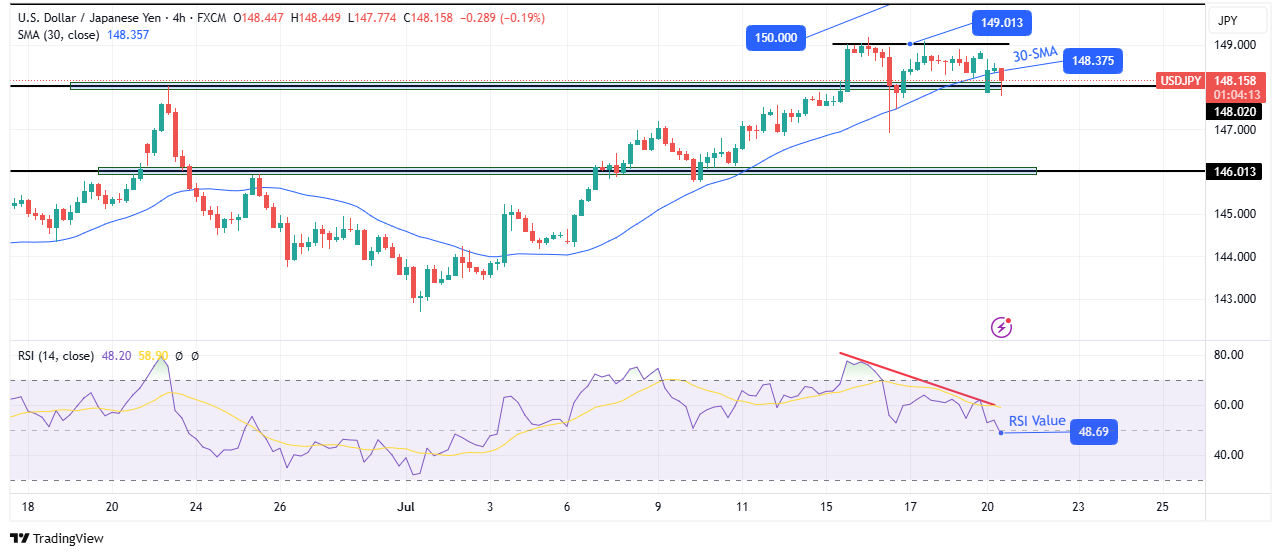
The USD/JPY has formed a temporary bottom at 148.88 with a corrective bounce above 150.0 that couldn’t be sustained. The current price level of around 149.50 is vulnerable, and the odds of breaking the bottom are high. The 4-hour chart shows that the price has stayed below the 30-period SMA since 14th Feb. Meanwhile, RSI is well above the oversold region, which indicates that the potential for a deeper downside persists.
-Are you looking for the best CFD broker? Check our detailed guide-
On the flip side, a corrective upside could bounce to 38.2 Fib level at 151.12 ahead of 50.0 Fib at 151.82. However, the pair has to find acceptance above the 30-period SMA first.
Looking to trade forex now? Invest at eToro!
67% of retail investor accounts lose money when trading CFDs with this provider. You should consider whether you can afford to take the high risk of losing your money.
Polygon’s currency price (MATICUSDT) fell in the intraday levels, while hurt by a negative divergence in the RSI after it reached overbought levels compared to the price’s movements, thus sending out negative signals, while readying to breach the pivotal support of $0.286, amid the dominance of the main downward trend, as it traded alongside the secondary short-term trend line, with negative pressure due to trading below the 50-day SMA.
Therefore we expect more losses for the price, provided the support of $0.286 was breached, thus targeting the next one at $0.149.
The British Pound has rallied a bit in the early hours of Monday, as we continue to see a lot of noisy behavior, but I also recognize that this is a market that is paying close attention to multiple things at the same time.
Keep in mind that the British Pound against the Japanese yen is considered to be a risk sensitive currency pair as the British pound offers more in the way of interest rates and swap than the Japanese yen, which of course has been the victim of the carry trade for years.
However, the bank of Japan now is suggesting that they are going to raise interest rates to 0.75% by the end of the year.
And while kind of pointless, it does pay something, and it does attract some money back into the Japanese mainland as the carried trade struggles. Nonetheless, I do think that there is the possibility that we bounce rather significantly given enough time. After all, the swap at the end of every day does eventually add up.
On a Move Higher
If we can break above the 190 yen level, then it opens up the possibility of a move to the 192 yen level. On the other hand, if we break down from here, it’s the 188 yen level that I will be watching very closely because it opens up the possibility of a move down to the 185 yen level. It’s worth noting that pretty much all of the yen related pairs all look the same. So I think that tells us that the Japanese yen is the main driver that’s going on overall. This chart looks quite a bit different than the British pound does against the Swiss franc, which is the other carry trade currency, mainly because the Swiss have been cutting rather aggressively. As long as Japan is not cutting, then it makes a lot of sense that we will continue to see more choppy volatility. That being said, I’m comfortable going long, not so much shorting, at least not until we break down below the latest swing below. Expect a lot of noise but expect a lot of volatility due to the shifting expectations of the carry trade in general.
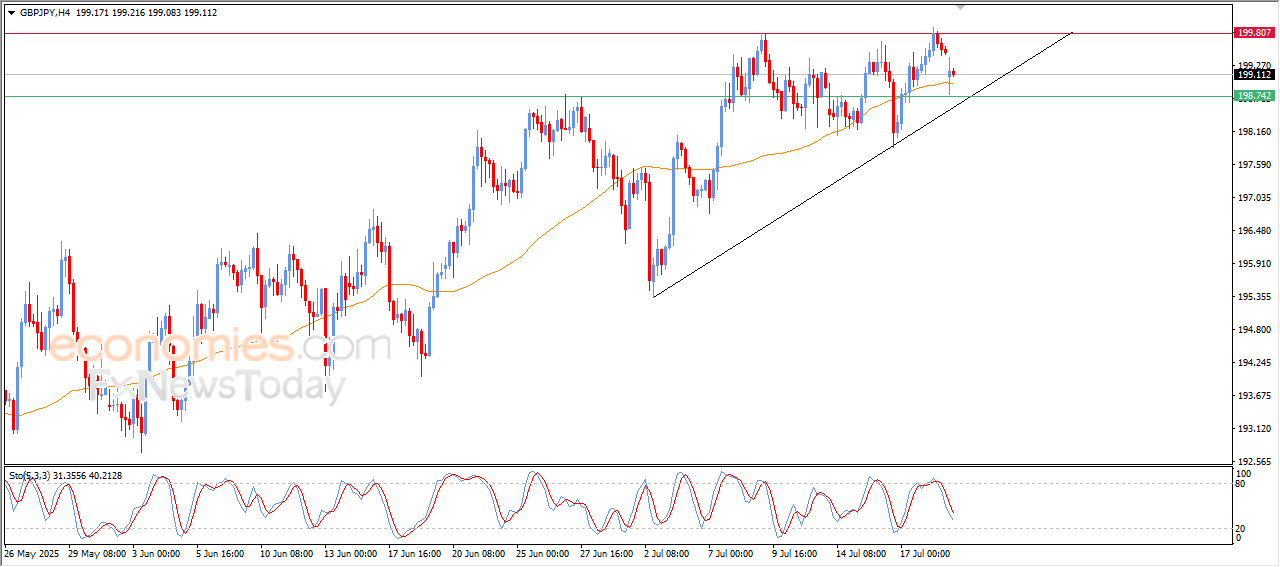
The GBPJPY pair failed to resume the negative attack despite the consolidation within the bearish channel, affected by the additional support at 188.10, to start forming sideways trades by fluctuating near 189.00.
We expect to witness more sideways trades until gathering the additional negative momentum to manage to break the current support and open the way to target the additional negative stations that might start at 186.90, while rallying above 189.75 will force it to postpone the decline until testing the bearish channel’s resistance line at 191.10.
The expected trading range for today is between 187.00 and 189.70
KILT/USD kept falling in the intraday levels, amid the dominance of the main downward trend in the medium term, while trading alongside the secondary short-term trend line, with negative pressure due to trading below the 50-day SMA, coupled with negative signals from the RSI despite settling at oversold levels.
Therefore we expect more losses for the price, targeting the support of $0.034, provided the resistance of $0.121 holds on.