The main tag of Forex News Today Articles.
You can use the search box below to find what you need.
[wd_asp id=1]

13 01, 2025

GBP/USD Analysis Today 13/01: Technical Indicators (Chart)

By |2025-01-13T19:38:01+02:00January 13, 2025|Forex News, News|0 Comments

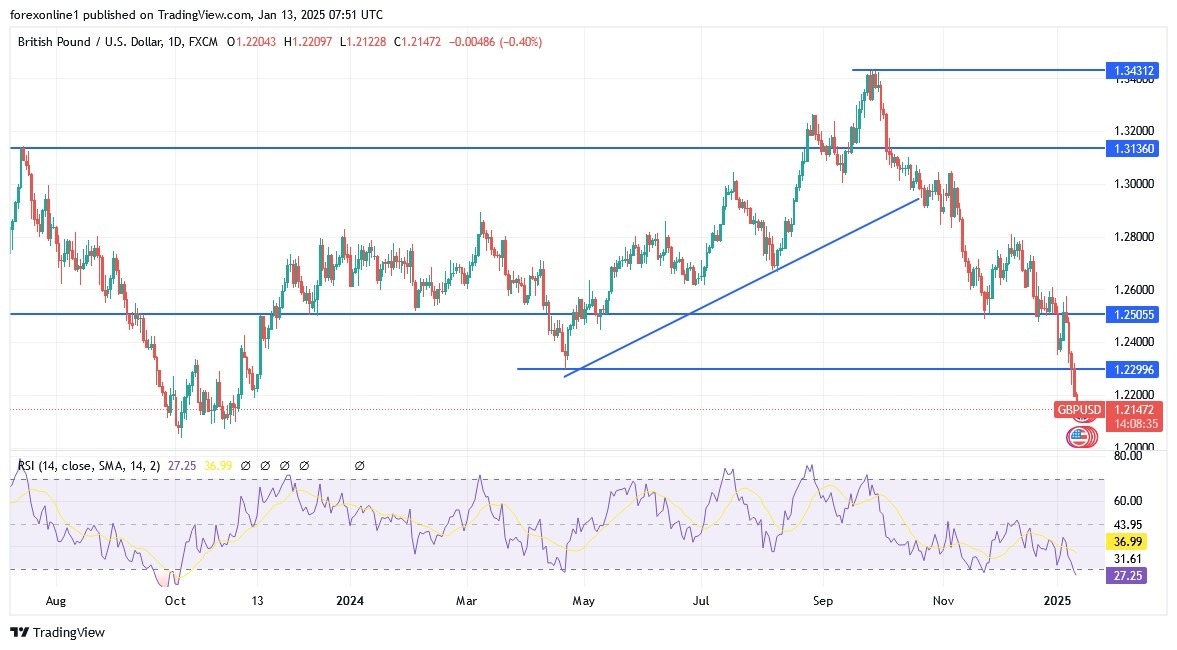
  • Over the past week, the GBP/USD pair plummeted below the support level of 1.2200, the lowest level for the currency pair in about 14 months and closed the week’s trading near these losses.
  • Sterling losses against other major currencies increased as concerns about rising borrowing costs in Britain undermined the currency pair.
  • Overall, the rise in government bond yields and the decline in the pound sterling were a clear reflection of the market’s discomfort with the fact that Reeves must now find billions of pounds in additional taxes or spending cuts to ensure compliance with a fiscal rule to ensure that debt as a percentage of GDP declines by 2029.

Pressure Factors on the Pound Sterling

According to reliable trading company platforms, the pound sterling (GBP) faced further losses against other major currencies as ongoing concerns about rising borrowing costs in Britain continued to weigh on sentiment. Recently, the yield on 10-year UK government bonds rose to its highest level since 2008, raising concerns about the country’s financial stability and the ability of the British government to effectively manage its economic challenges.

Trading Tips:

The pressure on the pound and the US dollar are still receiving more strength, which will ensure that the downtrend in the pound/dollar will remain for some time.

Will the selling of the pound continue?

In this regard, according to analysts from Deutsche Bank, the fundamental shifts that could work against the pound in the future include:

Loss of volatility-adjusted carry. This is where capital flows to countries with higher interest rates, which the UK prides itself on. But for this strategy to work, volatility must be low. According to the analysts: “Recent volatility is harmful.”

Meanwhile, the UK is printing “significantly weaker-than-expected economic data”. The first half of 2024 saw the opposite, with the UK growing faster than all its G7 peers.

Deutsche Bank therefore believes that the economic deterioration means there is a growing possibility of further interest rate cuts by the Bank of England this year compared to the current 50 basis points in money markets. Furthermore, the improvements in the current account deficit seen over recent years are also likely to fade as energy prices rise again. Deutsche Bank analysts added, “A wider current account deficit ahead increases the case for sterling weakness in an environment where UK yield rises are limited by the need for monetary policy easing,”.

They added, “After profiting on our long sterling positions at mid-December highs, we now recommend selling sterling,”.

Technical Analysis for the GBP/USD pair today:

Dear reader, according to recent trades, the overall trend of the GBP/USD currency pair is increasingly downward, and its recent losses were enough to push technical indicators towards oversold levels, led by the Relative Strength Index and the MACD. Currently, the closest support levels for the pound sterling are 1.2155, 1.2080, and the psychological support of 1.2000. Forex investors may look for buying opportunities, but this may be cautious until sentiment towards the sterling improves.

Conversely, and over the same timeframe, any attempts by bulls to rebound upwards may encounter resistance at levels of 1.2440 and 1.2600 respectively. Until then, gains in the pound sterling will remain vulnerable to a rapid collapse.

Ready to trade our daily GBP/USD Forex forecast? Here’s some of the best forex broker UK reviews to check out.

Source link

13 01, 2025

USD/JPY Analysis Today 13/01: Eyes 160

By |2025-01-13T17:36:51+02:00January 13, 2025|Forex News, News|0 Comments

USD/JPY Forecast: The Psychological Resistance Level of 160.00 Remains in Sight

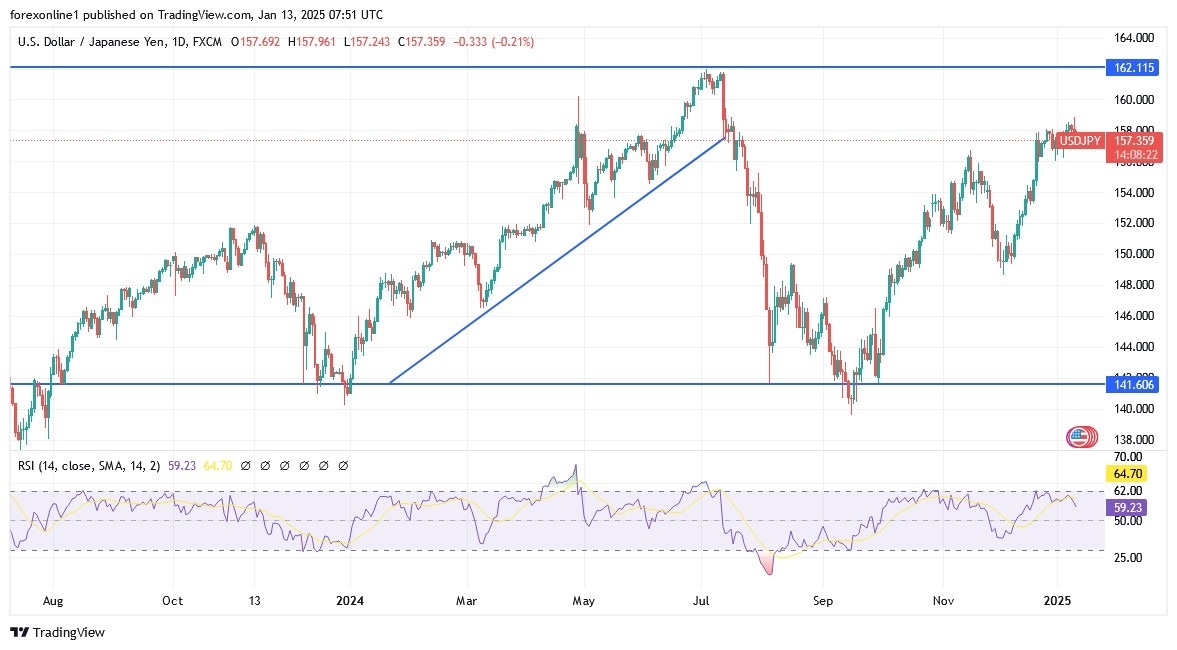
  • In the last trading session of last week, the bulls’ control over the USD/JPY pair culminated in a move towards the resistance level of 158.88, the highest level for the pair in six months.
  • Its gains increased as uncertainty persisted over the timing of Japan’s interest rate hike.
  • In addition, Japanese Economy Minister Ryusei Akazawa stated that the economy is at a “critical stage” in overcoming the public’s deflationary mindset, but he did not provide any clear indication of when the Bank of Japan might raise interest rates.
  • However, on the same trading day, the USD/JPY pair was exposed to profit-taking despite stronger-than-expected US jobs figures, with losses extending to 157.22 before closing trading stable around 157.70.

On the economic data front, household spending in Japan fell 0.4% year-on-year in November, while household income rose 0.7%. Externally, the Japanese yen faced additional pressure from the recent widening of the yield differential between the United States and Japan, driven by hawkish signals from the US Federal Reserve.

On the US side, according to economic calendar data, US job growth rates increased and unemployment rates decreased last month. According to an official announcement, the US economy added a total of 256,000 jobs last month, up from 212,000 jobs in November. The country’s unemployment rate, which was expected to remain at around 4.2%, fell to 4.1% last month. Overall, the final US jobs report for 2024 confirms that the economy and employment were able to grow at a strong pace even with interest rates significantly higher than before the pandemic. As a result, the likelihood of the US Federal Reserve cutting borrowing costs again in the coming months may be much lower.

Overall, the Federal Reserve has cut US interest rates three times in the past year in part due to concerns about slowing employment and growth. Strong jobs numbers suggest the economy is entering a post-Covid period of steady growth, higher interest rates, low unemployment and slightly higher inflation.

Trading Tips:

Don’t be fooled by the recent USD/JPY sell-off, it’s a natural thing after recent gains. The foundations of bullish control are in place and eyes are still easily set on the psychological resistance of 160.00

Expectations of a Pause in US Interest Rate Cuts

Following the latest economic data, expectations have increased that the US Federal Reserve may pause the pace of US interest rate cuts in the coming months amid concerns that Trump’s aggressive trade policies towards major global economies could re-ignite inflation.

Overall, the US numbers are likely to support policymakers’ intention to move cautiously this year – their December forecasts showed only two US interest rate cuts by 2025 – amid a clear pause in progress towards the 2% inflation target. Recently, Wall Street investors and economists had already scaled back expectations for rate cuts after the release. Also, this week’s US consumer and wholesale price reports will provide further clues on where inflation is headed ahead of the Fed’s next policy meeting on January 28-29.

USD/JPY Technical Analysis and Expectations Today:

Based on recent trading, USD/JPY is now trading slightly below its 100-hour moving average. However, the currency pair still has plenty of room to run before reaching oversold levels on the 14-hour RSI. In the near term, bears will look to extend the current decline towards 157.48 or lower to the support at 156.90. Bulls, on the other hand, will look to rebound higher with gains to the resistance levels at 158.00 and 158.65, respectively.

In the long term, based on the daily chart, the USD/JPY pair is trading in an ascending channel formation. Also, the 14-day RSI supports a long-term bullish bias as it approaches overbought levels. Therefore, bulls will seek to extend the overall uptrend gains towards the psychological resistance level of 160.00 or higher to the resistance of 162.60 respectively, which is enough to push all technical indicators towards strong overbought levels. On the other hand, and in the same time frame, bears will seek to benefit from pullbacks around 155.00 or lower at the support of 152.30 respectively.

Want to trade our USD/JPY forex analysis and predictions? Here’s a list of forex brokers in Japan to check out.

Source link

13 01, 2025

Hawkish Fed and dovish ECB equal parity

By |2025-01-13T15:35:42+02:00January 13, 2025|Forex News, News|0 Comments

  • Solid United States employment data smashed the odds for an interest rate cut.
  • Hotter-than-anticipated European inflation to maintain the ECB on the dovish path.
  • EUR/USD faces immediate resistance at 1.0197, the September 2022 monthly high.

The EUR/USD pair remained under selling pressure this week, with the US Dollar (USD) retaining its overall strength. The Greenback benefited from risk-aversion bouts, triggered by United States (US) President-elect Donald Trump’s tariffs plan. The pair heads into the weekend trading at around 1.0250, not far from the multi-year low posted on Friday at 1.0212.

Trade-war: Trump tariffs heat financial boards

The Washington Post reported on Monday that Donald Trump’s transition team was working on narrowing tariffs, focusing only on key sectors deemed vital to national security, such as defence, medical supplies and energy, narrowing the universal tariffs plan that Trump anticipated during his campaign. Latter in the day, however, Trump denied the headlines, saying that the story about paring back tariffs was wrong.

The EUR/USD pair jumped to 1.0431 with the initial headlines, as markets welcomed the idea of limited tariffs. Trump’s denial, on the other hand, boosted the US Dollar (USD) while sending stocks into a selling spiral.

Fears resumed mid-week when CNN reported that Trump was considering declaring a national economic emergency to impose widespread tariffs. Using the International Economic Emergency Powers Act (IEEPA) will unilaterally authorize a president to manage imports during a national emergency.

FOMC Minutes: Politics should not be in the way, but they are

The Federal Open Market Committee (FOMC) released the Minutes of the December Federal Reserve (Fed) monetary policy meeting on Wednesday, and the document brought some negative headlines.

Yet what caught investors’ attention is that the Minutes showed almost all members judged that the upside risk to inflation has increased. Officials mentioned “potential changes in trade, immigration, fiscal, and regulatory policies” as the reasons behind their fresh growth and inflation-related concerns.  Without saying it, officials said they are concerned about what Trump’s policies would mean to the economy.

Solid US employment data

Meanwhile, the US released multiple employment figures. The December ADP Employment Report showed that the private sector added 122K new jobs in the month, missing expectations of 140K. Additionally, Initial Jobless Claims for the week ended January 3 increased by 201K, better than the 218K expected and below the previous 211K. Also, US-based employers announced 38,792 cuts in December, a 33% decrease from the 57,727 cuts announced one month prior. It is up 11% from the 34,817 cuts announced in the last month of 2023, according to the Challenger Job Cuts report.

Finally, on Friday, the US published the Nonfarm Payrolls (NFP) report, which showed 256,000 new jobs were added in December. The reading was much stronger than the 160,000 anticipated and the November 212,000 reading. Even further, the Unemployment Rate edged lower to 4.1% from 4.2%, while the Labor Force Participation remained steady at 62.5%. Finally, annual wage inflation, as measured by the change in the Average Hourly Earnings, declined to 3.9% from 4%.

Markets turned risk-averse with the news, with the US Dollar rallying and stocks plummeting, as such figures suggest the Federal Reserve (Fed) will refrain from cutting interest rates in the upcoming months.

No good news in Europe  

European data fell once again short of encouraging. The preliminary estimate of the German Harmonized Index of Consumer Prices (HICP) was higher than anticipated, as the index rose 2.8% on its yearly comparison, above the 2.6% anticipated and the previous 2.4%. Retail Sales in the country fell 0.6% in November, while Factory Orders declined by 5.4% in the same period. 

The Eurozone HICP rose 2.7% in the year to December as expected, yet the Producer Price Index (PPI) was down 1.2% YoY in November, higher than the previous -3.3% or the -1.3% expected.

The European Central Bank (ECB) will likely continue trimming interest rates. That would keep the Euro on the downside, while a hawkish Fed means a stronger US Dollar. EUR/USD at parity is in the foreseeable future.

For the upcoming week, the focus will be on the US Consumer Price Index. The country will publish it next Wednesday, and Retail Sales will be published on Thursday. Other than that, the macroeconomic calendar has little relevant to offer.

EUR/USD technical outlook  

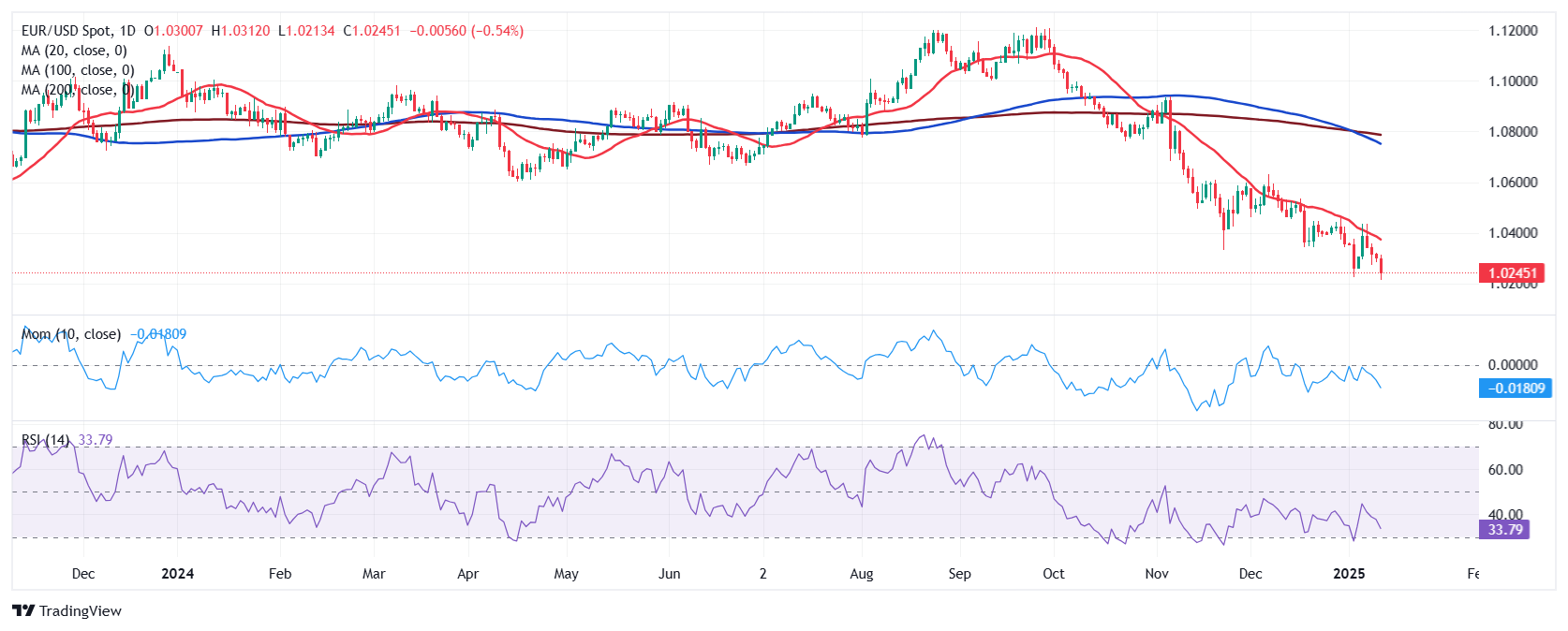
From a technical perspective, the EUR/USD pair is down for a fifth consecutive week and there are no technical signs that suggest an interim bottom is nearby. Indeed, EUR/USD is oversold in the weekly chart, yet the Relative Strength Index (RSI) indicator keeps heading south despite being at 28. The Momentum indicator in the same chart bounced just modestly from extreme levels but remains far below its midline, not enough to suggest an upcoming bounce. Finally, the 20 Simple Moving Average (SMA) has accelerated its slump and crossed below a flat 100 SMA, reflecting sellers’ strength.

In the daily chart, EUR/USD has plenty of room to extend its slide. Technical indicators head south within negative levels, still far from oversold readings. Even further, the EUR/USD pair posted lower lows after a couple of failed attempts to overcome a bearish 20 SMA, currently providing dynamic resistance at around 1.0380. In the same chart, the 100 SMA crossed below the 200 SMA after holding above it for roughly five months. Both moving averages stand around the 1.0800 level, not only anticipating additional slides but also reflecting sellers’ strength.

September 2022 high at 1.0197 is the immediate support level, ahead of the 1.0100 figure. A break below the latter exposes parity, albeit further slides seem unlikely in the upcoming days. The 1.0300 – 1.0330 area provides near-term support ahead of the 1.0400 mark.


US Dollar PRICE Last 7 days

The table below shows the percentage change of US Dollar (USD) against listed major currencies last 7 days. US Dollar was the strongest against the British Pound.

  USD EUR GBP JPY CAD AUD NZD CHF
USD   -0.04% 1.03% -0.19% 0.02% 0.52% 0.40% 0.30%
EUR 0.04%   1.05% -0.15% 0.05% 0.54% 0.43% 0.33%
GBP -1.03% -1.05%   -1.16% -0.99% -0.50% -0.61% -0.71%
JPY 0.19% 0.15% 1.16%   0.20% 0.69% 0.58% 0.48%
CAD -0.02% -0.05% 0.99% -0.20%   0.48% 0.38% 0.28%
AUD -0.52% -0.54% 0.50% -0.69% -0.48%   -0.11% -0.21%
NZD -0.40% -0.43% 0.61% -0.58% -0.38% 0.11%   -0.10%
CHF -0.30% -0.33% 0.71% -0.48% -0.28% 0.21% 0.10%  

The heat map shows percentage changes of major currencies against each other. The base currency is picked from the left column, while the quote currency is picked from the top row. For example, if you pick the US Dollar from the left column and move along the horizontal line to the Japanese Yen, the percentage change displayed in the box will represent USD (base)/JPY (quote).


Source link

13 01, 2025

Dives to its lowest level since November 2023 amid relentless USD buying

By |2025-01-13T09:31:19+02:00January 13, 2025|Forex News, News|0 Comments

  • GBP/USD continues losing ground for the fifth straight day and drops to over a one-year low.

  • Stagflation fears and UK fiscal concerns continue to weigh on the GBP amid a bullish US Dollar.

  • A slightly oversold RSI on the daily chart warrants some caution for aggressive bearish traders. 

The GBP/USD pair remains under heavy selling pressure for the fifth straight day and dives to its lowest level since November 2023, around the 1.2125 region during the Asian session on Monday. Moreover, the fundamental backdrop seems tilted in favor of bearish traders, though slightly oversold conditions on the daily chart warrant some caution before positioning for further losses.

Investors remain concerned about the risk of stagflation in the UK. This, along with the anxiety about the UK’s fiscal health, turn out to be key factors contributing to the British Pound’s (GBP) relative underperformance. Apart from this, the underlying strong bullish sentiment surrounding the US Dollar (USD), bolstered by firming expectations that the Federal Reserve (Fed) will pause its rate-cutting cycle, validates the negative outlook for the GBP/USD pair. 

From a technical perspective, the Relative Strength Index (RSI) on the daily chart has dropped below the 30 mark, making it prudent to wait for some near-term consolidation or a modest rebound before the next leg down. Any attempted recovery, however, might confront resistance and remain capped near the 1.2200 mark. That said, some follow-through buying beyond the Asian session top, around the 1.2210 area, could trigger a short-covering move. 

The GBP/USD pair might then accelerate the positive move towards the 1.2245-1.2250 intermediate hurdle before aiming to reclaim the 1.2300 round figure. The latter should act as a key pivotal point, which if cleared decisively could negate the negative bias and shift the near-term bias in favor of bullish traders. 

Meanwhile, the downward trajectory seems strong enough to drag the GBP/USD pair further towards testing sub-1.2100 levels, or the November 2023 low. Acceptance below the said handle could make spot prices vulnerable to decline further towards October 2023 through, around the 1.2035 region, en route to the 1.2000 psychological mark.

GBP/USD daily chart

US Dollar PRICE Today

The table below shows the percentage change of US Dollar (USD) against listed major currencies today. US Dollar was the strongest against the British Pound.


  USD EUR GBP JPY CAD AUD NZD CHF
USD   0.29% 0.56% -0.24% 0.12% 0.20% 0.18% 0.06%
EUR -0.29%   0.25% -0.47% -0.11% 0.06% -0.05% -0.14%
GBP -0.56% -0.25%   -0.73% -0.35% -0.21% -0.30% -0.39%
JPY 0.24% 0.47% 0.73%   0.35% 0.36% 0.28% 0.31%
CAD -0.12% 0.11% 0.35% -0.35%   0.04% 0.06% 0.03%
AUD -0.20% -0.06% 0.21% -0.36% -0.04%   -0.13% -0.18%
NZD -0.18% 0.05% 0.30% -0.28% -0.06% 0.13%   -0.09%
CHF -0.06% 0.14% 0.39% -0.31% -0.03% 0.18% 0.09%  

The heat map shows percentage changes of major currencies against each other. The base currency is picked from the left column, while the quote currency is picked from the top row. For example, if you pick the US Dollar from the left column and move along the horizontal line to the Japanese Yen, the percentage change displayed in the box will represent USD (base)/JPY (quote).


Source link

12 01, 2025

Pound to Dollar Forecast for Week Ahead: Sell to 1.1750?

By |2025-01-12T23:25:08+02:00January 12, 2025|Forex News, News|0 Comments

January 12, 2025 – Written by Tim Boyer

MUFG recommends selling the Pound to Dollar (GBP/USD) exchange rate with a target of 1.1750.

There was a slide in UK bonds during the week with a jump in yields as the 10-year yield hit a 16-year high while the 30-year yield hit the highest level since 1998.

Upward pressure on US yields contributed to the selling of US bonds.

There were fears that the government’s economic strategy would unravel with pressure for fiscal tightening. There were fears over a negative impact on UK growth.

This combination undermined confidence in the pound, resulting in losses across all major currencies.

GBP/USD posted sharp losses with 14-month lows just below 1.2200.

MUFG expects that ongoing pressure on the UK bond market will work in tandem with further Pound selling; “If Gilt yields continue to push higher, adding to the UK government’s funding costs, doubts will continue to build over fiscal plans triggering a further loss of confidence in the GBP.”

Advertisement


It added, “We are not expecting the BoE or government to step up and support the Gilt market in the near-term, leaving it vulnerable to further near-term weakness.”

MUFG also noted the negative implications of higher energy prices.

US developments have added to pressure on global bond markets and contributed to upward pressure on UK bond yields, a twin negative for GBP/USD.

US non-farm payrolls increased 256,000 for December compared with consensus forecasts of around 165,000, while the November increase was revised slightly lower to 212,000 from the flash reading of 227,000.

The unemployment rate declined to 4.1% from 4.2% and compared with expectations of no change.

The University of Michigan consumer confidence data also recorded an increase in 5-year inflation expectations to a 16-year high.

Following the data, markets ruled out the potential for a Fed rate cut in January and considered that the chances of a March cut had dipped to around 25%.

Markets also considered that the Fed may only cut rates once during the year.

Bank of America, for example, now expects that there will not be any further rate cuts this year.

The US 10-year bond yield increased to above 4.75%, the highest level since October 2023, maintaining pressure on the UK bond market.

Seema Shah, chief global strategist at Principal Asset Management, noted the adverse global implications; “The important payroll beat will be good news for the U.S. economy and the US dollar, unwelcome news for equities as they seek interest rate relief, and punishing news for global bond markets, particularly UK gilts.”

She added, “For global bonds, the strength of the U.S. jobs report just adds to their challenges. The peak for yields has not yet been reached, suggesting additional stresses that several markets, especially the UK, can ill afford.”

Rabobank expressed concerns over the UK fundamentals; “the UK is a price taker in sovereign debt markets, particularly exposed to the whims of foreign/nonbank investors because of its fiscal deficit and its current account deficit.”

The bank’s economists expect that the government will have to announce further fiscal tightening in the March budget.

It added, “If so, that would work out disinflationary instead of inflationary, and that would give the BoE enough policy space to at least stick to their theme of gradualism.”

It expects quarterly interest rate cuts by the BoE.

SocGen added, “GBP/USD is likely to remain under pressure due to US economic strength and a widening US-Europe/Asia rate differential.”

Capital Economics chief UK economist Paul Dales put the developments in context; “This week’s leap in gilt yields creates more problems for the Chancellor and is an extra headwind for the economy. But it is not a crisis and the cause mostly originates overseas rather than being home-grown.”

Bank of America also noted the risk of dollar logs being cut; “A USD reversal, if it happens, could be amplified by trend follower unwinds.”

It did, however, add, “Lingering fiscal and inflation concerns, coupled with negative sentiment, suggest caution before re-entering GBP longs.”

UBS will still look to buy Pound dips; “While we do not expect significant near-term weakness, we think that investors should use further strength in the dollar to diversify into other preferred currencies, including the British pound and Australian dollar.”

Like this piece? Please share with your friends and colleagues:


International Money Transfer? Ask our resident FX expert a money transfer question or try John’s new, free, no-obligation personal service! ,where he helps every step of the way,
ensuring you get the best exchange rates on your currency requirements.

TAGS: Currency Predictions Pound Dollar Forecasts

Source link

12 01, 2025

Weekly Forex Forecast – 12/01: (Charts)

By |2025-01-12T21:24:38+02:00January 12, 2025|Forex News, News|0 Comments

Fundamental Analysis & Market Sentiment

I wrote on 5th January that the best trade opportunities for the week were likely to be:

The weekly profit of 0.90% equals 0.45% per asset.

Last week saw several key data releases, although the directional movement was average:

  1. US Average Hourly Earnings – as expected, showing a month-on-month increase of 0.3%.
  2. US FOMC Meeting Minutes – no real surprises, notable takeaway was warnings on inflation reaching 2% target.
  3. US Non-Farm Payrolls – there was a strong outperformance, with almost twice as many new jobs created than was expected.
  4. US JOLTS Job Openings – notably stronger than expected, mirroring the item above.
  5. US ISM Services PMI – a little better than expected.
  6. German Preliminary CPI (inflation) – slightly higher than expected.
  7. Australian CPI (inflation) – slightly higher than expected.
  8. Swiss CPI (inflation) – as expected.
  9. US Unemployment Claims – slightly lower than expected.
  10. US Unemployment Rate – an unexpected fall to 4.1%.
  11. Canadian Unemployment Rate – unexpectedly fell to 6.7% from 6.8%, when it was expected to rise to 6.9%.

Last week saw continued risk-off sentiment, with particular fears of President-Elect Trump’s recent tariff threats and of slowing growth data in many G20 nations. This was accompanied by an ongoing bullish focus on the US Dollar, with US treasury yields rising and the anticipated tariffs boosting the greenback and hitting other currencies, notably commodity currencies.

The British Pound and the Australian and New Zealand Dollars are notably weak in the Forex market, while the US Dollar and the Japanese Yen are strong.

The high-impact data last week showed that the US economy is still hot, which in turn boosts expectations of a slower pace of US interest rate cuts, and keeps the US Dollar advancing to new 2-year high prices.

Another standout issue last week was growing alarm at the state of the UK’s finances, with the new British government rapidly losing credibility in the market, which is sinking the British Pound. The British government is trying to weather the storm by stating its fiscal rules are “non-negotiable”.

The Week Ahead: 13th – 17th January

The coming week has an even more vital schedule of releases, so we are very likely to see increased market activity and volatility in the Forex market.

The coming week’s important data points are:

  1. US CPI (inflation)
  2. US PPI
  3. US Retail Sales
  4. UK CPI (inflation)
  5. UK GDP
  6. US Unemployment Claims
  7. UK Retail Sales
  8. Australian Unemployment Rate

Monday is a public holiday in Japan.

Monthly Forecast January 2025

For January, I forecasted that the USD/JPY currency pair would rise in value and that the EUR/USD currency pair would fall in value. The performance so far of this forecast is:

Weekly Forex Forecast – 12/01: (Charts)

Weekly Forecast 12th January 2025

Last week, I made no weekly forecast as there were no unusually strong price movements in currency crosses, which is the basis of my trading strategy.

The US Dollar was the strongest major currency last week, while the British Pound was the weakest. Volatility was slightly lower last week, with 26% of the most important Forex currency pairs and crosses changing in value by more than 1%. It is likely to remain at a similar level over the coming week.

You can trade these forecasts in a real or demo Forex brokerage account.

Key Support/Resistance Levels for Popular Pairs

Weekly Forex Forecast – 12/01: (Charts)

Technical Analysis

US Dollar Index

Last week, the US Dollar Index again printed a bullish candlestick that continued the long-term bullish trend, again bullishly breaking out to make its highest close in more than 2 years. The price is above its price from three and six months ago, suggesting a healthy long-term bullish trend in the greenback that should be exploitable. The weekly candlestick has little upper wick and closed above the previous week’s high. These are bullish signs.

I have plenty of fundamental reasons to be bullish on the US Dollar after seeing the US unemployment rate unexpectedly fall to 4.1% after higher-than-expected non-farm payrolls data last week. We also seeing US 10-Year Treasury Yields rising to levels not seen in several months, currently above 4.75%, which is helping boost the greenback.

The Dollar is likely to rise over the coming week. The price has room to rise to at least the next resistance level at 110.00.

Weekly Forex Forecast – 12/01: (Charts)

GBP/USD

The GBP/USD currency pair is in a valid long-term bearish trend. It fell strongly last week, with the weekly candlestick shown in the price chart below closing very near its low with little lower wick, suggesting bearish momentum. The price reached a 1-year low on unusually high volatility, which is another sign of momentum in this currency pair.

This pair was the biggest mover last week and is in focus because both currencies are newsworthy.

The US Dollar is advancing to new 2-year highs in a strong bullish trend, boosted by incoming President Trump’s policies and their likely momentary consequences of higher for longer interest rates. Rising US yields, especially 10-year yields, are pushing the greenback higher.

On the other hand, the British Pound has suddenly become very weak as the new British government becomes unpopular very quickly, with its fiscal projections and monetary policies beginning to be called into serious question by the capital markets. Bets against the British Pound using options have reached historically high levels.

I see this currency pair as an obvious sell.

Weekly Forex Forecast – 12/01: (Charts)

EUR/USD

The EUR/USD currency pair is in a valid long-term bearish trend. After a period of consolidation within this trend, the price has begun to move lower with stronger bearish momentum. The price reached a new 2-year low last week but was ultimately held by the support level at $1.0223.

This currency pair often has very reliable trends, so I am interested in being short, especially as the price is now trading in “blue sky”.

The Euro is not especially weak, with the bearish momentum being driven mostly by a strong US Dollar which is advancing almost everywhere.

I see this currency pair as a sell, in fact, it is probably the most reliable trade right now in the entire Forex market, with the possible exception of the GBP/USD currency pair, which is probably dragging the price here lower.

Weekly Forex Forecast – 12/01: (Charts)

USD/JPY

The USD/JPY currency pair was not impressive last week, as it was notable that the Japanese Yen was not willing to fall significantly against the very strong USD. This led to this currency pair being one of the few ones where the US Dollar made only a very small gain, ending the week quite a way off its highest daily close at ¥155.34.

I think this pair’s failure to seriously rise shows that the days of a weak Japanese Yen might really be coming to an end, even though this pair is technically in a long-term bullish trend. However, the weekly candlestick was not far from being a doji, showing indecision in the price action.

Another factor lowering my confidence in the bullish trend is that the Bank of Japan will eventually start implementing a more hawkish monetary policy. When that finally really starts to happen with the Bank of Japan’s next rate hike, the price will be very likely to start moving down, so the trend is vulnerable to policy.

The Yen is also benefitting from the flow out of stock markets looking for a safe haven.

Technically, a daily close above ¥155.34 could be a good long trade entry signal, but I doubt it.

Weekly Forex Forecast – 12/01: (Charts)

AUD/USD

Last week, the AUD/USD currency pair printed a very strongly bearish and large outside candlestick, closing right on its low, which was a new 4-year low. A look at the weekly chart below shows that the bearish momentum has been strong here since October, and the trend here has been stronger and clearer than any other trend in the Forex market, except maybe the one in the USD/CAD currency pair. It is difficult to image being more technically bearish. The linear regression analysis applied within the price chart below shows the strength and reliability of the trend over the past few months.

The story is really about US economic success and a more hawkish Fed boosting the greenback, while Australia is dealing with a weakening economy which will make more rate cuts a matter of necessity, and this will probably have to go increasingly deeper. Adding to the pressure on the Aussie is the fact that stock markets and other risky assets have been selling off, and the Aussie tends to perform poorly during periods of risk-off sentiment such as we have seen in recent days. On the other hand, the Aussie has been selling off even as several stock indices made record highs over recent months, so maybe this is not such a big factor.

This currency pair does not trend very reliably, so I don’t take long-term trades in it, but it certainly looks very weak. All the commodity currencies except maybe the Canadian Dollar are looking weak right now, so it might be an idea to use the AUD and the NZD together as the short component of any Forex trades you are making this week, or at least part of the short component by creating a basket. For example, if you were short two lots EUR/USD, you might also be one lot of AUD/USD long.

Weekly Forex Forecast – 12/01: (Charts)

Natural Gas Futures

Last week, Natural Gas futures printed a strong and quite large bullish candlestick, which closed right on its high at a new 4-year high closing price, after it made a new 4-year high price the previous week before giving up some of its earlier gains.

Natural gas has been driven higher by strong demand due to cold weather in the USA and Europe. However, there are obviously deeper factors at work which are pushing the price to new highs and triggering a real bullish breakout last week.

Taking long trades when major commodities break out to new 6-month highs has historically been a very profitable trading strategy, which is the main reason that I want to get long here when the market opens on Monday. This bullish price pattern shown in the chart below is just starting to show an expansion of volatility, and we could see a very strong rise as the price has plenty of room to advance, especially once it clears the big round number at $4.

Micro futures in natural gas are available at the CME, so this commodity can be quite affordable to trade. There are also ETFs which hold natural gas such as UNG but note that the price of UNG is looking much less bullish than natural gas futures are, so it might not be a good idea to use that right now.

Weekly Forex Forecast – 12/01: (Charts)

Corn Futures

Last Friday, Corn futures printed a strong and large bullish candlestick, which closed at a new 6-month high closing price. However, it is notable that the price has not cleared the inflection point at 475. I think once this is cleared, the price will look much more bullish, so more cautious traders might want to wait for the price to make a bullish breakout beyond 475.

Taking long trades when major commodities break out to new 6-month highs has historically been a very profitable trading strategy, which is the main reason that I want to get long here. However, I do not have as much faith in this trade as I do in the natural gas trade I outlined above.

Unfortunately, Corn futures are quite expensive and just too large for retail traders, but there is an ETF called CORN which can be used to participate in increases in the price of corn. Here, this ETF is outperforming the relevant futures, which puts a bit of a question mark above corn.

I think it will be wise to wait for a daily close above 475 in corn futures before going long.

Weekly Forex Forecast – 12/01: (Charts)

Bottom Line

I see the best trading opportunities this week as:

  • Short of the EUR/USD currency pair.
  • Long of Natural Gas futures.
  • Long of Corn futures following a daily close above 475 (CORN etf can also be used).

Ready to trade our  weekly Forex forecast? Check out our list of the top 10 Forex brokers in the world.
Source link

12 01, 2025

EUR/USD forecast remains bearish ahead of US CPI

By |2025-01-12T13:20:39+02:00January 12, 2025|Forex News, News|0 Comments

The EUR/USD fell to a new multi-year low of just shy of 1.0200, before bouncing modestly off its earlier lows. The currency pair is now on track to drop for the fourth consecutive month. In the last 15 weeks, it has only managed two small positive weekly closes. The bearish momentum has been gathering pace, owing largely to a strengthening US dollar. Meanwhile, weak growth in the Eurozone and China have also weighed on the single currency, not to mentioned ongoing political turmoil in Germany and France. Against this backdrop, the EUR/USD forecast remains bearish, and we could see the pair drop below $1.02 handle in the early parts of the week ahead.


EUR/USD forecast: Why has the dollar been rising?


The greenback has been supported by investors repricing US interest rates higher due, first and foremost, to expectations of inflationary policies under Donald Trump, when he takes office later this month. At the same time, we have seen surprising strength in US data. This was again highlighted by the non-farm payrolls report on Friday, pointing to a labour market that appears to be gaining momentum again. Consequently, traders have now shifted the full pricing of the next Fed rate cut all the way to the start of Q4. Consequently, US bond yields have pushed further higher, with the benchmark 10-year now yielding 4.76% – and getting closer to last year’s high of 5.02% that was hit in October, just before the Fed pivoted. Due to this hawkish repricing of US interest rates, the EUR/USD forecast remains bearish as we look forward to another week of volatility. US CPI and Chinese GDP are among the data highlight to watch.


EUR/USD forecast

Source: TradingView.com


So, how strong was the jobs growth?


Well, it was almost extremely robust. While revisions shaved about 8K off the previous two months’ figures, the December payrolls report significantly outperformed expectations. Markets reacted swiftly: stock index futures sold off, and the dollar gained strength against all major currencies, except the yen. The unemployment rate also declined to 4.1% from 4.2%, bolstering the argument for an extended pause in policy changes from the Fed. Meanwhile, average earnings met expectations, rising 0.3% month-over-month and 3.9% year-over-year, slightly down from 4.0%. The combination of strong headline job gains and steady wage growth highlights a resilient labour market.


Attention turns to US CPI and Chinese growth


Should CPI inflation data on Wednesday show signs of persisting, any calls for a rate cut in the first half of the year will be firmly dismissed again. In any case, the upside potential for the EUR/USD is likely to be limited until something changes fundamentally. Thus, if CPI is to cause a shift in the market, it will have to be significantly weaker to cause a major dent in the dollar’s bullish trend or the EUR/USD’s bearish trend.

On Friday, we will have some important data from China. In addition to GDP figures, the day will bring the latest retail sales and industrial production data from the world’s second-largest economy. China’s gloomy economic outlook has driven a surge in demand for Chinese bonds, pushing down yields, local stock prices, and the yuan. It has also had a negative influence on the EUR/USD exchange rate. Stronger data will be crucial to alleviating concerns about a potential deflationary spiral in the Chinese economy. But if data reveals weakening growth, then this should further weigh on Chinese assets, and undermine the EUR/USD forecast.


— Written by Fawad Razaqzada, Market Analyst

Follow Fawad on Twitter @Trader_F_R


Source link

12 01, 2025

EUR/USD forecast remains bearish ahead of US CPI

By |2025-01-12T09:19:11+02:00January 12, 2025|Forex News, News|0 Comments

The EUR/USD fell to a new multi-year low of just shy of 1.0200, before bouncing modestly off its earlier lows. The currency pair is now on track to drop for the fourth consecutive month. In the last 15 weeks, it has only managed two small positive weekly closes. The bearish momentum has been gathering pace, owing largely to a strengthening US dollar. Meanwhile, weak growth in the Eurozone and China have also weighed on the single currency, not to mentioned ongoing political turmoil in Germany and France. Against this backdrop, the EUR/USD forecast remains bearish, and we could see the pair drop below $1.02 handle in the early parts of the week ahead.


EUR/USD forecast: Why has the dollar been rising?


The greenback has been supported by investors repricing US interest rates higher due, first and foremost, to expectations of inflationary policies under Donald Trump, when he takes office later this month. At the same time, we have seen surprising strength in US data. This was again highlighted by the non-farm payrolls report on Friday, pointing to a labour market that appears to be gaining momentum again. Consequently, traders have now shifted the full pricing of the next Fed rate cut all the way to the start of Q4. Consequently, US bond yields have pushed further higher, with the benchmark 10-year now yielding 4.76% – and getting closer to last year’s high of 5.02% that was hit in October, just before the Fed pivoted. Due to this hawkish repricing of US interest rates, the EUR/USD forecast remains bearish as we look forward to another week of volatility. US CPI and Chinese GDP are among the data highlight to watch.


EUR/USD forecast

Source: TradingView.com


So, how strong was the jobs growth?


Well, it was almost extremely robust. While revisions shaved about 8K off the previous two months’ figures, the December payrolls report significantly outperformed expectations. Markets reacted swiftly: stock index futures sold off, and the dollar gained strength against all major currencies, except the yen. The unemployment rate also declined to 4.1% from 4.2%, bolstering the argument for an extended pause in policy changes from the Fed. Meanwhile, average earnings met expectations, rising 0.3% month-over-month and 3.9% year-over-year, slightly down from 4.0%. The combination of strong headline job gains and steady wage growth highlights a resilient labour market.


Attention turns to US CPI and Chinese growth


Should CPI inflation data on Wednesday show signs of persisting, any calls for a rate cut in the first half of the year will be firmly dismissed again. In any case, the upside potential for the EUR/USD is likely to be limited until something changes fundamentally. Thus, if CPI is to cause a shift in the market, it will have to be significantly weaker to cause a major dent in the dollar’s bullish trend or the EUR/USD’s bearish trend.

On Friday, we will have some important data from China. In addition to GDP figures, the day will bring the latest retail sales and industrial production data from the world’s second-largest economy. China’s gloomy economic outlook has driven a surge in demand for Chinese bonds, pushing down yields, local stock prices, and the yuan. It has also had a negative influence on the EUR/USD exchange rate. Stronger data will be crucial to alleviating concerns about a potential deflationary spiral in the Chinese economy. But if data reveals weakening growth, then this should further weigh on Chinese assets, and undermine the EUR/USD forecast.


— Written by Fawad Razaqzada, Market Analyst

Follow Fawad on Twitter @Trader_F_R


Source link

12 01, 2025

British Pound Technical Forecast: GBP/USD, GBP/JPY, EUR/GBP

By |2025-01-12T07:18:11+02:00January 12, 2025|Forex News, News|0 Comments

British Pound Talking Points:

  • It was a rough week for the British Pound, as GBP sold-off against all of the Euro, U.S. Dollar and Japanese Yen.
  • Next Wednesday is key as we’ll see the next release of UK CPI ahead of the release of US CPI data.

It was a brutal week for the British Pound as the currency lost against all of the U.S. Dollar, the Euro and the Japanese Yen. In the major pair of GBP/USD, a fresh yearly low came into play as the final four days of the week produced a move that dropped by more than 380 pips, at one point. Perhaps more disconcerting for Sterling bulls is where the move took place, as a prior support at 1.2300 was taken-out before a bounce developed from 1.2250. But even that couldn’t last as the Friday NFP report helped to produce another downside thrust in the move until price breached the 1.2200 level.

At this point, there’s no sign yet of bears letting up and the next major level of contention below current price is the 1.2000 psychological level that hasn’t traded since early-2023.


GBP/USD Weekly Price Chart

gbpusd weekly 11025Chart prepared by James Stanley, GBP/USD on Tradingview


GBP/USD


At this point the challenge on Cable is how established the move has become. As of this writing RSI is pushing back into oversold territory on the daily chart and this would be the first such occurrence of that since November. This, of course, does not preclude bearish continuation, but it does urge caution from chasing, and given prior short-term support structure, there are a few areas of note that bears can look to for lower-high resistance.

The psychological level of 1.2250 is of interest, after which the Fibonacci level I had looked at earlier in the week at 1.2297 comes into the picture. And above that is another Fibonacci level at 1.2367.


GBP/USD Daily Chart

gbpusd daily 11025Chart prepared by James Stanley, GBP/USD on Tradingview


GBP/JPY


GBP/JPY printed an evening star formation that confirmed on Wednesday, and that led to a strong sell-off on Thursday and Friday. But similarly, there were some items of note at key support zones last week. I had looked at the 193.61-194.11 zone in the Wednesday article as this is the bottom portion of a gap from back in 2008. That area led to a bounce on Thursday but sellers caught the break on Friday, making a strong push down to a fresh monthly low.

For next week, the focus is on deeper support, looking to the 190.81 Fibonacci level which is nearing confluence with a bullish trendline drawn from August and December swing-lows.


GBP/JPY Daily Price Chart

gbpjpy daily 11025Chart prepared by James Stanley, GBP/JPY on Tradingview


EUR/GBP


As of this writing EUR/GBP has gained 1.09% this week, which would stand as the largest weekly gain for the pair since January of 2023. The pair rallied up to the 23.6% retracement of the two-year-move, and this follows almost two months of stalling after sellers were unable to elicit any significant bearish continuation below .8260.


EUR/GBP Weekly Price Chart

eurgbp weekly 11025Chart prepared by James Stanley, EUR/GBP on Tradingview


EUR/GBP Shorter-Term


Given the breakout to a fresh two-month high, the next natural question is whether a bullish trend can follow Given prior price structure, there’s now support potential around prior resistance, and I’m tracking this from around .8311 up to .8328. And for next resistance, there’s a prior swing-high at .8448 before the psychological level of .8500 would come back into play.


EUR/GBP Daily Price Chart

eurgbp daily 11025Chart prepared by James Stanley, EUR/GBP on Tradingview


— written by James Stanley, Senior Strategist


Source link

12 01, 2025

British Pound Technical Forecast: GBP/USD, GBP/JPY, EUR/GBP

By |2025-01-12T05:17:22+02:00January 12, 2025|Forex News, News|0 Comments

British Pound Talking Points:

  • It was a rough week for the British Pound, as GBP sold-off against all of the Euro, U.S. Dollar and Japanese Yen.
  • Next Wednesday is key as we’ll see the next release of UK CPI ahead of the release of US CPI data.

It was a brutal week for the British Pound as the currency lost against all of the U.S. Dollar, the Euro and the Japanese Yen. In the major pair of GBP/USD, a fresh yearly low came into play as the final four days of the week produced a move that dropped by more than 380 pips, at one point. Perhaps more disconcerting for Sterling bulls is where the move took place, as a prior support at 1.2300 was taken-out before a bounce developed from 1.2250. But even that couldn’t last as the Friday NFP report helped to produce another downside thrust in the move until price breached the 1.2200 level.

At this point, there’s no sign yet of bears letting up and the next major level of contention below current price is the 1.2000 psychological level that hasn’t traded since early-2023.


GBP/USD Weekly Price Chart

gbpusd weekly 11025Chart prepared by James Stanley, GBP/USD on Tradingview


GBP/USD


At this point the challenge on Cable is how established the move has become. As of this writing RSI is pushing back into oversold territory on the daily chart and this would be the first such occurrence of that since November. This, of course, does not preclude bearish continuation, but it does urge caution from chasing, and given prior short-term support structure, there are a few areas of note that bears can look to for lower-high resistance.

The psychological level of 1.2250 is of interest, after which the Fibonacci level I had looked at earlier in the week at 1.2297 comes into the picture. And above that is another Fibonacci level at 1.2367.


GBP/USD Daily Chart

gbpusd daily 11025Chart prepared by James Stanley, GBP/USD on Tradingview


GBP/JPY


GBP/JPY printed an evening star formation that confirmed on Wednesday, and that led to a strong sell-off on Thursday and Friday. But similarly, there were some items of note at key support zones last week. I had looked at the 193.61-194.11 zone in the Wednesday article as this is the bottom portion of a gap from back in 2008. That area led to a bounce on Thursday but sellers caught the break on Friday, making a strong push down to a fresh monthly low.

For next week, the focus is on deeper support, looking to the 190.81 Fibonacci level which is nearing confluence with a bullish trendline drawn from August and December swing-lows.


GBP/JPY Daily Price Chart

gbpjpy daily 11025Chart prepared by James Stanley, GBP/JPY on Tradingview


EUR/GBP


As of this writing EUR/GBP has gained 1.09% this week, which would stand as the largest weekly gain for the pair since January of 2023. The pair rallied up to the 23.6% retracement of the two-year-move, and this follows almost two months of stalling after sellers were unable to elicit any significant bearish continuation below .8260.


EUR/GBP Weekly Price Chart

eurgbp weekly 11025Chart prepared by James Stanley, EUR/GBP on Tradingview


EUR/GBP Shorter-Term


Given the breakout to a fresh two-month high, the next natural question is whether a bullish trend can follow Given prior price structure, there’s now support potential around prior resistance, and I’m tracking this from around .8311 up to .8328. And for next resistance, there’s a prior swing-high at .8448 before the psychological level of .8500 would come back into play.


EUR/GBP Daily Price Chart

eurgbp daily 11025Chart prepared by James Stanley, EUR/GBP on Tradingview


— written by James Stanley, Senior Strategist


Source link

Go to Top