The main tag of Forex News Today Articles.
You can use the search box below to find what you need.
[wd_asp id=1]
13
12, 2024
Pound Sterling bulls give up amid renewed US Dollar strength
- The Pound Sterling hit three-week highs against the US Dollar but then corrected.
- GBP/USD gears up for the Fed and BoE policy announcements, the grand finale for 2024.
- Pound Sterling buyers will likely stay reluctant below the key 200-day SMA at 1.2820.
The Pound Sterling (GBP) failed to sustain at three-week highs against the US Dollar (USD), sending GBP/USD back under the 1.2700 threshold.
Pound Sterling gave into persistent US Dollar demand
It was a mixed week for GBP/USD traders. In the early part of the week, the Pound Sterling defended the previous week’s upswing only to surrender into persistent USD demand in the second half. A hawkish shift in the expectations of the US Federal Reserve’s (Fed) future interest rate path and the sustained advance in US Treasury bond yields kept the Greenback’s bullish undertone alive throughout the week.
At the start of the week, the US Dollar picked up fresh haven demand as renewed geopolitical tensions emerged in the Middle East and amid China’s economic worries. This stalled the GBP/USD recovery at 1.2800. The sudden collapse of Syria’s government occurred over the weekend after Syrian rebels seized the capital, Damascus, ousting President Bashar al-Assad, who fled to Russia with his family seeking asylum. The toppling of Assad’s government ended a 13-year civil war and raised concerns over the political stability in the region.
Moving on, US Consumer Price Index (CPI) data on Wednesday aligned with market expectations, while Thursday’s Producer Price Index (PPI) inflation data came in hotter-than-expected and fuelled expectations that the Fed could turn to a wait-and-see policy approach after the expected 25 basis points (bps) interest-rate reduction next week.
Data showed that the US annual headline and core CPI rose by 2.7% and 3.3%, respectively, while on a monthly basis, both figures increased by 0.3%. On the other hand, The annual PPI rose 3.0% in November, above the market expectation of a 2.6% growth. Meanwhile, the annual core PPI rose 3.4% in the same period, surpassing the estimate of 3.2%. The headline PPI and the core figure rose 0.4% and 0.2% over the month, respectively.
Exacerbating the pain in the GBP/USD pair, ample supply in the US bond market kept the US Treasury bond yields northbound and the Greenback at the monthly top against its major rivals. The US Treasury Department saw good demand for a $39 billion sale of 10-year notes, the final sale of $119 billion in coupon-bearing sales after a solid $58 auction of three-year notes on Tuesday. Furthermore, the latest data showed that the US government posted a $367 billion budget deficit for November, up 17% from a year earlier.
The fresh leg higher in the USD triggered a corrective decline in the Pound Sterling heading into the weekend, with the UK Gross Domestic Product (GDP) report for October adding to the GBP downside. The UK economy unexpectedly contracted 0.1% month-over-month (MoM) in October, compared to the expected 0.1% growth. The UK Industrial and Manufacturing Production also declined 0.6% MoM in the same period.
The Fed and BoE grand finale awaited
The final full week of this year appears nothing short of a blockbuster one, filled with top-tier UK and US economic data and central banks’ policy announcements.
Monday starts with the preliminary S&P Global Manufacturing and Services PMI data from both sides of the Atlantic, while Chinese activity data will also be closely eyed.
The UK labor market report will be published on Tuesday, followed by the US Retail Sales and Industrial Production data.
Wednesday will feature the UK inflation report, followed by the all-important Fed interest rate decision, Dot Plot chart and Chairman Jerome Powell’s press conference.
The BoE policy verdict will stand out on Thursday amid the weekly Jobless Claims and Existing Home Sales data releases.
The UK Retail Sales and the US core Personal Consumption Expenditure (PCE) Price Index will wrap up an eventful week.
Also of note will remain the Middle East geopolitical developments and global trade updates.
GBP/USD: Technical Outlook
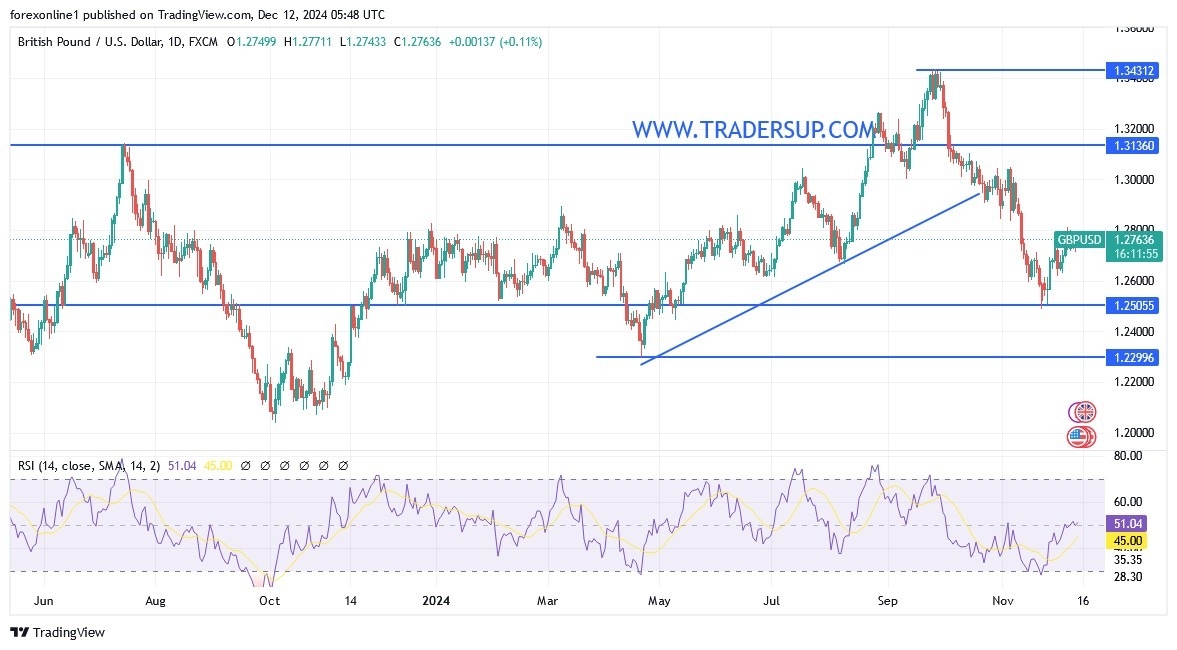
GBP/USD sellers refused to give up as the previous week’s recovery attempt fizzled out shy of the 200-day Simple Moving Average (SMA) at 1.2820.
An impending death and the previous dual Bear crosses will likely continue to cause headwinds in the Pound Sterling in the coming days.
The 50-day SMA is on the verge of crossing the 200-day SMA from above, which, if it occurs, will validate the Death Cross.
Further, the 14-day Relative Strength Index (RSI) has returned to negative territory at around 40, backing the case for additional downside.
The Pound Sterling must crack the 200-day SMA at 1.2820 to reverse the renewed downward momentum.
The next relevant upside target aligns near 1.2850, the confluence of the psychological level and the 50-day SMA.
Fresh buying interest could emerge on a sustained move above the latter, opening the door for a test of the 1.2900 round figure, followed by the 100-day SMA at 1.2958.
Contrarily, if the selling intensifies, the previous week’s low of 1.2617 will be tested, below which the six-month low of 1.2488 will be put to the test.
The line in the sand for buyers is seen at the 1.2400 round figure.

Pound Sterling FAQs
The Pound Sterling (GBP) is the oldest currency in the world (886 AD) and the official currency of the United Kingdom. It is the fourth most traded unit for foreign exchange (FX) in the world, accounting for 12% of all transactions, averaging $630 billion a day, according to 2022 data. Its key trading pairs are GBP/USD, also known as ‘Cable’, which accounts for 11% of FX, GBP/JPY, or the ‘Dragon’ as it is known by traders (3%), and EUR/GBP (2%). The Pound Sterling is issued by the Bank of England (BoE).
The single most important factor influencing the value of the Pound Sterling is monetary policy decided by the Bank of England. The BoE bases its decisions on whether it has achieved its primary goal of “price stability” – a steady inflation rate of around 2%. Its primary tool for achieving this is the adjustment of interest rates. When inflation is too high, the BoE will try to rein it in by raising interest rates, making it more expensive for people and businesses to access credit. This is generally positive for GBP, as higher interest rates make the UK a more attractive place for global investors to park their money. When inflation falls too low it is a sign economic growth is slowing. In this scenario, the BoE will consider lowering interest rates to cheapen credit so businesses will borrow more to invest in growth-generating projects.
Data releases gauge the health of the economy and can impact the value of the Pound Sterling. Indicators such as GDP, Manufacturing and Services PMIs, and employment can all influence the direction of the GBP. A strong economy is good for Sterling. Not only does it attract more foreign investment but it may encourage the BoE to put up interest rates, which will directly strengthen GBP. Otherwise, if economic data is weak, the Pound Sterling is likely to fall.
Another significant data release for the Pound Sterling is the Trade Balance. This indicator measures the difference between what a country earns from its exports and what it spends on imports over a given period. If a country produces highly sought-after exports, its currency will benefit purely from the extra demand created from foreign buyers seeking to purchase these goods. Therefore, a positive net Trade Balance strengthens a currency and vice versa for a negative balance.