The Canadian dollar has initially pulled back just a bit against the Japanese yen during early trading on Thursday.
That being said, this is a market that continues to see the same resistance barrier that people are paying attention to, specifically the area between the 111.50 yen area and the 112 yen area.
This is a region that’s been consolidating for some time, and I think that will continue to be the story in this market.
If we can break through there, then I think a lot of upward momentum re-enters the market. That being said, you also have to keep in mind that traders will continue to look at the overall risk appetite. And if that picks up, that should help. We do get core retail sales out of Canada on Friday, so that might be a mover as well. This will be especially true if retail sales in Canada, much stronger than anticipated, as it could only exacerbate the move to the upside and the potential breakout.
Moving Averages in this Pair
The 50 day EMA is starting to get towards the 200 day EMA. And it looks like we are trying to get a bit of a bullish cross, which of course helps the idea of longer term traders jumping in with the so called golden cross underneath. We have support at 109 yen. As long as we can stay above that level, I really don’t see a situation where the market breaks down.
And to the upside, we could go as high as 115 yen. I do expect this to happen sooner or later. But also keep in mind that the Canadian dollar is heavily influenced by crude oil, which hasn’t really been that great as of late. So ultimately, this is a market that’s building up pressure, but it can’t break out quite yet. If and when it does, it could be quite brutal.
The US Dollar appears unstoppable and reaches new top.
Next data of note in the euro area will be flash inflation data.
It was an awful week for EUR/USD. In fact, the fourth quarter has been dreadful so far for the European currency. Since late September’s yearly highs, above 1.1200, the pair has closed with gains in just one week. The Fiber has retreated nearly 8% since then or more than eight cents.
The Euro has had a rough ride lately, with much of its weakness amplified by a resurgent US Dollar (USD). The Greenback has gained fresh momentum, fueled by the sudden resurgence of geopolitical tensions — particularly in the Russia-Ukraine conflict — as well as the revival of the so-called “Trump trade.” Against this backdrop, the US Dollar Index (DXY) surged to a new cycle high, climbing above the 108.00 mark for the first time since early November 2022.
Why parity is back on the table
Considering the same scenario, if EUR/USD lost eight big figures in nearly two months, a “meagre” three-cent drop could seem even more likely. Aside from the current oversold condition of the single currency, there’s little to suggest a near-term rebound — let alone a sustainable recovery.
The prospects for a stronger US Dollar dominate sentiment and are only occasionally tempered by technical corrections as investors are expected to back the “Trump trade” throughout most of 2025.
On the domestic front, preliminary indicators of business activity in both Germany and the broader Euroland are far from encouraging. Adding to this, the bleak outlook for the German economy — exacerbated by visible political instability and stagnant economic activity across the bloc — doesn’t bode well for the Euro.
And that’s without even considering the performance of the US economy.
Looking ahead, the specter of renewed tariffs on European or Chinese goods under a possible Trump administration could stir up inflation in the US. If the Fed continues its cautious approach — or even tilts hawkish in response — the USD could strengthen further, keeping EUR/USD under pressure.
A looser ECB, a cautious Fed
On the monetary policy front, the Federal Reserve (Fed) cut its benchmark interest rate by 25 basis points at its November 7 meeting, bringing the Fed Funds Target Range (FFTR) to 4.75%-5.00%. This widely expected move is part of the Fed’s ongoing effort to steer inflation closer to its 2% target. However, cracks are beginning to appear in the labour market, even as unemployment rates remain near historic lows.
Fed Chair Jerome Powell struck a cautious tone in his latest remarks, signalling that the central bank is in no rush to lower rates further. This has dampened speculation about a December rate cut while simultaneously providing additional support for the Dollar.
Other Fed officials, notably Governor Michelle Bowman, echoed Powell’s sentiment, emphasising the need for restraint when considering future rate reductions.
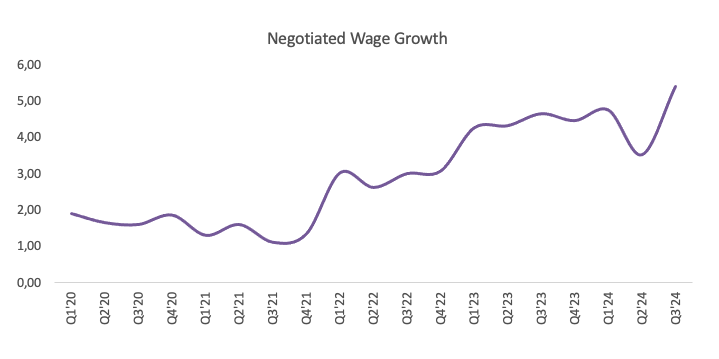
Meanwhile, across the Atlantic, a dovish narrative continues to dominate among European Central Bank (ECB) policymakers, despite October’s uptick in the Harmonised Index of Consumer Prices (HICP) and higher Negotiated Wage Growth in the third quarter.
So far, markets are pricing in approximately 75 basis points of easing by the Fed over a 12-month horizon, compared to around 150 basis points of rate reductions expected from the ECB within the same period.
Techs on EUR/USD
Further losses could push EUR/USD down to its 2024 low of 1.0331 (November 22). The breakdown of this level could open the door to a probable visit to the weekly lows of 1.0290 (November 30 2022) and 1.0222 (November 21).
On the upside, there is minor resistance at the weekly top of 1.0606 (November 18), seconded by the critical 200-day Simple Moving Average (SMA) at 1.0857.
It is worth noting that the short-term technical outlook remains bearish as long as the pair stays below the latter.
Furthermore, the daily Relative Strength Index (RSI) entered the oversold region near 16, while the Average Directional Index (ADX) at nearly 49 indicates a strong trend.
Economic Indicator
Core Harmonized Index of Consumer Prices (YoY)
The Core Harmonized Index of Consumer Prices (HICP) measures changes in the prices of a representative basket of goods and services in the European Monetary Union. The HICP, – released by Eurostat on a monthly basis, is harmonized because the same methodology is used across all member states and their contribution is weighted. The YoY reading compares prices in the reference month to a year earlier. Core HICP excludes volatile components like food, energy, alcohol, and tobacco. The Core HICP is a key indicator to measure inflation and changes in purchasing trends. Generally, a high reading is seen as bullish for the Euro (EUR), while a low reading is seen as bearish.
The European Central Bank (ECB) in Frankfurt, Germany, is the reserve bank for the Eurozone. The ECB sets interest rates and manages monetary policy for the region. The ECB primary mandate is to maintain price stability, which means keeping inflation at around 2%. Its primary tool for achieving this is by raising or lowering interest rates. Relatively high interest rates will usually result in a stronger Euro and vice versa. The ECB Governing Council makes monetary policy decisions at meetings held eight times a year. Decisions are made by heads of the Eurozone national banks and six permanent members, including the President of the ECB, Christine Lagarde.
In extreme situations, the European Central Bank can enact a policy tool called Quantitative Easing. QE is the process by which the ECB prints Euros and uses them to buy assets – usually government or corporate bonds – from banks and other financial institutions. QE usually results in a weaker Euro. QE is a last resort when simply lowering interest rates is unlikely to achieve the objective of price stability. The ECB used it during the Great Financial Crisis in 2009-11, in 2015 when inflation remained stubbornly low, as well as during the covid pandemic.
Quantitative tightening (QT) is the reverse of QE. It is undertaken after QE when an economic recovery is underway and inflation starts rising. Whilst in QE the European Central Bank (ECB) purchases government and corporate bonds from financial institutions to provide them with liquidity, in QT the ECB stops buying more bonds, and stops reinvesting the principal maturing on the bonds it already holds. It is usually positive (or bullish) for the Euro.
The table below shows the percentage change of British Pound (GBP) against listed major currencies today. British Pound was the strongest against the Swiss Franc.
USD
EUR
GBP
JPY
CAD
AUD
NZD
CHF
USD
0.72%
0.63%
0.25%
0.10%
0.25%
0.57%
0.94%
EUR
-0.72%
-0.08%
-0.45%
-0.61%
-0.44%
-0.14%
0.23%
GBP
-0.63%
0.08%
-0.37%
-0.53%
-0.38%
-0.06%
0.31%
JPY
-0.25%
0.45%
0.37%
-0.15%
0.00%
0.31%
0.69%
CAD
-0.10%
0.61%
0.53%
0.15%
0.14%
0.47%
0.84%
AUD
-0.25%
0.44%
0.38%
0.00%
-0.14%
0.33%
0.72%
NZD
-0.57%
0.14%
0.06%
-0.31%
-0.47%
-0.33%
0.36%
CHF
-0.94%
-0.23%
-0.31%
-0.69%
-0.84%
-0.72%
-0.36%
The heat map shows percentage changes of major currencies against each other. The base currency is picked from the left column, while the quote currency is picked from the top row. For example, if you pick the British Pound from the left column and move along the horizontal line to the US Dollar, the percentage change displayed in the box will represent GBP (base)/USD (quote).
UK retail sales fell by 0.7% in October, compared to estimates of a 0.3% drop.
The UK economy only expanded by 0.1% in the third quarter.
US initial jobless claims unexpectedly fell last week from 219,000 to 213,000.
The GBP/USD price analysis shows weaker consumer spending in the UK, which has pushed the pound to a six-month low. On the other hand, the US labor market remains resilient, reducing Fed rate cut expectations.
–Are you interested in learning more about Canadian forex brokers? Check our detailed guide-
Data on Friday revealed that retail sales in the UK fell by 0.7% in October, compared to estimates of a 0.3% drop. The decline in sales is a clear indication that consumer spending is weak. This follows other economic reports showing a slowdown in the UK economy. Notably, GDP data showed that the economy only expanded by 0.1% in the third quarter.
Adding fuel to the fire, the UK PMI reading for both services and manufacturing missed the estimates. The negative figures may keep lasting pressure on the pound throughout the current trading session.
If this trend continues, the Bank of England might be forced to change the timing for rate cuts. Initially, experts believed the new government budget would boost economic performance. However, so far, economic data has shown the opposite.
On the other hand, the US economy has remained resilient despite high interest rates, keeping policymakers cautious. Data on Thursday revealed that initial jobless claims unexpectedly fell last week from 219,000 to 213,000. Meanwhile, economists had expected 220,000 claims.
Labor market resilience has kept the Fed from rushing to lower borrowing costs. At the same time, Trump’s recent win has shifted the outlook for economic growth and inflation. His policy changes might boost growth and lead to a spike in inflation. High inflation will force the Fed to keep interest rates at a restrictive level, which is bullish for the dollar.
GBP/USD key events today
US flash manufacturing PMI
US flash services PMI
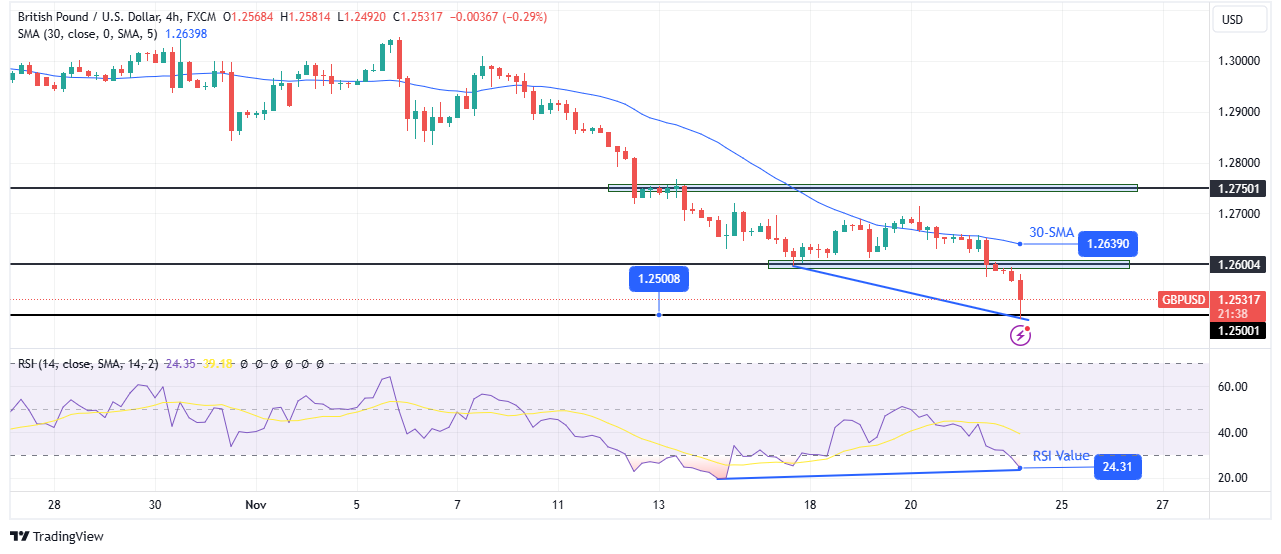
GBP/USD technical price analysis: Bears trigger a decline to the 1.2500 support
GBP/USD 4-hour chart
On the technical side, the GBP/USD price has broken below the 1.2600 support level to make a new low near the 1.2500 key psychological level. The new low indicates a continuation of the downtrend after retesting the 30-SMA resistance.
–Are you interested in learning more about high leveraged brokers? Check our detailed guide-
However, the RSI has made a slight bullish divergence. While the price has made a lower low, the indicator has made a higher one. This is a sign that bearish momentum is fading and could lead to a reversal. However, if the price stays below the 30-SMA, bears might eventually breach the 1.2500 support level.
Looking to trade forex now? Invest at eToro!
68% of retail investor accounts lose money when trading CFDs with this provider. You should consider whether you can afford to take the high risk of losing your money
Japan’s core consumer inflation increased by 2.3% in October.
56% of economists expect the Bank of Japan to hike rates in December.
US jobless claims unexpectedly fell to 213,000.
The USD/JPY outlook shows a stronger yen amid increasing bets for a December rate hike by the Bank of Japan. However, the pair fluctuated on Friday after mixed economic data from Japan. Meanwhile, the dollar remained strong after data in the previous session revealed a still-tight US labor market.
–Are you interested in learning more about Canadian forex brokers? Check our detailed guide-
Japan released mixed reports on Friday, which initially boosted the yen before it gave up its gains. Core consumer inflation in the country increased by 2.3% in October, above forecasts of 2.2%. At the same time, services inflation increased by 1.5% after a previous reading of 1.3%. Increasing price pressures give the Bank of Japan enough room to hike interest rates. As a result, traders raised the likelihood of a December rate hike.
At the same time, a Reuters poll revealed that 56% of economists expect the Bank of Japan to hike rates in December. This increased from the previous month when only 49% expected such a move; hence, the yen gained.
However, a separate report revealed that manufacturing activity in Japan fell in November amid weak demand in China.
On the other hand, data from the US on Thursday revealed that jobless claims unexpectedly fell to 213,000, compared to forecasts of 220,000 claims. Few claims indicate a low unemployment rate and a robust labor market, boosting the dollar. At the same time, a strong labor market lowers the likelihood of a Fed rate cut in December. Market participants are now awaiting US business activity data for more clues on whether policymakers will vote to cut rates in December.
USD/JPY key events today
US flash manufacturing PMI
US flash services PMI
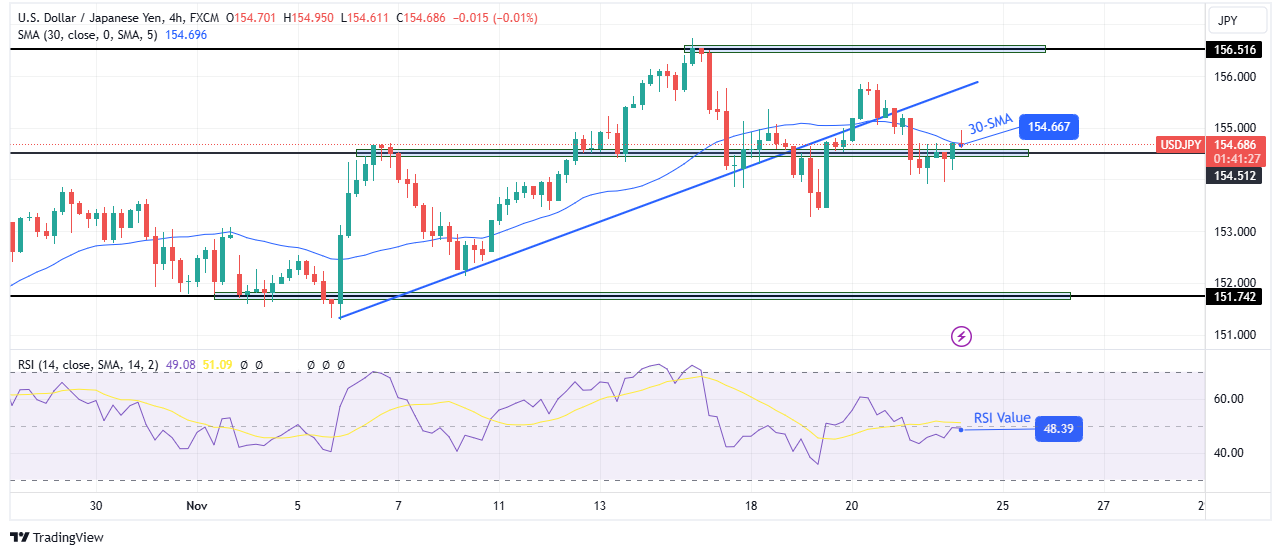
USD/JPY technical outlook: Bears meet strong hurdle at 154.51
USD/JPY 4-hour chart
On the technical side, the USD/JPY price trades below the 30-SMA with the RSI below 50, supporting a bearish bias. However, the decline has paused to consolidate near the 154.51 key support level.
–Are you interested in learning more about high leveraged brokers? Check our detailed guide-
Price action shows many wicks as bears and bulls battle for control between the support level and the 30-SMA resistance. If bears win, the price will make a lower low and target the next support at 151.74. On the other hand, if bulls win, USD/JPY will breach the SMA to retest the 156.51 resistance level.
Looking to trade forex now? Invest at eToro!
68% of retail investor accounts lose money when trading CFDs with this provider. You should consider whether you can afford to take the high risk of losing your money
EUR/USD trades at its lowest level in over a year below 1.0500.
The technical outlook suggests that the pair is about to turn oversold.
Investors await PMI data releases from Germany, the Eurozone and the US.
EUR/USD came under renewed bearish pressure in the American session on Thursday and touched its lowest level since October 2023 below 1.0500. The pair struggles to find a foothold early Friday as investors await key macroeconomic data releases.
Euro PRICE This week
The table below shows the percentage change of Euro (EUR) against listed major currencies this week. Euro was the weakest against the Canadian Dollar.
USD
EUR
GBP
JPY
CAD
AUD
NZD
CHF
USD
0.59%
0.40%
0.37%
-0.81%
-0.61%
0.49%
-0.19%
EUR
-0.59%
-0.03%
-0.13%
-1.29%
-1.05%
0.00%
-0.67%
GBP
-0.40%
0.03%
-0.08%
-1.26%
-1.02%
0.04%
-0.64%
JPY
-0.37%
0.13%
0.08%
-1.19%
-0.91%
0.17%
-0.49%
CAD
0.81%
1.29%
1.26%
1.19%
0.23%
1.31%
0.63%
AUD
0.61%
1.05%
1.02%
0.91%
-0.23%
1.07%
0.38%
NZD
-0.49%
-0.01%
-0.04%
-0.17%
-1.31%
-1.07%
-0.67%
CHF
0.19%
0.67%
0.64%
0.49%
-0.63%
-0.38%
0.67%
The heat map shows percentage changes of major currencies against each other. The base currency is picked from the left column, while the quote currency is picked from the top row. For example, if you pick the Euro from the left column and move along the horizontal line to the US Dollar, the percentage change displayed in the box will represent EUR (base)/USD (quote).
The US Dollar (USD) benefited from upbeat US data and hawkish comments from Federal Reserve (Fed) officials on Thursday, forcing EUR/USD to turn south in the second half of the day.
“Over the next year, it feels like rates will end up a fair bit lower than they are today,” Chicago Fed President Austan Goolsbee said and argued that it may make sense to slow the pace of interest rate cuts as the Fed gets close to where rates will settle.
Preliminary November HCOB Manufacturing and Services Purchasing Managers Index (PMI) data from Germany and the Eurozone will be featured in the European economic calendar. In case Services PMI unexpectedly falls into the contraction territory below 50 either in Germany or the Eurozone, the immediate reaction could cause the Euro to weaken further against its major rivals.
Later in the day, S&P Global Manufacturing and Services PMI data for the US will be watched closely by market participants. If the Manufacturing PMI recovers above 50 and the Services PMI comes in near October’s final print of 55, the USD could preserve its strength heading into the weekend and force EUR/USD to stretch lower.
EUR/USD Technical Analysis
EUR/USD trades near the mid-point of the descending regression channel and the Relative Strength Index (RSI) indicator on the 4-hour chart stays close to 30, suggesting that the pair could stage a technical correction before falling further.
On the upside, 1.0500 (former support, static level) aligns as first resistance before 1.0540 (20-period Simple Moving Average (SMA)) and 1.0570 (50-period SMA, upper limit of the descending channel). Looking south, supports could be spotted at 1.0400 (lower limit of the descending channel) and 1.0360 (static level from May 2023).
Euro FAQs
The Euro is the currency for the 19 European Union countries that belong to the Eurozone. It is the second most heavily traded currency in the world behind the US Dollar. In 2022, it accounted for 31% of all foreign exchange transactions, with an average daily turnover of over $2.2 trillion a day. EUR/USD is the most heavily traded currency pair in the world, accounting for an estimated 30% off all transactions, followed by EUR/JPY (4%), EUR/GBP (3%) and EUR/AUD (2%).
The European Central Bank (ECB) in Frankfurt, Germany, is the reserve bank for the Eurozone. The ECB sets interest rates and manages monetary policy. The ECB’s primary mandate is to maintain price stability, which means either controlling inflation or stimulating growth. Its primary tool is the raising or lowering of interest rates. Relatively high interest rates – or the expectation of higher rates – will usually benefit the Euro and vice versa. The ECB Governing Council makes monetary policy decisions at meetings held eight times a year. Decisions are made by heads of the Eurozone national banks and six permanent members, including the President of the ECB, Christine Lagarde.
Eurozone inflation data, measured by the Harmonized Index of Consumer Prices (HICP), is an important econometric for the Euro. If inflation rises more than expected, especially if above the ECB’s 2% target, it obliges the ECB to raise interest rates to bring it back under control. Relatively high interest rates compared to its counterparts will usually benefit the Euro, as it makes the region more attractive as a place for global investors to park their money.
Data releases gauge the health of the economy and can impact on the Euro. Indicators such as GDP, Manufacturing and Services PMIs, employment, and consumer sentiment surveys can all influence the direction of the single currency. A strong economy is good for the Euro. Not only does it attract more foreign investment but it may encourage the ECB to put up interest rates, which will directly strengthen the Euro. Otherwise, if economic data is weak, the Euro is likely to fall. Economic data for the four largest economies in the euro area (Germany, France, Italy and Spain) are especially significant, as they account for 75% of the Eurozone’s economy.
Another significant data release for the Euro is the Trade Balance. This indicator measures the difference between what a country earns from its exports and what it spends on imports over a given period. If a country produces highly sought after exports then its currency will gain in value purely from the extra demand created from foreign buyers seeking to purchase these goods. Therefore, a positive net Trade Balance strengthens a currency and vice versa for a negative balance.
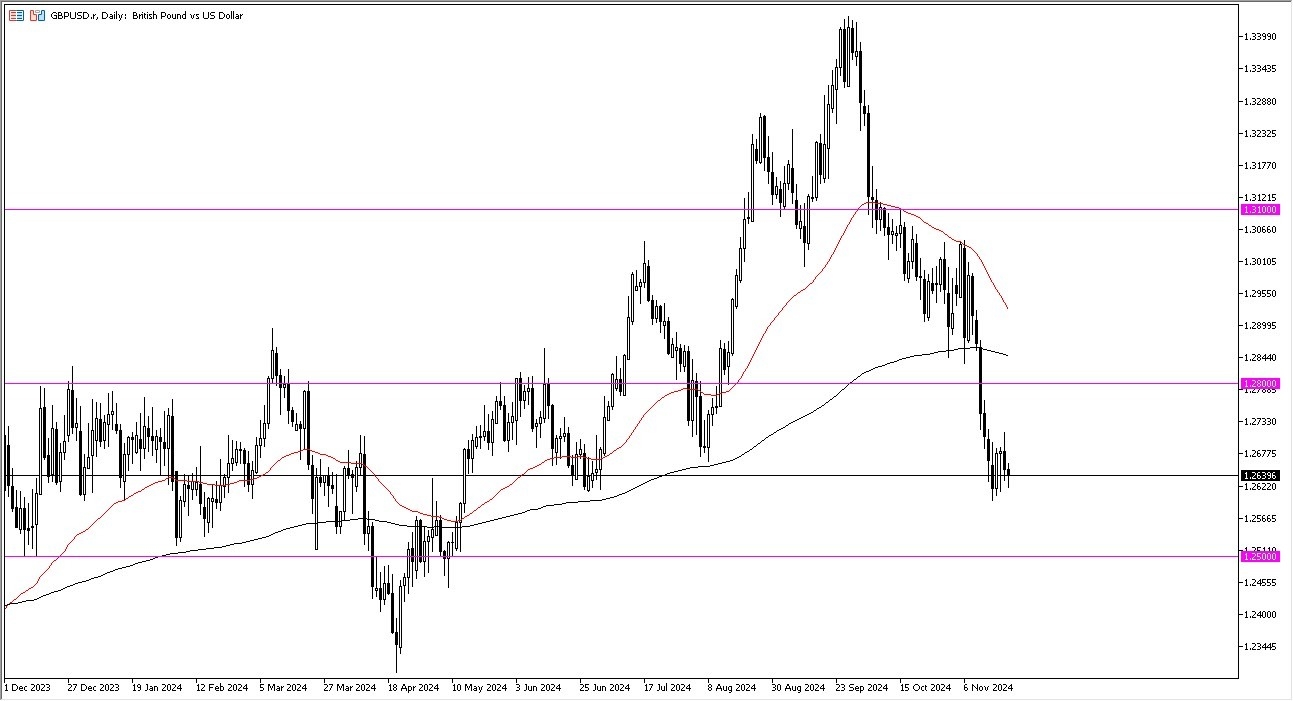
During my daily analysis of the GBP/USD pair, the British pound has truly looked fairly weak.
As we continue to threaten the 1.26 level, it looks as if we are eventually going to break down, and perhaps go looking to the 1.25 level underneath, which is a large, round, psychologically significant figure.
During the Friday session, we get the PMI numbers for both Manufacturing and Services from both the United Kingdom and the United States. That will have a direct influence on how this pair goes going forward, but I would also point out that a lot of people are paying close attention to the bond markets in the United States as interest rates continue to rise. As long as those interest rates continue to stay fairly high, it does make the US dollar much more attractive than the British pound. Furthermore, we have a lot of other things to think about at the moment that could continue to influence what happens next with the greenback.
US Dollar Continues to Be a Safety Currency
Keep in mind that the US dollar continues to be thought of as a currency that is sought out in times of need for safety. With the escalation of the war in Ukraine, I suspect that we have yet another reason to think that the US dollar will continue to strengthen against most others. Furthermore, the United Kingdom has a lot of economic and social issues at the moment that seem to be getting worse at this point. With that being said, it’s not necessarily an economy that a lot of foreign money wants to go running to. This isn’t to say that the United Kingdom’s economy is going to collapse or anything hyperbolic like that, just that the US economy seems to be on much stronger footing.
Given enough time, I think that this market will probably go looking to the 1.25 level, and if we were to break down below there, the GBP/USD market could really start to break down. In this environment, you would probably see the US dollar strengthen against multiple other currencies, not just this one.
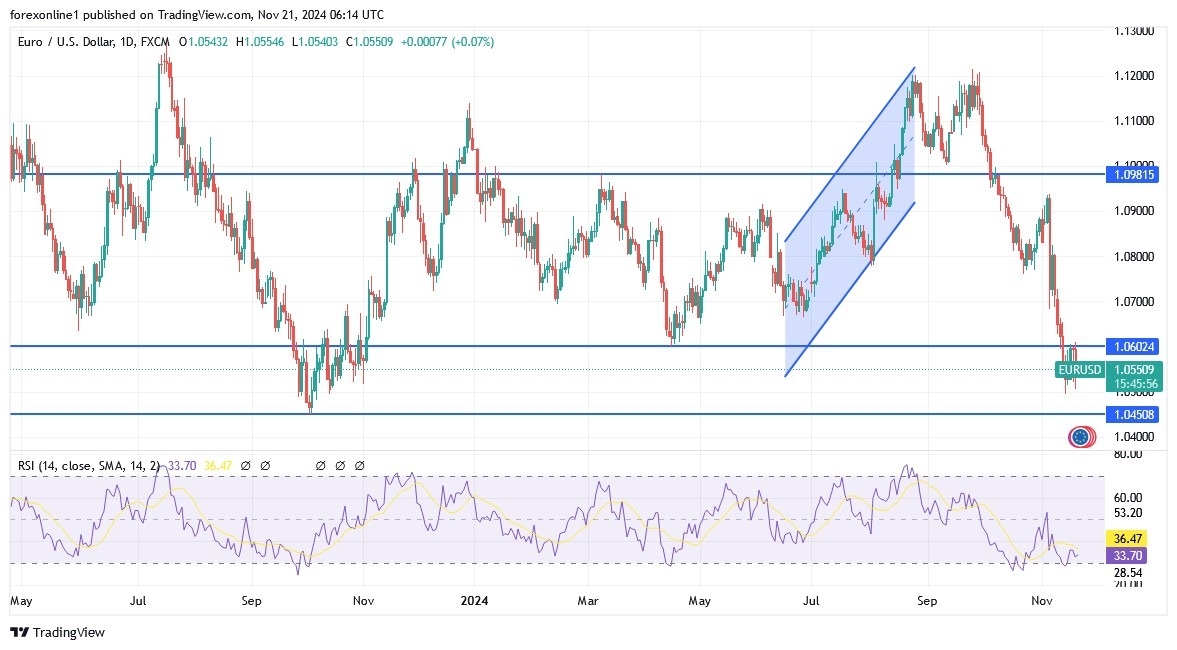
Since the beginning of this week, the EUR/USD currency pair has been attempting to recover from its year-low, but rebound gains have not exceeded the 1.0609 level.
It is currently stabilizing around 1.0548 at the time of writing this analysis.
Trump’s trade, along with European political concerns, is still affecting the EUR/USD gains.
Reasons for the Continued Decline of EUR/USD
According to reliable trading platforms, the EUR/USD price is still stable on the threshold of the psychological support of 1.0500, the lowest for the currency pair since October of last year. Also, due to several pressure factors, the most prominent of which is the strength of the US dollar since Trump won the US presidential elections, which is known for its trade hostility. Moreover, the euro zone is recovering with increased exports. This is in addition to the divergence in monetary policy between the US Federal Reserve, which hinted at calming down the rate cuts, and the opposite of the European Central Bank’s policy.
Also, the pressure on the euro is due to the escalation of tensions between Russia and Ukraine, and concerns about negative risks to the eurozone economy. According to the latest events, it was recently announced that Ukraine launched British cruise missiles at Russia for the first time in a dangerous development of the war that threatens to expand and continue.
European Central Bank Policy and Regional Tensions
The escalation of the war between Russia and Ukraine will remain a factor of concern for the eurozone. Amid these concerns, the European Central Bank highlighted in its annual financial stability report that rising geopolitical tensions and political uncertainty are amplifying sovereign vulnerabilities. Meanwhile, rising global trade tensions increase the likelihood of negative economic shocks. According to the results of the economic calendar data recently, it was announced that wages in the eurozone rose by 5.4% year-on-year in the third quarter, the largest rate since the introduction of the euro, which complicated the European Central Bank’s plans to cut interest rates. In general, the central bank is still expected to provide its fourth interest rate cut by 25 basis points in December.
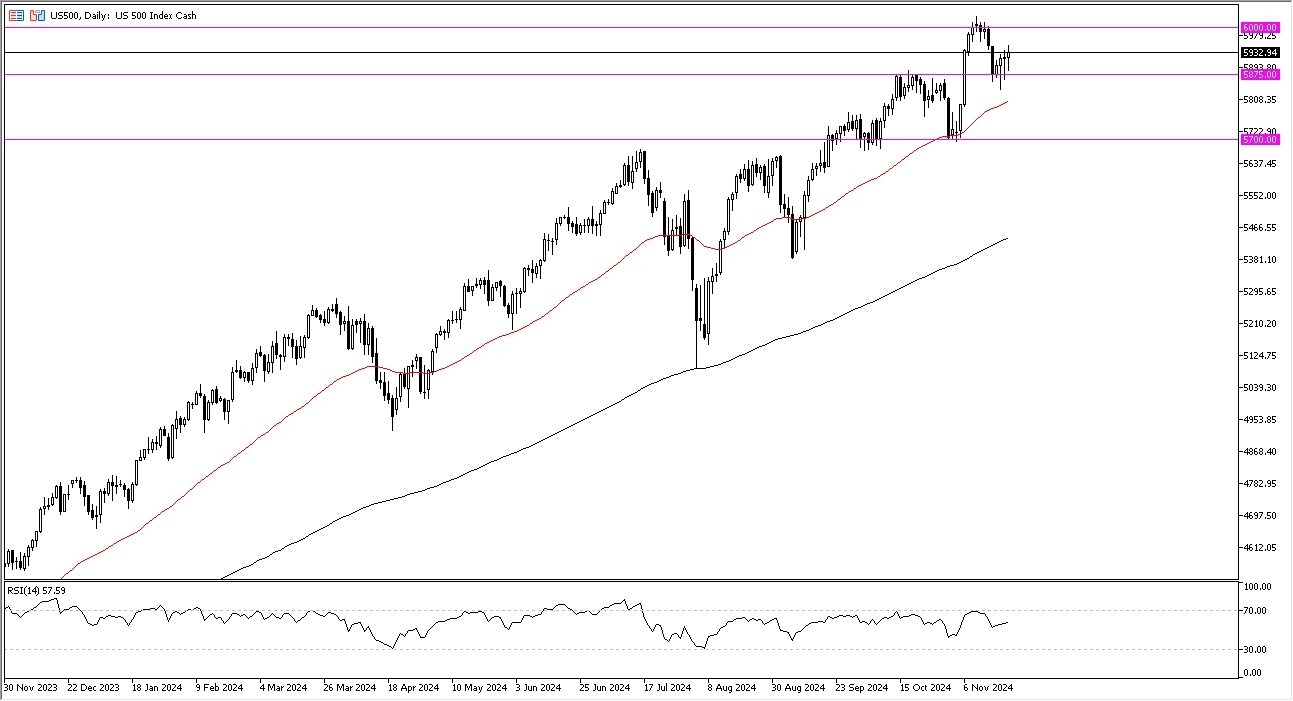
US stocks may witness selling
According to stock trading platforms, US stock futures declined today, Thursday, as investors reacted to the long-awaited earnings report from Nvidia. Despite the company beating quarterly expectations and issuing strong forward guidance, Nvidia’s stock fell by more than 2% in after-hours trading. Obviously, this decline came as investors had hoped for bigger surprises, given Nvidia’s dominant role in the AI-driven market rally. According to yesterday’s trading, the Dow Jones Industrial Average rose 0.32%, the S&P 500 closed flat. Also, the Nasdaq Composite fell 0.11%. These moves were driven by mixed earnings reports and rising geopolitical concerns.
EUR/USD Analysis Today:
According to the daily chart, the overall trend for the EUR/USD pair remains on a downward trajectory, with the 1.0500 support remaining key to keep the bears in control. Dear reader, it must be taken into consideration that the recent trading sessions formed a gathering area in narrow ranges on the chart, which may herald a strong upcoming move in one of the two directions. So far, the strongest expectations are still bearish due to several factors listed above, and the exacerbation of these factors will support a stronger bearish move. Currently, the closest support levels for the euro and dollar are 1.0500, 1.0455, and 1.0380, respectively.
On the other hand, and for the same period of time, the resistance levels of 1.0675 and 1.0800 will remain the most important to break the current downward trend and start a new shift. Today, investors will focus on economic data, including US initial unemployment claims and US existing home sales figures. In addition, more insights are expected from more comments by members of the US Federal Reserve.
EUR/USD Trading Signals:
If the EUR/USD moves below the 1.0500 support level, technical indicators will move towards strong oversold levels, and you can take buy trades but without taking risks and activating take-profit and stop-loss orders to ensure the safety of your trading account from any price reversals. You can consider buying from support levels of 1.0440 and 1.0370, respectively. In case of a sell signals, it can be from the resistance of 1.0666.
The Australian dollar initially did rally a bit during the trading session on Wednesday but found quite a bit of resistance above as we continue to see a lot of noisy behavior.
With that being said, I think we’ve got a scenario where traders are going to continue to look at this as a potential buy on the dip type of market as we have seen the 99.50 yen level offer massive support.
Now, we have the 50 day EMA as well as the 200 day EMA indicators coming into the picture to offer support.
This Market Could Remains Sideways For a While
With this being said, I think you’ve got a situation where traders are going to continue to be somewhat sideways, but given enough time, I do think that eventually the interest rate differential will continue to be a major driver of what happens next. If that’s the case, once we break the 102 yen level, the pair will likely move much higher. While Japan has started discussing tightening monetary policy, the reality is that they can’t take significant action beyond the recent moves they’ve already made.
So, with that being said, I think if we do break above the 102 yen level, it will probably be more or less a FOMO trade. If we were to break down below the 99.50 yen level, then we could see a drop to the 98 level, but really at this point in time, I think the bulk of traders are still looking for this to go higher.
AUD/JPY is a pair that will continue to follow the overall attitude of the Japanese yen more than anything else, as the Bank of Japan continues to be a major factor in what happens with currency markets, specifically anything that is related to the JPY. Ultimately, the interest rate differential still makes this a very desirable investment, as recently the Reserve Bank of Australia has chosen to sit still with its monetary policy.
EUR/GBP has returned to the range it has been trading in since the end of September.
It will probably continue oscillating there until it breaks out either higher or lower.
The false downside break at the start of November, suggests the range floor may be vulnerable.
EUR/GBP continues trading in a range. The pair is probably now in a sideways trend and given the principle of technical analysis that “the trend is your friend” it will probably continue oscillating until it makes a decisive breakout one way or another.
EUR/GBP 4-hour Chart
The pair made a false break on November 8 when it fell to a two-and-a-half year low of 0.8260. However, rather than continuing down to the target generated from the range, EUR/GBP recovered back inside where it now trades.
Because it is in a sideways trend, however, the odds favor a continuation sideways, which suggests the possibility of a recovery from the current level near the range floor, and the unfolding of a leg up towards the ceiling at around 0.8450.
It is too early to say with any confidence whether EUR/GBP will indeed rise up to the top of the range. Further, the false break may be a sign of weakness and be followed by another break lower, thus complicating the picture and adding a bearish tone to the chart.
Assuming a break lower, it is possible the pair could fall to the target established by the range, at 0.8219 – the 61.8% Fibonacci extension.