The main tag of Forex News Today Articles.
You can use the search box below to find what you need.
[wd_asp id=1]

28 11, 2024
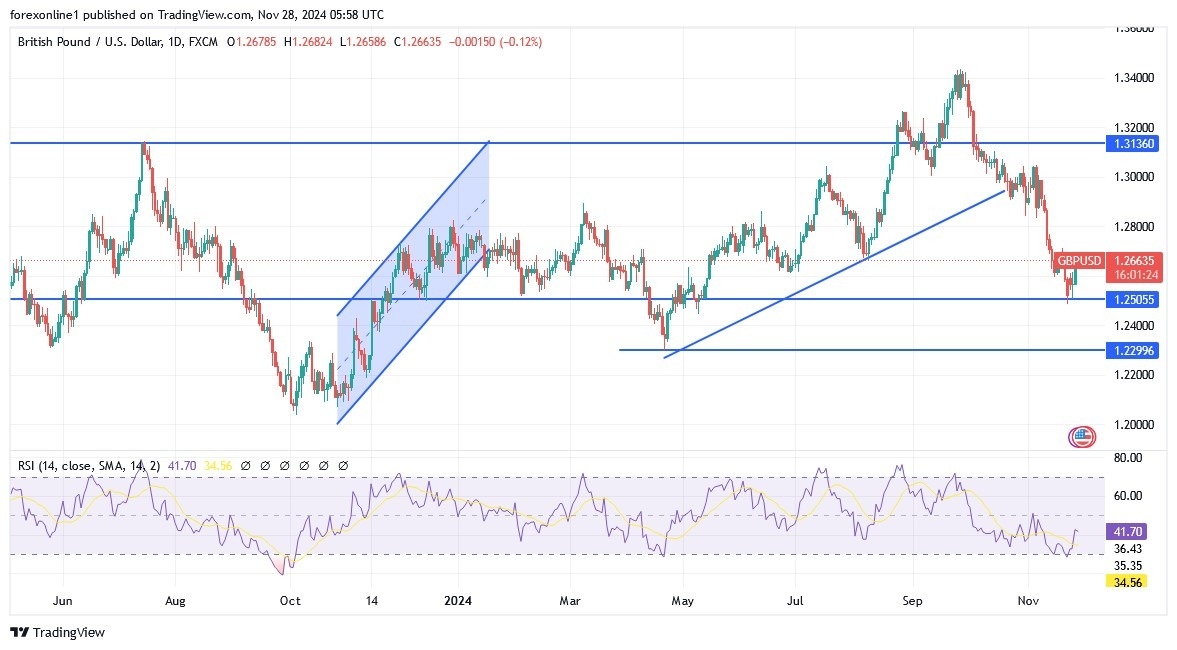
GBP/USD Analysis Today 28/11: Stalls Near 1.2660 (Chart)

By |2024-11-28T18:51:52+02:00November 28, 2024|Forex News, News|0 Comments

  • Yesterday’s session was the most notable in the GBP/USD currency pair’s attempts to rebound upwards, as it moved towards the resistance level of 1.2693 from the support level of 1.2565 in the same trading session.
  • Currently, it is stabilizing around the 1.2660 level at the time of writing.
  • Yesterday’s gains were primarily due to pressure on the US dollar’s performance, as it received a package of important US economic releases.
  • Also, as investors reduced their exposure to the market ahead of the US Thanksgiving holiday today, Thursday.

US Dollar Affected by Economic Data Results

The US dollar came under selling pressure after economic calendar data indicated that the Federal Reserve’s preferred inflation measure would not be enough to prevent another cut in US interest rates in December. According to the announcement, the core Personal Consumption Expenditures (PCE) price index rose 0.27% in October, the largest monthly increase since March. However, the figure was slightly below expectations, which had pointed to 0.3%. Following the data results, financial markets are now betting on a 66% chance of a US interest rate cut by the Federal Reserve at the last meeting of 2024. According to Fed funds futures, up from a 63% chance on Tuesday.

These events coincide with the decline in the US dollar price ahead of today’s US holiday. According to the data results, the 12-month PCE price index rose to 2.8% from 2.7% in October (and 3.4% a year ago), indicating a recent rise in inflationary pressures and should be enough to ensure the Federal Reserve maintains a cautious stance on cutting US interest rates in the coming months. This will naturally limit the weakness of the US dollar. However, in the near term, the US dollar is retreating slightly.

Analysts’ views on the performance of the US dollar

Analysts at HSBC believe that “the decline in the US dollar is also likely to reflect some unwinding of pre-US Thanksgiving holiday positioning.” Also, investment bank analysts see the possibility of US dollar selling as month-end flows begin to dominate the action. These are flows created by portfolio managers who buy and sell currencies to rebalance their portfolios to account for the previous month’s forex market movements. In the same context, Deutsche Bank’s end-of-month model sees the possibility of US dollar weakness, noting that the moves that occurred after the elections in US assets have generated some large rebalancing signals on relative performance. Meanwhile, with demand for the EUR/USD pair and supply of the USD/SEK and USD/CHF pairs as the largest signals within their model.

Generally, the weakness of the US dollar was also expected from a technical perspective, as many analysts noted that the November rally seemed overextended and deserved a downward correction.

Overall, most analysts see USD strength as a feature of 2025. However, the pace of gains makes it look overvalued over shorter time frames, opening the door to a December setback.

Technical Analysis for the GBP/USD pair today:

According to the performance on the daily chart above, the GBP/USD price is still at the beginning of forming an upward launch base, which means that the currency pair still lacks the strong momentum to start moving upward. Dear reader, you should take into account that the direction of the technical indicators has not turned upward yet. To start doing so, bulls should launch the GBP/USD currency pair towards the resistance levels of 1.2775 and then the psychological resistance of 1.3000 first. Otherwise, the general trend will remain bearish.

You should be cautious today as there is a holiday in the US markets, which may weaken liquidity amid traders staying away from trading screens. 

Ready to trade our daily GBP/USD Forex analysis? Check out the best forex trading company in UK worth using. 
Source link

28 11, 2024

Near Key Support at 150 -Video

By |2024-11-28T16:51:16+02:00November 28, 2024|Forex News, News|0 Comments

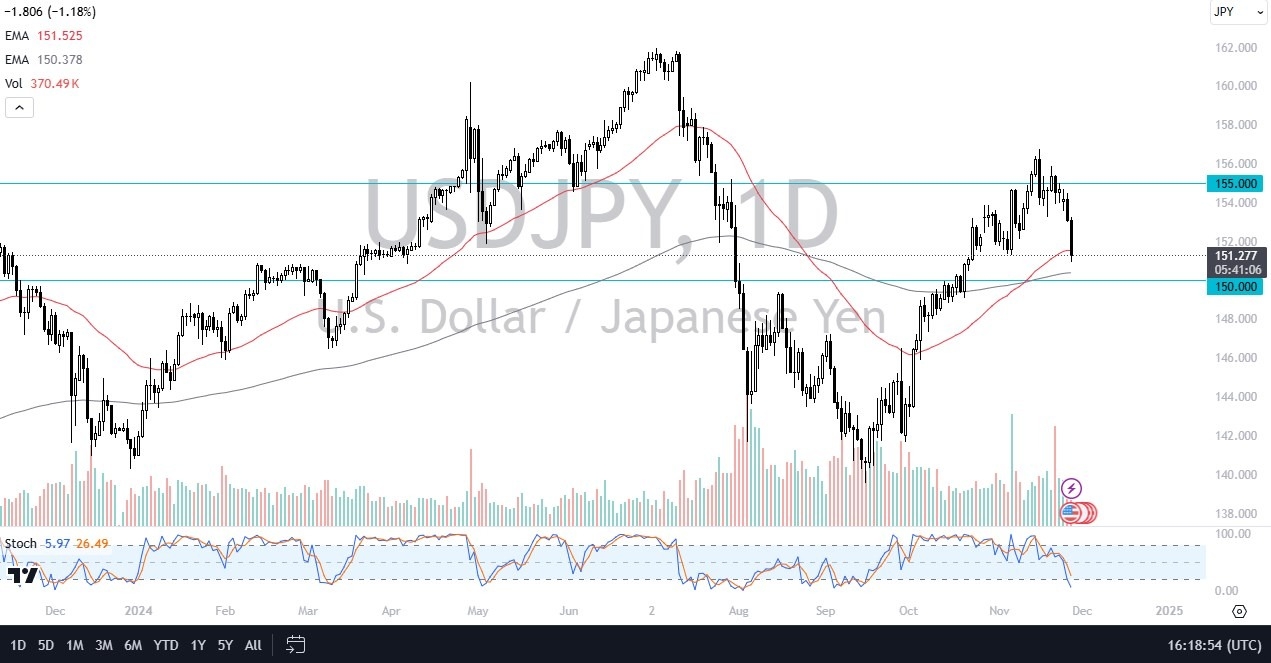
  • The US dollar has gotten hammered over the last couple of days against the Japanese yen, and has struggled against most currencies around the world.
  • Part of this could be cooling interest rates, part of it could be just a simple profit taking move as we head into Thanksgiving in the United States, which obviously has a major influence on demand for the dollar over the next day or two. Or it could just simply be more volatility.

At this point, when I look at the dollar against the Japanese yen, the first thing I see is that the 150 yen level underneath is backed up by the 200 day EMA. So, I think we’re getting close to an area where value hunting will begin. I would need to see a drop and then a bounce from here, perhaps something like a hammer to start to think about buying again.

Interest Rate Differential Still Favors America

The interest rate differential does favor the US dollar and in the longer term, that should come into the picture and start moving the market. If we were to break down below the 148 yen level, that could change everything. But until then, I think we still have a situation where the US dollar probably continues to outperform the Japanese yen over the longer term.

That being said, it really was only about two months ago that we were at 140 yen. So, it’s not a big surprise to see this little bit of a pullback. I don’t know that it makes any difference for the trend. I think it’s a little early to call that, but when you look at a Fibonacci retracement from the entire move, the 150 yen level ties together with the 38.2% Fib. So, it’s possible that might be where people get interested again. This would be a great value, assuming that the overall trend will continue over the longer term.

Want to trade our USD/JPY forex analysis and predictions? Here’s a list of forex brokers in Japan to check out. 

Source link

28 11, 2024

Gains Amid USD Weakness -Video

By |2024-11-28T14:50:12+02:00November 28, 2024|Forex News, News|0 Comments

  • The Euro has rallied a bit during the early hours on Wednesday as we have seen the United States dollar give back some of its gains.
  • The US dollar was a little overbought.
  • So, it’s not a huge surprise to see that things are starting to shift in another direction.

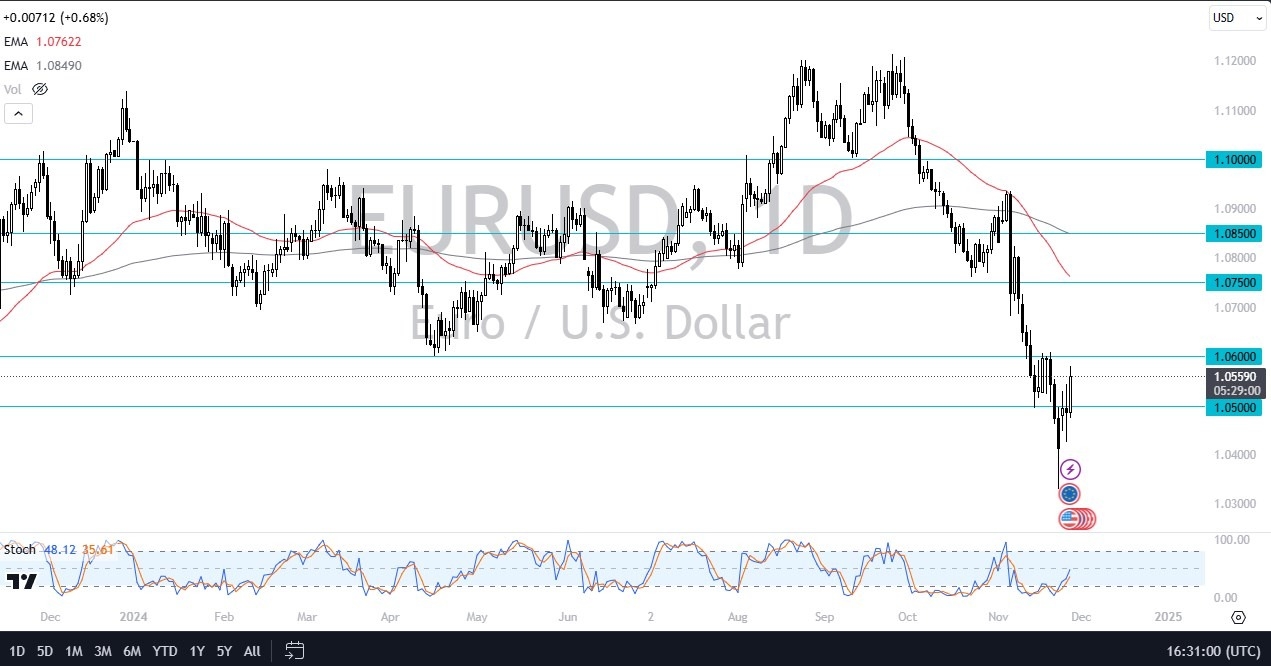
That being said, I think you’ve got a scenario where the 1.05 level continues to be major support. The fact that the stochastic oscillator crossed in the oversold condition a few days ago probably has this EUR/USD market ready for a technical bounce. Whether or not this sticks is a completely different question, but keep in mind that the 1.06 level above is going to be a bit of a barrier. I’ll be watching that because if we can break above the 1.06 level, then we have further gains ahead.

Short Term Pullbacks

Short term pullbacks probably end up showing signs of support near the 1.05 level again. And anything below there I think probably has some issues. Fundamentally speaking, the United States came out with the PCE numbers on Wednesday exactly as expected, right along with preliminary GDP and weekly unemployment claims came within about 2000 jobs from expected numbers. So, with all of that being said, I think the market is probably seeing some short covering due to the Thanksgiving holiday as a lot of the major traders in New York at least won’t be at their desk tomorrow for Thanksgiving. And then again on Friday, because most Americans take both days off if they can.

What will be interesting is to see how this pair behaves next week. I think anything above 1.0750 could change the trend again, but right now, this looks like a market where you will probably be fading signs of exhaustion after rallies. At this point, although the euro looks like it wants to rally, the reality is that the upside is probably still somewhat limited.

Ready to trade our EUR/USD Forex analysis? We’ve made a list of the best forex demo accounts worth trading with

Source link

28 11, 2024

GBP/USD Forecast Today 28/11: Tests Key Resistance (Video)

By |2024-11-28T12:49:18+02:00November 28, 2024|Forex News, News|0 Comments

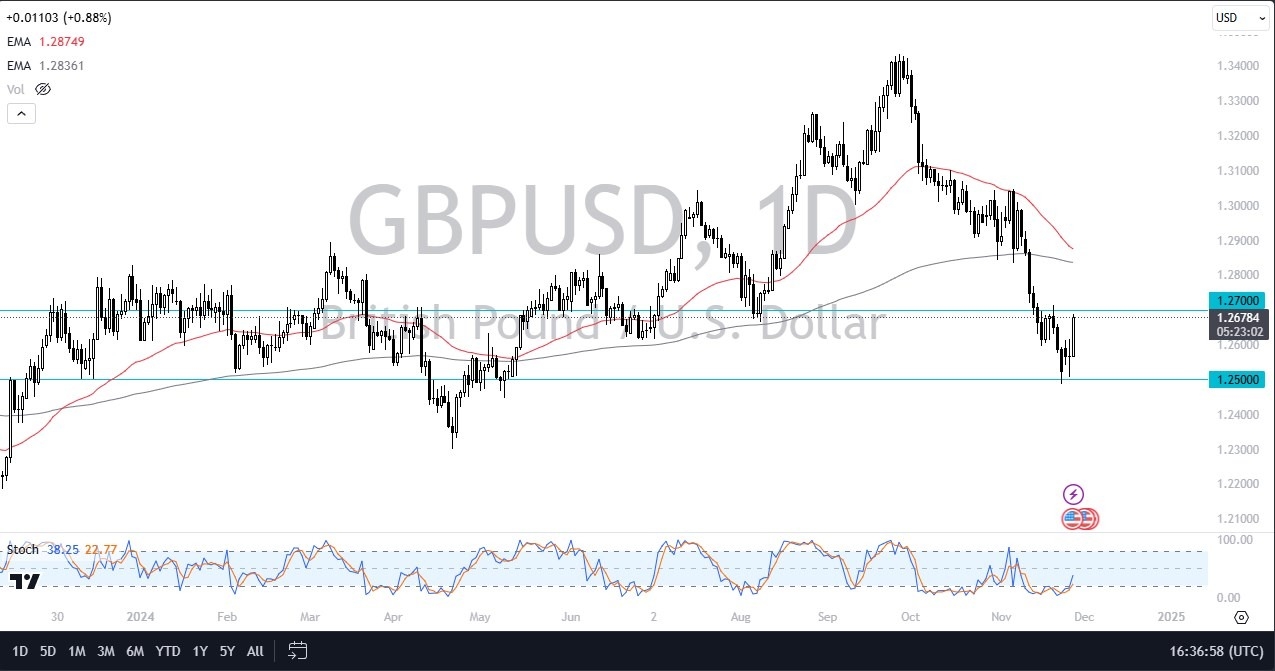
  • The British pound has rallied rather significantly during the day, gaining 0.9% by midday in North America.
  • It’ll be interesting to see what happens next because the 1.27 level above is what I consider to be a significant barrier.
  • If we can break above the 1.27 level, it’s very possible that this pair goes another 200 pips to the upside.

On the other hand, if we fail here, then I think we just say that we are in a basing pattern. The US dollar has given up quite a bit of its gains over the last couple of days against multiple currencies, but I think part of this is just simply profit taking. After all, it was just about six weeks ago that we were all the way up at 1.3450 and dropped drastically, roughly a thousand pips.

What I’m seeing with the US dollar is around the world. It’s not just in the British pound, but it’s also worth noting that the British pound for the longest time had fared better than many other currencies against the green bag.

Levels That Matter

The rubber meets the road here at the 1.27 level, so I will be watching it. And if we can get above there, then that 1.29 level comes into focus. But we also have the 200 day EMA and the 50 day EMA in that range offering a bit of resistance. If the market were to turn around and fall below the 1.25 level, then the 1.23 level gets targeted. But right now, that doesn’t look very likely. What will be interesting to see is how this GBP/USD market behaves on Thursday, as it is Thanksgiving in the United States.

That might be part of what we are seeing here is that New York traders are covering shorts so that they don’t get caught away from their desk with a big loser. So only time will tell on that, but I am watching these levels. There are some very clear levels in cable that will come to fruition here and influence where we go next. 

Ready to trade our daily GBP/USD Forex forecast? Here’s some of the best forex broker UK reviews to check out. 

Source link

28 11, 2024

Euro holds above key technical level ahead of German inflation data

By |2024-11-28T10:48:23+02:00November 28, 2024|Forex News, News|0 Comments

  • EUR/USD gathered bullish momentum and closed above 1.0550 on Wednesday.
  • The pair retreats slightly in the European morning on Thursday.
  • Investors await Consumer Price Index data from Germany.

EUR/USD capitalized on the selling pressure surrounding the US Dollar (USD) and registered strong gains on Wednesday. Before reaching 1.0600, however, the pair went into a consolidation phase and was last seen trading near 1.0550.

Euro PRICE This week

The table below shows the percentage change of Euro (EUR) against listed major currencies this week. Euro was the strongest against the Australian Dollar.

  USD EUR GBP JPY CAD AUD NZD CHF
USD   -1.10% -0.94% -1.58% 0.50% 0.28% -0.50% -0.83%
EUR 1.10%   -0.01% -1.07% 1.01% 1.32% 0.03% -0.35%
GBP 0.94% 0.00%   -1.07% 1.02% 1.33% 0.04% -0.34%
JPY 1.58% 1.07% 1.07%   2.09% 2.31% 1.14% 0.89%
CAD -0.50% -1.01% -1.02% -2.09%   -0.06% -0.98% -1.39%
AUD -0.28% -1.32% -1.33% -2.31% 0.06%   -1.28% -1.64%
NZD 0.50% -0.03% -0.04% -1.14% 0.98% 1.28%   -0.38%
CHF 0.83% 0.35% 0.34% -0.89% 1.39% 1.64% 0.38%  

The heat map shows percentage changes of major currencies against each other. The base currency is picked from the left column, while the quote currency is picked from the top row. For example, if you pick the Euro from the left column and move along the horizontal line to the US Dollar, the percentage change displayed in the box will represent EUR (base)/USD (quote).

The USD weakened against its rivals midweek following mixed macroeconomic data releases. Moreover, position adjustments heading into the Thanksgiving Day holiday may have played a part in the currency’s underperformance. 

Durable Goods Orders rose by 0.2% on a monthly basis in October, falling short of the market expectation for an increase of 0.5%. On a positive note, weekly Initial Jobless Claims declined to 213,000 from 215,000 in the previous week. Finally, the Personal Consumption Expenditures (PCE) Price Index, the Federal Reserve’s (Fed) preferred gauge of inflation, rose 2.3% on a yearly basis, matching the market consensus, while the annual core PCE inflation edged higher to 2.8% from 2.7%.

Later in the session, regional and nation-wide inflation data from Germany will be watched closely by investors. On a monthly basis, the Consumer Price Index (CPI) in Germany is forecast to decline 0.2% in November. A positive reading could help the Euro gather strength with the immediate reaction.

In an interview with Bloomberg on Wednesday, European Central Bank (ECB) board member Isabel Schnabel said that they could gradually move toward a neutral rate, given the inflation outlook, but warned against moving too far into accommodative territory.

EUR/USD Technical Analysis

EUR/USD broke out of its descending regression channel by rising above 1.0520 on Wednesday and the Relative Strength Index (RSI) climbed above 50, reflecting a bullish tilt in the short-term outlook. In case 1.0520 continues to hold as support, technical buyers could remain interested. In this scenario, 1.0580 (100-period Simple Moving Average (SMA) on the 4-hour chart, could be seen as first resistance before 1.0610 (static level) and 1.0660 (static level).

If EUR/USD returns below 1.0520, it could face interim support at 1.0500 (round level, 20-period SMA) ahead of 1.0440 (static level) and 1.0400 (round level).

Euro FAQs

The Euro is the currency for the 19 European Union countries that belong to the Eurozone. It is the second most heavily traded currency in the world behind the US Dollar. In 2022, it accounted for 31% of all foreign exchange transactions, with an average daily turnover of over $2.2 trillion a day. EUR/USD is the most heavily traded currency pair in the world, accounting for an estimated 30% off all transactions, followed by EUR/JPY (4%), EUR/GBP (3%) and EUR/AUD (2%).

The European Central Bank (ECB) in Frankfurt, Germany, is the reserve bank for the Eurozone. The ECB sets interest rates and manages monetary policy. The ECB’s primary mandate is to maintain price stability, which means either controlling inflation or stimulating growth. Its primary tool is the raising or lowering of interest rates. Relatively high interest rates – or the expectation of higher rates – will usually benefit the Euro and vice versa. The ECB Governing Council makes monetary policy decisions at meetings held eight times a year. Decisions are made by heads of the Eurozone national banks and six permanent members, including the President of the ECB, Christine Lagarde.

Eurozone inflation data, measured by the Harmonized Index of Consumer Prices (HICP), is an important econometric for the Euro. If inflation rises more than expected, especially if above the ECB’s 2% target, it obliges the ECB to raise interest rates to bring it back under control. Relatively high interest rates compared to its counterparts will usually benefit the Euro, as it makes the region more attractive as a place for global investors to park their money.

Data releases gauge the health of the economy and can impact on the Euro. Indicators such as GDP, Manufacturing and Services PMIs, employment, and consumer sentiment surveys can all influence the direction of the single currency. A strong economy is good for the Euro. Not only does it attract more foreign investment but it may encourage the ECB to put up interest rates, which will directly strengthen the Euro. Otherwise, if economic data is weak, the Euro is likely to fall. Economic data for the four largest economies in the euro area (Germany, France, Italy and Spain) are especially significant, as they account for 75% of the Eurozone’s economy.

Another significant data release for the Euro is the Trade Balance. This indicator measures the difference between what a country earns from its exports and what it spends on imports over a given period. If a country produces highly sought after exports then its currency will gain in value purely from the extra demand created from foreign buyers seeking to purchase these goods. Therefore, a positive net Trade Balance strengthens a currency and vice versa for a negative balance.


Source link

27 11, 2024

Japanese Yen buying remains unabated, USD/JPY slides below 152.00 ahead of US data

By |2024-11-27T20:42:00+02:00November 27, 2024|Forex News, News|0 Comments

  • The Japanese Yen draws haven flows amid concerns over Trump’s tariff plans and geopolitical risks. 
  • The USD languishes near the weekly low amid sliding US bond yields and weighs on the USD/JPY pair.
  • BoJ rate-hike uncertainty warrants caution for the JPY bulls ahead of the crucial US inflation data. 

The Japanese Yen (JPY) buying remains uninterrupted on Wednesday, which, along with a modest US Dollar (USD) weakness, drags the USD/JPY pair below the 152.00 mark, or a three-week low during the early European session. Against the backdrop of geopolitical risks stemming from the protracted Russia-Ukraine war, concerns about US President-elect Donald Trump’s tariff plans turn out to be key factors driving flows towards the safe-haven JPY. 

Furthermore, expectations that Trump’s US Treasury Secretary nominee, Scott Bessent will restrain budget deficits continue to drag the US Treasury bond yields lower. This, in turn, keeps the USD bulls on the defensive near the weekly low and offers additional support to the lower-yielding JPY. That said, the uncertainty over the Bank of Japan’s (BoJ) rate-hike plans could act as a headwind for the JPY ahead of Wednesday’s important US macro releases. 

Japanese Yen bulls retain near-term control amid flight to safety, sliding US bond yields

  • Concerns that US President-elect Donald Trump’s tariffs would trigger trade wars, and impact the global economy, continue to drive some haven flows towards the Japanese Yen. 
  • Scott Bessent’s nomination as the US Treasury secretary provided some respite to US bond investors and dragged the benchmark 10-year US Treasury yield to a two-week low on Monday.
  • Data released on Tuesday showed broadening service-sector inflation in Japan, keeping the door open for another rate hike by the Bank of Japan at its next policy meeting in December. 
  • Japanese Prime Minister Shigeru Ishiba said on Tuesday that he would ask companies to implement significant wage hikes at the annual “Shuntō” negotiations next spring.
  • The November FOMC meeting minutes revealed that the Committee could pause its easing of the policy rate and hold it at a restrictive level if inflation remained elevated.
  • Officials expressed confidence that inflation is easing and the labor market is strong, which should allow the Federal Reserve to cut rates further, albeit at a gradual pace.
  • According to the CME Group’s FedWatch Tool, traders are currently pricing in a 63% chance that the Fed will lower borrowing costs by 25 basis points in December. 
  • The US Dollar struggles to gain any meaningful traction and languishes near the weekly low touched on Tuesday, exerting additional pressure on the USD/JPY pair. 
  • Lebanon-based Hezbollah militant group said that it launched drones towards Israel on Tuesday night, while Israel launched air strikes on Beirut’s southern suburbs.
  • Moments later, US President Joe Biden announced that Lebanon and Israel have agreed to the ceasefire deal, which comes into effect from 02:00 GMT this Wednesday.
  • Traders now look forward to the first revision of the US Q3 GDP print and the US Personal Consumption Expenditure (PCE) Price Index for some meaningful impetus.
  • The market attention will then shift to a slew of Japanese macro data, including Tokyo’s Core CPI report, due for release during the Asian session on Friday. 

USD/JPY acceptance below the 152.00 pivotal support sets the stage for deeper losses

From a technical perspective, the overnight close below the 100-period Simple Moving Average (SMA) on the 4-hour chart and the subsequent downfall favors bearish traders. Moreover, oscillators on the daily chart have just started gaining negative traction and support prospects for a further USD/JPY depreciating move. Hence, some follow-through weakness towards the very important 200-day SMA, currently pegged around the 152.00 mark, looks like a distinct possibility. A convincing break below the latter could expose the monthly swing low, around the 151.30-151.25 region. 

On the flip side, the 153.00 round figure might now act as an immediate hurdle ahead of the 153.25-153.30 region. A sustained strength beyond the latter might trigger a short-covering rally and allow the USD/JPY pair to reclaim the 154.00 mark. The upward trajectory could extend further towards the 154.60 intermediate hurdle en route to the 155.00 psychological mark and the next relevant hurdle near the 155.35-155.40 area.

Economic Indicator

Gross Domestic Product Annualized

The real Gross Domestic Product (GDP) Annualized, released quarterly by the US Bureau of Economic Analysis, measures the value of the final goods and services produced in the United States in a given period of time. Changes in GDP are the most popular indicator of the nation’s overall economic health. The data is expressed at an annualized rate, which means that the rate has been adjusted to reflect the amount GDP would have changed over a year’s time, had it continued to grow at that specific rate. Generally speaking, a high reading is seen as bullish for the US Dollar (USD), while a low reading is seen as bearish.

Read more.


Source link

27 11, 2024

EUR/USD Analysis Today 27/11: Post-Fed Minutes (Chart)

By |2024-11-27T18:41:12+02:00November 27, 2024|Forex News, News|0 Comments

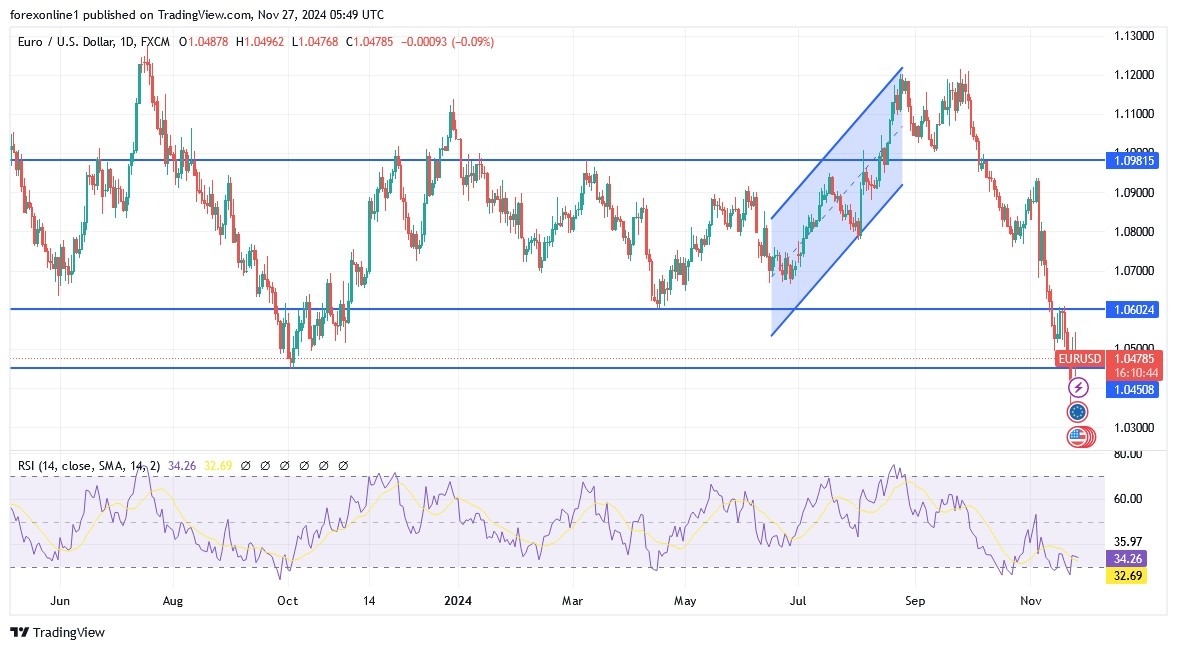
  • A surge in sentiment following Trump’s absence of threats to impose tariffs on the Eurozone helped the EUR/USD currency pair rebound to a high of 1.0544.
  • However, the EUR/USD pair quickly returned to its broader downward trajectory, stabilizing around the 1.0460 level at the time of writing.
  • According to reliable trading platforms, the EUR/USD’s attempts to rebound were halted after the release of the minutes of the latest meeting of the US Federal Reserve.

The US Central Bank: Cautious in cutting interest

According to the minutes of the latest meeting of the US Federal Reserve, Fed officials indicated broad support for a cautious approach to future US interest rate cuts considering the strength of the US economy and declining inflation. The minutes stated, “Participants expected that if incoming data were consistent with their current assessments, with inflation continuing to move down sustainably toward 2% and the U.S. economy remaining near maximum employment, it would likely be appropriate to move gradually toward a more neutral policy stance over time.”

The US Federal Reserve cut its benchmark interest rate by a quarter of a percentage point at its meeting this month to a range of 4.5%-4.75%, following a larger-than-usual half-point cut in September. In the same month, Fed Chairman Jerome Powell stated that the US economy is not sending signals to policymakers that they need to rush to cut interest rates.

Meanwhile, US Federal Reserve officials will meet for their last policy meeting of the year 2024 on December 17 and 18.

US Inflation and Its Impact on Fed Policy

Also, the minutes showed that some officials said the Fed could pause U.S. interest rate cuts and keep borrowing costs at a contained level if U.S. inflation remains high. Some officials have suggested that cuts could be accelerated if the economy or labour market deteriorates. Policymakers also cited the lack of clarity on the so-called neutral rate, a level of policy that neither restricts nor stimulates economic growth, as a reason for caution.

As for the U.S. labour market, U.S. monetary policymakers saw downside risks to employment and growth as “somewhat reduced.” Officials generally assessed that there was “no sign of rapid deterioration” in the U.S. labour market. On inflation, officials reported that price growth has slowed significantly from its peak but noted that the core measure, which excludes food and energy, remains “moderately elevated.”

You should expect inflation rates to increase during the Trump administration as his trade wars will inevitably result in higher inflation rates.

Euro outlook remains cautious

Investors remain cautious due to the ongoing economic gloom in Europe and growing concerns about the potential impact of the incoming Trump administration. Before taking office, Trump doubled down on his threats to impose tariffs, indicating a 10% increase in tariffs on China and a 25% increase on Mexico and Canada. At the same time, he also warned of imposing large tariffs on European goods, especially cars, claiming that the European Union “will pay a big price.”

As is well known, these threats increase the challenges facing Europe’s struggling manufacturing sector. Overall, this gloomy outlook has prompted investors to increase bets on aggressive monetary easing by the European Central Bank. While a 25-basis point interest rate cut next month is fully priced in, the probability of a larger 50 basis point cut has risen to 58%. These factors will continue to weigh on the performance of the euro.

EUR/USD Analysis Today:

There is no change in our technical view of the performance of the euro against the US dollar EUR/USD. Technically, the general trend remains bearish and the expectations for the future parity rate of the most popular currency pair in the forex market are increasing and closer than before. The implementation of Trump’s threats and global geopolitical tensions, in addition to the worsening economic and political situation in Germany, will remain valid factors for further collapse of the Euro Dollar price in the coming months. Currently, the closest support levels for the Euro Dollar are 1.0400, 1.0335 and 1.0200, respectively, which are sufficient to push all technical indicators towards strong oversold levels.

Today, the Euro Dollar pair will be affected by the announcement of a package of important US economic data before tomorrow’s holiday, the most prominent of which are the US GDP growth reading, the number of weekly jobless claims, and US durable goods orders, in addition to the US Federal Reserve’s preferred inflation reading.

EUR/USD Trading Signals:

In the above-mentioned narrative, we recommend selling the Euro Dollar currency pair EUR/USD from every upward level.

Ready to trade our daily EUR/USD Forex analysis? We’ve made a list of the best forex demo accounts worth trading with

Source link

27 11, 2024

GBP/USD Forecast Today 27/11: Struggles Near 1.25 (Video)

By |2024-11-27T16:40:10+02:00November 27, 2024|Forex News, News|0 Comments

  • The British Pound continues to find quite a bit of support near the 1.25 level, which could probably be thought of as a massive support level.
  • If we do break down below the 1.25 level, then I think it opens up a move for the British Pound to drop down to the 1.23 handle.
  • This is an area that has been very important in the past.

The 1.23 handle is an area that I think a lot of people will be watching very closely. Market participants continue to see that area as previous resistance, now likely to offer support, as it even did once during the latter part of April this year.

If We Could Break Higher…

On a rally, it’s really not until we break above the 1.27 level that I think things start to change. All things being equal, GBP/USD is a market that looks like it’s consolidating and trying to figure out where the bottom is, in an environment that continues to see the US Dollar destroy almost everything it touches.

There are a lot of reasons for the US Dollar to go higher, not the least of which is its safety play with geopolitics taking front and center stage. Yes, we’ve had these rallies, and the Lebanese agreed to a ceasefire, but we still have the issue in Ukraine. Furthermore, we have higher interest rates in America, and it looks like the pro-business administration that’s coming in will bring in more investment.

So, it’s a matter of people wanting to be involved in the US economy more than anything else at the moment. The interest rate differential between the two economies or currencies really isn’t much to speak of, so I think a lot of this just comes down to how dominant the US Dollar is against almost everything. Watch that 1.25 level. Watch the 1.27 level.

Ready to trade our daily GBP/USD Forex forecast? Here’s some of the best forex broker UK reviews to check out. 

Source link

27 11, 2024

USD/JPY Price Analysis: Risk Flows, BoJ Rate Cut Bets Lift Yen

By |2024-11-27T14:39:12+02:00November 27, 2024|Forex News, News|0 Comments

  • Traders sought safety after Trump’s tariff vows raised fears of trade wars.
  • The dollar rallied at the prospects of stronger economic performance.
  • Japan’s services producer price index increased by 2.9% in October.

The USD/JPY price analysis shows a strengthening yen amid safe-haven demand and increasing Bank of Japan rate cut expectations. Meanwhile, the dollar paused its rally as market participants awaited key reports including inflation, unemployment claims, and GDP.

Are you interested to learn more about forex options trading? Check our detailed guide-

The yen rallied on Tuesday and Wednesday as traders sought safety after Trump’s tariff vows raised fears of trade wars. The US president-elect promised to impose a 25% tariff on goods from Mexico, Canada and China. This news reduced risk appetite and boosted safe-haven currencies like the yen. Tariffs will significantly hurt major economies like China and Canada, impacting the global economy. 

On the other hand, the dollar rallied at the prospects of stronger economic performance. Tariffs imposed on imported goods will increase demand for local goods and boost the economy. However, by Wednesday, the rally paused as market focus shifted to looming US economic data. 

Elsewhere, data revealed that Japan’s services producer price index increased by 2.9% in October after a 2.8% rise in the previous month. Higher inflation increases the likelihood that the Bank of Japan will hike rates in December, lifting the yen.

Meanwhile, the US will release reports on GDP, unemployment claims, and inflation. Economists expect the economy to expand by 2.8%, holding from the previous reading. Meanwhile, the core PCE price index might increase by 0.3% as it did in the previous month. Upbeat economic data will lower the likelihood of a December rate cut, boosting the dollar. On the other hand, downbeat data will solidify rate-cut expectations.

USD/JPY key events today

  • US prelim GDP q/q
  • US unemployment claims
  • US core PCE price index m/m

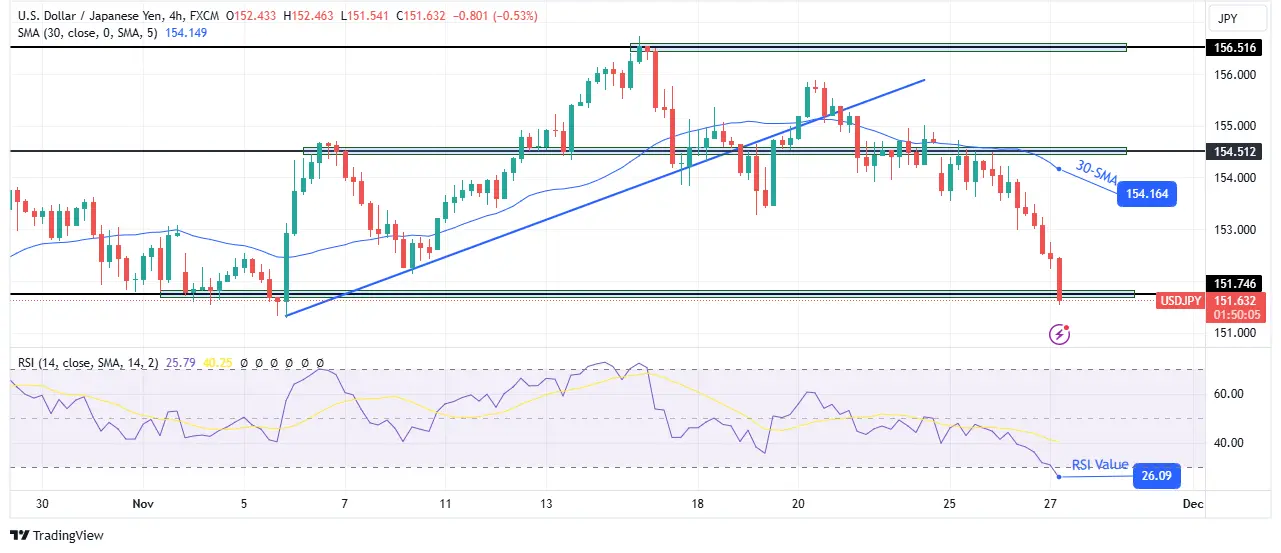
USD/JPY technical price analysis: Bears break below 151.74

USD/JPY Price Analysis: Risk Flows, BoJ Rate Cut Bets Lift Yen
USD/JPY 4-hour chart

On the technical side, the USD/JPY price is on the verge of breaking below the 151.74 support level. The price has fallen sharply after detaching from the 154.51 key level. It trades well below the 30-SMA, indicating a steep decline. Meanwhile, the RSI has dipped into the oversold region, showing solid bearish momentum. 

Are you interested in learning more about scalping forex brokers? Check our detailed guide-

If the price closes well below the 151.74 level, the decline will continue to the next support level. On the other hand, if USD/JPY fails to breach the support, it might pull back to retest the 30-SMA before making another attempt.

Looking to trade forex now? Invest at eToro!

67% of retail investor accounts lose money when trading CFDs with this provider. You should consider whether you can afford to take the high risk of losing your money.

Source link

27 11, 2024

Euro could extend recovery once it stabilizes above 1.0520

By |2024-11-27T12:37:29+02:00November 27, 2024|Forex News, News|0 Comments

  • EUR/USD trades in a narrow channel following Tuesday’s indecisive action.
  • The US economic calendar will feature several high-impact data releases.
  • The pair could extend its recovery once it clears 1.0520 resistance.

EUR/USD failed to make a decisive move in either direction on Tuesday and closed the day virtually unchanged slightly below 1.0500. The pair moves sideways in a narrow channel early Wednesday as investors await macroeconomic data releases from the US.

Euro PRICE This week

The table below shows the percentage change of Euro (EUR) against listed major currencies this week. Euro was the strongest against the Australian Dollar.

  USD EUR GBP JPY CAD AUD NZD CHF
USD   -0.77% -0.47% -1.40% 0.72% 0.25% -0.42% -0.81%
EUR 0.77%   0.13% -1.23% 0.89% 0.95% -0.23% -0.62%
GBP 0.47% -0.13%   -1.34% 0.76% 0.81% -0.36% -0.76%
JPY 1.40% 1.23% 1.34%   2.15% 2.10% 1.05% 0.78%
CAD -0.72% -0.89% -0.76% -2.15%   -0.32% -1.11% -1.54%
AUD -0.25% -0.95% -0.81% -2.10% 0.32%   -1.16% -1.55%
NZD 0.42% 0.23% 0.36% -1.05% 1.11% 1.16%   -0.40%
CHF 0.81% 0.62% 0.76% -0.78% 1.54% 1.55% 0.40%  

The heat map shows percentage changes of major currencies against each other. The base currency is picked from the left column, while the quote currency is picked from the top row. For example, if you pick the Euro from the left column and move along the horizontal line to the US Dollar, the percentage change displayed in the box will represent EUR (base)/USD (quote).

After dipping below 1.0450 on Tuesday, EUR/USD recovered its losses in the American session as the mixed data from the US and the modest improvement seen in risk mood made it difficult for the US Dollar (USD) to find demand.

Later in the day, the US Bureau of Economic Analysis will publish its second estimate of the annualized Gross Domestic Product (GDP) growth for the third quarter and release the Personal Consumption Expenditures (PCE) Price Index data, the Federal Reserve’s (Fed) preferred gauge of inflation, for October.

Investors expect the core PCE Price Index to rise 0.3% on a monthly basis to match September’s increase. A reading at or above the market expectation could support the USD with the immediate reaction. On the other hand, a print below analysts’ estimate could weigh on the USD and help EUR/USD push higher.

Ahead of the Thanksgiving holiday, the US economic calendar will feature other important data releases as well, making it difficult for market participants to assess the impact of these data on the USD’s valuation. The US Department of Labor will publish the weekly Initial Jobless Claims alongside the US Census Bureau’s Durable Goods Orders figures for October.

EUR/USD Technical Analysis

EUR/USD faces first resistance at 1.0520, where the upper limit of the descending regression channel meets the 50-period Simple Moving Average (SMA). In case the pair rises above this level and starts using it as support, 1.0570 (static level) could be seen as next hurdle before 1.0600 (100-period SMA).

On the downside, immediate support is located at 1.0480 (20-period SMA) ahead of 1.0430 (mid-point of the descending channel) and 1.0400 (static level).

Euro FAQs

The Euro is the currency for the 19 European Union countries that belong to the Eurozone. It is the second most heavily traded currency in the world behind the US Dollar. In 2022, it accounted for 31% of all foreign exchange transactions, with an average daily turnover of over $2.2 trillion a day. EUR/USD is the most heavily traded currency pair in the world, accounting for an estimated 30% off all transactions, followed by EUR/JPY (4%), EUR/GBP (3%) and EUR/AUD (2%).

The European Central Bank (ECB) in Frankfurt, Germany, is the reserve bank for the Eurozone. The ECB sets interest rates and manages monetary policy. The ECB’s primary mandate is to maintain price stability, which means either controlling inflation or stimulating growth. Its primary tool is the raising or lowering of interest rates. Relatively high interest rates – or the expectation of higher rates – will usually benefit the Euro and vice versa. The ECB Governing Council makes monetary policy decisions at meetings held eight times a year. Decisions are made by heads of the Eurozone national banks and six permanent members, including the President of the ECB, Christine Lagarde.

Eurozone inflation data, measured by the Harmonized Index of Consumer Prices (HICP), is an important econometric for the Euro. If inflation rises more than expected, especially if above the ECB’s 2% target, it obliges the ECB to raise interest rates to bring it back under control. Relatively high interest rates compared to its counterparts will usually benefit the Euro, as it makes the region more attractive as a place for global investors to park their money.

Data releases gauge the health of the economy and can impact on the Euro. Indicators such as GDP, Manufacturing and Services PMIs, employment, and consumer sentiment surveys can all influence the direction of the single currency. A strong economy is good for the Euro. Not only does it attract more foreign investment but it may encourage the ECB to put up interest rates, which will directly strengthen the Euro. Otherwise, if economic data is weak, the Euro is likely to fall. Economic data for the four largest economies in the euro area (Germany, France, Italy and Spain) are especially significant, as they account for 75% of the Eurozone’s economy.

Another significant data release for the Euro is the Trade Balance. This indicator measures the difference between what a country earns from its exports and what it spends on imports over a given period. If a country produces highly sought after exports then its currency will gain in value purely from the extra demand created from foreign buyers seeking to purchase these goods. Therefore, a positive net Trade Balance strengthens a currency and vice versa for a negative balance.


Source link

Go to Top