The main tag of Forex News Today Articles.
You can use the search box below to find what you need.
[wd_asp id=1]

23 07, 2024

US Dollar aims to extend gains

By |2024-07-23T17:00:39+03:00July 23, 2024|Forex News, News|0 Comments

You have reached your limit of 5 free articles for this month.

Take advantage of the Special Price just for today!

50% OFF and access to ALL our articles and insights.

Your coupon code


Subscribe to Premium

EUR/USD Current price: 1.0858

  • Financial markets are cautiously optimistic ahead of big names earning reports.
  • United States’ upcoming first-tier data exacerbates the cautious stance.
  • EUR/USD poised to extend its slide, near-term support at 1.0820.

The US Dollar keeps grinding higher on Tuesday, resulting in EUR/USD falling to a fresh two-week low in the 1.0850 price zone. The Greenback benefits from a cautious mood ahead of earnings reports. Multiple S&P500 big names will report results this week, and investors eagerly await the outcome before compromising with a particular position. Stock markets trade mixed ahead of Wall Street’s opening, yet overall, it seems markets retain a certain dose of optimism after current United States (US) President Joe Biden stepped down from the presidential race. The news boosted the USD amid hopes Donald Trump could win and apply more market-friendly measures.

Meanwhile, European Central Bank (ECB) Vice President Luis de Guindos hit the wires. De Guindos said that while the level of uncertainty is “huge,” inflation is “practically” in line with policymakers’ projections. Furthermore, he added that September would be a much more convenient month for making decisions as officials will have more data.

The macroeconomic calendar remains scarce, with first-tier US figures scheduled for later in the week, exacerbating the quietness. The country will release the first estimate of the Q2 Gross Domestic Product (GDP) and fresh Personal Consumption Expenditures (PCE) Price Index data.

After the US opening, the Eurozone will publish the preliminary estimate of July Consumer Confidence, while the US will release June Existing Home Sales and the Richmond Fed Manufacturing Index for July.

EUR/USD short-term technical outlook

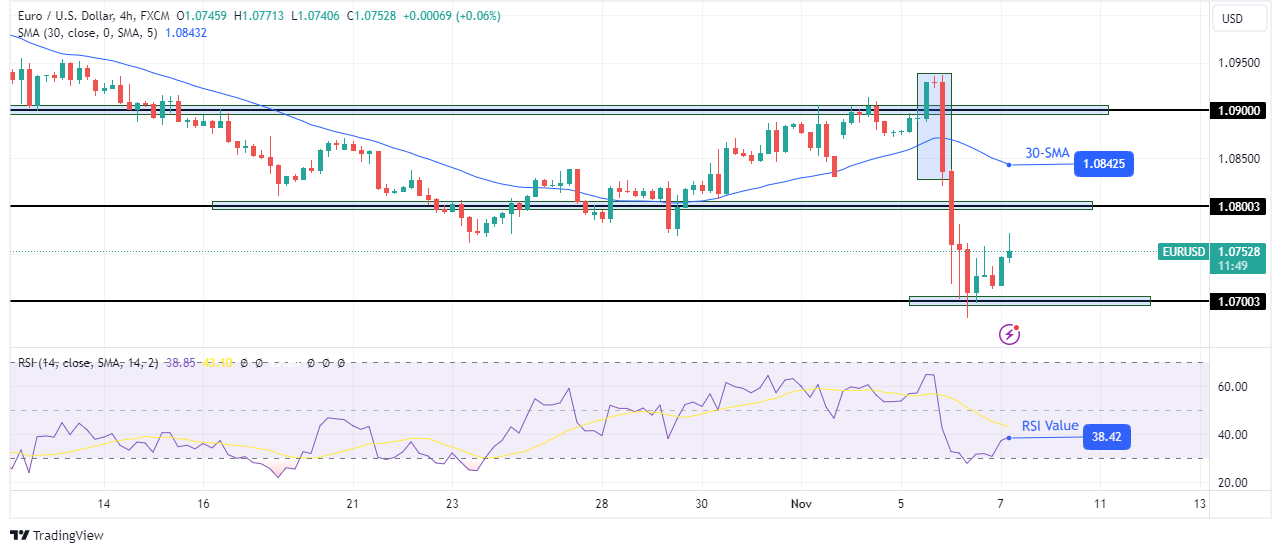
From a technical point of view, the EUR/USD pair is at risk of extending its slide. The pair keeps trading above all its moving averages, but technical indicators maintain their firmly downward slopes, approaching their midlines from above. Regarding moving averages, the 20 Simple Moving Average (SMA) advances above directionless 100 and 200 SMAs, but with its bullish strength moderating, suggesting buyers are not sure of adding on dips.

In the near term, and according to the 4-hour chart, the risk skews to the downside. Technical indicators resumed their slides after failing to regain positive levels, heading sharply lower below their midlines. At the same time, a bearish 20 SMA provides intraday resistance in the 1.0870 price zone, while EUR/USD approaches a bullish 100 SMA, acting as dynamic support at around 1.0820. Once below the latter, the bearish case will likely gain strength.

Support levels: 1.0820 1.0770 1.0725

Resistance levels: 1.0870 1.0910 1.0945  

EUR/USD Current price: 1.0858

  • Financial markets are cautiously optimistic ahead of big names earning reports.
  • United States’ upcoming first-tier data exacerbates the cautious stance.
  • EUR/USD poised to extend its slide, near-term support at 1.0820.

The US Dollar keeps grinding higher on Tuesday, resulting in EUR/USD falling to a fresh two-week low in the 1.0850 price zone. The Greenback benefits from a cautious mood ahead of earnings reports. Multiple S&P500 big names will report results this week, and investors eagerly await the outcome before compromising with a particular position. Stock markets trade mixed ahead of Wall Street’s opening, yet overall, it seems markets retain a certain dose of optimism after current United States (US) President Joe Biden stepped down from the presidential race. The news boosted the USD amid hopes Donald Trump could win and apply more market-friendly measures.

Meanwhile, European Central Bank (ECB) Vice President Luis de Guindos hit the wires. De Guindos said that while the level of uncertainty is “huge,” inflation is “practically” in line with policymakers’ projections. Furthermore, he added that September would be a much more convenient month for making decisions as officials will have more data.

The macroeconomic calendar remains scarce, with first-tier US figures scheduled for later in the week, exacerbating the quietness. The country will release the first estimate of the Q2 Gross Domestic Product (GDP) and fresh Personal Consumption Expenditures (PCE) Price Index data.

After the US opening, the Eurozone will publish the preliminary estimate of July Consumer Confidence, while the US will release June Existing Home Sales and the Richmond Fed Manufacturing Index for July.

EUR/USD short-term technical outlook

From a technical point of view, the EUR/USD pair is at risk of extending its slide. The pair keeps trading above all its moving averages, but technical indicators maintain their firmly downward slopes, approaching their midlines from above. Regarding moving averages, the 20 Simple Moving Average (SMA) advances above directionless 100 and 200 SMAs, but with its bullish strength moderating, suggesting buyers are not sure of adding on dips.

In the near term, and according to the 4-hour chart, the risk skews to the downside. Technical indicators resumed their slides after failing to regain positive levels, heading sharply lower below their midlines. At the same time, a bearish 20 SMA provides intraday resistance in the 1.0870 price zone, while EUR/USD approaches a bullish 100 SMA, acting as dynamic support at around 1.0820. Once below the latter, the bearish case will likely gain strength.

Support levels: 1.0820 1.0770 1.0725

Resistance levels: 1.0870 1.0910 1.0945  

Source link

23 07, 2024

Retail Trader Sentiment Analysis – USD/JPY, EUR/JPY, and AUD/JPY

By |2024-07-23T15:00:00+03:00July 23, 2024|Forex News, News|0 Comments

Retail Trader Sentiment Analysis – USD/JPY, EUR/JPY, and AUD/JPY

Gauge market dynamics by examining sentiment indicators, position ratios, price fluctuations, and technical signals to determine prevailing bullish or bearish trends.

Recent market data indicates notable performance variations among key currencies, with the Japanese yen showing relative strength while the Australian dollar underperforms. The following analysis examines current retail trader positioning and its potential implications for future price movements, utilizing a contrarian approach.

Recommended by Richard Snow

Improve your trading with IG Client Sentiment Data

USD/JPY Retail Trader Data: Bullish Bias

Current retail trader data reveals a short-to-long ratio of 2.07 to 1, with 32.57% of traders holding net-long positions. Net-long traders have increased by 0.70% since yesterday but decreased by 3.68% over the past week. Conversely, net-short traders have risen by 6.94% since yesterday and 3.96% over the week. This positioning suggests a USD/JPY bullish contrarian bias.

AUD/JPY Retail Trader Bias: Bearish Continuation

Retail trader data shows a short-to-long ratio of 1.39 to 1, with 41.91% of traders in net-long positions. Net-long traders have increased by 8.23% since yesterday and 47.41% over the week, while net-short traders have marginally increased by 0.42% since yesterday but decreased by 24.76% over the week. While the net-short position typically indicates potential price increases, recent shifts in sentiment suggest the AUD/JPY trend may continue lower despite the fact traders remain net-short.

EUR/JPY Retail Trader Data: Bearish Bias

Current data indicates a short-to-long ratio of 2.44 to 1, with 29.09% of traders holding net-long positions. Net-long traders have increased by 9.24% since yesterday and 13.56% over the week, while net-short traders have risen by 2.30% since yesterday but decreased by 8.41% over the week. Despite the overall net-short position suggesting potential price increases, recent sentiment changes may indicate a bearish continuation.

This analysis provides valuable insights for market participants to consider when formulating trading strategies. However, it is crucial to combine this information with other analytical tools and market factors for comprehensive decision-making.

Recommended by Richard Snow

Get Your Free JPY Forecast


— Written by Richard Snow for DailyFX.com

Contact and follow Richard on Twitter: @RichardSnowFX

DailyFX provides forex news and technical analysis on the trends that influence the global currency markets.


Source link

23 07, 2024

Pound Sterling extends sideways grind above 1.2900

By |2024-07-23T12:58:50+03:00July 23, 2024|Forex News, News|0 Comments

You have reached your limit of 5 free articles for this month.

Take advantage of the Special Price just for today!

50% OFF and access to ALL our articles and insights.

Your coupon code


Subscribe to Premium

  • GBP/USD continues to trade in a narrow channel above 1.2900.
  • The near-term technical outlook points to a slightly bearish bias.
  • Changes in risk perception could drive the pair’s action later in the day.

Following the sharp drop seen in the second half of the previous week, GBP/USD registered small gains on Monday. The pair struggles to attract bulls early Tuesday but manages to hold above 1.2900.

British Pound PRICE Last 7 days

The table below shows the percentage change of British Pound (GBP) against listed major currencies last 7 days. British Pound was the weakest against the Japanese Yen.

  USD EUR GBP JPY CAD AUD NZD CHF
USD   0.19% 0.36% -1.31% 0.60% 2.03% 1.86% -0.60%
EUR -0.19%   0.16% -1.49% 0.43% 1.82% 1.65% -0.80%
GBP -0.36% -0.16%   -1.67% 0.24% 1.66% 1.49% -0.95%
JPY 1.31% 1.49% 1.67%   1.93% 3.43% 3.22% 0.76%
CAD -0.60% -0.43% -0.24% -1.93%   1.43% 1.24% -1.19%
AUD -2.03% -1.82% -1.66% -3.43% -1.43%   -0.19% -2.60%
NZD -1.86% -1.65% -1.49% -3.22% -1.24% 0.19%   -2.41%
CHF 0.60% 0.80% 0.95% -0.76% 1.19% 2.60% 2.41%  

The heat map shows percentage changes of major currencies against each other. The base currency is picked from the left column, while the quote currency is picked from the top row. For example, if you pick the British Pound from the left column and move along the horizontal line to the US Dollar, the percentage change displayed in the box will represent GBP (base)/USD (quote).

The improving risk mood caused the US Dollar (USD) to lose interest in the American session on Monday, helping GBP/USD hold its ground. In the European session on Tuesday, the UK’s FTSE 100 Index trades marginally lower on the day and US stock index futures lose between 0.1% and 0.4%, reflecting a cautious market stance.

After Wall Street’s closing bell on Tuesday, Google (Alphabet), Visa and Tesla will be among the top companies that will release second-quarter earnings reports. Investors could opt to stay on the sidelines and make it difficult for major US equity indexes to build on Monday’s gains. In this scenario, the USD could stabilize and limit GBP/USD recovery attempts.

Existing Home Sales for June will be the only data featured in the US economic docket on Tuesday, which is unlikely to receive a noticeable market reaction. On Wednesday, preliminary July Manufacturing and Services PMI data from the UK and the US could trigger the next big action in GBP/USD.

GBP/USD Technical Analysis

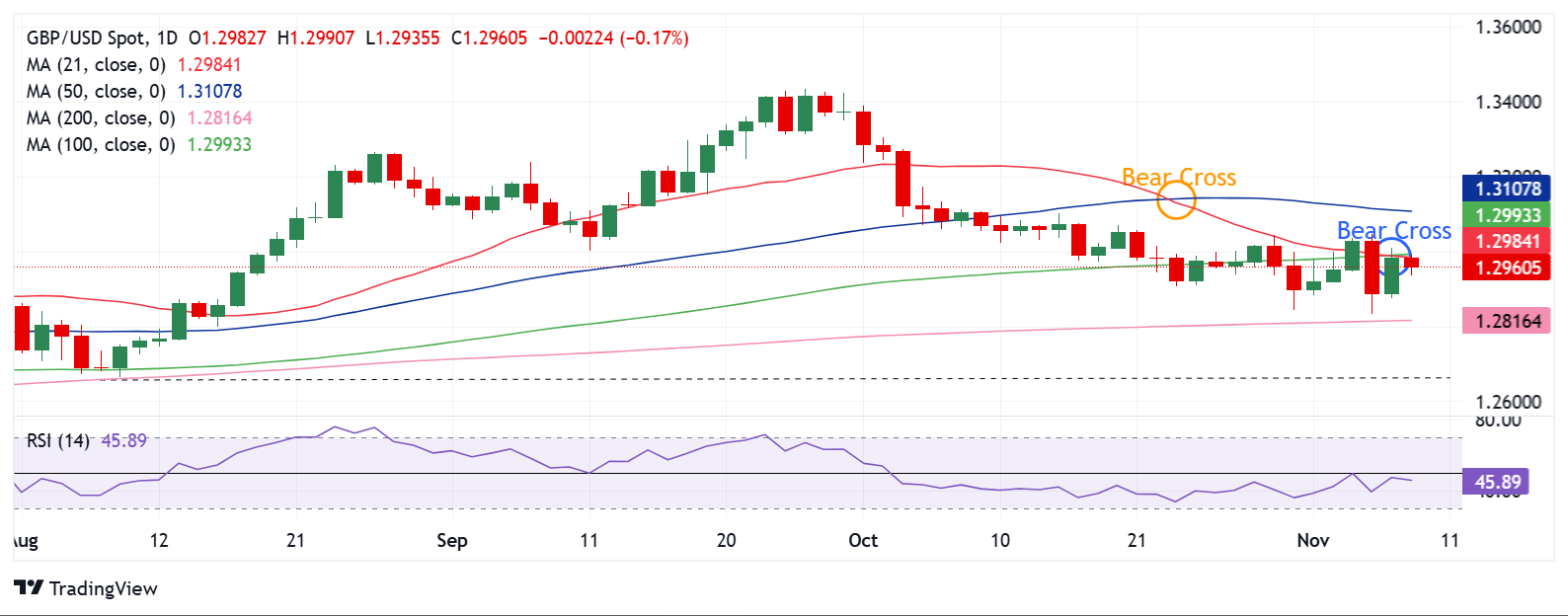
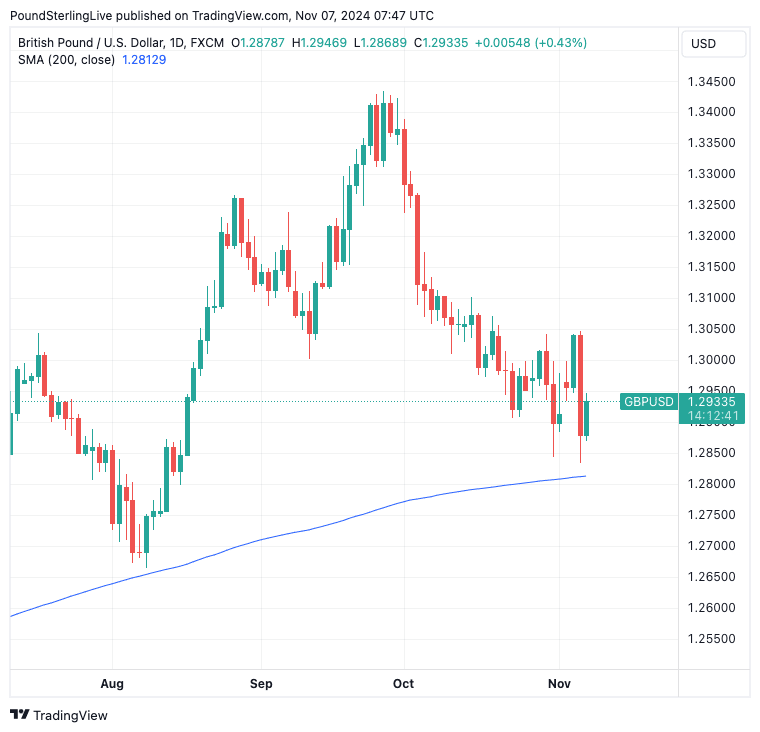
GBP/USD stays below the 20-period Simple Moving Average (SMA) and the 50-period SMA on the four-char, which made a bearish cross on Monday. Additionally, the Relative Strength Index moves sideways near 40, suggesting that the bearish bias remains intact but lacks momentum.

1.2900 (psychological level, static level) aligns as first support before 1.2875 (Fibonacci 38.2% retracement of the latest uptrend) and 1.2850 (100-period SMA).

On the upside, 1.2940-1.2950 (Fibonacci 23.6% retracement, 50-period SMA) forms resistance area ahead of 1.3000 (psychological level, static level).

Pound Sterling FAQs

The Pound Sterling (GBP) is the oldest currency in the world (886 AD) and the official currency of the United Kingdom. It is the fourth most traded unit for foreign exchange (FX) in the world, accounting for 12% of all transactions, averaging $630 billion a day, according to 2022 data. Its key trading pairs are GBP/USD, aka ‘Cable’, which accounts for 11% of FX, GBP/JPY, or the ‘Dragon’ as it is known by traders (3%), and EUR/GBP (2%). The Pound Sterling is issued by the Bank of England (BoE).

The single most important factor influencing the value of the Pound Sterling is monetary policy decided by the Bank of England. The BoE bases its decisions on whether it has achieved its primary goal of “price stability” – a steady inflation rate of around 2%. Its primary tool for achieving this is the adjustment of interest rates. When inflation is too high, the BoE will try to rein it in by raising interest rates, making it more expensive for people and businesses to access credit. This is generally positive for GBP, as higher interest rates make the UK a more attractive place for global investors to park their money. When inflation falls too low it is a sign economic growth is slowing. In this scenario, the BoE will consider lowering interest rates to cheapen credit so businesses will borrow more to invest in growth-generating projects.

Data releases gauge the health of the economy and can impact the value of the Pound Sterling. Indicators such as GDP, Manufacturing and Services PMIs, and employment can all influence the direction of the GBP. A strong economy is good for Sterling. Not only does it attract more foreign investment but it may encourage the BoE to put up interest rates, which will directly strengthen GBP. Otherwise, if economic data is weak, the Pound Sterling is likely to fall.

Another significant data release for the Pound Sterling is the Trade Balance. This indicator measures the difference between what a country earns from its exports and what it spends on imports over a given period. If a country produces highly sought-after exports, its currency will benefit purely from the extra demand created from foreign buyers seeking to purchase these goods. Therefore, a positive net Trade Balance strengthens a currency and vice versa for a negative balance.


  • GBP/USD continues to trade in a narrow channel above 1.2900.
  • The near-term technical outlook points to a slightly bearish bias.
  • Changes in risk perception could drive the pair’s action later in the day.

Following the sharp drop seen in the second half of the previous week, GBP/USD registered small gains on Monday. The pair struggles to attract bulls early Tuesday but manages to hold above 1.2900.

British Pound PRICE Last 7 days

The table below shows the percentage change of British Pound (GBP) against listed major currencies last 7 days. British Pound was the weakest against the Japanese Yen.

  USD EUR GBP JPY CAD AUD NZD CHF
USD   0.19% 0.36% -1.31% 0.60% 2.03% 1.86% -0.60%
EUR -0.19%   0.16% -1.49% 0.43% 1.82% 1.65% -0.80%
GBP -0.36% -0.16%   -1.67% 0.24% 1.66% 1.49% -0.95%
JPY 1.31% 1.49% 1.67%   1.93% 3.43% 3.22% 0.76%
CAD -0.60% -0.43% -0.24% -1.93%   1.43% 1.24% -1.19%
AUD -2.03% -1.82% -1.66% -3.43% -1.43%   -0.19% -2.60%
NZD -1.86% -1.65% -1.49% -3.22% -1.24% 0.19%   -2.41%
CHF 0.60% 0.80% 0.95% -0.76% 1.19% 2.60% 2.41%  

The heat map shows percentage changes of major currencies against each other. The base currency is picked from the left column, while the quote currency is picked from the top row. For example, if you pick the British Pound from the left column and move along the horizontal line to the US Dollar, the percentage change displayed in the box will represent GBP (base)/USD (quote).

The improving risk mood caused the US Dollar (USD) to lose interest in the American session on Monday, helping GBP/USD hold its ground. In the European session on Tuesday, the UK’s FTSE 100 Index trades marginally lower on the day and US stock index futures lose between 0.1% and 0.4%, reflecting a cautious market stance.

After Wall Street’s closing bell on Tuesday, Google (Alphabet), Visa and Tesla will be among the top companies that will release second-quarter earnings reports. Investors could opt to stay on the sidelines and make it difficult for major US equity indexes to build on Monday’s gains. In this scenario, the USD could stabilize and limit GBP/USD recovery attempts.

Existing Home Sales for June will be the only data featured in the US economic docket on Tuesday, which is unlikely to receive a noticeable market reaction. On Wednesday, preliminary July Manufacturing and Services PMI data from the UK and the US could trigger the next big action in GBP/USD.

GBP/USD Technical Analysis

GBP/USD stays below the 20-period Simple Moving Average (SMA) and the 50-period SMA on the four-char, which made a bearish cross on Monday. Additionally, the Relative Strength Index moves sideways near 40, suggesting that the bearish bias remains intact but lacks momentum.

1.2900 (psychological level, static level) aligns as first support before 1.2875 (Fibonacci 38.2% retracement of the latest uptrend) and 1.2850 (100-period SMA).

On the upside, 1.2940-1.2950 (Fibonacci 23.6% retracement, 50-period SMA) forms resistance area ahead of 1.3000 (psychological level, static level).

Pound Sterling FAQs

The Pound Sterling (GBP) is the oldest currency in the world (886 AD) and the official currency of the United Kingdom. It is the fourth most traded unit for foreign exchange (FX) in the world, accounting for 12% of all transactions, averaging $630 billion a day, according to 2022 data. Its key trading pairs are GBP/USD, aka ‘Cable’, which accounts for 11% of FX, GBP/JPY, or the ‘Dragon’ as it is known by traders (3%), and EUR/GBP (2%). The Pound Sterling is issued by the Bank of England (BoE).

The single most important factor influencing the value of the Pound Sterling is monetary policy decided by the Bank of England. The BoE bases its decisions on whether it has achieved its primary goal of “price stability” – a steady inflation rate of around 2%. Its primary tool for achieving this is the adjustment of interest rates. When inflation is too high, the BoE will try to rein it in by raising interest rates, making it more expensive for people and businesses to access credit. This is generally positive for GBP, as higher interest rates make the UK a more attractive place for global investors to park their money. When inflation falls too low it is a sign economic growth is slowing. In this scenario, the BoE will consider lowering interest rates to cheapen credit so businesses will borrow more to invest in growth-generating projects.

Data releases gauge the health of the economy and can impact the value of the Pound Sterling. Indicators such as GDP, Manufacturing and Services PMIs, and employment can all influence the direction of the GBP. A strong economy is good for Sterling. Not only does it attract more foreign investment but it may encourage the BoE to put up interest rates, which will directly strengthen GBP. Otherwise, if economic data is weak, the Pound Sterling is likely to fall.

Another significant data release for the Pound Sterling is the Trade Balance. This indicator measures the difference between what a country earns from its exports and what it spends on imports over a given period. If a country produces highly sought-after exports, its currency will benefit purely from the extra demand created from foreign buyers seeking to purchase these goods. Therefore, a positive net Trade Balance strengthens a currency and vice versa for a negative balance.


Source link

23 07, 2024

USD/JPY Forecast: BoJ Policy Outlook and Weak Yen Concerns Influence Trends

By |2024-07-23T04:54:46+03:00July 23, 2024|Forex News, News|0 Comments

Despite the weaker growth forecasts, investor bets on a July Bank of Japan rate hike linger. Economic indicators on Wednesday and Friday could dictate the BoJ’s policy maneuvers on July 31.

Japan’s Services PMI

On Wednesday, July 24, economists expect the Jibun Bank Services PMI to increase from 49.4 in June to 49.9 in July.

A higher-than-expected PMI could raise investor bets on a July BoJ rate hike. The BoJ needs the services sector to fuel demand-driven inflation. A sector returning to expansion could justify a rate hike to bolster the Japanese Yen.

However, investors should consider the sub-components, including prices. Higher wages would support a pickup in private consumption if a stronger Yen eases import price pressures.

Tokyo Inflation in Focus

On Friday, economists forecast Tokyo’s core inflation rate to rise from 2.1% in June to 2.2% in July.

A higher-than-expected core inflation rate could cement bets on a July BoJ rate hike.

Upward consumer price trends in Tokyo would align with national inflation trends. Japan’s inflation rate accelerated for the second month in June, supporting expectations of a July BoJ rate hike.

Bank of Japan Plans to Cut Japanese Government Bond Purchases

Beyond the possibility of an interest rate hike, the BoJ announced it would disclose its plans to reduce Japanese Government Bond (JGB) purchases in July.

A marked reduction in JGB purchases would likely narrow interest rate differentials between the US dollar and the Yen more significantly than rate hikes.

With US interest rates at 5.5%, a 0.1 to 0.5% increase by the BoJ would leave interest rate differentials firmly tilted toward the US dollar.

A BoJ rate hike and a convincing cut to JGB purchases could support a USD/JPY drop below 150.

What the Experts Say

Economists hold mixed views about the July BoJ monetary policy decision.

Unlimited Chief Investment Officer Bob Elliot commented on the national inflation numbers for June, stating,

“Japan continues to experience weak inflation, wage growth, demand, and GDP in contrast to much of the DW, with little urgency to tighten. While there are plenty of headlines trying to make a case for tightening, a more careful look at the data suggests little urgency.”

Bob Elliot attributed higher inflation to the roll-off of energy and travel subsidies. He also said there are expectations that the government will reintroduce subsidies in the summer, a downward drag on inflation.

Considering the likely effects of rate cuts and reductions in JGB purchases, the BoJ could cut JGB purchases more aggressively.

Nataxis Asia Pacific Chief Economist Alicia Garcia Herrero recently commented on JGB purchases, stating,

“Bank of Japan to start quantitative tightening, which could support the Yen more than intervention.”

US Economic Indicators

On Wednesday, the US housing sector will be in focus.

Economists predict existing home sales will increase by 3% in June after falling by 0.7% in May. Better-than-expected numbers could boost US dollar demand.

High demand for existing homes could tighten housing inventories and raise house prices. Higher house prices and tighter inventories may also push rental prices up. Higher rents can fuel housing services and headline inflation, which may reduce expectations of multiple 2024 Fed rate cuts.

However, investors should consider trends, as tight inventories can create volatile monthly existing home sales.

Source link

22 07, 2024

Rebounds could see 1.0950 retested

By |2024-07-22T22:50:08+03:00July 22, 2024|Forex News, News|0 Comments

You have reached your limit of 5 free articles for this month.

Get Premium without limits for only $479.76 for the first month

Access all our articles, insights, and analysts.

Your coupon code


UNLOCK OFFER

  • EUR/USD partially left behind recent bearishness.
  • The Dollar navigated a narrow range amidst firm yields.
  • Investors will look at US politics and key data this week.

The US Dollar (USD) retreated marginally on Monday, leaving the USD Index (DXY) around 104.30, despite a solid rebound in US yields across various time frames.

In response, EUR/USD halted its two-day pullback and revisited the 1.0900 barrier, although the move seems to have lacked conviction and fizzled out afterwards amidst the broad-based absence of volatility in the FX space.

Meanwhile, yields in the US and Germany edged higher following the change of landscape in the US political scenario, while ECB board member P. Kazimir advocated two more rate cuts for the remainder of the year if data supported those decisions.

Around the Fed, an interest rate cut in September appears fully priced in, while investors see another rate reduction in December.

Meanwhile, the Eurozone’s economic recovery prospects and signs of cooling in key US economic indicators may reduce the ongoing disparity in monetary policy between the Fed and the ECB, occasionally supporting the EUR/USD pair in the near future. This perspective has gained traction alongside rising expectations of Fed interest rate cuts.

Looking ahead, key US GDP figures, advanced PMIs across the FX world, and US PCE data should dictate the markets’ sentiment in the next few days.

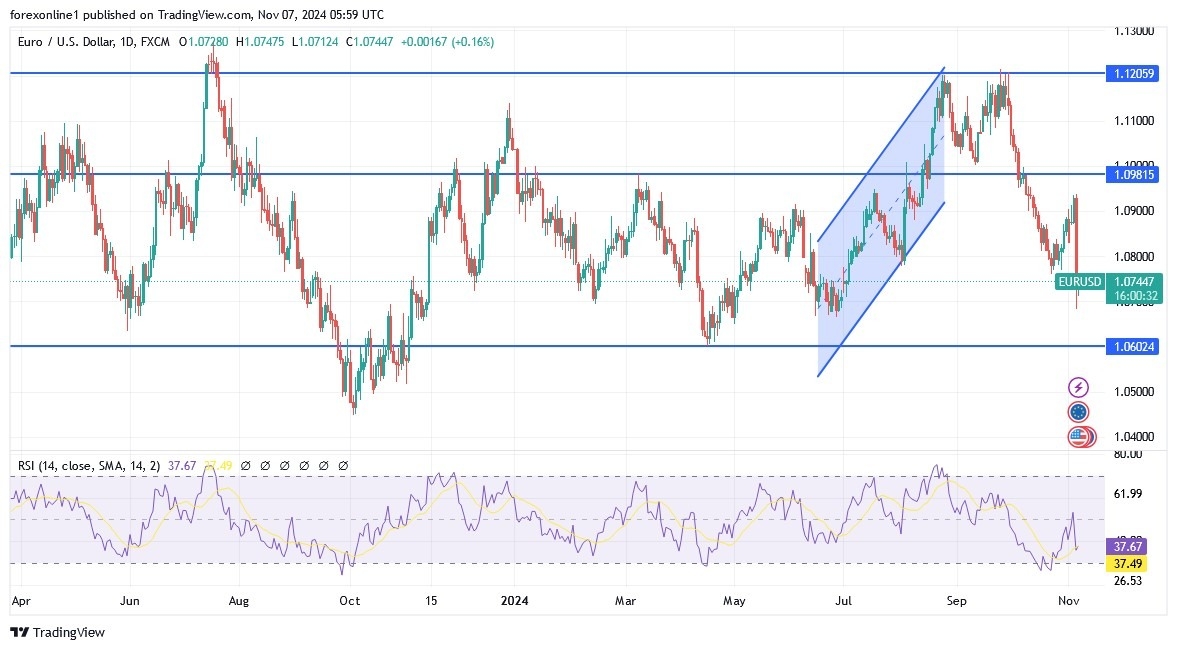
EUR/USD daily chart

EUR/USD short-term technical outlook

EUR/USD is projected to confront more upward resistance at the July peak of 1.0948 (July 17), followed by the March high of 1.0981 (March 8) and the key 1.1000 level.

If bears reclaim control, the pair may approach the 200-day SMA of 1.0813 before falling to the June low of 1.0666 (June 26). The loss of the May low of 1.0649 (May 1) leads to the 2024 bottom of 1.0601 (April 16).

Looking at the big picture, it appears that more gains are on the way if the par keeps the trade above the key 200-day SMA.

So far, the 4-hour chart indicates some temporary consolidation. However, the initial resistance is 1.0948, which comes before 1.0981 and 1.1000. On the other side, the 100-SMA at 1.0838 is first, followed by the 200-SMA at 1.0793 and then 1.0709. The relative strength index (RSI) improved to about 48.

  • EUR/USD partially left behind recent bearishness.
  • The Dollar navigated a narrow range amidst firm yields.
  • Investors will look at US politics and key data this week.

The US Dollar (USD) retreated marginally on Monday, leaving the USD Index (DXY) around 104.30, despite a solid rebound in US yields across various time frames.

In response, EUR/USD halted its two-day pullback and revisited the 1.0900 barrier, although the move seems to have lacked conviction and fizzled out afterwards amidst the broad-based absence of volatility in the FX space.

Meanwhile, yields in the US and Germany edged higher following the change of landscape in the US political scenario, while ECB board member P. Kazimir advocated two more rate cuts for the remainder of the year if data supported those decisions.

Around the Fed, an interest rate cut in September appears fully priced in, while investors see another rate reduction in December.

Meanwhile, the Eurozone’s economic recovery prospects and signs of cooling in key US economic indicators may reduce the ongoing disparity in monetary policy between the Fed and the ECB, occasionally supporting the EUR/USD pair in the near future. This perspective has gained traction alongside rising expectations of Fed interest rate cuts.

Looking ahead, key US GDP figures, advanced PMIs across the FX world, and US PCE data should dictate the markets’ sentiment in the next few days.

EUR/USD daily chart

EUR/USD short-term technical outlook

EUR/USD is projected to confront more upward resistance at the July peak of 1.0948 (July 17), followed by the March high of 1.0981 (March 8) and the key 1.1000 level.

If bears reclaim control, the pair may approach the 200-day SMA of 1.0813 before falling to the June low of 1.0666 (June 26). The loss of the May low of 1.0649 (May 1) leads to the 2024 bottom of 1.0601 (April 16).

Looking at the big picture, it appears that more gains are on the way if the par keeps the trade above the key 200-day SMA.

So far, the 4-hour chart indicates some temporary consolidation. However, the initial resistance is 1.0948, which comes before 1.0981 and 1.1000. On the other side, the 100-SMA at 1.0838 is first, followed by the 200-SMA at 1.0793 and then 1.0709. The relative strength index (RSI) improved to about 48.

Source link

22 07, 2024

Treading water around 1.0880 as investors await a catalyst

By |2024-07-22T18:47:53+03:00July 22, 2024|Forex News, News|0 Comments

You have reached your limit of 5 free articles for this month.

Get Premium without limits for only $479.76 for the first month

Access all our articles, insights, and analysts.

Your coupon code


UNLOCK OFFER

EUR/USD Current price: 1.0882

  • US President Joe Biden stepped down from the presidential race.
  • Financial markets stand cautious, but unable to find a directional strength.
  • EUR/USD pressures its recent lows, downward corrective slide losing steam.

The EUR/USD pair trades uneventfully around the 1.0880 level, little changed from Friday’s close. Financial markets showed little reaction to weekend political news, as United States (US) President Joe Biden announced through a letter posted in X that he is stepping down from the presidential race. He also endorsed Vice-President Kamala Harris to lead the Democratic party into victory against Republican Donald Trump.

The US Dollar shed some ground at the weekly opening but ground higher afterwards, heading into the American opening with a firmer tone. Meanwhile, the macroeconomic calendar has little to offer. The US released the June Chicago Fed National Activity Index, which resulted in 0.05, down from the 0.23 posted in the previous month.

Other than that, European stocks trade with a positive tone, although Wall Street is set to open where it left off on Friday.

EUR/USD short-term technical outlook

From a technical point of view, the daily chart for the EUR/USD pair suggests the corrective decline is losing strength. Technical indicators retreated from overbought readings but turning flat well above their midlines. Furthermore, the pair remains well above all its moving averages, with a bullish 20 Simple Moving Average (SMA) heading north above directionless 100 and 200 SMAs.

In the near term, and according to the 4-hour chart, the risk skews to the downside. The 20 SMA gains downward traction above the current level while technical indicators consolidate within negative levels without signs of downward exhaustion. Finally, the 100 SMA maintains its bullish slope below the current level, providing dynamic support in the 1.0820 price zone.

Support levels: 1.0865 1.0820 1.0770

Resistance levels: 1.0910 1.0945 1.0990  

EUR/USD Current price: 1.0882

  • US President Joe Biden stepped down from the presidential race.
  • Financial markets stand cautious, but unable to find a directional strength.
  • EUR/USD pressures its recent lows, downward corrective slide losing steam.

The EUR/USD pair trades uneventfully around the 1.0880 level, little changed from Friday’s close. Financial markets showed little reaction to weekend political news, as United States (US) President Joe Biden announced through a letter posted in X that he is stepping down from the presidential race. He also endorsed Vice-President Kamala Harris to lead the Democratic party into victory against Republican Donald Trump.

The US Dollar shed some ground at the weekly opening but ground higher afterwards, heading into the American opening with a firmer tone. Meanwhile, the macroeconomic calendar has little to offer. The US released the June Chicago Fed National Activity Index, which resulted in 0.05, down from the 0.23 posted in the previous month.

Other than that, European stocks trade with a positive tone, although Wall Street is set to open where it left off on Friday.

EUR/USD short-term technical outlook

From a technical point of view, the daily chart for the EUR/USD pair suggests the corrective decline is losing strength. Technical indicators retreated from overbought readings but turning flat well above their midlines. Furthermore, the pair remains well above all its moving averages, with a bullish 20 Simple Moving Average (SMA) heading north above directionless 100 and 200 SMAs.

In the near term, and according to the 4-hour chart, the risk skews to the downside. The 20 SMA gains downward traction above the current level while technical indicators consolidate within negative levels without signs of downward exhaustion. Finally, the 100 SMA maintains its bullish slope below the current level, providing dynamic support in the 1.0820 price zone.

Support levels: 1.0865 1.0820 1.0770

Resistance levels: 1.0910 1.0945 1.0990  

Source link

22 07, 2024

GBP/USD Analysis Today – 22/07: All eyes on BoE (Chart)

By |2024-07-22T16:46:52+03:00July 22, 2024|Forex News, News|0 Comments

  • The pound continues to retreat from recent highs, supported along the way by UK retail sales data that showed a sharp decline in activity in June.
  • According to reliable trading platforms, the pound fell below 1.19 against the euro and the pound against the US dollar GBP/USD approached 1.29 after the Office for National Statistics said that UK sales fell by 1.2% on a monthly basis in June, after growing by 2.9% in May. 

This was below the consensus forecast of -0.4%. The year-on-year growth rate was -0.2%, down from 1.3% and below estimates that indicated a 0.2% growth. According to the economic calendar, the Office for National Statistics stated that retailers cited election uncertainty, poor weather, and low foot traffic as factors affecting sales. Phil Monckhouse, Country Manager at Ebury UK, noted, “It’s clear that the wet summer we’ve experienced so far has deterred shoppers.” 

Maher Drag, Head of Research for the Americas at HSBC, added, “The pound weakens after weak retail sales data.” He explained, “The weak sales data follows labor market data that showed slowing wage growth. Together, these data points present a bearish outlook on the persistent and high services inflation, making the market pricing for the likely outcome of the Bank of England meeting in August finely balanced.” 

Meanwhile, July should see an improvement in retail activity as the UK weather settles in, the election is in the rearview mirror and consumer confidence improves. Data released on Friday from GfK already shows that UK consumer confidence has picked up this month. Furthermore, the GfK composite consumer confidence index rose to -13 in July from -14 in June. GfK reported a seven-point rise in the headline purchasing index (a sub-component of its consumer confidence survey), saying this was “likely to be good news for retailers and could translate into improved footfall in the coming months”. 

For sterling, the outlook now hinges on the Bank of England’s interest rate decision on August 1. Data this week confirmed no rate cut next month, with services inflation rising by 5.7% year-on-year in June. Such a strong reading suggests that broader inflation will start to pick up again in the coming months, especially as household energy bills are set to start rising again in the autumn. 

If the BoE abandons raising rates and continues to urge caution, sterling could remain supported as it benefits from one of the highest interest rates in the G10. Last Thursday’s wages data was more mixed, with some economists saying there was enough of a slack in the labor market underway to allow the Bank to cut rates. The bank says that strong wage growth will keep inflation high, but if it believes that wages are falling, it may believe that it can cut interest rates without stimulating inflation. Also, it will be aware that keeping interest rates high for too long could damage the economy. 

The August 1 decision is finely balanced, with many policymakers indicating they were close to voting for a rate hike at the June meeting. Unlikely, a rate cut is to significantly undermine the pound’s rally if accompanied by guidance warning that it is not on a predetermined path for further rate cuts. Ultimately, this could keep the pound supported until the end of the year. 

Technical forecasts for the GPB/USD pair today: 

As we mentioned before, the 1.3000 psychological resistance will remain the most important for bulls to control the direction of the GBP/USD pair, as it is the most prominent on the daily chart to confirm the strength of the uptrend. Now, bulls are trying to hold on to that as a continuation of the recent sell-off and a move to break the 1.2820 support threatens the recent bullish bounce path. 

Ready to trade our daily Forex analysis? We’ve made this UK forex brokers list for you to check out. 

Source link

22 07, 2024

USD/JPY Analysis Today – 22/07: When to Buy? (Chart)

By |2024-07-22T14:45:15+03:00July 22, 2024|Forex News, News|0 Comments

  • Last week, the USD/JPY continued its decline, reaching the support level of 155.37, the lowest for the pair in a month and a half, continuing a sell-off from the yen’s weakest level in 38 years.
  • Since mid-week, the USD/JPY rebounded to reach the resistance level of 157.86, stabilizing around 157.35 at the beginning of this week’s trading.
  • The USD/JPY rate will continue to be influenced by the future of central bank policies and the extent of Japanese intervention in the forex markets. 

According to reliable trading platforms, the performance of the US dollar was mixed at the opening of the first trading session of last week, as the assassination attempt on US presidential candidate Donald Trump sparked volatile trading conditions in the United States. As markets continue to price in a September rate cut by the Federal Reserve, the US dollar struggled to find support. 

Meanwhile, Tepid comments from Fed Chairman Jerome Powell on Monday evening left the greenback rudderless, before a stronger-than-expected batch of US retail sales data lifted the greenback on Tuesday afternoon. While growth stalled in June, an upward revision to the May release provided modest support to the US dollar. Recently, the US dollar has been continued to slide on Wednesday as bets on a Fed rate cut held back any significant movement. However, in the latter part of the session, the dollar attracted some investor support after the release of US industrial production data. 

 The release showed higher-than-expected output in June, while May’s figures were also revised higher. The latest US initial jobless claims data was released on Thursday. Also, the data showed a higher-than-expected number of newly unemployed Americans filing for benefits, suggesting continued stagnation in the US Labor market. However, the US dollar managed to resist losses after recovering from a brief period of oversold trading throughout the week, driven by overbought bets on a Fed rate cut. 

Overall, rising US Treasury yields and cautious market sentiment have supported the US dollar as a safe haven as the week draws to a close. 

USD/JPY Technical analysis and Expectations Today 

USD/JPY has now risen to trade near the 100-hour moving average line. As a result, the pair is trading near overbought levels on the 14-hour Relative Strength Index (RSI). In the near term, based on the hourly chart, USD/JPY is trading within an ascending channel. Also, the 14-hour RSI has risen to trade near overbought levels. Therefore, bulls will target extended gains around 158.00 or higher at 158.60. On the other hand, the bears will look to pounce on pullbacks around 156.80 or lower at 156.00. 

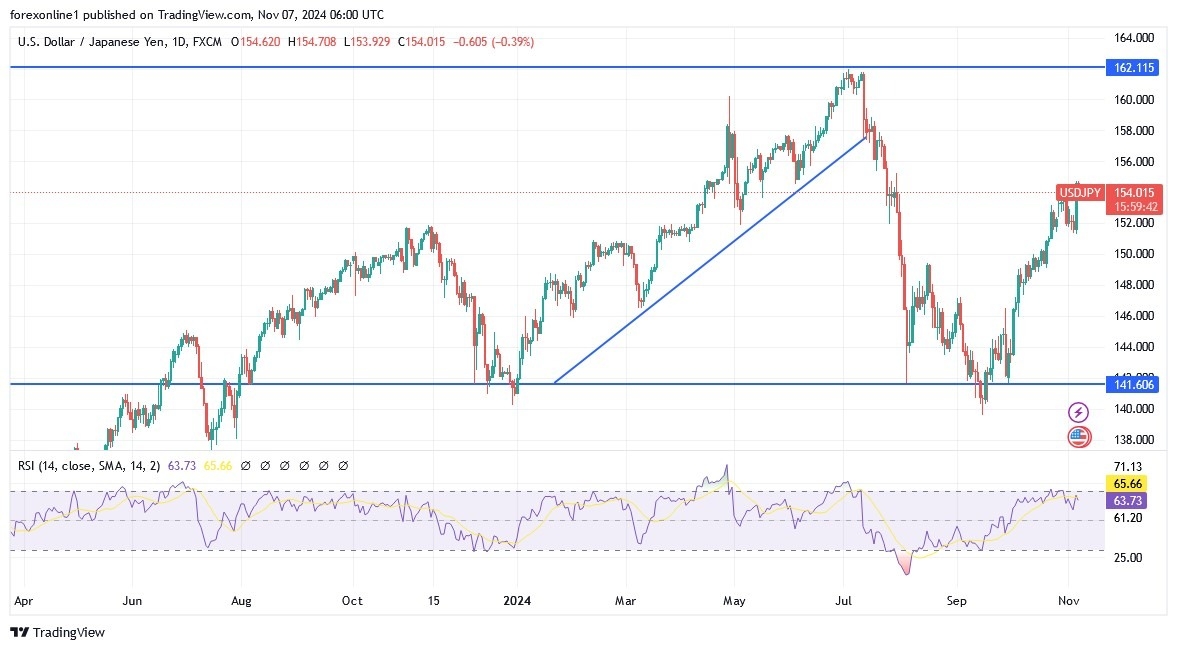
In the long term, based on the daily chart, the USD/JPY pair is trading within an ascending channel. However, the 14-day RSI has recently declined to trade near the oversold levels of the indicator. Therefore, the bears will target extended pullbacks around 154.81 or lower at the 152.53 support. On the other hand, the bulls will look to pounce on pullbacks around 159.72 or higher at the 162.00 resistance. 

Ready to trade our daily forex forecast? Here are the best forex brokers in Japan to choose from. 

Source link

22 07, 2024

Euro finds it difficult to gather bullish momentum

By |2024-07-22T12:44:00+03:00July 22, 2024|Forex News, News|0 Comments

You have reached your limit of 5 free articles for this month.

Get Premium without limits for only $479.76 for the first month

Access all our articles, insights, and analysts.

Your coupon code


UNLOCK OFFER

  • EUR/USD trades in a tight range slightly below 1.0900 early Monday.
  • Market reaction to US politics remain subdued at the beginning of the week.
  • The pair could stretch lower if 1.0880 support fails.

After closing the last two days of the previous week in negative territory, EUR/USD seems to have entered into a consolidation phase slightly below 1.0900 early Monday. The pair’s technical outlook points to a lack of buyer interest in the near term.

Euro PRICE Last 7 days

The table below shows the percentage change of Euro (EUR) against listed major currencies last 7 days. Euro was the strongest against the New Zealand Dollar.

  USD EUR GBP JPY CAD AUD NZD CHF
USD   0.17% 0.48% -0.82% 0.71% 1.81% 1.84% -0.75%
EUR -0.17%   0.34% -0.80% 0.72% 1.68% 1.85% -0.73%
GBP -0.48% -0.34%   -1.05% 0.37% 1.33% 1.46% -1.08%
JPY 0.82% 0.80% 1.05%   1.53% 2.42% 2.63% -0.13%
CAD -0.71% -0.72% -0.37% -1.53%   1.03% 1.13% -1.46%
AUD -1.81% -1.68% -1.33% -2.42% -1.03%   0.18% -2.37%
NZD -1.84% -1.85% -1.46% -2.63% -1.13% -0.18%   -2.55%
CHF 0.75% 0.73% 1.08% 0.13% 1.46% 2.37% 2.55%  

The heat map shows percentage changes of major currencies against each other. The base currency is picked from the left column, while the quote currency is picked from the top row. For example, if you pick the Euro from the left column and move along the horizontal line to the US Dollar, the percentage change displayed in the box will represent EUR (base)/USD (quote).

The US Dollar (USD) benefited from the souring risk mood in the second half of last week and caused EUR/USD to turn south. Additionally, several European Central Bank (ECB) officials hinted at another rate reduction in September on Friday, making it difficult for the Euro to gather strength.

Over the weekend, US President Joe Biden announced that he will no longer run for President at the upcoming election and endorsed Vice President Kamala Harris to be the new nominee. Nevertheless, markets showed little to no reaction to this development. 

In the European morning, US stock index futures trade modestly higher on the day. Investors, however, could refrain from taking large positions ahead of Tesla and Google’s second-quarter earnings figures, which will be released after the closing bell on Tuesday.

The US economic docket will not feature any high-tier data releases on Monday. Later in the week, S&P Global PMI data from Germany, the Eurozone and the US will be watched closely by market participants. On Thursday, the US Bureau of Economic Analysis will release its first estimate of the second-quarter Gross Domestic Product (GDP) growth ahead of Friday’s Personal Consumption Expenditures (PCE) Price Index

EUR/USD Technical Analysis

EUR/USD failed to return within the ascending regression channel coming from late June after testing the lower limit at the beginning of the week. Additionally, the Relative Strength Index (RSI) indicator on the 4-hour chart stays below 50, reflecting a lack of buyer interest.

On the downside, 1.0880 (Fibonacci 23.6% retracement of the latest uptrend) aligns as immediate support. If EUR/USD falls below that level and starts using it as resistance, 1.0840-1.0835 (Fibonacci 38.2% retracement, 100-period Simple Moving Average) could be seen as next support before 1.0810-1.0800 (Fibonacci 50% retracement, static level).

In case EUR/USD manages to rise above 1.0900-1.0910 (lower limit of the ascending channel, 20-period Simple Moving Average) and stabilize there, technical buyers could take action. In this scenario, 1.0940 (mid-point of the channel, static level) could act as strong resistance before 1.1000 (static level, psychological level) could be set as the next bullish target.

Euro FAQs

The Euro is the currency for the 20 European Union countries that belong to the Eurozone. It is the second most heavily traded currency in the world behind the US Dollar. In 2022, it accounted for 31% of all foreign exchange transactions, with an average daily turnover of over $2.2 trillion a day. EUR/USD is the most heavily traded currency pair in the world, accounting for an estimated 30% off all transactions, followed by EUR/JPY (4%), EUR/GBP (3%) and EUR/AUD (2%).

The European Central Bank (ECB) in Frankfurt, Germany, is the reserve bank for the Eurozone. The ECB sets interest rates and manages monetary policy. The ECB’s primary mandate is to maintain price stability, which means either controlling inflation or stimulating growth. Its primary tool is the raising or lowering of interest rates. Relatively high interest rates – or the expectation of higher rates – will usually benefit the Euro and vice versa. The ECB Governing Council makes monetary policy decisions at meetings held eight times a year. Decisions are made by heads of the Eurozone national banks and six permanent members, including the President of the ECB, Christine Lagarde.

Eurozone inflation data, measured by the Harmonized Index of Consumer Prices (HICP), is an important econometric for the Euro. If inflation rises more than expected, especially if above the ECB’s 2% target, it obliges the ECB to raise interest rates to bring it back under control. Relatively high interest rates compared to its counterparts will usually benefit the Euro, as it makes the region more attractive as a place for global investors to park their money.

Data releases gauge the health of the economy and can impact on the Euro. Indicators such as GDP, Manufacturing and Services PMIs, employment, and consumer sentiment surveys can all influence the direction of the single currency. A strong economy is good for the Euro. Not only does it attract more foreign investment but it may encourage the ECB to put up interest rates, which will directly strengthen the Euro. Otherwise, if economic data is weak, the Euro is likely to fall. Economic data for the four largest economies in the euro area (Germany, France, Italy and Spain) are especially significant, as they account for 75% of the Eurozone’s economy.

Another significant data release for the Euro is the Trade Balance. This indicator measures the difference between what a country earns from its exports and what it spends on imports over a given period. If a country produces highly sought after exports then its currency will gain in value purely from the extra demand created from foreign buyers seeking to purchase these goods. Therefore, a positive net Trade Balance strengthens a currency and vice versa for a negative balance.


  • EUR/USD trades in a tight range slightly below 1.0900 early Monday.
  • Market reaction to US politics remain subdued at the beginning of the week.
  • The pair could stretch lower if 1.0880 support fails.

After closing the last two days of the previous week in negative territory, EUR/USD seems to have entered into a consolidation phase slightly below 1.0900 early Monday. The pair’s technical outlook points to a lack of buyer interest in the near term.

Euro PRICE Last 7 days

The table below shows the percentage change of Euro (EUR) against listed major currencies last 7 days. Euro was the strongest against the New Zealand Dollar.

  USD EUR GBP JPY CAD AUD NZD CHF
USD   0.17% 0.48% -0.82% 0.71% 1.81% 1.84% -0.75%
EUR -0.17%   0.34% -0.80% 0.72% 1.68% 1.85% -0.73%
GBP -0.48% -0.34%   -1.05% 0.37% 1.33% 1.46% -1.08%
JPY 0.82% 0.80% 1.05%   1.53% 2.42% 2.63% -0.13%
CAD -0.71% -0.72% -0.37% -1.53%   1.03% 1.13% -1.46%
AUD -1.81% -1.68% -1.33% -2.42% -1.03%   0.18% -2.37%
NZD -1.84% -1.85% -1.46% -2.63% -1.13% -0.18%   -2.55%
CHF 0.75% 0.73% 1.08% 0.13% 1.46% 2.37% 2.55%  

The heat map shows percentage changes of major currencies against each other. The base currency is picked from the left column, while the quote currency is picked from the top row. For example, if you pick the Euro from the left column and move along the horizontal line to the US Dollar, the percentage change displayed in the box will represent EUR (base)/USD (quote).

The US Dollar (USD) benefited from the souring risk mood in the second half of last week and caused EUR/USD to turn south. Additionally, several European Central Bank (ECB) officials hinted at another rate reduction in September on Friday, making it difficult for the Euro to gather strength.

Over the weekend, US President Joe Biden announced that he will no longer run for President at the upcoming election and endorsed Vice President Kamala Harris to be the new nominee. Nevertheless, markets showed little to no reaction to this development. 

In the European morning, US stock index futures trade modestly higher on the day. Investors, however, could refrain from taking large positions ahead of Tesla and Google’s second-quarter earnings figures, which will be released after the closing bell on Tuesday.

The US economic docket will not feature any high-tier data releases on Monday. Later in the week, S&P Global PMI data from Germany, the Eurozone and the US will be watched closely by market participants. On Thursday, the US Bureau of Economic Analysis will release its first estimate of the second-quarter Gross Domestic Product (GDP) growth ahead of Friday’s Personal Consumption Expenditures (PCE) Price Index

EUR/USD Technical Analysis

EUR/USD failed to return within the ascending regression channel coming from late June after testing the lower limit at the beginning of the week. Additionally, the Relative Strength Index (RSI) indicator on the 4-hour chart stays below 50, reflecting a lack of buyer interest.

On the downside, 1.0880 (Fibonacci 23.6% retracement of the latest uptrend) aligns as immediate support. If EUR/USD falls below that level and starts using it as resistance, 1.0840-1.0835 (Fibonacci 38.2% retracement, 100-period Simple Moving Average) could be seen as next support before 1.0810-1.0800 (Fibonacci 50% retracement, static level).

In case EUR/USD manages to rise above 1.0900-1.0910 (lower limit of the ascending channel, 20-period Simple Moving Average) and stabilize there, technical buyers could take action. In this scenario, 1.0940 (mid-point of the channel, static level) could act as strong resistance before 1.1000 (static level, psychological level) could be set as the next bullish target.

Euro FAQs

The Euro is the currency for the 20 European Union countries that belong to the Eurozone. It is the second most heavily traded currency in the world behind the US Dollar. In 2022, it accounted for 31% of all foreign exchange transactions, with an average daily turnover of over $2.2 trillion a day. EUR/USD is the most heavily traded currency pair in the world, accounting for an estimated 30% off all transactions, followed by EUR/JPY (4%), EUR/GBP (3%) and EUR/AUD (2%).

The European Central Bank (ECB) in Frankfurt, Germany, is the reserve bank for the Eurozone. The ECB sets interest rates and manages monetary policy. The ECB’s primary mandate is to maintain price stability, which means either controlling inflation or stimulating growth. Its primary tool is the raising or lowering of interest rates. Relatively high interest rates – or the expectation of higher rates – will usually benefit the Euro and vice versa. The ECB Governing Council makes monetary policy decisions at meetings held eight times a year. Decisions are made by heads of the Eurozone national banks and six permanent members, including the President of the ECB, Christine Lagarde.

Eurozone inflation data, measured by the Harmonized Index of Consumer Prices (HICP), is an important econometric for the Euro. If inflation rises more than expected, especially if above the ECB’s 2% target, it obliges the ECB to raise interest rates to bring it back under control. Relatively high interest rates compared to its counterparts will usually benefit the Euro, as it makes the region more attractive as a place for global investors to park their money.

Data releases gauge the health of the economy and can impact on the Euro. Indicators such as GDP, Manufacturing and Services PMIs, employment, and consumer sentiment surveys can all influence the direction of the single currency. A strong economy is good for the Euro. Not only does it attract more foreign investment but it may encourage the ECB to put up interest rates, which will directly strengthen the Euro. Otherwise, if economic data is weak, the Euro is likely to fall. Economic data for the four largest economies in the euro area (Germany, France, Italy and Spain) are especially significant, as they account for 75% of the Eurozone’s economy.

Another significant data release for the Euro is the Trade Balance. This indicator measures the difference between what a country earns from its exports and what it spends on imports over a given period. If a country produces highly sought after exports then its currency will gain in value purely from the extra demand created from foreign buyers seeking to purchase these goods. Therefore, a positive net Trade Balance strengthens a currency and vice versa for a negative balance.


Source link

22 07, 2024

EUR/GBP Forecast Today – 22/07: EUR/GBP recovers (Chart)

By |2024-07-22T10:42:28+03:00July 22, 2024|Forex News, News|0 Comments

  • The EUR/GBP pair looks as if it is trying to continue its overall trajectory to the upside.
  • Ultimately, the market has fallen rather significantly only to turn around and show signs of life. The 0.84 level has been conquered again, so we can stay above your that would obviously be a very bullish sign.
  • If we can continue to go higher, then we could challenge the 50-Day EMA, which of course is a technical indicator that a lot of people would pay close attention to.
  • If we can break above that, then it’s likely that the market could go looking to the 0.85 level.

Volatility of course is going to continue to be a major issue, and we have of course seen a lot of negativity overall. The market is most certainly in a very negative trend, and therefore I think we’ve got a situation where a lot of people will be looking at this as a potential issue, but it certainly is worth noting that the 0.84 level is a massive support level on the monthly chart, so we are most certainly in an area where you are going to see a lot of decisions asked.

Euro, and the European Central Bank

The euro of course is moving based upon the recent statements coming out of the European Central Bank, and the fact that perhaps the central bank did not cut rates like a lot of people thought they with this past week. However, the question then becomes whether or not the euro is going to continue to strengthen. That of course is a completely different question, but I do believe that if the market were to rally from here and break above the 0.85 level, that would be a huge boon for the euro itself.

If we were to see the market breaks significantly lower, then we could see this pair trade all the way down to the 0.80 level. Because of this, I think you’ve got a scenario where buyers are trying to come in and pick up a bit of value, but even if we do turn things around here, it’s going to be more or less a grind to the upside.

Ready to trade daily forex forecast? Here are the best forex trading platforms for beginners to choose from. 

Source link

Go to Top