The main tag of Forex News Today Articles.
You can use the search box below to find what you need.
[wd_asp id=1]

30 05, 2024

USD/JPY Forecast Today 30/5: Buy the Dips (Video+Chart)

By |2024-05-30T10:56:34+03:00May 30, 2024|Forex News, News|0 Comments

  • The US dollar initially pulled back just a bit during the trading session on Wednesday, but it looks like we continue to find plenty of value hunting.
  • This is a market that pays you at the end of the day to hang on to it.
  • The fact that the swap on Wednesday is typically a triple swap with most brokers, it makes sense that Wednesday would be a positive session.

It’s been positive for ages and should continue to be

Whether or not it hangs on to this positivity remains to be seen, but clearly, this is a market that I think will continue to favor the upside regardless. I like the idea of buying dips when they happen, but they just don’t happen that much. Underneath, we have the 155 yen level as an area of potential support, as it is a large round psychologically significant figure, and it is also attracting the 50 day EMA.

On the upside we have the 158 yen level offering resistance due to the Bank of Japan intervention several weeks ago. We have seen other currencies break out to fresh new highs against the Japanese yen, so I don’t see why this USD/JPY one won’t eventually. With this I do believe that we are trying to get to the 160 yen level which of course is the next major level. If we can break above that, then it kicks off the next leg higher in the overall uptrend. After all, the interest rate differential between these two currencies isn’t going to change anytime soon.

Make sure to position size accordingly, because that of course can cause a significant amount of trouble if you get overexposed. Furthermore, keep in mind that some other currencies are behaving much stronger against the Japanese yen than the US dollar, so although this is a great measuring stick for the weakness of the Japanese yen, the reality is that although we go higher, you may get more momentum in other pairs such as the GBP/JPY pair or even the NZD/JPY pair.

Ready to trade our daily Forex forecast? Here’s a list of some of the best online forex trading platforms to check out. 

Source link

30 05, 2024

Continues to See Support -Video

By |2024-05-30T08:55:29+03:00May 30, 2024|Forex News, News|0 Comments

  • The Euro has bounced slightly against the British pound during the trading session on Wednesday, as we continue to pay close attention to the 0.85 level.
  • This is a market that I think will continue to be very noisy, and it’s probably worth noting that the 0.85 level has been crucial multiple times in the past.

Because of this, I think you have to look at it through the prism of a market that is trying everything it can to hang on to overall support. Zooming out, you can see that the 0.85 level has been crucial going back to at least the middle of 2022, but there’s been multiple times in the past that it has also caused a lot of attention.

Even with support there are still concerns

That being said, there does seem to be a lot of resistance just above that you will have to deal with, not the least of which will be the 0.8525 level. If we can break above there, then I think you have a real shot at this market recovering. In that environment, we would more likely than not go looking to the 50-day EMA, and then eventually the 200-day EMA after that, which sits just below the crucial 0.86 level, which is the top of the consolidation area.

If we break down below the bottom of the candlestick for the trading session on Wednesday, we could see this market drop another 100 pips. Keep in mind that the position sizing in this pair is a little bit different. The pip value is higher, so you need to be cautious about that, but recognize that we are at a major inflection point that a lot of people will be paying close attention to.

At this point, we could be setting the table for the next major move, and therefore we need to pay close attention to how this is resolved. Over the longer term, I would anticipate a bounce, but we also have to keep in mind that the European Central Bank is very likely to cut rates so that of course has caused a lot of concerns when it comes to holding the euro.

Ready to trade our Forex daily forecast? We’ve shortlisted the best FX trading platform in the industry for you. 

Source link

30 05, 2024

USD/JPY Forecast: Yen Weakness in Focus as Investors Eye BoJ’s Next Moves

By |2024-05-30T04:52:59+03:00May 30, 2024|Forex News, News|0 Comments

Tight labor market conditions could support wage growth and increase disposable income. Higher disposable income may fuel consumer spending and demand-driven inflation.

Other stats include housing sector data. However, these will likely play second fiddle to the GDP and labor market numbers.

Beyond the numbers, Fed commentary needs consideration. Reactions to recent US economic data, views on inflation, and the Fed rate path could move the dial. Fed Vice Chair John Williams and FOMC member Lorie Logan are on the calendar to speak.

Short-term Forecast

Near-term trends for the USD/JPY may depend on the Japanese and US inflation figures. However, BoJ and Fed chatter could also influence near-term price trends in the USD/JPY pairing. Moreover, investors should consider the implications of a weaker Yen on BoJ policy goals.

USD/JPY Price Action

Daily Chart

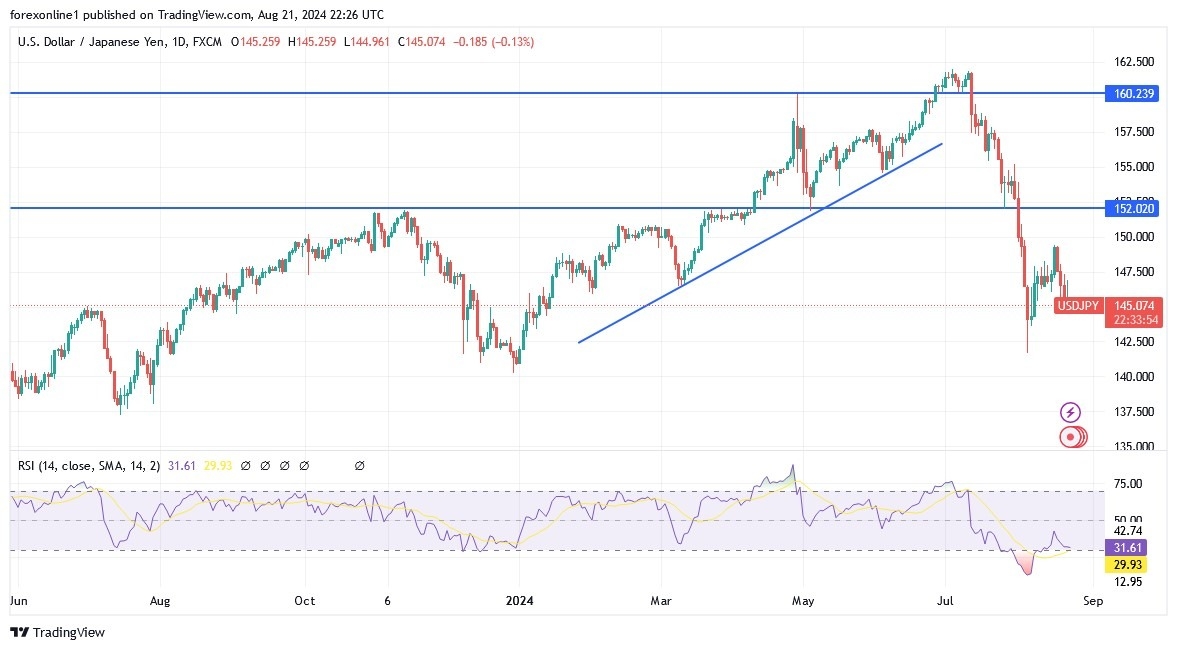
The USD/JPY sat well above the 50-day and 200-day EMAs, confirming the bullish price trends.

A USD/JPY breakout from the 157.5 handle could give the bulls a run at the 160 handle. Furthermore, a return to 160 could signal a move to the April 29 high of 160.209.

US GDP, initial jobless claims, and central bank comments need consideration before the Friday session.

Conversely, a USD/JPY fall through the 157 handle could signal a drop toward the 50-day EMA. A break below the 50-day EMA could give the bears a run at the 151.685 support level.

The 14-day RSI at 64.39 indicates a USD/JPY climb to the April 29 high of 160.209 before entering overbought territory.

Source link

30 05, 2024

The 1.0800 support holds the downside so far

By |2024-05-30T00:50:31+03:00May 30, 2024|Forex News, News|0 Comments

You have reached your limit of 5 free articles for this month.

Take advantage of the Special Price just for today!

50% OFF and access to ALL our articles and insights.

Your coupon code


Subscribe to Premium

  • EUR/USD tumbles to three-day lows near 1.0800.
  • The Greenback picked up extra pace amidst higher yields.
  • The ECB might not reduce its interest rates in June.

The US Dollar (USD) managed to extend its weekly recovery, making the risk complex vulnerable and prompting another test of the vicinity of the 1.0800 zone by EUR/USD on Wednesday.

The pair’s second consecutive daily retracement occurred amidst the acceleration of the upside momentum in the Greenback and a significant rebound in US yields, driven by renewed speculation that the Federal Reserve (Fed) might maintain its restrictive stance longer than anticipated, a view supported by recent hawkish comments from Fed officials.

On the latter, the President of the Federal Reserve Bank of Minneapolis, Neel Kashkari, emphasized that the Fed should wait for significant progress on inflation before considering interest rate cuts. He went even further and argued that the Fed might hike rates in the event that disinflationary pressures stall.

According to the CME Group’s FedWatch Tool, the probability of lower interest rates by September has now decreased to nearly 40%, down from over 60% last week.

Regarding the European Central Bank (ECB), higher inflation figures in May poured cold water over expectations of a rate cut in June ahead of the release of the flash CPI for the broader Euroland later in the week.

Looking ahead, the relatively subdued economic fundamentals in the Eurozone, coupled with the resilience of the US economy, reinforce the ongoing narrative of Fed-ECB policy divergence and suggest a stronger Dollar in the long run. Given the rising likelihood of the ECB reducing rates before the Fed, the potential for further weakness in EUR/USD should be considered in the medium term.

EUR/USD daily chart

EUR/USD short-term technical outlook

Extra weakness might drag EUR/USD to the 200-day SMA of 1.0787 prior to the May low of 1.0649 (May 1), ahead of the 2024 bottom of 1.0601 (April 16) and the November 2023 low of 1.0516 (November 1). Once this zone is passed, the pair may go for the weekly low of 1.0495 (October 13, 2023), the 2023 low of 1.0448 (October 3), and the 1.0400 round milestone.

If bulls regain the upper hand, EUR/USD might revisit the May high of 1.0894 (May 16), ahead of the March top of 1.0981 (March 8) and the weekly peak of 1.0998 (January 11), all before hitting the important 1.1000 level.

So far, the 4-hour chart indicates the continuation of the downward bias. The next upward barrier is the 55-SMA at 1.0849 ahead of 1.0894, and 1.0942. Looking southward, 1.0807 comes first before 1.0766 and the 200-SMA at 1.0756. The relative strength index (RSI) dropped to about 32.

  • EUR/USD tumbles to three-day lows near 1.0800.
  • The Greenback picked up extra pace amidst higher yields.
  • The ECB might not reduce its interest rates in June.

The US Dollar (USD) managed to extend its weekly recovery, making the risk complex vulnerable and prompting another test of the vicinity of the 1.0800 zone by EUR/USD on Wednesday.

The pair’s second consecutive daily retracement occurred amidst the acceleration of the upside momentum in the Greenback and a significant rebound in US yields, driven by renewed speculation that the Federal Reserve (Fed) might maintain its restrictive stance longer than anticipated, a view supported by recent hawkish comments from Fed officials.

On the latter, the President of the Federal Reserve Bank of Minneapolis, Neel Kashkari, emphasized that the Fed should wait for significant progress on inflation before considering interest rate cuts. He went even further and argued that the Fed might hike rates in the event that disinflationary pressures stall.

According to the CME Group’s FedWatch Tool, the probability of lower interest rates by September has now decreased to nearly 40%, down from over 60% last week.

Regarding the European Central Bank (ECB), higher inflation figures in May poured cold water over expectations of a rate cut in June ahead of the release of the flash CPI for the broader Euroland later in the week.

Looking ahead, the relatively subdued economic fundamentals in the Eurozone, coupled with the resilience of the US economy, reinforce the ongoing narrative of Fed-ECB policy divergence and suggest a stronger Dollar in the long run. Given the rising likelihood of the ECB reducing rates before the Fed, the potential for further weakness in EUR/USD should be considered in the medium term.

EUR/USD daily chart

EUR/USD short-term technical outlook

Extra weakness might drag EUR/USD to the 200-day SMA of 1.0787 prior to the May low of 1.0649 (May 1), ahead of the 2024 bottom of 1.0601 (April 16) and the November 2023 low of 1.0516 (November 1). Once this zone is passed, the pair may go for the weekly low of 1.0495 (October 13, 2023), the 2023 low of 1.0448 (October 3), and the 1.0400 round milestone.

If bulls regain the upper hand, EUR/USD might revisit the May high of 1.0894 (May 16), ahead of the March top of 1.0981 (March 8) and the weekly peak of 1.0998 (January 11), all before hitting the important 1.1000 level.

So far, the 4-hour chart indicates the continuation of the downward bias. The next upward barrier is the 55-SMA at 1.0849 ahead of 1.0894, and 1.0942. Looking southward, 1.0807 comes first before 1.0766 and the 200-SMA at 1.0756. The relative strength index (RSI) dropped to about 32.

Source link

29 05, 2024

GBP/USD Analysis Today 29/5: Mid-Uptrend Consolidation

By |2024-05-29T20:48:40+03:00May 29, 2024|Forex News, News|0 Comments

  • GBP/USD is consolidating in a mid-uptrend this week, with gains extending to the 1.2800 resistance level, the highest in two months, before settling around 1.2760 at the time of writing.
  • According to the economic calendar, there are no major reports from the UK today, leaving GBP vulnerable to selling against the dollar, which has been supported by stronger-than-expected consumer confidence data.

The US Federal Reserve’s Beige Book will be released next, and the performance of the Fed’s regions is likely to influence the economic and policy outlook. The improvements could confirm the central bank’s preference to keep borrowing costs higher for longer, which could mean more upside for the US currency. Weak results could revive expectations for three interest rate cuts this year.

On Thursday, the preliminary US GDP report will be released and may have a stronger impact on the US dollar price trends.

According to forex market trading, GBP has generally held its ground in global markets, with the GBP/EUR (GBP/EUR) exchange rate again testing the key resistance zone around 1.1765 without being able to break through. According to licensed trading platforms, GBP will gain new momentum if the GBP/USD pair can break above 1.28, especially if GBP/EUR moves above 1.1765.

There were no major domestic developments today as stock markets fell, with the FTSE 100 down 0.9%. Weaker stock markets tend to be a headwind for GBP.

According to the economic calendar, US consumer confidence rebounded to 102.0 for May from a revised 97.5 the previous month and above consensus expectations of 96.0. The further decline this month could have been the lowest reading since July 2022. The current conditions index rose to 143.1 from 140.6 in April, while the expectations component improved strongly to 74.6 from 68.8, although this remains in recession territory.

On the other hand, according to Dana M. Peterson, chief economist at The Conference Board, “Confidence improved in May after three consecutive months of decline. Consumers’ assessment of current business conditions was slightly less positive than last month. “However, the strong labor market continued to reinforce it.” Overall, the data will provide some reassurance about near-term consumer spending trends, although there remains an important element of uncertainty. For its part, ING Bank commented: “The big question for domestic demand in the United States is whether spending by the top 20% of households in terms of income can continue to compensate for the struggles faced by the bottom 60% of households. Furthermore, ING Bank’s call is that higher interest rates will eventually weigh on consumption and weigh on growth in the US during the year. Besides, there will be ongoing discussion of the broader economy, inflation, and interest rates.

MUFG notes that there has been significant debate about the potential neutral rate for interest rates. Consequently, this will have an important impact on the implications for shorter-term interest rates.

If the natural rate rises, it will make it difficult for the Fed to cut rates significantly. Accordingly, US data will continue to be closely monitored. In this regard, MUFG commented: “This growing discussion around the implied neutral policy stance could have an increasing impact on pushing up market yields if the economy fails to slow down. Moreover, it has been in the early days since the FOMC minutes highlighted the debate around the restrictive policy stance that markets may now be more sensitive to incoming data that is stronger than expected – such as the PMI data released last week that did not tend to move markets much.”

ING Bank pointed out the importance of the US economy to global markets. At the heart of this story, investors are once again preparing for a soft landing in the United States. Central to this is the release of core PCE inflation data for April on Friday. After taking inputs from the already released US CPI and PPI numbers for April, the consensus now expects Friday’s number to come in at 0.2% m/m. clearly, such an outcome could rebuild expectations for a rate cut by the Fed in September (now priced at 44% probability) and hold the dollar lower.

Technical forecasts for the GBP/USD pair today:

Based on recent trades, the GBP/USD price has been forming higher lows and higher highs connected by an ascending channel on the hourly chart, and the price is currently in a correction phase. Meanwhile, the Fibonacci retracement tool shows that the 50% level aligns with the channel support around the secondary psychological mark at 1.2750, in addition to the dynamic inflection point of the 100 SMA. The 100 SMA is above the 200 SMA, indicating that the stronger path is the upward trend or that the uptrend is likely to resume rather than reverse.

Therefore, a larger correction could reach the 61.8% Fibonacci level at 1.2723, near the dynamic support of the 200 SMA, which may serve as the threshold for the bullish pullback. In other words, a break below this level could mean that a reversal is in place. The Stochastic indicator is heading downwards, showing some remaining bearish pressure, but it is also moving into the oversold area, indicating seller exhaustion. In the meantime, the RSI has a chance to drop before reaching the oversold area, so the correction may continue until that happens.

A rise would confirm that buyers are returning, potentially pushing the GBP/USD price back up to the recent high near 1.2800 and the top of the channel.

Ready to trade our daily Forex forecast? Here’s a list of some of the top forex brokers UK to check out. 

Source link

29 05, 2024

USD/JPY Analysis Today 29/5: Inflation Data (Chart)

By |2024-05-29T18:47:26+03:00May 29, 2024|Forex News, News|0 Comments

  • In today’s trading, the value of the yen fell to more than 157 yen per dollar, reaching its lowest level in four weeks and facing pressure from a strong dollar and Treasury yields.
  • Clearly, these moves came as a lackluster US government debt auction raised concerns about demand for US Treasuries, while a Fed official added fuel to concerns about US interest rates.
  • This keeps the wide gap between US and Japanese yields intact, encouraging yen carry trades.
  • According to forex market trading, the USD/JPY price rose to the 157.40 resistance level and is stable around it at the time of writing the analysis.

Meanwhile, Bank of Japan board member Seiji Adachi said that the central bank could raise interest rates if the sharp decline in the yen leads to further inflation. According to economic calendar data, last week, data showed that Japan’s core inflation rate slowed to 2.2% in April from 2.6% in March due to moderating food inflation, in line with expectations. Also, the headline rate fell to 2.5% in April from 2.7% in March, declining for the second consecutive month.

US Central Bank Policy

“Most people thought we would be in a recession by the end of last year, and that hasn’t happened. Instead, we’ve had very strong growth. US consumers have remained remarkably resilient, and the housing market has also remained resilient. So, I don’t see any need to rush into cutting rates. I think we need to take our time and do it right.”

The US Federal Reserve member also said: “Most people thought we would be in a recession towards the end of last year, and that did not happen.” Instead, we achieved very strong growth. American consumers have remained remarkably resilient, and the housing market has remained resilient. Therefore, I do not see the need to rush and lower interest rates. Also, “I think we have to take our time and do it right.”

He added, “At the beginning of this year, inflation moved sideways, which raised questions in my mind: Will the deflation process continue, or will we fall to an inflation level above 3%?” furthermore, “I think it is still too early to know and we will have to wait and see to gain more confidence. Ultimately, I don’t think we should rule anything out at this point. We are all committed to bringing inflation back to our 2% target.”

USD/JPY Technical Analysis and Expectations Today

The ongoing divergence between the future policies of the US Federal Reserve and the Bank of Japan will remain a significant factor in maintaining the upward trend of the USD/JPY exchange rate. Technically, this trend may continue until Japanese intervention in the currency markets to prevent further depreciation of the yen, which harms the Japanese economy. According to the current performance, the nearest resistance levels for the upward trend are 157.85, 158.20, and 159.00, respectively. Furthermore, with the understanding that these levels may be sufficient to push all technical indicators towards strong overbought conditions, as shown in the daily chart above.

Ready to trade our Forex daily forecast? We’ve shortlisted the best FX trading platform in the industry for you

Source link

29 05, 2024

EUR/USD Analysis Today 29/5: Bulls Need Stimulus (Chart)

By |2024-05-29T16:45:31+03:00May 29, 2024|Forex News, News|0 Comments

  • In an attempt to further rebound the EUR/USD price, the pair rose towards the 1.0889 resistance level yesterday before stabilizing around the 1.0850 level at the time of writing the analysis.
  • Recently, the euro is waiting for the announcement of the German inflation figure today.
  • At the same time, the US dollar remains bullish in anticipation of the future tightening of the Federal Reserve’s policy.

What is expected for the EUR/USD price in the coming days?

In this regard, according to Danske Bank, although the narrow ranges will continue at first, there will be some signs of weakness in the US economy and the recovery of the Eurozone may lead to slight risks to the upside of the Euro/Dollar (EUR/USD) exchange rate. Now, markets expect less than a 20% chance of a US interest rate cut in July. However, Danske Bank believes that a reduction in July may still be possible and notes that the influx of US data indicated some weakness in the economy. Furthermore, the latest PCE price data at the end of May as well as the ISM Business Confidence and latest employment report in early June are expected to be critical.

Compatibly, there are two more releases on inflation ahead of the July meeting.

According to licensed trading platforms, the EUR/USD currency pair reached its highest level in 8 weeks below the 1.09 level last week before drifting to 1.0835. obviously, EUR/USD has only traded above 1.10 twice this year and Danske Bank expects heavy selling at any approach to 1.10. Looking at interest rates, Danske expects the Fed to cut rates by 25 basis points at its September policy meeting, with further easing in December.

As for the European Central Bank, it agrees with the strong market view that interest rates will be cut in June and expects two more cuts before the end of 2024. Also, the bank said in its forecast, “We still believe that fundamentals point to a medium-term decline in EUR/USD, including the structural case for stronger growth dynamics in the US.” Added, “In the near term, we believe there is downside risk to US yields, posing a slight upside risk to EUR/USD; however, we generally believe the pair will continue to trade in a tight range in the near term. Thus, continued downside surprises in the US macro economy could lead to some tactical weakness in the US dollar, but we believe the potential is somewhat limited.”

EUR/USD Technical analysis and forecast:

We expect the EUR/USD exchange rate to remain within its current range until the announcement of the US inflation figures favoured by the Federal Reserve and the Eurozone inflation figures. According to the daily chart performance attached, the 1.080 support level remains crucial for the bears to move further downward. Conversely, the bulls will not gain significant control of the trend without moving towards the resistance levels of 1.0890 and 1.0955, which would encourage a push towards the psychological resistance at 1.1000. Ultimately, the strategy of selling the EUR/USD remains the strongest.

Ready to trade our Forex daily analysis and predictions? Here’s a list of regulated forex brokers to choose from. 

Source link

29 05, 2024

GBP/JPY Forecast – Pound Looks Tired Against the Yen

By |2024-05-29T14:44:44+03:00May 29, 2024|Forex News, News|0 Comments

GBP/JPY Forecast Video for 13.06.23

British Pound vs Japanese Yen Technical Analysis

The British pound has rallied a bit during the early hours on Monday, to continue the move above the ¥175 level. That being said, the market does look like it’s running into a lot of resistance, and perhaps the British pound is a little bit tired against the Japanese yen. Nonetheless, there is a lot of support underneath, so I do think that this will only open up the likelihood of buyers jumping into this market based on value. The ¥175 level of course is a significant round figure that a lot of people will pay attention to, and an area where we had seen a lot of resistance previously. If we were to break above the top of the candlestick for the Monday session, that would obviously be a very bullish sign.

Underneath, I see the ¥172.50 level as potential support, so if we were to break down significantly, then that will be our first major buying area. Underneath there, then you have the ¥170 level, where the 50-Day EMA has just crossed. It is probably worth mentioning that there is a minor support level near the ¥171.50 level, so that could also come into the picture as well.

At this point, the pair does continue to be very noisy, but overall it does end up being a lot of upward momentum over the longer term. Quite frankly, this is just simply a matter of trying to find “cheap pounds” and take advantage of the overall structural weakness of the Japanese yen. Furthermore, the Bank of Japan does have a meeting on Friday, and therefore that could come into the picture as well, although they have already somewhat signaled that that it is very unlikely that they are going to be doing anything to change monetary policy.

In other words, you continue to get paid to hang on to this currency pair via swap, so I just don’t see why traders would suddenly run away from that interest-rate differential situation. Ultimately, I do think that we will try to get to the ¥177.50 level, but you don’t want to be overly exposed to any particular one currency pair at the moment right now, due to the fact that we have so many central banks meeting this week.

For a look at all of today’s economic events, check out our economic calendar.

This article was originally posted on FX Empire

More From FXEMPIRE:

Source link

29 05, 2024

Pound Sterling could correct lower on risk aversion

By |2024-05-29T12:43:59+03:00May 29, 2024|Forex News, News|0 Comments

You have reached your limit of 5 free articles for this month.

Take advantage of the Special Price just for today!

50% OFF and access to ALL our articles and insights.

Your coupon code


Subscribe to Premium

  • GBP/USD moves sideways slightly above 1.2750 early Wednesday.
  • US stock index futures trade deep in negative territory.
  • The near-term technical outlook points to a loss of bullish momentum.

GBP/USD continued to push higher during the European trading hours on Tuesday and climbed above 1.2800 for the first time in over two months. With the US Dollar (USD) benefiting from upbeat data in the American session, however, the pair erased its daily gains. Early Wednesday, GBP/USD moves sideways in a very narrow channel slightly above 1.2750.

US Dollar PRICE This week

The table below shows the percentage change of US Dollar (USD) against listed major currencies this week. US Dollar was the strongest against the Euro.

  USD EUR GBP JPY CAD AUD NZD CHF
USD   0.10% -0.18% 0.08% -0.06% -0.37% -0.37% -0.15%
EUR -0.10%   -0.31% 0.00% -0.15% -0.53% -0.57% -0.22%
GBP 0.18% 0.31%   0.24% 0.13% -0.22% -0.18% 0.06%
JPY -0.08% 0.00% -0.24%   -0.17% -0.46% -0.37% -0.26%
CAD 0.06% 0.15% -0.13% 0.17%   -0.34% -0.31% -0.15%
AUD 0.37% 0.53% 0.22% 0.46% 0.34%   0.06% 0.28%
NZD 0.37% 0.57% 0.18% 0.37% 0.31% -0.06%   0.20%
CHF 0.15% 0.22% -0.06% 0.26% 0.15% -0.28% -0.20%  

The heat map shows percentage changes of major currencies against each other. The base currency is picked from the left column, while the quote currency is picked from the top row. For example, if you pick the US Dollar from the left column and move along the horizontal line to the Japanese Yen, the percentage change displayed in the box will represent USD (base)/JPY (quote).

The Conference Board’s Consumer Confidence Index improved to 102.00 in May from 97.5 in April, while the Expectations Index rose to 74.6 from 68.8. Assessing the US consumer sentiment survey’s findings, “the strong labor market continued to bolster consumers’ overall assessment of the present situation,” said Dana M. Peterson, Chief Economist at the Conference Board.

The benchmark 10-year US Treasury bond yield rose nearly 2% after this report and the USD Index closed the day marginally higher.

The US economic calendar will not offer any high-impact data releases. Later in the session, the Federal Reserve (Fed) will release its Beige Book.

Investors are likely to pay close attention to risk perception in the American trading hours. At the time of press, US stock index futures were down about 0.5% on the day. If Wall Street’s main indexes open deep in the red and struggle to stage a rebound, the USD could capitalize on safe-haven flows and force GBP/USD to correct lower.

GBP/USD Technical Analysis

If GBP/USD falls below 1.2760-1.2750 (Fibonacci 78.6% retracement of the latest downtrend, mid-point of the ascending regression channel) and starts using that area as resistance, it could extend its slide toward 1.2700 (psychological level, static level) and 1.2675 (lower limit of the ascending channel).

On the upside, resistances are located at 1.2800 (psychological level, static level) and 1.2850 (upper limit of the ascending regression channel).

Meanwhile, the Relative Strength Index (RSI) indicator on the 4-hour chart edges lower toward 50 on Wednesday, highlighting a loss of bullish momentum.

Pound Sterling FAQs

The Pound Sterling (GBP) is the oldest currency in the world (886 AD) and the official currency of the United Kingdom. It is the fourth most traded unit for foreign exchange (FX) in the world, accounting for 12% of all transactions, averaging $630 billion a day, according to 2022 data. Its key trading pairs are GBP/USD, aka ‘Cable’, which accounts for 11% of FX, GBP/JPY, or the ‘Dragon’ as it is known by traders (3%), and EUR/GBP (2%). The Pound Sterling is issued by the Bank of England (BoE).

The single most important factor influencing the value of the Pound Sterling is monetary policy decided by the Bank of England. The BoE bases its decisions on whether it has achieved its primary goal of “price stability” – a steady inflation rate of around 2%. Its primary tool for achieving this is the adjustment of interest rates. When inflation is too high, the BoE will try to rein it in by raising interest rates, making it more expensive for people and businesses to access credit. This is generally positive for GBP, as higher interest rates make the UK a more attractive place for global investors to park their money. When inflation falls too low it is a sign economic growth is slowing. In this scenario, the BoE will consider lowering interest rates to cheapen credit so businesses will borrow more to invest in growth-generating projects.

Data releases gauge the health of the economy and can impact the value of the Pound Sterling. Indicators such as GDP, Manufacturing and Services PMIs, and employment can all influence the direction of the GBP. A strong economy is good for Sterling. Not only does it attract more foreign investment but it may encourage the BoE to put up interest rates, which will directly strengthen GBP. Otherwise, if economic data is weak, the Pound Sterling is likely to fall.

Another significant data release for the Pound Sterling is the Trade Balance. This indicator measures the difference between what a country earns from its exports and what it spends on imports over a given period. If a country produces highly sought-after exports, its currency will benefit purely from the extra demand created from foreign buyers seeking to purchase these goods. Therefore, a positive net Trade Balance strengthens a currency and vice versa for a negative balance.


  • GBP/USD moves sideways slightly above 1.2750 early Wednesday.
  • US stock index futures trade deep in negative territory.
  • The near-term technical outlook points to a loss of bullish momentum.

GBP/USD continued to push higher during the European trading hours on Tuesday and climbed above 1.2800 for the first time in over two months. With the US Dollar (USD) benefiting from upbeat data in the American session, however, the pair erased its daily gains. Early Wednesday, GBP/USD moves sideways in a very narrow channel slightly above 1.2750.

US Dollar PRICE This week

The table below shows the percentage change of US Dollar (USD) against listed major currencies this week. US Dollar was the strongest against the Euro.

  USD EUR GBP JPY CAD AUD NZD CHF
USD   0.10% -0.18% 0.08% -0.06% -0.37% -0.37% -0.15%
EUR -0.10%   -0.31% 0.00% -0.15% -0.53% -0.57% -0.22%
GBP 0.18% 0.31%   0.24% 0.13% -0.22% -0.18% 0.06%
JPY -0.08% 0.00% -0.24%   -0.17% -0.46% -0.37% -0.26%
CAD 0.06% 0.15% -0.13% 0.17%   -0.34% -0.31% -0.15%
AUD 0.37% 0.53% 0.22% 0.46% 0.34%   0.06% 0.28%
NZD 0.37% 0.57% 0.18% 0.37% 0.31% -0.06%   0.20%
CHF 0.15% 0.22% -0.06% 0.26% 0.15% -0.28% -0.20%  

The heat map shows percentage changes of major currencies against each other. The base currency is picked from the left column, while the quote currency is picked from the top row. For example, if you pick the US Dollar from the left column and move along the horizontal line to the Japanese Yen, the percentage change displayed in the box will represent USD (base)/JPY (quote).

The Conference Board’s Consumer Confidence Index improved to 102.00 in May from 97.5 in April, while the Expectations Index rose to 74.6 from 68.8. Assessing the US consumer sentiment survey’s findings, “the strong labor market continued to bolster consumers’ overall assessment of the present situation,” said Dana M. Peterson, Chief Economist at the Conference Board.

The benchmark 10-year US Treasury bond yield rose nearly 2% after this report and the USD Index closed the day marginally higher.

The US economic calendar will not offer any high-impact data releases. Later in the session, the Federal Reserve (Fed) will release its Beige Book.

Investors are likely to pay close attention to risk perception in the American trading hours. At the time of press, US stock index futures were down about 0.5% on the day. If Wall Street’s main indexes open deep in the red and struggle to stage a rebound, the USD could capitalize on safe-haven flows and force GBP/USD to correct lower.

GBP/USD Technical Analysis

If GBP/USD falls below 1.2760-1.2750 (Fibonacci 78.6% retracement of the latest downtrend, mid-point of the ascending regression channel) and starts using that area as resistance, it could extend its slide toward 1.2700 (psychological level, static level) and 1.2675 (lower limit of the ascending channel).

On the upside, resistances are located at 1.2800 (psychological level, static level) and 1.2850 (upper limit of the ascending regression channel).

Meanwhile, the Relative Strength Index (RSI) indicator on the 4-hour chart edges lower toward 50 on Wednesday, highlighting a loss of bullish momentum.

Pound Sterling FAQs

The Pound Sterling (GBP) is the oldest currency in the world (886 AD) and the official currency of the United Kingdom. It is the fourth most traded unit for foreign exchange (FX) in the world, accounting for 12% of all transactions, averaging $630 billion a day, according to 2022 data. Its key trading pairs are GBP/USD, aka ‘Cable’, which accounts for 11% of FX, GBP/JPY, or the ‘Dragon’ as it is known by traders (3%), and EUR/GBP (2%). The Pound Sterling is issued by the Bank of England (BoE).

The single most important factor influencing the value of the Pound Sterling is monetary policy decided by the Bank of England. The BoE bases its decisions on whether it has achieved its primary goal of “price stability” – a steady inflation rate of around 2%. Its primary tool for achieving this is the adjustment of interest rates. When inflation is too high, the BoE will try to rein it in by raising interest rates, making it more expensive for people and businesses to access credit. This is generally positive for GBP, as higher interest rates make the UK a more attractive place for global investors to park their money. When inflation falls too low it is a sign economic growth is slowing. In this scenario, the BoE will consider lowering interest rates to cheapen credit so businesses will borrow more to invest in growth-generating projects.

Data releases gauge the health of the economy and can impact the value of the Pound Sterling. Indicators such as GDP, Manufacturing and Services PMIs, and employment can all influence the direction of the GBP. A strong economy is good for Sterling. Not only does it attract more foreign investment but it may encourage the BoE to put up interest rates, which will directly strengthen GBP. Otherwise, if economic data is weak, the Pound Sterling is likely to fall.

Another significant data release for the Pound Sterling is the Trade Balance. This indicator measures the difference between what a country earns from its exports and what it spends on imports over a given period. If a country produces highly sought-after exports, its currency will benefit purely from the extra demand created from foreign buyers seeking to purchase these goods. Therefore, a positive net Trade Balance strengthens a currency and vice versa for a negative balance.


Source link

Go to Top