The main tag of Forex News Today Articles.
You can use the search box below to find what you need.
[wd_asp id=1]

25 06, 2024

EUR/USD Analysis Today – 25/06: Rangebound (Chart)

By |2024-06-25T12:23:18+03:00June 25, 2024|Forex News, News|0 Comments

  • For the second day in a row, the EUR/USD price is moving higher, holding around 1.0744 at the time of writing.
  • Clearly, the rebound came after two sessions of declines as investors assessed fresh economic data and monetary policy expectations ahead of the first round of voting in the French legislative elections on June 30.

On the economic calendar data front, the latest business survey from the German Ifo Institute revealed an unexpected decline in business sentiment for June. On the inflation front, preliminary data for major economies, including France, Spain and Italy, will be published this week. 

Spanish annual inflation is expected to ease to 3.3% in June from 3.6% in May, while consumer prices in Italy are expected to rise 0.2% on the month, the same as in May. Politically, investors are concerned about the French parliamentary elections, with early elections for President Emmanuel Macron adding to the uncertainty. The outcome of the elections, whether in favour of Marine Le Pen’s far-right party or the left-wing alliance, could have a significant impact on financial markets, especially if it results in major policy shifts. 

The question now is: What is the EUR/USD forecast for this week? 

We believe there is room for a recovery in the near term, although it should be shallow as the euro is likely to remain under pressure ahead of the French elections. Moreover, the EUR/USD exchange rate has been recovering since the start of trading this week, and we are looking for near-term consolidation after five consecutive weekly losses. The recent losing streak indicates broader pressure on the exchange rate, which is why we view any periods of strength as short-lived, meaning that those considering buying the US dollar should be smart.

EUR/USD Technical analysis and forecast: 

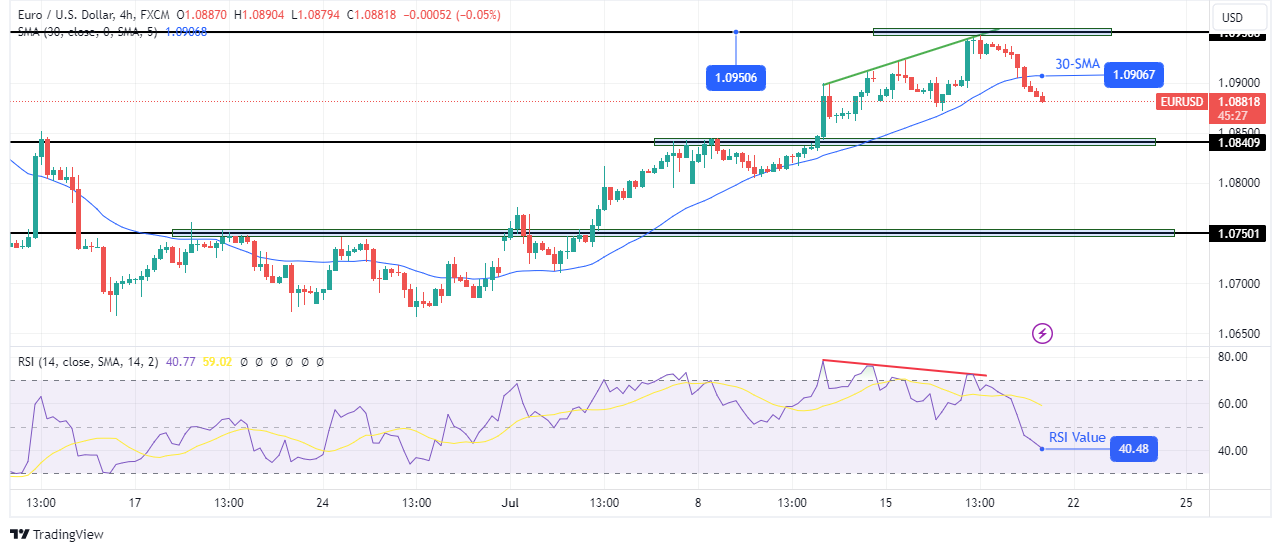
In fact, there could be some strength in the coming days, we believe. The Forex chart above shows the 100-day moving average at 1.0663, which could form the basis for a return to 1.08 in the immediate outlook. However, we must be cautious, as we will need to see two positive weekly closes before we can call for a return to the 2024 highs. 

The overall trend remains down, with the potential for shallow rebounds. 

The ongoing uncertainty over the French elections and the rise of far-right parties across Europe, not to mention the recent surge in crude oil prices, will continue to weigh on the euro, making the EUR/USD forecast today bearish in the short-term. Thanks to the renewed weakness in Eurozone data and uncertainty over the French elections, we would not be surprised if EUR/USD continues to trend lower in the short-term outlook. Now, it may establish a new ceiling below the 1.07 level. It has already successfully defended previously broken support levels such as 1.0750 and 1.0790. In contrast, the psychological support at 1.0500 will remain an important destination for further bear control of the trend. 

Moving to the US, the ongoing rally in the stock market has proven to be a strong source of support for the US dollar as global investors look to gain exposure to this outperformance. Further gains in the stock market in the coming days and weeks could keep the dollar on the offensive, according to forecasters. Obviously, the main data release this week is the release of core personal consumption expenditures inflation on Friday, which is a key input into the Federal Reserve’s policymaking process. 

Meanwhile, markets expect the Fed to cut rates later this year. If those expectations fade, the dollar could gain strength. Furthermore, the data needs to continue to beat expectations. With that in mind, core PCE is expected to come in at 0.1% month-on-month and 2.6% year-on-year. May consensus was for a 0.1% month-on-month rise, down from 0.2%. 

If it beats expectations, we expect the US dollar to end the week at a higher level, with the EUR/USD likely to end the week at its lowest level not seen since mid-April (1.06).

Ready to trade our Forex daily analysis and predictions? Here’s a list of regulated forex brokers to choose from.

Source link

25 06, 2024

GBP/JPY Forecast – British Pound Continues to Build Pressure

By |2024-06-25T10:22:25+03:00June 25, 2024|Forex News, News|0 Comments

GBP/JPY Forecast Video for 09.06.23

British Pound vs Japanese Yen Technical Analysis

The British pound has gone back and forth during the course of the trading session on Thursday, as we continue to build up pressure underneath the ¥175 level in an attempt to break above there. If we do break above the ¥175 level, then the market is likely to go much further to the upside. At that point, I would anticipate it will be more of a “buy-and-hold” type of scenario, something that I think it makes quite a bit of sense over the longer term. When you look at the chart, you can see that the Thursday candlestick was very bullish, so I do think that there are buyers underneath willing to jump into this market if we do offer a bit of value.

The 50-Day EMA sits right around the ¥170 level, which was previously important, and of course is a large, round, psychologically significant figure. With that being the case, it’s very likely that it has become the “floor in the market”, assuming that we can even get down to that area.

All things being equal, I think we continue to see a lot of noisy behavior but I think given enough time we probably continue to break out to the upside as the interest rate differential between the British and the Japanese are wide enough to drive a truck through. Interest rate differential continues to be a major driver of the currency markets right now, and I think that will most certainly be the case in this market.

Another thing to keep in the back of your mind is that sometimes risk appetite has a major influence on what we do in this pair as well, so remember that the Japanese yen can be considered a safety currency at times, and therefore it’s likely that we will see a lot of interest paid to what’s going on with the overall risk appetite of the world. At this point, I have no interest in shorting this market anytime soon, at least not until we break down below the ¥170 level at the very minimum.

For a look at all of today’s economic events, check out our economic calendar.

This article was originally posted on FX Empire

More From FXEMPIRE:

Source link

25 06, 2024

USD/JPY Forecast: BoJ’s Yen Strategy Under Scrutiny Amid Economic Indicators

By |2024-06-25T04:19:37+03:00June 25, 2024|Forex News, News|0 Comments

However, the Jibun Bank Services PMI unexpectedly fell from 53.8 to 49.8 in June, contracting for the first time since August 2022. Notably, output price inflation rose at the slowest pace in seven months.

With economic indicators falling short, the BoJ may need to change tack and emphasize the effects of a weak Japanese Yen, supporting the case for a rate hike to strengthen the Yen, consumer price trends, and the economy.

Can Bank of Japan Board members align on the need for monetary policy moves to address the Yen effect?

While the BoJ faces Yen weakness, US consumer confidence numbers could influence the Fed rate path.

Will the CB Consumer Confidence Index Signal a September Fed Rate Cut?

Later in the session on Tuesday, the CB Consumer Confidence Index will draw investor interest. Economists predict the CB Consumer Confidence Index will fall from 102.0 to 100.0 in June. A drop below 100, for the first time since July 2022, could raise investor bets on a September Fed rate cut.

A significant decline in consumer confidence could curb consumer spending, potentially easing demand-driven inflation pressures. A milder inflation outlook might allow the Fed to cut interest rates to stabilize prices.

Could a larger-than-expected decline in the index rekindle investor concerns about a severe economic slowdown?

A larger-than-expected drop could retrigger investor jitters about a US economic recession. Private consumption contributed 67.6% to the US economy in March 2024. A sharp decline in consumption may adversely affect the US economy.

Dana M. Peterson, Chief Economist at the Conference Board, attributed the CB Consumer Confidence Index fall below 100 in April 2024 to consumer worries about inflation.

Source link

25 06, 2024

EUR/USD, GBP/USD, USD/CAD, USD/JPY Forecasts – DXY Eases as Traders Eye PCE Data and Political Events

By |2024-06-25T00:17:28+03:00June 25, 2024|Forex News, News|0 Comments

Daily USD/JPY
The yen faced pressure, flirting with intervention levels, triggering warnings from Japanese authorities. After reaching significant highs, it briefly tumbled, highlighting market volatility. Japan’s Ministry of Finance remains vigilant but has not yet intervened. The yen’s decline, driven by the Bank of Japan’s stimulus policies and U.S. rate differentials, reflects ongoing challenges. The yen’s sensitivity to U.S. Treasury yields and the BOJ’s policy decisions will continue to influence its performance, with traders alert to potential intervention signals.

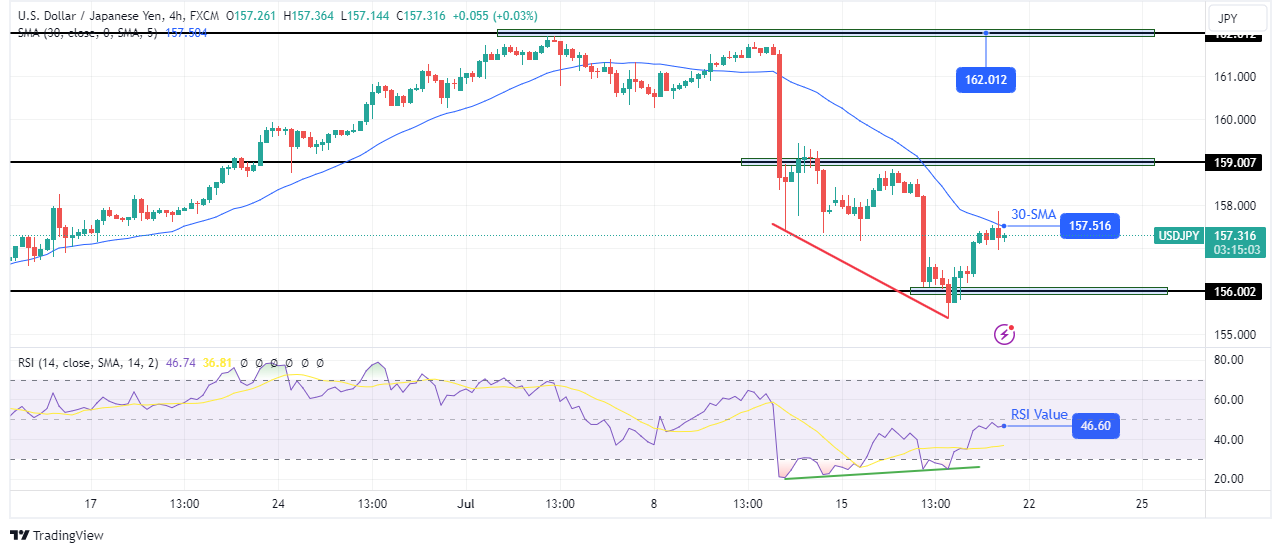
The USD/JPY is trading higher on Monday, consolidating just below it’s 4-hour high at 159.929. This level is a potential triggre point for an acceleration to the upside. Fear of an intervention, may however, prevent speculators from chasing it higher.

Key support is the former resistance zone at 158.500 to 158.001. This is followed by the uptrending 50-4-hour moving average at 157.993. A normal pullback into this support would likely attract buyers, but a sell-off fueled by an intervention would likely wipe it out, while putting 155.048 to 154.526 on the radar.

Source link

24 06, 2024

Sellers keep defending the upside at around 1.0750

By |2024-06-24T22:16:21+03:00June 24, 2024|Forex News, News|0 Comments

You have reached your limit of 5 free articles for this month.

Get Premium without limits for only $479.76 for the first month

Access all our articles, insights, and analysts.

Your coupon code


UNLOCK OFFER

EUR/USD Current price: 1.0725

  • The German IFO Business Climate survey missed expectations in June.
  • The better tone of Wall Street helped EUR/USD to stay afloat in the second half of the day.
  • EUR/USD loses its upward steam, could pierce the 1.0700 threshold.

The EUR/USD pair saw little action on Monday, confined to a tight 50 pips range. The US Dollar found demand at the beginning of the day, resulting in the pair bottoming at 1.0681. It recovered, advancing with Wall Street up to 1.0745, where sellers reappeared. EUR/USD settled in the 1.0720 price zone, holding on to modest gains.

The macroeconomic calendar had little to offer, although Germany published the June IFO Business Climate survey, which unexpectedly fell to 88.6 from 89.3 in May, missing the 89.7 expected. The assessment of the current situation and expectations sub-indexes also missed the market’s estimates. Across the pond, the United States (US) unveiled the Dallas Fed Manufacturing Business Index, which improved to -15.1 in June from -19.4 in the previous month.

In the absence of significant headlines, major pairs followed stock markets, which reflected the market mood. Following a cautious stance in Asia, markets seemed more optimistic after the American opening, as the three major US indexes posted gains.

On Tuesday, the Eurozone macroeconomic calendar will have little to offer, while the US will publish housing-related figures and June CB Consumer Confidence. The latter is foreseen at 100.0, contracting from the previous 102.0. Later in the week, investors will look at the  Federal Open Market Committee (FOMC) meeting Minutes and the US Personal Consumption Expenditures (PCE) Price Index.

EUR/USD short-term technical outlook

The daily chart for the EUR/USD pair shows further advances seem unlikely. The pair remains below all its moving averages, with a bearish 20 Simple Moving Average (SMA) crossing below directionless 100 and 200 SMAs, all of them in the 1.0780/90 price zone. At the same time, technical indicators have barely recovered from near oversold readings, maintaining modest upward slopes, although far below their midlines.

In the near term, and according to the 4-hour chart, the risk increasingly turns to the downside. EUR/USD develops above its 20 SMA, which anyway maintains a bearish slope. The 100 and 200 SMAs also head south while above the current level. Finally, technical indicators lost their upward strength after testing their midlines and slowly turn south, in line with another leg lower.

 Support levels: 1.0710 1.0665 1.0620

Resistance levels: 1.0760 1.0810 1.0840

EUR/USD Current price: 1.0725

  • The German IFO Business Climate survey missed expectations in June.
  • The better tone of Wall Street helped EUR/USD to stay afloat in the second half of the day.
  • EUR/USD loses its upward steam, could pierce the 1.0700 threshold.

The EUR/USD pair saw little action on Monday, confined to a tight 50 pips range. The US Dollar found demand at the beginning of the day, resulting in the pair bottoming at 1.0681. It recovered, advancing with Wall Street up to 1.0745, where sellers reappeared. EUR/USD settled in the 1.0720 price zone, holding on to modest gains.

The macroeconomic calendar had little to offer, although Germany published the June IFO Business Climate survey, which unexpectedly fell to 88.6 from 89.3 in May, missing the 89.7 expected. The assessment of the current situation and expectations sub-indexes also missed the market’s estimates. Across the pond, the United States (US) unveiled the Dallas Fed Manufacturing Business Index, which improved to -15.1 in June from -19.4 in the previous month.

In the absence of significant headlines, major pairs followed stock markets, which reflected the market mood. Following a cautious stance in Asia, markets seemed more optimistic after the American opening, as the three major US indexes posted gains.

On Tuesday, the Eurozone macroeconomic calendar will have little to offer, while the US will publish housing-related figures and June CB Consumer Confidence. The latter is foreseen at 100.0, contracting from the previous 102.0. Later in the week, investors will look at the  Federal Open Market Committee (FOMC) meeting Minutes and the US Personal Consumption Expenditures (PCE) Price Index.

EUR/USD short-term technical outlook

The daily chart for the EUR/USD pair shows further advances seem unlikely. The pair remains below all its moving averages, with a bearish 20 Simple Moving Average (SMA) crossing below directionless 100 and 200 SMAs, all of them in the 1.0780/90 price zone. At the same time, technical indicators have barely recovered from near oversold readings, maintaining modest upward slopes, although far below their midlines.

In the near term, and according to the 4-hour chart, the risk increasingly turns to the downside. EUR/USD develops above its 20 SMA, which anyway maintains a bearish slope. The 100 and 200 SMAs also head south while above the current level. Finally, technical indicators lost their upward strength after testing their midlines and slowly turn south, in line with another leg lower.

 Support levels: 1.0710 1.0665 1.0620

Resistance levels: 1.0760 1.0810 1.0840

Source link

24 06, 2024

Dollar Rallies Amid PMI (Video)

By |2024-06-24T20:15:22+03:00June 24, 2024|Forex News, News|0 Comments

  • The US dollar has rallied yet again during the trading session on Friday as the PMI numbers in the United States came out hotter than anticipated.
  • This has people betting that the Federal Reserve may not cut rates between now and the end of the year, which is a bit of a surprise to me considering that they basically said that’s very possible.
  • After all, inflation has been very sticky in the United States, and it was just 6 months ago the people were suggesting that perhaps we could be getting 7 interest rate cuts this year. In other words, it’s astonishing how many people have been blind all year to the reality of inflation sticking around.

Plenty of momentum still

The US dollar continues to beat up on the Japanese yen, which makes a lot of sense. After all, the Bank of Japan can do nothing about its monetary policy other than keep it extraordinarily loose. It has to be loose. The debt in Japan is so out of control that they can’t afford to pay it back with any interest whatsoever.

With this being the case, I think the market is likely to continue to see the Japanese yen get just absolutely crushed by almost anything against it. If we can take out the 160 yen level, this is a pair that could go much higher. After all, the Bank of Japan intervened from there, so that would be the next major barrier to overcome. Ultimately, short-term pullbacks end up in buying opportunities, especially near the 158 yen level, which we just broke out of.

I have no interest in shorting this USD/JPY pair because you have to pay for the privilege of doing so, which would be fine flying in the face of the overall trend. And therefore, I think anytime you get a dip, you have to be looking for some type of bounce in order to take advantage of the value that you could find in the greenback. This goes for pretty much all Japanese yen related currency pairs.

Want to trade our daily forex analysis and predictions? Here’s a list of forex brokers in Japan to check out. 

Source link

24 06, 2024

Eyes on Support Levels (Chart)

By |2024-06-24T18:14:18+03:00June 24, 2024|Forex News, News|0 Comments

  • At the end of last week’s trading, the latest UK data recorded a strong rebound in retail sales for May, but the pound struggled to make significant headway in global markets.
  • According to trading, the pound against the dollar (GBP/USD) exchange rate fell to a 6-week low overnight before recovering slightly to 1.2665 after the data.
  • In the same performance, the pound against the euro (GBP/EUR) exchange rate also approached a one-week low at 1.1820.

According to the results of the economic calendar, UK sales volumes jumped by 2.9% in May after a revised 1.8% decline in April, which was originally reported as a 2.3% decline. Clearly, this was much stronger than the consensus forecast for a 1.6% increase. On the other hand, Sales rose 1.0% in the three months to May compared with the previous three months. Sales in April were hurt by bad weather conditions and there were more favorable conditions in May, which helped to spur a recovery. There was a 1.3% annual increase in sales compared with a previous 2.3% decline, but sales are still slightly below pre-pandemic levels.

Non-food store sales volumes jumped 3.5% during the month, the biggest increase since April 2021.

Elsewhere, the latest UK consumer confidence index also improved to -14 for June from -17 the previous month, which was the strongest reading since December 2021.

The Bank of England has hinted that more officials may be moving closer to supporting interest rate cuts, keeping alive hopes of policy easing by the end of the summer. Last week, the Bank of England kept its main lending rate at a 16-year high of 5.25%. But the minutes of the meeting said the decision not to cut rates was “finely balanced” for some of the nine members of the Monetary Policy Committee.

Investors had been pricing in a greater than 50% chance of a BoE move in August, the first time in more than a month they were certain. Moreover, Governor Andrew Bailey said inflation falling to its 2% target for the first time in nearly three years was “good news,” but officials wanted to make sure the pressure on prices had eased before acting.

What’s next for the pound versus the dollar?

The pound is set to weaken against the dollar to levels last seen in May, according to new analysis. ING forex analysts say the BoE will cut rates by a larger margin in 2024 than markets are currently pricing in, which will weigh on sterling. The main focus of sterling weakness will be against the dollar, as the US Federal Reserve is in no position to match the Bank of England’s rate cuts. Francesco Bisol, FX strategist at ING said, “We expect most of the sterling weakness to be channeled through GBP/USD, which we expect to trade back below 1.25,”.

Technical forecasts for the GBP/USD pair today:

The US dollar has had a quiet week, but “cautious” developments in Europe have helped it maintain its upward momentum. It has gained a third of a percent against the pound over the past week, looking set to post its third straight weekly advance. Also, it is outperforming the euro.

“The US dollar looks set to end the week on a higher note, extending its winning streak into a third week,” said analysts at XM.com. furthermore, the signs of a slowdown in inflationary pressures and the broader economy have boosted expectations that the US Federal Reserve may be able to deliver two rate cuts after all in 2024, with the first expected in September, other central banks appear to be ahead in the race to ease policy.”

Recently, the pound fell after the Bank of England left interest rates unchanged on Thursday but issued a statement saying a number of its Monetary Policy Committee members were close to voting for a cut. Clearly, this has led markets to raise their expectations for a rate cut in August. Moreover, ING adds that it expects three rate cuts in 2024 starting in August. This is more pessimistic than the two cuts that the market has priced in.

Currently, financial markets price in a cut of around 65% in August and are seeing two 25bp cuts this year. According to analysts, central banks in Europe are far ahead of the Federal Reserve in terms of interest rate cuts, which is a positive development for the US dollar, but we doubt that there is enough to push the dollar down significantly at this stage.”

Ready to trade our daily Forex forecast? Here’s a list of some of the top forex brokers UK to check out. 

Source link

24 06, 2024

Boj Minutes Suggest A July Rate Hike Is Not Out Of The Question, Yen Unchanged

By |2024-06-24T16:13:18+03:00June 24, 2024|Forex News, News|0 Comments

Date


(MENAFN– DailyFX) uggest a July Rate Hike is not out of the Question, Yen Unchanged

Skip to Conten

News & Analysis at your fingertips.

MENAFN24062024000076011015ID1108365248


DailyFX


Legal Disclaimer:
MENAFN provides the information “as is” without warranty of any kind. We do not accept any responsibility or liability for the accuracy, content, images, videos, licenses, completeness, legality, or reliability of the information contained in this article. If you have any complaints or copyright issues related to this article, kindly contact the provider above.

Source link

24 06, 2024

Euro holds above key support, struggles to gather momentum

By |2024-06-24T14:12:15+03:00June 24, 2024|Forex News, News|0 Comments

You have reached your limit of 5 free articles for this month.

Get Premium without limits for only $479.76 for the first month

Access all our articles, insights, and analysts.

Your coupon code


UNLOCK OFFER

  • EUR/USD fluctuates above 1.0700 to start the new week.
  • The technical outlook doesn’t yet point to a buildup of recovery momentum.
  • The data from Germany showed that business morale weakened in June.

After closing the previous week marginally lower, EUR/USD edges higher and trades above 1.0700 in the European session on Monday. The technical outlook doesn’t yet point to a buildup of recovery momentum but the improving risk mood could help the pair stretch higher in the second half of the day.

Euro PRICE Last 7 days

The table below shows the percentage change of Euro (EUR) against listed major currencies last 7 days. Euro was the weakest against the Australian Dollar.

  USD EUR GBP JPY CAD AUD NZD CHF
USD   -0.10% 0.19% 1.50% -0.50% -0.60% 0.08% 0.36%
EUR 0.10%   0.32% 1.64% -0.39% -0.59% 0.23% 0.47%
GBP -0.19% -0.32%   1.40% -0.71% -0.92% -0.13% 0.18%
JPY -1.50% -1.64% -1.40%   -1.89% -2.09% -1.28% -1.08%
CAD 0.50% 0.39% 0.71% 1.89%   -0.17% 0.57% 0.89%
AUD 0.60% 0.59% 0.92% 2.09% 0.17%   0.88% 1.10%
NZD -0.08% -0.23% 0.13% 1.28% -0.57% -0.88%   0.30%
CHF -0.36% -0.47% -0.18% 1.08% -0.89% -1.10% -0.30%  

The heat map shows percentage changes of major currencies against each other. The base currency is picked from the left column, while the quote currency is picked from the top row. For example, if you pick the Euro from the left column and move along the horizontal line to the US Dollar, the percentage change displayed in the box will represent EUR (base)/USD (quote).

The PMI data from the US showed on Friday that the business activity continued to expand at a robust pace in June, helping the US Dollar (USD) preserve its strength ahead of the weekend and not allowing EUR/USD to gain traction.

Early Monday, Germany’s Ifo Institute reported that the Business Climate Index declined to 88.6 in June from 89.3 in May. This reading came in weaker than the market expectation of 89.7 but failed to trigger a noticeable market reaction.

The US economic docket will not feature any high-tier data releases that could drive the USD’s valuation in the second half of the day. Hence, investors are likely to react to changes in risk perception.

In the European session, US stock index futures gain above 0.2%. A bullish opening in Wall Street could make it difficult for the USD to find demand and help EUR/USD to extend its rebound.

EUR/USD Technical Analysis

The Relative Strength Index (RSI) indicator on the 4-hour chart recovers to 50, reflecting sellers’ hesitancy. On the upside, 1.0730-1.0740 (Fibonacci 61.8% retracement of the latest uptrend, 50-period Simple Moving Average) aligns as immediate resistance before 1.0760 (Fibonacci 50% retracement) and 1.0785 (100-period SMA).

On the downside, 1.0670 (Fibonacci 78.6% retracement) stays intact as key support level.  If EUR/USD falls below that level and starts using it as resistance, 1.0600 (static level) could be seen as next support.

Euro FAQs

The Euro is the currency for the 20 European Union countries that belong to the Eurozone. It is the second most heavily traded currency in the world behind the US Dollar. In 2022, it accounted for 31% of all foreign exchange transactions, with an average daily turnover of over $2.2 trillion a day. EUR/USD is the most heavily traded currency pair in the world, accounting for an estimated 30% off all transactions, followed by EUR/JPY (4%), EUR/GBP (3%) and EUR/AUD (2%).

The European Central Bank (ECB) in Frankfurt, Germany, is the reserve bank for the Eurozone. The ECB sets interest rates and manages monetary policy. The ECB’s primary mandate is to maintain price stability, which means either controlling inflation or stimulating growth. Its primary tool is the raising or lowering of interest rates. Relatively high interest rates – or the expectation of higher rates – will usually benefit the Euro and vice versa. The ECB Governing Council makes monetary policy decisions at meetings held eight times a year. Decisions are made by heads of the Eurozone national banks and six permanent members, including the President of the ECB, Christine Lagarde.

Eurozone inflation data, measured by the Harmonized Index of Consumer Prices (HICP), is an important econometric for the Euro. If inflation rises more than expected, especially if above the ECB’s 2% target, it obliges the ECB to raise interest rates to bring it back under control. Relatively high interest rates compared to its counterparts will usually benefit the Euro, as it makes the region more attractive as a place for global investors to park their money.

Data releases gauge the health of the economy and can impact on the Euro. Indicators such as GDP, Manufacturing and Services PMIs, employment, and consumer sentiment surveys can all influence the direction of the single currency. A strong economy is good for the Euro. Not only does it attract more foreign investment but it may encourage the ECB to put up interest rates, which will directly strengthen the Euro. Otherwise, if economic data is weak, the Euro is likely to fall. Economic data for the four largest economies in the euro area (Germany, France, Italy and Spain) are especially significant, as they account for 75% of the Eurozone’s economy.

Another significant data release for the Euro is the Trade Balance. This indicator measures the difference between what a country earns from its exports and what it spends on imports over a given period. If a country produces highly sought after exports then its currency will gain in value purely from the extra demand created from foreign buyers seeking to purchase these goods. Therefore, a positive net Trade Balance strengthens a currency and vice versa for a negative balance.


  • EUR/USD fluctuates above 1.0700 to start the new week.
  • The technical outlook doesn’t yet point to a buildup of recovery momentum.
  • The data from Germany showed that business morale weakened in June.

After closing the previous week marginally lower, EUR/USD edges higher and trades above 1.0700 in the European session on Monday. The technical outlook doesn’t yet point to a buildup of recovery momentum but the improving risk mood could help the pair stretch higher in the second half of the day.

Euro PRICE Last 7 days

The table below shows the percentage change of Euro (EUR) against listed major currencies last 7 days. Euro was the weakest against the Australian Dollar.

  USD EUR GBP JPY CAD AUD NZD CHF
USD   -0.10% 0.19% 1.50% -0.50% -0.60% 0.08% 0.36%
EUR 0.10%   0.32% 1.64% -0.39% -0.59% 0.23% 0.47%
GBP -0.19% -0.32%   1.40% -0.71% -0.92% -0.13% 0.18%
JPY -1.50% -1.64% -1.40%   -1.89% -2.09% -1.28% -1.08%
CAD 0.50% 0.39% 0.71% 1.89%   -0.17% 0.57% 0.89%
AUD 0.60% 0.59% 0.92% 2.09% 0.17%   0.88% 1.10%
NZD -0.08% -0.23% 0.13% 1.28% -0.57% -0.88%   0.30%
CHF -0.36% -0.47% -0.18% 1.08% -0.89% -1.10% -0.30%  

The heat map shows percentage changes of major currencies against each other. The base currency is picked from the left column, while the quote currency is picked from the top row. For example, if you pick the Euro from the left column and move along the horizontal line to the US Dollar, the percentage change displayed in the box will represent EUR (base)/USD (quote).

The PMI data from the US showed on Friday that the business activity continued to expand at a robust pace in June, helping the US Dollar (USD) preserve its strength ahead of the weekend and not allowing EUR/USD to gain traction.

Early Monday, Germany’s Ifo Institute reported that the Business Climate Index declined to 88.6 in June from 89.3 in May. This reading came in weaker than the market expectation of 89.7 but failed to trigger a noticeable market reaction.

The US economic docket will not feature any high-tier data releases that could drive the USD’s valuation in the second half of the day. Hence, investors are likely to react to changes in risk perception.

In the European session, US stock index futures gain above 0.2%. A bullish opening in Wall Street could make it difficult for the USD to find demand and help EUR/USD to extend its rebound.

EUR/USD Technical Analysis

The Relative Strength Index (RSI) indicator on the 4-hour chart recovers to 50, reflecting sellers’ hesitancy. On the upside, 1.0730-1.0740 (Fibonacci 61.8% retracement of the latest uptrend, 50-period Simple Moving Average) aligns as immediate resistance before 1.0760 (Fibonacci 50% retracement) and 1.0785 (100-period SMA).

On the downside, 1.0670 (Fibonacci 78.6% retracement) stays intact as key support level.  If EUR/USD falls below that level and starts using it as resistance, 1.0600 (static level) could be seen as next support.

Euro FAQs

The Euro is the currency for the 20 European Union countries that belong to the Eurozone. It is the second most heavily traded currency in the world behind the US Dollar. In 2022, it accounted for 31% of all foreign exchange transactions, with an average daily turnover of over $2.2 trillion a day. EUR/USD is the most heavily traded currency pair in the world, accounting for an estimated 30% off all transactions, followed by EUR/JPY (4%), EUR/GBP (3%) and EUR/AUD (2%).

The European Central Bank (ECB) in Frankfurt, Germany, is the reserve bank for the Eurozone. The ECB sets interest rates and manages monetary policy. The ECB’s primary mandate is to maintain price stability, which means either controlling inflation or stimulating growth. Its primary tool is the raising or lowering of interest rates. Relatively high interest rates – or the expectation of higher rates – will usually benefit the Euro and vice versa. The ECB Governing Council makes monetary policy decisions at meetings held eight times a year. Decisions are made by heads of the Eurozone national banks and six permanent members, including the President of the ECB, Christine Lagarde.

Eurozone inflation data, measured by the Harmonized Index of Consumer Prices (HICP), is an important econometric for the Euro. If inflation rises more than expected, especially if above the ECB’s 2% target, it obliges the ECB to raise interest rates to bring it back under control. Relatively high interest rates compared to its counterparts will usually benefit the Euro, as it makes the region more attractive as a place for global investors to park their money.

Data releases gauge the health of the economy and can impact on the Euro. Indicators such as GDP, Manufacturing and Services PMIs, employment, and consumer sentiment surveys can all influence the direction of the single currency. A strong economy is good for the Euro. Not only does it attract more foreign investment but it may encourage the ECB to put up interest rates, which will directly strengthen the Euro. Otherwise, if economic data is weak, the Euro is likely to fall. Economic data for the four largest economies in the euro area (Germany, France, Italy and Spain) are especially significant, as they account for 75% of the Eurozone’s economy.

Another significant data release for the Euro is the Trade Balance. This indicator measures the difference between what a country earns from its exports and what it spends on imports over a given period. If a country produces highly sought after exports then its currency will gain in value purely from the extra demand created from foreign buyers seeking to purchase these goods. Therefore, a positive net Trade Balance strengthens a currency and vice versa for a negative balance.


Source link

24 06, 2024

EUR/USD, GBP/USD, DXY Forecast: DXY at 105.80; EUR, GBP to Trade Bullish Today?

By |2024-06-24T12:10:25+03:00June 24, 2024|Forex News, News|0 Comments

EUR/USD is trading at $1.07127, up 0.03%. The pivot point is $1.07109, marked by the green line. Immediate resistance levels are at $1.07381, $1.07597, and $1.07817, suggesting potential upward movement.

On the downside, immediate support is found at $1.06865, with further support at $1.06678 and $1.06479. The 50-day Exponential Moving Average (EMA) stands at $1.07342, while the 200-day EMA is at $1.07802.

These technical indicators suggest a bullish outlook above $1.07109. However, a break below this level could trigger a sharp selling trend.

GBP/USD Technical Forecast

Source link

Go to Top