The main tag of Forex News Today Articles.
You can use the search box below to find what you need.
[wd_asp id=1]

11 04, 2024

GBP/JPY Forecast – British Pound Continues to Probe Resistance

By |2024-04-11T18:24:06+02:00April 11, 2024|Forex News|0 Comments

GBP/JPY Forecast Video for 14.04.23

British Pound vs Japanese Yen Technical Analysis

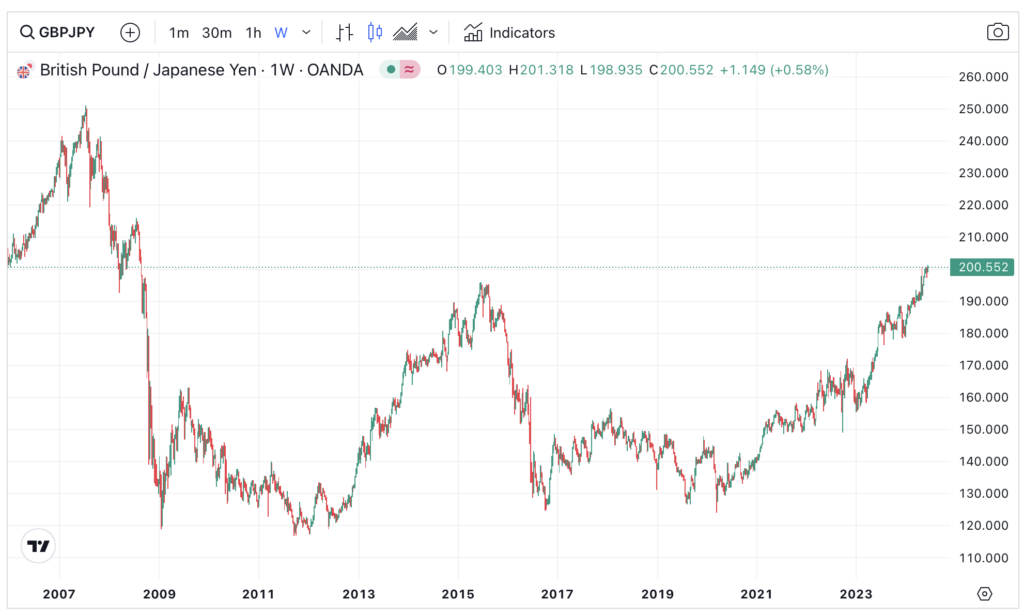
The British pound has rallied a bit during the trading session on Thursday to show signs of strength again, but it looks like there is still a significant amount of resistance just above that could cause some issues, and therefore it’s worth noting that the market will continue to be difficult to overcome in that area. However, I think we also have a situation where the noise above is without a doubt a major contributor to a lot of the confusion, and quite frankly hesitation that we will continue to see in the market.

The ¥166 level has been important multiple times, therefore it’s not a huge surprise to think that it’s an epicenter of trading as we formed a hammer leading up to it, but then saw the level pull price right back to it to show it itself as a bit of a magnet. Ultimately, I think you’ve got a scenario where the market will continue to be a situation where we will see plenty of questions asked about this region, and I think a pullback at this point in time would make a certain amount of sense. That being said, I also believe that a pullback at this point could very well end up being a value proposition as we’ve seen so much strength in the British pound.

At this point, the market is trying to break out and I think it’s probably only a matter of time before does, simply based on British pound strength. What the Japanese yen does probably remains to be seen, but it should be noted that the Bank of Japan continues its yield curve control policy, but as time goes on, a lot of this is starting to go by the wayside, as yields have dropped. In other words, it appears that the market is probably starting to pay attention to other concerns. With this, I think we’ve got a situation where we will pull back, but there will be plenty of buyers underneath to take advantage of potential value in a market that clearly has a lot of momentum over the last couple of weeks to the upside.

For a look at all of today’s economic events, check out our economic calendar.

This article was originally posted on FX Empire

More From FXEMPIRE:

Source link

11 04, 2024

USD/CAD Forecast Today – 5/04: USD/CAD Ready to Move (Chart)

By |2024-04-11T18:24:05+02:00April 11, 2024|Forex News|0 Comments

USD/CAD awaits US and Canadian employment data, likely inducing volatility. Sideways consolidation with 1.34 support and 1.36 resistance. Breakout could lead to significant moves. Caution advised amid high volatility.

  • The Friday session should be very interesting for the USD/CAD pair as the day will feature both the American and Canadian employment figures.
  • Because of this, I think you have a situation, or we are going to see a lot of volatility, this might be “Ground Zero” for the Forex world during the day.
  • After all, the 200-Day EMA is starting to show signs of support is something worth paying attention to but quite frankly I think this is a market that is just killing time before we get more information that we can take advantage of.

The technical analysis for this pair is one of sideways consolidation from the longer-term standpoint, with a 1.34 level underneath offering a massive amount of support, while the 1.36 level above offers significant resistance. The 200-Day EMA and the 50-Day indicators both come into the picture’s offer potential noise. With this being said, I think you have got a market that is going to continue to just bounce back and forth but you have to pay attention to both of those levels as a breakout from that range could be a major turn of events.

brokers-we-recommend Forex Brokers We Recommend in Your Region

See full brokers list see-full-broker

If we were to break above the 1.36 level, then it is possible that we could go to the 1.3850 level. If we break down below the 1.34 level underneath, then it opens up the possibility of a move down to the 1.3250 level. Either way, if we break out of this trading range, I think it becomes a huge potential move. Otherwise, then we will just simply bounce around in this area and continue to use those 2 levels as boundaries for your trading.

Keep in mind that the employment figures come out at the same time, so this will cause a massive amount of volatility that you have to be aware of. Do not put big positions on, but once we break out of this range then you could start to add to a position if it’s already working out in your favor. Expect a lot of noise, but hopefully we’ll get a little bit of clarity.

Ready to trade our Forex daily analysis and predictions? Check out the best currency exchange broker Canada for you.

Source link

11 04, 2024

EUR/USD Forecast Today 05/04: Reaches Fair Value (Chart)

By |2024-04-11T18:24:04+02:00April 11, 2024|Forex News|0 Comments

 I like the idea of waiting to see what Friday does before putting money to work, but I think the set up from a technical analysis standpoint currently is to wait to we get to the outer part of the consolidation range to put money to work.

  • The euro rallied a bit during the trading session on Thursday, as we continue to see a lot of recovery from the bottom of the overall consolidation area.
  • After all, keep in mind that the 1.07 level underneath has been a significant support level, right along with the 1.10 level above which of course has been a significant resistance barrier.
  • At this point in time, we are essentially hanging around in the middle, and therefore it looks like we are going to continue to see traders hang around this area as it is essentially where I would mark “fair value.”

The nonfarm payroll announcement comes out during the day on Friday, that will almost certainly have a major influence on what happens next. This is probably why we have ended up at “fair value”, and therefore I think it makes perfect sense that we are sitting right where we are. I like the idea of waiting to see what Friday does before putting money to work, but I think the set up from a technical analysis standpoint currently is to wait to we get to the outer part of the consolidation range to put money to work and then start to fade signs of exhaustion, regardless of what direction it is. That being said, if we were to break out of this range, it’s very likely that we could see quite a bit of momentum, but at this point it doesn’t look like we are going to see that anytime soon as we are so far away from both edges.

brokers-we-recommend Forex Brokers We Recommend in Your Region

See full brokers list see-full-broker

The ECB and the Federal Reserve both are likely to cut rates sometime this year, and therefore neither central bank has a “leg up” on the other. Because of this, I don’t necessarily think that any direction has more strength than the other, and it’s also possible that any knee-jerk reaction from the jobs figure will fade by the end of the session. This is typical for nonfarm payroll Friday anyway, so that would not be a surprise to me at this point in time.

Ready to trade our daily Forex analysis? We’ve made a list of the best forex trading accounts worth trading with. 

Source link

11 04, 2024

USD/JPY Outlook: Yen Rises Amid BoJ’s Intervention Signals

By |2024-04-11T18:24:03+02:00April 11, 2024|Forex News|0 Comments

  • The dollar strengthened on hawkish Fed remarks.
  • The yen firmed after hints that the BoJ might hike interest rates.
  • US data on Thursday revealed a surge in unemployment claims.

The USD/JPY outlook is mildly bullish as the dollar gains momentum on hawkish Fed remarks. Yet, the yen is also holding its ground, fueled by hints of potential interest rate hikes from the Bank of Japan. At the same time, there is caution in the markets ahead of the NFP report.

The dollar rallied despite a poor employment report on Thursday as Fed officials pushed back rate cut expectations. Initially, the dollar fell after the US released data showing a surge in unemployment claims. The jobless claims rose to a two-month high, indicating a rise in unemployment. Consequently, rate-cut bets increased. 

However, this soon changed when Fed officials assumed a hawkish tone. Some officials, including Neel Kashkari and Thomas Barkin, said the Fed still had enough time to ensure inflation would reach its target. Therefore, there was no hurry to cut rates. Kashkari even said there might be no need for rate cuts this year. These remarks damped rate-cut expectations and pushed the dollar higher.

Investors will now watch the nonfarm payrolls for more clues on rate cuts. Economists expect a decline in employment in March.

However, gains were small in the USD/JPY pair as the yen also strengthened. Notably, BoJ governor Kazuo Ueda said inflation will likely accelerate after the recent pay hikes.  Market participants took this as a hint that the central bank might be planning another rate hike. Consequently, Japanese yields soared, boosting the yen. At the same time, Finance Minister Shunichi Suzuki warned that authorities would do all it takes to stop more sharp declines in the yen.

USD/JPY key events today

  • US average hourly earnings m/m
  • US nonfarm employment change
  • US unemployment rate
USD/JPY Outlook: Yen Rises Amid BoJ’s Intervention Signals
USD/JPY 4-hour chart

On the technical side, the USD/JPY price has broken below the 30-SMA with strong bearish candles. At the same time, the RSI now trades below 50, supporting bearish momentum. The price has traded in a tight consolidation since it made an engulfing candle. However, it has now made a strong move lower that could lead to further declines.

Are you interested to learn more about forex bonuses? Check our detailed guide-

Before the price continues lower, it might pull back to retest the 30-SMA as resistance. Bears will likely target the 150.00 key support level if the SMA holds firm.

Looking to trade forex now? Invest at eToro!

68% of retail investor accounts lose money when trading CFDs with this provider. You should consider whether you can afford to take the high risk of losing your money.

Source link

11 04, 2024

Pound Sterling could turn south in case US NFP beats expectations

By |2024-04-11T18:24:02+02:00April 11, 2024|Forex News|0 Comments

You have reached your limit of 5 free articles for this month.

Get Premium without limits for only $9.99 for the first month

Access all our articles, insights, and analysts.

Your coupon code


UNLOCK OFFER

  • GBP/USD fluctuates above 1.2600 after posting small losses on Thursday.
  • March jobs report from the US could drive the pair’s action ahead of the weekend.
  • The pair needs to clear 1.2670 to attract technical buyers.

GBP/USD advanced toward 1.2700 during the European trading hours on Thursday but reversed its direction in the American session to end the day with small losses. The pair holds comfortably above 1.2600 early Friday as market participants await labor market data from the US.

After suffering large losses against its major rivals in the first half of the week, the US Dollar gained traction in the second half of the day on Thursday.

Wall Street’s main indexes turned south after the opening bell and safe-haven flows helped the USD find demand. Additionally, hawkish comments from Federal Reserve (Fed) officials caused market participants to reassess the probability of a Fed policy pivot in June and provided an additional boost to the currency.

Minneapolis Fed President Neel Kashkari said that he wonders if the Fed should cut rates at all this year if inflation continues to move sideways, while Richmond Fed President Thomas Barking argued that it is difficult to reconcile the current breadth of inflation with the progress the Fed needs to see for a reduction in interest rates.

Later in the day, the US Bureau of Labor Statistics (BLS) will publish the jobs report for March. Nonfarm Payrolls (NFP) are forecast to rise 200,000 following the 275,000 increase recorded in February. The immediate reaction to the could be straightforward, with an upbeat reading supporting the USD and a disappointing print hurting the currency, unless there are significant revisions to previous prints.

In case the data arrives near the market expectation, investors could react to the wage inflation data. On a yearly basis, Average Hourly Earnings are forecast to rise 4.1%, below the February’s growth of 4.3%.

GBP/USD Technical Analysis

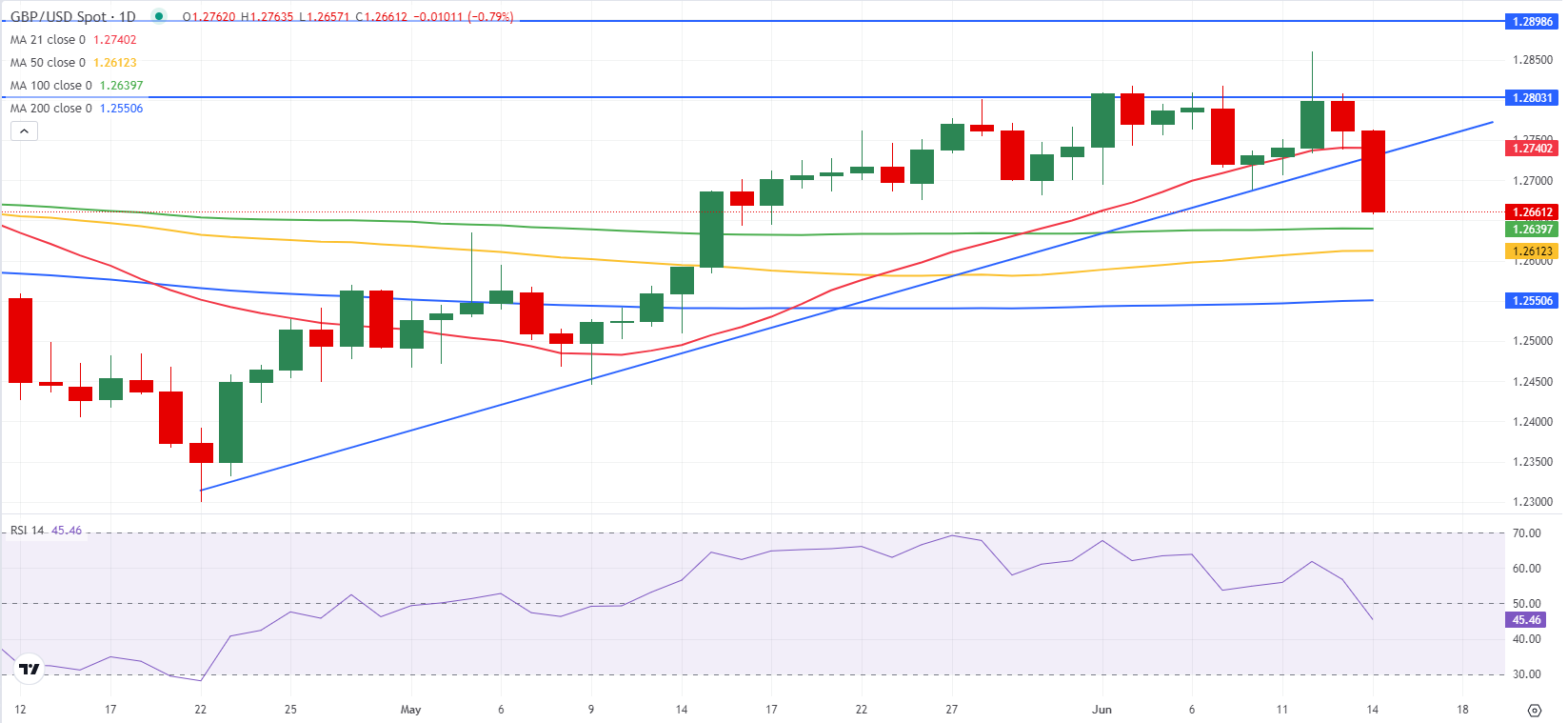
The Relative Strength Index (RSI) indicator holds slightly above 50 and GBP/USD closed above the 200-day Simple Moving Average (SMA) for the second straight on Tuesday. The pair, however, failed to clear the 100-day SMA at 1.2670.

In case GBP/USD flips 1.2670 into support, technical buyers could show interest. In this scenario, 1.2710 (Fibonacci 50% retracement of the latest downtrend) could be seen as first resistance before 1.2750 (Fibonacci 61.8% retracement).

On the downside, 1.2620 (Fibonacci 23.6% retracement) could be seen as interim support before 1.2590 (200-day SMA).

Economic Indicator

Nonfarm Payrolls

The Nonfarm Payrolls release presents the number of new jobs created in the US during the previous month in all non-agricultural businesses; it is released by the US Bureau of Labor Statistics (BLS). The monthly changes in payrolls can be extremely volatile. The number is also subject to strong reviews, which can also trigger volatility in the Forex board. Generally speaking, a high reading is seen as bullish for the US Dollar (USD), while a low reading is seen as bearish, although previous months’ reviews ​and the Unemployment Rate are as relevant as the headline figure. The market’s reaction, therefore, depends on how the market assesses all the data contained in the BLS report as a whole.
Read more.


  • GBP/USD fluctuates above 1.2600 after posting small losses on Thursday.
  • March jobs report from the US could drive the pair’s action ahead of the weekend.
  • The pair needs to clear 1.2670 to attract technical buyers.

GBP/USD advanced toward 1.2700 during the European trading hours on Thursday but reversed its direction in the American session to end the day with small losses. The pair holds comfortably above 1.2600 early Friday as market participants await labor market data from the US.

After suffering large losses against its major rivals in the first half of the week, the US Dollar gained traction in the second half of the day on Thursday.

Wall Street’s main indexes turned south after the opening bell and safe-haven flows helped the USD find demand. Additionally, hawkish comments from Federal Reserve (Fed) officials caused market participants to reassess the probability of a Fed policy pivot in June and provided an additional boost to the currency.

Minneapolis Fed President Neel Kashkari said that he wonders if the Fed should cut rates at all this year if inflation continues to move sideways, while Richmond Fed President Thomas Barking argued that it is difficult to reconcile the current breadth of inflation with the progress the Fed needs to see for a reduction in interest rates.

Later in the day, the US Bureau of Labor Statistics (BLS) will publish the jobs report for March. Nonfarm Payrolls (NFP) are forecast to rise 200,000 following the 275,000 increase recorded in February. The immediate reaction to the could be straightforward, with an upbeat reading supporting the USD and a disappointing print hurting the currency, unless there are significant revisions to previous prints.

In case the data arrives near the market expectation, investors could react to the wage inflation data. On a yearly basis, Average Hourly Earnings are forecast to rise 4.1%, below the February’s growth of 4.3%.

GBP/USD Technical Analysis

The Relative Strength Index (RSI) indicator holds slightly above 50 and GBP/USD closed above the 200-day Simple Moving Average (SMA) for the second straight on Tuesday. The pair, however, failed to clear the 100-day SMA at 1.2670.

In case GBP/USD flips 1.2670 into support, technical buyers could show interest. In this scenario, 1.2710 (Fibonacci 50% retracement of the latest downtrend) could be seen as first resistance before 1.2750 (Fibonacci 61.8% retracement).

On the downside, 1.2620 (Fibonacci 23.6% retracement) could be seen as interim support before 1.2590 (200-day SMA).

Economic Indicator

Nonfarm Payrolls

The Nonfarm Payrolls release presents the number of new jobs created in the US during the previous month in all non-agricultural businesses; it is released by the US Bureau of Labor Statistics (BLS). The monthly changes in payrolls can be extremely volatile. The number is also subject to strong reviews, which can also trigger volatility in the Forex board. Generally speaking, a high reading is seen as bullish for the US Dollar (USD), while a low reading is seen as bearish, although previous months’ reviews ​and the Unemployment Rate are as relevant as the headline figure. The market’s reaction, therefore, depends on how the market assesses all the data contained in the BLS report as a whole.
Read more.


Source link

11 04, 2024

EUR/USD Analysis Today 04/04: Rebound Gains Weak (Chart)

By |2024-04-11T18:23:57+02:00April 11, 2024|Forex News|0 Comments

 The outlook for the pair is very bearish, with the next level to watch being at 1.0690, its Valentine’s Day low.

  • According to recent trading, the EUR/USD exchange rate was softer after inflation data for March declined, but it is important to keep in mind that there are inflationary trends that will limit any weakness.
  • According to the results of the economic calendar data, inflation in the Eurozone’s Consumer Price Index fell to 2.4% year-on-year in March from 2.6% in February, according to Eurostat, below expectations of 2.5%.
  • Core inflation fell to 2.9% from 3.1%, below market expectations of 3.0%.

This decline explains the recent retracement in EUR/USD exchange rates, but there are details in the report that suggest any weakness related to inflation will be limited. Despite the announcement, there were opportunities for the EUR/USD to rebound higher. Gains are extending to the 1.0836 resistance level and extending in today’s session, Thursday, to the 1.0860 resistance level, around which it is stabilizing at the time of writing the analysis.

Analysts at Commerzbank commented on inflation figures in the euro zone by saying: “Core inflation has risen sharply since the beginning of the year.” It indicates that the basic index rose by 0.3% on a monthly, seasonally adjusted basis. Therefore, the 5-month moving average continues its upward trend. Now that the dampening effect of energy prices on the core rate is beginning to fade, strong wage increases are helping the core index rise strongly again. According to European Central Bank estimates, collectively agreed wages are likely to rise by an average of 4.5% this year. Therefore, if this trend continues in the coming months, as we expect, core inflation will continue to decline slightly on an annual basis until mid-year.

Commerzbank estimates that inflation should remain in the long term at 3%, higher than the European Central Bank’s target of 2%. Accordingly, the European Central Bank (ECB) is expected to cut interest rates in June, but inflation dynamics indicate the need to proceed slowly, limiting the downside of the EUR/USD.

brokers-we-recommend Forex Brokers We Recommend in Your Region

See full brokers list see-full-broker

Generally, services inflation in the euro area remained steady at 4.0% in March, so this stubbornness could severely limit the deflation process. According to analysts, service price inflation is expected to continue to rise due to continuing pressure on wages. For its part, the European Central Bank said that it will be very attentive to wage negotiations this spring and believes that high settlements will ensure services inflation remains high, ensuring the need to be vigilant about the future path of interest rates. Accordingly, Nordea Bank expects the European Central Bank to move only gradually when reducing interest rates, given the strong development in the labor market, which will keep service price inflation somewhat high.

Meanwhile, there are many indicators that the European Central Bank will make its first interest rate cut in June. According to our estimates, the ECB is also likely to reduce the deposit rate from the current 4.0% to 3.0% in a total of four steps by the first step. However, in light of the inflation rate, which has settled well above 2%, the central bank is likely to reconsider raising future interest rates next year.

All of this points to the euro’s continued resilience, all other things being equal.

EUR/USD reached a new monthly low of 1.0725 last week, as expected. However, the momentum appears to have stalled at the moment, as the US dollar is in the overbought zone on a daily basis, indicating a countermove. The next short-term price target is 1.0830, which is also the 50- and 200-day moving average. The EUR/USD pair has been in a strong downtrend over the past few weeks. This decline occurred after the pair peaked at 1.0978 in March. On the daily chart, the pair fell below the lower side of the pitchfork tool. Concurrently, the exchange rate fell below the 50-day and 25-day moving averages. The two averages formed a bearish crossover pattern. Also, the Klinger Index and the Money Flow Index (MFI) indicated a decline.

Therefore, the outlook for the pair is very bearish, with the next level to watch being at 1.0690, its Valentine’s Day low. Clearly, a drop below this level will see the pair decline to the main support level at 1.0600. Ultimately, there will be no upward shift in the trend without moving towards the 1.1000 resistance.

Ready to trade our Forex daily forecast? We’ve shortlisted the top forex brokers in the industry for you. 

Source link

11 04, 2024

Extra gains appear in the pipeline near term

By |2024-04-11T18:23:51+02:00April 11, 2024|Forex News|0 Comments

You have reached your limit of 5 free articles for this month.

Get Premium without limits for only $9.99 for the first month

Access all our articles, insights, and analysts.

Your coupon code


UNLOCK OFFER

  • EUR/USD climbed to new highs near 1.0880.
  • The ECB Accounts left the door open to rate cuts.
  • Markets’ attention now shifts to US NFP release.

Yet another significant decline in the US Dollar (USD) spurred a robust upward movement in EUR/USD, this time revisiting the 1.0870-1.0880 band on Thursday, an area coincident with the transitory 100-day SMA.

Meanwhile, the movement in the pair was accompanied by vacillating developments in US yields across various maturity periods, while German 10-year bund yields added to Wednesday’s retracement against the backdrop of an unchanged monetary policy framework.

On the latter, both the Federal Reserve (Fed) and the European Central Bank (ECB) are anticipated to initiate easing cycles, potentially commencing in June. However, the pace of subsequent interest rate reductions may vary, potentially leading to differing strategies between the two central banks. Nonetheless, it is expected that the ECB will not significantly lag behind the Fed.

Around the Fed, Chicago Federal Reserve Bank President Austan Goolsbee remarked on Thursday that the most significant obstacle hindering the bank’s efforts to restore inflation to its 2% target rate is the enduring prevalence of substantial price hikes within the housing services sector.

According to the FedWatch Tool provided by CME Group, the probability of a rate cut in June remained around 61%.

Regarding the ECB, the Accounts from its March 6-7 meeting unveiled a rising sense of confidence among policymakers regarding the trajectory of inflation towards their 2% target. This strengthened the case for implementing interest rate cuts.

Looking forward, the relatively subdued fundamentals of the eurozone, coupled with the increasing likelihood of a “soft landing” for the US economy, reinforce expectations of a stronger Dollar in the medium term, particularly as both the ECB and the Fed may introduce easing measures nearly simultaneously. In such a scenario, EUR/USD could experience a more pronounced decline, initially targeting its year-to-date low around 1.0700 before potentially revisiting the lows observed in late October 2023 or early November below 1.0500.

EUR/USD daily chart

EUR/USD short-term technical outlook

On the upside, EUR/USD is projected to encounter initial resistance at March high of 1.0981 (March 8), seconded by the weekly top of 1.0998 (January 11), and the psychological barrier of 1.1000. Further gains from here might lead to a December 2023 peak of 1.1139 (December 28).

On the downside, another test of the April low of 1.0724 (April 2), as well as the 2024 low of 1.0694 (February 14), is not ruled out. The low for November 2023 is 1.0516 (November 1), followed by the weekly low of 1.0495 (October 13, 2023), the 2023 bottom of 1.0448 (October 3), and the round milestone of 1.0400.

The 4-hour chart shows a significant rebound from recent lows around 1.0720. The initial level of resistance is 1.0876, prior to 1.0942. In the other direction, the next obvious downward barrier appears to be 1.0724, followed by 1.0694 and 1.0656. The Moving Average Convergence Divergence (MACD) rose to the positive territory, while the Relative Strength Index (RSI) looked stable around 70.

  • EUR/USD climbed to new highs near 1.0880.
  • The ECB Accounts left the door open to rate cuts.
  • Markets’ attention now shifts to US NFP release.

Yet another significant decline in the US Dollar (USD) spurred a robust upward movement in EUR/USD, this time revisiting the 1.0870-1.0880 band on Thursday, an area coincident with the transitory 100-day SMA.

Meanwhile, the movement in the pair was accompanied by vacillating developments in US yields across various maturity periods, while German 10-year bund yields added to Wednesday’s retracement against the backdrop of an unchanged monetary policy framework.

On the latter, both the Federal Reserve (Fed) and the European Central Bank (ECB) are anticipated to initiate easing cycles, potentially commencing in June. However, the pace of subsequent interest rate reductions may vary, potentially leading to differing strategies between the two central banks. Nonetheless, it is expected that the ECB will not significantly lag behind the Fed.

Around the Fed, Chicago Federal Reserve Bank President Austan Goolsbee remarked on Thursday that the most significant obstacle hindering the bank’s efforts to restore inflation to its 2% target rate is the enduring prevalence of substantial price hikes within the housing services sector.

According to the FedWatch Tool provided by CME Group, the probability of a rate cut in June remained around 61%.

Regarding the ECB, the Accounts from its March 6-7 meeting unveiled a rising sense of confidence among policymakers regarding the trajectory of inflation towards their 2% target. This strengthened the case for implementing interest rate cuts.

Looking forward, the relatively subdued fundamentals of the eurozone, coupled with the increasing likelihood of a “soft landing” for the US economy, reinforce expectations of a stronger Dollar in the medium term, particularly as both the ECB and the Fed may introduce easing measures nearly simultaneously. In such a scenario, EUR/USD could experience a more pronounced decline, initially targeting its year-to-date low around 1.0700 before potentially revisiting the lows observed in late October 2023 or early November below 1.0500.

EUR/USD daily chart

EUR/USD short-term technical outlook

On the upside, EUR/USD is projected to encounter initial resistance at March high of 1.0981 (March 8), seconded by the weekly top of 1.0998 (January 11), and the psychological barrier of 1.1000. Further gains from here might lead to a December 2023 peak of 1.1139 (December 28).

On the downside, another test of the April low of 1.0724 (April 2), as well as the 2024 low of 1.0694 (February 14), is not ruled out. The low for November 2023 is 1.0516 (November 1), followed by the weekly low of 1.0495 (October 13, 2023), the 2023 bottom of 1.0448 (October 3), and the round milestone of 1.0400.

The 4-hour chart shows a significant rebound from recent lows around 1.0720. The initial level of resistance is 1.0876, prior to 1.0942. In the other direction, the next obvious downward barrier appears to be 1.0724, followed by 1.0694 and 1.0656. The Moving Average Convergence Divergence (MACD) rose to the positive territory, while the Relative Strength Index (RSI) looked stable around 70.

Source link

11 04, 2024

GBP/USD Analysis Today 05/04: Downtrend Channel (Chart)

By |2024-04-11T18:23:48+02:00April 11, 2024|Forex News|0 Comments

The trend will not be broken first without moving towards the resistance level of 1.2775 and then 1.2830, as the last level stimulates expectations for the future of the psychological resistance 1.3000. 

  • The US dollar fell against other major currencies after the ISM Services PMI survey showed a slowdown in momentum, raising hopes that the Federal Reserve will cut interest rates for the first time in June.
  • As a result, the GBP/USD currency pair had a stronger chance of rebounding higher, with gains reaching the resistance level of 1.2670 and stabilizing around it at the time of writing the analysis.

Distinctly, the gains of the GBP/USD currency pair increased after the ISM reported that the US services Purchasing Managers’ Index (PMI) reached 51.4% in March, significantly lower than the 52.6% recorded in February and below expectations for an increase to 52.7%. Commenting on this, Kevin Watts from forexbrokers.net said, “The dollar has become more flexible following the release of the services PMI, indicating renewed hopes for a rate cut in June.” However, it was the paid services component – which provides a good indicator of inflationary pressures in the sector – that surprised, dropping from 58.6% to 53.4%. This was the lowest level for this sub-index in four years.

Meanwhile, the employment index contracted for the third time in four months, reaching 48.5%, an increase of 0.5 percentage points from 48% recorded in February. According to analysts, the general message from the report is that service sector inflation is likely to decline further rather than accelerate from here. Recently, these data contradicted other recent surveys showing an increase in activity. Earlier on the same day, the ADP employment report showed strong gains that pushed expectations for a Federal Reserve rate cut in June. Obviously, these ISM results reflect expectations once again, providing some disruption to the US dollar’s price.

brokers-we-recommend Forex Brokers We Recommend in Your Region

See full brokers list see-full-broker

According to analysts, “While US employment was virtually flat, the sharp decline in the paid price component from its January peak supports our conviction that some weak inflation rates are on the way. This should provide the entry point that policymakers are looking for to start cutting interest rates this summer. Therefore, we expect the Fed to err on the side of caution at the April – and possibly June – meetings, but the data still points to two or three cuts this year.”

For his part, James Knightley, chief economist at ING Bank, warns that timely ISM reports have become less useful in signaling trends in official data. Consequently, this could limit any weakness in the dollar, as investors prefer to sit back and wait for the crucial details of the official releases.

Despite the recent rebound, the price trend of the British pound against the US dollar GBP/USD is moving within its most prominent bearish channel on the daily chart. Technically, the trend will not be broken first without moving towards the resistance level of 1.2775 and then 1.2830, as the last level stimulates expectations for the future of the psychological resistance 1.3000. On the other hand, and over the same period, the support 1.2600 will remain the most important for the bears’ strong and continuous control over the trend.

Ready to trade our daily Forex forecast? Here’s some of the best forex broker UK reviews to check out. 

Source link

11 04, 2024

Another test of 0.6700 emerges on the horizon

By |2024-04-11T18:23:48+02:00April 11, 2024|Forex News|0 Comments

You have reached your limit of 5 free articles for this month.

Get Premium without limits for only $9.99 for the first month

Access all our articles, insights, and analysts.

Your coupon code


UNLOCK OFFER

  • AUD/USD extends its strong recovery beyond 0.6600.
  • Immediately to the upside comes the March high near 0.6670.
  • Australian Services sector remained healthy in March.

The heightened downward pressure on the US Dollar (USD) maintained the strong recovery in AUD/USD well in place, motivating the pair to finally reclaim the 0.6600 barrier and beyond on Thursday.

Concurrently, the Australian dollar’s extra advance came in tandem with the ongoing rise in copper prices, reaching levels last seen in June 2022 past the $800.00 mark, vs. a slight drop in iron ore prices, which appear to have shifted their focus to the crucial $100.00 level per tonne.

Meanwhile, recent positive outcomes from Chinese PMIs also contributed to the AUD’s recovery along with lingering news of potential stimulus measures from both the government and the PBoC, as sustained improvements in economic indicators are vital to strengthen the Australian currency and potentially initiate a more lasting uptrend in AUD/USD.

Regarding the Reserve Bank of Australia (RBA), the release of its March meeting Minutes earlier in the week confirmed the central bank’s departure from considering tightening monetary policy. Unlike the February session, there was no discourse about raising the cash rate target in March. Instead, members agreed that characterizing the policy outlook as uncertain regarding future adjustments to the cash rate target was appropriate. RBA cash rate futures still imply an expectation of just under 50 bps of policy rate cuts in 2024.

It’s noteworthy that the RBA is one of the final G10 central banks expected to contemplate interest rate adjustments this year.

Due to the differing timelines for monetary policy adjustments between the RBA and the Fed, the Australian dollar may gather momentum later in the year, potentially leading to further strengthening in AUD/USD. If the pair surpasses the December 2023 peak of 0.6871, it could aim for a significant level of 0.7000 in the near term.

AUD/USD daily chart

AUD/USD short-term technical outlook

Further upward momentum in AUD/USD should now test its March high of 0.6667 (March 8) before hitting its December 2023 top of 0.6871 (December 28). Further north, monthly peaks of 0.6894 (July 14) and 0.6899 (June 16) occur prior to the critical 0.7000 level.

If sellers regain control, the pair could fall to its April low of 0.6480 (April 1), then the March low of 0.6477 (March 5), and lastly the 2024 low of 0.6442 (February 13). Breaking below this level may result in a test of 2023’s lowest level, 0.6270 (October 26), before the round level of 0.6200.

Looking at the big picture, the pair is projected to continue its bullish trend if it successfully surpasses the important 200-day SMA.

On the 4-hour chart, the pair’s constructive bias appears intact for the time being. Against this, there is initial resistance at 0.6634, followed by 0.6638 and finally 0.6667. On the other hand, fresh losses may drive the pair to retest 0.6480, ahead of 06477, and finally 0.6442. Furthermore, the MACD entered the positive zone, and the RSI increased past 74.

  • AUD/USD extends its strong recovery beyond 0.6600.
  • Immediately to the upside comes the March high near 0.6670.
  • Australian Services sector remained healthy in March.

The heightened downward pressure on the US Dollar (USD) maintained the strong recovery in AUD/USD well in place, motivating the pair to finally reclaim the 0.6600 barrier and beyond on Thursday.

Concurrently, the Australian dollar’s extra advance came in tandem with the ongoing rise in copper prices, reaching levels last seen in June 2022 past the $800.00 mark, vs. a slight drop in iron ore prices, which appear to have shifted their focus to the crucial $100.00 level per tonne.

Meanwhile, recent positive outcomes from Chinese PMIs also contributed to the AUD’s recovery along with lingering news of potential stimulus measures from both the government and the PBoC, as sustained improvements in economic indicators are vital to strengthen the Australian currency and potentially initiate a more lasting uptrend in AUD/USD.

Regarding the Reserve Bank of Australia (RBA), the release of its March meeting Minutes earlier in the week confirmed the central bank’s departure from considering tightening monetary policy. Unlike the February session, there was no discourse about raising the cash rate target in March. Instead, members agreed that characterizing the policy outlook as uncertain regarding future adjustments to the cash rate target was appropriate. RBA cash rate futures still imply an expectation of just under 50 bps of policy rate cuts in 2024.

It’s noteworthy that the RBA is one of the final G10 central banks expected to contemplate interest rate adjustments this year.

Due to the differing timelines for monetary policy adjustments between the RBA and the Fed, the Australian dollar may gather momentum later in the year, potentially leading to further strengthening in AUD/USD. If the pair surpasses the December 2023 peak of 0.6871, it could aim for a significant level of 0.7000 in the near term.

AUD/USD daily chart

AUD/USD short-term technical outlook

Further upward momentum in AUD/USD should now test its March high of 0.6667 (March 8) before hitting its December 2023 top of 0.6871 (December 28). Further north, monthly peaks of 0.6894 (July 14) and 0.6899 (June 16) occur prior to the critical 0.7000 level.

If sellers regain control, the pair could fall to its April low of 0.6480 (April 1), then the March low of 0.6477 (March 5), and lastly the 2024 low of 0.6442 (February 13). Breaking below this level may result in a test of 2023’s lowest level, 0.6270 (October 26), before the round level of 0.6200.

Looking at the big picture, the pair is projected to continue its bullish trend if it successfully surpasses the important 200-day SMA.

On the 4-hour chart, the pair’s constructive bias appears intact for the time being. Against this, there is initial resistance at 0.6634, followed by 0.6638 and finally 0.6667. On the other hand, fresh losses may drive the pair to retest 0.6480, ahead of 06477, and finally 0.6442. Furthermore, the MACD entered the positive zone, and the RSI increased past 74.

Source link

11 04, 2024

Extra gains appear in the pipeline near term

By |2024-04-11T18:23:47+02:00April 11, 2024|Forex News|0 Comments

  • EUR/USD climbed to new highs near 1.0880.
  • The ECB Accounts left the door open to rate cuts.
  • Markets’ attention now shifts to US NFP release.

Yet another significant decline in the US Dollar (USD) spurred a robust upward movement in EUR/USD, this time revisiting the 1.0870-1.0880 band on Thursday, an area coincident with the transitory 100-day SMA.

Meanwhile, the movement in the pair was accompanied by vacillating developments in US yields across various maturity periods, while German 10-year bund yields added to Wednesday’s retracement against the backdrop of an unchanged monetary policy framework.

On the latter, both the Federal Reserve (Fed) and the European Central Bank (ECB) are anticipated to initiate easing cycles, potentially commencing in June. However, the pace of subsequent interest rate reductions may vary, potentially leading to differing strategies between the two central banks. Nonetheless, it is expected that the ECB will not significantly lag behind the Fed.

Around the Fed, Chicago Federal Reserve Bank President Austan Goolsbee remarked on Thursday that the most significant obstacle hindering the bank’s efforts to restore inflation to its 2% target rate is the enduring prevalence of substantial price hikes within the housing services sector.

According to the FedWatch Tool provided by CME Group, the probability of a rate cut in June remained around 61%.

Regarding the ECB, the Accounts from its March 6-7 meeting unveiled a rising sense of confidence among policymakers regarding the trajectory of inflation towards their 2% target. This strengthened the case for implementing interest rate cuts.

Looking forward, the relatively subdued fundamentals of the eurozone, coupled with the increasing likelihood of a “soft landing” for the US economy, reinforce expectations of a stronger Dollar in the medium term, particularly as both the ECB and the Fed may introduce easing measures nearly simultaneously. In such a scenario, EUR/USD could experience a more pronounced decline, initially targeting its year-to-date low around 1.0700 before potentially revisiting the lows observed in late October 2023 or early November below 1.0500.

EUR/USD daily chart

EUR/USD short-term technical outlook

On the upside, EUR/USD is projected to encounter initial resistance at March high of 1.0981 (March 8), seconded by the weekly top of 1.0998 (January 11), and the psychological barrier of 1.1000. Further gains from here might lead to a December 2023 peak of 1.1139 (December 28).

On the downside, another test of the April low of 1.0724 (April 2), as well as the 2024 low of 1.0694 (February 14), is not ruled out. The low for November 2023 is 1.0516 (November 1), followed by the weekly low of 1.0495 (October 13, 2023), the 2023 bottom of 1.0448 (October 3), and the round milestone of 1.0400.

The 4-hour chart shows a significant rebound from recent lows around 1.0720. The initial level of resistance is 1.0876, prior to 1.0942. In the other direction, the next obvious downward barrier appears to be 1.0724, followed by 1.0694 and 1.0656. The Moving Average Convergence Divergence (MACD) rose to the positive territory, while the Relative Strength Index (RSI) looked stable around 70.

Source link

Go to Top