The main tag of Forex News Today Articles.
You can use the search box below to find what you need.
[wd_asp id=1]

11 06, 2024

USD/JPY Forecast: Investor Focus on Machine Tool Orders, BoJ’s Next Moves

By |2024-06-11T09:23:26+03:00June 11, 2024|Forex News, News|0 Comments

Better-than-expected numbers could affect investor expectations of a September Fed rate cut. A pickup in business confidence could support business investment and job creation. Tighter US labor market conditions may send wages higher and increase disposable income. Higher disposable income could fuel consumer spending and demand-driven inflation.

Nevertheless, investors may hold back from taking positions, with the US CPI Report and FOMC interest rate decision looming. The markets expect the Fed to leave interest rates unchanged on Wednesday. However, hotter-than-expected US inflation numbers could influence the FOMC economic projections.

Short-term Forecast

Near-term trends for the USD/JPY will remain hinged on the US CPI Report, the Fed, and the Bank of Japan. Hawkish FOMC economic projections could tilt monetary policy divergence toward the US dollar. However, a post-Fed USD/JPY rally could fuel speculation about a BoJ rate hike to bolster the Japanese Yen. It could be a choppy second half of the week for the USD/JPY pair.

USD/JPY Price Action

Daily Chart

The USD/JPY sat comfortably above the 50-day and 200-day EMAs, affirming the bullish price trends.

A USD/JPY break above 157.5 could signal a return to the 158 level. If the USD/JPY returns to the 158 handle, the bulls could target the April 29 high of 160.209.

Japan machine tool orders, Bank of Japan chatter, and US economic indicators need consideration.

Conversely, a USD/JPY drop below the 156 handle could give the bears a run at the 50-day EMA. A fall through the 50-day EMA would bring the 151.685 support level into view.

The 14-day RSI at 56.44 indicates a USD/JPY climb to the April 29 high of 160.209 before entering overbought territory.

Source link

11 06, 2024

Negative outlook should persist below the 200-day SMA

By |2024-06-11T07:22:27+03:00June 11, 2024|Forex News, News|0 Comments

You have reached your limit of 5 free articles for this month.

Get Premium without limits for only $9.99 for the first month

Access all our articles, insights, and analysts.

Your coupon code


UNLOCK OFFER

  • EUR/USD gapped lower and tested five-week lows near 1.0730.
  • The US Dollar picked up strong pace and advanced to multi-week tops.
  • Political uncertainty in Europe resurged after Parliamentary elections.

On Monday, the US Dollar (USD) maintained its post-NFP uptrend well and sound, prompting EUR/USD to extend its downward momentum to five-week lows in the 1.0735–1.0730 band.

The firm price action in the Greenback, however, could not avoid part of the risk complex to regain some balance after Friday’s sharp losses and was exclusively derived from weakness in the European currency in response to results from parliamentary elections in the old continent and the call for snap elections by French President E. Macron to be held on June 30.

Monday, in the meantime, saw some ECB board members, including board member P. Kazimir, J. Nagel, and President C. Lagarde, urging caution in considering further interest rate cuts due to uncontrolled inflation and potential price pressures. They compared the bank’s interest rate trajectory to a mountain ridge, suggesting policymakers may wait multiple meetings before implementing further cuts.

Regarding the Federal Reserve (Fed), the latest Nonfarm Payrolls numbers in May (+272K) hurt bets on anticipated interest rate hikes and now suggest the likelihood of such a move in November or December.

The CME Group’s FedWatch Tool now suggests a nearly 65% probability of lower interest rates by the November 7 meeting and around 49% in September.

In the short term, the ECB’s recent rate cut widened the policy gap with the Fed, potentially exposing the EUR/USD to further weakness. However, in the longer term, the emerging economic recovery in the Eurozone, coupled with perceived slowdowns in the US economy, should mitigate this disparity, offering support to the pair.

Looking ahead, the next big events for the pair will be the release of US inflation figures tracked by the CPI and the FOMC meeting, both due on June 12.

EUR/USD daily chart

EUR/USD short-term technical outlook

If the bearish tone persists, EUR/USD may initially target the June low of 1.0732 (June 10), before the May low of 1.0649 (May 1), and the 2024 bottom of 1.0601 (April 16).

If bulls regain some composure, spot may test the June high of 1.0916 (June 4), seconded by the March top of 1.0981 (March 8), and the weekly peak of 1.0998 (January 11), all before reaching the important 1.1000 level.

So far, the 4-hour chart indicates some signs of life following the recent sharp drop. That said, the next hurdle is the 200-SMA (1.0802), ahead of the 55-SMA of 1.0846. On the flip side, 1.0732 comes first prior to 1.0723 and 1.0.649. The relative strength index (RSI) bounced to around 30.

  • EUR/USD gapped lower and tested five-week lows near 1.0730.
  • The US Dollar picked up strong pace and advanced to multi-week tops.
  • Political uncertainty in Europe resurged after Parliamentary elections.

On Monday, the US Dollar (USD) maintained its post-NFP uptrend well and sound, prompting EUR/USD to extend its downward momentum to five-week lows in the 1.0735–1.0730 band.

The firm price action in the Greenback, however, could not avoid part of the risk complex to regain some balance after Friday’s sharp losses and was exclusively derived from weakness in the European currency in response to results from parliamentary elections in the old continent and the call for snap elections by French President E. Macron to be held on June 30.

Monday, in the meantime, saw some ECB board members, including board member P. Kazimir, J. Nagel, and President C. Lagarde, urging caution in considering further interest rate cuts due to uncontrolled inflation and potential price pressures. They compared the bank’s interest rate trajectory to a mountain ridge, suggesting policymakers may wait multiple meetings before implementing further cuts.

Regarding the Federal Reserve (Fed), the latest Nonfarm Payrolls numbers in May (+272K) hurt bets on anticipated interest rate hikes and now suggest the likelihood of such a move in November or December.

The CME Group’s FedWatch Tool now suggests a nearly 65% probability of lower interest rates by the November 7 meeting and around 49% in September.

In the short term, the ECB’s recent rate cut widened the policy gap with the Fed, potentially exposing the EUR/USD to further weakness. However, in the longer term, the emerging economic recovery in the Eurozone, coupled with perceived slowdowns in the US economy, should mitigate this disparity, offering support to the pair.

Looking ahead, the next big events for the pair will be the release of US inflation figures tracked by the CPI and the FOMC meeting, both due on June 12.

EUR/USD daily chart

EUR/USD short-term technical outlook

If the bearish tone persists, EUR/USD may initially target the June low of 1.0732 (June 10), before the May low of 1.0649 (May 1), and the 2024 bottom of 1.0601 (April 16).

If bulls regain some composure, spot may test the June high of 1.0916 (June 4), seconded by the March top of 1.0981 (March 8), and the weekly peak of 1.0998 (January 11), all before reaching the important 1.1000 level.

So far, the 4-hour chart indicates some signs of life following the recent sharp drop. That said, the next hurdle is the 200-SMA (1.0802), ahead of the 55-SMA of 1.0846. On the flip side, 1.0732 comes first prior to 1.0723 and 1.0.649. The relative strength index (RSI) bounced to around 30.

Source link

11 06, 2024

Far-Right Election Gains See Pound to Euro Exchange Rate at 22-Month Best

By |2024-06-11T05:21:26+03:00June 11, 2024|Forex News, News|0 Comments

June 10, 2024 – Written by John Cameron

The Pound to Euro (GBP/EUR) exchange rate pushed through key resistance at 1.1765 on Friday as the Euro dipped more than the Pound following the US jobs data.

GBP/EUR gains accelerated in Asia on Monday after the latest European elections and French President Macron’s election gamble.

Rabobank still considers that the Pound can make further headway; “In our view, GBP’s gentle recovery is likely to remain a theme through the remainder of the year and into 2025. We continue to expect EUR/GBP to creep towards the 0.84 level this year (1.1905 for GBP/EUR) and we remain of the view that any rallies towards the 0.86 area are selling opportunities. (GBP/EUR buying at 1.1630).

ING considers there could be further near-term GBP/EUR gains, but added; “we think this sterling rally does not last and probably reverses next week when we hear from the Bank of England next Thursday – likely preparing the market for an August rate cut.”

Although overall results were mixed, far-right or Nationalist gains in Germany, France, and Italy hurt the Euro.

In this context, GBP/EUR jumped to near 1.1820 and the strongest reading since August 2022.

The election results overall were mixed with left-wing parties, for example, making headway across Scandinavia.

Advertisement


Within the parliament overall, the centre-right European People’s Party maintained control. In France, President Macron’s centrist alliance was defeated by Marine Le Pen’s far-right National Rally which secured around double the vote share of Macron’s group.

Following the result, Macron called early parliamentary elections in an attempt to re-assert authority.

ING noted; “This move is widely seen as a gamble either to question the French electorate on whether they really want a far-right government or to give the electorate three years’ experience with a far-right government ahead of the next French presidential election in 2027.”

It added; “While Marine Le Pen’s National Rally party has shifted away from the anti-euro manifesto it ran on in 2017, fears about shifting support for Ukraine stand to unnerve markets.”

According to Credit Agricole’s Valentin Marinov; “This could be seen as a blow to the nascent euro-positive sentiment that has started to dominate the FX markets in recent weeks. Any renewed widening of peripheral sovereign yield spreads to bunds could be seen as negative for the euro.”

According to Mansoor Mohi-Uddin, chief economist at Bank Of Singapore “The prospects of a far-right victory in France’s snap elections may keep the euro under pressure in the near term.”

Euro-Zone data releases will also continue to be watched closely.

Jan von Gerich, chief market analyst at Nordea “Obviously, the snap election is a new source of uncertainty, which should have some negative impact on economic and market confidence, at least in France.”

Market positioning will be an important element.

CFTC data recorded a further strong increase in long Sterling positions to over 43,000 in the latest week from 25,400 the previous week. This was the highest long position since early April, limiting scope for further buying.

There was also an increase in long Euro positions for close to three months, limiting the potential GBP/EUR impact.

UK economic developments will be in focus this week.

The labour-market data will be monitored closely on Tuesday with the data released at the European open.

Consensus forecasts are for the unemployment rate to hold at 4.3% with headline annual earnings growth holding at 5.7% with the underlying increase expected to remain at 6.0%.

Markets do not expect a Bank of England rate cut this month, but there will be important implications for the August meeting.

In particular, any slowdown in the rate of wages growth would spark stronger speculation surrounding an August cut.

Like this piece? Please share with your friends and colleagues:


International Money Transfer? Ask our resident FX expert a money transfer question or try John’s new, free, no-obligation personal service! ,where he helps every step of the way,
ensuring you get the best exchange rates on your currency requirements.

TAGS: Pound Euro Forecasts

Source link

11 06, 2024

U.S. Inflation Could Prompt Technical Breakdown

By |2024-06-11T03:20:28+03:00June 11, 2024|Forex News, News|0 Comments

Image © Adobe Images


Pound Sterling looks vulnerable to a meaningful technical breakdown against the Dollar in the event of a strong U.S. inflation report midweek.

The Pound to Dollar exchange rate dropped 0.60% Friday after it was announced the U.S. created 272k jobs in May and saw wages rise 4.1% year-on-year, figures that were stronger than expected. They lower the odds of a September interest rate cut and raise speculation that we won’t see a cut until 2025.

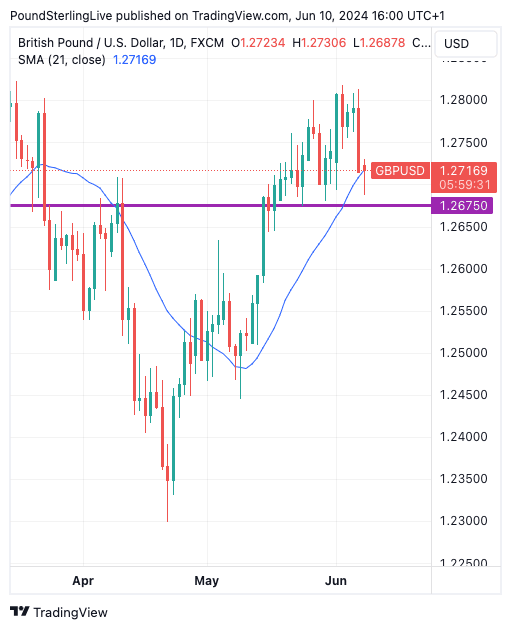
The subsequent decline in Pound-Dollar brings the exchange rate down to the 21-day moving average (1.2717), which looks like an immediate level of technical support ahead of the midweek release of U.S. inflation numbers:


Above: GBP/USD at daily intervals. Track GBP/EUR with your own custom rate alerts. Set Up Here  


“The pound’s failure to extend gains through the low 1.28s through early June is coming home to roost,” says Shaun Osborne, Chief FX Strategist at Scotiabank. He says the current selloff could target support at 1.2675, which is where support formed in late May.

“Loss of support here—which is hard to rule out because of the broader buildup of US bullish momentum—would target losses extending to the 1.2550/00 zone,” warns Osborne.


The Pound is nevertheless competing with the Dollar for the title of 2024’s best-performing currency, with the two trading places regularly. This speaks of ongoing GBP outperformance and we note the broader technical setup in GBP/USD is still broadly supportive as it resides above the majority of the key moving averages.

A retest of 2024 highs over the coming weeks cannot be ruled out at this stage.

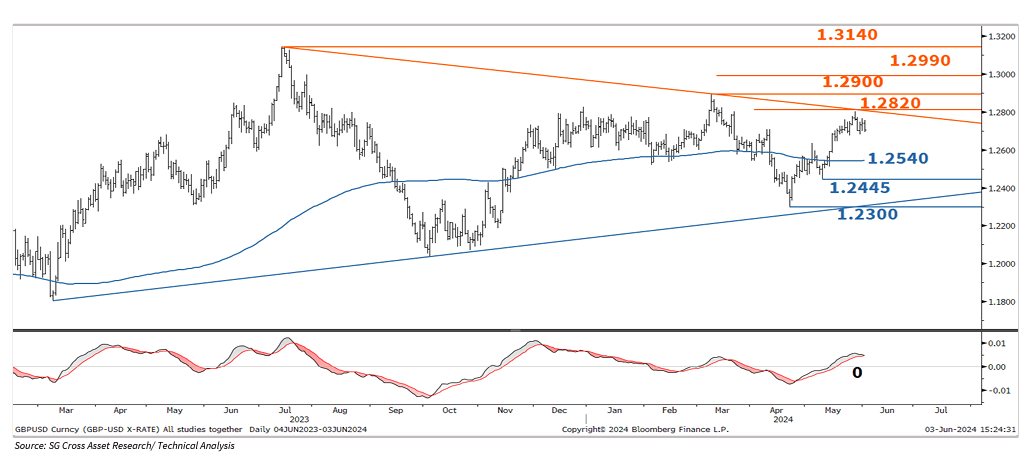
“GBP/USD has unfolded a sideways consolidation since last year it has evolved within two converging trend lines forming a symmetrical triangle,” says Tanmay Purohit, a technical analyst at Société Générale.

He says the pair is approaching the upper band near 1 2820 which could be an interim hurdle.

“Once this is overcome, a larger up move is likely towards 1 2900 and perhaps even towards last year’s peak of 1 3140,” he predicts.


The USD side of the equation will be important this week, with the Federal Reserve and U.S. inflation release on tap.

Regarding inflation, the figure to watch is 0.1% month-on-month for headline CPI and 0.3% m/m for core. A beat on this figure could prompt a breakdown in Pound-Dollar below the aforementioned 1.2675 support.

A surprisingly soft report would put GBP/USD back into the early 1.28’s and reinvigorate the uptrend.


Watch the release of the Federal Reserve’s policy decision, also due midweek.

Analysts expect the Fed to maintain current policy settings. Of interest will be the changes in the forecasts, with Fed members likely to reduce the number of rate cuts they now believe appropriate for 2024 to two (down from three previously).

So, changes should be in a hawkish direction for the Dollar, but a good deal of these developments are well understood and baked into the value of the USD.

Source link

10 06, 2024

Negative outlook should persist below the 200-day SMA

By |2024-06-10T23:19:09+03:00June 10, 2024|Forex News, News|0 Comments

  • EUR/USD gapped lower and tested five-week lows near 1.0730.
  • The US Dollar picked up strong pace and advanced to multi-week tops.
  • Political uncertainty in Europe resurged after Parliamentary elections.

On Monday, the US Dollar (USD) maintained its post-NFP uptrend well and sound, prompting EUR/USD to extend its downward momentum to five-week lows in the 1.0735–1.0730 band.

The firm price action in the Greenback, however, could not avoid part of the risk complex to regain some balance after Friday’s sharp losses and was exclusively derived from weakness in the European currency in response to results from parliamentary elections in the old continent and the call for snap elections by French President E. Macron to be held on June 30.

Monday, in the meantime, saw some ECB board members, including board member P. Kazimir, J. Nagel, and President C. Lagarde, urging caution in considering further interest rate cuts due to uncontrolled inflation and potential price pressures. They compared the bank’s interest rate trajectory to a mountain ridge, suggesting policymakers may wait multiple meetings before implementing further cuts.

Regarding the Federal Reserve (Fed), the latest Nonfarm Payrolls numbers in May (+272K) hurt bets on anticipated interest rate hikes and now suggest the likelihood of such a move in November or December.

The CME Group’s FedWatch Tool now suggests a nearly 65% probability of lower interest rates by the November 7 meeting and around 49% in September.

In the short term, the ECB’s recent rate cut widened the policy gap with the Fed, potentially exposing the EUR/USD to further weakness. However, in the longer term, the emerging economic recovery in the Eurozone, coupled with perceived slowdowns in the US economy, should mitigate this disparity, offering support to the pair.

Looking ahead, the next big events for the pair will be the release of US inflation figures tracked by the CPI and the FOMC meeting, both due on June 12.

EUR/USD daily chart

EUR/USD short-term technical outlook

If the bearish tone persists, EUR/USD may initially target the June low of 1.0732 (June 10), before the May low of 1.0649 (May 1), and the 2024 bottom of 1.0601 (April 16).

If bulls regain some composure, spot may test the June high of 1.0916 (June 4), seconded by the March top of 1.0981 (March 8), and the weekly peak of 1.0998 (January 11), all before reaching the important 1.1000 level.

So far, the 4-hour chart indicates some signs of life following the recent sharp drop. That said, the next hurdle is the 200-SMA (1.0802), ahead of the 55-SMA of 1.0846. On the flip side, 1.0732 comes first prior to 1.0723 and 1.0.649. The relative strength index (RSI) bounced to around 30.

Source link

10 06, 2024

USD/JPY Forecast – US Dollar Drifts Lower Against Japanese Yen

By |2024-06-10T21:17:31+03:00June 10, 2024|Forex News, News|0 Comments

USD/JPY Forecast Video for 06.04.23

US Dollar vs Japanese Yen Technical Analysis

The US dollar has drifted a little bit lower against the Japanese yen during the trading session on Wednesday, as it looks like we are continuing to look for some type of floor in this market. Alternatively, the market is paying attention to the 50-Day EMA above, as it has offered a bit of dynamic resistance, right along with the 200-Day EMA just above it.

Underneath, the ¥130 level is an area that offers a certain amount of psychological support, and we have seen the market bounce from there recently. The market formed a hammer the last time we got down to that area, to see the market bounce towards those moving averages. On the other hand, if we were to turn around and break above those moving averages, that would obviously be a very bullish sign, and open up the possibility of going to the ¥135 level.

On the other hand, if we were to turn around and break down below the hammer that we bounced from that ¥130 level, then it opens up the possibility of the market testing the ¥127.50 level, where we had formed a bit of a double bottom. Breaking down below that level then opens up the possibility of a move down to the ¥125 level. That would also be yet another large, round, psychologically significant figure that a lot of people would be paying attention to.

Keep in mind that the Bank of Japan continues its yield curve control situation, trying to keep the 10 year JGB down to 50 basis points. Having said that, there were remarks overnight from a Bank of Japan official that perhaps they could abandon that as the interest rate situation seems to be calming down. That being said, it’ll be interesting to see how this plays out over the longer term, but we are most certainly getting very close to a major support level that should have an effect on the market. Ultimately, this is a situation where you will have to pay close attention to the bond markets, and of course the overall strength of the US dollar itself.

For a look at all of today’s economic events, check out our economic calendar.

This article was originally posted on FX Empire

More From FXEMPIRE:

Source link

10 06, 2024

Fears to maintain Euro under selling pressure

By |2024-06-10T19:16:51+03:00June 10, 2024|Forex News, News|0 Comments

EUR/USD Current price: 1.0752

  • Far-right parties stood out in European Parliamentary Elections, spurring risk aversion.
  • The United States Federal Reserve will announce its decision on monetary policy this week.
  • EUR/USD bearish potential intact, break through 1.0700 at sight.

The EUR/USD pair gapped lower at the weekly opening, falling to 1.0732 during European trading hours, its lowest in a month. The result of the European Parliamentary Elections hit the Euro hard. Despite the centrist coalition managing to keep a narrow majority, far-right parties won in France, Austria, and Germany, leading to French President Emmanuel Macron calling for a snap parliamentary election in his country. Concerns about far-right parties gaining momentum pushed financial markets into risk-averse mode, boosting demand for the safe-haven US Dollar.

Demand for the Greenback pared ahead of Wall Street’s opening, although the USD holds on to gains against most major rivals. Meanwhile, European indexes trimmed a good part of their early losses but remain in the red. Across the pond, US indexes are poised to open with modest losses after falling on Friday following the release of a much stronger than anticipated United States (US) Nonfarm Payrolls (NFP) report.

Data-wise, the Eurozone published the June Sentix Investor Confidence index, which improved to 0.3 from -3.6 in May. The US has nothing to offer on Monday but will release the May Consumer Price Index (CPI) next Wednesday. The Federal Reserve (Fed) will announce its decision on monetary policy afterwards and publish alongside fresh economic projections. It seems hard that markets will move too far away from their current levels before the news.

EUR/USD short-term technical outlook

From a technical point of view, the EUR/USD pair is currently trading at around 1.0750, maintaining the bearish momentum. In the daily chart, the pair is developing below all its moving averages, with the 20 Simple Moving Average (SMA) having lost its bullish strength but holding above the longer ones, which hold directionless. At the same time, technical indicators head firmly south within negative levels, in line with another leg lower.

In the near term, and according to the 4-hour chart, EUR/USD is oversold. The Momentum indicator heads firmly south within negative levels, while the Relative Strength Index (RSI) indicator stabilized at around 23. Finally, the 20 SMA turned sharply south and is currently crossing below the 100 SMA, converging in the 1.0850 price zone. The 200 SMA, in the meantime, provides dynamic resistance in the 1.0800 price zone.

Support levels: 1.0730 1.0690 1.0645

Resistance levels: 1.0805 1.0850 1.0895

Source link

10 06, 2024

GBP/USD Analysis Today 10/6: Upward Trend (chart)

By |2024-06-10T17:15:27+03:00June 10, 2024|Forex News, News|0 Comments

  • Despite the recent strength of the US dollar following stronger-than-expected US jobs data, which has dampened any expectations of imminent US rate cuts, the GBP/USD currency pair has shown remarkable resilience.
  • It settled around the 1.2720 level at the time of writing.
  • Its highest gain last week touched the 1.2817 resistance level, the highest in nearly three months.

According to the results of the economic calendar, economists are divided on how many rate cuts Fed officials will signal for 2024 in their policy meeting this week, following recent high inflation numbers. Overall, policymakers are likely to backtrack on their long-held expectations of three US rate cuts this year, but it’s a close call on whether they will stick to two rate cuts or not. Moreover, a majority of 41% of economists expect the “dot plot” to show two cuts, while 41% expect the projections to show just one cut or no cuts at all, according to a Bloomberg survey.

The FOMC, which has kept the benchmark interest rate at its highest level in two decades since July last year, was encouraged by the sharp decline in inflation in the second half of 2023 to decide on a gradual rate cut this year. However, these plans were put on hold after failing to make progress in early 2024. In this regard, Ryan Sweet, senior US economist at Oxford Economics, said in response to the survey: “The Fed is waiting for a series of data that will boost its confidence that inflation is on a sustainable path towards its 2% target.” Added, “the balance of risks to our inflation outlook remains tilted to the upside.”

Overall, officials are confident they will keep the U.S. benchmark rate steady in a range of 5.25% to 5.5% for a seventh straight meeting next week. Concurrently, chairman Jerome Powell and his colleagues will update their economic forecasts and interest rates at the June 11-12 meeting for the first time since March. Thus, the lower cuts point to a later start to cuts. Ultimately, this could have implications for the November presidential election, although Fed officials are uniformly saying their decisions are based solely on economic considerations.

Technical forecasts for the GBP/USD pair today:

We expect the GBP/USD rate to remain under downward pressure in an attempt to avoid further losses until markets and investors react to the release of US inflation figures and the US Federal Reserve’s policy decisions, along with a package of important UK economic releases. Based on the performance on the daily chart above, the 1.2775 resistance will remain a catalyst for bulls to push higher. The 1.3000 psychological resistance will be the most important to confirm the strength of the uptrend. Conversely, and over the same time frame, the 1.2600 support level will remain the strongest threat to the future of the current bullish rebound.

Ready to trade our daily Forex forecast? Here’s a list of some of the top forex brokers UK to check out. 

Source link

10 06, 2024

Sellers take action as Euro pierces through key support area

By |2024-06-10T15:14:09+03:00June 10, 2024|Forex News, News|0 Comments

You have reached your limit of 5 free articles for this month.

Get Premium without limits for only $9.99 for the first month

Access all our articles, insights, and analysts.

Your coupon code


UNLOCK OFFER

  • Euro stays under heavy selling pressure at the beginning of the week.
  • Political uncertainy following the European Parliament election weighs on sentiment.
  • EUR/USD could extend its slide while 1.0790-1.0800 resistance area holds.

EUR/USD started the new week with a bearish gap and slumped to its weakest level in a month below 1.0750. The pair’s technical outlook points to oversold conditions but the Euro could have a difficult time staging a rebound in the current risk-averse market atmosphere.

Euro PRICE Today

The table below shows the percentage change of Euro (EUR) against listed major currencies today. Euro was the weakest against the US Dollar.

  USD EUR GBP JPY CAD AUD NZD CHF
USD   0.38% 0.03% 0.11% 0.11% -0.11% -0.04% -0.07%
EUR -0.38%   -0.01% -0.02% 0.00% -0.22% -0.17% -0.20%
GBP -0.03% 0.00%   0.12% -0.01% -0.21% -0.16% -0.20%
JPY -0.11% 0.02% -0.12%   0.00% -0.29% -0.25% -0.13%
CAD -0.11% -0.01% 0.01% -0.00%   -0.18% -0.14% -0.19%
AUD 0.11% 0.22% 0.21% 0.29% 0.18%   0.06% 0.02%
NZD 0.04% 0.17% 0.16% 0.25% 0.14% -0.06%   -0.04%
CHF 0.07% 0.20% 0.20% 0.13% 0.19% -0.02% 0.04%  

The heat map shows percentage changes of major currencies against each other. The base currency is picked from the left column, while the quote currency is picked from the top row. For example, if you pick the Euro from the left column and move along the horizontal line to the US Dollar, the percentage change displayed in the box will represent EUR (base)/USD (quote).

The US Dollar (USD) capitalized on the strong jobs report on Friday and forced EUR/USD to erase its weekly gains. Nonfarm Payrolls in the US rose 272,000 in May. This print surpassed the market expectation of 185,000 and April’s increase of 165,000 by a wide margin. In turn, US Treasury bond yields surged higher ahead of the weekend and provided a boost to the USD.

Preliminary results of the European Parliament election triggered a flight to safety at the beginning of the week and caused the Euro to weaken against its rivals.

The European People’s Party became the clear winner, gaining 8 seats to secure a total of 184 seats in the European Parliament.

In France, National Rally won 31.5% of the vote against the Besoin d’Europe alliance’s – including President Macron’s Renaissance – 14.5%. French President Emmanuel Macron said that far-right parties in Europe were “progressing across the continent” and called for a snap election. Meanwhile, in Germany, Chancellor Olaf Scholz’s SPD became the third party behind the main opposition conservative party, CDU, which received 30% of the vote, and the far-right Alternative for Germany (AfD) party, which got nearly 16% of the vote.

Assessing the outcome of the European Parliament election, analysts BBH said that things could get complicated or delayed with regards to the progress towards a deeper Eurozone integration. “It may take weeks before political alliances are shaped and a centrist “super grand coalition” remains the most likely scenario,” analysts noted and added: “The centre-right European People’s Party (EPP) are still the parliament’s biggest group followed by the centre-left Socialists and Democrats (S&D), and the centrist Renew Europe (RE).”

The economic calendar will not offer any high-tier data releases on Monday and the risk perception could continue to drive EUR/USD’s action ahead of the US Consumer Price Index (CPI) data and the Federal Reserve’s (Fed) monetary policy announcements on Wednesday.

EUR/USD Technical Analysis

The Relative Strength Index (RSI) indicator on the 4-hour chart dropped below 30, pointing to oversold conditions in the near term. In case EUR/USD stages a correction, 1.0790-1.0800 area, where the Fibonacci 38.2% retracement of the latest uptrend meets the 100-day and the 200-day Simple Moving Averages (SMA), could act as stiff resistance. If the pair rises above that level and confirms it as support, an extended recovery toward 1.0850 (static level, 100-period SMA on the 4-hour chart) could be seen.

On the downside, interim support seems to have formed at 1.0750 before 1.0730 (Fibonacci 61.8% retracement) and 1.0700 (psychological level, static level).

Euro FAQs

The Euro is the currency for the 20 European Union countries that belong to the Eurozone. It is the second most heavily traded currency in the world behind the US Dollar. In 2022, it accounted for 31% of all foreign exchange transactions, with an average daily turnover of over $2.2 trillion a day. EUR/USD is the most heavily traded currency pair in the world, accounting for an estimated 30% off all transactions, followed by EUR/JPY (4%), EUR/GBP (3%) and EUR/AUD (2%).

The European Central Bank (ECB) in Frankfurt, Germany, is the reserve bank for the Eurozone. The ECB sets interest rates and manages monetary policy. The ECB’s primary mandate is to maintain price stability, which means either controlling inflation or stimulating growth. Its primary tool is the raising or lowering of interest rates. Relatively high interest rates – or the expectation of higher rates – will usually benefit the Euro and vice versa. The ECB Governing Council makes monetary policy decisions at meetings held eight times a year. Decisions are made by heads of the Eurozone national banks and six permanent members, including the President of the ECB, Christine Lagarde.

Eurozone inflation data, measured by the Harmonized Index of Consumer Prices (HICP), is an important econometric for the Euro. If inflation rises more than expected, especially if above the ECB’s 2% target, it obliges the ECB to raise interest rates to bring it back under control. Relatively high interest rates compared to its counterparts will usually benefit the Euro, as it makes the region more attractive as a place for global investors to park their money.

Data releases gauge the health of the economy and can impact on the Euro. Indicators such as GDP, Manufacturing and Services PMIs, employment, and consumer sentiment surveys can all influence the direction of the single currency. A strong economy is good for the Euro. Not only does it attract more foreign investment but it may encourage the ECB to put up interest rates, which will directly strengthen the Euro. Otherwise, if economic data is weak, the Euro is likely to fall. Economic data for the four largest economies in the euro area (Germany, France, Italy and Spain) are especially significant, as they account for 75% of the Eurozone’s economy.

Another significant data release for the Euro is the Trade Balance. This indicator measures the difference between what a country earns from its exports and what it spends on imports over a given period. If a country produces highly sought after exports then its currency will gain in value purely from the extra demand created from foreign buyers seeking to purchase these goods. Therefore, a positive net Trade Balance strengthens a currency and vice versa for a negative balance.


  • Euro stays under heavy selling pressure at the beginning of the week.
  • Political uncertainy following the European Parliament election weighs on sentiment.
  • EUR/USD could extend its slide while 1.0790-1.0800 resistance area holds.

EUR/USD started the new week with a bearish gap and slumped to its weakest level in a month below 1.0750. The pair’s technical outlook points to oversold conditions but the Euro could have a difficult time staging a rebound in the current risk-averse market atmosphere.

Euro PRICE Today

The table below shows the percentage change of Euro (EUR) against listed major currencies today. Euro was the weakest against the US Dollar.

  USD EUR GBP JPY CAD AUD NZD CHF
USD   0.38% 0.03% 0.11% 0.11% -0.11% -0.04% -0.07%
EUR -0.38%   -0.01% -0.02% 0.00% -0.22% -0.17% -0.20%
GBP -0.03% 0.00%   0.12% -0.01% -0.21% -0.16% -0.20%
JPY -0.11% 0.02% -0.12%   0.00% -0.29% -0.25% -0.13%
CAD -0.11% -0.01% 0.01% -0.00%   -0.18% -0.14% -0.19%
AUD 0.11% 0.22% 0.21% 0.29% 0.18%   0.06% 0.02%
NZD 0.04% 0.17% 0.16% 0.25% 0.14% -0.06%   -0.04%
CHF 0.07% 0.20% 0.20% 0.13% 0.19% -0.02% 0.04%  

The heat map shows percentage changes of major currencies against each other. The base currency is picked from the left column, while the quote currency is picked from the top row. For example, if you pick the Euro from the left column and move along the horizontal line to the US Dollar, the percentage change displayed in the box will represent EUR (base)/USD (quote).

The US Dollar (USD) capitalized on the strong jobs report on Friday and forced EUR/USD to erase its weekly gains. Nonfarm Payrolls in the US rose 272,000 in May. This print surpassed the market expectation of 185,000 and April’s increase of 165,000 by a wide margin. In turn, US Treasury bond yields surged higher ahead of the weekend and provided a boost to the USD.

Preliminary results of the European Parliament election triggered a flight to safety at the beginning of the week and caused the Euro to weaken against its rivals.

The European People’s Party became the clear winner, gaining 8 seats to secure a total of 184 seats in the European Parliament.

In France, National Rally won 31.5% of the vote against the Besoin d’Europe alliance’s – including President Macron’s Renaissance – 14.5%. French President Emmanuel Macron said that far-right parties in Europe were “progressing across the continent” and called for a snap election. Meanwhile, in Germany, Chancellor Olaf Scholz’s SPD became the third party behind the main opposition conservative party, CDU, which received 30% of the vote, and the far-right Alternative for Germany (AfD) party, which got nearly 16% of the vote.

Assessing the outcome of the European Parliament election, analysts BBH said that things could get complicated or delayed with regards to the progress towards a deeper Eurozone integration. “It may take weeks before political alliances are shaped and a centrist “super grand coalition” remains the most likely scenario,” analysts noted and added: “The centre-right European People’s Party (EPP) are still the parliament’s biggest group followed by the centre-left Socialists and Democrats (S&D), and the centrist Renew Europe (RE).”

The economic calendar will not offer any high-tier data releases on Monday and the risk perception could continue to drive EUR/USD’s action ahead of the US Consumer Price Index (CPI) data and the Federal Reserve’s (Fed) monetary policy announcements on Wednesday.

EUR/USD Technical Analysis

The Relative Strength Index (RSI) indicator on the 4-hour chart dropped below 30, pointing to oversold conditions in the near term. In case EUR/USD stages a correction, 1.0790-1.0800 area, where the Fibonacci 38.2% retracement of the latest uptrend meets the 100-day and the 200-day Simple Moving Averages (SMA), could act as stiff resistance. If the pair rises above that level and confirms it as support, an extended recovery toward 1.0850 (static level, 100-period SMA on the 4-hour chart) could be seen.

On the downside, interim support seems to have formed at 1.0750 before 1.0730 (Fibonacci 61.8% retracement) and 1.0700 (psychological level, static level).

Euro FAQs

The Euro is the currency for the 20 European Union countries that belong to the Eurozone. It is the second most heavily traded currency in the world behind the US Dollar. In 2022, it accounted for 31% of all foreign exchange transactions, with an average daily turnover of over $2.2 trillion a day. EUR/USD is the most heavily traded currency pair in the world, accounting for an estimated 30% off all transactions, followed by EUR/JPY (4%), EUR/GBP (3%) and EUR/AUD (2%).

The European Central Bank (ECB) in Frankfurt, Germany, is the reserve bank for the Eurozone. The ECB sets interest rates and manages monetary policy. The ECB’s primary mandate is to maintain price stability, which means either controlling inflation or stimulating growth. Its primary tool is the raising or lowering of interest rates. Relatively high interest rates – or the expectation of higher rates – will usually benefit the Euro and vice versa. The ECB Governing Council makes monetary policy decisions at meetings held eight times a year. Decisions are made by heads of the Eurozone national banks and six permanent members, including the President of the ECB, Christine Lagarde.

Eurozone inflation data, measured by the Harmonized Index of Consumer Prices (HICP), is an important econometric for the Euro. If inflation rises more than expected, especially if above the ECB’s 2% target, it obliges the ECB to raise interest rates to bring it back under control. Relatively high interest rates compared to its counterparts will usually benefit the Euro, as it makes the region more attractive as a place for global investors to park their money.

Data releases gauge the health of the economy and can impact on the Euro. Indicators such as GDP, Manufacturing and Services PMIs, employment, and consumer sentiment surveys can all influence the direction of the single currency. A strong economy is good for the Euro. Not only does it attract more foreign investment but it may encourage the ECB to put up interest rates, which will directly strengthen the Euro. Otherwise, if economic data is weak, the Euro is likely to fall. Economic data for the four largest economies in the euro area (Germany, France, Italy and Spain) are especially significant, as they account for 75% of the Eurozone’s economy.

Another significant data release for the Euro is the Trade Balance. This indicator measures the difference between what a country earns from its exports and what it spends on imports over a given period. If a country produces highly sought after exports then its currency will gain in value purely from the extra demand created from foreign buyers seeking to purchase these goods. Therefore, a positive net Trade Balance strengthens a currency and vice versa for a negative balance.


Source link

10 06, 2024

Pound Sterling turns bearish, closes in on important support

By |2024-06-10T13:12:30+03:00June 10, 2024|Forex News, News|0 Comments

You have reached your limit of 5 free articles for this month.

Get Premium without limits for only $9.99 for the first month

Access all our articles, insights, and analysts.

Your coupon code


UNLOCK OFFER

  • GBP/USD continues to edge lower following Friday’s sharp decline.
  • Sellers could remain interested if Pound Sterling drops below 1.2700.
  • The technical outlook points to a buildup of bearish momentum.

GBP/USD stays on the back foot and continues to edge lower toward 1.2700 in the European session on Monday. The pair’s near-term technical outlook highlights a buildup of bearish momentum.

British Pound PRICE Last 7 days

The table below shows the percentage change of British Pound (GBP) against listed major currencies last 7 days. British Pound was the weakest against the Swiss Franc.

  USD EUR GBP JPY CAD AUD NZD CHF
USD   0.93% 0.33% -0.24% 1.08% 1.00% 0.48% -0.73%
EUR -0.93%   -0.57% -1.15% 0.15% -0.06% -0.45% -1.66%
GBP -0.33% 0.57%   -0.52% 0.72% 0.59% 0.07% -1.09%
JPY 0.24% 1.15% 0.52%   1.28% 1.27% 0.85% -0.33%
CAD -1.08% -0.15% -0.72% -1.28%   -0.11% -0.59% -1.80%
AUD -1.00% 0.06% -0.59% -1.27% 0.11%   -0.40% -1.62%
NZD -0.48% 0.45% -0.07% -0.85% 0.59% 0.40%   -1.24%
CHF 0.73% 1.66% 1.09% 0.33% 1.80% 1.62% 1.24%  

The heat map shows percentage changes of major currencies against each other. The base currency is picked from the left column, while the quote currency is picked from the top row. For example, if you pick the British Pound from the left column and move along the horizontal line to the US Dollar, the percentage change displayed in the box will represent GBP (base)/USD (quote).

GBP/USD came under heavy bearish pressure on Friday and erased all of its weekly gains. The US Dollar (USD) capitalized on the upbeat labor market data and forced the pair to push lower as investors reassessed the probability of a Federal Reserve (Fed) rate cut in September.

The US Bureau of Labor Statistics reported that Nonfarm Payrolls rose 272,000 in May. This reading beat analysts’ estimate for an increase of 185,000 by a wide margin. Additionally, the annual wage inflation, as measured by the change in the Average Hourly Earnings, rose to 4.1% from 4% in April. According to the CME FedWatch Tool, the probability of the Fed leaving the policy rate unchanged in September rose slightly above 50% after the May jobs report from 40% earlier in the week.

On Tuesday, the UK’s Office for National Statistics will release labor market data. More importantly, the US economic docket will feature Consumer Price Index (CPI) data for May before the Fed announces monetary policy decisions and releases the revised Summary of Projections later in the day. Ahead of these events, the risk perception could drive GBP/USD’s action.

At the time of press, US stock index futures were down between 0.3% and 0.4%, suggesting that the USD could preserve its strength in the second half of the day with safe-haven flows dominating the markets.

GBP/USD Technical Analysis

GBP/USD dropped below the lower limit of the ascending regression channel and the Relative Strength Index (RSI) indicator on the 4-hour chart fell below 40, reflecting the bearish shift in the short-term outlook.

The Fibonacci 23.6% retracement level of the latest uptrend aligns as immediate support at 1.2700. In case GBP/USD falls below this level and starts using it as resistance, sellers could target 1.2640 (100-day Simple Moving Average (SMA) and the 200-period SMA on the 4-hour chart) ahead of 1.2600 (psychological level, static level).

On the upside, resistances could be seen at 1.2730 (lower limit of the ascending channel, 100-period SMA) and 1.2800 (mid-point of the ascending channel, psychological level, static level).

Pound Sterling FAQs

The Pound Sterling (GBP) is the oldest currency in the world (886 AD) and the official currency of the United Kingdom. It is the fourth most traded unit for foreign exchange (FX) in the world, accounting for 12% of all transactions, averaging $630 billion a day, according to 2022 data. Its key trading pairs are GBP/USD, aka ‘Cable’, which accounts for 11% of FX, GBP/JPY, or the ‘Dragon’ as it is known by traders (3%), and EUR/GBP (2%). The Pound Sterling is issued by the Bank of England (BoE).

The single most important factor influencing the value of the Pound Sterling is monetary policy decided by the Bank of England. The BoE bases its decisions on whether it has achieved its primary goal of “price stability” – a steady inflation rate of around 2%. Its primary tool for achieving this is the adjustment of interest rates. When inflation is too high, the BoE will try to rein it in by raising interest rates, making it more expensive for people and businesses to access credit. This is generally positive for GBP, as higher interest rates make the UK a more attractive place for global investors to park their money. When inflation falls too low it is a sign economic growth is slowing. In this scenario, the BoE will consider lowering interest rates to cheapen credit so businesses will borrow more to invest in growth-generating projects.

Data releases gauge the health of the economy and can impact the value of the Pound Sterling. Indicators such as GDP, Manufacturing and Services PMIs, and employment can all influence the direction of the GBP. A strong economy is good for Sterling. Not only does it attract more foreign investment but it may encourage the BoE to put up interest rates, which will directly strengthen GBP. Otherwise, if economic data is weak, the Pound Sterling is likely to fall.

Another significant data release for the Pound Sterling is the Trade Balance. This indicator measures the difference between what a country earns from its exports and what it spends on imports over a given period. If a country produces highly sought-after exports, its currency will benefit purely from the extra demand created from foreign buyers seeking to purchase these goods. Therefore, a positive net Trade Balance strengthens a currency and vice versa for a negative balance.


  • GBP/USD continues to edge lower following Friday’s sharp decline.
  • Sellers could remain interested if Pound Sterling drops below 1.2700.
  • The technical outlook points to a buildup of bearish momentum.

GBP/USD stays on the back foot and continues to edge lower toward 1.2700 in the European session on Monday. The pair’s near-term technical outlook highlights a buildup of bearish momentum.

British Pound PRICE Last 7 days

The table below shows the percentage change of British Pound (GBP) against listed major currencies last 7 days. British Pound was the weakest against the Swiss Franc.

  USD EUR GBP JPY CAD AUD NZD CHF
USD   0.93% 0.33% -0.24% 1.08% 1.00% 0.48% -0.73%
EUR -0.93%   -0.57% -1.15% 0.15% -0.06% -0.45% -1.66%
GBP -0.33% 0.57%   -0.52% 0.72% 0.59% 0.07% -1.09%
JPY 0.24% 1.15% 0.52%   1.28% 1.27% 0.85% -0.33%
CAD -1.08% -0.15% -0.72% -1.28%   -0.11% -0.59% -1.80%
AUD -1.00% 0.06% -0.59% -1.27% 0.11%   -0.40% -1.62%
NZD -0.48% 0.45% -0.07% -0.85% 0.59% 0.40%   -1.24%
CHF 0.73% 1.66% 1.09% 0.33% 1.80% 1.62% 1.24%  

The heat map shows percentage changes of major currencies against each other. The base currency is picked from the left column, while the quote currency is picked from the top row. For example, if you pick the British Pound from the left column and move along the horizontal line to the US Dollar, the percentage change displayed in the box will represent GBP (base)/USD (quote).

GBP/USD came under heavy bearish pressure on Friday and erased all of its weekly gains. The US Dollar (USD) capitalized on the upbeat labor market data and forced the pair to push lower as investors reassessed the probability of a Federal Reserve (Fed) rate cut in September.

The US Bureau of Labor Statistics reported that Nonfarm Payrolls rose 272,000 in May. This reading beat analysts’ estimate for an increase of 185,000 by a wide margin. Additionally, the annual wage inflation, as measured by the change in the Average Hourly Earnings, rose to 4.1% from 4% in April. According to the CME FedWatch Tool, the probability of the Fed leaving the policy rate unchanged in September rose slightly above 50% after the May jobs report from 40% earlier in the week.

On Tuesday, the UK’s Office for National Statistics will release labor market data. More importantly, the US economic docket will feature Consumer Price Index (CPI) data for May before the Fed announces monetary policy decisions and releases the revised Summary of Projections later in the day. Ahead of these events, the risk perception could drive GBP/USD’s action.

At the time of press, US stock index futures were down between 0.3% and 0.4%, suggesting that the USD could preserve its strength in the second half of the day with safe-haven flows dominating the markets.

GBP/USD Technical Analysis

GBP/USD dropped below the lower limit of the ascending regression channel and the Relative Strength Index (RSI) indicator on the 4-hour chart fell below 40, reflecting the bearish shift in the short-term outlook.

The Fibonacci 23.6% retracement level of the latest uptrend aligns as immediate support at 1.2700. In case GBP/USD falls below this level and starts using it as resistance, sellers could target 1.2640 (100-day Simple Moving Average (SMA) and the 200-period SMA on the 4-hour chart) ahead of 1.2600 (psychological level, static level).

On the upside, resistances could be seen at 1.2730 (lower limit of the ascending channel, 100-period SMA) and 1.2800 (mid-point of the ascending channel, psychological level, static level).

Pound Sterling FAQs

The Pound Sterling (GBP) is the oldest currency in the world (886 AD) and the official currency of the United Kingdom. It is the fourth most traded unit for foreign exchange (FX) in the world, accounting for 12% of all transactions, averaging $630 billion a day, according to 2022 data. Its key trading pairs are GBP/USD, aka ‘Cable’, which accounts for 11% of FX, GBP/JPY, or the ‘Dragon’ as it is known by traders (3%), and EUR/GBP (2%). The Pound Sterling is issued by the Bank of England (BoE).

The single most important factor influencing the value of the Pound Sterling is monetary policy decided by the Bank of England. The BoE bases its decisions on whether it has achieved its primary goal of “price stability” – a steady inflation rate of around 2%. Its primary tool for achieving this is the adjustment of interest rates. When inflation is too high, the BoE will try to rein it in by raising interest rates, making it more expensive for people and businesses to access credit. This is generally positive for GBP, as higher interest rates make the UK a more attractive place for global investors to park their money. When inflation falls too low it is a sign economic growth is slowing. In this scenario, the BoE will consider lowering interest rates to cheapen credit so businesses will borrow more to invest in growth-generating projects.

Data releases gauge the health of the economy and can impact the value of the Pound Sterling. Indicators such as GDP, Manufacturing and Services PMIs, and employment can all influence the direction of the GBP. A strong economy is good for Sterling. Not only does it attract more foreign investment but it may encourage the BoE to put up interest rates, which will directly strengthen GBP. Otherwise, if economic data is weak, the Pound Sterling is likely to fall.

Another significant data release for the Pound Sterling is the Trade Balance. This indicator measures the difference between what a country earns from its exports and what it spends on imports over a given period. If a country produces highly sought-after exports, its currency will benefit purely from the extra demand created from foreign buyers seeking to purchase these goods. Therefore, a positive net Trade Balance strengthens a currency and vice versa for a negative balance.


Source link

Go to Top