The Federal Open Market Committee (FOMC) meet on March 19 and 20. Market expectations heading into the meeting are, at present, slightly above 50% for a June 25bp rate cut.
Analysts at Wolfe Research in the US are flagging a concern:
“We think the risk leans a bit hawkish next week”
“After two strong CPI prints, we’re not convinced the Fed will be ready to cut rates by the June meeting with only 2.5 additional CPI readings from here (May CPI comes out on the 2nd day of the June FOMC).”
“This would be reflected in the Fed potentially moving its median 2024 dot to two cuts instead of three, although this is not yet our base case”
I can’t help but agree. After hot inflation reports for January and February we have all been bombarded with excuses reminiscent of the ‘transitory’ days, but this time from analysts, not from the Fed. Fed officials have been more cautious on inflation readings than the median economists.
The BOJ statement is on the 19th.
The FOMC will be on the 20th.
Buckle up!
Fashion tip for next week
ps. There are calls coming in for later Fed rate cuts:
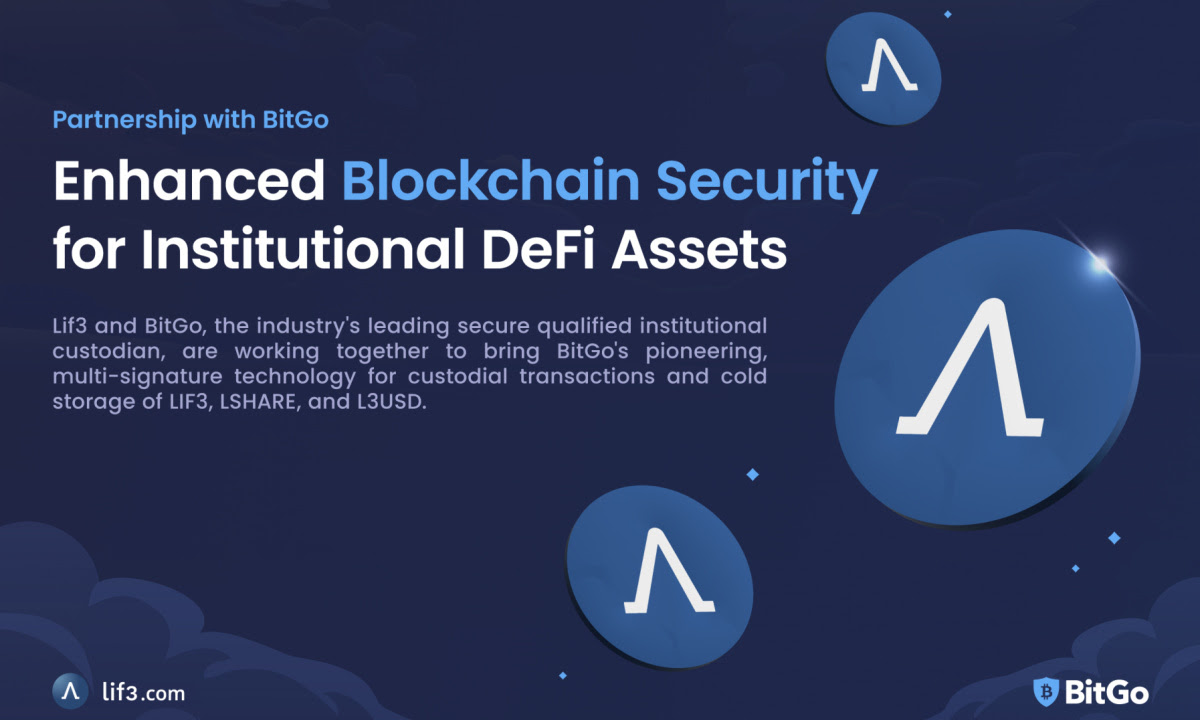
The innovative multi-chain DeFi Layer-1 ecosystem Lif3 (LIF3/USD)(LIF3/USDt), which runs on Ethereum, Polygon, BNB Chain, and Fantom, is elated to announce its strategic alliance with BitGo, the most secure qualified institutional custodian in the market. As a result of this partnership, users globally will have greater security and accessibility to blockchain technologies. BitGo’s multi-signature technology is utilized by Lif3.com for custodial transactions, cold storage of Lif3 tokens, LSHARE tokens, and L3USD.
“We are pleased to support Lif3’s aim of increasing access to DeFi with our industry-leading, secure custody solutions. This partnership will provide Lif3 users peace of mind to confidently engage in the DeFi ecosystem,” says Mike Belshe, CEO of BitGo. “This strategic collaboration not only enhances the safety of digital assets for institutional clients, but also instills a newfound confidence in the secure storage and transaction capabilities within the Lif3 ecosystem, setting a new gold standard for asset protection in the DeFi space. As an advocate for the LIF3 ecosystem, I’m most excited to harness BitGo’s renowned multi-signature institutional custodial solutions for the impeccable safeguarding of its core assets. Joining forces with BitGo, recognized as the industry standard in security, will help provide an innovative, unparalleled layer of security for Lif3 tokens, LSHARE tokens, and L3USD – utilizing BitGo’s cutting-edge cold storage technology. The relationship with BitGo spans over a decade as I have been using their products since 2013, where their product offerings have evolved from securing Bitcoin to creating Wrapped Bitcoin (WBTC), for example. It was an easy decision to help choose BitGo to secure Lif3’s ecosystem,” says Harry Yeh, Managing Director of Quantum FinTech Group.
This collaboration helps Lif3 realize its goal of providing users with a more straightforward, secure, and engaging experience. It also makes it easier for consumers to purchase DeFi using the “Lif3 Wallet,” which can be downloaded from the App Store and Google Play.
This BitGo news aligns with Lif3’s recent announcement regarding the Ethereum Migration and its strategic alliance with Layer Zero. The alliance aims to address the difficulties related to token bridging and provide a more secure and effective blockchain experience.
The “Lif3 Wallet” and Lif3.com remain a valuable resource for anybody with an interest in the fire of blockchain tech and defi. With its dedication to innovation and constant improvement, Lif3 is positioned to lead the way in reshaping the future digital economy. Its vision is to remove obstacles to the widespread adoption of cryptocurrencies by providing a one-stop shop for on-ramping, trading, investing, earning, gaming, and off-ramping through the Lif3 Mobile App.
Japanese media (Nikkei) with the report. In brief:
The Bank of Japan will discuss whether to end its negative interest rate policy at a meeting that starts Monday, Nikkei has learned, as pay hikes by major companies bring the central bank’s 2% price stability target within reach.
With more BOJ policymakers embracing the idea, the decision is seen coming down to the results of Japan’s annual wage negotiations, to be published by top labor confederation Rengo on Friday.
Earlier this week Bank of Japan Gov. Kazuo Ueda has said the outcome of annual negotiations between labor unions and employers will factor into his decision, they’ll be a “key consideration”.
“I hope to make the appropriate decision based on a comprehensive look at the tally of negotiation results and other factors,”
–
The Nikkei is gated but here is the link if you can access it.
Since demand has stayed strong following last week’s peak, there remains a chance that gold will continue its ascent before a more significant retracement. A rally above today’s high of 2,180 will provide the next sign of strength. However, that should be followed by a breakout above yesterday’s high of 2,184 as it will further confirm the bullish signal. A continuation of the bull trend above 2,185 then becomes more likely.
Long-Term Breakout Confirmed
Since gold has broken out to a new record high and it was confirmed by a weekly close above the prior high of 2,135, there is a good chance that the next higher target zone could be reached. In addition, bullish signals were triggered on the monthly chart for gold. The breakout is from a multi-year basing pattern and the breakout has only just begun. The next higher target zone is from 2,235 to 2,247 and is derived from Fibonacci ratio analysis. Two 161.8% extended targets make up that range. The next higher target range beyond 2,447 is from 2,277 to 2,298.
Drop Below 2,156 Likely Leads to Deeper Retracement
Nevertheless, a deeper retracement becomes more likely on a drop below today’s low of 2,156 and confirmed on a drop below yesterday’s low of 2,151. The 8-Day MA is currently at 2,155. Previous resistance at the prior high of 2,135 may then be tested as support. Further down is the 38.2% Fibonacci retracement at 2,115. However, the more significant support area looks to be around 2,088. That level includes the 50% retracement, and it was a resistance peak in late-December.
For a look at all of today’s economic events, check out our economic calendar.
Inpay, a rapidly growing European fintech company, has enhanced the expansion of Tranglo, a global payment service provider (PSP), into Europe.
This has been done through the implementation of Instant SEPA, which made it possible to enable instant payout services across the continent.
The partnership, which commenced with 12 key SEPA countries, is set to extend Tranglo’s reach to an additional 24 European nations.
This collaboration marks a significant stride in Inpay’s broader expansion strategy, particularly into the Asian market.
The right partner to support scalability
Inpay’s regulatory compliance, overseen by the Danish FSA, and its expertise in risk management are crucial to Tranglo’s scaling efforts.
The partnership enables Tranglo to offer cost-effective, multi-currency, cross-border payments in SEPA regions. This would significantly reduce transaction times and costs compared to traditional methods.
Customers benefit from transparent fees and reliable transfer times, thanks to Inpay’s efficient processing and broad network.
Jacky Lee, Tranglo Group CEO, stressed the importance of shared goals and robust risk management in selecting Inpay as a partner, praising their ability to manage complex payment flows and regulatory demands effectively.
A strategic alliance with Ripple
Since 2022, Tranglo has been a key player in Ripple’s on-demand liquidity (ODL) service, enabling instant, cost-efficient cross-border payments across 25 payment corridors without the need for pre-funding.
This followed the successful pilot of the ODL service, which processed transactions worth USD 48 million in its initial stages. Ripple’s acquisition of a 40% stake in Tranglo in 2021 aimed to enhance the reach and efficiency of RippleNet and its ODL service, which utilizes the digital asset XRP.
The partnership with Ripple has allowed Tranglo to offer improved payout services and expand its global footprint, providing remittance and payment solutions across a vast network.
The NZDUSD started the day with a move below the low of a swing area at 0.6148. However, the price started to find buyers later in the Asian session, and in the process moved through the high of a swing area at 0.6159.
That break took the price up to test its 100 hour moving average near 0.6167. Sellers leaned against that level and forced the price back down to the low of the swing area at 0.6148, where buyers store the fall again.
Once again the price moved back to the 100-day moving average and found sellers against the level.
So overall, there is a lot of “ping-ponging” going on between the 100-hour moving average above at 0.6167, and the low of the swing area near 0.6148.
That is not a huge range which suggests that at some point the price is going to break either to the upside or downside. Traders will be looking for momentum on the break in the direction of the break.
Bitcoin’s price finally broke its previous all-time high on March 5th, surging past $69,200 and currently trading above $72,000. The last time BTC traded anywhere near this price level was in November 2021.
Bitcoin’s price finally broke its previous all-time high on March 5th, surging past $69,200 and currently trading above $72,000. The last time BTC traded anywhere near this price level was in November 2021.
However, while this spike in price has definitely increased the net worth of spot BTC holders, not everyone is in a celebratory mood. Shortly after BTC touched its previous all-time high, there was a violent sell-off which saw the price tank by around 14%, triggering over $1 billion in liquidations across the larger digital asset market.
To some extent, this sell-off was anticipated given that Bitcoin’s notional open interest (OI) had soared by over 23,000 BTC within a span of a week. Additionally, the funding rates also hit levels last seen three years ago.
Nonetheless, even some of the best crypto traders could not resist the allure of adding leverage as BTC’s price nudged higher and higher. The result? A knife-catching contest that wiped out overleveraged positions within a span of hours.
Effective Risk Management in DeFi Lending and Borrowing
Similar to overly exposed margin trading and futures positions, open DeFi lending positions are also not spared when crypto prices take a sudden nosedive.
There have been multiple liquidation events, including the infamous MakerDAO liquidation on Black Thursday, when close to $8.3 million was liquidated after ETH’s price dropped by 45% while MakerDAO’s native token MKR plunged by almost 60% within a day.
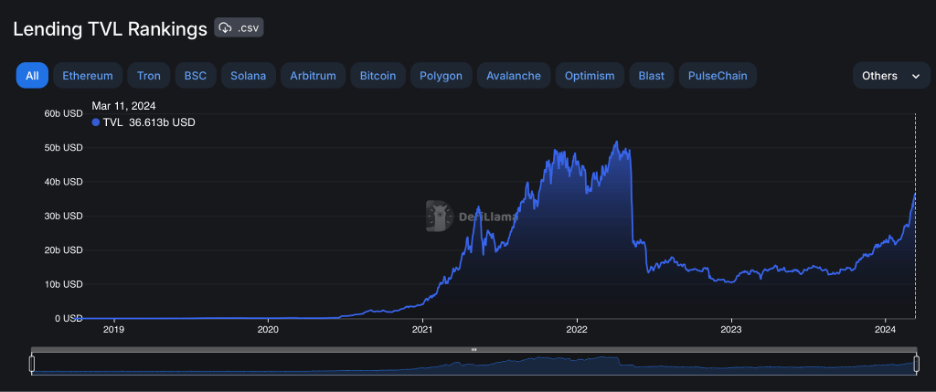
To provide some more context, the total value locked (TVL) across DeFi lending platforms is currently at $36.61 billion, up from $22.2 billion at the beginning of 2024.
This growth is a testament that more and more crypto users are gradually returning to DeFi lending and borrowing platforms to put their idle capital to use.
However, while DeFi lending and borrowing platforms like Aave, Compound, and MakerDAO have opened up a new avenue to access loans by placing digital assets like ETH and WBTC as collateral, the caveat is that these DeFi loans are over-collateralized.
Borrowers can only secure a lower loan amount than the value of the collateral they put up; for example, MakerDAO’s minimum collateralization ratio is 150% (for ETH), which means a borrower looking to access a $100,000 DAI stablecoin loan would have to lock up $150,000 worth of ETH.
Although an effective way to protect DeFi lending protocols from becoming insolvent during, the over-collateralization requirement beats the logic of traditional loan structures where the loan-to-value ratio (LTV) is typically below 100%; in most cases, it is around 80%.
On the brighter side, there are several ways through which DeFi users can minimize their liquidation risks. One of them is by operating on lending platforms with a more friendly collateralization requirement. Nolus protocol is a great example of the DeFi lending platforms whose lending ecosystem is based on an undercollateralized model.
Built on the Cosmos SDK, this DeFi protocol borrows from the concept of traditional leasing, allowing borrowers to access a loan of up to 3x (150%) their collateral’s worth. Also, unlike typical DeFi lending platforms, Nolus’ DeFi lease model stores both the down payment and the loan provided in an automated smart contract to act as collateral, significantly reducing the risk of liquidation.
It is also advantageous to have enough gas fees, especially if you mostly trade on Ethereum. At the height of the DeFi bull run in 2021, Ethereum gas fees went as high as 500 Gwei. What this means is that if one wanted to instantly liquidate a losing position when the ETH blockchain was busy, yet they only had enough ETH to purchase 200 Gwei, then they were probably out of luck in closing the transaction swiftly.
Given that on-chain DeFi activity seems to be picking up again, having a good amount of ETH at any time could help you prevent all your assets from being liquidated when the network is too busy and everyone is likely looking to cash out.
DeFi lending and borrowing platforms also feature automated liquidation functions, which operate in a similar way to the limit or stop-loss orders on Central Limit Order Book (CLOB) exchanges. In fact, it was one of the pioneering functions integrated by DeFi lending platforms such as MakerDAO and Compound. Instead of stressing over every single candlestick, you can alternatively use the automated liquidation function to trigger partial liquidations and avoid your c-ratio from falling below the liquidation threshold.
Conclusion
The total crypto market capitalization is currently hovering around $2.8 trillion, slightly below its all-time high of $3 trillion, yet the interest in Bitcoin is still nowhere near the 2021 bull market levels according to Google Trends. Unfortunately, most of the time it is a zero-sum game. For every trade in profit, there is a countertrade in the red. The only way to make the most of a potential crypto bull market is by implementing effective risk management strategies to reduce one’s downside exposure in case of extreme liquidation events.
The subject matter and the content of this article are solely the views of the author. FinanceFeeds does not bear any legal responsibility for the content of this article and they do not reflect the viewpoint of FinanceFeeds or its editorial staff.
Contrasting the tech sector’s struggles, the S&P 500 technology sector dropped by 1.2%, while the energy sector gained 1.8%, buoyed by rising crude prices. This mixed performance comes after the S&P 500 hit a record high on Tuesday, driven by strong performance from Oracle and tempered reactions to consumer price data.
Inflation and Federal Reserve’s Stance
Investors are currently processing the latest consumer price index data, which indicated a higher-than-expected rise in prices. February’s CPI showed a 0.4% monthly increase and a 3.2% annual rise, slightly above forecasts. Core CPI, excluding food and energy, also rose more than anticipated. Despite inflation rates exceeding the Federal Reserve’s 2% target, there is a growing expectation of interest rate cuts, with the FedWatch Tool indicating a 65% chance of a cut in June.
Market Outlook and Upcoming Data
The market is now looking towards the Federal Reserve’s next meeting, with a focus on their assessment of inflation trends. Additional economic data, including the February producer price index, is expected to provide further insight into inflationary trends.
Short-Term Market Forecast
Given the current economic indicators and the Federal Reserve’s cautious stance on rate cuts, the market outlook remains cautiously optimistic. Investors should expect continued volatility in tech stocks, with potential uplifts in sectors like energy. The overall market trend in the short term is likely to be influenced by upcoming economic data and the Federal Reserve’s policy decisions.
Disclaimer: The opinions expressed by our writers are their own and do not represent the views of U.Today. The financial and market information provided on U.Today is intended for informational purposes only. U.Today is not liable for any financial losses incurred while trading cryptocurrencies. Conduct your own research by contacting financial experts before making any investment decisions. We believe that all content is accurate as of the date of publication, but certain offers mentioned may no longer be available.
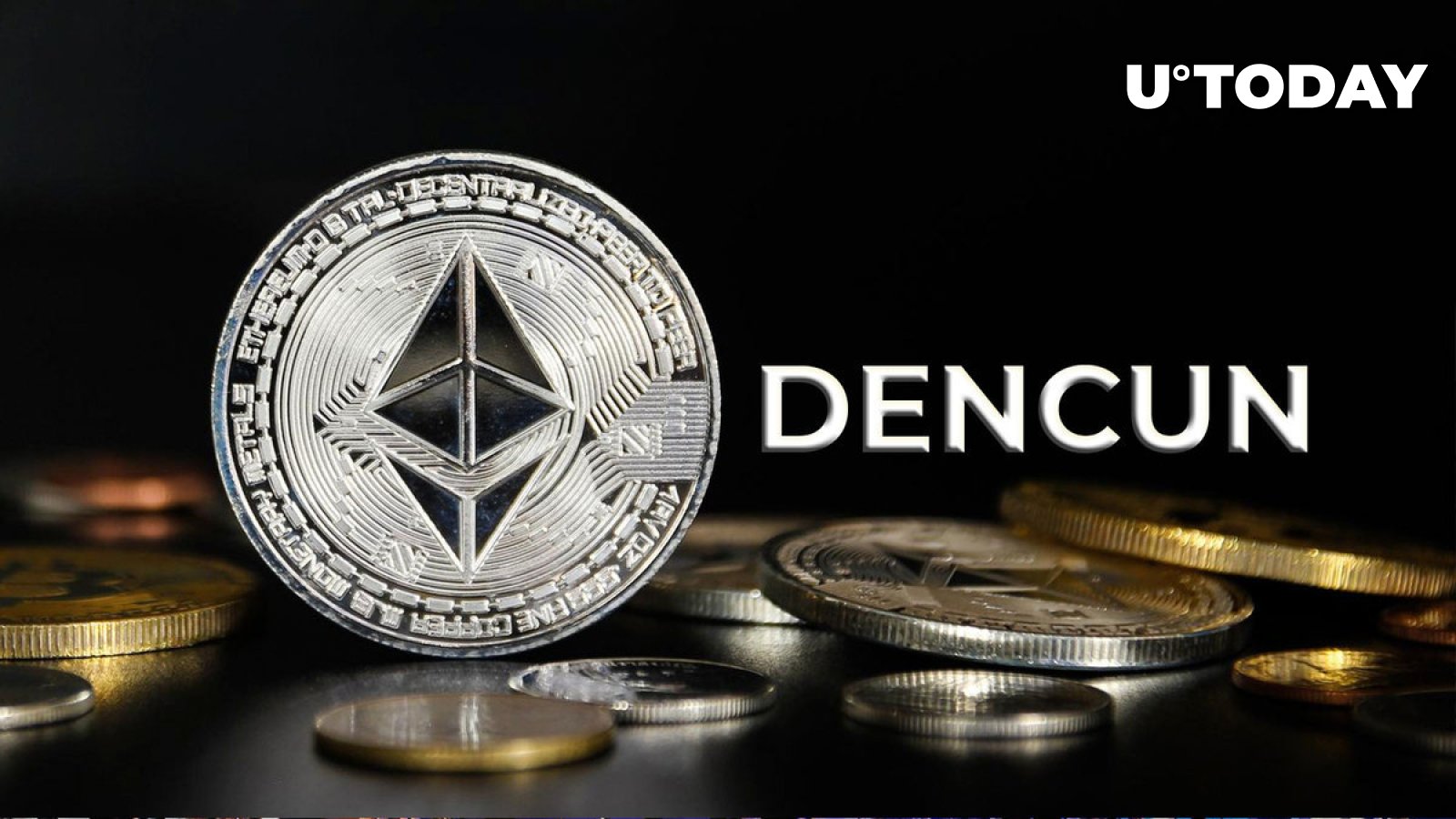
Excitement is brewing in the Ethereum community as the final countdown to the Dencun upgrade begins. After successfully activating on all testnets, the Dencun network update is now ready for deployment on the Ethereum mainnet and will activate on the network at epoch 269568, which will occur on March 13, 2024, at 1:55 p.m. UTC.
The upgrade, which follows last year’s Shapella upgrade, features several changes, the most notable of which is the implementation of ephemeral data blobs with EIP-4844, better known as “protodanksharding,” which will help cut L2 transaction fees.
Tim Beiko, an Ethereum core developer, excitedly tweeted about the countdown to X, saying, “Less than 24 hours before Dencun.”
Less than 24h before Dencun .oO!
Since the announcement, many client teams have shipped performance & stability improvements. The blog post has been updated to list both minimum & recommended versions — if you haven’t done so yet, upgrade your node 🤖https://t.co/9Wa3Y5M5k4
The initial announcement regarding the Dencun mainnet upgrade was made on Feb. 27, and Beiko highlighted that several client teams have since made Dencun-compatible releases containing significant performance and stability improvements.
A March 12 update of this initial blog post explains the client releases, listing both the minimum and recommended versions.
The Minimum Version column indicates the lowest Dencun-compatible release for a client, while the Recommended Version contains performance and stability improvements.
Ahead of the big launch on the ETH mainnet, Gnosis Chain has deployed a version of the Dencun upgrade on its network. Gnosis Chain, formerly known as xDai Chain, functions as a sidechain to Ethereum and is managed by GnosisDAO.
This milestone was hailed by the larger Ethereum community as well as Ethereum cofounder Joseph Lubin.
Expectations for Dencun upgrade
According to IntoTheBlock’s recent analysis, major Ethereum layer 2 (L2) may experience fee reductions of at least 80% following the Dencun upgrade. This also includes OP stack chains, which are expected to receive upgrades that include data blob functionality.
Based on estimates, costs for depositing USDC on platforms such as Aave might fall as low as $0.0091, representing a 27-fold decrease. The fee reductions for L2s could be considerably greater, potentially 60 times lower than current levels based on PolyMarket estimations.
While the likelihood of fee reductions remains, the exact magnitude of such reductions resulting from the Dencun upgrade remains largely unknown.
DYdX stakers are cashing in on trading fees during the crypto rally.
DeFi exchange launched a network for traders playing BTC and ETH.
Uniswap is eyeing a similar staking model.
With Bitcoin hitting new highs on a weekly basis, dYdX stakers are earning hundreds of thousands of dollars in trading fees.
Stakers on the decentralised perpetual exchange earned an aggregate of $460,000 on March 5, the first time Bitcoin broke past its previous record high of $69,000.
In the last 30 days, all dYdX stakers have earned a total of $5 million, according to data from Mintscan. The fees were paid out in USDC, Circle’s US dollar-pegged stablecoin.
“We’ve done over $62 billion in trading volume over the last three weeks,” Tristan Dickinson, a dYdX Foundation spokesman, told DL News.
Stay ahead of the game with our weekly newsletters
During that same period, Bitcoin and Ethereum have soared 51% and 60%, respectively.
Trading pairs
And with crypto markets showing no signs of slowing down, these fees for stakers are expected to keep growing.
DYdX typically handles around $1 billion in trading volume daily across 54 different trading pairs, according to CoinGecko.
Due to the design of dYdX’s new bespoke blockchain network, 100% of protocol fees from the dYdX chain go to dYdX chain stakers, Dickinson said.
Join the community to get our latest stories and updates
Launched in 2017 on the Ethereum blockchain, dYdX rapidly grew in popularity but eventually ran into the network’s limitations.
Trading cryptocurrencies on Ethereum is often too expensive and slow to compete with centralised exchanges like Binance or Coinbase.
To meet demand, dYdX launched an independent chain in November using tools from another blockchain network called Cosmos.
Validators
Now, dYdX has native staking and its own group of validators — the machines that help verify crypto transactions. Users can stake the network’s native dYdX token with any validator.
The project is maintained by four entities: the dYdX Foundation, dYdX Trading Inc., the dYdX grants subDAO, and the dYdX operations subDAO.
A DAO, or a decentralised autonomous organisation, is an online group of token holders that can vote and make proposals to change a crypto protocol or approve grants.
With trading fees now distributed entirely to stakers, these four entities are funded by making proposals to their community and then, if those proposals pass, drawing from the community treasury.
Dickinson explained that the $230 million treasury was accumulated with fees from previous versions of dYdX. The dYdX community approved a $30 million grant to the foundation in February.
“We’re moving into this area model where eventually it’s going to be completely community-controlled and governed, and the funding comes from the treasury,” Dickinson said.
Stakers eye decentralised exchanges
Another decentralised exchange mulling a similar model is Uniswap.
Calling its version of the model the “fee switch,” the Uniswap community has waffled over whether holders of its native UNI token should also be allowed a slice of the platform’s trading fees.
The initial temperature check proposal passed nearly unanimously last week, moving it to the next stage of the governance process. Temperature checks are Uniswap’s first step in weighing community sentiment before making any sweeping changes.
With daily trading volumes over $3 billion and nearly $1.5 billion in accrued fees, flipping that switch would undoubtedly benefit UNI token holders.
Liam Kelly is DL News’ Berlin correspondent. Contact him at liam@dlnews.com.



:quality(70)/cloudfront-eu-central-1.images.arcpublishing.com/dlnews/O4L4B4UBX5FA7EMV64ECL5U23U.jpg "DYdX attracts stakers as DeFi exchange does bn in volume in three weeks – DL News")