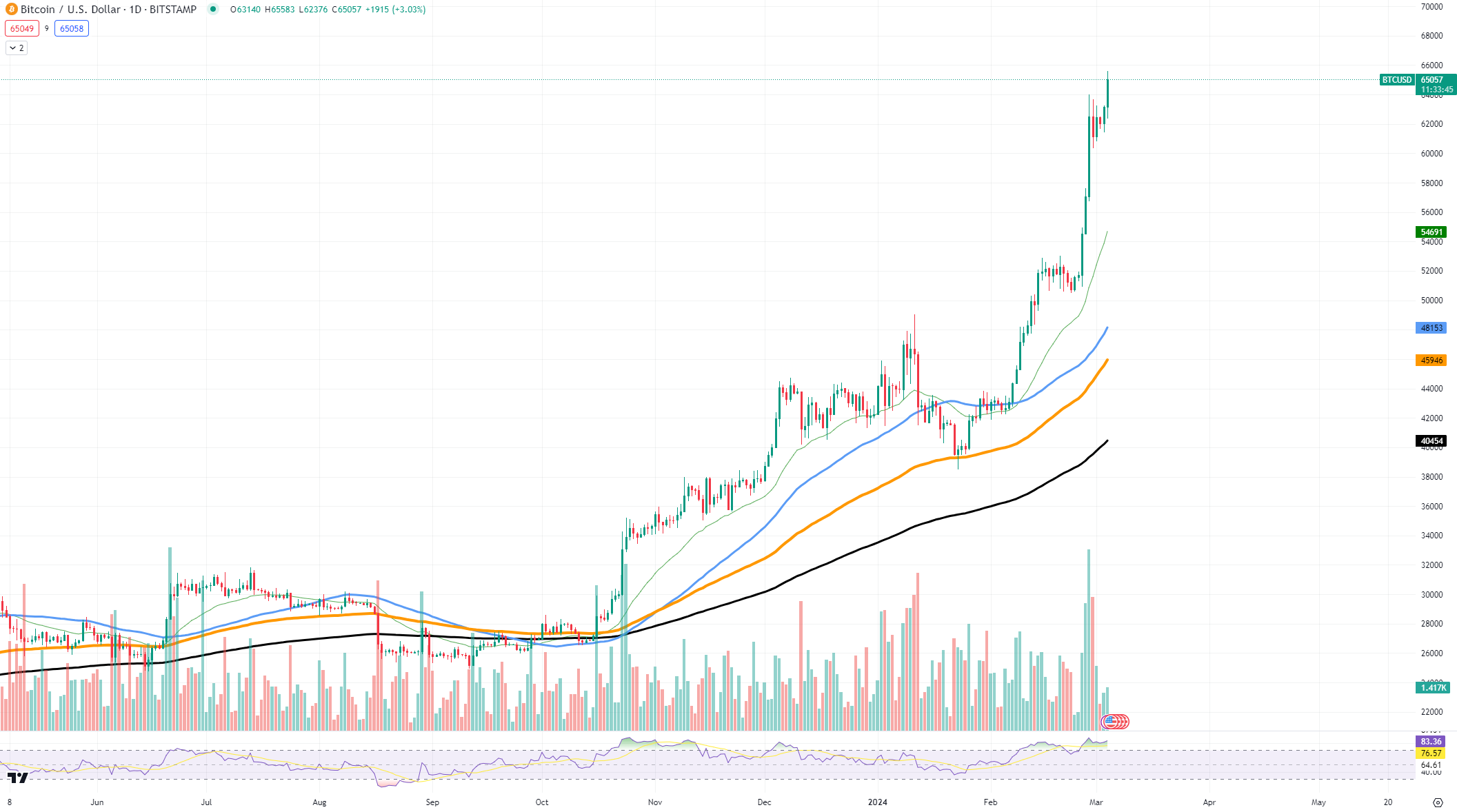
Social media reports overnight on comments from former New York Fed economist Steven Friedman:
Federal Reserve policymakers will stay cautious about cutting interest rates this year given strong growth and volatile inflation, and there’s a rising chance they will deliver even fewer than the three cuts embedded in official projections, former New York Fed economist Steven Friedman told MNI.
“Three rate cuts as a base case this year still looks reasonable, but the risks are now increasingly skewed to fewer than that and a later start,” he said in an interview. “This is going to be a very cautious cutting cycle.”
—
It was only 8 weeks ago that analysts were looking for six or even seven FOMC rate cuts in 2024. Yesterday I reported on an analyst saying there won’t be any at all:
The greenback once again suffered disheartening prints from US fundamentals, although speculation for a rate cut by the Fed in June appears firm. On another note, Gold climbed to record highs as well as Bitcoin.
Here is what you need to know on Wednesday, March 6:
The greenback retreated for yet another session and kept the price action around the USD Index (DXY) depressed well below the 104.00 level. On March 6, all the attention will be on Chair Powell’s first testimony, followed by the ADP report.
EUR/USD maintained the bullish bias in place and rose to two-week highs near 1.0880. In the domestic calendar, the Balance of Trade in Germany and Retail Sales in the broader Euroland are due on March 6.
GBP/USD could not sustain an earlier move to multi-week highs near 1.2730, closing the session with marginal gains instead. On March 6, the S&P Global Construction PMI will be the sole release across the Channel.
USD/JPY left behind two consecutive daily advances and broke below the key 150.00 zone. Next on tap in the Japanese docket will be the usual weekly Foreign Bond Investment figures and the speech by BoJ Nakagawa on March 7.
AUD/USD traded on the defensive and added to Monday’s pessimism, briefly revisiting the 0.6480 region. The GDP Growth Rate during the October–December period takes centre stage in Oz on March 6.
On March 6, the Bank of Canada is expected to keep its policy rate unchanged, seconded by the Ivey PMI and the press conference by Governor T. Macklem. USD/CAD, in the meantime, rose further and trespassed the 1.3600 hurdle, although it gave away some of those gains afterwards.
WTI prices remained on the back foot as news of extra reforms in China and the country’s planned GDP target failed to ignite some optimism among traders.
Gold prices advanced further and printed an all-time high past the $2,140 mark per troy ounce on the back of increasing bets of rate cuts by the Fed. Silver rose to fresh tops north of the $24.00 mark per ounce, although the industrial metal later succumbed to renewed selling impetus.
Outside the FX universe and moving into the political arena, the US Super Tuesday results are expected to be one of the salient events on Wednesday. On Super Tuesday, the highest number of states will host presidential primaries or caucuses, as more than one-third of all delegates available for both the Republican and Democratic nominations will be up for grabs. President J. Biden stands as the frontrunner for the Democratic nomination, facing no significant primary challenge. Meanwhile, former President D. Trump maintains a lead over former Un Ambassador Nikki Haley in the race for the Republican nomination.
For the first time in nearly two years, the total value locked in defi protocols surpassed $100 billion, reaching $101.3 billion.
Lending represented $32.6 billion, or 32.2% of the total, with decentralized exchanges at $19.97 billion or 19.7%, collateralized debt positions at $12.22 billion, 12%, and restaking activities at $10.06 billion, 9.9%.
All-time TVL by category from The Block
The previous instance when defi TVL exceeded $100 billion was on May 11, 2022, with a TVL of $112.67 billion, as reported by DefiLlama.
Concurrently, over 31.5 million Ether, valued at approximately $115 billion and constituting 26% of the total Ether supply, has been staked on the Ethereum blockchain.
Gold continues to trade below both the 2,131 target and the prior record high at 2,135. Therefore, it could easily close below those price levels. However, if it can close above 2,131 it will be showing greater strength than closing lower. And a close above 2,135 of course is a more bullish indication than a close below 2,135.
Higher Target is 2,189
In the short-term, gold may be extended and due for a retracement or consolidation of a day or a few, if not longer. Once that phase is done, whichever form it takes, gold should be ready to proceed towards the first major higher target zone around 2,189 to 2,194. The current sharp advance in gold began following a breakout of a large symmetrical triangle pattern. An initial target can be calculated from the pattern, and it points to 2,189. The purple arrows mark the related measurements.
Measured Moves Confirm Target
Further, two previous measured moves are highlighted in blue on the chart. They show impulse rallies coming up off the October swing low. The first rally is 11% and the second 10.5%. If the lower 10.5% advance occurs in the current advance, gold would be hitting approximately 2,094. The measure starts from the most recent swing low at 1,984 (C).
Highest Daily Closing Price Historically
Yesterday’s closing price of 2,114 was the highest daily closing price ever for gold, and today will likely end with a new record closing price. Gold has been setting up for large move into new record highs ever since reaching a high of 1,921 in 2,011. A multi-year basing pattern followed in the shape of a cup with handle. If this week’s advance is sustained and the price of gold further strengthens, gold will be rising out of a new floor in price.
For a look at all of today’s economic events, check out our economic calendar.
The economy’s medium-run growth potential remains tepid around 1% despite continued progress on reforms through the “Greece 2.0” and Greek Recovery and Resilience plans. Constraints include adverse demographics, as well as weak and uneven productivity growth across the regions because of years of public- and private-sector under-investment and a lack of business-sector dynamism.
Political Stability And Policy Continuity Crucial To Sustaining Investor Confidence
The recent out-performance of the Greek economy gives us confidence that robust economic growth is not transitory, but there are nevertheless several challenges for the outlook. Persistent uncertainty over the inflation outlook raises questions of whether inflation will continue to decline towards the ECB 2% objective. Core inflation sits well above 2% despite recent significant disinflation.
We see inflation remaining above the ECB objective for much of this year. Furthermore, we cannot exclude new supply-side crises in view of a turbulent international political and economic context, which might again send inflation higher later and further postpone the fuller normalisation of monetary policies.
Environmental challenges are also relevant. Among the EU, Greece is most exposed to rising temperatures and more frequent heatwaves and wildfires, which can damage the crucial tourism and agriculture sectors.
Finally, new political challenges could emerge following general elections due by 2027 if the government shifts away from current business-friendly policies. Maintaining a constructive dialogue with European institutions and the capital markets is relevant, as is avoiding the temptation of further reversing the difficult reforms introduced during the debt crisis.
Regaining investment-grade status has contributed to the narrowing of yield spreads on 10-year Greek government bonds – to under 100bp to Germany recently – reflecting significantly better investor confidence.
Further progress on reforms to strengthen the structure of the economy and enhance macroeconomic sustainability would contribute to improving Greece’s appeal for foreign and domestic investors. Moreover, the presumed peak in the ECB rate-hike cycle ought to facilitate investment.
For a look at all of today’s economic events, check out our economic calendar.
Dennis Shen is Senior Director in Sovereign and Public Sector ratings at Scope Ratings GmbH, and lead analyst on Greece. Alessandra Poli, Analyst at Scope, and Matthew Curtin, Deputy Head of Communications of Scope, contributed to writing this article.
One Filecoin protocol is getting in on the points meta
Check out the best bits of this year’s ETHDenver
Bitcoin DeFi? What’s going on?
DeFi deposits on the Bitcoin network have soared to over $2.7 billion and are up 723% from the start of the year mainly thanks to Merlin Chain — a so-called Bitcoin layer 2 network.
Stay ahead of the game with our weekly newsletters
Merlin Chain is running a campaign — called Merlin’s Seal — which is similar to one run by the widely-criticised Ethereum layer 2 Blast.
Users can deposit Bitcoin, stablecoins, and more than a dozen Bitcoin-related assets to earn M-points. Later this month, users will be able to claim MERL governance token rewards based on the M-points they have accumulated.
Finally in April, users will be able to withdraw their staked assets.
But hold up — if Bitcoin can’t support smart contracts, how does it have billions worth of deposits? You might be asking.
Join the community to get our latest stories and updates
Currently, like Blast, Merlin Chain just sends deposits to a wallet, although it claims this process is non-custodial.
Later, Merlin Chain will operate as a separate blockchain built on top of Bitcoin using zero-knowledge proofs.
And Merlin Chain is not alone. B² Network, another upcoming Bitcoin layer 2, is running a similar campaign and has already accumulated over $500 million of deposits.
Filecoin liquid staking protocol GLIF to offer points
GLIF, a long-running project on Filecoin, is planning to give out points to those who stake the Filecoin blockchain’s FIL token.
In early February, GLIF announced a $4.5 million raise and the launch of a points system sometime in the first quarter of the year.
Since then, the value of crypto locked in GLIF’s Filecoin liquid staking protocol has grown to more than 161%. Other liquid staking protocols on the chain have also experienced similar growth.
GLIF founder Jon Schwartz told DL News he attributes the jump to the upcoming points system and to growing comfort with Filecoin.
The influx also shows a rekindling of interest in Filecoin after its FIL token plummeted some 95% during the crypto winter.
Points programmes, which function much like traditional businesses’ rewards programmes, can juice user activity.
Unlike airdrops, however, they allow US-based projects to avoid the regulatory headache that can come with promising or issuing tokens.
ETHDenver wraps up
ETHDenver is over for another year, and DL News is here to give you the quick rundown of everything that happened at the event.
As always there were some big announcements. Trading app Robinhood announced it will let users of its crypto wallet trade digital assets through Arbitrum, while Bitcoin staking protocol Babylon announced a collaboration with Ankr to create Bitcoin liquid staking tokens.
SEC Commissioner Hester Peirce delivered another scathing reproach of her agency where she expressed frustration over delayed action on Bitcoin ETFs.
I also wrote up a retrospective on the entire event, focusing on independent presidential candidate Robert F. Kennedy’s visit to ETHDenver.
Data of the week
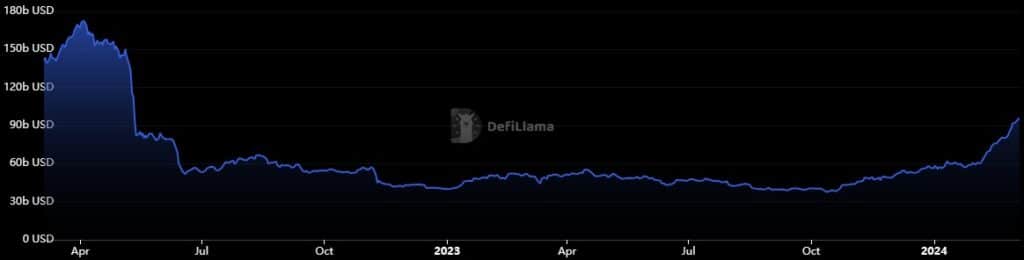
Bitcoin has overtaken Solana to become the fifth-biggest blockchain in terms of DeFi TVL.
The OG cryptocurrency’s rapid ascent to over $2.7 billion in TVL is mostly due to a single concept: creating layer 2s on Bitcoin. Two upcoming Bitcoin layer 2s — Merlin Chain and B² Network — account for almost 90% of all Bitcoin’s TVL.
Up and to the right: Deposits to Bitcoin DeFi projects have exploded in recent weeks. (DefiLlama)
Disclaimer: The opinions expressed by our writers are their own and do not represent the views of U.Today. The financial and market information provided on U.Today is intended for informational purposes only. U.Today is not liable for any financial losses incurred while trading cryptocurrencies. Conduct your own research by contacting financial experts before making any investment decisions. We believe that all content is accurate as of the date of publication, but certain offers mentioned may no longer be available.
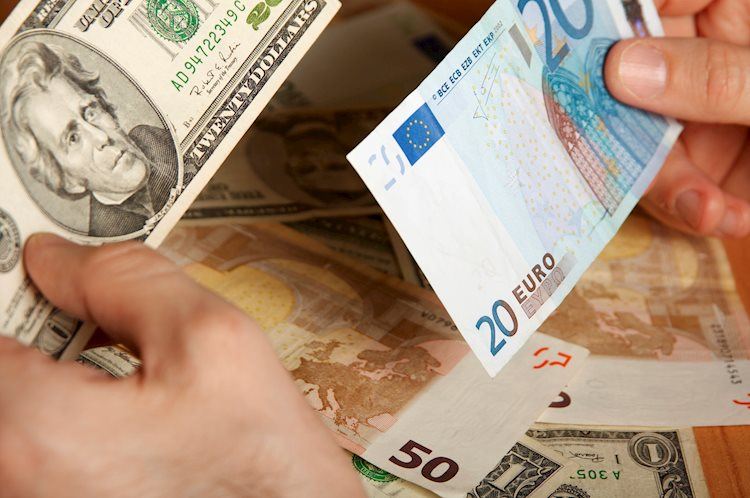
Bitcoin is showcasing a robust trend that indicates a potential trajectory toward the $70,000 mark. The current price action reflects strong bullish sentiment, and if the momentum is sustained, Bitcoin could very well be on its way to setting a new all-time high.
A technical analysis of Bitcoin’s chart reveals that it has been consistently forming higher highs and higher lows — a classic indicator of a bullish trend. The moving averages are aligned in a way that supports continued growth, with the short-term averages above the longer-term ones, suggesting that the immediate trend is upward.
The key support levels have been established at $54,683 and $48,151, which have provided a solid foundation during the recent climb. As long as these levels hold, the path toward $70,000 remains open.
However, it is notable that the buying power is showing signs of fatigue, as indicated by the decreasing volume on the recent uptrend. This divergence between price and volume could suggest that a consolidation or minor pullback might occur before any further significant upward movement.
Despite the fading buying power, there is a possibility of a supply shock on the Bitcoin market. A supply shock occurs when there is a sudden decrease in the available supply of Bitcoin, often due to hoarding by long-term holders or institutional acquisitions. Such a reduction in liquidity can lead to a rapid price increase as demand outstrips supply.
Shiba Inu explodes
Shiba Inu continues to display a bullish performance that keeps market woes at bay. The token appears to be gearing up for another rally, potentially pushing it to new heights.
The price analysis of SHIB shows a clear uptrend, with the asset breaking past several resistance levels in recent months. The token has been making consistent gains, drawing in both retail and speculative investors attracted by its volatile yet lucrative market movements. Support levels have risen correspondingly, with the token finding new floors at higher price ranges after each spike.
The current trend for SHIB is positive, with the token showing resilience and maintaining its gains despite broader market fluctuations. The immediate resistance to watch is at the recent high; if SHIB breaks through, there could be little stopping it from achieving new record levels.
In a bearish scenario, a sudden shift in investor sentiment or broader market dynamics could trigger a sell-off, leading to a sharp correction. The meme coin space is crowded with new entrants seeking to replicate SHIB’s success, and the competition could dilute interest and impact the price negatively.
XRP on the edge
XRP has recently approached a significant resistance level at $0.64, a price point that has historically acted as a major breakpoint for the asset. This level is critical for XRP’s continued upward movement, and breaking through could signal a new bullish phase for the cryptocurrency.
Currently, XRP is trading in a range where the moving averages are starting to realign in a way that might indicate an upcoming golden cross — a technical chart pattern where a shorter-term moving average crosses above a longer-term moving average, typically suggesting a potential bull market on the horizon.
In the bullish scenario, the golden cross would materialize, and with a strong volume breakout above the $0.64 resistance, XRP could enter a new uptrend, targeting previous highs. This could potentially attract more investors, both retail and institutional, leading to a substantial price increase.
However, there is also the bearish possibility to consider. If XRP fails to break the $0.64 level, it may result in a price rejection that could see it retreating back to lower support levels. These levels, around $0.55 and $0.52, could serve as consolidation points before another attempt at resistance. A drop below these support levels might indicate a more prolonged bearish trend, potentially undoing recent gains.
Bank of America forecasts no significant changes in the European Central Bank guidance during the upcoming meeting, but anticipates a soft indication of forthcoming rate cuts in the press conference. Despite the expectation of dovish-leaning new ECB forecasts, BofA predicts a minimal sustained impact on the Euro (EUR), as the market has already priced in almost four cuts for this year. The focus for EUR/USD movement remains on US data, the Federal Reserve’s actions, and overall risk sentiment, with BofA maintaining its forecast of EUR/USD at 1.15 by the end of 2024.
Key Points:
ECB Guidance and Forecasts: BofA expects the ECB to maintain unchanged guidance but to hint at impending rate cuts, with forecasts possibly indicating a 2.0% core inflation rate by late 2026. However, consensus for an April rate cut seems unlikely given current market conditions.
Market Pricing vs. Expectations: The market’s anticipation of almost four rate cuts this year is slightly more aggressive than BofA’s economists’ expectation of three to four cuts. The potential dovish signal about an April cut, currently priced in with 6 basis points of cuts, may pose a slight bearish risk for the EUR.
Impact on EUR/USD: The influence of the ECB meeting on EUR/USD is expected to be minimal, as factors such as US economic data, Fed policy decisions, and general risk sentiment are likely to have a more significant effect on the currency pair. BofA remains consistent with its forecast of EUR/USD reaching 1.15 by the end of 2024, although a short-term projection puts it at 1.07 by the end of Q1.
Cross Currency Impact: The ECB’s influence is anticipated to be more pronounced in currency crosses, aligning with trends observed this year.
Conclusion:
BofA suggests that the upcoming ECB meeting is unlikely to have a lasting impact on the EUR, attributing more significance to US economic indicators and Federal Reserve policies for future EUR/USD movements. While the ECB may lean dovish in its forecasts and soft guidance, the already priced-in market expectations for rate cuts diminish the potential for surprise. As such, BofA advises focusing on broader economic and policy developments for insights into EUR/USD trajectory, particularly in the context of cross-currency impacts.
For bank trade ideas, check out eFX Plus. For a limited time, get a 7 day free trial, basic for $79 per month and premium at $109 per month. Get it here.
BNB Chain, the leading community-driven blockchain ecosystem, has officially launched the second phase of its Total Value Locked (TVL) Incentive Program, targeting DeFi projects on the BNB Smart Chain (BSC). With a generous prize pool of up to $160,000 USD, the initiative seeks to reward projects demonstrating significant TVL growth, reinforcing BNB Chain’s commitment to fostering innovation within the Web3 space.
Empowering DeFi Innovation
The BNB Chain TVL Incentive Program is an initiative designed to stimulate growth and innovation among DeFi projects on the BSC. By offering financial incentives, the program aims to encourage developers to build and enhance their applications, contributing to a richer, more robust DeFi ecosystem. Eligible projects must have been deployed on the BSC mainnet since 1 January 2023, and must have undergone at least one security audit. The program’s focus on security and growth potential highlights BNB Chain’s dedication to maintaining a safe, dynamic environment for both developers and users alike. For more details on eligibility and the application process, interested projects can apply here.
Previous Success Stories
BNB Chain’s TVL Incentive Program is not new to the scene. Its first phase has already buoyed several projects, including notable names like KiloEx and Kinza Finance, which have since become pillars of the BNB Chain ecosystem. These success stories serve as a testament to the program’s ability to identify and nurture promising DeFi projects, offering them a platform for growth and visibility. It’s a win-win situation, as these projects not only benefit from the financial rewards but also from the increased user engagement and network effects facilitated by their participation in the program.
Looking Ahead: The Future of DeFi on BSC
With the launch of the second phase of the TVL Incentive Program, BNB Chain reaffirms its vision of a vibrant, inclusive DeFi landscape. The program, coupled with the ongoing Most Valuable Builder (MVB) initiative, represents a comprehensive effort to support developers at various stages of their project lifecycle. As the application window opens, the DeFi community watches in anticipation to see which projects will emerge as the next leaders in innovation on the BSC. This initiative not only promises to elevate the selected projects but also to inspire a new wave of DeFi applications, driving forward the future of finance on blockchain.
As we reflect on the launch of this exciting phase, it’s clear that BNB Chain’s commitment to supporting DeFi projects extends beyond mere financial incentives. It’s about building a sustainable, innovative ecosystem where new ideas can thrive. By nurturing these projects, BNB Chain not only contributes to the growth of its own platform but also to the broader blockchain and DeFi community. The implications of this program are far-reaching, potentially setting the stage for the next generation of DeFi applications that will redefine our understanding of decentralized finance.
The UK’s financial regulatory authority has announced plans to examine if small enterprises are encountering undue obstacles to expansion due to increasing banks requiring personal loan guarantees.
The Financial Conduct Authority (FCA) revealed on Tuesday that the Federation of Small Businesses (FSB), acting as a consumer advocacy group, has raised concerns about the negative impact on small businesses caused by lenders’ heightened demands for personal guarantees, potentially deterring them from seeking financial support.
Although the FCA’s mandate does not extend to lending practices for limited companies, it has committed to facilitating the growth of small businesses by identifying and eliminating any unnecessary barriers. The specific steps to be taken were not elaborated upon.
Highlighting the significant role of small and medium-sized enterprises in the UK economy, the FSB has reported that these businesses are responsible for 60% of employment and about half of the revenue within the private sector as of 2023.
Particularly, small firms, defined as those with less than 50 workers, had employed 13.1 million individuals last year, generating a total revenue of 1.6 trillion pounds ($2.03 trillion).
To assess the prevalence of personal guarantees, the FCA plans to gather data from April to June 2024, focusing on loans below 25,000 pounds ($31,713) provided to sole traders and small partnerships.
This investigation will include monitoring complaints and reviewing the circumstances under which such guarantees are mandated. Furthermore, based on their findings, the FCA will evaluate the need for consultation and the issuance of guidance.
In instances where issues identified are beyond its regulatory scope, the FCA intends to disclose these findings publicly. This transparency prompts governmental consideration of whether small businesses, deemed crucial to the UK’s economic fabric, require additional protections.




:quality(70)/cloudfront-eu-central-1.images.arcpublishing.com/dlnews/GIY6SUDJFRFNXGIG2OZBAEPBNA.jpg "Bitcoin layer 2s bootstrap .7bn in DeFi deposits with points offerings – DL News")