The main tag of Gold Price Articles.
You can use the search box below to find what you need.
[wd_asp id=1]
The main tag of Gold Price Articles.
You can use the search box below to find what you need.
[wd_asp id=1]
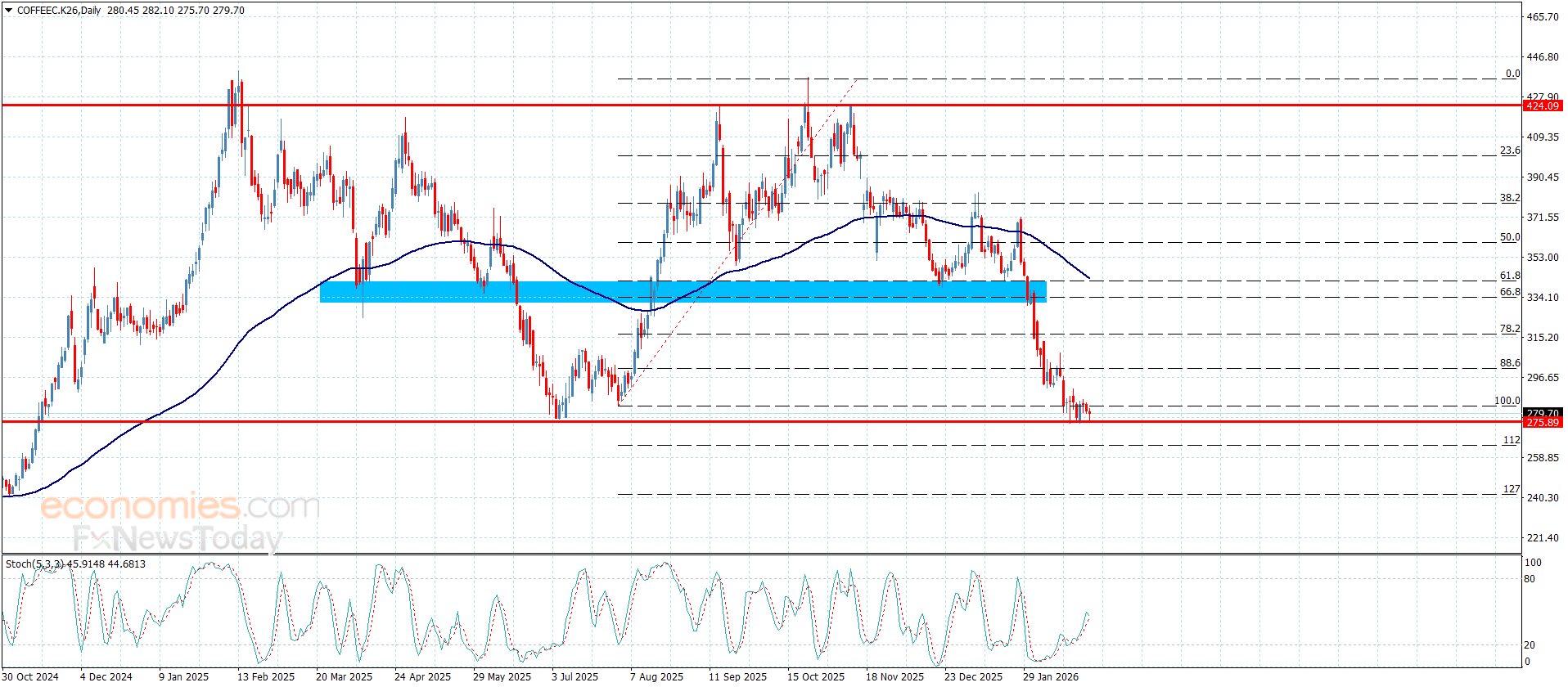
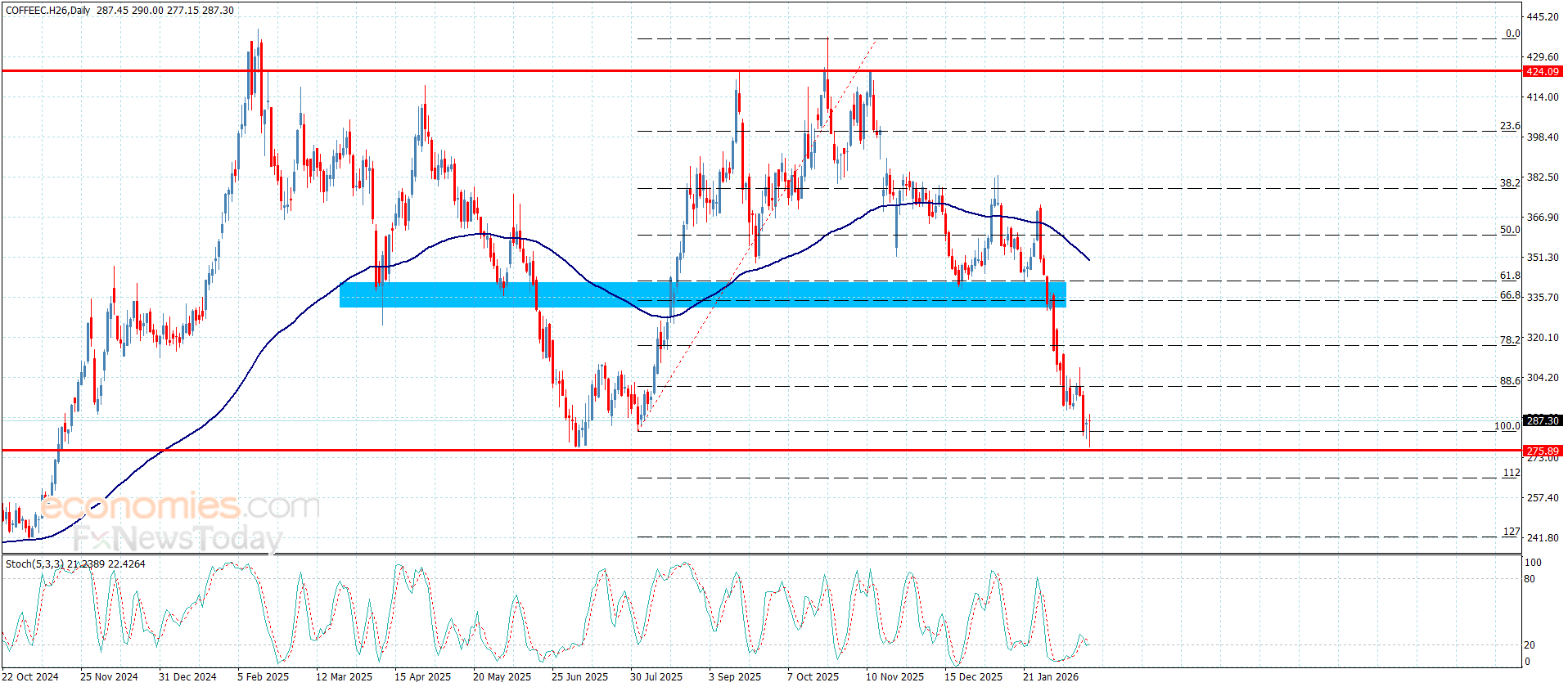
Coffee price kept its stability above 275.80 support until this moment, attempting to find a chance to reduce the losses, farming sideways waves by its fluctuation near 280.00 level.
The price needs new bullish momentum, reinforcing the chances of beginning recovering the losses, to expect its rally towards 293.50 directly, to press on the barrier at 301.00, while the decline below the current support will confirm the continuation of the negativity in the upcoming trading, expecting the next negative target at 264.80 level.
The expected trading range for today is between 275.00 and 293.50
Trend forecast: Bullish
Listen to this article
Estimated 4 minutes
The audio version of this article is generated by AI-based technology. Mispronunciations can occur. We are working with our partners to continually review and improve the results.
Inflation fears and rising gas prices may be the most widely felt impacts of the oil price shock that the Iran conflict has triggered. But for the Alberta government, there could be a significant financial upside to this sudden global supply crunch.
The province, which is currently staring down a $4.1-billion deficit for the current fiscal year and just forecast a $9.4-billion shortfall for 2026-2027, is highly sensitive to changes in the price of oil because of how reliant its revenues are on royalties from Alberta oil production.
The budgeting year that ends on March 31 was based on the North American benchmark West Texas Intermediate (WTI) crude averaging $61.50 US per barrel, while the coming fiscal year that begins in April forecasts $60.50.
The sudden stoppage of all oil tanker traffic through the Strait of Hormuz, through which one-fifth of the world’s crude travels, has sent prices skyward — WTI jumped by around eight per cent Monday to $71.35 by the trading day’s end.
Because the next fiscal year hasn’t begun, this sudden price hike might not have any bearing on the forward-looking budget but could brighten the Alberta balance sheet of the fiscal year now concluding.
“I suspect that rather than a $4.1 billion deficit that we were projecting in the budget, it might be somewhat less than that,” Alberta Premier Danielle Smith at a health care announcement in Lethbridge.
How much less? That will depend on how long prices stay high.
If the benchmark price climbs by $1 US, that roughly means an extra $680 million for provincial coffers.
But that’s over the course of a whole year — the impacts of these short-term price spikes might be better expressed in days.
That one-dollar rise works out to about $2 million per day for the Alberta government’s income, according to calculations by University of Calgary economist Trevor Tombe. Which means that a price $10 US higher than expected translates into an additional $20 million every day this jolt lasts.
“So if this lasts for the entire month of March, for example, that’s about $600 million [in reduced Alberta deficit] just from these four weeks alone,” Tombe told CBC News.
Should security risks for tankers in the Mideast, along with tighter global supply and high prices, persist into April, it could similarly erode the much larger deficit that Alberta just tabled for 2026-27.
But Alberta’s newly forecast budget deficit is so deep that oil lingering at current prices would still result in a $2 billion to $3 billion shortfall next year, Tombe said.

Finance Minister Nate Horner has said Alberta needs $74 US-per-barrel prices to balance its budget in the coming year.
The conflict-related price jump isn’t making him reconsider his deficit budget and its oil-price forecast, which was based on advice from multiple private-sector analysts.
“We want to have conservative forecasts,” the minister said Monday. “We do want the potential for upside for the province. We don’t want to over-estimate that to make budget day go easier for myself and the government.”
Alberta budgets have often wound up in surplus because the spring budget under-estimated how high oil prices would be that year — and the inverse has previously happened with per-barrel price forecasts that wound up being too rosy.
Long-term disruption to ship traffic in the Strait of Hormuz could send prices even higher, and so could damage to oil infrastructure in other Gulf countries. Meanwhile, a shorter conflict in which disruptions are easily reversible could mean the current price spike won’t last.
“As the risk dissipates it will quickly become a supply-demand calculation again, and that’s what led us to our forecast in the first place,” Horner said.
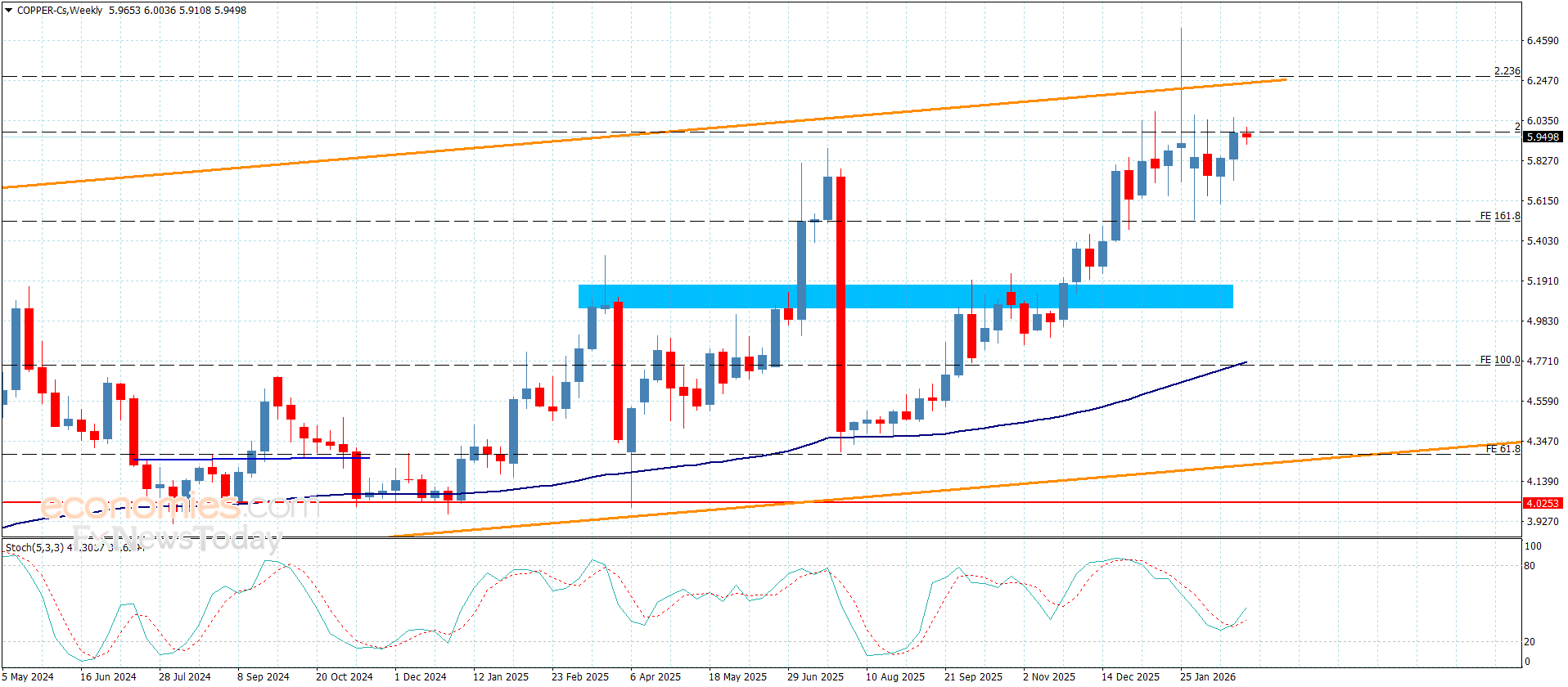
Copper prices failed to provide positive close above $5.9700 level, which forces it to delay the bullish rally and provide sideways trading, fluctuating near $5.9400 level.
The sideways trading might continue in the near period, until it is activated the main indicators’ positivity, to reinforce the chances of resuming the rise and reaching positive stations that is located at $6.1200 and $6.2400 level, while reaching below $5.8100 will force it to suffer some losses before reaching the suggested positive stations.
The expected trading range for today is between $5.8500 and $6.1200
Trend forecast: Bullish
Copper prices failed to provide positive close above $5.9700 level, which forces it to delay the bullish rally and provide sideways trading, fluctuating near $5.9400 level.
The sideways trading might continue in the near period, until it is activated the main indicators’ positivity, to reinforce the chances of resuming the rise and reaching positive stations that is located at $6.1200 and $6.2400 level, while reaching below $5.8100 will force it to suffer some losses before reaching the suggested positive stations.
The expected trading range for today is between $5.8500 and $6.1200
Trend forecast: Bullish
Coffee price kept its stability above 275.80 support until this moment, attempting to find a chance to reduce the losses, farming sideways waves by its fluctuation near 280.00 level.
The price needs new bullish momentum, reinforcing the chances of beginning recovering the losses, to expect its rally towards 293.50 directly, to press on the barrier at 301.00, while the decline below the current support will confirm the continuation of the negativity in the upcoming trading, expecting the next negative target at 264.80 level.
The expected trading range for today is between 275.00 and 293.50
Trend forecast: Bullish
Gold is taking a breather after the initial run to over one-month highs near $5,400, kicking off the new week with a bang.
A global flight to safety theme, following the US-Israel joint attacks on Iran over the weekend, bolstered the demand for the traditional store of value, Gold.
Gold buyers resort to cashing in on their long positions, fuelling a modest retracement in the prices heading toward the European opening bells.
However, the bullish potential for Gold remains intact in the near-term amid continued geopolitical escalation in the Middle East.
The Times of Israel reported that the Israel Defence Force (IDF) struck Hezbollah targets in Beirut and across Lebanon in response to rocket fire.
Meanwhile, the UK Defense Ministry stated that British forces responded to a suspected drone strike at its military base in Cyprus.
Additionally, US President Donald Trump suggested the conflict could last for four more weeks, saying that attacks would continue until US objectives were met.
Gold also continues to draw support from surging Oil prices, caused by supply disruption fears, which could spike inflation and send the global economy into a tailspin once again. The bright metal is widely known as a hedge against inflation.
Several oil shipments were not permitted by Iran’s Islamic Revolutionary Guard Corps (IRGC) Navy to pass through the Strait of Hormuz.
“While Iran has yet to officially confirm that the vital waterway has been blocked, marine tracking sites showed tankers piling up on either side of the strait wary of attack or maybe unable to get insurance for the voyage,” according to the Guardian.
Looking ahead, all eyes remain on the Middle East tensions, while top-tier US economic data will also be awaited for fresh trading cues on Gold. However, geopolitical developments will continue to lead the sentiment.
US Defense Secretary Pete Hegseth is scheduled to hold a press conference at 13 GMT, according to the Defense Department on X.
The near-term bias is mildly bullish as price holds above the 21-day and 50-day Simple Moving Averages (SMAs), which both rise above the slower 100- and 200-day SMAs and signal an established uptrend. The Relative Strength Index (RSI) at 64.48 stays above the 50 midline, indicating firm but not extreme bullish momentum after cooling from earlier overbought readings. Price trades above the 50.00% Fibonacci retracement at $4,999.94 and the 61.80% retracement at $5,141.05 measured from the $4,401.99 low to the $5,597.89 high, reinforcing the view that recent pullbacks remain corrective within a broader advance.
Initial support aligns with the 21-day SMA near $5,036.64, ahead of the 50.00% retracement at $4,999.94, where a break would expose the 38.20% retracement at $4,858.82. Below that, the area around the rising 50-day SMA at $4,814.84 forms a deeper support zone. On the upside, immediate resistance emerges at the 78.60% retracement at $5,341.96, with a sustained break opening the way toward the prior swing high region near $5,598. A daily close above the 78.60% level would strengthen the bullish bias, while a drop through the 50.00% retracement would shift focus back to the lower supports.
(The technical analysis of this story was written with the help of an AI tool.)
Gold has played a key role in human’s history as it has been widely used as a store of value and medium of exchange. Currently, apart from its shine and usage for jewelry, the precious metal is widely seen as a safe-haven asset, meaning that it is considered a good investment during turbulent times. Gold is also widely seen as a hedge against inflation and against depreciating currencies as it doesn’t rely on any specific issuer or government.
Central banks are the biggest Gold holders. In their aim to support their currencies in turbulent times, central banks tend to diversify their reserves and buy Gold to improve the perceived strength of the economy and the currency. High Gold reserves can be a source of trust for a country’s solvency. Central banks added 1,136 tonnes of Gold worth around $70 billion to their reserves in 2022, according to data from the World Gold Council. This is the highest yearly purchase since records began. Central banks from emerging economies such as China, India and Turkey are quickly increasing their Gold reserves.
Gold has an inverse correlation with the US Dollar and US Treasuries, which are both major reserve and safe-haven assets. When the Dollar depreciates, Gold tends to rise, enabling investors and central banks to diversify their assets in turbulent times. Gold is also inversely correlated with risk assets. A rally in the stock market tends to weaken Gold price, while sell-offs in riskier markets tend to favor the precious metal.
The price can move due to a wide range of factors. Geopolitical instability or fears of a deep recession can quickly make Gold price escalate due to its safe-haven status. As a yield-less asset, Gold tends to rise with lower interest rates, while higher cost of money usually weighs down on the yellow metal. Still, most moves depend on how the US Dollar (USD) behaves as the asset is priced in dollars (XAU/USD). A strong Dollar tends to keep the price of Gold controlled, whereas a weaker Dollar is likely to push Gold prices up.
Silver is no longer just a “precious metal”, it has become the primary financial barometer for global instability. As of today, Sunday, March 1, 2026, silver (XAG/USD) is ending the week with an explosive surge, trading in the $93.80–$94.50 range. This nearly 8% single-day gain follows the dramatic escalation of the US-Israel-Iran conflict, specifically the reported strikes on Tehran and the subsequent death of Iran’s Supreme Leader.
With the Strait of Hormuz facing a potential blockade and safe-haven demand hitting fever pitch, the “Silver Squeeze” of 2026 is entering a parabolic phase. When markets reopen on Monday, March 2, traders are bracing for a massive gap-up that could finally push silver into triple-digit territory.
The current rally is being supercharged by a “Triple-Engine” catalyst that gold simply cannot match:
Following the US-Israeli joint military operations (dubbed “Epic Fury” and “Roaring Lion”), geopolitical risk has reached a decade-high. Silver’s reaction, surging 8% compared to gold’s 2%, confirms its status as a “high-beta” safe haven. Investors are fleeing equities and the dollar, rotating into silver as a hedge against a prolonged Middle Eastern conflict.
A critical “paper vs. physical” disconnect is emerging. Recent reports of a 159-million-ounce sell order triggering a CME trading halt have raised alarms, as the order far exceeded the registered inventory available for delivery. With March First Notice Day approaching and registered stocks under 60 million ounces, the physical market is tighter than at any point since the 1970s.
Major banks are rapidly revising their year-end targets. Deutsche Bank recently signaled that the current gold-to-silver ratio of 57 presents a significant upside risk to their $100/oz forecast. Meanwhile, billionaire Eric Sprott has warned that if the physical supply drain continues, a “revaluation shock” could eventually target the $300 mark.
[[XAG/USD-graph]]
On the 4-hour chart, silver is exhibiting a textbook ascending channel breakout. The metal has decisively reclaimed the $91.33 horizontal resistance, flipping it into a rock-solid support floor.
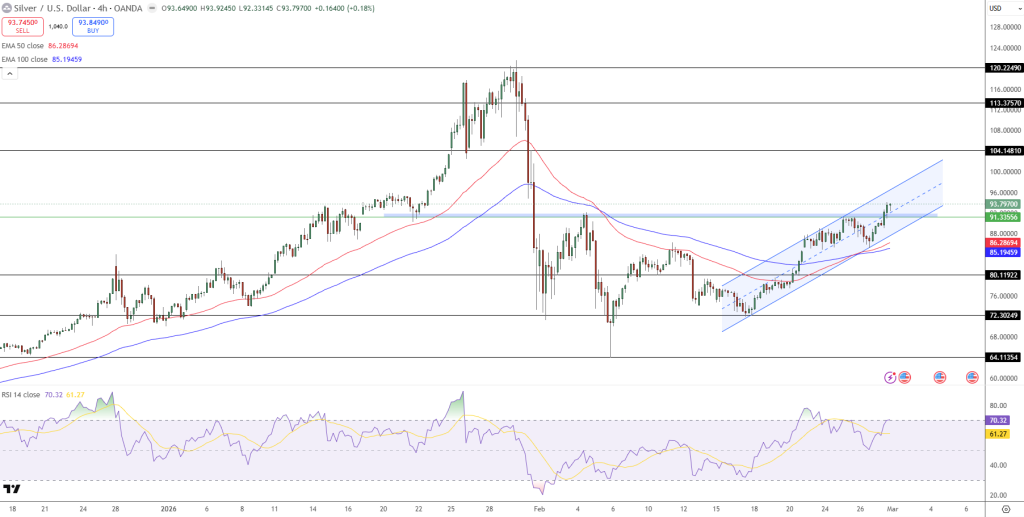
As a professional analyst, I am advising extreme caution for the Monday open. We are likely to see a “Gap and Run” scenario if the headlines from the Middle East continue to deteriorate. However, silver is famous for its “bull traps”, if diplomatic de-escalation signals emerge over the weekend, we could see a rapid “fill the gap” move back toward $91.
Trade Idea: Look for bullish continuation above $95.00 targeting $104.14.
Stop Loss: Place a tight stop below $91.33 to protect against a “buy the rumor, sell the news” reversal.

Arslan Butt
Lead Markets Analyst – Multi-Asset (FX, Commodities, Crypto)
Arslan Butt serves as the Lead Commodities and Indices Analyst, bringing a wealth of expertise to the field. With an MBA in Behavioral Finance and active progress towards a Ph.D., Arslan possesses a deep understanding of market dynamics.
His professional journey includes a significant role as a senior analyst at a leading brokerage firm, complementing his extensive experience as a market analyst and day trader. Adept in educating others, Arslan has a commendable track record as an instructor and public speaker.
His incisive analyses, particularly within the realms of cryptocurrency and forex markets, are showcased across esteemed financial publications such as ForexCrunch, InsideBitcoins, and EconomyWatch, solidifying his reputation in the financial community.
Despite providing bullish momentum by stochastic, however the fluctuation below the initial barrier at $3.520 level, which pushed it to form new bearish waves, repeating the pressure on the main support at $3.000.
The current support forms detecting key for the main trend in the upcoming trading, to expect its stability to begin forming new bullish waves, motivating it to surpass $3.520 barrier, to record new gains by its rally towards $3.750 and $4.000, while breaking the support and holding below it will force it to suffer big losses, to expect reaching $2.850 and $2.660 initially.
The expected trading range for today is between $3.000 and $3.520
Trend forecast: Bullish