The main tag of Gold Price Articles.
You can use the search box below to find what you need.
[wd_asp id=1]
The main tag of Gold Price Articles.
You can use the search box below to find what you need.
[wd_asp id=1]
Monday, October 6, 2025. Gold Forecast and Analysis of the price of gold XAU/USD today
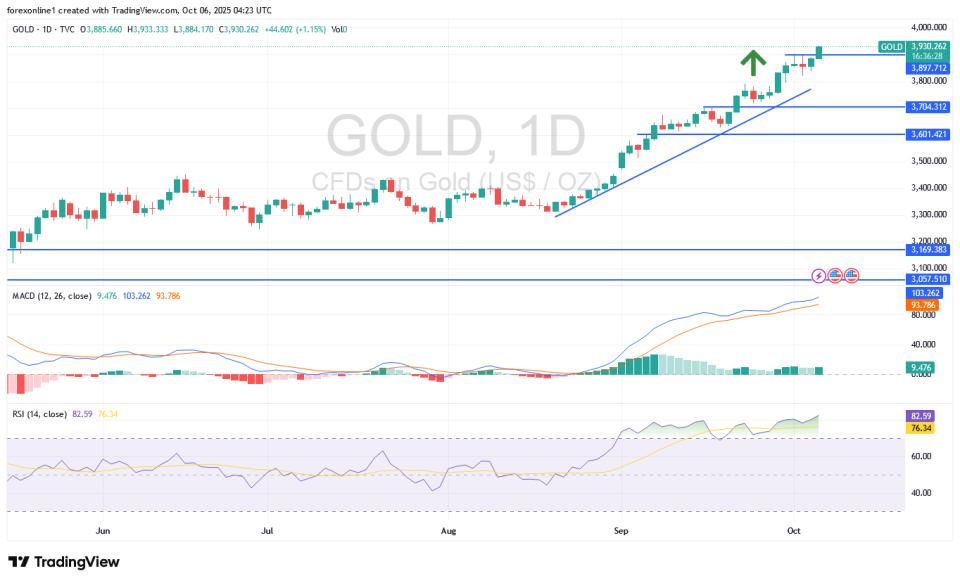
The price of gold at $4000 per ounce is the next target for gold bulls amid the continued strong positive momentum in the market. According to platforms of gold trading companies, momentary gold prices rose to the resistance level of $3897 per ounce, the highest in the history of the yellow metal market. The absence of US job numbers at the end of last week provided enough momentum for gold bulls to hold onto their gains. The US government shutdown joined the factors driving gains in the gold market, leading traders to ignore the fact that all technical indicators had reached sharp overbought levels.
According to today’s gold analyst forecasts, the markets in general remain optimistic about gold prices rising, as is their custom after another distinguished performance, with key market investors becoming more optimistic about gold’s potential gains in the coming days. According to platforms of reliable trading companies, the gold price rose for the seventh consecutive week, having declined in only one week since the end of July. Generally, the US government shutdown, increasing talk of Europe re-using Russian reserves, and the trade war in Europe are all factors supporting sentiment. Regarding the most prominent support and resistance levels for gold trading, the near-term support appears to be around $3800, and $4000 per ounce is the closest point in the upward trajectory.

Dear TradersUp trader, keep in mind that the gold market is one of the most important safe havens for investors in times of uncertainty, and the situation surrounding the markets and the global economy will support the continued rise in the price of gold.
We expect the new trading week to see a continued rise in gold prices. There are factors that could converge to stop its continuous ascent: the end of the US government shutdown, a peace agreement reached in Gaza, and the ongoing “strike” among Chinese gold buyers. However, the first two factors were not the cause of the gold price rise, so it is logical that they would have no effect if they reversed, while the cessation of Chinese buying—the effects of which are evident in the significant discounts in Shanghai—has been ongoing for some time. Therefore, I believe the gold index will strongly overcome these potential negatives.
According to some trading experts, the government shutdown’s impact on the Federal Reserve’s ability to measure employment rates is minimal, as they don’t believe the Fed relies heavily on government figures, which have been far from forecasts recently. Generally speaking, the Fed should have its own database to track, so I don’t think they’re acting randomly. They should have a good understanding of things.
Recently, we’ve seen some market volatility as a result of dovish Fed statements, but it was short-lived. Gold trading fell sharply when Dallas Fed President Lori Logan said they didn’t want a major interest rate cut and would have to raise them again. “But it looks like things are starting to recover.” Overall, the gold market’s positive outlook has returned significantly. Many metals analysts expect gold prices to rise this week, while none expect a decline. Other analysts expect gold to trade neutrally in the coming days.
Ready to trade our Gold price forecast? We’ve made a list of the best Gold trading platforms worth trading with.
Silver (XAG/USD) appreciates for the second consecutive day on Monday, to reach fresh 4-year highs at $48.75, with downside attempts contained so far above last week’s highs at $48.30.
Precious metals are thriving on Monday as a combination of a US government shutdown, which looks to be an extended one, expectations of a looser monetary policy in Japan, and the growing political uncertainty in France, have prompted investors to find alternative assets.
From a technical perspective, the pair remains trading higher within an ascending channel from id September lows. The 4-Hour RSI, however, is showing some bearish divergence, which should act as a warning for buyers.
Bulls are likely to be challenged at $ 49.24-$49.30, where the 161.8% of the September 17 to September 24 range meets the top of the ascending channel. Further up, the $50.00 psychological level emerges as the next bullish target..
Downside attempts are being contained above $48.30 (September 3 high) for now. Below here, the 47.60 area (Intra-day support and trendline support, at $46.90 would come into focus.
Silver is a precious metal highly traded among investors. It has been historically used as a store of value and a medium of exchange. Although less popular than Gold, traders may turn to Silver to diversify their investment portfolio, for its intrinsic value or as a potential hedge during high-inflation periods. Investors can buy physical Silver, in coins or in bars, or trade it through vehicles such as Exchange Traded Funds, which track its price on international markets.
Silver prices can move due to a wide range of factors. Geopolitical instability or fears of a deep recession can make Silver price escalate due to its safe-haven status, although to a lesser extent than Gold’s. As a yieldless asset, Silver tends to rise with lower interest rates. Its moves also depend on how the US Dollar (USD) behaves as the asset is priced in dollars (XAG/USD). A strong Dollar tends to keep the price of Silver at bay, whereas a weaker Dollar is likely to propel prices up. Other factors such as investment demand, mining supply – Silver is much more abundant than Gold – and recycling rates can also affect prices.
Silver is widely used in industry, particularly in sectors such as electronics or solar energy, as it has one of the highest electric conductivity of all metals – more than Copper and Gold. A surge in demand can increase prices, while a decline tends to lower them. Dynamics in the US, Chinese and Indian economies can also contribute to price swings: for the US and particularly China, their big industrial sectors use Silver in various processes; in India, consumers’ demand for the precious metal for jewellery also plays a key role in setting prices.
Silver prices tend to follow Gold’s moves. When Gold prices rise, Silver typically follows suit, as their status as safe-haven assets is similar. The Gold/Silver ratio, which shows the number of ounces of Silver needed to equal the value of one ounce of Gold, may help to determine the relative valuation between both metals. Some investors may consider a high ratio as an indicator that Silver is undervalued, or Gold is overvalued. On the contrary, a low ratio might suggest that Gold is undervalued relative to Silver.
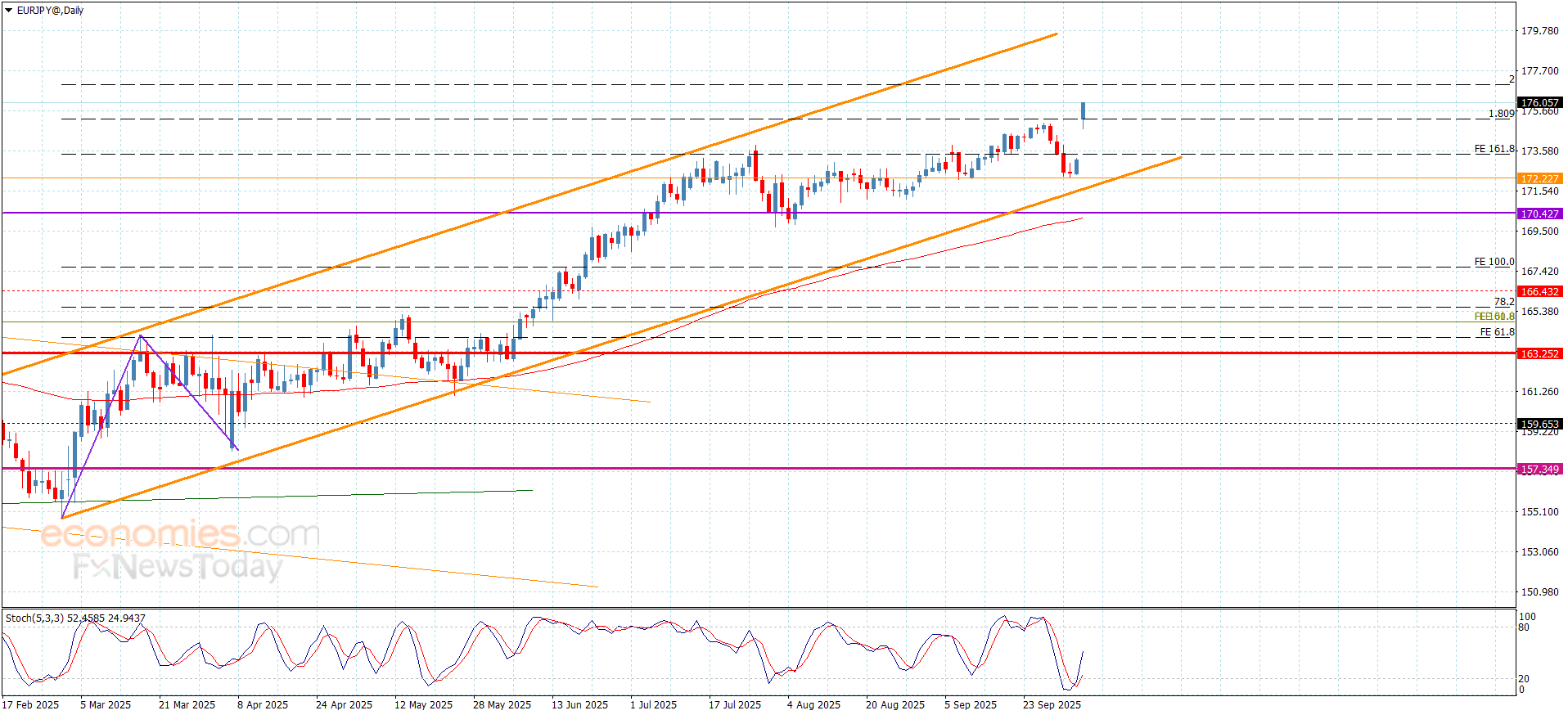
The GBPJPY pair opened today’s trading with a big price gap, to settle above the barrier at 200.45, recording big gains by its rally towards 202.10, approaching the initial main target at 202.40, forming 161.8%Fibonacci extension level that appears in the above image.
And that confirms the price surrender to the bullish bias dominance, by providing extra positive momentum by the main indicators, which increase the chances of surpassing 202.40 level, to begin achieving extra gains by its rally towards 202.85 reaching 1.809% Fibonacci extension level near 203.85.
The expected trading range for today is between 200.60 and 202.80
Trend forecast: Bullish
The GBPJPY pair opened today’s trading with a big price gap, to settle above the barrier at 200.45, recording big gains by its rally towards 202.10, approaching the initial main target at 202.40, forming 161.8%Fibonacci extension level that appears in the above image.
And that confirms the price surrender to the bullish bias dominance, by providing extra positive momentum by the main indicators, which increase the chances of surpassing 202.40 level, to begin achieving extra gains by its rally towards 202.85 reaching 1.809% Fibonacci extension level near 203.85.
The expected trading range for today is between 200.60 and 202.80
Trend forecast: Bullish
Gold has extended the previous advance, rallying as much as 1% so far this Monday to clinch a new all-time high near $3,925.
Gold buyers appear unstoppable at the start of a fresh week, early Monday, despite the renewed US Dollar (USD) upswing and a risk-on rally on global stocks.
Gold is finding demand due to increased safe-haven flows, mainly driven by the murky United States (US) economic outlook in the face of the extended government shutdown, which has entered a seventh day.
There are no public signs that the Republican and Democratic lawmakers are making any efforts to end the impasse on reopening the federal government.
This deadlock has raised worries over layoffs amid already weakening US labor market conditions.
Asked on Sunday night when federal workers would be fired as he has threatened to do, US President Donald Trump said that “it’s taking place right now and it’s all because of the Democrats.”
“The Democrats are causing the loss of a lot of jobs,” Trump added.
Delayed US economic reports also add to the uncertainty over the US Federal Reserve’s (Fed) outlook on interest rates beyond the October 28-29 meeting.
Markets have fully priced in a 25 basis points (bps) rate cut later this month, with chances of a December rate reduction standing at about 94%, according to the CME Group’s FedWatch Tool.
The Fed’s dovish narrative combined with the US political and fiscal concerns outweighs the risk-on mood and the USD/JPY rally-driven USD rebound, powering the Gold price upside.
The Japanese Yen (JPY) sinks against the USD after “Sanae Takaichi won the Japanese ruling Liberal Democratic Party (LDP) leadership election at the weekend, setting the country on course for more expansionary fiscal policy and complicating the task facing the Bank of Japan (BoJ),” per Reuters.
Looking ahead, any fresh updates on the US shutdown talks could have a significant impact on the Greenback and Gold.
Meanwhile, any private data from the US will be closely eyed alongside speeches from Fed officials for fresh insights on the US economy and the Fed’s path forward on interest rates.
As observed on the four-hour chart, the 14-day Relative Strength Index (RSI) is approaching the overbought region, currently near 67, suggesting that there is more room to the upside in the upcoming sessions.
Buyers now target the $3,950 psychological barrier on the way to the $4,000 mark.
Alternatively, if buyers take a breather and a pullback sets in, Gold could test the initial support at $3,872, the 21-Simple Moving Average (SMA), below which a drop toward the 50-SMA at $3,820 will be inevitable.
A deeper correction could target the 100-SMA at $3,753.
Gold has played a key role in human’s history as it has been widely used as a store of value and medium of exchange. Currently, apart from its shine and usage for jewelry, the precious metal is widely seen as a safe-haven asset, meaning that it is considered a good investment during turbulent times. Gold is also widely seen as a hedge against inflation and against depreciating currencies as it doesn’t rely on any specific issuer or government.
Central banks are the biggest Gold holders. In their aim to support their currencies in turbulent times, central banks tend to diversify their reserves and buy Gold to improve the perceived strength of the economy and the currency. High Gold reserves can be a source of trust for a country’s solvency. Central banks added 1,136 tonnes of Gold worth around $70 billion to their reserves in 2022, according to data from the World Gold Council. This is the highest yearly purchase since records began. Central banks from emerging economies such as China, India and Turkey are quickly increasing their Gold reserves.
Gold has an inverse correlation with the US Dollar and US Treasuries, which are both major reserve and safe-haven assets. When the Dollar depreciates, Gold tends to rise, enabling investors and central banks to diversify their assets in turbulent times. Gold is also inversely correlated with risk assets. A rally in the stock market tends to weaken Gold price, while sell-offs in riskier markets tend to favor the precious metal.
The price can move due to a wide range of factors. Geopolitical instability or fears of a deep recession can quickly make Gold price escalate due to its safe-haven status. As a yield-less asset, Gold tends to rise with lower interest rates, while higher cost of money usually weighs down on the yellow metal. Still, most moves depend on how the US Dollar (USD) behaves as the asset is priced in dollars (XAU/USD). A strong Dollar tends to keep the price of Gold controlled, whereas a weaker Dollar is likely to push Gold prices up.
Gold’s remarkable ascent continues to dominate global markets as prices soar to unprecedented levels, breaking through $3,897.13 per ounce before settling near $3,886.45. This marks the seventh consecutive week of gains, pushing the metal’s year-to-date increase above 47%, its strongest annual performance since 1979. The yellow metal has now logged multiple all-time highs in 2025, with analysts from major banks projecting it could soon test or even exceed the $4,000 barrier. Market capitalization across gold ETFs has expanded sharply, while bullion demand from both institutions and central banks remains relentless. The rally reflects a perfect storm of macroeconomic drivers — a weakening U.S. dollar, renewed geopolitical risk, policy interference fears at the Federal Reserve, and surging official sector purchases.
The latest catalyst stems from the ongoing U.S. government shutdown, now entering its fifth day, which has disrupted the release of crucial data such as non-farm payrolls and CPI. With the Bureau of Labor Statistics offline, the Federal Reserve is effectively operating blind ahead of its October 29 meeting. According to CME FedWatch, markets are pricing a 97% probability of a 25-basis-point cut this month and an 85% chance of another by December. The dollar index dropped to 97.78, its weakest close since July, while 10-year Treasury yields slipped to 4.092%, further bolstering demand for non-yielding assets. Analysts at UBS and Goldman Sachs have lifted their 2025 targets to $4,200 and $4,300, respectively, citing sustained rate-cut expectations and intensifying safe-haven flows.
According to HSBC, central bank demand continues to underpin the market, with official sector purchases remaining robust as nations diversify away from the U.S. dollar. While buying may slow from the record levels of 2022–2024, the aggregate pace remains historically elevated. HSBC projects that “rallies can continue into 2026,” aided by institutional diversification. This thesis aligns with ongoing inflows into major gold ETFs, led by the SPDR Gold Trust (GLD), whose holdings rose 0.59% this week to 1,018.89 metric tons. This marks the seventh straight week of accumulation by institutions, bringing total global ETF reserves to multi-year highs. Gold’s dual role as both an inflation hedge and a monetary hedge has regained prominence, particularly as concerns rise over the Fed’s independence following reports of political interference involving President Trump’s attempt to remove Fed Governor Lisa Cook.
Gold’s rally has also been powered by escalating political risk and a weakening greenback. The standoff in Washington has frozen critical economic functions, while ongoing conflicts across Eastern Europe and the Middle East continue to amplify safe-haven flows. The spot price’s relentless climb — up nearly 50% year-to-date — mirrors capital flight from risk assets toward real stores of value. Analysts note that XAU/USD tends to rally in periods of non-recessionary uncertainty when real yields decline but nominal growth remains intact. With the U.S. Dollar Index trending downward and investors increasingly skeptical of fiscal discipline, gold has reclaimed its role as the world’s ultimate risk-off anchor.
From a technical standpoint, gold’s trajectory remains distinctly bullish. The metal trades well above its 52-week moving average of $3,090.96, underscoring structural strength but also suggesting possible overheating. Weekly momentum remains firmly in the green, with seven consecutive positive closes, a rare occurrence historically associated with multi-month continuation phases. Technical analysts identify $4,000 as the next psychological resistance level, followed by a potential overshoot toward $4,200–$4,300 if momentum remains unchecked. The market shows no overhead resistance beyond current levels, with price action now in uncharted territory. While the rally appears extended, the absence of a weekly reversal pattern keeps the bias firmly bullish. A corrective phase could emerge if the market prints a closing reversal top, but until then, the long-term uptrend remains the dominant narrative.
The rally in spot gold has translated into explosive performance for mining equities. The Sprott Gold Miners ETF (SGDM) has soared 115% year-to-date, doubling the performance of gold itself. The fund, which holds 37 gold majors, including Agnico Eagle Mines (NYSE:AEM), Newmont (NYSE:NEM), Kinross Gold (NYSE:KGC), and Barrick Mining (NYSE:B), offers leveraged exposure to the ongoing gold boom. As bullion prices approach $4,000, miners’ margins are expanding at their fastest pace in years. SGDM’s expense ratio of 0.5% is offset by periodic distributions — the ETF paid a $0.29 per-share dividend in December 2024, and a higher payout is likely for 2025 given the record profitability of underlying constituents. Analysts suggest that as gold surpasses new thresholds, mining stocks will continue to outperform physical bullion due to operational leverage and expanding cash flows.
Investment banks remain unified in their bullish stance. HSBC forecasts that gold could trade above $4,000 in the near term, projecting continued strength through 2026 driven by fiscal uncertainty, official sector accumulation, and diversification away from the dollar. UBS anticipates a move toward $4,200, while Goldman Sachs sets a ceiling near $4,300, emphasizing that the combination of geopolitical risk and U.S. fiscal stress is likely to sustain demand well into next year. Meanwhile, macro strategists warn that if the Fed cuts rates faster than expected, the rally could overshoot targets, though slower easing might temporarily moderate the pace of gains. Despite this, both scenarios remain net-positive for gold, which thrives in environments of monetary instability and negative real yields.
Retail enthusiasm has returned, particularly through gold-linked ETFs and mining funds. Data from FXEmpire shows that inflows into the SPDR Gold Trust (GLD) and other major ETFs have grown consistently since early September, while trading volume in gold futures has risen sharply. Market chatter around “$4,000 gold” has fueled speculative momentum, though analysts emphasize that the current rally is rooted in fundamentals, not hype. Investors disenchanted with crypto volatility have rotated capital into precious metals, reinforcing gold’s reputation as the ultimate hedge against both inflation and institutional instability.
The U.S. government’s failure to pass a funding bill has triggered its 15th shutdown since 1981, halting regulatory oversight, economic reporting, and financial research. The absence of data leaves the Federal Reserve navigating without visibility, a situation reminiscent of 2013’s shutdown but with far higher stakes given the size of today’s deficits. Markets interpret this paralysis as deeply inflationary in the medium term, as political gridlock erodes confidence in fiscal management. The resulting demand for safe-haven assets has sent both gold and silver into synchronized rallies — with silver up 2.16% this week and closing near $31 per ounce. Gold’s safe-haven dominance has become self-reinforcing, with ETF flows, central bank buying, and retail participation converging into a sustained structural bid.
All fundamental, technical, and macro indicators converge on a single theme: XAU/USD remains in a confirmed bull market. The trajectory points to $4,000 as the next milestone, with extension targets toward $4,200–$4,300 by early 2026. Volatility will remain elevated, but the underlying drivers — Fed easing, political instability, dollar weakness, and institutional accumulation — remain intact. While short-term corrections are possible given the magnitude of gains, each retracement is likely to attract renewed buying from both central banks and private funds. Mining equities, led by SGDM, provide leveraged upside as margins expand alongside bullion prices.
Verdict: Buy (Strong Bullish) — Gold remains the premier safe-haven asset of 2025. With technical structure firm, institutional flows accelerating, and macro fundamentals aligned, the path toward $4,000–$4,300 appears both achievable and sustainable.
Futures are now approaching the 50-day moving average at $3.291, a level that will likely determine near-term direction. A sustained hold above this level could trigger a bounce back toward the $3.529–$3.585 resistance zone. However, failure to hold could open the door for a decline toward $3.122–$3.063, with the next key support band at $2.986–$2.938. The downside risk is heightened by seasonal weakness, as traders typically fade rallies into mild shoulder-season demand.
Despite the bullish surprise from the EIA, total storage stands at 3,561 Bcf—171 Bcf above the five-year average and 21 Bcf higher than this time last year. This reflects strong production and soft demand. BNEF data shows dry gas output hit 107.1 Bcf/d on Thursday, up 4.9% year-on-year, while Lower 48 demand dropped 4.4% to 67.9 Bcf/d. LNG exports dipped slightly to 15.3 Bcf/d. The Waha Hub cash market also hit record lows ahead of the PHP pipeline outage, underscoring regional bottlenecks.
Forecasts for October 2–8 show weak national gas demand, with warm temperatures across most of the U.S. Atmospheric G2 is also calling for above-normal heat from October 12–16. This could further suppress residential and commercial heating load, keeping physical demand soft even as electricity output trends higher. The Edison Electric Institute reported a 5.96% year-over-year increase in U.S. electricity generation last week, but it hasn’t been enough to tip the demand balance meaningfully.
The confirmed bearish reversal and seasonal low demand suggest more downside in the near term. A test of the 50-day MA near $3.291 is likely, and failure to hold that level could spark further liquidation. Until temperatures cool materially or production slows, natural gas prices are expected to remain under pressure.
More Information in our Economic Calendar.
Yet, such an extended rally also increases the likelihood of a sharper corrective move. The market has advanced with little pause, and while momentum remains supportive, the longer gold stretches away from its moving averages, the more vulnerable it becomes to mean reversion. A decisive drop below the 10-Day moving average, now at $3,805, could be the first warning that bullish momentum is beginning to weaken. Until then, the uptrend remains intact, represented by dynamic demand seen in the 10-Day line.
Gold’s advance has recently stalled near a 261.8% projection derived from a large ABCD pattern dating back several years. This long-term Fibonacci level at $3,897 has so far acted as resistance. A daily close above this week’s high of $3,897 would confirm a breakout through this resistance zone and open the door to the next projected target range between $3,969 and $4,000.
Adding to the significance of this upper range, the rising trend channel that has guided gold’s advance for months intersects near the $3,969 to $4,000 zone. This confluence of pattern resistance, Fibonacci projection, and channel resistance could represent a major technical barrier. Should gold extend into this area, traders will be closely watching for signs of exhaustion or a potential reversal.
For now, buyers remain in charge, and the strong weekly close reinforces the bullish narrative heading into Monday. The challenge for bulls will be to sustain momentum above the 10-Day line and decisively push through the $3,897 threshold. A successful breakout could pave the way toward $4,000, while failure to hold current levels may finally trigger the deeper correction that has so far been avoided.
For a look at all of today’s economic events, check out our economic calendar.
The (silver) price declined in its last intraday trading, due to the stability of the key resistance at $47.50, attempting to gain positive momentum that might help it to recover and rise again, amid the continuation of the positive pressure due to its trading above EMA50, under the dominance of the main bullish trend on the short-term basis and its trading alongside trendline, noticing the emergence of positive overlapping signals on the relative strength indicators, after reaching oversold levels.
Get high-accuracy trading signals delivered directly to your Telegram. Subscribe to specialized packages tailored for the world’s top markets:
Full VIP signals performance report for September 22–26, 2025:
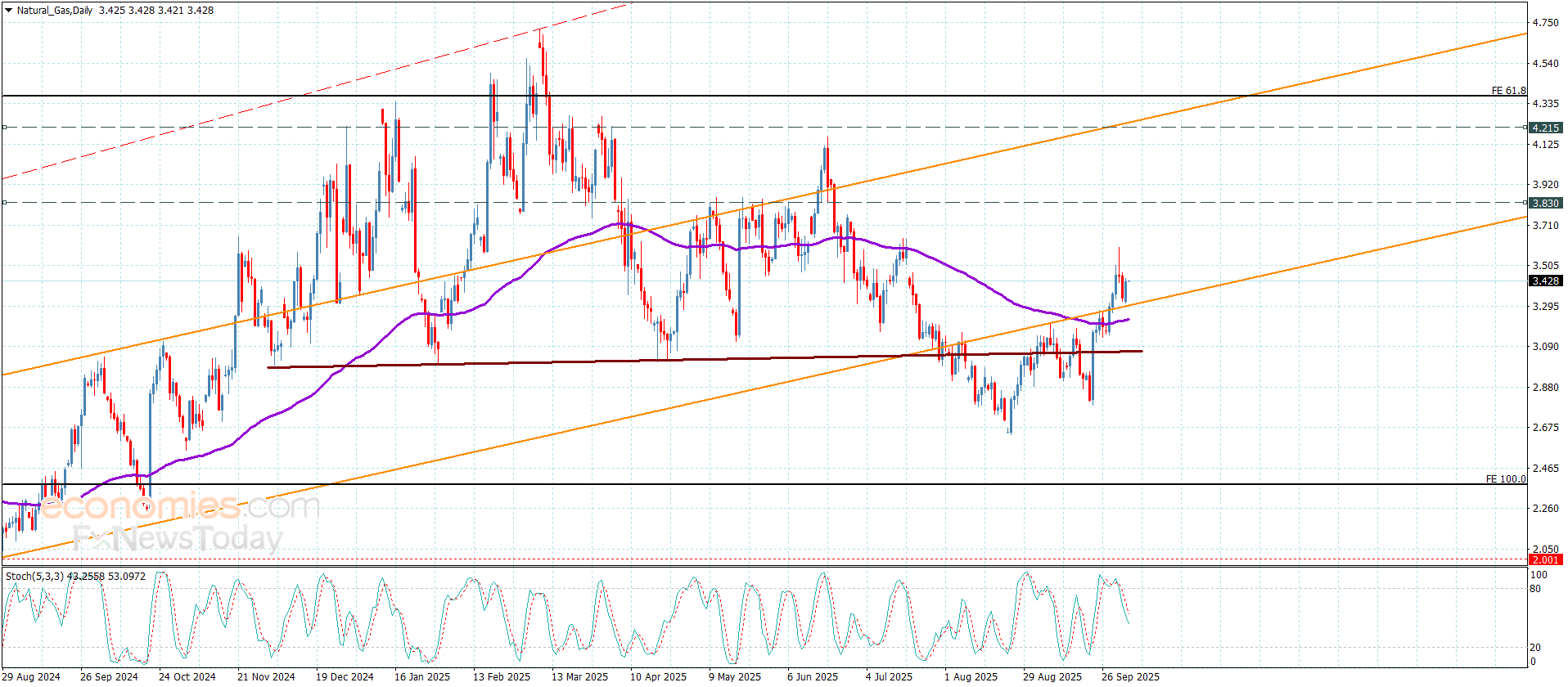
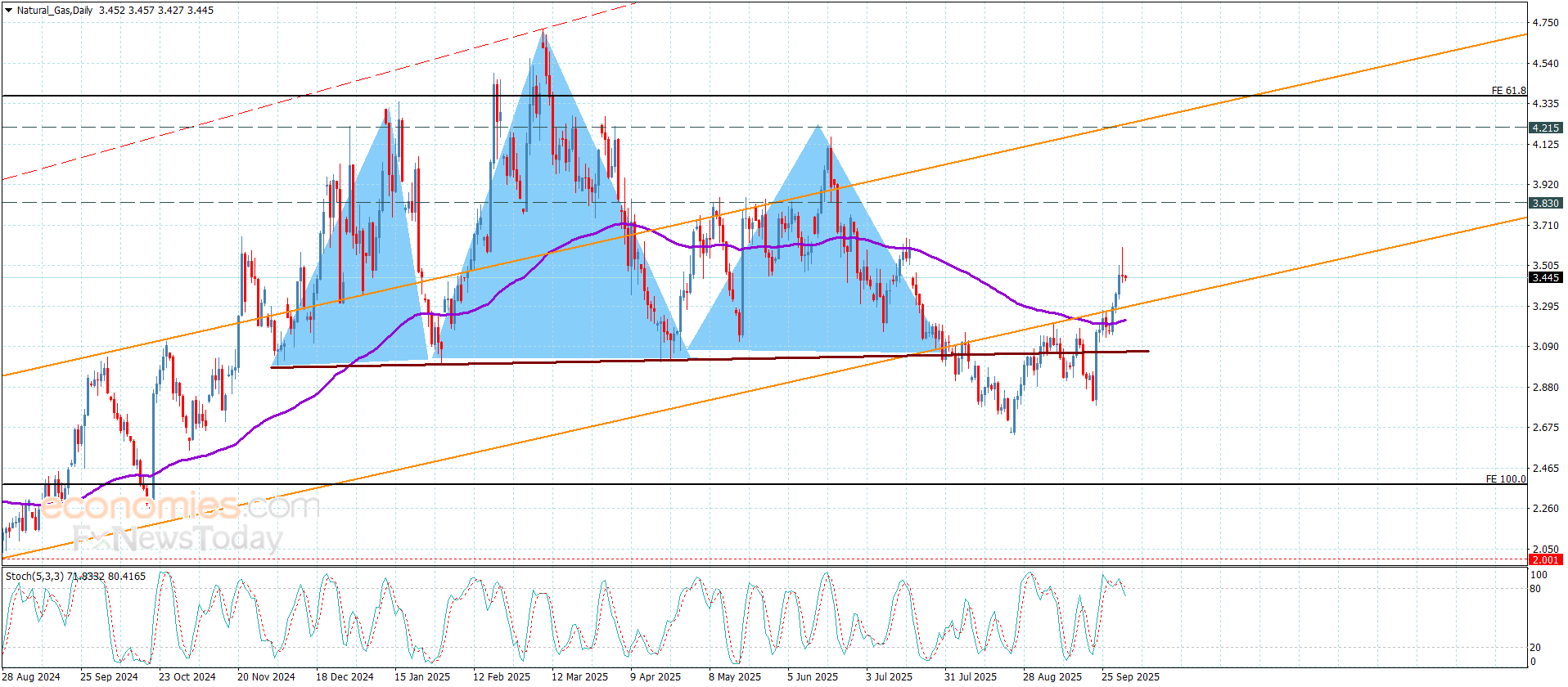
Natural gas price reached $3.600 level, achieving the second suggested target in the previous report, which forced it to form quick correctional rebound, to settle near $3.440.
The intraday sideways trading is caused by stochastic exit from the overbought level, to expect providing unstable mixed trading until gathering the extra positive momentum, to ease the mission of resuming the bullish attack, and reaching extra stations that are represented by $3.710 and $3.830.
The expected trading range for today is between $3.380 and $3.600
Trend forecast: Fluctuated