The main tag of Gold Price Articles.
You can use the search box below to find what you need.
[wd_asp id=1]
The main tag of Gold Price Articles.
You can use the search box below to find what you need.
[wd_asp id=1]
Gold (XAU/USD) was capped at the $4,175 area on Wednesday and is showing minor losses on Thursday, although it remains trading within the previous day’s range, with support around the $4,140 area holding downside attempts for now.
The US Dollar Index (DXY) is showing a mild recovery after dropping nearly 0.7% over the previous three days, which is weighing on Gold’s recovery. The precious metal is about 0.5% higher on the week, as growing hopes that the US Federal Reserve will cut rates further in December have sent US Treasury yields tumbling and the Greenback down with them
The technical pìcture shows the broader bullish trend still in play with XAU/USD trading at $4,156. The Relative Strength Index (RSI) in four-hour charts prints 58.73, above the midline, suggesting buyers retain a modest advantage, while the Moving Average Convergence Divergence (MACD) eases toward the zero line with its latest reading near positive territory, hinting at fading bullish momentum.
Wednesday’s highs at $4,175 are holding bulls for now, although the focus remains on the November 14 high, at $4,211, and the November peak, near $4,245.
On the downside, immediate support is seen at Wednesday’s low of $4,140, ahead of the November 25 low, right below $4,110. A confirmation below here would cancel the bullish scenario and bring the November 20,21, and 24 lows, between $4,020 and $4,040, back into play.
(The technical analysis of this story was written with the help of an AI tool)
Gold has played a key role in human’s history as it has been widely used as a store of value and medium of exchange. Currently, apart from its shine and usage for jewelry, the precious metal is widely seen as a safe-haven asset, meaning that it is considered a good investment during turbulent times. Gold is also widely seen as a hedge against inflation and against depreciating currencies as it doesn’t rely on any specific issuer or government.
Central banks are the biggest Gold holders. In their aim to support their currencies in turbulent times, central banks tend to diversify their reserves and buy Gold to improve the perceived strength of the economy and the currency. High Gold reserves can be a source of trust for a country’s solvency. Central banks added 1,136 tonnes of Gold worth around $70 billion to their reserves in 2022, according to data from the World Gold Council. This is the highest yearly purchase since records began. Central banks from emerging economies such as China, India and Turkey are quickly increasing their Gold reserves.
Gold has an inverse correlation with the US Dollar and US Treasuries, which are both major reserve and safe-haven assets. When the Dollar depreciates, Gold tends to rise, enabling investors and central banks to diversify their assets in turbulent times. Gold is also inversely correlated with risk assets. A rally in the stock market tends to weaken Gold price, while sell-offs in riskier markets tend to favor the precious metal.
The price can move due to a wide range of factors. Geopolitical instability or fears of a deep recession can quickly make Gold price escalate due to its safe-haven status. As a yield-less asset, Gold tends to rise with lower interest rates, while higher cost of money usually weighs down on the yellow metal. Still, most moves depend on how the US Dollar (USD) behaves as the asset is priced in dollars (XAU/USD). A strong Dollar tends to keep the price of Gold controlled, whereas a weaker Dollar is likely to push Gold prices up.
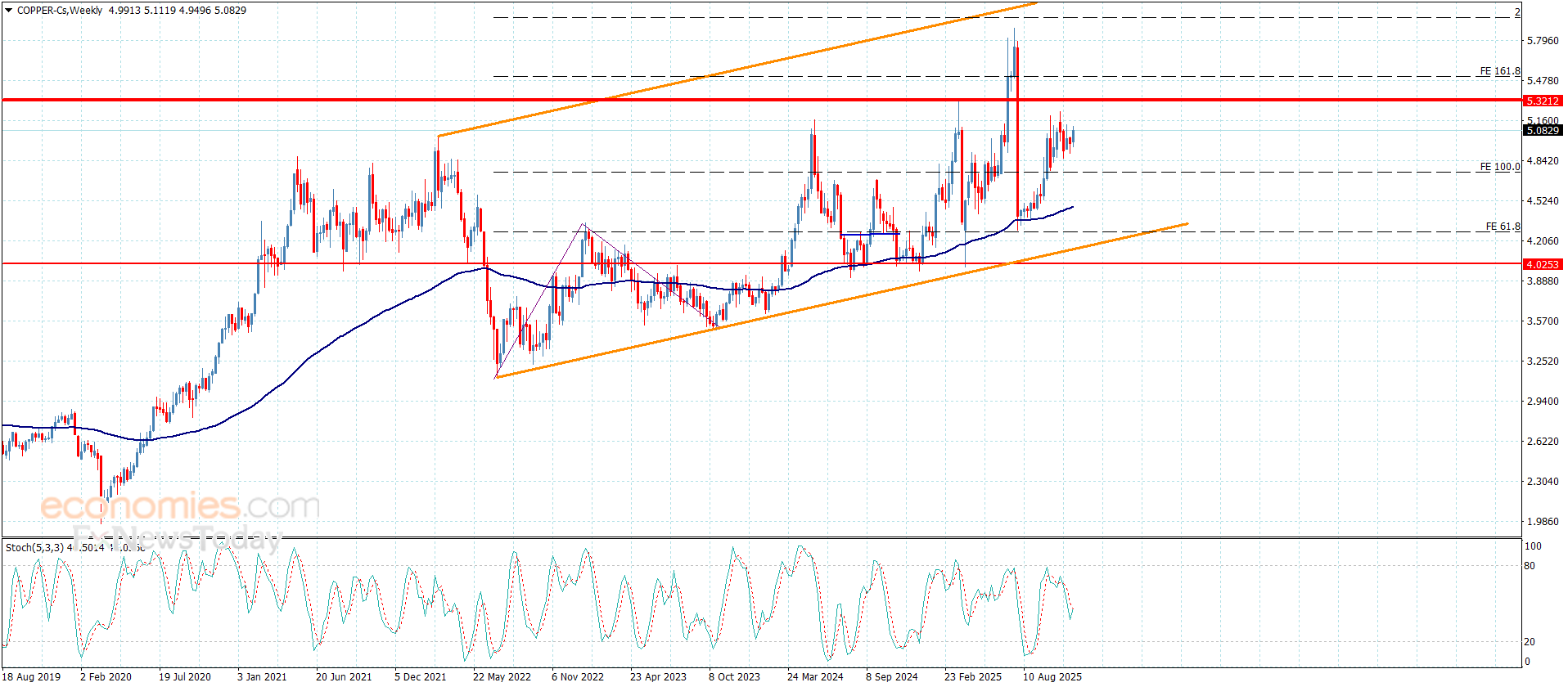
Copper price succeeded in recording some gains by hitting $5.1200 level, depending on the positive factors that are represented by the stability of the support level at $4.7500, besides the continuation of the positive factors that are represented by the support at $4.7500 besides the continuation of the attempts to provide bullish momentum by the main indicators.
Reminding you that surpassing the barrier at $5.2000 and holding above it is important to reinforce the efficiency of the bullish scenario, then begin targeting new positive stations by its rally towards $5.3200 and $5.5000.
The expected trading range for today is between $4.9800 and $5.2000
Trend forecast: Bullish
Copper price succeeded in recording some gains by hitting $5.1200 level, depending on the positive factors that are represented by the stability of the support level at $4.7500, besides the continuation of the positive factors that are represented by the support at $4.7500 besides the continuation of the attempts to provide bullish momentum by the main indicators.
Reminding you that surpassing the barrier at $5.2000 and holding above it is important to reinforce the efficiency of the bullish scenario, then begin targeting new positive stations by its rally towards $5.3200 and $5.5000.
The expected trading range for today is between $4.9800 and $5.2000
Trend forecast: Bullish
Silver price (XAG/USD) declines after three days of gains, trading around $52.80 during the Asian hours on Thursday. However, the non-interest-bearing Silver may regain its ground amid rising odds of Federal Reserve (Fed) rate cut bets in December, given that lower interest rates reduce the opportunity cost of holding non-yielding assets.
US data showed unexpectedly low Initial Jobless Claims and stronger-than-expected Durable Goods Orders, yet rate-cut expectations remained intact. The CME FedWatch Tool suggests that markets are now pricing in a more than 84% chance that the Fed will cut its benchmark overnight borrowing rate by 25 basis points (bps) at its December meeting, up from the 30% probability that markets priced a week ago.
The US Department of Labor (DOL) reported on Wednesday that Initial Jobless Claims fell to 216,000 for the week ending November 22, down 6,000 from the previous week’s revised figure. The result was stronger than the market expectation of 225,000. Meanwhile, the 4-week moving average eased by 1,000 to 223,750.
Fed rate expectations increased by reports that the White House has narrowed its search for the next Fed chair to National Economic Council Director Kevin Hassett. Investors see Hassett as supportive of US President Donald Trump’s preference for lower interest rates.
The dollar-denominated Silver attracts buyers with foreign currencies amid a weakening Greenback. The US Dollar Index (DXY), which measures the value of the US Dollar (USD) against six major currencies, is losing ground for the third successive session and trading around 99.50 at the time of writing.
Silver is a precious metal highly traded among investors. It has been historically used as a store of value and a medium of exchange. Although less popular than Gold, traders may turn to Silver to diversify their investment portfolio, for its intrinsic value or as a potential hedge during high-inflation periods. Investors can buy physical Silver, in coins or in bars, or trade it through vehicles such as Exchange Traded Funds, which track its price on international markets.
Silver prices can move due to a wide range of factors. Geopolitical instability or fears of a deep recession can make Silver price escalate due to its safe-haven status, although to a lesser extent than Gold’s. As a yieldless asset, Silver tends to rise with lower interest rates. Its moves also depend on how the US Dollar (USD) behaves as the asset is priced in dollars (XAG/USD). A strong Dollar tends to keep the price of Silver at bay, whereas a weaker Dollar is likely to propel prices up. Other factors such as investment demand, mining supply – Silver is much more abundant than Gold – and recycling rates can also affect prices.
Silver is widely used in industry, particularly in sectors such as electronics or solar energy, as it has one of the highest electric conductivity of all metals – more than Copper and Gold. A surge in demand can increase prices, while a decline tends to lower them. Dynamics in the US, Chinese and Indian economies can also contribute to price swings: for the US and particularly China, their big industrial sectors use Silver in various processes; in India, consumers’ demand for the precious metal for jewellery also plays a key role in setting prices.
Silver prices tend to follow Gold’s moves. When Gold prices rise, Silver typically follows suit, as their status as safe-haven assets is similar. The Gold/Silver ratio, which shows the number of ounces of Silver needed to equal the value of one ounce of Gold, may help to determine the relative valuation between both metals. Some investors may consider a high ratio as an indicator that Silver is undervalued, or Gold is overvalued. On the contrary, a low ratio might suggest that Gold is undervalued relative to Silver.
Gold (XAU/USD) trades at $4,167 per ounce, regaining strength after weeks of consolidation and touching a two-week high of $4,169. The move reflects a decisive rotation into safe-haven assets as weak U.S. data fuels expectations of a December Federal Reserve rate cut, now priced at over 80% probability, up sharply from 50% last week. The metal has now gained 57.9% year-to-date, supported by persistent central bank accumulation, ETF inflows, and the broad weakening of the U.S. dollar. Gold’s current trading range between $3,900 and $4,400 forms the tightest and most critical consolidation zone of 2025, and the upcoming Fed meeting on December 17–18 is likely to determine whether the next leg is toward $4,500 or back to $4,000 support.
The U.S. macro backdrop remains the defining driver. Retail sales missed forecasts, consumer confidence fell to 88.7 — the lowest since May, and PPI data stagnated. These weak readings have accelerated expectations for monetary easing. Treasury yields dropped for a fourth straight session, with the 10-year yield sliding below 4.02%, reinforcing the narrative of a softer dollar environment. Fed officials, including Christopher Waller, have signaled openness to rate cuts in response to slower inflation and labor softening. The result has been a notable reduction in real yields — a major tailwind for non-yielding assets such as gold. XAU/USD benefits directly: the lower yield environment reduces opportunity cost, and dovish expectations now imply a two-cut cycle in H1 2026, which could sustain the gold uptrend into the mid-$4,000s.
Technically, XAU/USD shows sustained momentum. Immediate resistance sits at $4,210, followed by secondary resistance at $4,370–$4,400, corresponding to historical highs. Support levels hold firm at $4,150, $4,000, and $3,900, with a wider safety buffer between $3,300 and $3,450 aligning with the 200-day EMA. The Relative Strength Index (RSI) on the 4-hour chart remains above 60, signaling ongoing bullish momentum, while the MACD histogram shows a widening green spread, confirming positive price acceleration. The 50-day EMA near $4,000 acts as a key psychological and structural defense zone. If gold breaches $4,210, the path opens toward $4,370, and ultimately the Fibonacci extension targets at $5,000 (100%) and $5,500 (161.8%) projected from the July-to-October impulse wave.
Institutional projections now converge on a higher 2026 target range: Deutsche Bank raised its forecast to $4,450/oz, expecting a $3,950–$4,950 trading range next year, with persistent ETF inflows maintaining a strong support floor near $3,900. Goldman Sachs predicts a $4,900 target by late 2026, citing 75 bps in expected global rate cuts and renewed central bank diversification after the freezing of Russian reserves. Bank of America foresees a $5,000 level, driven by U.S. deficit expansion and inflationary fiscal policy under Trump’s administration. HSBC projects a $3,600–$4,400 range, acknowledging geopolitical risk and global trade tensions as persistent supports but noting potential drag from higher physical supply and slowed bank purchases. Despite differing targets, the institutional alignment on the $4,400–$5,000 band underlines a unified bullish bias rooted in both policy and structural drivers.
Deutsche Bank analyst Michael Hsueh highlighted that gold’s performance is being underpinned by inelastic official-sector demand. Central banks continue to accumulate aggressively, seeking protection against geopolitical and reserve risks. Surveys show the highest percentage of central banks planning gold accumulation in years, with one respondent calling gold the “ultimate protection against black-swan tail risk events.” Official purchases in Q3 ranked as the third-highest on record, even at elevated price levels. ETF flows have also reversed four years of outflows, shifting back to net accumulation. This institutional behavior absorbs supply that would otherwise enter the jewelry and industrial markets, creating an artificial scarcity that supports price floors. Physical supply growth remains constrained: 2026 mined output is expected at 3,715 tonnes, with disruptions at Indonesia’s Grasberg mine offsetting new projects. Recycling rates remain below historical peaks, and major miners still model internal assumptions at $2,500–$3,000, limiting capacity expansion. This structural mismatch — expanding official demand versus inelastic supply — continues to define the bullish setup for XAU/USD into 2026.
According to a Bank of America fund manager survey, only 5% of global portfolio managers expect gold above $5,000 by 2026, while 39% hold no gold exposure at all. This imbalance between price strength and institutional participation signals latent upside. Historically, similar conditions — strong fundamentals combined with under-allocation — preceded multi-quarter rallies. The Kobeissi Letter data underscores this divergence: 34% of investors expect gold between $4,000 and $4,500, while just 8% predict sub-$3,500 levels. Such skepticism amid structural demand growth suggests gold remains under-owned relative to macro risk, positioning it as one of the few assets capable of outperforming in both inflationary and deflationary environments.
Persistent geopolitical and fiscal instability continues to reinforce the appeal of gold. The U.S. fiscal deficit is widening sharply, with debt-to-GDP expected to exceed 122% in 2026, sustaining long-term inflationary pressure. Simultaneously, ongoing tariff escalations under the Trump administration raise global trade friction and increase demand for neutral assets like gold. In parallel, China and India — representing over 50% of global retail gold demand — remain key stabilizers. Seasonal physical buying, particularly ahead of the Lunar New Year, tends to amplify price strength in early Q1. The Dollar Index (DXY) remains below 100, its lowest in 12 months, while global liquidity measures continue to improve as central banks loosen policy. Combined, these conditions suggest macro tailwinds remain intact for XAU/USD through the first half of 2026.
Fibonacci mapping from July lows to October highs sets a 100% extension target at $5,000 and 161.8% extension above $5,500, validating the bullish case. The $4,200–$4,210 resistance remains the immediate test area; breaking it confirms the start of an expansion phase toward the upper bound. Momentum indicators show constructive alignment. The Stochastic Oscillator at 62 and CCI at +84 support continued upward bias. Volumes have begun expanding again on each up-leg, confirming institutional re-entry. A sustained close above $4,210 unlocks the $4,370–$4,400 zone, while closing above $4,400 shifts focus toward $4,900. Conversely, a break below $4,000 risks a pullback to $3,900, though long-term support near $3,300–$3,450 ensures the broader uptrend remains structurally intact.
The juxtaposition of official sector accumulation, ETF re-engagement, and investor skepticism creates a textbook setup for asymmetric upside. The Deutsche Bank, Goldman Sachs, and BofA alignment near $4,900–$5,000 underscores that even conservative models expect double-digit gains through 2026. The combination of lower real yields, persistent inflation, tight mine supply, and currency debasement risks continues to position gold as the premier macro hedge. Every pullback into the $3,900–$4,000 range remains a high-probability accumulation zone for long-term investors. Verdict: STRONG BUY — Gold (XAU/USD) is fundamentally and technically supported for continued appreciation. The next major breakout above $4,210 opens room toward $4,400, followed by $5,000–$5,500 Fibonacci targets. Downside risk remains limited while real rates and U.S. fiscal policy both point to sustained medium-term bullish momentum.
Momentum stayed muted as price met a significant overhead barrier: two separate top ascending trend channel lines plus a short-term downtrend line all converging near today’s high. This triple confluence effectively capped the session and prevented immediate follow-through above the $4,173 area.
Since October’s $4,381 record high, gold has formed a bull pennant—small symmetrical triangle—consolidation pattern. The 20-day average at $4,068, after moving sideways-to-slightly lower since November 4, has now resumed its rise and is closely tracking the internal uptrend line that connects Friday’s slightly higher swing low, creating tight dynamic support.
The first indication of upside resolution appears on a decisive rally above the short-term downtrend line. A true pennant breakout, however, requires a sustained advance and daily close above the recent lower swing high of $4,245 to confirm continuation of the larger uptrend.
Consolidation has remained entirely in the top half of the advance and near the upper channel boundaries, reflecting persistent underlying strength. The 50-day average, still untested as support since its late-August reclaim, continues rising below current levels and stands as the ultimate deeper safety net.
Gold’s higher high/low sequence and confirmed 10-day support keep buyers in command inside the tightening pennant. A decisive close above $4,245 validates upside continuation toward fresh records; persistent failure to clear the triple trendline resistance risks a deeper test of the 20-day/uptrend line confluence near $4,068, with the untested 50-day as final backstop. The long-term bull trend strongly favors eventual upside resolution unless bearish price behavior negates that outlook.
For a look at all of today’s economic events, check out our economic calendar.
The daily high respected the long-term rising top channel line (blue) that has repeatedly capped moves. Just overhead, a separate downtrend line intersects a more recent top channel line (black), creating a tight resistance band that further defines the upper pennant boundary. It looks likely that further advances in the short-term may be capped around $4,185, the intersection of the two lines.
The 20-day average at $4,057 has begun turning higher after multiple failed attempts to break below it. Yesterday’s $4,040 low sparked a six-day breakout with a strong close near highs. The 20-day is nearing convergence with the internal uptrend line that defines near-term dynamic support and the lower boundary of the pennant; failure there directs focus to the rising 50-day average at $3,999, untested since the August rally began.
An upside pennant breakout requires a sustained advance above the recent lower swing high at $4,245. Repeated tests of the upper downtrend line that produce a lower swing high would instead lower the bullish trigger level. But that hasn’t happened yet.
Gold is rapidly approaching the pennant apex, forcing expanded volatility soon. A downside break first shows on a drop below Monday’s $4,040 low, with confirmation beneath Friday’s $4,022 low. Momentum on any breakdown would remain limited as long as the 50-day average acts as dynamic support.
The bull pennant is coiling into its apex with resistance directly overhead and the 20-day/50-day complex below. A decisive push above $4,245 validates continuation higher; failure to clear the upper trend lines keeps risk of a downside break toward $4,040–$4,022, then the 50-day near $3,999. Until a clean directional trigger fires, expect continued tight range trading.
For a look at all of today’s economic events, check out our economic calendar.
The EURJPY pair is forced to provide weak sideways trading, affected by the contradiction between the main indicators, keeping its stability near 180.80, reminding you that the negative stability below 181.75 barrier forms main factors to motivate the dominance of the bearish corrective trend, to expect the attempt of pressing on 179.40 level, where surpassing it will form next main target at 178.60 for the bearish trading.
While breaching the mentioned barrier and holding above it will increase the chances of resuming the main bullish trend, to expect recording extra gains by its rally towards 182.30 and 183.05.
The expected trading range for today is between 179.30 and 181.10
Trend forecast: Bearish
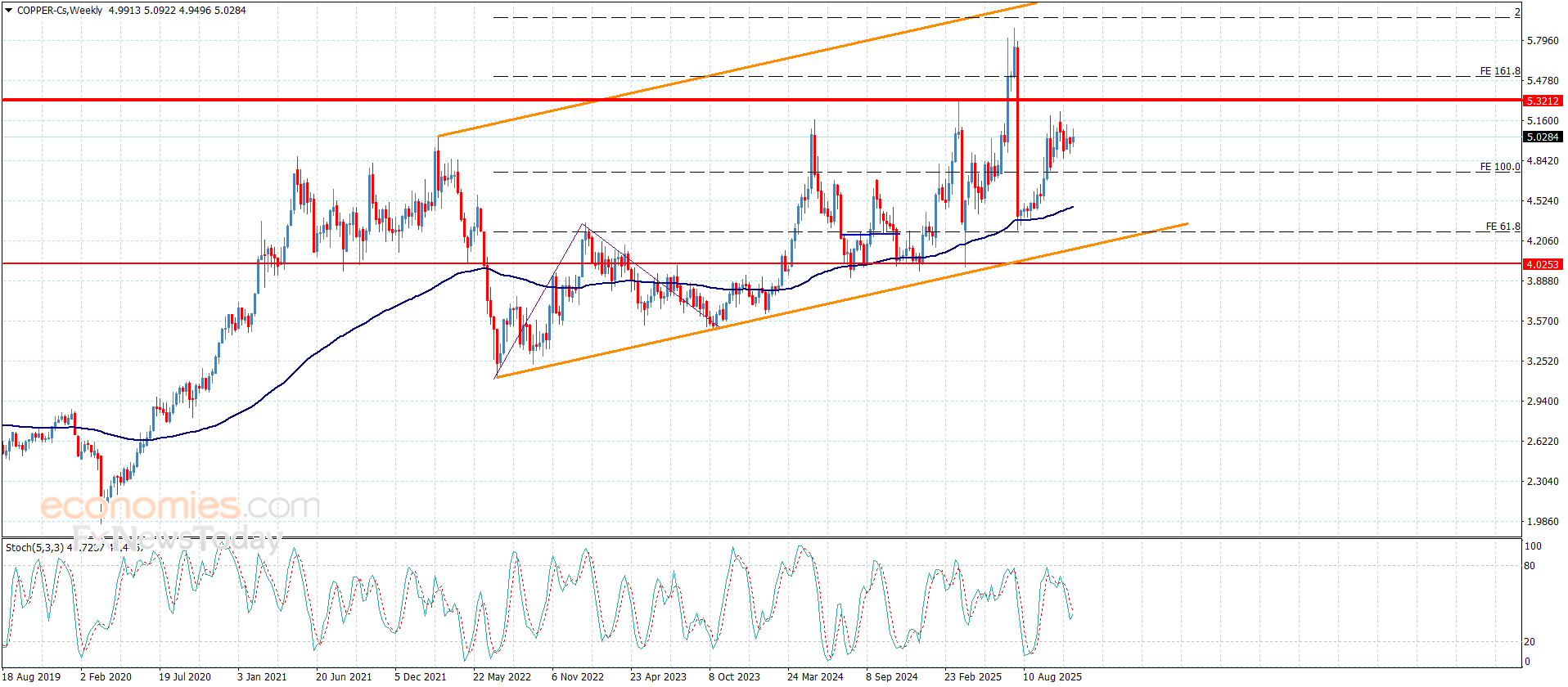
Despite the weakness of copper prices in the last period, its stability within the main bullish channel’s levels, and holding above $4,7500, supports the chances of renewing the bullish attempts, to settle near $5.0500.
Facing the barrier at $5.2000 by the main indicators confirms the importance of surpassing it to open the way for recording extra gains that might begin at $5.3200 and $5.5000.
The expected trading range for today is between $4.9500 and $5.2000
Trend forecast: Bullish
Despite the weakness of copper prices in the last period, its stability within the main bullish channel’s levels, and holding above $4,7500, supports the chances of renewing the bullish attempts, to settle near $5.0500.
Facing the barrier at $5.2000 by the main indicators confirms the importance of surpassing it to open the way for recording extra gains that might begin at $5.3200 and $5.5000.
The expected trading range for today is between $4.9500 and $5.2000
Trend forecast: Bullish