The main tag of Gold Price Articles.
You can use the search box below to find what you need.
[wd_asp id=1]
The main tag of Gold Price Articles.
You can use the search box below to find what you need.
[wd_asp id=1]
The decisive decline in the price of natural gas looks to be heading for a test of support around 50-Day MA, now at $3.48, and a recent higher swing low at $3.45. If support fails around the 50-Day line, then the 200-Day, currently at $3.36, will probably be on the agenda. Since the 50-Day MA was reclaimed on June 2, there has been one pullback to test the 50-Day MA as support. It was successful and followed by a rally to new trend highs for the short-term uptrend. Therefore, this second test of the line should provide clues about supply and demand. If it fails to lead to a bullish reversal, a deeper retracement or consolidation may follow.
Despite the trend lines and moving averages on the chart marking various dynamic price levels, the bigger picture is one of consolidation, with a low at $2.86 and a high at $4.90. Inside that larger consolidation pattern is a rising trend channel, begun from the April swing low. That channel pattern may continue to evolve or fail. A continuation of the pattern triggered last Tuesday. Nonetheless, a potential failure of the pattern would first be indicated by a drop below the interim swing low at $3.45. That would show a failure of both a lower trendline and 50-Day MA to show support.
Otherwise, the expectation is for support to be found near the lower support zone of the price channel and then turn back up. That would lead to the possible continuation of the rising trend channel. As the past couple of days have shown, an advance that rises into a consolidation zone may find resistance before going to too far.
For a look at all of today’s economic events, check out our economic calendar.
Spot Gold is depressed, barely holding above the $3,300 threshold. The XAU/USD pair is sharply down for a second consecutive day amid optimistic headlines flooding the news feeds.
On the one hand, United States (US) President Donald Trump announced a ceasefire between Iran and Israel late on Monday, with the fragile truce still spurring risk appetite. Recent headlines indicate that Israeli Prime Minister Benjamin Netanyahu agreed to the ceasefire because his country had achieved all of its war goals. Also, Iranian President Masoud Pezeshkian said that Tehran would not violate the ceasefire deal unless Israel does.
Other than that, Federal Reserve (Fed) Chair Jerome Powell testified on monetary policy before Congress. In his prepared remarks, Powell reiterated that Fed officials are concerned about the impact of tariffs on the economy and, hence, expect inflation to tick north. He also repeated that uncertainty is high, while adding that the US is not in recession. His message was tilted to hawkish, helping the market’s mood to remain upbeat and safe-haven assets under selling pressure.
Technically, the XAU/USD pair’s daily chart hints at additional slides, particularly if the pair breaks below the intraday low set at $3,295.46. The mentioned chart shows the pair develops below a now flat 20 Simple Moving Average (SMA), providing resistance at around $3,352. At the same time, technical indicators crossed their midlines into negative territory, maintaining their downward slopes and hinting at lower lows ahead. It is worth noting that the long-term moving averages maintain their sharp bullish slopes below the current level, limiting the case for a steeper slide below the $3,000 mark.
The 4-hour chart for XAU/USD suggests sellers have temporarily paused. The Relative Strength Index (RSI) indicator lost its bearish strength after reaching oversold readings, while the Momentum indicator turned flat below its 100 line. Still, the pair develops below all its moving averages, with a bearish 20 SMA extending its slide below a flat 100 SMA, usually indicating solid selling interest.
Support levels: 3,295.45 3,279.20 3,26490
Resistance levels: 3,328.80 3,352.00 3,374.45
The interim higher swing low at $3,293 is also a weekly low and close to the previous week’s low at $3,296. Together, they identify a potential significant weekly support level. Therefore, a sustained drop below $3,293 could see a burst in momentum as the possibility of a failure of support at the 50-Day MA would increase. If a weekly breakdown occurs then there is potential support at the crossover of two trendlines, at $3,271, and an earlier higher swing low at $3,245. Alternatively, if a breakdown is followed by a quick recovery above prior lows, then that could also be a sign of an end to the pullback.
Given the current trend pattern, a decisive advance above today’s high of $3,370 would be needed for signs of strength that might be sustainable. That would also put the price of gold back above the 20-Day MA, which is now at $3,352. As noted above, the behavior of gold around the 50-Day MA, may provide clues as to what could be next. Each of the recent two tests of support at the 50-Day ended by daily closing prices above the line. There was only one day that the line was breached earlier in the trading session, and it was recovered before the close.
For a look at all of today’s economic events, check out our economic calendar.
Silver (XAG/USD) is bouncing up from a key support area at $35.50 on Tuesday, following a three-day reversal from multi-year highs at $37.35. The pair is drawing support from US Dollar weakness amid the risk-on mood, but the weak demand for safe havens is also keeping Silver upside attempts limited.
Investors are celebrating what the US President, Donald Trump, announced as a “complete and total ceasefire”, which only hours later is under threat amid accusations of violation from Iran. Israel has vowed a strong response in case of attack, but so far, risk appetite prevails.
On the macroeconomic domain, further calls for Fed easing, this time from the Vice Chair for Supervision Bowman, have underscored the divergence within the Federal Reserve’s committee and increased bearish pressure on the US Dollar ahead of Powell’s testimony to Congress, due later today.
A look at the 4-hour charts, and we see the pair moving without a clear bias, with upside attempts limited at below Monday’s high, at $36.40. The Doji candles on the daily chart indicate a hesitant market following a three-day reversal from long-term highs.
The broader trend remains positive, but the lower highs this week anticipate a potential Head & Shoulders pattern, which is often a signal of a trend shift. A break of the neckline, at $35.50, suggests that there is room for a deeper correction, aiming at $34.10 (June 4 low) and the $32.70 area, which held prices on May 22, 27, 28 and 30.
Silver is a precious metal highly traded among investors. It has been historically used as a store of value and a medium of exchange. Although less popular than Gold, traders may turn to Silver to diversify their investment portfolio, for its intrinsic value or as a potential hedge during high-inflation periods. Investors can buy physical Silver, in coins or in bars, or trade it through vehicles such as Exchange Traded Funds, which track its price on international markets.
Silver prices can move due to a wide range of factors. Geopolitical instability or fears of a deep recession can make Silver price escalate due to its safe-haven status, although to a lesser extent than Gold’s. As a yieldless asset, Silver tends to rise with lower interest rates. Its moves also depend on how the US Dollar (USD) behaves as the asset is priced in dollars (XAG/USD). A strong Dollar tends to keep the price of Silver at bay, whereas a weaker Dollar is likely to propel prices up. Other factors such as investment demand, mining supply – Silver is much more abundant than Gold – and recycling rates can also affect prices.
Silver is widely used in industry, particularly in sectors such as electronics or solar energy, as it has one of the highest electric conductivity of all metals – more than Copper and Gold. A surge in demand can increase prices, while a decline tends to lower them. Dynamics in the US, Chinese and Indian economies can also contribute to price swings: for the US and particularly China, their big industrial sectors use Silver in various processes; in India, consumers’ demand for the precious metal for jewellery also plays a key role in setting prices.
Silver prices tend to follow Gold’s moves. When Gold prices rise, Silver typically follows suit, as their status as safe-haven assets is similar. The Gold/Silver ratio, which shows the number of ounces of Silver needed to equal the value of one ounce of Gold, may help to determine the relative valuation between both metals. Some investors may consider a high ratio as an indicator that Silver is undervalued, or Gold is overvalued. On the contrary, a low ratio might suggest that Gold is undervalued relative to Silver.
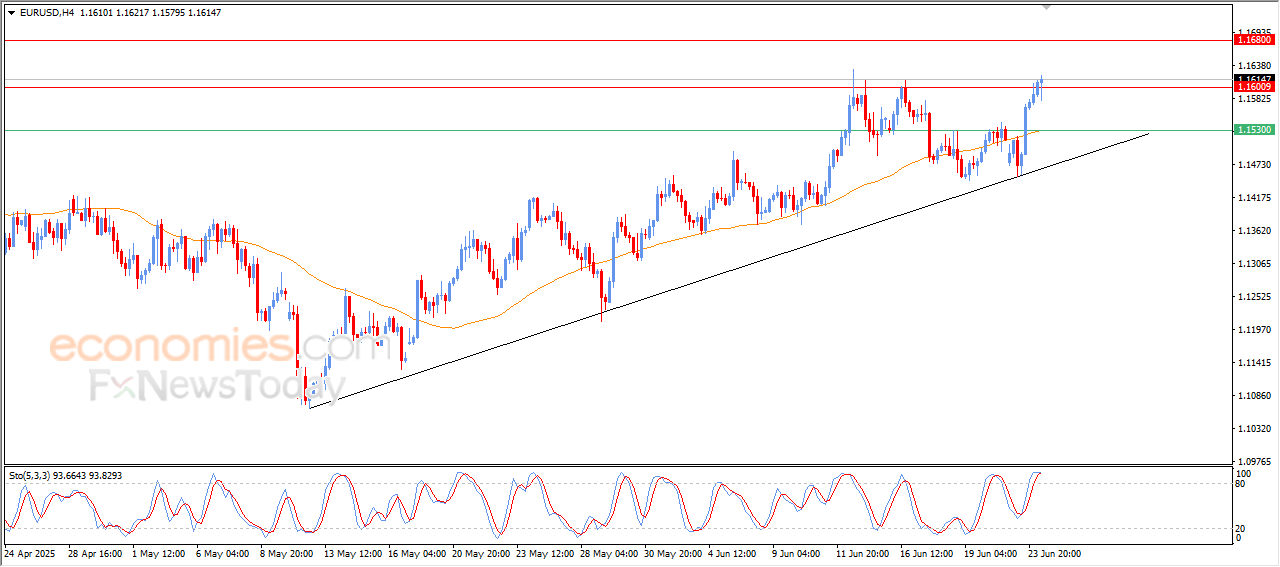
Hedera Hashgraph’s currency price settled higher in latest intraday trading, boosted by trading above the 50-day SMA, but still dominated by the main downward trend, with negative signals from the Stochastic after reaching overbought levels compared to the price’s movements.
Therefore we expect the price to decline and target the support of $0.1385, provided the resistance of $0.1616 holds on.
Today’s price forecast: Bearish
Gold price (XAU/USD) plummets to near $3,320 during the European trading session on Tuesday. The yellow metal faces a sharp selling pressure as safe-haven assets are underperforming after the announcement of a ceasefire between Israel and Iran.
United States (US) President Donald Trump has stated in a post on Truth.Social that the two Middle East nations have agreed to stopping the 12-day long aerial war. “The ceasefire is now in effect. Please do not violate it!” Trump wrote.
Meanwhile, Israeli Prime Minister Benjamin Netanyahu has warned its defence forces will respond forcefully if Iran violates the truce.
However, investors expect the Gold price to get supported by a dramatic change in the Federal Reserve’s (Fed) stance on the monetary policy outlook. Fed Vice Chair Michelle Bowman stated in a gathering in Prague on Monday that monetary policy adjustments are becoming appropriate amid growing job market risks and expectations that the tariff policy announced by Donald Trump will have limited impact on inflation.
Should inflation pressures remain contained, I [Michelle] would support lowering the policy rate as soon as our next meeting in order to bring it closer to its neutral setting and to sustain a healthy labor market,” Bowman said.
Lower interest rates by the Fed bodes well for non-yielding assets, such as Gold. Meanwhile, Fed’s dovish stance on the monetary policy outlook and easing geopolitical tensions have weighed heavily on the US Dollar (USD).
Gold price trades in an Ascending Triangle formation on a daily timeframe, which indicates volatility contraction. The horizontal resistance of the above-mentioned chart pattern is plotted from the April 22 high around $3,500, while the upward-sloping trendline is placed from the April 7 low of $2,957.
The precious metal slides below the 20-day Exponential Moving Average (EMA), suggesting that the near-term trend has become uncertain.
The 14-day Relative Strength Index (RSI) drops below 50.00, indicating that the momentum has shifted to the downside.
Looking up, the Gold price would enter in an unchartered territory after breaking above the psychological level of $3,500 decisively. Potential resistances would be $3,550 and $3,600.
Alternatively, a downside move by the Gold price below the May 29 low of $3,245 would drag it towards the round-level support of $3,200, followed by the May 15 low at $3,121.
Gold has played a key role in human’s history as it has been widely used as a store of value and medium of exchange. Currently, apart from its shine and usage for jewelry, the precious metal is widely seen as a safe-haven asset, meaning that it is considered a good investment during turbulent times. Gold is also widely seen as a hedge against inflation and against depreciating currencies as it doesn’t rely on any specific issuer or government.
Central banks are the biggest Gold holders. In their aim to support their currencies in turbulent times, central banks tend to diversify their reserves and buy Gold to improve the perceived strength of the economy and the currency. High Gold reserves can be a source of trust for a country’s solvency. Central banks added 1,136 tonnes of Gold worth around $70 billion to their reserves in 2022, according to data from the World Gold Council. This is the highest yearly purchase since records began. Central banks from emerging economies such as China, India and Turkey are quickly increasing their Gold reserves.
Gold has an inverse correlation with the US Dollar and US Treasuries, which are both major reserve and safe-haven assets. When the Dollar depreciates, Gold tends to rise, enabling investors and central banks to diversify their assets in turbulent times. Gold is also inversely correlated with risk assets. A rally in the stock market tends to weaken Gold price, while sell-offs in riskier markets tend to favor the precious metal.
The price can move due to a wide range of factors. Geopolitical instability or fears of a deep recession can quickly make Gold price escalate due to its safe-haven status. As a yield-less asset, Gold tends to rise with lower interest rates, while higher cost of money usually weighs down on the yellow metal. Still, most moves depend on how the US Dollar (USD) behaves as the asset is priced in dollars (XAU/USD). A strong Dollar tends to keep the price of Gold controlled, whereas a weaker Dollar is likely to push Gold prices up.
The EURJPY pair continued the rise to reach the resistance of the targeted bullish channel’s resistance at 169.70 level, which explains the direct correctional rebound towards 168.80, despite the attempts of providing mixed sideways trading, and there is a chance to activate the attempts of gathering gains by reaching 168.05.
While the price success in breaching the resistance and providing a positive close above it, will confirm its move to a new positive station, to begin recording new gains by its rally to 170.40 initially reaching the next barrier near 171.60.
The expected trading range for today is between 168.30 and 169.80
Trend forecast: Fluctuated within the bullish track
Copper price received extra positive momentum yesterday by stochastic rally to 80 level, accompanied with our bullish expectation, to notice its rally to the target at $4.8900, which forms an important barrier against resuming the bullish scenario.
The price keeps forming mixed sideways trading until achieving the current barrier, to open the way towards recording extra gains that might extend to $5.030, while the failure will increase the chances for activating the bearish correctional track, which might force it to decline towards $4.7500 reaching the extra support at $4.660 level.
The expected trading range for today is between $4.7700 and $4.9600
Trend forecast: Bullish
Copper price received extra positive momentum yesterday by stochastic rally to 80 level, accompanied with our bullish expectation, to notice its rally to the target at $4.8900, which forms an important barrier against resuming the bullish scenario.
The price keeps forming mixed sideways trading until achieving the current barrier, to open the way towards recording extra gains that might extend to $5.030, while the failure will increase the chances for activating the bearish correctional track, which might force it to decline towards $4.7500 reaching the extra support at $4.660 level.
The expected trading range for today is between $4.7700 and $4.9600
Trend forecast: Bullish
Gold price is off the nine-day low, attempting a tepid recovery early Tuesday amid a positive shift in risk sentiment and the ongoing US Dollar (USD) correction.
Gold price has managed to defend critical support levels so far, as it remains on the back foot for the third consecutive day.
The Iran-Israel ceasefire announcement by US President Donald Trump and later by Iranian Foreign Minister Abbas Araghchi added to the bearish momentum in the traditional safe-haven Gold price.
Further, the sharp retracement in Oil prices also contributed to the extra losses in Gold price as weakening black gold reduced its appeal as an inflation hedge.
However, the bright metal found buyers at lower levels amid the ceasefire-led diminishing haven demand for the USD.
Meanwhile, reviving expectations surrounding a US Federal Reserve (Fed) interest rate cut in July also acts as a headwind for the Greenback, supporting the non-yielding Gold price.
Fed Governor Michelle Bowman joined her colleague Christopher Waller in advocating the next rate cut as early as July. Bowman said on Monday, “open to cutting rates as soon as the July FOMC meeting if inflation pressures stay contained.”
Waller noted on Friday, “Fed is in a position to cut the policy rate as early as July.”
Markets are now pricing in a 21% probability that the Fed will lower rates next month as against a 14.5% chance seen last Friday, according to the CME Group’s Fed WatchTool.
Looking ahead, all eyes now remain on Fed Chairman Jerome Powell’s two-day congressional testimony, starting Tuesday for fresh hints on the timings of the next rate cut.
Besides, markets will continue to pay close attention to the Iran-Israel conflict as to whether the ceasefire is maintained. Israeli Military continues to report ballistic missiles launched on Israel from Iran.
Any re-escalation in the Middle East conflict will once again propel the US Dollar at the expense of the Gold price.
The daily chart shows that Gold price is struggling at around the 21-day Simple Moving Average (SMA) at $3,352 on its recovery from nine-day lows of $3,333.
The yellow metal rebounded from just above the 50-day SMA key support at $3,324.
The 14-day Relative Strength Index (RSI) has turned lower, inching closer to the midline. The leading indicator currently trades near 52.
As it still defends the midline, Gold buyers remain hopeful but yearn for acceptance above the 21-day SMA, followed by the 23.6% Fibonacci Retracement (Fibo) level of the April record rally at $3,377.
The next topside target is seen at $3,400, above which the static resistance at $3,440 will be tested.
A failure to resist above the 21-day SMA on a daily closing basis will attack the 50-day SMA at $3,324, below which the 38.2% Fibo level at $3,297 will be targeted.
Federal Reserve Chair Jerome Powell testifies before Congress, providing a broad overview of the economy and monetary policy. Powell’s prepared remarks are published ahead of the appearance on Capitol Hill.
Next release:
Tue Jun 24, 2025 14:00
Frequency:
Irregular
Consensus:
–
Previous:
–
Source:
Federal Reserve