The main tag of Gold Price Articles.
You can use the search box below to find what you need.
[wd_asp id=1]
The main tag of Gold Price Articles.
You can use the search box below to find what you need.
[wd_asp id=1]
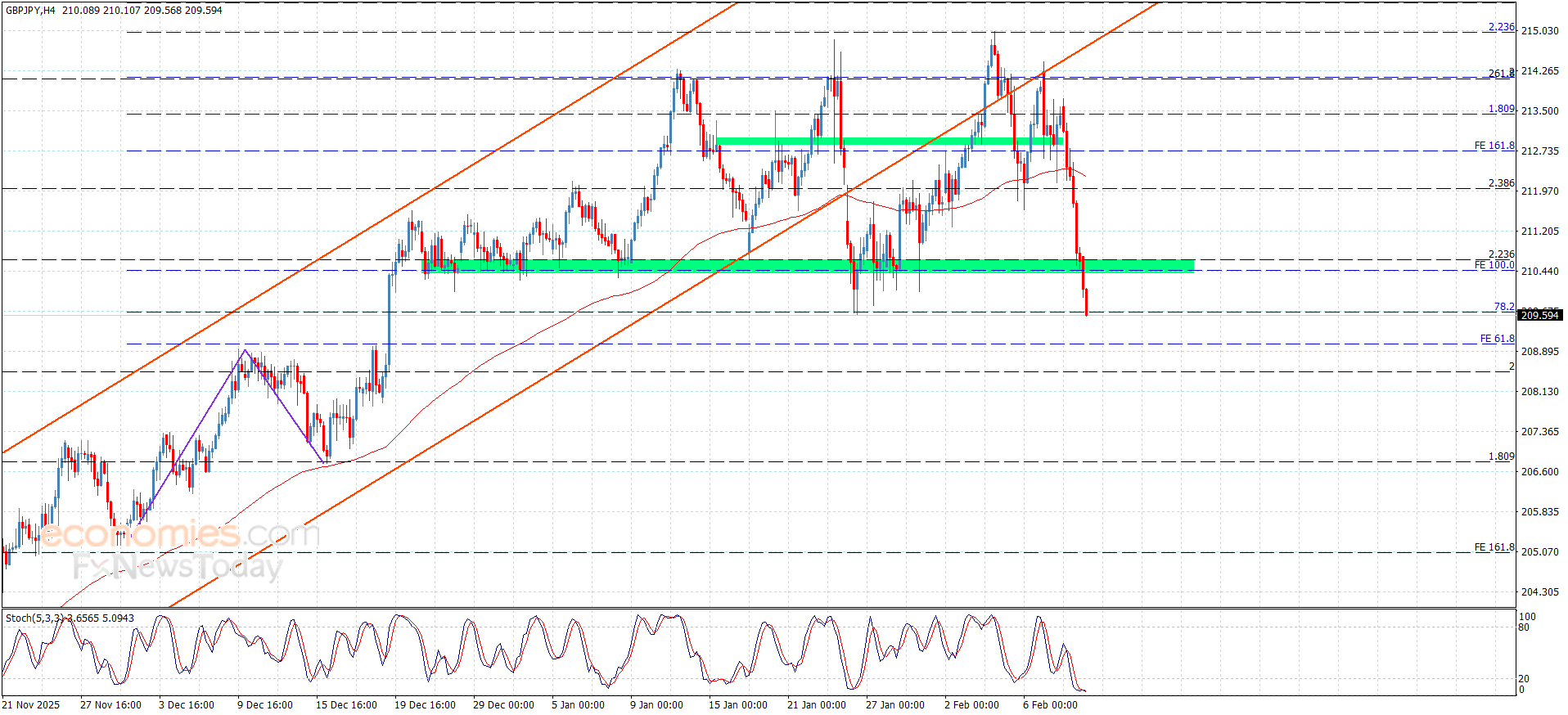
The GBPJPY pair surrendered to the negative factors, to resume the previously suggested negative attack, to notice breaking the targeted support at 209.10, forcing it to suffer extra losses by reaching 207.65 as appears in the above image.
Note that the continuation of the price stability below 209.10 level, which might form a strong barrier will force the price to resume the negative trading, to expect reaching 207.00 followed by the next support base at 205.10 level, while its rally above 209.10 will increase the chances of activating the attempts of recovering the losses by its rally gradually towards 209.75 and 210.45.
The expected trading range for today is between 207.00 and 208.80
Trend forecast: Bearish
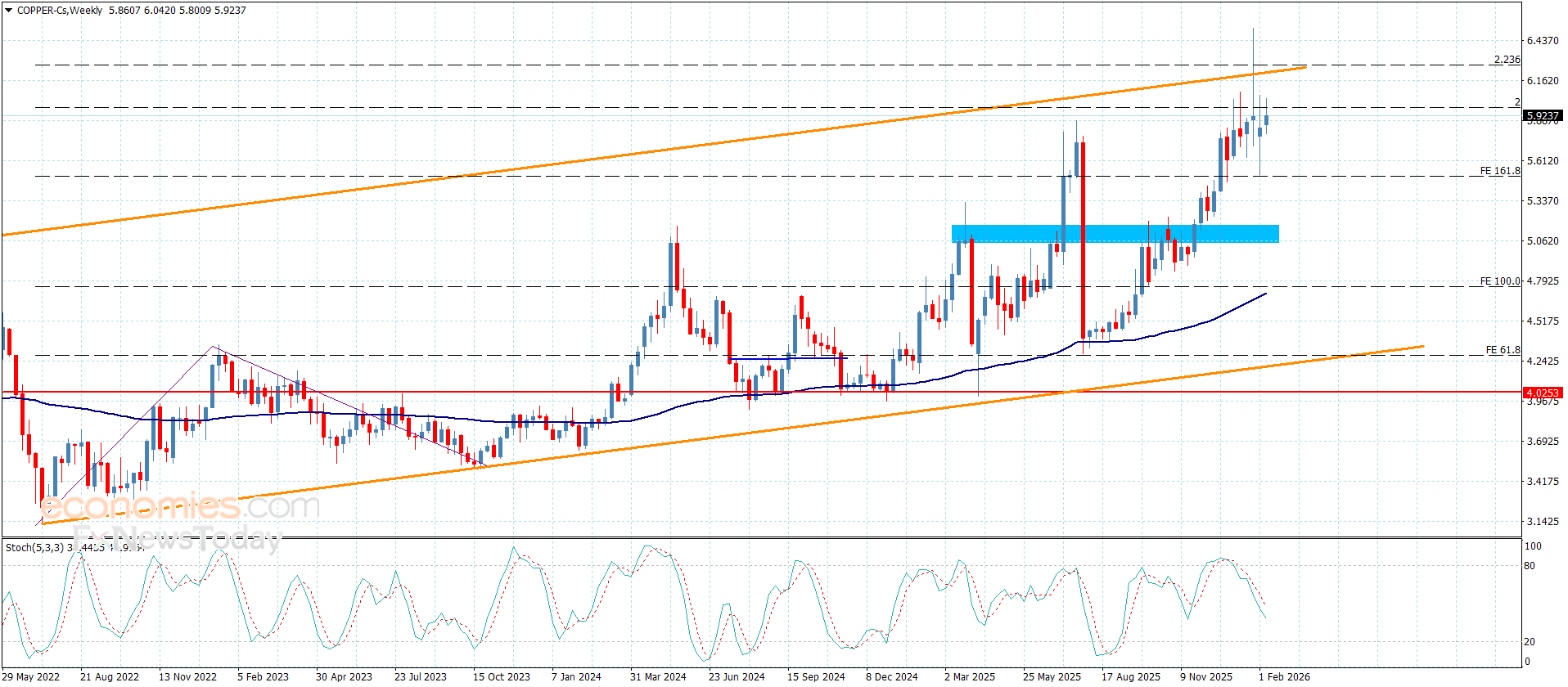
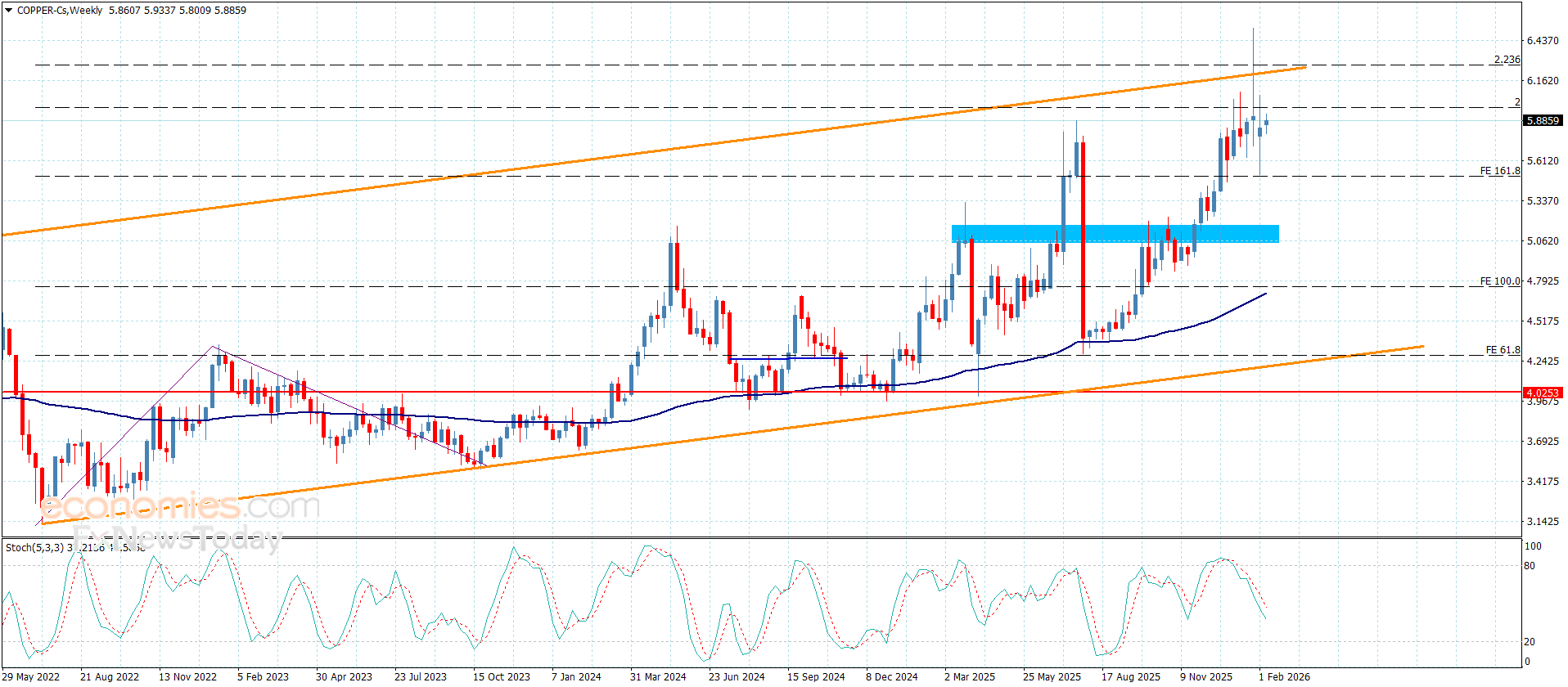
No news for copper price until this moment, to continue providing weak sideways trading by its fluctuation below $5.9700 barrier, attempting to confirm its readiness to activate the previously suggested bearish corrective track.
Stochastic attempt to reach below 50 level might increase the effectiveness of the corrective track, to reinforce the chances of targeting $5.7200 level, then attempts to press on the extra support at $5.5100.
The expected trading range for today is between $5.7200 and $5.9700
Trend forecast: Bearish
The GBPJPY pair achieved the previously suggested negative targets by hitting 210.40 level, but providing negative momentum by the main indicators pushed this morning trading to resume the negative trend.
Forming negative attempts make us expect targeting 209.10 level, which might form an important support to recover the losses gradually by its rally towards 209.90 and 210.40, while breaking this barrier will force it suffer extra losses that might extend towards 208.50 and 208.20.
The expected trading range for today is between 209.00 and 210.40
Trend forecast: Bearish
BitcoinWorld
Silver Price Forecast: XAG/USD Bulls Face Critical $82.00 Resistance as Crucial US NFP Data Looms
Global precious metals markets remain tense as silver prices hover below the critical $82.00 resistance level, with traders worldwide awaiting the March 2025 US Non-Farm Payrolls report that could determine the next major directional move for XAG/USD. The white metal’s recent consolidation reflects broader market uncertainty about Federal Reserve policy and global economic stability.
Silver’s XAG/USD pair currently faces significant technical resistance below the $82.00 psychological barrier. Market analysts observe that the precious metal has tested this level three times in the past month without achieving a decisive breakthrough. Consequently, technical indicators suggest potential consolidation between $78.50 support and $82.00 resistance until fundamental catalysts emerge.
Several key technical factors influence the current silver price forecast. First, the 50-day moving average at $79.25 provides immediate support. Second, the Relative Strength Index (RSI) reading of 58 indicates neither overbought nor oversold conditions. Third, trading volume patterns show decreased participation ahead of major economic data releases.
| Level | Type | Significance |
|---|---|---|
| $82.00 | Resistance | Psychological barrier, previous highs |
| $79.25 | Support | 50-day moving average |
| $78.50 | Support | March consolidation low |
| $84.75 | Resistance | 2025 year-to-date high |
The upcoming US employment report represents the most significant fundamental catalyst for silver prices this week. Economists project the March 2025 Non-Farm Payrolls will show 180,000 new jobs created, with unemployment holding steady at 3.8%. However, wage growth data may prove more influential for precious metals markets.
Historical analysis reveals specific patterns in silver’s response to NFP data. Strong employment numbers typically strengthen the US dollar, creating headwinds for dollar-denominated silver. Conversely, weaker-than-expected data often triggers safe-haven flows into precious metals. The Federal Reserve’s dual mandate of maximum employment and price stability makes this report particularly significant for monetary policy expectations.
Major financial institutions provide nuanced silver price forecasts based on multiple variables. Goldman Sachs analysts note industrial demand remains robust despite recent price consolidation. Meanwhile, JP Morgan researchers highlight central bank diversification into precious metals as a structural support factor. Bloomberg Intelligence reports ETF holdings have stabilized after February outflows.
The World Silver Survey 2024 provides crucial context for current market dynamics. Global silver demand reached 1.2 billion ounces last year, with industrial applications accounting for over 50% of total consumption. Photovoltaic panel manufacturing alone consumed 140 million ounces, representing 11% growth year-over-year. Mine production increased modestly to 850 million ounces, maintaining the market deficit that has persisted for three consecutive years.
Multiple macroeconomic variables beyond employment data affect the silver price forecast. Real interest rates remain the primary driver of opportunity costs for holding non-yielding assets. Inflation expectations continue to influence investor allocation decisions. Geopolitical tensions in multiple regions support safe-haven demand. Additionally, dollar strength inversely correlates with silver prices approximately 70% of the time.
Recent Federal Reserve communications suggest cautious optimism about inflation control. Chair Powell’s March testimony emphasized data-dependent decision-making. Consequently, each economic release carries amplified significance for forward guidance. Market-implied probabilities currently suggest 65% likelihood of a rate cut by June 2025, according to CME FedWatch Tool data.
Silver’s price action diverges notably from gold in recent sessions. While gold maintains strength above $2,150 per ounce, silver struggles with specific resistance. The gold-silver ratio currently stands at 86:1, above the 10-year average of 80:1. This discrepancy suggests potential mean reversion opportunities if silver catches up to gold’s performance.
Platinum and palladium provide additional context for industrial precious metals. Both face unique supply challenges but lack silver’s dual investment-industrial characteristics. Automotive sector transitions affect platinum group metals more directly than silver. However, all precious metals respond similarly to dollar strength and real yield movements.
Market psychology around key resistance levels often creates self-fulfilling prophecies. The $82.00 level represents not just technical resistance but psychological barrier for traders. Previous instances show that decisive breaks above such levels typically require fundamental catalysts combined with technical momentum. Volume analysis indicates institutional participation increases after major economic releases.
The 2020-2024 period provides relevant historical parallels. Silver broke above $30 resistance in 2020 following massive monetary stimulus. The 2022 consolidation around $24 preceded the 2023 rally. Current market structure resembles 2021’s sideways action before the September breakout. Options market data shows increased interest in $85 calls for April expiration.
Several risk factors could alter the current silver price forecast. Unexpectedly strong NFP data might trigger dollar rallies pressuring metals. Geopolitical de-escalation could reduce safe-haven demand. Technological breakthroughs in silver substitution represent longer-term risks. Regulatory changes in major markets might affect trading volumes and liquidity conditions.
Alternative scenarios deserve consideration in comprehensive analysis. A dovish Fed interpretation of strong data could support metals despite dollar strength. Coordinated central bank buying might provide unexpected support. Supply disruptions from major producing regions could tighten physical markets. Green energy acceleration might boost industrial demand beyond current projections.
The silver price forecast remains contingent on the upcoming US Non-Farm Payrolls data and the XAG/USD pair’s ability to overcome $82.00 resistance. Technical indicators suggest consolidation, while fundamental factors await clarification. Market participants should monitor employment data, dollar dynamics, and industrial demand indicators for directional signals. The precious metal’s dual nature as both monetary asset and industrial commodity creates unique opportunities amid current economic crosscurrents.
Q1: Why is $82.00 important for silver prices?
The $82.00 level represents significant technical resistance tested multiple times in recent months. A decisive break above could trigger further buying, while rejection might lead to consolidation or correction.
Q2: How does US employment data affect silver?
Strong NFP data typically strengthens the US dollar, creating headwinds for dollar-denominated silver. Weak data may boost safe-haven demand for precious metals as investors anticipate dovish Fed policy.
Q3: What percentage of silver demand comes from industrial uses?
Industrial applications account for approximately 50% of total silver demand, with photovoltaic manufacturing representing the fastest-growing segment at 11% annual growth.
Q4: How does silver differ from gold in market behavior?
Silver exhibits higher volatility and stronger correlation with industrial cycles than gold. The gold-silver ratio measures their relative performance, currently favoring gold at 86:1.
Q5: What are the main risk factors for silver prices?
Primary risks include dollar strength, rising real interest rates, economic slowdown reducing industrial demand, and technological substitution in key applications like photography and electronics.
This post Silver Price Forecast: XAG/USD Bulls Face Critical $82.00 Resistance as Crucial US NFP Data Looms first appeared on BitcoinWorld.
Natural gas price continued forming negative pressures to keep its positive stability above the bullish channel’s support at $3.050, forming weak sideways trading due to the contradiction of the main indicators by providing negative momentum in the last period.
Note that the stability above the support level makes us wait for gathering the bullish momentum, to ease the mission of forming bullish waves, to target $3.450 reaching $3.910 level, while breaking the support and holding below it will force it to resume the decline, suffering big losses by reaching $2.850 and $2.660.
The expected trading range for today is between $3.000 and $3.450
Trend forecast: Bullish
Despite the weakness of copper price’s last trading, the stability below $5.9700 level and providing bearish momentum by stochastic reaching below50 level makes us keep the bearish corrective scenario in the near-period trading, reminding you that the initial targets is located near $5.7200 and $5.5100 level.
While breaching the barrier and holding above it will reinforce the chances of forming new bullish waves, attempting to record some extra gains by reaching $6.1200.
The expected trading range for today is between $5.5100 and $5.9500
Trend forecast: Bearish
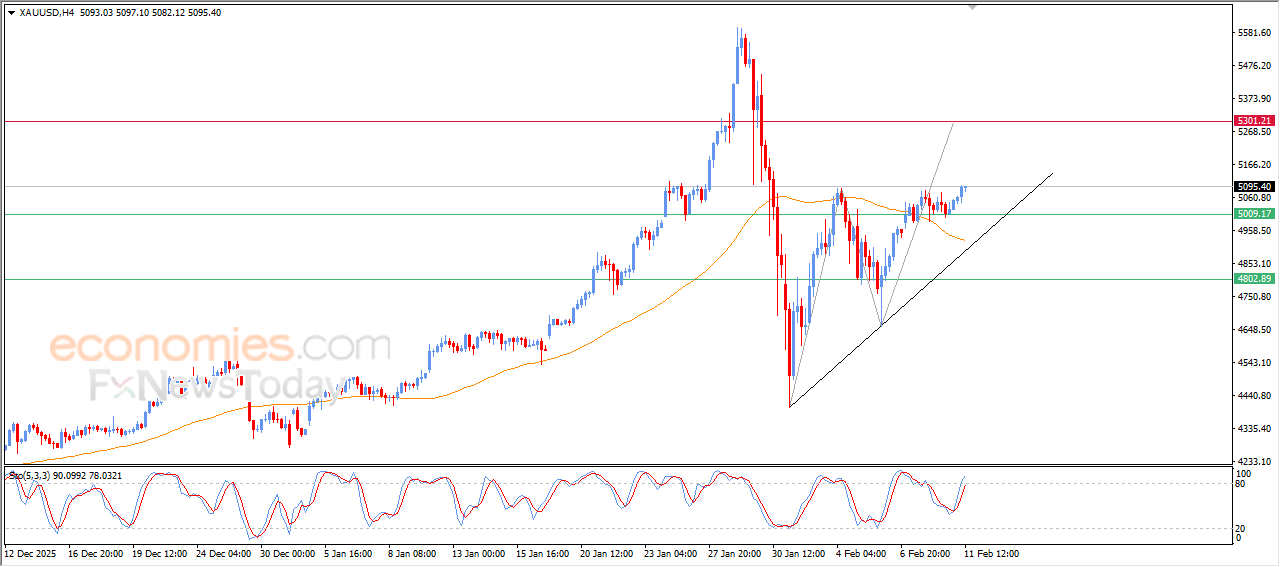
Gold is trading around $5,056 on the 4-hour chart, staying above the key $5,000 level after bouncing from the $4,540 low. The price is within the 0.382 ($4,854) to 0.618 ($5,138) Fibonacci retracement zone, which suggests a steady recovery instead of a full reversal.
Recent candlesticks have tight bodies and small pullbacks, showing steady demand near $4,996, where the 50-period moving average acts as support. A downward trendline from the $5,598 high is still present, keeping pressure near the $5,138 resistance. If price breaks above $5,138, it could move toward $5,303. If it falls below $4,855, attention may turn back to $4,680.
Trade idea: Consider buying if price moves above $5,140, with a stop below $4,855 and a target of $5,300.
If a prediction from the U.S. Energy Information Administration is accurate, natural gas users better hang on tight for the next two months.
Natural gas prices, based on an EIA study, will skyrocket 40%.
EIA raises natural gas price forecast following increased heating demand amid severe winter weather
Natural gas prices rose sharply in January, averaging $7.72 per million British thermal units (MMBtu), as cold weather increased heating demand, reduced production, and led to record storage withdrawals during Winter Storm Fern. The drawdown for the week ending January 30 was the largest weekly net withdrawal recorded in the history of EIA’s Weekly Natural Gas Storage Report.
In the February Short-Term Energy Outlook (STEO), the U.S. Energy Information Administration (EIA) now forecasts U.S. natural gas inventories to end the withdrawal season in late March at less than 1.9 trillion cubic feet. This is 8% below previous forecasts, prompting the forecast for the Henry Hub spot price for February and March to be 40% higher than last month’s STEO.
“Winter Storm Fern caused significant short-term pressure on natural gas markets, but we expect higher prices in the near term will increase drilling, resulting in higher production later this year and helping to replenish storage,” said EIA Administrator Tristan Abbey. “Ultimately, this will result in lower natural gas prices next year than we had forecast. Our updated forecast anticipates Henry Hub prices will average $4.30/MMBtu in 2026 and $4.40/MMBtu in 2027, 5% lower than our January forecast.”
Other key takeaways from the February STEO are below.
|
2025 |
2026 |
2027 |
|
|
Brent crude oil spot price (dollars per barrel) |
$69 |
$58 |
$53 |
|
Retail gasoline price (dollars per gallon) |
$3.10 |
$2.91 |
$2.93 |
|
U.S. crude oil production (million barrels per day) |
13.6 |
13.6 |
13.3 |
|
Natural gas price at Henry Hub (dollars per million British thermal units) |
$3.53 |
$4.31 |
$4.38 |
|
U.S. liquefied natural gas gross exports (billion cubic feet per day) |
15 |
16 |
18 |
|
Shares of U.S. electricity generation |
|
|
|
|
Natural gas |
40% |
40% |
39% |
|
Coal |
17% |
16% |
15% |
|
Nuclear |
18% |
18% |
18% |
|
Conventional hydropower |
6% |
6% |
6% |
|
Wind |
11% |
11% |
12% |
|
Solar |
7% |
8% |
9% |
|
Other energy sources |
1% |
1% |
1% |
|
U.S. GDP (percentage change) |
2.2% |
2.4% |
2.0% |
|
U.S. CO2 emissions (billion metric tons) |
4.9 |
4.8 |
4.8 |
|
Data source: U.S. Energy Information Administration, Short-Term Energy Outlook, February 2026 Note: Values in this table are rounded and may not match values in other tables in this report. |
|||
EIA completed STEO modeling and analysis for this report on February 5, 2026, and therefore this month’s STEO report does not include the Petroleum Supply Monthly or Natural Gas Monthly data published on February 6, 2026.
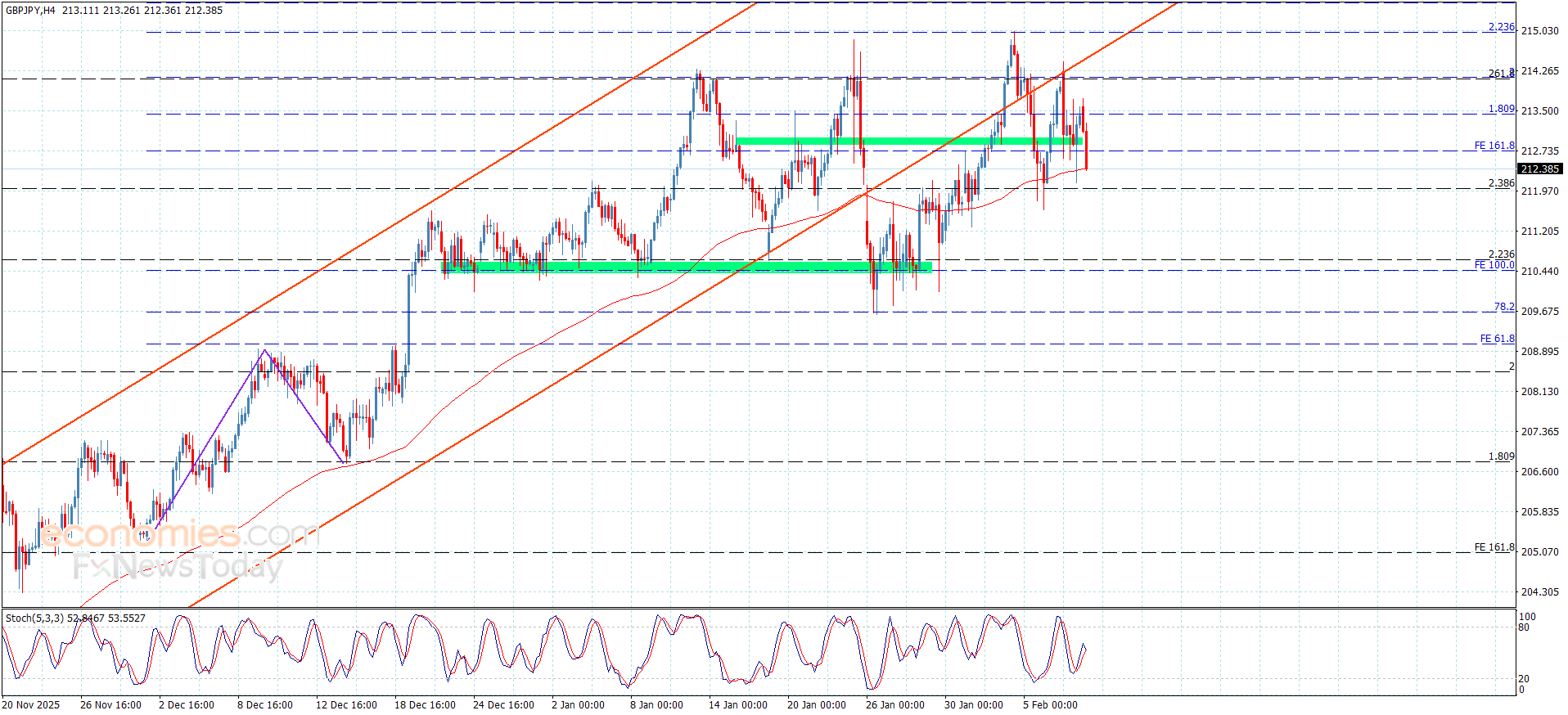
The GBPJPY pair activated with stochastic negativity this morning, forming some extra bearish waves after breaking the extra support at 212.85, announcing its readiness to resume the previously suggested bearish corrective attack, to settle near 212.40.
We expect reaching 212.00 level soon, which forms an intraday obstacle against the negative attempts, note that surpassing it will reinforce the chances of reaching corrective stations, that is located near 211.10 and 210.60.
The expected trading range for today is between 211.60 and 212.90
Trend forecast: Bearish
Silver (XAG/USD) struggles to capitalize on its recent goodish recovery move from the $64.00 mark, or its lowest level since December 17, touched last week, and edges lower on Tuesday. The white metal, however, trims a part of intraday losses and trades around the $82.25-$82.30 region during the first half of the European session.
From a technical perspective, Monday’s breakout and acceptance above the 23.6% Fibonacci retracement level of the recent sharp pullback from the all-time peak favors the XAG/USD bulls. The Moving Average Convergence Divergence (MACD) line remains above the Signal line and in positive territory, though the histogram has started to contract, suggesting fading upside momentum. The Relative Strength Index (RSI) prints at 52, neutral, reflecting a modest stabilization above the 50 mark.
Hence, any subsequent move up is likely to confront stiff resistance near the $86.25-$86.30 confluence – comprising the 200-period Simple Moving Average (SMA) on the 4-hour chart and the 38.2% Fibo. retracement level. A sustained break above the first barrier would bring $87.04 into focus and strengthen the rebound; failure to overcome it would preserve the broader bearish bias beneath the rising long-term average.
(The technical analysis of this story was written with the help of an AI tool.)
Silver is a precious metal highly traded among investors. It has been historically used as a store of value and a medium of exchange. Although less popular than Gold, traders may turn to Silver to diversify their investment portfolio, for its intrinsic value or as a potential hedge during high-inflation periods. Investors can buy physical Silver, in coins or in bars, or trade it through vehicles such as Exchange Traded Funds, which track its price on international markets.
Silver prices can move due to a wide range of factors. Geopolitical instability or fears of a deep recession can make Silver price escalate due to its safe-haven status, although to a lesser extent than Gold’s. As a yieldless asset, Silver tends to rise with lower interest rates. Its moves also depend on how the US Dollar (USD) behaves as the asset is priced in dollars (XAG/USD). A strong Dollar tends to keep the price of Silver at bay, whereas a weaker Dollar is likely to propel prices up. Other factors such as investment demand, mining supply – Silver is much more abundant than Gold – and recycling rates can also affect prices.
Silver is widely used in industry, particularly in sectors such as electronics or solar energy, as it has one of the highest electric conductivity of all metals – more than Copper and Gold. A surge in demand can increase prices, while a decline tends to lower them. Dynamics in the US, Chinese and Indian economies can also contribute to price swings: for the US and particularly China, their big industrial sectors use Silver in various processes; in India, consumers’ demand for the precious metal for jewellery also plays a key role in setting prices.
Silver prices tend to follow Gold’s moves. When Gold prices rise, Silver typically follows suit, as their status as safe-haven assets is similar. The Gold/Silver ratio, which shows the number of ounces of Silver needed to equal the value of one ounce of Gold, may help to determine the relative valuation between both metals. Some investors may consider a high ratio as an indicator that Silver is undervalued, or Gold is overvalued. On the contrary, a low ratio might suggest that Gold is undervalued relative to Silver.