The main tag of Gold Price Articles.
You can use the search box below to find what you need.
[wd_asp id=1]
The main tag of Gold Price Articles.
You can use the search box below to find what you need.
[wd_asp id=1]
Shares of the company fell 12% in extended trading.
“In a highly challenged environment, this quarter’s results do not reflect the power of our brand, our capabilities or the opportunities ahead,” CEO Laxman Narasimhan said in a statement. “It did not meet our expectations, but we understand the specific challenges and opportunities immediately in front of us.”
The company’s same-store sales fell 4% as traffic to its cafes declined 6% in the quarter. Wall Street was anticipating same-store sales growth of 1%, according to StreetAccount estimates.
Across all regions, Starbucks reported shrinking same-store sales and falling traffic.
In the U.S., same-store sales decreased 3% as traffic sank 7%. This marks the second quarter that the company’s home market has struggled. Last quarter, executives blamed sluggish sales on boycotts targeting the company due to “misperceptions” of its stance on Israel.
Starbucks’ international segment reported same-store sales declines of 6% as both average ticket and transactions dropped. In China, Starbucks’ second-largest market, same-store sales plunged 11%, fueled by an 8% decline in average ticket.
“In this environment, many customers have been more exacting about where and how they choose to spend their money,” Narasimhan told analysts on the company’s conference call.
Here’s what the company reported compared with what Wall Street was expecting, based on a survey of analysts by LSEG:
The coffee giant reported fiscal second-quarter net income attributable to the company of $772.4 million, or 68 cents per share, down from $908.3 million, or 79 cents per share, a year earlier.
Net sales dropped nearly 2% to $8.56 billion.
For fiscal 2024, Starbucks now expects revenue growth in the low single digits, down from its prior forecast of 7% to 10%. The company also revised its projections for global and U.S. same-store sales growth to a range of low single digits to flat from its previous forecast of 4% to 6%. Same-store sales in China are expected to decline by single digits, down from the prior outlook of a single-digit increase.
Starbucks now also expects earnings per share growth in a range of flat to low single digits. It previously forecast its earnings would climb 15% to 20% in fiscal 2024.
The company forecasts that sales will start improving in the fiscal fourth quarter.
Starbucks’ most dedicated customers have stayed loyal and been using discounts offered via the company’s mobile app, executives said. But coffee drinkers who visit only occasionally have been buying Starbucks’ macchiatos and cold brew less often, executives said; Narasimhan said those customers want more variety from their coffee.
Starbucks is planning to offer a version of its app that allows customers to order without being a loyalty member in order to attract these occasional customers to visit more frequently.
Narasimhan said Starbucks is also exploring how to meet overnight demand, from 5 p.m. to 5 a.m. The company conducted a pilot test, which Narasimhan said doubled business.
He also said the chain’s lavender drinks were one of its most successful launches.
“Building off that success, we are aggressively pursuing options to build a $2 billion business over the next five years,” he said.
McDonald’s, PepsiCo and other companies have said this quarter that low-income consumers have pulled back their spending and are looking for deals.
“While it was a difficult quarter, we learned from our own underperformance and sharpened our focus with a comprehensive roadmap of well thought out actions making the path forward clear,” CFO Rachel Ruggeri said in a statement.
Narasimhan also said that the company now expects supply-chain cost savings of $4 billion over the next four years, revising its prior forecast of $3 billion over three years.
Starbucks (SBUX) posted quarterly earnings and revenue that came up short of Wall Street expectations amid an unexpected decline in both U.S. and international same store sales, news that sent the coffee chain’s shares sharply lower in premarket trading Wednesday.
The Seattle-based company late Tuesday reported fiscal second-quarter adjusted earnings of 68 cents per share, whereas analysts had called for 79 cents a share. Net sales in the period fell 2% to $8.56 billion from a year earlier and came in below the $9.13 billion Street estimate.
The company’s same-store sales fell 4% in the quarter, driven by a 6% decline in cafe traffic. Analysts had expected same-store sales growth of 1%. Regionally, same-store sales decreased 3% in the U.S. and 6% internationally. In China—Starbucks’ second largest market — the metric contracted 11% on the back of the average ticket shrinking 8%.
“In this environment, many customers have been more exacting about where and how they choose to spend their money,” Starbucks’ CEO Laxman Narasimhan told analysts on the company’s conference call. Narasimhan also said a deteriorating economic outlook in several of the coffee chain’s markets had contributed to a reduction in customer traffic.
Looking ahead, the company trimmed its 2024 revenue growth guidance to the low single digits, down from its earlier forecast of 7% to 10%. It sees global and U.S. same-store sales growth ranging from low single digits to flat, below its prior projection of 4% to 6%.
Turning to China, Starbucks, anticipates same-store sales to decline by single digits compared to its previous outlook of a single-digit increase. On the earnings front, the company guided full-year bottom-line growth of flat to low single digits, down from its prior earnings growth forecast of 15% to 20%.
Starbucks shares have traded within a descending channel since March 2023, with the price testing the pattern’s upper and lower levels several times over the past 13 months. Leading into the coffee chain’s quarterly results, the stock has consolidated just below the 50-day moving average, indicating indecision among market participants.
Although the price sits poised to open on Wednesday below the channel, investors should monitor if it can close above the pattern’s lower trendline around $81. A failure to hold this important technical level could potentially see a retest of two prior prominent price troughs near $71.
Starbucks shares were down 12.7% at $77.30 about three hours before the opening bell. Through Tuesday’s close, the stock had lost about 23% of its value over the past 12 months.
The comments, opinions, and analyses expressed on Investopedia are for informational purposes only. Read our warranty and liability disclaimer for more info.
As of the date this article was written, the author does not own any of the above securities.
Ultimately, we’ve got a situation where traders continue to look at this through the prism of an oversupply situation in their most certainly is. But we do have a tight range between about a $1.50 and $2. That is somewhat compressing the market into a nice little predictable trading range. And if that’s going to be the case, then I think you’ve got a situation where you have to take advantage of it.
If you are short term inclined, however, don’t use big positions. I do favor the upside, simply because once we get below $1.50, the drillers will just simply leave and then eventually you’ll have a massive spike. I don’t think that happens. So, I think what we got here is just a market killing time.
For a look at all of today’s economic events, check out our economic calendar.
You have reached your limit of 5 free articles for this month.
Access all our articles, insights, and analysts.
Your coupon code
Gold price (XAU/USD) continues with its struggle to gain meaningful traction on Friday and remains confined in the weekly range through the early European session. Traders seem reluctant to place aggressive directional bets and opt to wait on the sidelines ahead of the release of the closely watched US monthly employment details, leading to the subdued price action. The popularly known Nonfarm Payrolls (NFP) report will be looked upon for cues about the Federal Reserve’s (Fed) rate cut path, which, in turn, will play a key role in influencing the near-term trajectory for the non-yielding yellow metal.
In the meantime, growing acceptance that the US central bank will keep interest rates higher for longer amid still sticky inflation is seen undermining demand for the non-yielding Gold price. Apart from this, the risk-on mood – as depicted by a generally positive tone around the equity markets – might continue to act as a headwind for the safe-haven precious metal. The downside, however, remains cushioned in the wake of the post-FOMC US Dollar (USD) selling bias, which is likely to benefit the USD-denominated commodity and hold back traders from placing aggressive bearish bets around the XAU/USD.
Fed Chair Jerome Powell, addressing the post-meeting press conference on Wednesday, acknowledged that the progress towards the 2% annual inflation target had largely stalled, though ruled out the possibility of any further rate hikes. This drags the USD lower for the third straight day, to a three-week low, which could offer some support to the Gold price. Hence, it will be prudent to wait for strong follow-through selling before positioning for an extension of the commodity’s pullback from the all-time peak touched in April Nevertheless, the XAU/USD remains on track to register losses for the second straight week.
From a technical perspective, the range-bound price action witnessed since the beginning of the current week constitutes the formation of a rectangle on short-term charts and points to a consolidation phase. Moreover, neutral oscillators on the daily chart warrant some caution before placing aggressive directional bets around the Gold price. Hence, any further weakness below the $2,300 mark might continue to find support near the lower end of the weekly range, around the $2,285-2,280 area. A convincing break should pave the way for deeper losses and drag the XAU/USD towards the next relevant support near the $2,268-2,265 area en route to the $2,230-2,25 region and the $2,200 round figure.
On the flip side, the $2,326-2,328 area now seems to act as an immediate hurdle ahead of the $2,335 supply zone and the weekly top, around the $2,346-2,347 region. A sustained strength beyond the latter will confirm a fresh breakout through the short-term trading range and pave the way for a move towards the $2,371-2,372 resistance. The Gold price could extend the momentum further towards the $2,400 mark before aiming to challenge the all-time peak, around the $2,431-2,432 area touched on April 12.
Gold price (XAU/USD) continues with its struggle to gain meaningful traction on Friday and remains confined in the weekly range through the early European session. Traders seem reluctant to place aggressive directional bets and opt to wait on the sidelines ahead of the release of the closely watched US monthly employment details, leading to the subdued price action. The popularly known Nonfarm Payrolls (NFP) report will be looked upon for cues about the Federal Reserve’s (Fed) rate cut path, which, in turn, will play a key role in influencing the near-term trajectory for the non-yielding yellow metal.
In the meantime, growing acceptance that the US central bank will keep interest rates higher for longer amid still sticky inflation is seen undermining demand for the non-yielding Gold price. Apart from this, the risk-on mood – as depicted by a generally positive tone around the equity markets – might continue to act as a headwind for the safe-haven precious metal. The downside, however, remains cushioned in the wake of the post-FOMC US Dollar (USD) selling bias, which is likely to benefit the USD-denominated commodity and hold back traders from placing aggressive bearish bets around the XAU/USD.
Fed Chair Jerome Powell, addressing the post-meeting press conference on Wednesday, acknowledged that the progress towards the 2% annual inflation target had largely stalled, though ruled out the possibility of any further rate hikes. This drags the USD lower for the third straight day, to a three-week low, which could offer some support to the Gold price. Hence, it will be prudent to wait for strong follow-through selling before positioning for an extension of the commodity’s pullback from the all-time peak touched in April Nevertheless, the XAU/USD remains on track to register losses for the second straight week.
From a technical perspective, the range-bound price action witnessed since the beginning of the current week constitutes the formation of a rectangle on short-term charts and points to a consolidation phase. Moreover, neutral oscillators on the daily chart warrant some caution before placing aggressive directional bets around the Gold price. Hence, any further weakness below the $2,300 mark might continue to find support near the lower end of the weekly range, around the $2,285-2,280 area. A convincing break should pave the way for deeper losses and drag the XAU/USD towards the next relevant support near the $2,268-2,265 area en route to the $2,230-2,25 region and the $2,200 round figure.
On the flip side, the $2,326-2,328 area now seems to act as an immediate hurdle ahead of the $2,335 supply zone and the weekly top, around the $2,346-2,347 region. A sustained strength beyond the latter will confirm a fresh breakout through the short-term trading range and pave the way for a move towards the $2,371-2,372 resistance. The Gold price could extend the momentum further towards the $2,400 mark before aiming to challenge the all-time peak, around the $2,431-2,432 area touched on April 12.
You have reached your limit of 5 free articles for this month.
Access all our articles, insights, and analysts.
Your coupon code
Financial markets struggle for direction on Thursday, with XAU/USD hovering around the $2,300 mark. The US Dollar traded throughout the day on sentiment, advancing with optimism while falling when things soured. In a broader view, however, little has changed across the board throughout the week, as the Federal Reserve (Fed) failed to deliver a clear message. The central bank announced on Wednesday that it would slow the pace of decline in its securities holdings by reducing the monthly redemption cap on Treasury securities from $60 billion to $25 billion starting in June. Interest rates have been left unchanged, as expected.
The Fed was hawkish but not as hawkish as feared. Indeed, Chairman Jerome Powell dropped some dovish comments in the middle of his press conference. Inflation is still the main issue, but not the only one. Price pressures intensified in the first quarter of the year, while other macroeconomic data indicated economic progress slowed. Still, Powell repeated that decisions will be made meeting by meeting and clarified that it is unlikely the next policy move will be a hike. He added that cutting rates is an option if inflation resumes its fall but also if there is weakness in the labor market, uplifting the relevance of employment-related figures ahead of the next Fed decision.
Data released these days showed the labor market remains tight. The ADP survey indicated that the private sector added 192K new positions in April while the number of job openings remained little changed at 8.5 million on the last business day of March, according to the JOLTS Job Openings report. Furthermore, the US reported Unit Labor Costs in the first quarter of the year rose 4.7%, implying an upward risk to inflaiton, while Nonfarm Productivity in the same quarter advanced a measly 0.3%.
Another indicator of labor sector performance will be the April Nonfarm Payrolls report, which will be out on Friday. The US is expected to have added 243K, while the Unemployment Rate is foreseen steady at 3.8%. The report includes an update on wages, while separately, the US will release the April ISM Services PMI, an indicator of economic health.
From a technical perspective, the daily chart shows sellers rejected advances for a second consecutive day around $2,326.50, the 23.6% Fibonacci retracement of the $1,996.06/$2,431.43 rally. The same chart shows the 20 Simple Moving Average (SMA) remains flat just above the mentioned level, while the longer ones maintain their upward slopes well below the current price. Finally, technical indicators held within negative levels with uneven strength, skewing the risk to the downside.
The 4-hour chart shows the pair is currently developing below bearish 20 and 100 SMAs, although a modestly bullish 200 SMA. Technical indicators recovered from their early lows but remain below their midlines and are losing their upward strength, suggesting buyers are not interested at the time being.
Support levels: 2,291.20 2,276.50 2,260.30
Resistance levels: 2,310.50 2,326.50 2,341.05
Financial markets struggle for direction on Thursday, with XAU/USD hovering around the $2,300 mark. The US Dollar traded throughout the day on sentiment, advancing with optimism while falling when things soured. In a broader view, however, little has changed across the board throughout the week, as the Federal Reserve (Fed) failed to deliver a clear message. The central bank announced on Wednesday that it would slow the pace of decline in its securities holdings by reducing the monthly redemption cap on Treasury securities from $60 billion to $25 billion starting in June. Interest rates have been left unchanged, as expected.
The Fed was hawkish but not as hawkish as feared. Indeed, Chairman Jerome Powell dropped some dovish comments in the middle of his press conference. Inflation is still the main issue, but not the only one. Price pressures intensified in the first quarter of the year, while other macroeconomic data indicated economic progress slowed. Still, Powell repeated that decisions will be made meeting by meeting and clarified that it is unlikely the next policy move will be a hike. He added that cutting rates is an option if inflation resumes its fall but also if there is weakness in the labor market, uplifting the relevance of employment-related figures ahead of the next Fed decision.
Data released these days showed the labor market remains tight. The ADP survey indicated that the private sector added 192K new positions in April while the number of job openings remained little changed at 8.5 million on the last business day of March, according to the JOLTS Job Openings report. Furthermore, the US reported Unit Labor Costs in the first quarter of the year rose 4.7%, implying an upward risk to inflaiton, while Nonfarm Productivity in the same quarter advanced a measly 0.3%.
Another indicator of labor sector performance will be the April Nonfarm Payrolls report, which will be out on Friday. The US is expected to have added 243K, while the Unemployment Rate is foreseen steady at 3.8%. The report includes an update on wages, while separately, the US will release the April ISM Services PMI, an indicator of economic health.
From a technical perspective, the daily chart shows sellers rejected advances for a second consecutive day around $2,326.50, the 23.6% Fibonacci retracement of the $1,996.06/$2,431.43 rally. The same chart shows the 20 Simple Moving Average (SMA) remains flat just above the mentioned level, while the longer ones maintain their upward slopes well below the current price. Finally, technical indicators held within negative levels with uneven strength, skewing the risk to the downside.
The 4-hour chart shows the pair is currently developing below bearish 20 and 100 SMAs, although a modestly bullish 200 SMA. Technical indicators recovered from their early lows but remain below their midlines and are losing their upward strength, suggesting buyers are not interested at the time being.
Support levels: 2,291.20 2,276.50 2,260.30
Resistance levels: 2,310.50 2,326.50 2,341.05
You have reached your limit of 5 free articles for this month.
Access all our articles, insights, and analysts.
Your coupon code
Gold price is consolidating Wednesday’s rebound in Asian trading on Thursday, as buyers await more employment and wage inflation data from the United States (US) for fresh trading impetus. Traders also digest the US Federal Reserve (Fed) interest rate decision and Chair Jerome Powell’s words delivered late Wednesday.
Gold price staged an impressive comeback from four-week lows of $2,282 on Wednesday, as the US Dollar and the US Treasury bond yields got sold off into Fed Chair Powell’s dovish signals on the interest rate outlook. The US stocks witnessed a relief rally and dented the haven demand for the Greenback after Powell ruled out the possibility of rate hikes while indicating that policymakers are still leaning toward eventual rate cuts this year.
As expected, the Fed held the Fed Funds Rate steady in the range of 5.25% to 5.5% at its May policy meeting. Powell, however, said that central bankers want “greater confidence” that inflation is falling toward 2%. “It is likely that gaining such greater confidence will take longer than previously expected. We are prepared to maintain the current target federal funds rate for as long as appropriate,” Powell added.
The probability of the first Fed rate cut, likely to be in September, rose to 53% from about 47% pre-Fed announcements. Gold price tends to benefit in a low interest-rate environment.
Meanwhile, the US Dollar was also hit by yet another suspected intervention by the Japanese authorities overnight, which saw USD/JPY crash nearly 450 pips in a span of 45 minutes. Gold price, therefore, holds on to the recent gains but the further upside appears capped should the US Dollar recover further ground, tracking the turnaround in the USD/JPY pair from near 153.00 region.
Later in the day, the weekly US Jobless Claims and the preliminary Unit Labor Cost data for the first quarter will hold relevance ahead of Friday’s Nonfarm Payrolls release.
As observed on the daily chart, Gold price found buyers near $2,280 and recaptured the $2,300 level on a daily closing basis, as the 14-day Relative Strength Index (RSI) flipped back into the bullish territory, currently sitting above 53.50.
However, Gold price faces stiff resistance at the 21-day Simple Moving Average (SMA) at $2,340. A sustained move above that level will revive the bullish interests, calling for a test of the $2,370 round level.
The next topside target is seen at the April 22 high of $2,392.
Alternatively, the immediate support is seen at the $2,300 threshold, below which the multi-month low of $2,282 will come into play.
Failure to defend the latter will trigger a fresh downtrend toward the 50-day SMA at $2,229.
Gold has played a key role in human’s history as it has been widely used as a store of value and medium of exchange. Currently, apart from its shine and usage for jewelry, the precious metal is widely seen as a safe-haven asset, meaning that it is considered a good investment during turbulent times. Gold is also widely seen as a hedge against inflation and against depreciating currencies as it doesn’t rely on any specific issuer or government.
Central banks are the biggest Gold holders. In their aim to support their currencies in turbulent times, central banks tend to diversify their reserves and buy Gold to improve the perceived strength of the economy and the currency. High Gold reserves can be a source of trust for a country’s solvency. Central banks added 1,136 tonnes of Gold worth around $70 billion to their reserves in 2022, according to data from the World Gold Council. This is the highest yearly purchase since records began. Central banks from emerging economies such as China, India and Turkey are quickly increasing their Gold reserves.
Gold has an inverse correlation with the US Dollar and US Treasuries, which are both major reserve and safe-haven assets. When the Dollar depreciates, Gold tends to rise, enabling investors and central banks to diversify their assets in turbulent times. Gold is also inversely correlated with risk assets. A rally in the stock market tends to weaken Gold price, while sell-offs in riskier markets tend to favor the precious metal.
The price can move due to a wide range of factors. Geopolitical instability or fears of a deep recession can quickly make Gold price escalate due to its safe-haven status. As a yield-less asset, Gold tends to rise with lower interest rates, while higher cost of money usually weighs down on the yellow metal. Still, most moves depend on how the US Dollar (USD) behaves as the asset is priced in dollars (XAU/USD). A strong Dollar tends to keep the price of Gold controlled, whereas a weaker Dollar is likely to push Gold prices up.
Gold price is consolidating Wednesday’s rebound in Asian trading on Thursday, as buyers await more employment and wage inflation data from the United States (US) for fresh trading impetus. Traders also digest the US Federal Reserve (Fed) interest rate decision and Chair Jerome Powell’s words delivered late Wednesday.
Gold price staged an impressive comeback from four-week lows of $2,282 on Wednesday, as the US Dollar and the US Treasury bond yields got sold off into Fed Chair Powell’s dovish signals on the interest rate outlook. The US stocks witnessed a relief rally and dented the haven demand for the Greenback after Powell ruled out the possibility of rate hikes while indicating that policymakers are still leaning toward eventual rate cuts this year.
As expected, the Fed held the Fed Funds Rate steady in the range of 5.25% to 5.5% at its May policy meeting. Powell, however, said that central bankers want “greater confidence” that inflation is falling toward 2%. “It is likely that gaining such greater confidence will take longer than previously expected. We are prepared to maintain the current target federal funds rate for as long as appropriate,” Powell added.
The probability of the first Fed rate cut, likely to be in September, rose to 53% from about 47% pre-Fed announcements. Gold price tends to benefit in a low interest-rate environment.
Meanwhile, the US Dollar was also hit by yet another suspected intervention by the Japanese authorities overnight, which saw USD/JPY crash nearly 450 pips in a span of 45 minutes. Gold price, therefore, holds on to the recent gains but the further upside appears capped should the US Dollar recover further ground, tracking the turnaround in the USD/JPY pair from near 153.00 region.
Later in the day, the weekly US Jobless Claims and the preliminary Unit Labor Cost data for the first quarter will hold relevance ahead of Friday’s Nonfarm Payrolls release.
As observed on the daily chart, Gold price found buyers near $2,280 and recaptured the $2,300 level on a daily closing basis, as the 14-day Relative Strength Index (RSI) flipped back into the bullish territory, currently sitting above 53.50.
However, Gold price faces stiff resistance at the 21-day Simple Moving Average (SMA) at $2,340. A sustained move above that level will revive the bullish interests, calling for a test of the $2,370 round level.
The next topside target is seen at the April 22 high of $2,392.
Alternatively, the immediate support is seen at the $2,300 threshold, below which the multi-month low of $2,282 will come into play.
Failure to defend the latter will trigger a fresh downtrend toward the 50-day SMA at $2,229.
Gold has played a key role in human’s history as it has been widely used as a store of value and medium of exchange. Currently, apart from its shine and usage for jewelry, the precious metal is widely seen as a safe-haven asset, meaning that it is considered a good investment during turbulent times. Gold is also widely seen as a hedge against inflation and against depreciating currencies as it doesn’t rely on any specific issuer or government.
Central banks are the biggest Gold holders. In their aim to support their currencies in turbulent times, central banks tend to diversify their reserves and buy Gold to improve the perceived strength of the economy and the currency. High Gold reserves can be a source of trust for a country’s solvency. Central banks added 1,136 tonnes of Gold worth around $70 billion to their reserves in 2022, according to data from the World Gold Council. This is the highest yearly purchase since records began. Central banks from emerging economies such as China, India and Turkey are quickly increasing their Gold reserves.
Gold has an inverse correlation with the US Dollar and US Treasuries, which are both major reserve and safe-haven assets. When the Dollar depreciates, Gold tends to rise, enabling investors and central banks to diversify their assets in turbulent times. Gold is also inversely correlated with risk assets. A rally in the stock market tends to weaken Gold price, while sell-offs in riskier markets tend to favor the precious metal.
The price can move due to a wide range of factors. Geopolitical instability or fears of a deep recession can quickly make Gold price escalate due to its safe-haven status. As a yield-less asset, Gold tends to rise with lower interest rates, while higher cost of money usually weighs down on the yellow metal. Still, most moves depend on how the US Dollar (USD) behaves as the asset is priced in dollars (XAU/USD). A strong Dollar tends to keep the price of Gold controlled, whereas a weaker Dollar is likely to push Gold prices up.
The 20-Day MA recently crossed back above the 50-Day after being below it since early December, other than for a brief time in late-January. However, it hasn’t yet moved away from the 50-Day MA, reflecting the current pause in bullish momentum. It will become more useful if it rises away from the 50-Day line or falls back below.
Today is on track to end with a relatively narrow range day as volatility declines. It sets up the potential for a spike in volatility tomorrow, either up or down. At the time of this writing, the day’s high is at 1.97 and the low is at 1.91. But caution is warranted on the downside as the top boundary line of the triangle may continue to act as support and it is slightly below today’s low.
If the price of natural gas does fall through the top line and continues to drop the area around the most recent swing high of 1.85 would be an area of interest for buyers. Slightly lower is potential support around the 20-Day MA at 1.80 and the 50-Day line at 1.78. After that, the lower boundary line of the triangle is the final support zone before another bearish breakdown would trigger.
A decisive advance above today’s high will show strength but it won’t be confirmed until there is a sustainable rally above Tuesday’s high of 2.09, also this week’s high. If that happens before a deeper pullback, natural gas first targets the completion of a rising ABCD pattern with the CD leg extended by 127.2% of the AB leg. An initial target reflecting price symmetry between the two legs of the pattern was reached yesterday at 2.07.
For a look at all of today’s economic events, check out our economic calendar.
Gold bottomed at $2,281.56 early on Wednesday, as demand for the US Dollar extended at the beginning of the day amid a dismal mood. Speculative interest turned risk-averse on Tuesday following the release of the higher-than-anticipated United States (US) Q1 Employment Cost Index, which fueled concerns about persistent inflationary pressure. As a result, Wall Street turned red, while government bond yields rallied, with the 2-year Treasury note hitting its highest since last November.
Conditions worsened on Wednesday, as most major markets closed due to the Labor Day Holiday. Canada and the US, however, work normally as they celebrate such a holiday on a different date. American stock markets remain under pressure, reflecting continued concerns. At the same time, demand for the Greenback eased following dismal US data and ahead of the Federal Reserve (Fed) monetary policy announcement, sending investors back into Gold. XAU/USD recovered the $2,300 threshold and trades near a daily high of $2,310.35.
US data released earlier in the day showed the labor market in the country remains tight. On the one hand, the ADP survey indicated that the private sector added 192K new positions in April. On the other hand, the number of job openings remained little changed at 8.5 million on the last business day of March, according to the JOLTS Job Openings report. Furthermore, growth-related data was tepid, to say the least. Manufacturing output “contracted in April after one month of expansion following 16 consecutive months of contraction, say the nation’s supply executives in the latest Manufacturing ISM report.” Finally, S&P Global confirmed the Manufacturing PMI for the same month at 49.4, well below the 50 expected and the previous 49.8.
The Fed is widely anticipated to leave the policy rate unchanged at 5.25%-5.5% for the sixth consecutive meeting, while market players are also pricing in a hawkish message, that is, higher for longer rates. The focus will be on Chairman Jerome Powell’s press conference and whatever clue he gives on future moves.
The daily chart for XAU/USD shows it has trimmed half of Tuesday’s losses but also that the pair keeps trading below $2,326.50, the 23.6% Fibonacci retracement of the $1,996.06/$2,431.43 rally. Also, the pair met buyers before the next Fibonacci level, the 38.2% retracement at $2,260.30. The technical picture skews the risk to the downside, as the 20 Simple Moving Average (SMA) lost its bullish strength and stands flat at around $2,335. At the same time, technical indicators remain within negative levels, although with uneven directional strength, falling short of suggesting a clear direction.
In the near term, and according to the 4-hour chart, the latest advance seems corrective. XAU/USD trades below the 20 and 100 SMAs, with the shorter gaining bearish traction. Meanwhile, technical indicators corrected oversold readings but turned directionless below their midlines, suggesting buying interest is still limited.
Support levels: 2,291.20 2,276.50 2,260.30
Resistance levels: 2,310.50 2,326.50 2,341.05
You have reached your limit of 5 free articles for this month.
Access all our articles, insights, and analysts.
Your coupon code
Gold bottomed at $2,281.56 early on Wednesday, as demand for the US Dollar extended at the beginning of the day amid a dismal mood. Speculative interest turned risk-averse on Tuesday following the release of the higher-than-anticipated United States (US) Q1 Employment Cost Index, which fueled concerns about persistent inflationary pressure. As a result, Wall Street turned red, while government bond yields rallied, with the 2-year Treasury note hitting its highest since last November.
Conditions worsened on Wednesday, as most major markets closed due to the Labor Day Holiday. Canada and the US, however, work normally as they celebrate such a holiday on a different date. American stock markets remain under pressure, reflecting continued concerns. At the same time, demand for the Greenback eased following dismal US data and ahead of the Federal Reserve (Fed) monetary policy announcement, sending investors back into Gold. XAU/USD recovered the $2,300 threshold and trades near a daily high of $2,310.35.
US data released earlier in the day showed the labor market in the country remains tight. On the one hand, the ADP survey indicated that the private sector added 192K new positions in April. On the other hand, the number of job openings remained little changed at 8.5 million on the last business day of March, according to the JOLTS Job Openings report. Furthermore, growth-related data was tepid, to say the least. Manufacturing output “contracted in April after one month of expansion following 16 consecutive months of contraction, say the nation’s supply executives in the latest Manufacturing ISM report.” Finally, S&P Global confirmed the Manufacturing PMI for the same month at 49.4, well below the 50 expected and the previous 49.8.
The Fed is widely anticipated to leave the policy rate unchanged at 5.25%-5.5% for the sixth consecutive meeting, while market players are also pricing in a hawkish message, that is, higher for longer rates. The focus will be on Chairman Jerome Powell’s press conference and whatever clue he gives on future moves.
The daily chart for XAU/USD shows it has trimmed half of Tuesday’s losses but also that the pair keeps trading below $2,326.50, the 23.6% Fibonacci retracement of the $1,996.06/$2,431.43 rally. Also, the pair met buyers before the next Fibonacci level, the 38.2% retracement at $2,260.30. The technical picture skews the risk to the downside, as the 20 Simple Moving Average (SMA) lost its bullish strength and stands flat at around $2,335. At the same time, technical indicators remain within negative levels, although with uneven directional strength, falling short of suggesting a clear direction.
In the near term, and according to the 4-hour chart, the latest advance seems corrective. XAU/USD trades below the 20 and 100 SMAs, with the shorter gaining bearish traction. Meanwhile, technical indicators corrected oversold readings but turned directionless below their midlines, suggesting buying interest is still limited.
Support levels: 2,291.20 2,276.50 2,260.30
Resistance levels: 2,310.50 2,326.50 2,341.05
Gold bottomed at $2,281.56 early on Wednesday, as demand for the US Dollar extended at the beginning of the day amid a dismal mood. Speculative interest turned risk-averse on Tuesday following the release of the higher-than-anticipated United States (US) Q1 Employment Cost Index, which fueled concerns about persistent inflationary pressure. As a result, Wall Street turned red, while government bond yields rallied, with the 2-year Treasury note hitting its highest since last November.
Conditions worsened on Wednesday, as most major markets closed due to the Labor Day Holiday. Canada and the US, however, work normally as they celebrate such a holiday on a different date. American stock markets remain under pressure, reflecting continued concerns. At the same time, demand for the Greenback eased following dismal US data and ahead of the Federal Reserve (Fed) monetary policy announcement, sending investors back into Gold. XAU/USD recovered the $2,300 threshold and trades near a daily high of $2,310.35.
US data released earlier in the day showed the labor market in the country remains tight. On the one hand, the ADP survey indicated that the private sector added 192K new positions in April. On the other hand, the number of job openings remained little changed at 8.5 million on the last business day of March, according to the JOLTS Job Openings report. Furthermore, growth-related data was tepid, to say the least. Manufacturing output “contracted in April after one month of expansion following 16 consecutive months of contraction, say the nation’s supply executives in the latest Manufacturing ISM report.” Finally, S&P Global confirmed the Manufacturing PMI for the same month at 49.4, well below the 50 expected and the previous 49.8.
The Fed is widely anticipated to leave the policy rate unchanged at 5.25%-5.5% for the sixth consecutive meeting, while market players are also pricing in a hawkish message, that is, higher for longer rates. The focus will be on Chairman Jerome Powell’s press conference and whatever clue he gives on future moves.
The daily chart for XAU/USD shows it has trimmed half of Tuesday’s losses but also that the pair keeps trading below $2,326.50, the 23.6% Fibonacci retracement of the $1,996.06/$2,431.43 rally. Also, the pair met buyers before the next Fibonacci level, the 38.2% retracement at $2,260.30. The technical picture skews the risk to the downside, as the 20 Simple Moving Average (SMA) lost its bullish strength and stands flat at around $2,335. At the same time, technical indicators remain within negative levels, although with uneven directional strength, falling short of suggesting a clear direction.
In the near term, and according to the 4-hour chart, the latest advance seems corrective. XAU/USD trades below the 20 and 100 SMAs, with the shorter gaining bearish traction. Meanwhile, technical indicators corrected oversold readings but turned directionless below their midlines, suggesting buying interest is still limited.
Support levels: 2,291.20 2,276.50 2,260.30
Resistance levels: 2,310.50 2,326.50 2,341.05
There has been a general decline in safe haven demand for precious metals, including platinum, palladium, silver, and gold. This has been driven by the cooling of geopolitical tensions in the Middle East in the last two weeks. Furthermore, the US dollar has been stronger than most leading fx market currencies during that period, making it more expensive to purchase precious metals.
However, Israel’s Prime Minister Benjamin Netanyahu threw a spanner in the works on Tuesday when he reiterated that a ground offensive on the highly-populated Rafah city would go on with or without a ceasefire deal. That could add geopolitical premium to platinum prices and help it reverse recent losses. Many analysts have stated that a ground offensive in Rafah would be a significant turning point in the nearly six-month old war. However, there has been no escalation in recent weeks despite threats from either side, making many commodity prices unresponsive to such news.
Meanwhile, the US dollar is likely to be the single-largest source of headwinds to platinum prices. The DXY has returned above 106, signaling a continuation of strengthening against six of the major global currencies. Also, the Federal Reserve is expected to retain the current 5.25%-5.0% interest rate in its announcement on Wednesday, and that is expected to buttress the dollar’s strength. Furthermore, high-yielding US treasury bonds will continue to be more attractive to investors than non-yielding platinum. As of this writing, yields on benchmark 10-year US treasury bonds are above 4.680%.
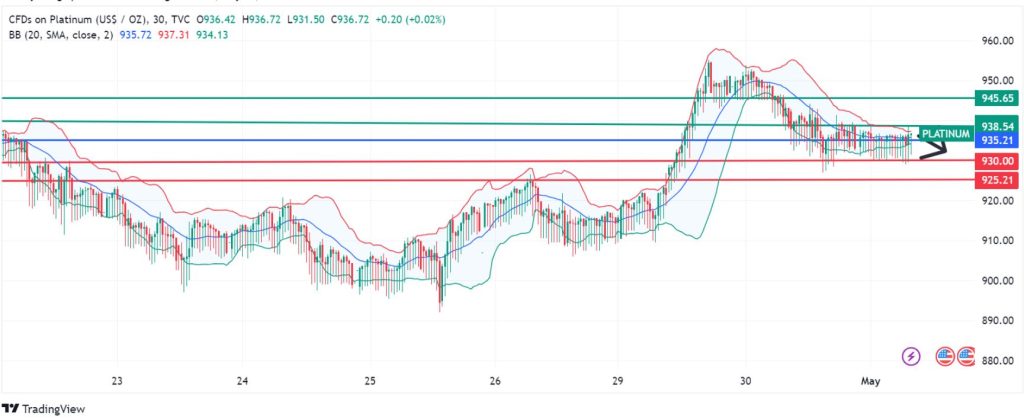
Our platinum price forecast shows that the pivot is at 935.21, and the downside is likely to prevail if resistant remains at that mark. With the sellers in control, the commodity will find the first support at 930.00. Furthermore, a continuation of the bearish control could break the support and potentially test 925.21. On the other hand, a move above 935.21 will favour the buyers to be in control, with the next resistance likely to be at 938.54. Furthermore, a break past that level will invalidate the downside narrative and favour the bulls to test 945.65 in extension.

:max_bytes(150000):strip_icc()/SBUXChart-8ef0e3173f164c72807d543af2f2d583.GIF "Starbucks Stock Plunges After Declining Same-Store Sales Weaken 2024 Outlook")