The main tag of Gold Price Articles.
You can use the search box below to find what you need.
[wd_asp id=1]
The main tag of Gold Price Articles.
You can use the search box below to find what you need.
[wd_asp id=1]
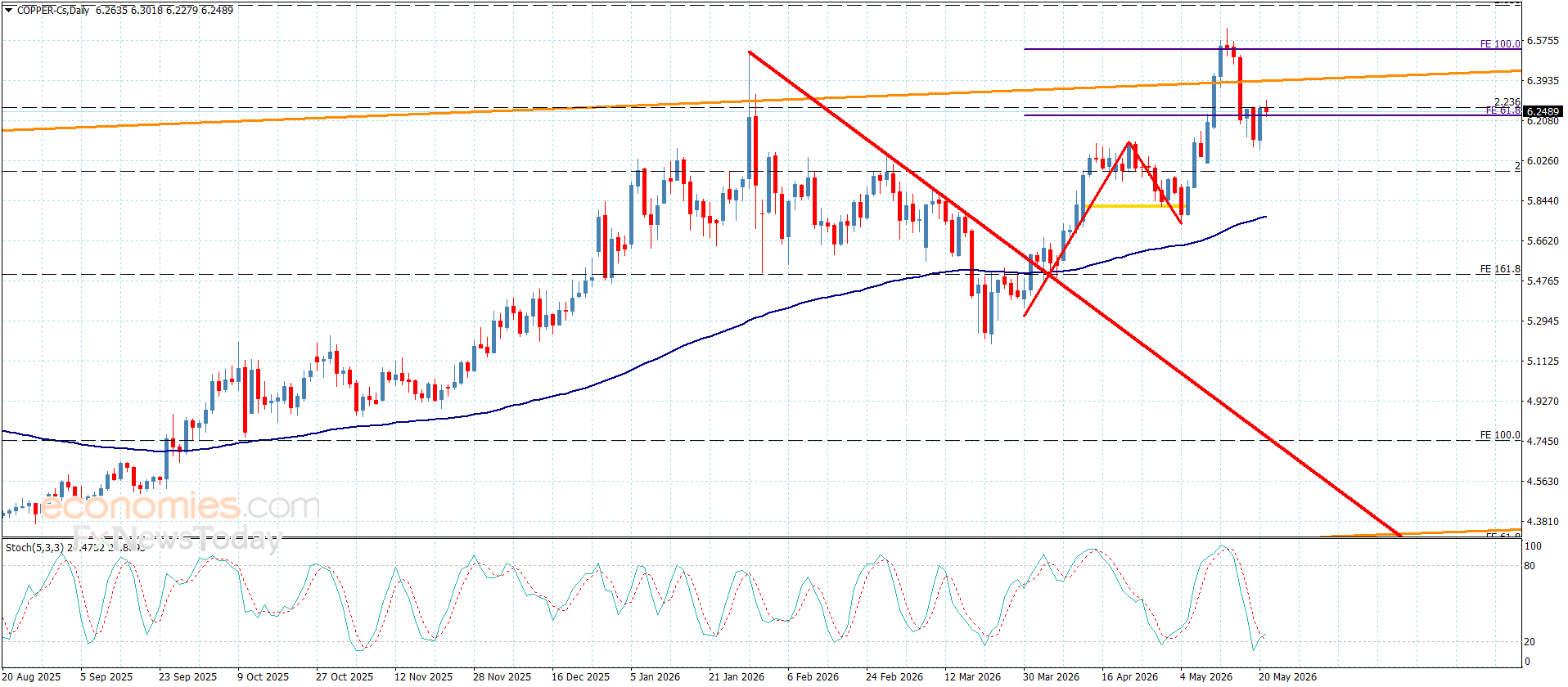
Copper price was forced to provide weak trading due to the continuation of the main indicators’ contradiction against the negative stability below the barrier at $6.3800 level, to force it to delay the corrective decline and hold near $6.2800 level.
Note that confirming the dominance of the bearish corrective trend needs to break the initial support at $6.1000, to ease the mission of the corrective stations, which might begin at $5.9500 and $58000, while surpassing the barrier will provide a chance for recording some gains, to expect attacking the resistance near $6.5800.
The expected trading range for today is between $6.1000 and$6.3500
Trend forecast: Bearish
Copper price took advantage of the initial support near $6.1000 by forming positive rebound, to settle near $6.2500 level, attempting to delay the previously suggested corrective trend, the continuation of forming extra barrier at $6.3800 level might force the price to renew the corrective attempts, to press on $6.1000 level breaking it will extend the trading towards $5.5900 reaching $5.8000 level.
While surpassing the barrier and holding above it will confirm its readiness to renew the bullish attempts, attempting to reach $6.5400 initially, which might record historical targets by its rally towards $6.7300.
The expected trading range for today is between $6.000 and $6.3500
Trend forecast: Bearish
Silver (XAG/USD) is seen building on the previous day’s bounce from the vicinity of a nearly two-week low, around the $73.00 neighborhood, and gaining positive traction for the second straight day on Thursday. The white metal climbs above mid-$76.00s during the Asian session, though it remains below the weekly high set on Tuesday.
From a technical perspective, the XAG/USD currently trades just below the $76.75 confluence hurdle – comprising the 100-hour Simple Moving Average (SMA) and the 23.6% Fibonacci retracement level of the recent downfall from the monthly peak. A sustained strength beyond the said barrier will be seen as a fresh trigger for bullish traders and pave the way for a further near-term appreciating move.
Constructive momentum indicators on the 1-hour chart hint that selling pressure is moderating rather than accelerating. The Relative Strength Index is near 57, and the Moving Average Convergence Divergence (MACD) line is holding slightly above zero. Hence, a clear breakout through the aforementioned hurdle could lift the XAG/USD to the 38.2% Fibo. at $79.21 and then the 50% level at $81.14.
On the downside, the main structural floor emerges at the cycle low and Fibonacci anchor around $72.97, where buyers would be expected to show more determined interest if the current pullback extends.
(The technical analysis of this story was written with the help of an AI tool.)
Silver is a precious metal highly traded among investors. It has been historically used as a store of value and a medium of exchange. Although less popular than Gold, traders may turn to Silver to diversify their investment portfolio, for its intrinsic value or as a potential hedge during high-inflation periods. Investors can buy physical Silver, in coins or in bars, or trade it through vehicles such as Exchange Traded Funds, which track its price on international markets.
Silver prices can move due to a wide range of factors. Geopolitical instability or fears of a deep recession can make Silver price escalate due to its safe-haven status, although to a lesser extent than Gold’s. As a yieldless asset, Silver tends to rise with lower interest rates. Its moves also depend on how the US Dollar (USD) behaves as the asset is priced in dollars (XAG/USD). A strong Dollar tends to keep the price of Silver at bay, whereas a weaker Dollar is likely to propel prices up. Other factors such as investment demand, mining supply – Silver is much more abundant than Gold – and recycling rates can also affect prices.
Silver is widely used in industry, particularly in sectors such as electronics or solar energy, as it has one of the highest electric conductivity of all metals – more than Copper and Gold. A surge in demand can increase prices, while a decline tends to lower them. Dynamics in the US, Chinese and Indian economies can also contribute to price swings: for the US and particularly China, their big industrial sectors use Silver in various processes; in India, consumers’ demand for the precious metal for jewellery also plays a key role in setting prices.
Silver prices tend to follow Gold’s moves. When Gold prices rise, Silver typically follows suit, as their status as safe-haven assets is similar. The Gold/Silver ratio, which shows the number of ounces of Silver needed to equal the value of one ounce of Gold, may help to determine the relative valuation between both metals. Some investors may consider a high ratio as an indicator that Silver is undervalued, or Gold is overvalued. On the contrary, a low ratio might suggest that Gold is undervalued relative to Silver.
Domestic coffee prices today
The domestic coffee market in the morning session of May 21, 2026 recorded a slight downward adjustment trend, immediately cutting off the recovery streak of yesterday’s trading session.
According to survey data in key growing areas of the Central Highlands, bulk purchase prices simultaneously decreased by 100 to 200 VND per kg, bringing the regional average price level to 86,000 VND per kg.
Specifically, in Dak Nong province (old), the purchasing price decreased the most by 200 VND, falling to the threshold of 86.100 VND per kg but still maintaining the highest price in the region.
Dak Lak and Gia Lai localities both recorded a slight decrease of 100 VND, currently trading stably at 86,000 VND per kg.
Meanwhile, the Lam Dong area listed the lowest price in the region at 85,500 VND per kg after losing 100 VND compared to the previous session.
In other items, pepper prices remained unchanged at the level of 142,000 VND per kg, especially the USD/VND exchange rate at Vietcombank recorded a fairly strong increase of up to 10 VND, currently trading around the threshold of 26,131 VND.
World coffee prices
Developments on international futures exchanges in the nearest closing session continued to witness the dominance of the selling side, causing red to cover both exchanges. On the New York exchange, Arabica coffee prices for July 2026 delivery fell another 1.85 cents, equivalent to 0.68%, closing at 268.30 cents per pound.
Sharing the downward trend, the London exchange recorded Robusta futures for July delivery in 2026 falling 17 USD, equivalent to 0.51%, falling to the threshold of 3,328 USD per ton, officially setting the lowest level in the past month. This decline shows that the short-term optimistic sentiment from the lack of technical buying replenishment in the previous session was quickly extinguished by the wave of defensive selling as South American countries entered the peak harvest.
Coffee price assessment and forecast
From the perspective of market analysts, the coffee price situation is under heavy pressure from the prospect of abundant supply on a global scale.
Forecast data from Coffee Trading Academy and Marex Group Plc both simultaneously indicated the 2026 crop output. 2027 of Brazil will grow strongly, even StoneX forecasts that the global surplus in 2026 will expand to 10 million bags, the highest level in the past 6 years. In Vietnam, the export momentum in the first 4 months of the year increased sharply by 15.8% to 810,000 tons from the Bureau of Statistics continues to be a factor directly hindering the recovery momentum of the London exchange, even when Robusta inventory monitored by ICE just had a slight recovery to a 2.5-week high of 3,845 lots.
Although the “bottlenecks” from the closure of themuz Strait increased global transportation costs and Brazil’s decrease in exports in April are still technical support, pressure from the new crop line about to flood the market in June is expected to make domestic coffee prices unlikely to have a strong breakthrough.
Spot Gold trades in the $4,540 region, recovering in the American afternoon. The US Dollar (USD) started the day on the back foot amid hopes the United States (US) and Iran were working their way towards a deal. Optimism, however, faded as the day went by, with the usual standoff between both reviving concerns. As a result, the Greenback and Oil recovered, while high-yielding assets retreated.
Mid American session, however, headlines indicated that both countries have reached an agreement via Pakistan mediation, and that the announcement will be made in a matter of hours. The USD resumed its slide and pushed XAU/USD into positive territory.
Data-wise, S&P Global released the flash estimate of the US Composite Purchasing Managers Index (PMI), confirming a reading of 51.7 in May, matching the April outcome. Manufacturing output improved to 55.3 from the previous 54.5, also surpassing expectations of 54. Finally, the Services PMI resulted at 50.9, slightly below the 51 posted in April.
The 4-hour chart shows XAU/USD has shrugged off the negative stance, but additional gains are still unclear. Technical indicators turned north, but remain below their midlines. At the same time, the pair has crossed above a flat 20 Simple Moving Average (SMA), now providing near-term support at around $4,520. The same chart shows that the 100 and 200 SMAs maintain their downward slopes far above the current level, limiting the upward scope.
Bigger time frames, however, hint at bears holding the grip but staying on pause. Technical indicators in the daily chart aim marginally lower within negative levels, but lack directional strength. At the same time, a bearish 20 SMA stands at $4,620, providing strong resistance while the 100 SMA holds far above the shorter one, further limiting the bullish case.
No change for the EURCHF negative trend by its stability below 0.9250 resistance, besides forming extra barrier by the moving average 55 at 0.9190, to begin recording some negative targets by reaching 0.9120 level.
Note that providing negative momentum by stochastic will increase the efficiency of the bearish trend in the near trading, to expect reaching 0.9100, to press on the barrier near 0.9070 to find an exit for resuming the negative trend in the upcoming period trading.
The expected trading range for today is between 0.9070 and 0.9170
Trend forecast: Bearish
Copper price took advantage of the initial support near $6.1000 by forming positive rebound, to settle near $6.2500 level, attempting to delay the previously suggested corrective trend, the continuation of forming extra barrier at $6.3800 level might force the price to renew the corrective attempts, to press on $6.1000 level breaking it will extend the trading towards $5.5900 reaching $5.8000 level.
While surpassing the barrier and holding above it will confirm its readiness to renew the bullish attempts, attempting to reach $6.5400 initially, which might record historical targets by its rally towards $6.7300.
The expected trading range for today is between $6.000 and $6.3500
Trend forecast: Bearish
Copper price took advantage of the initial support near $6.1000 by forming positive rebound, to settle near $6.2500 level, attempting to delay the previously suggested corrective trend, the continuation of forming extra barrier at $6.3800 level might force the price to renew the corrective attempts, to press on $6.1000 level breaking it will extend the trading towards $5.5900 reaching $5.8000 level.
While surpassing the barrier and holding above it will confirm its readiness to renew the bullish attempts, attempting to reach $6.5400 initially, which might record historical targets by its rally towards $6.7300.
The expected trading range for today is between $6.000 and $6.3500
Trend forecast: Bearish
Silver (XAG/USD) remains under pressure on Tuesday as a stronger US Dollar (USD) and rising US Treasury yields continue to weigh on the precious metal amid growing expectations that the Federal Reserve (Fed) may need to raise interest rates to tackle rising Oil-driven inflation pressures. At the time of writing, XAG/USD is trading around $74.76, down more than 3.5% on the day after hitting an intraday low near $73 earlier in the day.
US-Iran negotiations remain deadlocked over disagreements surrounding Tehran’s nuclear program, while the Strait of Hormuz remains largely closed. US President Donald Trump said on Tuesday that military action against Iran could resume within the next few days or by early next week if no agreement is reached.
The ongoing uncertainty is keeping the US Dollar supported, with the US Dollar Index (DXY), which tracks the Greenback’s value against a basket of six major currencies, hovering near more than one-month highs around 99.33.
Meanwhile, hawkish Fed expectations continue to push US Treasury yields sharply higher, with the benchmark US 10-year Treasury yield climbing to a 16-month high near 4.687% on Tuesday, while the US 30-year Treasury yield rose to around 5.197%, its highest level since July 2007. Higher yields increase the opportunity cost of holding non-yielding assets such as Silver.
According to the CME FedWatch Tool, traders now see nearly a 32% probability of a 25 basis point (bps) Fed rate hike at the October meeting, rising to around 40% for December.
On the daily chart, XAG/USD holds a mildly bearish near-term bias as it sits below the short-term trend defined by the 50-day Simple Moving Average (SMA) at $76.60 while remaining above the longer-term 200-day SMA at $65.40.
The 100-day SMA at $81.28 strengthens the overhead supply zone, suggesting rallies face increasing headwinds, while the Relative Strength Index (RSI) around 45 leans soft but not oversold, and the Moving Average Convergence Divergence (MACD) has slipped back below zero, hinting that bullish momentum has faded.
On the topside, initial resistance is located at the 50-day SMA near $76.60, ahead of the 100-day SMA near $81, with a more distant cap at the horizontal barrier around $90.00.
On the downside, first support emerges at the $70.00 horizontal level, followed by the 200-day SMA at $65.40, with a deeper cushion near the longer-term floor around $55.00 if selling pressure accelerates.
(The technical analysis of this story was written with the help of an AI tool.)
Silver is a precious metal highly traded among investors. It has been historically used as a store of value and a medium of exchange. Although less popular than Gold, traders may turn to Silver to diversify their investment portfolio, for its intrinsic value or as a potential hedge during high-inflation periods. Investors can buy physical Silver, in coins or in bars, or trade it through vehicles such as Exchange Traded Funds, which track its price on international markets.
Silver prices can move due to a wide range of factors. Geopolitical instability or fears of a deep recession can make Silver price escalate due to its safe-haven status, although to a lesser extent than Gold’s. As a yieldless asset, Silver tends to rise with lower interest rates. Its moves also depend on how the US Dollar (USD) behaves as the asset is priced in dollars (XAG/USD). A strong Dollar tends to keep the price of Silver at bay, whereas a weaker Dollar is likely to propel prices up. Other factors such as investment demand, mining supply – Silver is much more abundant than Gold – and recycling rates can also affect prices.
Silver is widely used in industry, particularly in sectors such as electronics or solar energy, as it has one of the highest electric conductivity of all metals – more than Copper and Gold. A surge in demand can increase prices, while a decline tends to lower them. Dynamics in the US, Chinese and Indian economies can also contribute to price swings: for the US and particularly China, their big industrial sectors use Silver in various processes; in India, consumers’ demand for the precious metal for jewellery also plays a key role in setting prices.
Silver prices tend to follow Gold’s moves. When Gold prices rise, Silver typically follows suit, as their status as safe-haven assets is similar. The Gold/Silver ratio, which shows the number of ounces of Silver needed to equal the value of one ounce of Gold, may help to determine the relative valuation between both metals. Some investors may consider a high ratio as an indicator that Silver is undervalued, or Gold is overvalued. On the contrary, a low ratio might suggest that Gold is undervalued relative to Silver.
The price of natural gas continued forming bullish waves, holding near the first target at $3.150. Despite the divergence in key indicators, the overall stability above the $2.620 support level supports maintaining a bullish bias.
This reinforces expectations that the price may soon retest the resistance at $3.250, with a potential breakout opening the way for continued upward movement in the near to medium term, targeting $3.520 as the next main objective.
However, failure to break above resistance may lead to mixed trading, with a possibility of downside pressure pushing the price toward $2.850 and then back to the previously mentioned support level.
The expected trading range for today is between $2.950 and $3.250
Trend forecast: Bullish