The main tag of Gold Price Articles.
You can use the search box below to find what you need.
[wd_asp id=1]
The main tag of Gold Price Articles.
You can use the search box below to find what you need.
[wd_asp id=1]
Economies.com
2026-09-07 01:39 UTC
The Ethereum price (ETHUSD) edged higher during its latest intraday trading, as it attempts to break above the pivotal and stubborn resistance at $2,500, while continuing its short-term sideways movement, supported by its continued trading above EMA50, which provides the price with a dynamic support base that enhances the chances of a breakout over the coming period. On the other hand, negative signals are beginning to emerge from the relative strength indicators after reaching extremely overbought levels, which may hinder the pair’s chances of a rapid recovery, to relieve these overbought conditions.
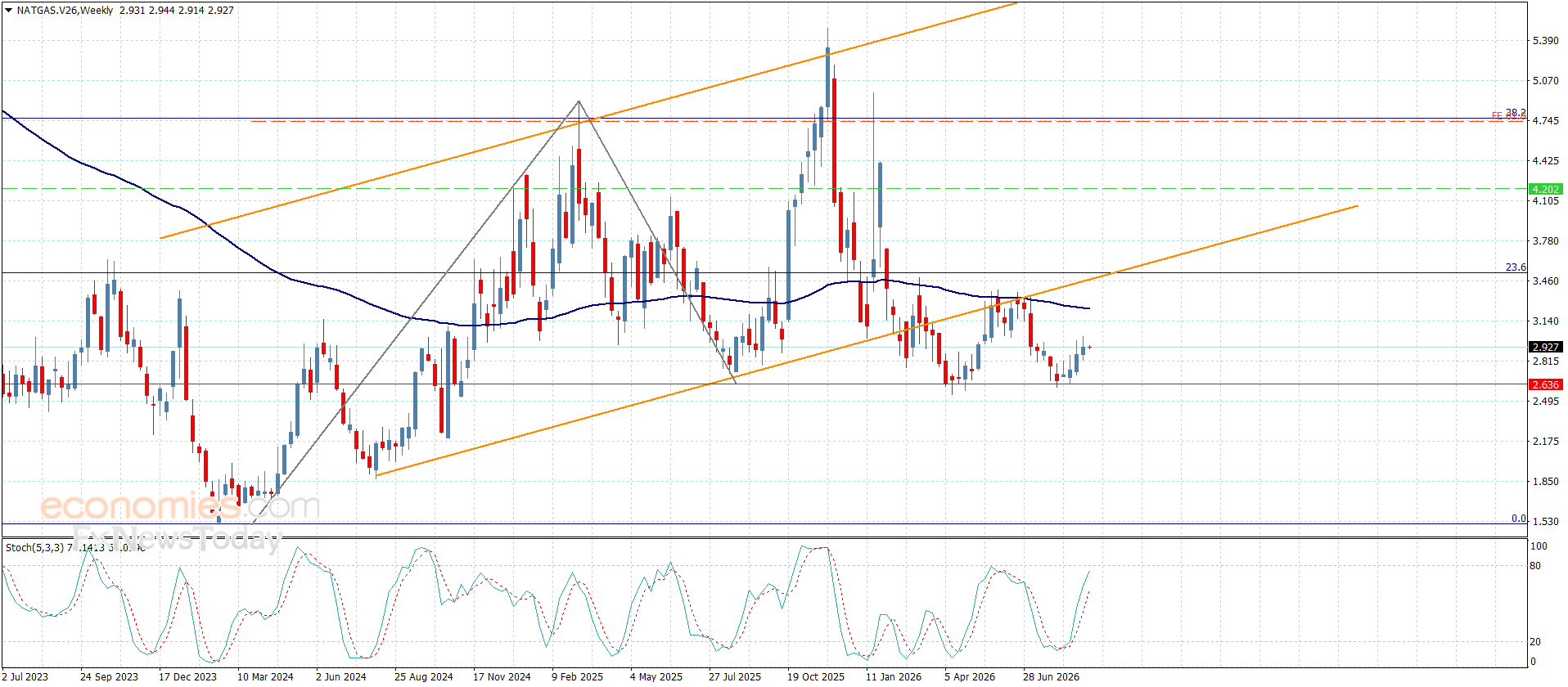
Despite the weakness of the last weak trading by its fluctuations near $2.920 level, it will not affect the previously suggested bullish scenario, depending on its stability above $2.620 level.
The continuation of providing bullish momentum by stochastic will increase the efficiency of the bullish corrective trend, which might target $3.100 level reaching 55 moving average at $2.240.
The expected trading range for today is between $2.860 and $3.100
Trend forecast: Bullish
Domestic coffee prices
Today (September 6), the coffee market ended a week of alternating increases and decreases, currently the purchase price fluctuates in the range of 94,200 – 95,000 VND/kg, down 300 – 800 VND/kg compared to the price range at the beginning of the week. The average purchase price of coffee in the Central Highlands provinces today is 94,800 VND/kg.
The old Dak Nong area is still the province with the highest coffee purchasing price in the Central Highlands region, differing from the average price by about 200 VND/kg. Compared to the closing price last weekend, the coffee price in this area decreased by 300 VND/kg, bringing it to the market at 95,000 VND/kg.
In Dak Lak and Gia Lai, coffee prices decreased by 800 VND/kg, down to 94,700 VND/kg.
Similarly, Lam Dong also decreased by 700 VND/kg, currently trading at a price of 94,600 VND/kg.
World coffee prices
On the London and New York exchanges, the coffee market diễn biến in the same direction in all terms.
On the online trading floor Robusta, the September 2026 futures contract on the London exchange was traded at 3,344 USD/ton, up 46 USD/ton compared to the previous session. The November 2026 contract increased by 1.66% (about 56 USD/ton), to 3,430 USD/ton.
On the New York Stock Exchange, the price of arabica coffee for September 2026 delivery was almost unchanged when it only decreased by 0.03% (0.1 US cent/lb), reaching 324.25 US cent/lb. The December 2026 contract increased by 0.08% (0.25 US cent/lb), reaching 295.6 US cent/lb.
Market outlook
Robusta coffee prices have interrupted a series of consecutive declines, rebounding strongly, while Arabica coffee prices have increased less.
Arabica coffee contracts are under pressure due to the increase in coffee exports from Brazil, the leading producer. Along with that, the return of rain is a positive sign for the flowering phase, a factor that plays a decisive role in the output of next year’s coffee crop.
In the first 8 months of 2026, Vietnam exported 1.33 million tons of coffee, up 13.7% compared to the same period last year. Coffee export revenue in this period decreased by 8.6% to 6 billion USD. In August alone, Vietnam exported 132,000 tons of coffee, up 13.7% compared to the same period last year.
The prospects for the Robusta crop 2027-2028 are also quite positive. Robusta coffee trees have completed the flowering process and if weather conditions are favorable, the next crop output may be equivalent to or even exceed the record level of the 2025-2026 crop year.
The article covers the following subjects:
Consider long positions from corrections above 79.00 with a target of 105.17–115.50.
Breakout and consolidation below 79.00 will allow the asset to continue declining to the levels of 67.00–58.50.
On the weekly chart, a descending correction has likely finished developing as the second wave of larger degree (2) and an ascending third wave (3) is forming. On the daily chart, apparently, the first wave of smaller degree 1 of (3) has formed, a local correction has been completed as wave 2 of (3), and wave 3 of (3) has started unfolding. Wave i of 3 appears to continue forming on the H4 chart, with wave (iii) of i unfolding as its part. If the presumption is correct, WTI will continue to rise to 105.17–115.50. The level of 79.00 is critical in this scenario as a breakout below it will enable the asset to continue declining to the levels of 67.00–58.50.
This forecast is based on the Elliott Wave Theory. When developing trading strategies, it is essential to consider fundamental factors, as the market situation can change at any time.
The content of this article reflects the author’s opinion and does not necessarily reflect the official position of LiteFinance broker. The material published on this page is provided for informational purposes only and should not be considered as the provision of investment advice for the purposes of Directive 2014/65/EU.
According to copyright law, this article is considered intellectual property, which includes a prohibition on copying and distributing it without consent.
Select market data provided by ICE Data Services. Select reference data provided by FactSet. Copyright © 2026 FactSet Research Systems Inc.Copyright © 2026, American Bankers Association. CUSIP Database provided by FactSet Research Systems Inc. All rights reserved. SEC filings and other documents provided by Quartr.© 2026 TradingView, Inc.
Domestic coffee prices today
Coffee prices today in the domestic market simultaneously increased by 1,000 VND/kg compared to the previous session. According to giacaphe. com, coffee prices on September 5th averaged 94,800 VND/kg.
In Gia Lai and Dak Lak, coffee prices were recorded at 94,700 VND/kg, an increase of 1,000 VND/kg.
In Lam Dong, coffee prices are still 94,200 VND/kg.
The old Dak Nong area recorded a level of 95,000 VND/kg, reversing to increase by 1,000 VND/kg. This is the highest level in today’s price list.
The USD/VND exchange rate according to Vietcombank was recorded at 25,845 VND/USD, down 30 VND/USD.
World coffee prices
In the world market, coffee prices increase and decrease interspersed.
According to Barchart, the September 2026 Robusta futures contract remained unchanged, anchored at the $3,298/ton mark. The November 2026 futures increased by $56/ton, listed at $3,430/ton. The term from January 2027 to May 2027 saw an increase of $55-57/ton, to $3,383 – $3,415/ton.
Similarly, the September 2026 Arabica futures contract closed the session at 324.35 cents/lb. The December 2026 term increased slightly by 0.25 US cents/lb, equivalent to 0.08%, raising the cost price to 295.60 cents/lb. Further forwards increased from 2.35 to 3.40 cents/lb, anchored in the 287.4 – 283.4 cents/lb range.
Assessments and forecasts
Arabica prices on the ICE exchange have fallen to a 5-week low, while Robusta fell to a 2.5-month low. This development reflects market concerns about the possibility of increased coffee supply to the market in the near future.
For Arabica, Brazil is a noteworthy factor as new crop yield prospects are improved. StoneX raises its 2026-2027 crop yield forecast to a record 77.2 million bags, 2.6% higher than the forecast made in March. The return of rainfall at the time coffee trees enter the flowering stage also creates more grounds for expectations of a favorable crop.
For the domestic market, in the short term, domestic coffee prices are likely to recover after a deep decline, however, the increase is not too sudden, continuing to accumulate around the area of 94,000 – 95,000 VND/kg.
The market is expected to maintain a probing state and can only clearly define the new trend when the first assessments of Vietnam’s actual harvest output next season begin to appear.
The article covers the following subjects:
Consider long positions from corrections above 4,282.50 with a target of 4,900.00–5,610.00.
Breakout and consolidation below 4,282.50 will allow the asset to continue declining to the levels of 4,003.25–3,720.00.
An ascending third wave of larger degree (3) is presumably developing on the weekly chart. Within it, a descending correction has been completed as the fourth wave of smaller degree 4 of (3). Apparently, the fifth wave 5 of (3) started developing on the daily chart, with wave i of 5 forming as its part. The H4 time frame shows that wave (iii) of i of 5 has formed, a local correction has been completed as wave (iv) of i, and wave (v) of i is currently developing. If the presumption is correct, XAU/USD will continue to rise to 4,900.00–5,610.00. The level of 4,282.50 is critical in this scenario as a breakout below it will enable the asset to continue declining to the levels of 4,003.25–3,720.00.
This forecast is based on the Elliott Wave Theory. When developing trading strategies, it is essential to consider fundamental factors, as the market situation can change at any time.
The content of this article reflects the author’s opinion and does not necessarily reflect the official position of LiteFinance broker. The material published on this page is provided for informational purposes only and should not be considered as the provision of investment advice for the purposes of Directive 2014/65/EU.
According to copyright law, this article is considered intellectual property, which includes a prohibition on copying and distributing it without consent.
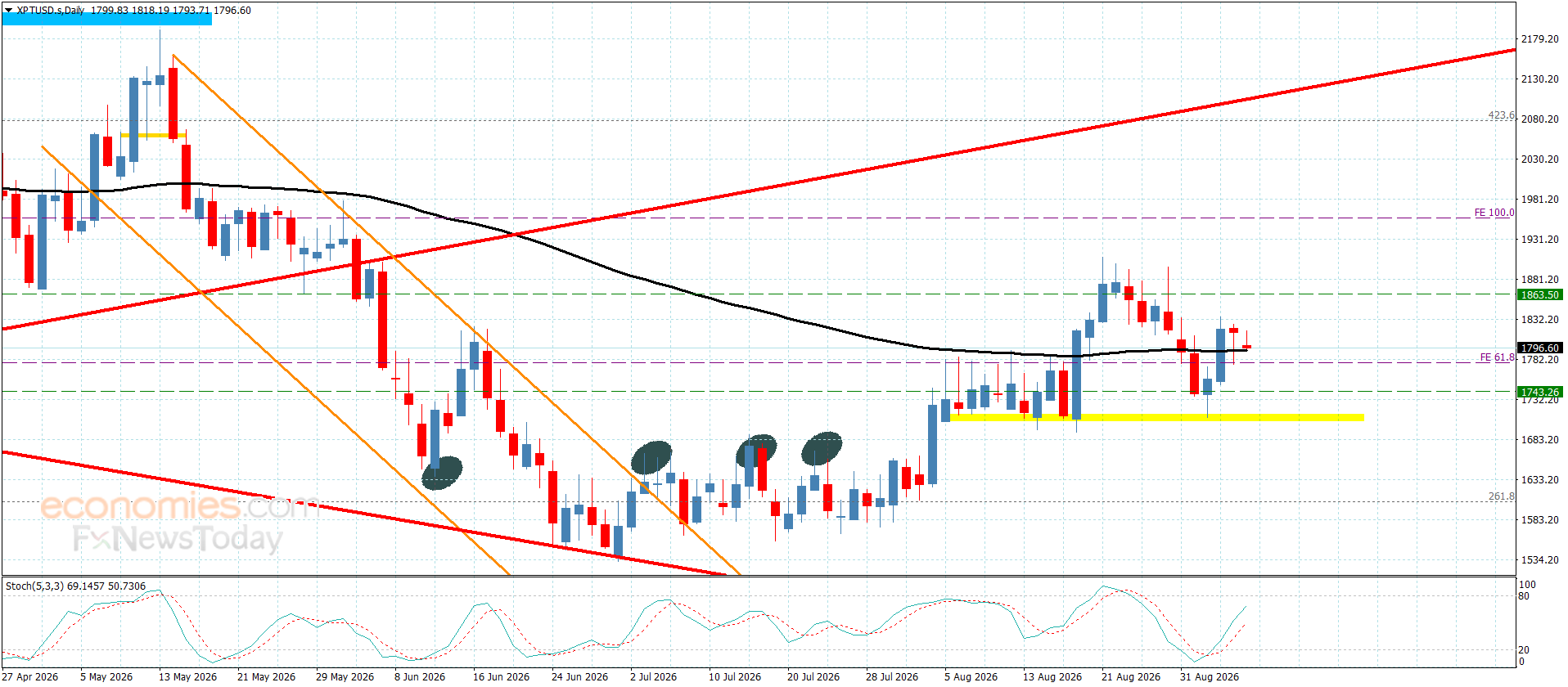
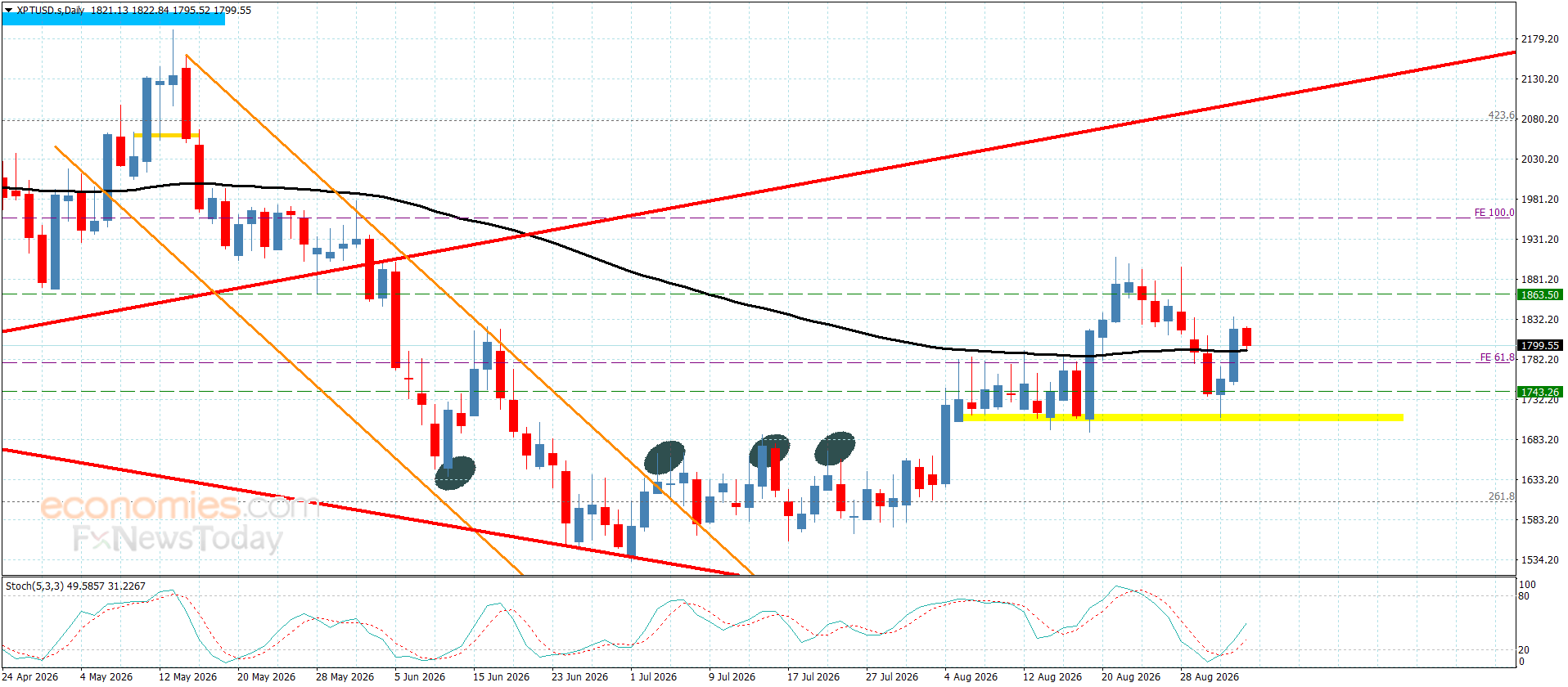
Platinum price kept its stability above $1695.00 support in its last trading, confirming the stability of the bullish scenario, recording clear gains by approaching the initial target at $1860.00.
The attempt of the price to settle above the 55 moving average level reinforces the chances of gathering the positive momentum, to expect surpassing $1860.00 level and reaching the extra stations near $1910.00 and $1955.00.
The expected trading range for today is between $1785.00 and $1900.00
Trend forecast: Bullish
Silver price (XAG/USD) retreats to near $66.30 in the European trading session on Friday after posting a fresh five-day high near $68.00. The white metal comes under pressure ahead of the United States (US) Nonfarm Payrolls (NFP) data for August, which will be published at 12:30 GMT.
According to TD Securities, the US labour market is set for a partial recovery in August, with the bank forecasting that “August NFP [will] rebound to 95k after July posted a decline of 23k.” The firm also expects limited movement in joblessness, noting that “the UE rate likely went sideways at 4.1% with balanced risks.”
Investors will closely track the US NFP data to get fresh cues regarding the Federal Reserve’s (Fed) monetary policy outlook. In TD’s view, a modestly hawkish employment report will reaffirm the Fed’s attention on inflation, but it will be by itself unlikely to push the Committee towards hikes, suggesting that even a stronger print would not materially alter the current policy stance.
Meanwhile, traders have diminished Fed interest rate expectations after comments from Governor Christopher Waller on Thursday, in which he said that recent data shows signs of disinflation.
Analysts at Commerzbank also said that lingering uncertainty over the US rate outlook was “underscored yesterday by comments from Fed Governor Christopher Waller,” who, in their words, signalled that “a rate hike is by no means necessary.” They add that Waller “also confirmed what we have been arguing: next week’s inflation data are likely to be the key input for the Fed’s upcoming policy decision,” a shift in emphasis that, in their view, “further [reduces] the significance of today’s employment report.”
In the daily chart, XAG/USD trades at $66.73, maintaining a bullish near-term bias as it holds above the 20-day exponential moving average (EMA) at roughly $65.71. The metal is advancing within an uptrend structure, with price comfortably supported by this short-term EMA, while the Relative Strength Index (RSI) around 55 suggests moderate bullish momentum without yet signaling overbought conditions.
On the downside, immediate support is seen at the 20-day EMA near $65.71, where a break would expose the white metal to a deeper correction. Looking up, the August high at $71.12 is the key hurdle.
(The technical analysis of this story was written with the help of an AI tool. Know more.)
Silver is a precious metal highly traded among investors. It has been historically used as a store of value and a medium of exchange. Although less popular than Gold, traders may turn to Silver to diversify their investment portfolio, for its intrinsic value or as a potential hedge during high-inflation periods. Investors can buy physical Silver, in coins or in bars, or trade it through vehicles such as Exchange Traded Funds, which track its price on international markets.
Silver prices can move due to a wide range of factors. Geopolitical instability or fears of a deep recession can make Silver price escalate due to its safe-haven status, although to a lesser extent than Gold’s. As a yieldless asset, Silver tends to rise with lower interest rates. Its moves also depend on how the US Dollar (USD) behaves as the asset is priced in dollars (XAG/USD). A strong Dollar tends to keep the price of Silver at bay, whereas a weaker Dollar is likely to propel prices up. Other factors such as investment demand, mining supply – Silver is much more abundant than Gold – and recycling rates can also affect prices.
Silver is widely used in industry, particularly in sectors such as electronics or solar energy, as it has one of the highest electric conductivity of all metals – more than Copper and Gold. A surge in demand can increase prices, while a decline tends to lower them. Dynamics in the US, Chinese and Indian economies can also contribute to price swings: for the US and particularly China, their big industrial sectors use Silver in various processes; in India, consumers’ demand for the precious metal for jewellery also plays a key role in setting prices.
Silver prices tend to follow Gold’s moves. When Gold prices rise, Silver typically follows suit, as their status as safe-haven assets is similar. The Gold/Silver ratio, which shows the number of ounces of Silver needed to equal the value of one ounce of Gold, may help to determine the relative valuation between both metals. Some investors may consider a high ratio as an indicator that Silver is undervalued, or Gold is overvalued. On the contrary, a low ratio might suggest that Gold is undervalued relative to Silver.
Domestic coffee prices today
Coffee prices today in the domestic market continued to decrease compared to the previous session. According to giacaphe. com, coffee prices on September 4th averaged 93,800 VND/kg.
In Dak Lak, coffee prices were recorded at 93,700 VND/kg, down 500 VND/kg.
In Lam Dong, coffee prices are still 93. 200 VND/kg, down 500 VND/kg.
In Gia Lai, coffee prices are at 93,700 VND/kg, down 500 VND/kg compared to the previous session.
The old Dak Nong area recorded a level of 94,000 VND/kg, down 500 VND/kg. This is the highest level in today’s price list.
The domestic coffee market has had a consecutive week of price decreases, generally losing 1,800 VND/kg compared to the beginning of the week.
The USD/VND exchange rate according to Vietcombank was recorded at 25,875 VND/USD, an increase of 15 VND/USD.
World coffee prices
In the world market, coffee prices are dominated by red color.
According to Barchart, the September 2026 Robusta futures contract slipped by 27 USD/ton, anchored at 3,298 USD/ton. The November 2026 futures fell by another 32 USD/ton, listed at 3,374 USD/ton. The January 2027-5. 2027 futures saw a decrease from 35-37 USD/ton, down to 3,326-3,360 USD/ton.
Similarly, the September 2026 Arabica futures contract closed down 4.05 US cents/lb, equivalent to 1.23%, to 324.35 cents/lb. The December 2026 term closed down 2.75 US cents/lb, equivalent to 0.92%, to 295.35 cents/lb. Further forwards fell from 2.7 to 3.15 cents/lb, anchored in the 280.00 – 285.05 cents/lb range.
Assessments and forecasts
According to statistics from the Japanese Customs authority, in the first 6 months of 2026, Japan’s coffee imports reached 173.0 thousand tons, worth nearly 1.20 billion USD, down 9.3% in volume, but up 2.4% in value compared to the same period in 2025.
In the first 6 months of 2026, the average import price of coffee into Japan reached 6,922 USD/ton, an increase of 12.9% compared to the same period in 2025. In which, the average import price of Japanese coffee from major markets all increased compared to the same period in 2025, only imports from Vietnam decreased. The import price of Japanese coffee from Vietnam decreased by 16.4% compared to the same period in 2025, down to 4,462 USD/ton.
Vietnam is the second largest coffee supplier to Japan in the first 6 months of 2026, reaching 55.5 thousand tons, worth 247.8 million USD, an increase of 5.0% in volume, but a decrease of 12.2% in value compared to the same period in 2025. Vietnam’s coffee market share in Japan’s total imports increased from 27.74% in the first 6 months of 2025 to 32.10% in the first 6 months of 2026.