The main tag of Gold Price Articles.
You can use the search box below to find what you need.
[wd_asp id=1]
The main tag of Gold Price Articles.
You can use the search box below to find what you need.
[wd_asp id=1]
Domestic coffee prices
The domestic coffee market this morning, April 2, recorded green color spreading widely. Key coffee growing localities in the Central Highlands simultaneously adjusted to increase purchasing prices, helping the average price level of the whole region reach the threshold of 90. 100 VND/kg. This is a very positive signal as coffee prices have regained important psychological milestones after deep declines at the end of March.
Detailed changes in localities are as follows:
In Dak Nong province (old): increased by 700 VND/kg, currently purchasing at the highest level in the region is 90. 200 VND/kg.
In Dak Lak province: Recorded an increase of 800 VND/kg, currently the transaction price reaches 9,000 VND/kg.
In Gia Lai province: Similarly to Dak Lak, the recorded increase is 800 VND/kg, bringing coffee prices to the 9,000 VND/kg mark.
In Lam Dong province: Recorded the strongest increase with +1. 000 VND/kg, currently listed at 89,700 VND/kg.
World coffee prices
The trading session on Wednesday witnessed a clear differentiation between the London and New York exchanges as fundamentals and currencies intertwined.
London Stock Exchange (Robusta): May 2026 futures continued the recovery momentum, increasing by another 28 USD (+0.80%), closing the session at 3,521 USD/ton. Robusta prices maintained their upward momentum thanks to short-term supply tightening. According to the latest data, Robusta inventories monitored by ICE have fallen to the lowest level in 3.5 months, down to only 4,993 lots as of Wednesday.
New York Stock Exchange (Arabica): May 2026 futures recorded a slight decrease of 0.55 cents (-0.18%), closing at 297.80 cents/lb. Arabica prices fell to a 1.5-week low due to pressure from Brazil’s record crop prospects. However, the decline was significantly curbed when the Brazilian Real rose to a 3-week high against the USD, limiting export sales from this country.
Market outlook and analysis
The developments of the coffee market are currently a confrontation between long-term oversupply sentiment and short-term supply bottlenecks:
International organizations continuously raise their forecasts for Brazil’s record output for the next crop year. Marex Group Plc estimates output to reach 75.9 million bags (up 15.5% y/y), while Sucafina forecasts 75.4 million bags and StoneX is 75.3 million bags. In addition, Arabica inventories on the ICE exchange are still anchored at the highest level of 6.25 months (585.621 bags).
Rainfall in the Minas Gerais region of Brazil last week only reached 11.7 mm, equivalent to 47% of the historical average, raising concerns about crop quality. At the same time, the fact that the Hormuz Strait continues to be closed due to war in Iran is disrupting sea transport, directly pushing up ship, insurance and fuel costs.
With Robusta receiving strong support from low inventory, domestic coffee prices in the short term are likely to continue to accumulate and fluctuate around the 89,500 – 91,000 VND/kg range.
The actual price at the purchasing yards may change depending on the quality of the seeds and the transaction agreement.
The oil market on Good Friday, April 3, 2026, is simultaneously the most discussed and most misunderstood commodity situation in a generation — and the confusion is not the market’s fault. It is a structural artifact of how oil gets priced across multiple benchmarks, timeframes, and delivery windows that have historically moved in near-lockstep but have now diverged by amounts that have no modern precedent. At 9 a.m. Eastern Time, Brent crude was priced at $112.42 per barrel — a gain of 73 cents from the prior morning and approximately $34 higher than one year ago, representing a 52.35% year-over-year increase. West Texas Intermediate (WTI) settled Thursday at $111.54, up $11.94 or 11.93% in a single session — the largest single-day dollar gain in the futures contract’s 43-year trading history. Brent crude futures settled at $109.03, up 7.78% on the same session. Murban crude is at $114.80, up 10.82%. Gasoline futures are at $3.288, up 6.36%. Heating oil is at $4.361, up 7.50%. WTI Midland — the physical crude grade originating from the Permian Basin — is printing at $119.30, up 12.51%. One month ago, oil was trading at $79.74. The 40.98% gain in a single month is the largest monthly percentage increase in crude oil prices since the immediate aftermath of the 2020 Covid crash recovery. But all of those numbers — as significant as they are — are not the most important oil price in the world right now. The most important number is one that most financial media has dramatically underreported: the Brent crude spot price for physical delivery in the next 10 to 30 days reached $141.36 on Thursday, according to S&P Global — the highest level since the 2008 financial crisis. That $141.36 spot price sits $32.33 above the June Brent futures contract that settled at $109.03 — a spread of extraordinary magnitude that reveals a physical supply crisis so severe that the futures market, which is supposed to be the world’s primary oil price discovery mechanism, is materially underpricing the actual tightness of physical supply right now.
The $141.36 Brent crude spot price is the single most important data point in the entire global oil market right now, and understanding why it exists — and what it implies — is the most critical analytical task for anyone trying to forecast where oil prices are going. The spot price measures what buyers are willing to pay for Brent crude oil that will be delivered within the next 10 to 30 days. It is the physical market’s direct expression of immediate supply scarcity — what a refiner who needs oil right now, today, this week, must pay to secure a cargo. The fact that the spot price is $141.36 while the June futures contract trades at $109.03 — a $32.33 spread — is not a market malfunction. It is the futures market embedding an expectation that the Iran war will end within the next 60 days and that physical supply will normalize before the June contract expires. The spot market, which has no such luxury — physical buyers need oil now, not in June — is pricing the actual scarcity that exists in the physical world today. Amrita Sen, founder of Energy Aspects, told CNBC’s “The Exchange” on Thursday that the futures price is “almost giving a false sense of security that things are not that stressed.” She added that “you are seeing it but the financial market is almost masking the true tightness that everywhere else is showing up.” As concrete evidence of that physical tightness, she noted that the price for a barrel of diesel in Europe has reached approximately $200 per barrel right now — a figure that translates directly into catastrophic transport, logistics, and manufacturing cost increases across the entire European economy. Chevron (CVX) CEO Mike Wirth foreshadowed this dynamic at the CERAWeek conference on March 23, warning that the futures price is not reflecting the scale of the oil supply disruption from the Strait closure and that the market is trading on “scant information” and “perception.” “There are very real, physical manifestations of the closure of the Strait of Hormuz that are working their way around the world and through the system that I don’t think are fully priced into the futures curves on oil,” Wirth said. The $32.33 spread between the physical spot price and the June futures contract is the market’s quantification of exactly that gap between futures-priced optimism and physical-market reality. Robin J. Brooks — Senior Fellow at the Brookings Institution and former Chief FX Strategist at Goldman Sachs — published a critical analytical framework this week explaining that the front-month futures contract — currently the June contract at approximately $112 per barrel — is the key oil price for medium-term economic analysis. The spot price of $141.36 reflects immediate scarcity. The June futures at $112 reflects what the market currently thinks oil will be worth when the June contract expires. The resolution of the war — and its timing relative to the June contract’s expiry — will determine which price converges toward the other. If the war ends before June, the $141.36 spot price will fall toward $112 as physical supply normalizes. If the war continues past June, the June futures contract will be dragged upward toward the $141.36 spot price as the front-month contract approaches expiry and becomes effectively a spot transaction — exactly the pattern that played out with the now-expired March 31 front-month contract, which was pulled toward the spot price as it approached expiration.
The Strait of Hormuz is the geographic foundation of the entire oil crisis, and understanding its physical reality is essential for any credible oil price forecast. The Strait is 21 miles wide at its narrowest navigable point. Under normal conditions, approximately 20 million barrels of crude oil per day flow through it — roughly 20% of the world’s total oil trade — along with enormous volumes of liquefied natural gas from Qatar, the world’s largest LNG exporter. Since Iran’s effective closure of the Strait to the majority of tanker traffic following the U.S.-Israeli strikes that began on February 28, that flow has been reduced to a fraction of its normal volume. OPEC output has plunged by approximately 7 million barrels per day as a result of the supply disruption, according to Oilprice.com data — a reduction that represents more than 7% of total global oil supply disappearing from the market virtually overnight. The physical consequences are cascading globally. Japan’s JERA — one of the world’s largest LNG importers — cancelled a long-term LNG deal with Commonwealth as supply security became untenable. Canada’s synthetic crude has soared 200% as the war chokes diesel supply chains. Asia is burning more coal as Middle East war sends LNG prices to 3-year highs. The UAE’s biggest gas plant has been forced offline for the second time since the war began. Europe is bracing for a prolonged energy crisis as supplies tighten, with the EU explicitly warning that energy prices won’t fall even if the Iran war ends tomorrow — reflecting the structural damage to infrastructure and supply chains that will persist beyond any ceasefire. The one genuinely positive headline on the energy front today: the first Western European vessel has transited Hormuz since the war began — a development that could signal the early stages of the monitoring protocol that Iran and Oman have been reportedly negotiating, and that would be the first concrete evidence of any movement toward restored tanker traffic. However, a single vessel transit does not constitute a reopening — the full restoration of 20 million barrels per day of flow through the Strait requires sustained, safe, commercially viable tanker operations that no single transit event confirms.
The catalyst for Thursday’s historic $11.94 single-day WTI gain was President Trump’s Wednesday night primetime address to the nation, which delivered maximum market disruption by destroying the cautious de-escalation optimism that had been building for two days while simultaneously failing to provide any concrete framework for ending the conflict. Trump told the nation that the U.S. would hit Iran “extremely hard over the next two to three weeks” and vowed to bring Iran “back to the Stone Ages.” He said the U.S. would complete its strategic objectives “very shortly” — a timeline qualifier that markets interpreted as meaning the military campaign would intensify before it concluded rather than wind down toward an immediate ceasefire. When Trump said “over the next two to three weeks, we’re going to bring them back to the Stone Ages where they belong,” the futures market repriced the war’s duration and intensity upward in real time, and oil surged from below $100 — where it had been trading before the speech on hopes of a de-escalation announcement — to ultimately settling at $111.54 on Thursday. The $11 intraday swing from pre-speech levels represents an extraordinary single-event price move for a commodity that normally moves in cents on routine trading days and in single-digit dollars on major geopolitical events. Trump also told the audience that the U.S. did not need the Middle East’s energy and urged other nations to step in to free up Hormuz shipments — a statement that Alberto Bellorin of InterCapital Energy described as effectively removing hopes that disruptions will be resolved swiftly. By telling other countries to go take the Strait themselves while America focuses on its own energy independence, Trump transferred the burden of Hormuz reopening to a coalition that does not yet credibly exist. French President Macron has said forcing the Strait open militarily is unrealistic. The UK hosted a 36-country summit aimed at reopening Hormuz, but no concrete military or diplomatic mechanism has yet emerged from that process. The UN Security Council vote on a draft resolution to “use all defensive means necessary” to secure Strait transit was postponed without a new date. The result of all these failed and stalled mechanisms is a physical supply disruption that is now entering its fifth week with no credible exit and an increasing number of market participants concluding that “months rather than weeks” is the more realistic timeline for normalization.
The institutional oil price forecast landscape has shifted dramatically since the Iran war began, and the consensus of major financial institutions now reflects a range of scenarios that would have been considered extreme just six weeks ago. JP Morgan’s most recent research note puts $150 per barrel Brent crude as a credible scenario if the Hormuz closure remains in place through mid-May — approximately six more weeks from today. That $150 Brent target represents approximately 37% upside from the current $109 June futures price, and given that the spot Brent is already at $141.36, it would require only modest additional pressure on the physical market to push spot prices to that level. Goldman Sachs, which published its scenario analysis earlier in the crisis, placed $140 Brent as the base case if the closure extends beyond April — a threshold that is now being tested with the futures market at $112 and the spot market already at $141.36. The convergence between Goldman’s $140 scenario and the actual physical market’s $141.36 reading suggests that Goldman’s projection was not alarmist — it was accurate, and the physical market has already reached that level. Robin J. Brooks’ analytical framework — the most rigorous public examination of the oil futures-versus-spot dynamics — emphasizes that the June futures contract at approximately $112 is the key price to track for medium-term economic impact analysis, because it is the price that most directly influences what U.S. consumers pay at the gas pump and what businesses use for their energy cost planning. The 40.98% one-month gain in WTI — from $79.74 one month ago to $111.54 today — has already embedded enormous economic damage in the US and global economy that will take months to fully express itself in inflation data, consumer spending behavior, business investment decisions, and corporate earnings. The futures market’s $112 June reference price — while dramatically below the $141.36 physical spot — still represents a level that Bank of America economists project will drive PCE inflation to nearly 4% year-over-year in Q2 2026. If the June futures contract is dragged toward the spot price by an extended war — reaching $130 to $140 — those inflation projections would need to be revised materially higher, likely toward 5% or beyond.
One of the most technically significant developments in the oil market this week is the inversion of the traditional pricing relationship between WTI and Brent crude. Historically, WTI has traded at a discount to Brent — typically $2 to $5 per barrel below — reflecting the logistical costs and export capacity constraints of moving US-produced oil to global markets. The market data this week shows WTI futures at $111.54 versus Brent futures at $109.03 — with WTI trading $2.51 above Brent. This is an historically unusual configuration that Oilprice.com has specifically highlighted: “WTI Prices Soar Past Brent” — reflecting a structural shift in relative supply and demand dynamics. The WTI-Brent inversion is occurring because American crude, which is geographically insulated from the direct Hormuz supply disruption, has become simultaneously the most accessible and most urgently sought source of oil for buyers who cannot access Persian Gulf supplies. Importers who previously sourced crude from the Gulf are redirecting to WTI-priced American production, driving up demand for the US benchmark. India’s Russian crude imports jumped 90% in March after receiving a U.S. waiver — demonstrating that major importers are aggressively diversifying away from Gulf sources wherever possible. Venezuela’s oil exports topped 1 million barrels per day in March — a dramatic acceleration as buyers scour for any non-Gulf alternative. Canada’s synthetic crude has soared 200% as buyers pay whatever is necessary to secure North American supply. Robin J. Brooks explains the inversion in his analytical framework: under normal conditions, there is limited incentive to take WTI out of the US given the shipping costs involved in moving it to international markets. But as the Brent futures-spot spread has widened dramatically, the economic calculus has shifted — for buyers desperate enough to pay spot prices, importing US crude at elevated cost becomes viable in a way it previously was not. The WTI inversion above Brent reflects the market’s recognition that American supply is now the global swing barrel in a way it has never been during a Middle Eastern supply disruption.
The analytical framework for understanding the current oil market — and for forecasting where prices are going — requires a precise understanding of the difference between the physical spot market and the futures market, and why the $32.33 spread between them is not evidence of a broken market but of a market doing exactly what markets are supposed to do. Robin J. Brooks’ analysis provides the most rigorous public explanation of this dynamic. In normal times, the front-month futures contract for Brent is an excellent proxy for the spot market because the two prices naturally converge as the contract approaches expiry. The market currently has two competing price signals: the spot price at $141.36, which reflects what physical buyers must pay today for immediate delivery — reflecting the genuine scarcity of oil that can be obtained without transiting Hormuz; and the June futures contract at $109.03, which reflects what the market believes oil will be worth in June — embedding an expectation that the war ends and some degree of supply normalization occurs before the contract expires. The spread between those two prices is the market’s quantification of its war-end probability distribution. A $32 spread implies the market assigns high probability to an end of the conflict before June’s contract expiry while simultaneously recognizing that anyone who needs oil before that end must pay $32 per barrel more than the futures price to obtain it. The dynamic that Brooks highlights as most critical for price forecasting is the convergence process. The now-expired March 31 front-month contract demonstrated exactly how this works: as that contract approached its expiry date, it was dragged upward toward the spot price — because a contract that matures into physical delivery becomes functionally equivalent to a spot transaction, forcing convergence. The June contract will undergo the same process. If the war ends before June, the $141.36 spot price converges down toward $109. If the war continues, the $109 June futures converges up toward $141.36. The direction of convergence is the most important binary in the global oil market right now, and it will be determined entirely by geopolitical events that the futures market cannot predict.
The quantitative scale of the oil supply disruption from the Hormuz closure is staggering and places the current episode in historical context alongside only a handful of prior energy crises. OPEC output has plunged by approximately 7 million barrels per day as a result of the war and Strait closure — a reduction that represents roughly 7% of total global oil consumption disappearing from accessible supply in a matter of weeks. For comparison, the Arab oil embargo of 1973 reduced global supply by approximately 5 million barrels per day and produced the first major global oil shock that drove prices up more than 300%. The Russian production disruption following the 2022 Ukraine invasion removed approximately 2 to 3 million barrels per day from accessible European markets and sent Brent crude to $155. The current 7 million barrel per day disruption is larger in absolute terms than either of those precedents, though the global economy has expanded since those episodes, making the percentage of total supply disrupted somewhat smaller on a relative basis. The disruption is particularly acute because the Strait of Hormuz is not merely an oil transit route — it is the primary export corridor for multiple Gulf states simultaneously. Saudi Arabia, Iraq, Kuwait, the UAE, Qatar, and Bahrain all depend on Hormuz access for the vast majority of their petroleum and LNG exports. When the Strait is closed, those countries cannot meaningfully substitute alternative export routes — the pipeline alternatives are limited in capacity, and the Red Sea route has its own security challenges. The WTI surge of 51% in a single month — as reported by Oilprice.com — is the direct mathematical consequence of removing 7 million barrels per day from a market that was already running with limited spare capacity. The price elasticity of oil demand in the short run is notoriously low — users cannot rapidly substitute alternative energy sources when oil becomes expensive, meaning price must rise dramatically before demand destruction occurs and supply-demand balance is restored at a higher price level.
One of the most underappreciated dimensions of the current oil crisis is the physical infrastructure damage that has occurred in the Gulf region during the conflict, and its implications for how quickly oil supply can normalize even after a ceasefire or diplomatic resolution. Anne-Sophie Corbeau, former head of gas analysis at BP and now at the Center on Global Energy Policy at Columbia University, told the BBC’s Today programme that repairing the Gulf’s energy infrastructure — which has been damaged by strikes from Iran, Israel, and the US — could take between three and five years. Three to five years is not a short-term supply disruption. It is a structural reshaping of global energy supply capacity that will require massive capital investment, technical expertise, and political stability to address. The UAE’s biggest gas plant has already been forced offline for the second time since the war began — damage accumulating with each additional strike. As Corbeau noted, disruption to traffic through the Strait of Hormuz is likely to persist even after a formal end to hostilities, and additional costs in the form of fees to use the strait could be “quite substantial.” She referenced a reported $2 million charge per ship currently for using the Strait — a fee that, if made permanent, amounts to what she called “the worst-case solution” for global energy users. Iran’s formal institutionalization of a $1 per barrel toll payable in yuan or stablecoins — announced this week — adds a layer of permanence to the economic costs of Strait transit that did not exist before the war. Even if peace is declared tomorrow, the pipeline of physical infrastructure repairs, the normalization of insurance costs for tanker transit, the rebuilding of confidence among shipowners to enter the Persian Gulf, and the restoration of full production capacity from damaged facilities will take months if not years. The EU’s warning that energy prices won’t fall even if the Iran war ends tomorrow is not hyperbole — it is a technically accurate assessment of the supply chain realities that the physical oil market has already begun pricing through the $141.36 spot price.
The connection between $111 WTI crude and what Americans pay at the gas station is direct and mathematically unavoidable, even if the transmission is not instantaneous. Fortune reports the national average gas price has been pushed above $4 per gallon by the ongoing Iran conflict — with significant variation across states creating opportunities for cross-border savings of $0.50 to more than $1 per gallon in some cases. The “rockets and feathers” dynamic that characterizes the crude-to-gas price relationship means that the 40.98% one-month surge in oil prices is already reflected in gas prices to a significant degree, while any future oil price decline will transmit to gas prices more slowly. Paul Krugman published analysis arguing that $4 gasoline is “less than half” of the economic impact of the Hormuz closure when all the second-order effects — transportation costs, shipping and logistics inflation, food price increases from fertilizer and agricultural input cost surges, and manufacturing input cost pressures — are properly accounted for. Krugman’s framing captures an important truth about the Iran war’s economic damage: the pump price increase is the most visible and politically salient consequence of the oil shock, but the total economic impact is far larger and more diffuse, spreading through every sector of the economy that uses energy as an input — which is every sector of the economy without exception. The US Strategic Petroleum Reserve (SPR) represents the primary emergency mechanism available to provide temporary relief, but the SPR is a short-term buffer rather than a structural solution. It was designed to cover supply disruptions measured in weeks rather than months, and a conflict that has now entered its fifth week without resolution is beginning to test the SPR’s capacity to provide meaningful relief without depleting the reserve to dangerously low levels that would compromise energy security in any subsequent emergency.
The global oil supply response to the Hormuz closure is proceeding on multiple fronts as importers and producers alike scramble to fill the gap left by the 7 million barrel per day OPEC production loss. Venezuela’s oil exports topped 1 million barrels per day in March — a significant acceleration driven by buyers who previously avoided Venezuelan crude for sanctions-compliance reasons but are now willing to navigate those complications in order to secure supply. India’s Russian crude imports jumped 90% in March after receiving a U.S. waiver — India, as one of Asia’s largest oil importers and therefore one of the most severely affected economies, has moved aggressively to replace Gulf supply with sanctioned Russian barrels at whatever discount is necessary to secure volume. India has simultaneously boosted diesel exports to Southeast Asia to a 7-year high — emerging as a regional supplier to neighbors who are even more constrained in their ability to access alternative crude sources. China has directed private refiners to maintain fuel output even at a loss — a command-economy response to the supply emergency that prioritizes energy security over profitability and reflects the severity of China’s own energy vulnerability given its massive dependence on Persian Gulf crude. Canada’s synthetic crude soaring 200% reflects the extraordinary price premium buyers are now paying for geographically secure, non-Gulf oil that can be delivered without Hormuz transit risk. The UAE investment firm buying U.S. midstream gas assets for $2.25 billion reflects Gulf state producers beginning to invest in alternative energy infrastructure outside the region as a hedge against the vulnerability their own geography imposes. OPEC+ is reportedly preparing “paper oil barrels” while actual exports stall — meaning producers are maintaining the legal and contractual framework of supply agreements while the physical volumes cannot be delivered. This creates a shadow supply system where contracts are written but oil is not moving, potentially generating a wave of force majeure claims and supply dispute litigation that will add legal complexity to the physical supply crisis.
Polymarket traders — the decentralized prediction market that has consistently demonstrated strong forecasting accuracy on binary events — are currently pricing WTI crude hitting $120 per barrel, according to Invezz reporting. That $120 target represents approximately 7.6% upside from the current $111.54 settlement price and implies the prediction market sees continued price momentum from the current level. The Polymarket price targets are meaningful because they aggregate the probability-weighted views of a diverse community of financially motivated participants who are actively risking capital on their forecasts — making them a decentralized, market-based supplement to institutional oil price forecasts. The $120 target sits between the current WTI settlement of $111.54 and the JP Morgan $150 scenario — positioning it as a plausible near-term destination if the war continues for several more weeks at current intensity without breakthrough diplomatic progress. The Brent spot at $141.36 is already providing a real-world validation of the prediction market’s directional view on physical supply tightness, even if the futures market has not yet caught up to that reality.
Placing the current oil price shock in its full historical context reveals both the severity of the current disruption and the range of possible outcomes based on historical precedent. The 1973 Arab oil embargo — the first modern energy crisis — reduced global supply by approximately 5 million barrels per day and produced price increases of 300% within months, triggering a global recession, double-digit inflation, and a fundamental restructuring of global energy policy. The 1979 Iranian revolution removed approximately 4 to 5 million barrels per day from the market and sent prices to their inflation-adjusted highest levels ever seen. The 1990 Gulf War disrupted approximately 4 million barrels per day of supply and triggered a sharp oil price spike that contributed to the 1990-91 US recession. The 2022 Russia-Ukraine war removed approximately 2 to 3 million barrels per day from accessible European markets and drove Brent crude to $155 per barrel at its peak. The current Iran war has removed approximately 7 million barrels per day from the market — the largest supply disruption in absolute terms of any of these historical episodes. The $141.36 physical spot price already exceeds the 2022 peak of $155 on a real-time basis in specific market segments, and is approaching the level that would make this the most severe oil crisis in the modern era. The key distinction from prior episodes that limits the damage — for now — is the futures market’s expectation of a relatively short-duration disruption. If that expectation proves wrong and the war extends into June and July, the futures convergence process will carry WTI and Brent futures toward the spot price level, potentially delivering the $150 JP Morgan target and the economic consequences that accompany it.
The physical cost of moving oil by sea has reached levels never before recorded in the history of the Baltic Dirty Tanker Index — the benchmark measure of crude oil freight rates. The index, which sat around 1,000 for most of 2025, has surged past 3,737 — a level more than 1,000 points above the peak seen during the 2022 Russia-Ukraine crisis. The shipping cost explosion is a direct consequence of the Strait closure’s impact on tanker traffic patterns and the insurance premium explosion for vessels attempting to operate in or near the Persian Gulf. Ships attempting Hormuz transit face physical threat from Iranian naval forces, drone strikes, and mine risks — threats that underwriters are pricing through insurance premiums that are effectively prohibitive for many operators. The result is a dramatic reduction in the pool of willing tankers, which drives freight rates to extremes as buyers compete for the reduced supply of vessels willing to take the risk. Anne-Sophie Corbeau referenced a reported $2 million per ship charge for Strait transit — and if Iran’s formal $1 per barrel yuan-denominated toll system is implemented and becomes permanent, the total cost of Hormuz transit including the toll, insurance premiums, and freight rates makes Persian Gulf crude significantly more expensive even after reopening. Those incremental costs will be embedded in global energy prices long after the military phase of the conflict ends, creating a structural upward shift in the oil price floor that will persist for years.
The oil price surge is the most visible economic consequence of the Hormuz closure, but the fertilizer supply disruption that the Strait blockade is simultaneously generating will produce a second wave of price increases that hits global food markets with a 3 to 6 month lag. Approximately one third of the world’s seaborne fertilizer supply transits the Strait of Hormuz — primarily nitrogen fertilizers derived from Persian Gulf natural gas feedstocks that are essential for modern agricultural production. With ships blocked from Hormuz transit for five weeks and counting, US fertilizer prices have already risen approximately 30% according to the Bloomberg Green Markets price index. The northern hemisphere’s spring planting season is beginning now — corn, in particular, requires nitrogen fertilizer inputs that are now severely supply-constrained and dramatically more expensive. If the Strait closure extends beyond the next two to three weeks, the supply disruption will have directly impacted the 2026 crop planting cycle, potentially reducing yields and setting up a food price surge in the second half of 2026 that would compound the energy price inflation already underway. Goldman Sachs economists and Bank of America analysts are incorporating the fertilizer and food inflation pipeline into their inflation forecasts — Bank of America currently projects PCE inflation approaching 4% in Q2 2026, but that projection may need to be revised higher if the food price surge materializes as anticipated. For the oil price forecast, this second-order inflation channel matters because it increases the political and economic pressure on all parties to find a resolution — but it also increases the stakes of prolonged conflict in ways that make a quick settlement harder to achieve.
The technical analysis of WTI crude at $111.54 presents a picture of a market in a powerful, momentum-driven uptrend that has already broken every meaningful technical resistance level from the pre-war baseline of $72.50 and is now operating in price territory that requires reference to 2022 highs for historical context. The June futures contract at approximately $112 represents the primary reference price for technical analysis purposes, as Robin J. Brooks has established. At $112, WTI has surpassed every resistance level from the prior cycle and is testing the upper boundary of the price range established during the 2021-2022 energy crisis, when WTI reached $130 at its March 2022 peak before retreating. The next major technical resistance sits at the 2022 peak near $130 — a level that JP Morgan’s $150 scenario implies will be surpassed if the war extends through mid-May. Between $112 and $130, there are no major technical resistance levels that were established during normal market conditions — the 2022 price spike was too brief and too violent to establish meaningful support/resistance structures at intermediate levels, meaning the path from $112 to $130 faces limited technical opposition. The primary upside scenario — Hormuz closure extending past May, June futures converging toward $141 spot, JP Morgan $150 target — implies WTI moving from current levels toward $130, then $141, and potentially $150 over the next 4 to 8 weeks. The primary downside scenario — credible ceasefire announcement, Hormuz reopening timeline established, physical supply normalization beginning — would trigger a rapid spot price collapse from $141 toward $100, while the futures market’s current $112 June price would likely fall toward $80 to $85 in a rapid repricing of the war risk premium. The futures curve already prices crude in the $80s by July and drifting toward $70s by year-end — embedding the optimistic scenario of full conflict resolution. Every day that resolution fails to materialize, those back-month futures prices come under upward pressure as the market’s war-end probability distribution shifts toward longer duration.
The oil supply disruption is being accompanied by an equally severe but less publicly discussed LNG supply crisis that is compounding the global energy shock through a different commodity pathway. Qatar — the world’s largest LNG exporter — depends on Hormuz for its LNG shipments, and the effective closure of the Strait has dramatically curtailed Qatari LNG exports to European and Asian buyers who had contracted for those deliveries. Japan’s JERA cancelled a long-term LNG deal with Commonwealth, reflecting the realization that contracted LNG supply is no longer reliably deliverable in the current Hormuz-disrupted environment. China has been reselling record LNG volumes as the global gas crunch bites — a sign that even China, which has secured Russian pipeline gas as an alternative, is repositioning its LNG portfolio in response to the supply crisis. Asian LNG demand has plunged as Qatar outages and Hormuz chaos bite — buyers who cannot obtain supply are being forced to reduce consumption rather than pay the extreme spot prices that the physical LNG market is commanding. Natural gas futures are at $2.800, down 0.67% — a seemingly contradictory data point given the supply disruption, but reflecting US domestic natural gas, which is geographically insulated from the Gulf supply shock and is itself benefiting from redirected demand as global buyers seek non-Hormuz energy sources. The natural gas price dynamic illustrates the bifurcation in global energy markets — US domestic gas is cheap and plentiful while international LNG prices are soaring, creating an opportunity for expanded US LNG export infrastructure that will accelerate in the post-conflict period as global buyers seek to diversify permanently away from Gulf LNG dependence.
The forward oil price forecast resolves into three distinct scenarios that are entirely dependent on the war’s resolution timeline and the Strait of Hormuz’s reopening. The base case scenario — war ends within 4 to 6 weeks, Hormuz reopens gradually, physical supply begins normalizing by late May or early June — implies WTI June futures holding near $112 and potentially declining toward $90 to $100 as the physical spot price converges downward toward the futures level. The $85 to $90 by July pricing embedded in the current futures curve represents this scenario’s full expression. In this outcome, the Fed’s inflation headache eases, rate-cut expectations return, equity markets recover, and the economic damage from the supply shock is limited to the Q1-Q2 2026 inflation surge. The bear case for oil prices — bullish resolution — is essentially this scenario: rapid war end, $140 spot price collapses, WTI retreats to $80 to $90, the $150 JP Morgan scenario never materializes. The bull case for oil prices — bearish economic resolution — is the prolonged war scenario. If the Hormuz closure extends through May and into June, the June futures contract is dragged toward the $141 spot price through the convergence process, WTI moves from $112 toward $130, then $141, and the JP Morgan $150 scenario becomes the base case rather than the tail risk. Goldman Sachs’s $140 Brent is reached on the futures market rather than only in the physical spot market. Global inflation accelerates toward 5% PCE in the US, food prices surge as the fertilizer crisis hits crop yields, consumer spending collapses, and the Fed faces the most severe stagflationary challenge since the 1970s. The probability distribution across these scenarios — incorporating the current market signals, the geopolitical evidence, and the institutional forecasts — positions the base case at approximately 45% probability, the bull-for-oil prolonged war scenario at 35%, and a rapid de-escalation that takes oil below $90 at 20%. The asymmetry of risk — where the 35% prolonged war scenario delivers $150 Brent and enormous economic damage while the 20% rapid resolution scenario delivers the most relief — is precisely the risk architecture that makes this weekend so critical for every asset class.
The oil market on Good Friday, April 3, 2026, is presenting every market participant with a binary risk of historic proportions. The futures market at $112 WTI is betting on a relatively quick resolution to the Iran war — embedding a 35% or greater normalization in oil prices from current physical spot levels before the June contract expires. The physical market at $141.36 Brent spot is pricing the reality of today’s supply scarcity with brutal arithmetic honesty. Robin J. Brooks is correct that the June futures contract at $112 is the key price for medium-term economic analysis — it is the price that most directly impacts consumer energy costs, business planning, and Federal Reserve policy. But the $141.36 physical spot price is the price that matters for any buyer who needs oil now — and every day the Strait stays closed, more buyers find themselves in that category. WTI was at $79.74 one month ago. It settled Thursday at $111.54 — a 40% monthly gain and the largest single-month dollar increase in the contract’s 43-year history. The Brent spot at $141.36 is already matching Goldman Sachs’s worst-case scenario on the physical market. JP Morgan sees $150 if Hormuz stays closed through mid-May. Canada’s synthetic crude is up 200%. European diesel is at $200 per barrel. The Baltic Dirty Tanker Index is at an all-time record. OPEC has lost 7 million barrels per day of accessible production. The fertilizer crisis is building toward a food price surge. The Strait has been closed for five weeks. Trump said “two to three more weeks” of bombing on Wednesday night. The math of the resolution timing and the June futures convergence process defines the most important oil price forecast variable anyone can track right now: does the June futures contract at $112 converge down toward $80 as peace arrives, or does it converge up toward $141 as the war extends? That question — and only that question — determines whether the next chapter of this oil crisis is written at $150 or at $85.
BitcoinWorld
Silver Price Forecast: XAG/USD Plunges to $72.00 as Safe-Haven Appeal Evaporates
Global silver markets witnessed a significant correction on Thursday, with the XAG/USD pair falling sharply to trade near the $72.00 per ounce threshold. This notable decline represents one of the most substantial single-day drops in the precious metal this quarter, primarily driven by a rapid erosion of traditional safe-haven demand. Consequently, traders are now reassessing the fundamental and technical outlook for silver as broader financial conditions shift.
The recent price action for XAG/USD shows a clear break below several short-term moving averages. Market data from major exchanges indicates selling pressure intensified during the European trading session. Furthermore, trading volumes spiked by approximately 35% above the 30-day average, confirming the move’s significance. This technical breakdown suggests that the previous consolidation zone between $74.50 and $76.00 has now transformed into a new resistance area.
Several key technical indicators are flashing warning signals for silver bulls. The Relative Strength Index (RSI) on the daily chart has descended into oversold territory below 30. Meanwhile, the Moving Average Convergence Divergence (MACD) histogram shows increasing negative momentum. Critical support now lies at the 100-day simple moving average, currently positioned around $70.80. A sustained break below this level could potentially open the door for a deeper correction toward the $68.50 region.
Analysis of the four-hour chart reveals the formation of a descending triangle pattern over the past two weeks. This pattern typically indicates distribution and often precedes further downside. The neckline of this pattern was breached decisively at the $73.80 level, triggering the subsequent sell-off. Additionally, the market structure has shifted from a series of higher highs and higher lows to a sequence of lower highs, confirming a short-term bearish trend reversal.
The primary catalyst for silver’s decline is the marked improvement in global risk sentiment. Major equity indices across North America and Europe have rallied strongly this week. This rally follows better-than-expected corporate earnings reports and encouraging economic data from several G20 nations. As investor confidence returns to growth-oriented assets, the appeal of defensive holdings like precious metals naturally diminishes.
Concurrently, the U.S. dollar has strengthened against a basket of major currencies. The Dollar Index (DXY) climbed 0.8% during the same period that silver declined. Since silver is priced in dollars globally, a stronger dollar makes the metal more expensive for holders of other currencies. This dynamic typically suppresses international demand and exerts downward pressure on dollar-denominated commodity prices.
Key factors reducing safe-haven flows include:
Beyond its monetary role, silver possesses substantial industrial applications that significantly influence its price. The automotive sector, a major consumer for silver in catalytic converters and electrical components, shows mixed signals. Electric vehicle production continues to expand globally, supporting long-term demand. However, recent monthly data indicates a slight slowdown in manufacturing growth rates within this sector.
The photovoltaic industry remains a cornerstone of silver demand. Solar panel installations continue at a robust pace, particularly in Asia and North America. Industry analysts project that photovoltaic demand will consume over 20% of annual silver supply by 2025. Nevertheless, technological advances are steadily reducing the amount of silver required per panel through improved efficiency and material substitution. This trend creates a complex demand profile with competing forces.
| Category | 2024 Estimate (Moz) | 2025 Forecast (Moz) | Change |
|---|---|---|---|
| Mine Production | 850 | 865 | +1.8% |
| Recycled Supply | 180 | 175 | -2.8% |
| Industrial Demand | 600 | 620 | +3.3% |
| Investment Demand | 250 | 220 | -12.0% |
| Jewelry & Silverware | 200 | 195 | -2.5% |
Silver’s price movement often exhibits higher volatility compared to gold, a phenomenon traders refer to as “gold’s levered cousin.” During the recent risk-on shift, gold declined by 1.2%, while silver fell by over 3.5%. This disparity highlights silver’s dual nature as both a precious and industrial metal. Platinum and palladium, which have even stronger industrial ties to the automotive sector, showed declines of 2.1% and 2.8%, respectively, placing silver’s performance between these two groups.
The gold-to-silver ratio, a closely watched metric by precious metals investors, has widened to approximately 78:1. This ratio represents how many ounces of silver are needed to purchase one ounce of gold. The historical average over the past two decades sits near 65:1. The current elevated ratio suggests that silver may be relatively undervalued compared to gold. However, this relationship can persist for extended periods during specific market regimes, particularly when industrial demand softens.
Financial analysts from leading institutions offer varied interpretations of the current silver landscape. Dr. Anya Sharma, Head of Commodities Research at Global Markets Advisory, notes, “The short-term technical picture for silver has undoubtedly weakened. However, the fundamental supply-demand equation remains structurally tight. Any resurgence in green energy investment or unexpected supply disruption could quickly alter the price trajectory.”
Conversely, Marcus Chen, a senior trader at Precious Metals Capital, emphasizes caution. “The breakdown below $73.80 was technically significant,” Chen observes. “The market needs to reclaim this level to invalidate the bearish pattern. Until then, rallies should be viewed as selling opportunities within the current corrective phase.”
The broader economic environment continues to shape precious metals performance. Global manufacturing PMI data released this week showed a slight improvement, reducing immediate recession concerns. Bond yields have edged higher as investors price in a reduced likelihood of aggressive central bank easing. This shift in interest rate expectations directly impacts assets like silver that carry no yield.
Central bank purchasing activity, particularly from institutions in emerging markets, remains a supportive wildcard. Official sector demand has absorbed a meaningful portion of annual supply in recent years. While this demand tends to be less price-sensitive than investment flows, its persistence provides a foundational floor for the market. The next round of IMF COFER data, due for release next month, will provide updated insights into official sector allocation trends.
The silver price forecast faces immediate headwinds as XAG/USD tests the $72.00 support level amid fading safe-haven demand. Technical indicators suggest further downside risk if key support levels fail to hold. However, the metal’s fundamental underpinnings, driven by industrial applications in the energy transition, remain intact over the longer horizon. Market participants should monitor the $70.80 support closely, alongside developments in the U.S. dollar and global risk sentiment, for directional clues. The current correction presents both challenges and potential opportunities, depending on one’s investment timeframe and risk tolerance.
Q1: What caused the sudden drop in silver prices?
The decline was primarily driven by improving global risk sentiment, which reduced safe-haven demand, coupled with a strengthening U.S. dollar that made silver more expensive for international buyers.
Q2: Is the $72.00 level important for XAG/USD?
Yes, $72.00 represents a significant psychological and technical support level. A sustained break below could trigger further selling toward the next major support around $70.80.
Q3: How does silver’s performance compare to gold during market stress?
Silver typically exhibits higher volatility than gold. It often falls more sharply during risk-on periods but can also rally more aggressively during risk-off episodes or when industrial demand is strong.
Q4: What are the main industrial uses of silver affecting its price?
Key industrial uses include photovoltaic (solar panel) manufacturing, automotive applications (electrical components and catalytic converters), electronics, and medical devices. Demand from these sectors significantly influences the overall supply-demand balance.
Q5: Should investors consider buying silver after this price drop?
Investment decisions depend on individual goals and risk tolerance. Some analysts view corrections as potential entry points for long-term positions, given silver’s role in the energy transition. However, traders await confirmation of support holding before assuming the downtrend has ended.
This post Silver Price Forecast: XAG/USD Plunges to $72.00 as Safe-Haven Appeal Evaporates first appeared on BitcoinWorld.
The article covers the following subjects:
Consider long positions from corrections above 93.07 with a target of 126.00–150.00.
Breakout and consolidation below 93.07 will allow the asset to continue declining to the levels of 75.70–65.00.
A descending correction appears to have formed as the second wave of larger degree (2) on the weekly chart, with wave C of (2) completed as its part. On the daily time frame, the ascending third wave (3) has started unfolding, with the first wave of smaller degree 1 of (3) still developing as its part. On the H4 chart, a bearish correction has likely finished developing as wave iv of 1 and wave v of 1 is currently forming. Within it, wave (iii) of v is unfolding. If the presumption is correct, WTI will continue to rise to the levels of 126.00–150.00. The level of 93.07 is critical in this scenario as a breakout below it will enable the asset to continue declining to the levels of 75.70–65.00.
This forecast is based on the Elliott Wave Theory. When developing trading strategies, it is essential to consider fundamental factors, as the market situation can change at any time.
The content of this article reflects the author’s opinion and does not necessarily reflect the official position of LiteFinance broker. The material published on this page is provided for informational purposes only and should not be considered as the provision of investment advice for the purposes of Directive 2014/65/EU.
According to copyright law, this article is considered intellectual property, which includes a prohibition on copying and distributing it without consent.
Silver price (XAG/USD) remains in the negative territory after experiencing volatility, trading around $73.10 during the Asian hours on Friday. The dollar-denominated Silver comes under pressure as a stronger US Dollar (USD), driven by safe-haven demand, makes the white metal costlier for foreign buyers. Trading activity may remain subdued due to the Good Friday holiday.
Non-interest-bearing Silver remains under pressure as hawkish central bank expectations for 2026 intensify. Rising energy prices tied to Middle East tensions reinforce inflation concerns, supporting tighter policy outlooks and reducing the appeal of precious metals that offer no yield.
US President Donald Trump offered no clarity on steps toward reopening the Strait of Hormuz, warning of intensified military action over the next two to three weeks and issuing strong threats against Iran. Iran’s Foreign Minister Abbas Araghchi responded that recent US strikes on civilian infrastructure would not force a retreat, describing them instead as evidence of an opponent in disarray and moral decline.
Chicago Fed President Austan Goolsbee expressed concern on Thursday over rising oil prices, noting they could complicate efforts to curb inflation, particularly if gasoline costs surge and lift inflation expectations.
Meanwhile, Lorie Logan, President of the Federal Reserve (Fed) Bank of Dallas, supported the Federal Reserve holding rates steady at the latest FOMC meeting, noting the labor market has stabilized since late 2025, though payroll growth remains weak and “uncomfortable.”
Silver is a precious metal highly traded among investors. It has been historically used as a store of value and a medium of exchange. Although less popular than Gold, traders may turn to Silver to diversify their investment portfolio, for its intrinsic value or as a potential hedge during high-inflation periods. Investors can buy physical Silver, in coins or in bars, or trade it through vehicles such as Exchange Traded Funds, which track its price on international markets.
Silver prices can move due to a wide range of factors. Geopolitical instability or fears of a deep recession can make Silver price escalate due to its safe-haven status, although to a lesser extent than Gold’s. As a yieldless asset, Silver tends to rise with lower interest rates. Its moves also depend on how the US Dollar (USD) behaves as the asset is priced in dollars (XAG/USD). A strong Dollar tends to keep the price of Silver at bay, whereas a weaker Dollar is likely to propel prices up. Other factors such as investment demand, mining supply – Silver is much more abundant than Gold – and recycling rates can also affect prices.
Silver is widely used in industry, particularly in sectors such as electronics or solar energy, as it has one of the highest electric conductivity of all metals – more than Copper and Gold. A surge in demand can increase prices, while a decline tends to lower them. Dynamics in the US, Chinese and Indian economies can also contribute to price swings: for the US and particularly China, their big industrial sectors use Silver in various processes; in India, consumers’ demand for the precious metal for jewellery also plays a key role in setting prices.
Silver prices tend to follow Gold’s moves. When Gold prices rise, Silver typically follows suit, as their status as safe-haven assets is similar. The Gold/Silver ratio, which shows the number of ounces of Silver needed to equal the value of one ounce of Gold, may help to determine the relative valuation between both metals. Some investors may consider a high ratio as an indicator that Silver is undervalued, or Gold is overvalued. On the contrary, a low ratio might suggest that Gold is undervalued relative to Silver.
Domestic coffee prices
The domestic coffee market this morning, April 3, simultaneously turned down in price in all localities. Dealers in the Central Highlands region adjusted down from 800 to 1,000 VND/kg, pushing the average price of the whole region back to 89.2 million VND/kg.
Detailed fluctuations in key growing areas:
In Dak Nong province (old): Recorded a decrease of 900 VND/kg, currently purchasing at 89. 300 VND/kg.
In Dak Lak province: Coffee prices plummeted by 800 VND/kg, currently trading at 89. 200 VND/kg.
In Gia Lai province: Similarly to Dak Lak, the decrease is 800 VND/kg, bringing coffee prices to the 89. 200 VND/kg mark.
In Lam Dong province: Recorded the strongest decrease with -1,000 VND/kg, currently listed at the lowest level in the region at 88,700 VND/kg.
World coffee prices
Following the same trend, coffee prices on both London and New York exchanges closed the recent session with a significant decrease.
London Stock Exchange (Robusta): May 2026 delivery fell sharply by 73 USD (equivalent to 2.07%), closing the session at 3,448 USD/ton. The decline occurred despite the information that Robusta inventory monitored by ICE is still at a low level in 3.5 months of 4,993 lots. Export pressure from Vietnam (in the first 2 months of 2026, it increased by 14% to 360,000 tons) continues to put pressure on this exchange.
New York Stock Exchange (Arabica): May 2026 futures fell 2.40 cents (equivalent to 0.81%), closing at 295.40 cents/lb. The strength of the USD has made commodity prices more expensive, and the prospect of abundant supply has kept Arabica prices.
Market outlook and analysis
Pressure on coffee prices currently comes from a combination of many macroeconomic factors and supply. The rising USD index ($DXY) makes futures coffee prices lose their attractiveness to investors.
Marex Group Plc has just forecast that Brazil’s production in the 2026/27 crop year will reach a record 75.9 million bags (up 15.5% y/y). Other reports from Sucafina (75.4 million bags) and StoneX (75.3 million bags) also simultaneously strengthen the long-term oversupply sentiment.
Although the closure of the Strait of Hormuz increased transportation costs and rainfall in Brazil’s Minas Gerais region to only 47% of the historical average, this information is currently not strong enough to withstand technical sell-off pressure. In addition, Arabica inventories on the ICE exchange reaching a 6.25-month peak (more than 585,000 bags) are also creating downward pressure.
The actual price at the purchasing yards may vary depending on the locality and the quality of the seeds.
Trump’s national address on April 1 did not outline a clear exit strategy from the ongoing conflict in Iran, which began a month ago, but it reinforced his commitment to military escalation if needed. The president emphasized that the US does not rely on Middle Eastern energy, urging other nations to step in to maintain Gulf oil shipments. Oil markets, however, reacted strongly to the speech, as hopes for a rapid resolution faded.
Today, the WTI crude (CL00) jumped to $109.40, gaining $9.28 or 9.27%, while Brent crude (BZC00) climbed to $109.46, up $8.30 or 8.20%, both nearing critical resistance levels. Natural gas (NG00) showed modest movement at $2.84, rising 0.89%, indicating relatively stable demand. Meanwhile, unleaded gasoline (RB00) surged to $3.31, up 7.14%, reflecting rising downstream fuel costs.
Meanwhile, global efforts to secure maritime trade are underway. UK Prime Minister Keir Starmer announced a virtual summit with nearly 36 countries to explore measures ensuring safe navigation in the Strait of Hormuz, a critical passage for global oil flow. Analysts warn that energy supply disruptions in the Middle East could worsen in April, driven by the ongoing conflict and tightening restrictions in the region.
Oil prices have historically reacted to geopolitical threats in the Middle East, and Trump’s statements have intensified market uncertainty. Brent crude surged above $108 per barrel after the speech, while WTI crude hit $108.36, reflecting investor fears of prolonged disruption in oil flows.
The Strait of Hormuz, through which roughly 20% of global oil shipments pass, has effectively seen oil tanker traffic grind to a halt since the US-Israel military strikes began on February 28, 2026. Analysts from Oxford Analytica suggest that resuming commercial navigation through the strait is unlikely in the near term, further tightening global supply.
Fidelity International portfolio manager George Efstathopoulos explained that markets had been bracing for a “binary outcome” from Trump’s address—either a path to de-escalation or a signal for continued escalation. “Clearly, we seem to be on the latter path right now,” he told CNBC, highlighting the risk-off sentiment dominating global investors.
Trump’s threats to “hit Iran extremely hard” and “finish the job very fast” have heightened fears of further escalation. Iran has responded with vows of “crushing attacks” against the US and Israel, signaling a potentially prolonged confrontation.
Missile fire targeting Israel was reported on April 2, and the United Arab Emirates confirmed that its air defenses were actively intercepting missile and drone threats. Analysts warn that if hostilities intensify, oil prices could breach $110 per barrel in the coming weeks, straining global energy markets already facing volatility.
The International Energy Agency (IEA) warns that disruptions in Middle Eastern energy supply will likely worsen in April due to the combination of military strikes and stricter maritime restrictions. Investors are closely monitoring both military developments and diplomatic signals, as uncertainty remains the key driver of market swings.
The UK has convened a virtual meeting with 36 nations to discuss securing free navigation through the Strait of Hormuz. The focus is on protecting stranded vessels, ensuring crew safety, and restoring the flow of essential goods.
Trump has also indicated that Iran requested a ceasefire, but he stated it would only be considered if the strait is “open, free, and clear.” Iran, however, insists that US actions will not dictate the reopening of this vital waterway, citing the IRGC Navy’s control over the passage. This ongoing standoff leaves energy traders and governments grappling with a high-risk supply environment.
1. How high can oil prices surge amid Trump’s Iran threats? Oil prices have jumped nearly 8% following Trump’s renewed threats against Iran, with Brent crude reaching $107.60 per barrel and WTI at $108.36. Analysts warn that continued conflict and disruptions in the Strait of Hormuz could push prices above $110 per barrel, making energy markets highly volatile in the coming weeks. Global investors and traders are closely monitoring military developments and supply bottlenecks to anticipate further price spikes.
2. What impact does the Iran conflict have on global oil supply and shipping?
The ongoing US-Iran conflict has effectively halted tanker traffic through the Strait of Hormuz, a route that handles roughly 20% of the world’s oil shipments. This disruption is tightening global energy supply and fueling sharp price increases. International efforts, including a UK-led summit with 36 nations, aim to restore safe navigation, but short-term supply risks remain high, affecting both markets and consumers worldwide.
TradingKey – Panic sentiment spreads further as U.S. stock index futures plunge across the board, while crude oil prices surge to a nearly one-month high.
Ahead of the U.S. market open on April 2, the volatility index surged over 10%, sending stock index futures into a collective dive. Specifically, Nasdaq futures fell 478 points, or nearly 2%, to 23,541; S&P 500 futures dropped over 100 points, or 1.54%, to 6,474; and Dow Jones futures fell 658 points, or 1.41%, to 45,907.
Meanwhile, international crude oil prices jumped by more than 10%. Among them, WTI crude ( USOIL) rose 11%, briefly breaking above $110 per barrel and currently trading at $109.93 per barrel, marking a new high for the past month.
WTI Crude Oil Price Chart, Source: TradingView
On April 1, U.S. President Trump delivered a national address regarding the conflict in Iran, declaring that “the United States will launch extremely heavy strikes against Iran within the next two to three weeks.” Following these remarks, gold, cryptocurrencies, and equities all plummeted, while only crude oil prices surged.
Trump’s speech not only negated previous de-escalation signals regarding troop withdrawals but also further intensified the conflict. In fact, immediately after Trump concluded his national address, Iran launched a barrage of missiles toward Israel, and the Iranian Revolutionary Guard Corps Navy Command announced an expansion of its target range to accelerate the expulsion of U.S. presence in the region in response to Trump’s provocation.
The EURJPY pair continued forming mixed trading, due to the continuation of the main indicators’ contradiction, delaying the negative attack in the current trading by its rally towards 184.25 yesterday, to open this morning trading with new negativity, to notice targeting 183.60.
In general, the bearish scenario will remain valid depending on the stability below 184.80 resistance, forming an extra barrier at 184.20 level will support the chances of gathering the negative momentum, to ease the mission of targeting negative levels, which might begin at 183.10 and 182.20.
The expected trading range for today is between 182.20 and 184.20
Trend forecast: Bearish
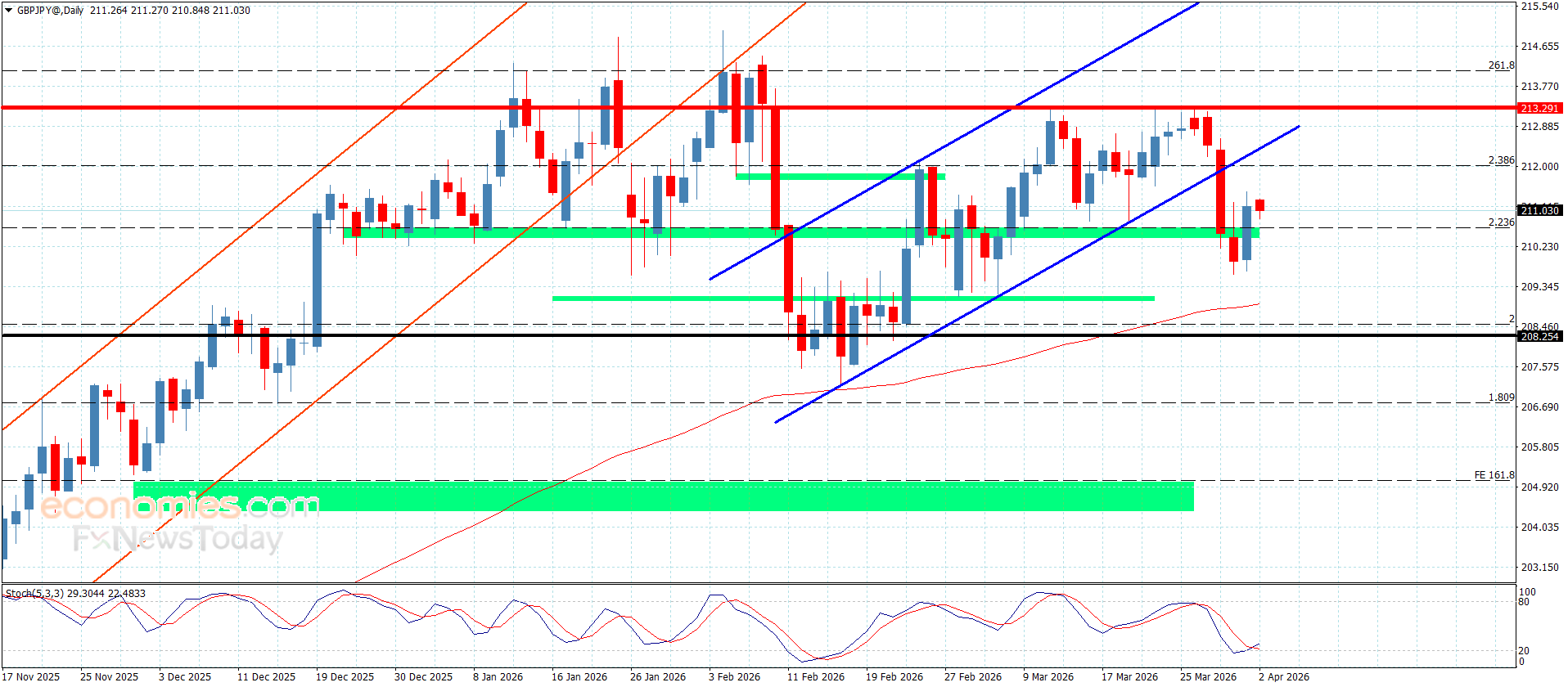
The GBPJPY pair is under positive pressure, which forces it to delay the bearish movement, by its rally above 210.60 level, recording some gains by reaching 211.43.
Note that the stability below the main resistance at 213.30 and forming extra barrier at 212.10 level makes us keep waiting for gathering negative momentum, to ease the mission of activating the negative scenario by reaching 210.60 initially, to begin targeting the negative stations near 209.10 and 208.25.
The expected trading range for today is between 209.10 and 211.80
Trend forecast: Bearish