The main tag of Gold Price Articles.
You can use the search box below to find what you need.
[wd_asp id=1]
The main tag of Gold Price Articles.
You can use the search box below to find what you need.
[wd_asp id=1]
The EURJPY pair moves away from 182.00 support, affected by the positivity of the main indicators, attacking the barrier at 184.20 which represents %66.8 Fibonacci corrective level as appears in the above image.
Note that the continuation of the stability below the barrier that might push it to provide new bearish trading, reaching 183.40 and 182.65, while breaching the barrier and holding above it will confirm its readiness to form strong bullish waves, to expect reaching 184.80, attempting to reach the next target near 185.45.
The expected trading range for today is between 183.40 and 184.20
Trend forecast: Fluctuating
Gold is popular among investors and often serves as a “safe haven”, a financial asset that helps preserve capital during economic instability. Forecasting the price of this instrument requires a comprehensive analysis of economic, political, and financial factors, as well as market trends and macroeconomic conditions.
In this article, we will examine the price history of XAU/USD and insights from professional analysts to develop scenarios for gold prices in 2026, 2027, 2028, and beyond.
The article covers the following subjects:
The current gold price as of 23.03.2026 is $4 391.03.
To assess the current state of the precious metal, the following metrics should be analyzed:
|
Metric |
Value (US) |
|
US Inflation Rate y/y |
2.4% |
|
US Interest Rate |
3.75% |
|
52-Week Range |
$2,880.30–$5,595.46 |
|
Yearly Change |
+19.65% |
|
Recommendation |
Buy |
|
All-Time High |
$5595.42 |
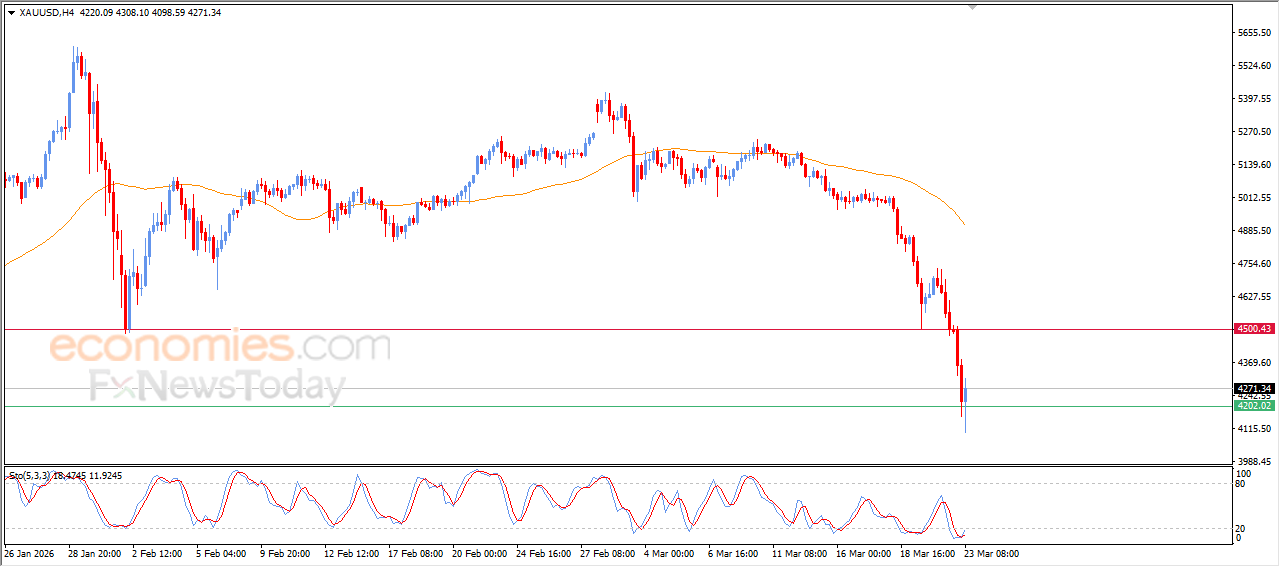
Gold’s medium-term uptrend reversed last week. As a result, the price dropped to the Target Zone 2 at 4,636–4,601. At the end of last week, the metal broke below this zone. Now, the Target Zone 3 at 4,278–4,243 is the next bearish target.
Consider short trades during pullbacks at the strong resistance A at 4,871–4,835 with a first target at 4,675 and a second one near last week’s low of 4,477.
Sell at resistance A at 4,871–4,835. TakeProfit: 4,675, 4,477. StopLoss: 4,957.
Technical analysis based on margin zones methodology was provided by an independent analyst, Alex Rodionov.
Gold continues to trade within a sustained ascending channel, with lows and highs increasing. After a strong impulse at the beginning of the year, the price corrected and tested the dynamic support area, after which the movement stabilized within the trading channel.
The XAU/USD is trading in the $5,100.00–$5,200.00 range above key moving averages. The SMA50 is trending above the SMA200, confirming the continuation of a strong medium-term uptrend.
MACD is gradually declining after the previous impulse, while the RSI remains in the 55–60 range, indicating a decrease in overbought conditions and a persisting upward trend. Notably, such consolidations often precede a new growth phase.
If the current structure persists, gold may continue to move within the bullish channel and gradually shift towards its upper boundary. In this case, the asset may surge to the $6,500.00–$7,000.00 range by the end of the year.
Below are the projected price levels for XAUUSD over the next 12 months.
|
Month |
Minimum, $ |
Average, $ |
Maximum, $ |
|
March 2026 |
4,950.00 |
5,150.00 |
5,400.00 |
|
April 2026 |
5,000.00 |
5,250.00 |
5,550.00 |
|
May 2026 |
5,050.00 |
5,350.00 |
5,700.00 |
|
June 2026 |
4,950.00 |
5,250.00 |
5,600.00 |
|
July 2026 |
5,100.00 |
5,450.00 |
6,000.00 |
|
August 2026 |
5,200.00 |
5,600.00 |
6,300.00 |
|
September 2026 |
5,100.00 |
5,450.00 |
6,100.00 |
|
October 2026 |
5,300.00 |
5,750.00 |
6,500.00 |
|
November 2026 |
5,400.00 |
5,900.00 |
6,800.00 |
|
December 2026 |
5,500.00 |
6,100.00 |
7,000.00 |
|
January 2027 |
5,400.00 |
5,850.00 |
6,700.00 |
|
February 2027 |
5,450.00 |
5,950.00 |
6,900.00 |
The strategy for 2026 suggests opening trades within the ascending channel on pullbacks to dynamic support levels, especially in the $4,900.00–$5,000.00 zone, where the channel line passes, and the SMA50 is located.
When the price settles in this area, you can open long positions with the expectation that the trend will continue. The closest targets are at previous highs and the upper boundary of the trading channel.
As bullish momentum develops, part of the position can be closed in the $6,000.00–$6,500.00 area, leaving part for a possible further upward movement. If the uptrend remains intact, the price may approach the $7,000.00 area by the end of the year.
Sometimes, the price may accelerate and break outside the channel in response to important news, such as increased geopolitical tensions, which boost demand for defensive assets.
An alternative scenario implies a price decline below $4,900.00. This would signal a weakening of momentum, prompting a reassessment of strategy.
Most analysts expect gold prices to rise in 2026, although opinions differ on the magnitude of the move. Some experts foresee moderate gains, while others anticipate a more substantial expansion in the trading range.
Price range: $4,819.00–$8,375.00.
LongForecast expects the price of XAU/USD to rise during the year. In the spring, gold quotes may rise above $5,600.00. In the middle of the year, the range will likely shift to the $6,000.00–$6,800.00 area and continue to expand in the fall. The maximum value of $8,375.00 can be reached in December.
|
Month |
Minimum, $ |
Average, $ |
Maximum, $ |
|
March |
4,819.00 |
5,417.00 |
5,688.00 |
|
April |
5,041.00 |
5,638.00 |
5,938.00 |
|
May |
5,638.00 |
5,988.00 |
6,287.00 |
|
June |
5,988.00 |
6,359.00 |
6,677.00 |
|
July |
6,147.00 |
6,407.00 |
6,794.00 |
|
August |
6,407.00 |
6,856.00 |
7,199.00 |
|
September |
6,728.00 |
7,082.00 |
7,436.00 |
|
October |
7,082.00 |
7,521.00 |
7,897.00 |
|
November |
7,514.00 |
7,909.00 |
8,304.00 |
|
December |
7,577.00 |
7,976.00 |
8,375.00 |
Price range: $5,218.19–$5,714.67.
According to WalletInvestor, the price of gold will rise steadily throughout the year. The price may settle above $5,200.00 and reach higher values, increasing in small increments over several months. Gold is expected to peak at $5,714.67 in December
|
Month |
Minimum, $ |
Average, $ |
Maximum, $ |
|
April |
5,218.19 |
5,249.85 |
5,281.51 |
|
May |
5,280.59 |
5,302.68 |
5,324.77 |
|
June |
5,330.62 |
5,346.80 |
5,362.97 |
|
July |
5,364.85 |
5,400.76 |
5,436.66 |
|
August |
5,444.68 |
5,479.78 |
5,514.87 |
|
September |
5,517.23 |
5,538.97 |
5,560.71 |
|
October |
5,562.28 |
5,590.52 |
5,618.76 |
|
November |
5,620.38 |
5,640.26 |
5,660.15 |
|
December |
5,662.05 |
5,688.36 |
5,714.67 |
Price range: $5,202.05–$10,023.00.
Analysts at CoinCodex predict a significant increase in the price of XAU/USD during the year. In the second half of the year, quotes may settle above $7,000.00, after which the range will continue to expand. The maximum value is expected in December at $10,023.00.
|
Month |
Minimum, $ |
Average, $ |
Maximum, $ |
|
March |
5,202.05 |
5,404.06 |
5,655.53 |
|
April |
5,440.43 |
5,801.78 |
6,684.81 |
|
May |
5,761.76 |
6,266.94 |
6,887.90 |
|
June |
6,321.63 |
6,645.32 |
6,993.62 |
|
July |
6,657.25 |
7,150.43 |
8,526.62 |
|
August |
7,139.95 |
7,762.88 |
8,535.46 |
|
September |
7,833.74 |
8,144.05 |
8,578.73 |
|
October |
8,515.89 |
8,981.15 |
9,641.53 |
|
November |
8,706.21 |
9,031.94 |
9,388.09 |
|
December |
9,265.56 |
9,566.24 |
10,023.00 |
Forecasts for 2027 generally agree that gold prices will continue to rise. Analysts predict that the upward trend will persist, with varying rates depending on the analytical models used. Analytical platforms differ significantly in their forecast ranges.
Note: The price ranges reflect the asset's expected volatility throughout the year. Lows and highs may not be shown in the summary tables.
Price range: $7,611.00–$11,389.00.
LongForecast anticipates the price of XAU/USD to rise during the year. According to the analytical platform, quotes will remain above $8,000.00 in the first half of the year, then growth may accelerate. In December, gold may hit a yearly high of $11,389.00.
|
Quarter |
Minimum, $ |
Average, $ |
Maximum, $ |
|
Q1 |
7,611.00 |
8,166.33 |
8,870.00 |
|
Q2 |
8,448.00 |
9,235.00 |
10,130.00 |
|
Q3 |
8,782.00 |
9,442.33 |
10,065.00 |
|
Q4 |
9,537.00 |
10,366.67 |
11,389.00 |
Price range: $5,716.79–$6,391.60.
WalletInvestor expects a gradual increase in gold prices throughout 2027. The price will likely move from levels above $5,700.00 to higher values without sharp fluctuations. The highest yearly price is expected at $6,391.60 in December.
|
Quarter |
Minimum, $ |
Average, $ |
Maximum, $ |
|
Q1 |
5,716.79 |
5,870.72 |
5,902.64 |
|
Q2 |
5,895.01 |
6,002.79 |
6,042.76 |
|
Q3 |
6,042.37 |
6,180.76 |
6,237.83 |
|
Q4 |
6,239.31 |
6,341.87 |
6,391.60 |
Price range: $9,547.56–$12,325.00.
According to CoinCodex, the price of XAU/USD will increase during the year, with significant fluctuations expected. According to the platform, in the first half of the year, gold will remain above $10,000.00 and continue to rally in the summer. It could reach a high of $12,325.00 in the third quarter, followed by a correction amid increased market volatility.
|
Quarter |
Minimum, $ |
Average, $ |
Maximum, $ |
|
Q1 |
9,547.56 |
10,928.67 |
12,233.00 |
|
Q2 |
10,826.00 |
11,330.33 |
11,988.00 |
|
Q3 |
11,761.00 |
12,007.00 |
12,325.00 |
|
Q4 |
10,153.00 |
10,957.00 |
11,844.00 |
Forecasts for 2028 suggest that the gold market will remain highly volatile. Experts link price expectations to inflationary trends, central bank interest rate decisions, and potential geopolitical turmoil. These factors often drive price fluctuations in safe-haven assets.
Price range: $10,246.00–$13,715.00.
According to LongForecast, the price of XAU/USD will grow throughout the year, although the movement is expected to be uneven. At the beginning of the year, quotes will likely stabilize above $11,000.00, then the range will gradually expand, and the price will move to higher values. The strongest movement is predicted closer to autumn, when a maximum of $13,715.00 will be reached.
|
Quarter |
Minimum, $ |
Average, $ |
Maximum, $ |
|
Q1 |
10,246.00 |
11,020.00 |
11,803.00 |
|
Q2 |
11,238.00 |
11,892.33 |
12,535.00 |
|
Q3 |
11,428.00 |
12,463.33 |
13,715.00 |
|
Q4 |
11,548.00 |
12,392.00 |
13,267.00 |
Price range: $6,401.76–$7,066.73.
WalletInvestor projects that the price of gold will increase throughout the year. The movement is expected to be gradual, with prices rising from above $6,400.00 to higher levels in stages. The highest level will be $7,066.73, reached by year-end.
|
Quarter |
Minimum, $ |
Average, $ |
Maximum, $ |
|
Q1 |
6,401.76 |
6,552.30 |
6,581.09 |
|
Q2 |
6,583.63 |
6,681.60 |
6,720.59 |
|
Q3 |
6,723.07 |
6,861.41 |
6,914.90 |
|
Q4 |
6,922.97 |
7,020.65 |
7,066.73 |
Price range: $10,356.00–$12,175.00.
According to CoinCodex, the price of gold is projected to trade in a wide range without a sustained trend throughout 2028. At different points, the market may shift from growth to a correction, reflecting increased volatility. The peak values are expected in the third quarter, with a maximum of $12,175.00.
|
Quarter |
Minimum, $ |
Average, $ |
Maximum, $ |
|
Q1 |
10,356.00 |
10,967.00 |
11,311.00 |
|
Q2 |
10,958.00 |
11,325.33 |
11,635.00 |
|
Q3 |
10,872.00 |
11,509.67 |
12,175.00 |
|
Q4 |
11,164.00 |
11,492.67 |
11,751.00 |
Forecasts for 2029 point to different scenarios for gold price movements. Some analysts predict further growth, while others suggest a gradual decline after gold hits higher levels. These discrepancies reflect the uncertainty of expectations in the gold market.
Price range: $11,574.00–$14,931.00.
According to LongForecast, gold may continue to rise throughout the year. In the spring, the price may rise above $13,000.00, and in the middle of the year, the range will expand and the market will move to higher levels. In August, gold may peak at $14,931.00.
|
Quarter |
Minimum, $ |
Average, $ |
Maximum, $ |
|
Q1 |
11,574.00 |
12,246.00 |
12,911.00 |
|
Q2 |
11,761.00 |
12,814.67 |
13,697.00 |
|
Q3 |
12,721.00 |
13,852.67 |
14,931.00 |
|
Q4 |
12,227.00 |
13,143.67 |
14,183.00 |
Price range: $7,076.13–$7,750.81.
WalletInvestor expects a steady rise in gold prices throughout the year. At the beginning of the year, gold prices are expected to remain above $7,000.00, then gradually rise to higher levels each quarter. By the end of the year, gold may reach a high of $7,750.81.
|
Quarter |
Minimum, $ |
Average, $ |
Maximum, $ |
|
Q1 |
7,076.13 |
7,230.83 |
7,258.99 |
|
Q2 |
7,257.35 |
7,359.91 |
7,398.47 |
|
Q3 |
7,400.52 |
7,538.26 |
7,590.70 |
|
Q4 |
7,598.30 |
7,700.99 |
7,750.81 |
Price range: $10,540.00–$12,244.00.
According to CoinCodex, after relatively high values at the beginning of the year, gold is expected to decline gradually. In the first months, the price may remain above $11,700.00, but by mid-year, the trading range will shift downward. The lowest yearly values near $10,540.00 are expected in August.
|
Quarter |
Minimum, $ |
Average, $ |
Maximum, $ |
|
Q1 |
11,765.00 |
11,966.33 |
12,244.00 |
|
Q2 |
11,229.00 |
11,745.67 |
12,178.00 |
|
Q3 |
10,540.00 |
11,900.00 |
11,365.00 |
|
Q4 |
10,679.00 |
11,072.00 |
11,538.00 |
Forecasts from analytical platforms for 2030 generally predict an increase in the price of gold. In their assessments, analysts take into account long-term demand from central banks, global foreign exchange rates, and investment flows into safe-haven assets. These factors can significantly boost demand for gold.
Price range: $7,753.71–$8,428.46.
According to WalletInvestor, the price of gold is expected to continue its steady rise throughout the year. In the first few months, quotes are likely to remain above $7,700.00 and gradually rise. The maximum price is likely to be $8,428.46, reached by the fourth quarter.
|
Quarter |
Minimum, $ |
Average, $ |
Maximum, $ |
|
Q1 |
7,753.71 |
7,907.33 |
7,936.75 |
|
Q2 |
7,931.30 |
8,037.69 |
8,076.38 |
|
Q3 |
8,078.13 |
8,217.48 |
8,273.81 |
|
Q4 |
8,276.06 |
8,378.04 |
8,428.46 |
Price range: $11,425.00–$13,965.00.
According to CoinCodex, XAU/USD is expected to experience significant fluctuations throughout the year, with an upward trend persisting. At the beginning of the year, gold will trade in the range of $11,500.00–$12,000.00, then the movement is likely to accelerate in the summer. Gold may hit a new all-time high of $13,965.00 in September.
|
Quarter |
Minimum, $ |
Average, $ |
Maximum, $ |
|
Q1 |
11,560.00 |
11,730.33 |
12,091.00 |
|
Q2 |
11,425.00 |
11,794.33 |
12,872.00 |
|
Q3 |
12,525.00 |
13,272.67 |
13,965.00 |
|
Q4 |
13,069.00 |
13,342.33 |
13,706.00 |
Long-term assessments of the gold market are based on a range of macroeconomic factors. Analysts consider changes in global reserve structures, central bank demand, investment flows, and the overall trajectory of the global economy. These factors can significantly affect the supply-demand balance in the precious metals market. As a result, long-term forecasts typically indicate the general direction of gold prices rather than precise levels on specific dates.
According to Coin Price Forecast, gold prices are expected to rise steadily over the long term. Analysts anticipate a gradual widening of the price range as the years progress. Based on the platform’s projections, prices could reach $21,247 by 2037.
|
Year |
Coin Price Forecast, $ |
|
2031 |
13,746.00 |
|
2033 |
16,620.00 |
|
2035 |
18,155.00 |
|
2037 |
21,247.00 |
Media sentiment about gold can significantly influence short-term price movements, as social media discussions shape traders’ expectations and amplify reactions to technical signals. When the market approaches important levels, the flow of comments can reinforce momentum and increase volatility. At such moments, market sentiment often becomes an additional factor accelerating price movements.
User @AamirFXPro is optimistic about the gold price, noting that strong buying momentum remains and anticipating a short-term pullback to the support zone before a resumption of growth. In this scenario, the current correction is seen as a potential turning point at which the upward trend could resume.
User @FxTrade_master1 takes a more cautious stance, highlighting the strong supply area. The price may decline if it fails to consolidate above this zone. The market may first decline before the trend continues.
Overall, sentiment appears mixed: some traders expect growth to continue after the pullback, while others anticipate a deeper correction.
Gold reached its all-time high of $5595.42 on 29.01.2026.
The lowest price of gold was recorded on 25.08.1999, when the asset declined to $252.55.
Below is the chart of XAU/USD covering the past 10 years. To make our forecasts as accurate as possible, it’s important to estimate historical data.
In 2021, as the global economy began to recover and inflation rose, gold prices fluctuated in response to shifts in monetary policies from major central banks. A strengthening US dollar put downward pressure on gold prices.
In 2022, geopolitical tensions, particularly the conflict in Ukraine, drove gold prices upward again. Inflation continued to climb, prompting central banks to tighten monetary policy.
A tug-of-war between inflationary expectations and rising interest rates marked 2023 and 2024. Gold remained sensitive to changes in bond yields and the geopolitical landscape.
From January to April 2025, gold prices rose from $2,624.61 to $3,499.98 amid escalating geopolitical tensions. Between late April and mid-August, the metal traded within a relatively narrow range of $3,120.83–$3,451.11. In late August 2025, the price rose to $4,381.24 before correcting.
At the end of December 2025, gold was trading near $4,550.00 amid strong demand for safe-haven assets. In early January, the asset stood at around $4,331.00. Subsequently, the price began to rise, setting a new all-time high of $5,593.00.
In early 2026, gold prices were highly volatile. By the end of January, the price had reached a historic high of $5,600.00, but then corrected to $4,401.00 amid strong US employment data.
By the end of February, the price had stabilized at $5,210.00 due to conflicting statements from the Fed about rate cuts. Geopolitical tensions in the Middle East supported demand for gold, but rising oil prices and a stronger dollar partially curbed further growth.
Fundamental analysis is typically associated with the stock market rather than precious metals. While experts analyze the financial statements of specific companies, XAU/USD analysts monitor macroeconomic factors, global political and economic news, and various forecasts.
The price of gold is influenced by a variety of economic and geopolitical factors:
Gold is one of the longest-standing and most valuable metals, with mining operations dating back over 6,000 years to ancient Egypt. During this period, gold was a symbol of power and wealth. Over time, gold has become a universally accepted means of exchange and an essential component of the global economy. Its scarcity and resilience to external influences drive the continued demand for this precious metal. Gold’s limited deposits and mining difficulty make it a valuable asset, particularly during economic uncertainty. In periods of economic turbulence, the demand for gold rises as it offers a reliable hedge against inflation.
Gold is a versatile asset, used not only as an investment tool but also in many industrial applications. In jewelry, it is esteemed for its aesthetic appeal and resilience. In electronics and medicine, gold is employed due to its conductivity and resistance to corrosion. In the space industry, it is used to safeguard equipment from radiation. In addition, gold is a favored asset among traders due to its liquidity. This precious metal is regarded as a symbol of stability and reliability, playing a pivotal role in the global economy.
Gold is a popular asset among traders and investors, offering a range of advantages over other asset types.
However, there are disadvantages to investing in gold.
Gold can be a valuable asset in a diversified portfolio, especially during economic uncertainty. However, it is essential to adopt a cautious approach and to carefully assess the potential risks involved before making investment decisions.
We employ a comprehensive approach to forecasting gold prices.
Gold appears to be a reliable way to preserve money during times of crisis and rising prices, when other assets fall in value. Strong demand for gold worldwide makes the XAUUSD pair an attractive long-term investment.
However, gold does not generate interest income, and its price can fluctuate significantly because of market speculation. In addition, holding physical gold entails extra expenses related to storage and insurance.
Although gold is not a one-size-fits-all solution, it can be a valuable asset for portfolio diversification. The XAUUSD pair can help reduce risk and provide protection against inflation. Nevertheless, it is essential to perform fundamental and technical analysis and study expert assessments before making any trading or investment decisions.
The content of this article reflects the author’s opinion and does not necessarily reflect the official position of LiteFinance broker. The material published on this page is provided for informational purposes only and should not be considered as the provision of investment advice for the purposes of Directive 2014/65/EU.
According to copyright law, this article is considered intellectual property, which includes a prohibition on copying and distributing it without consent.
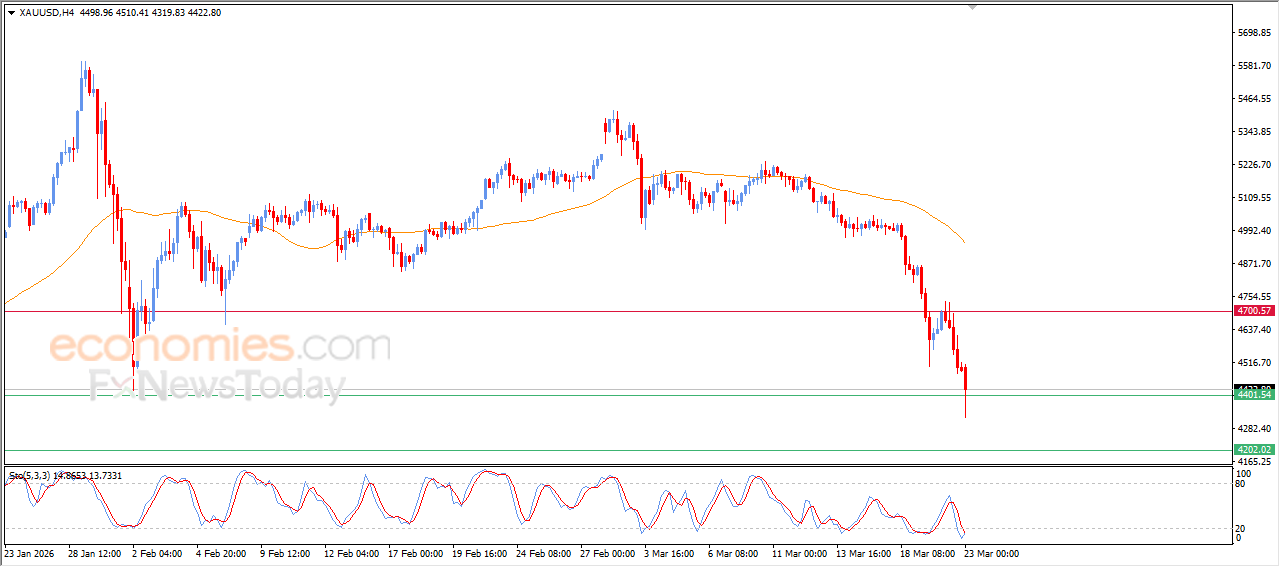
Gold continued its sharp decline during its latest intraday trading, reaching a key support level at $4,400, amid the dominance of a short-term bearish corrective trend. This comes alongside negative pressure due to trading below EMA50, reinforcing the dominance of the bearish trend.
On the other hand, we notice the beginning of a positive crossover of the relative strength indicators after reaching deeply oversold levels, which may support some corrective rebounds in the coming period, especially if the current support level holds, aiming to recover part of the previous losses.
Copper price confirmed its surrender to the bearish corrective bias, by providing several closes below the broken support that is represented by $5.5100 level, recording negative targets by reaching $5.1900.
The continuation of providing negative momentum by the main indicators might push the price to resume the corrective moves, to reach $5.0500 that might form an extra support, breaking this support will open a new way for targeting extra negative stations that might begin at $4.9500, while the stability above it might provide a chance for forming some bullish waves, to target $5.4200 level.
The expected trading range for today is between $5.0500 and $5.4000
Trend forecast: Bearish
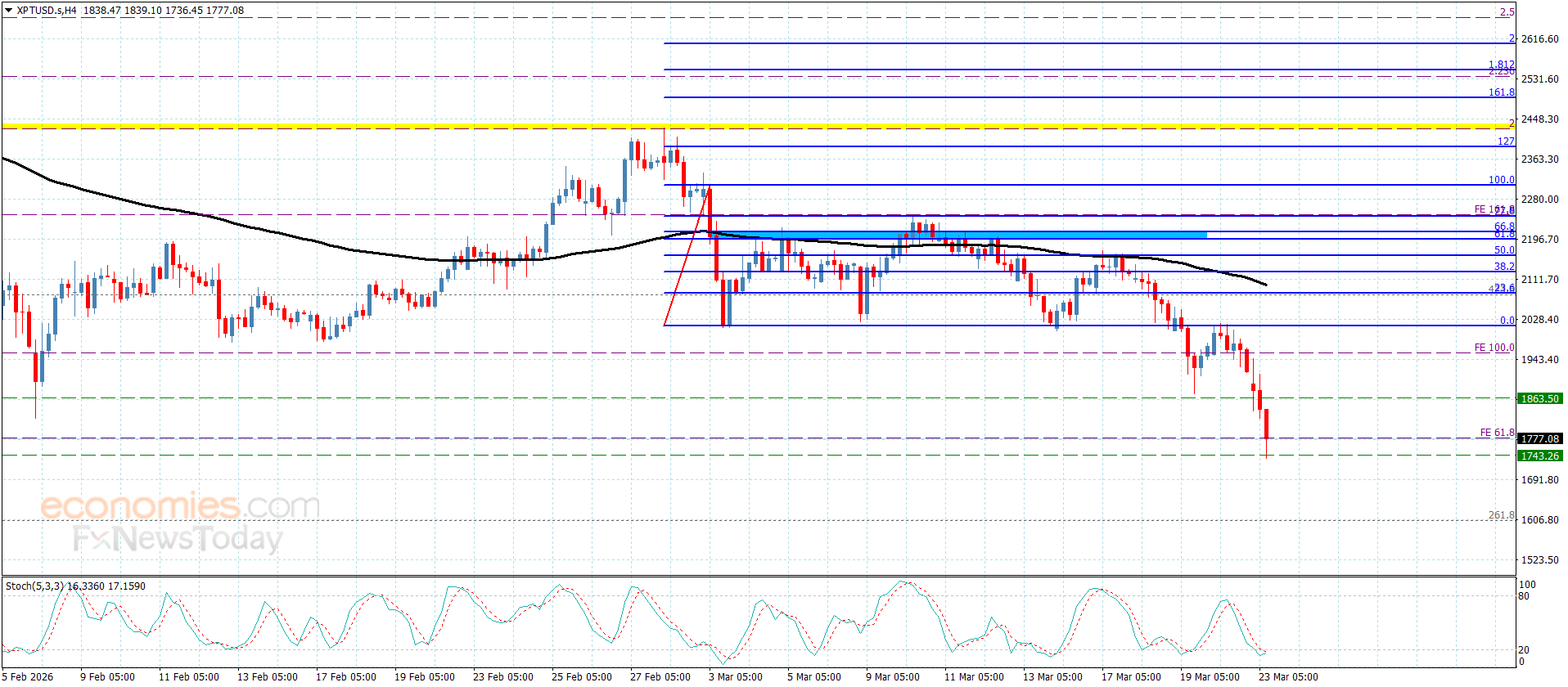
Price movements in platinum are often sharper than gold or silver due to its limited availability and reliance on a few global mining regions. Automotive regulations, global production levels, and technology usage influence the platinum price today. As platinum becomes more relevant in clean energy applications, its daily rate has gained importance for both buyers and investors.

The rise in oil prices is linked to tension between the United States and Iran, threats to energy infrastructure, and disruption in the Strait of Hormuz. Markets are reacting to supply risks and uncertainty. Brent futures closed at a high level before the weekend, showing strong demand concerns. Analysts say the situation has created pressure on supply chains and raised fears of further escalation. These developments are pushing traders to expect higher prices when markets reopen on Monday.
Brent futures are rising due to supply disruption and rising geopolitical risk. The closure of the Strait of Hormuz has reduced global oil supply. Iran’s attacks on ports and refineries across Gulf countries have also affected output. The market is pricing in risk linked to further damage to infrastructure. Brent gained about 8.8% last week and settled at $112.19 per barrel, which is the highest level since July 2022. Traders are reacting to uncertainty and limited supply availability.
Oil prices are expected to rise due to the 48-hour ultimatum issued by U.S. President Donald Trump to Iran. The warning includes possible action against Iranian power plants if the Strait of Hormuz is not reopened. Iran has responded with threats to attack U.S.-linked infrastructure in the Gulf. Analysts say this exchange increases the chance of escalation. This situation is likely to trigger a strong market reaction when trading begins on Monday.
Oil markets are reacting to statements from U.S. President Donald Trump and responses from Iran. Trump issued a 48-hour ultimatum to Iran to reopen the Strait of Hormuz. He also warned of action against Iranian power plants. Iran responded by stating it would target U.S.-linked infrastructure in the Gulf. This includes energy and desalination facilities. Analysts say this exchange has increased the risk of further escalation. Brent futures for May settled at $112.19 per barrel on Friday. This marked the highest level since July 2022. The weekly gain for Brent stood at about 8.8%.
The Strait of Hormuz plays a central role in global oil supply. The closure during the conflict has already removed around 440 million barrels from the market over 22 days. Iran has carried out attacks on ports and refineries in Saudi Arabia, Kuwait, Bahrain, the UAE, and Qatar. These actions have reduced supply flow and increased concern among traders. So far, Iran has not targeted major desalination plants. These plants provide water to millions in the region. Experts say damage to such facilities could disrupt daily life and force evacuations.
Experts say oil prices may rise further if tensions continue. Restoring supply from the Middle East Gulf may take up to six months, according to the International Energy Agency. Reports suggest the U.S. is considering steps involving Iran’s Kharg Island. Such moves could further impact supply and market stability. Markets will track developments around the Strait of Hormuz and any military action. Oil prices are expected to remain sensitive to updates.
Analysts say uncertainty is driving prices higher. Market analyst Tony Sycamore said the 48-hour deadline creates a situation that could push prices up if not resolved. Energy analyst Amrita Sen said the situation shows continued escalation. She added that expectations of Iran backing down may not hold. The price gap between WTI and Brent has also widened. WTI settled slightly lower last week, while Brent gained. The discount reached its widest level in 11 years.
Investors are closely watching why are Brent futures up and oil prices looking to surge on Monday, and what to expect next as volatility increases. Market participants are tracking updates on the Strait of Hormuz, supply restoration, and any military developments. Experts suggest monitoring global supply data and policy decisions before making moves. Oil prices may remain unstable in the short term due to ongoing tension. Investors are expected to focus on risk management and avoid decisions based only on short-term price movements.
Q1. Why are oil prices going to surge on Monday?
Oil prices are expected to surge on Monday due to rising U.S.-Iran tension, threats to energy infrastructure, and disruption in the Strait of Hormuz, which has reduced global supply and increased market uncertainty.
Q2. What factors will decide oil prices next?
Oil prices will depend on Strait of Hormuz reopening, Middle East developments, supply restoration timelines, U.S.-Iran actions, global demand levels, and the stability of energy infrastructure across Gulf countries in coming weeks.
NEW YORK, March 22, 2026, 2:24 PM EDT
U.S. natural gas opens the week trading close to $3.10 per mmBtu, following Friday’s settlement for the front-month April Henry Hub contract at $3.095. The main issue up ahead: will renewed U.S.-Iran tensions targeting Gulf energy sites send gas prices higher along with the broader energy sector as trading kicks back in? MarketWatch
Timing’s in play here. Henry Hub heads into the spring shoulder season—right between peak winter heating and the ramp-up for summer cooling—just as the global LNG crunch gets sharper. After Thursday’s price jump, Reuters said Saturday that the EU pushed members to scale back gas-storage refill goals to 80% from 90%. Officials, it seems, want to avoid fueling more upside. Reuters
Right now, U.S. weather looks mild. NOAA’s new 6-10 day and 8-14 day forecasts show most of the lower 48 heading for warmer-than-average temperatures, except the Northeast, which still stands apart. That mix suggests heating demand should ease off heading through late March into early April. Climate Prediction Center
Storage numbers are pointing in that direction. The Energy Information Administration logged a 35 billion cubic feet injection for the week ending March 13, taking total inventories up to 1.883 trillion cubic feet—2.6% higher than the five-year average. The next update lands March 26. EIA Information Releases
The bullish factor is coming from abroad. On Thursday, Reuters reported that Iranian strikes have taken out 17% of Qatar’s LNG export capacity — that’s 12.8 million tonnes per year — and repairs could stretch from three up to five years. QatarEnergy CEO Saad al-Kaabi said force majeure might have to be declared on some long-term supply deals to Europe and Asia, a move that would let the company suspend deliveries after such disruptions. Reuters
Analysts aren’t ignoring the risks. Saul Kavonic at MST Financial described the situation as a “doomsday gas-crisis scenario.” Tom Marzec-Manser of Wood Mackenzie added that gas prices in Europe and Asia are set to “remain elevated for longer,” as power generators and industrial players look to alternative fuels when possible. Reuters
Politics over the weekend just added to the confusion. On Sunday, Reuters said President Donald Trump warned he’d destroy Iran’s power infrastructure unless the Strait of Hormuz was cleared for shipping in 48 hours. Iran, for its part, fired back, threatening energy and desalination facilities across the Gulf. IG analyst Tony Sycamore labeled the standoff a “48-hour ticking time bomb” for markets. Reuters
Domestic supply isn’t looking tight enough yet to spark a breakout. U.S. gas rigs fell by two to 131 this week, according to Baker Hughes—the lowest count since early February. Even so, the EIA projects U.S. gas output will climb, reaching 109.5 billion cubic feet per day in 2026 from 107.7 bcfd in 2025. Reuters
That’s part of the reason gas-linked stocks can move out of sync with prompt futures. Cheniere and Venture Global both jumped after Qatar revealed the extent of the damage, while Reuters noted buyers are putting more focus on supply outside the Middle East. Companies like NextDecade and Sempra are increasingly seen as players in the longer-term replacement mix. Reuters
The week sets up for a clear divide. No new Gulf gas or LNG disruptions? Traders may pivot back to the mild U.S. forecast and the early pace of storage injections. But if weekend threats materialize and outages crop up, Henry Hub might begin tracking global moves more closely than it has recently. Climate Prediction Center
Summer’s still in focus on the strip. CME quotes put May at about $3.07 per mmBtu, with June bumped up to $3.20, July holding $3.47, and August at $3.56. Each contract remains above April’s $3.10. Traders are watching three things to break the standoff: Thursday’s storage print, the latest weather models, and any sudden headlines from the Gulf. CME Group
Price movements in platinum are often sharper than gold or silver due to its limited availability and reliance on a few global mining regions. Automotive regulations, global production levels, and technology usage influence the platinum price today. As platinum becomes more relevant in clean energy applications, its daily rate has gained importance for both buyers and investors.
Price movements in platinum are often sharper than gold or silver due to its limited availability and reliance on a few global mining regions. Automotive regulations, global production levels, and technology usage influence the platinum price today. As platinum becomes more relevant in clean energy applications, its daily rate has gained importance for both buyers and investors.