The main tag of Gold Price Articles.
You can use the search box below to find what you need.
[wd_asp id=1]
The main tag of Gold Price Articles.
You can use the search box below to find what you need.
[wd_asp id=1]
West Texas Intermediate (WTI) Oil price falls on Wednesday, early in the European session. WTI trades at $58.19 per barrel, down from Tuesday’s close at $58.22.
Brent Oil Exchange Rate (Brent crude) is also shedding ground, trading at $62.00 after its previous daily close at $62.07.
WTI Oil is a type of Crude Oil sold on international markets. The WTI stands for West Texas Intermediate, one of three major types including Brent and Dubai Crude. WTI is also referred to as “light” and “sweet” because of its relatively low gravity and sulfur content respectively. It is considered a high quality Oil that is easily refined. It is sourced in the United States and distributed via the Cushing hub, which is considered “The Pipeline Crossroads of the World”. It is a benchmark for the Oil market and WTI price is frequently quoted in the media.
Like all assets, supply and demand are the key drivers of WTI Oil price. As such, global growth can be a driver of increased demand and vice versa for weak global growth. Political instability, wars, and sanctions can disrupt supply and impact prices. The decisions of OPEC, a group of major Oil-producing countries, is another key driver of price. The value of the US Dollar influences the price of WTI Crude Oil, since Oil is predominantly traded in US Dollars, thus a weaker US Dollar can make Oil more affordable and vice versa.
The weekly Oil inventory reports published by the American Petroleum Institute (API) and the Energy Information Agency (EIA) impact the price of WTI Oil. Changes in inventories reflect fluctuating supply and demand. If the data shows a drop in inventories it can indicate increased demand, pushing up Oil price. Higher inventories can reflect increased supply, pushing down prices. API’s report is published every Tuesday and EIA’s the day after. Their results are usually similar, falling within 1% of each other 75% of the time. The EIA data is considered more reliable, since it is a government agency.
OPEC (Organization of the Petroleum Exporting Countries) is a group of 12 Oil-producing nations who collectively decide production quotas for member countries at twice-yearly meetings. Their decisions often impact WTI Oil prices. When OPEC decides to lower quotas, it can tighten supply, pushing up Oil prices. When OPEC increases production, it has the opposite effect. OPEC+ refers to an expanded group that includes ten extra non-OPEC members, the most notable of which is Russia.
Gold is trading higher for the fifth consecutive day on Wednesday, attempting to confirm the breach of the $4,200. The precious metal is trading at $4,193 at the time of writing, after having hit a fresh all-time high at $4,218 earlier on the day.
Bullion is drawing support from a softer US Dollar on Wednesday, following dovish comments by the Fed Chairman Jerome Powell at a speech in Philadelphia. Powell reiterated that the labour market deterioration is more concerning than inflation right now, which practically confirms a rate cut in October and raises expectations of another one in December.
The technical picture shows Gold skyrocketing. The pair has rallied an eye-watering 27% in less than two months, which normally leads to a correction. The 4-hour RSI is way within overbought territory. So far, however, downside attempts remain limited.
Above the $4,200 level, the 172.2% Fibonacci extension of the October 1.14 rally is at $4,235, and the 161.8% Fibonacci extension of the same cycle is at $4,300; these are the following potential targets.
Downside attempts remain contained at the previous all-time high near $4170 (Tuesday’s high). Further down, Tuesday’s low at $4,090 and the October 8, 9 highs at $4.050 area would come into focus.
Gold has played a key role in human’s history as it has been widely used as a store of value and medium of exchange. Currently, apart from its shine and usage for jewelry, the precious metal is widely seen as a safe-haven asset, meaning that it is considered a good investment during turbulent times. Gold is also widely seen as a hedge against inflation and against depreciating currencies as it doesn’t rely on any specific issuer or government.
Central banks are the biggest Gold holders. In their aim to support their currencies in turbulent times, central banks tend to diversify their reserves and buy Gold to improve the perceived strength of the economy and the currency. High Gold reserves can be a source of trust for a country’s solvency. Central banks added 1,136 tonnes of Gold worth around $70 billion to their reserves in 2022, according to data from the World Gold Council. This is the highest yearly purchase since records began. Central banks from emerging economies such as China, India and Turkey are quickly increasing their Gold reserves.
Gold has an inverse correlation with the US Dollar and US Treasuries, which are both major reserve and safe-haven assets. When the Dollar depreciates, Gold tends to rise, enabling investors and central banks to diversify their assets in turbulent times. Gold is also inversely correlated with risk assets. A rally in the stock market tends to weaken Gold price, while sell-offs in riskier markets tend to favor the precious metal.
The price can move due to a wide range of factors. Geopolitical instability or fears of a deep recession can quickly make Gold price escalate due to its safe-haven status. As a yield-less asset, Gold tends to rise with lower interest rates, while higher cost of money usually weighs down on the yellow metal. Still, most moves depend on how the US Dollar (USD) behaves as the asset is priced in dollars (XAU/USD). A strong Dollar tends to keep the price of Gold controlled, whereas a weaker Dollar is likely to push Gold prices up.
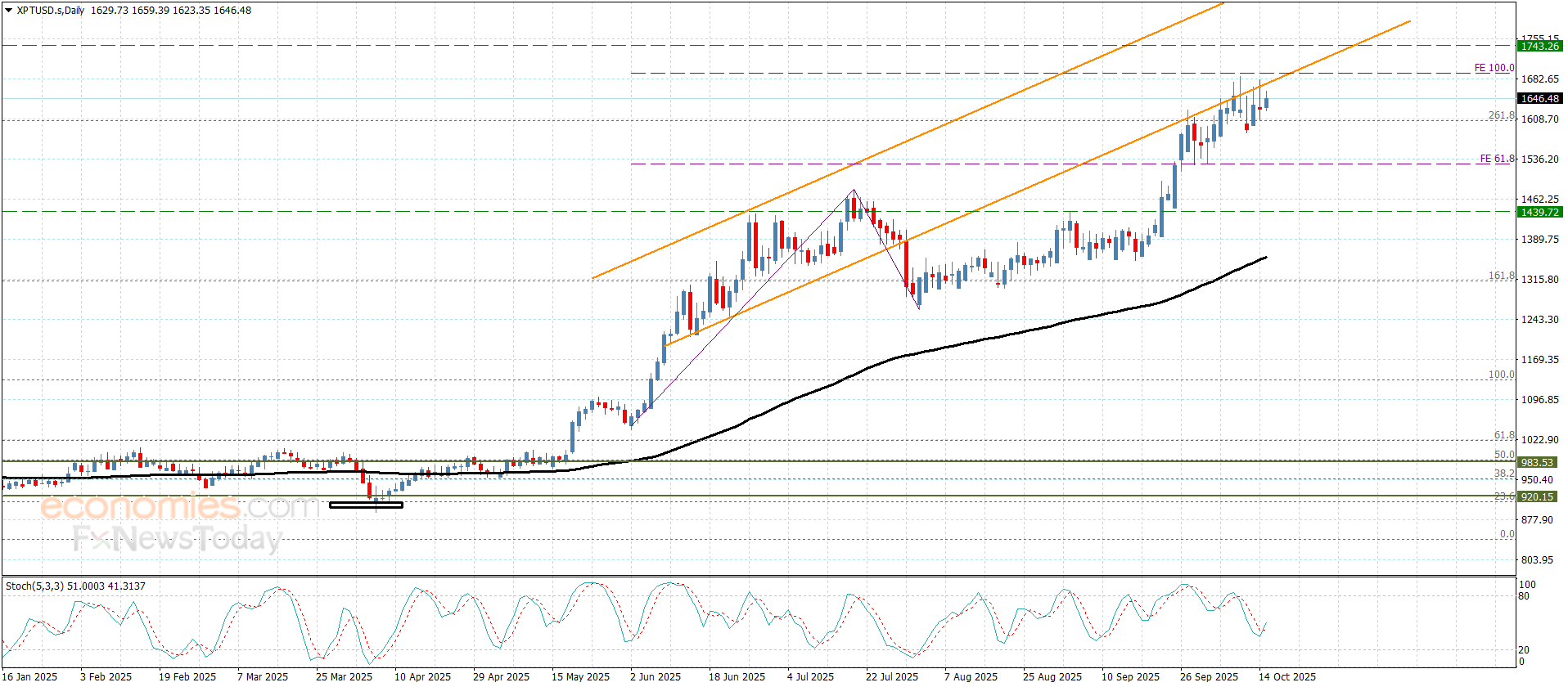
Platinum price is affected by the stability of the barrier near $1690.00, despite the attempt to provide positive momentum by the main indicators, which forces it to provide new sideways trading near $1650.00 level, attempting to settle above the extra support at $1600.00.
Reminding you that the bullish scenario will remain valid by the stability of the price above 61.8% Fibonacci extension level that is located near $1625.00, which makes us wait to breach the current barrier, then targeting new historical stations that might begin at $1745.00 reaching the next main target near $1835.00.
The expected trading range for today is between $1610.00 and $1690.00
Trend forecast: Sideways until achieving the breach
Platinum price is affected by the stability of the barrier near $1690.00, despite the attempt to provide positive momentum by the main indicators, which forces it to provide new sideways trading near $1650.00 level, attempting to settle above the extra support at $1600.00.
Reminding you that the bullish scenario will remain valid by the stability of the price above 61.8% Fibonacci extension level that is located near $1625.00, which makes us wait to breach the current barrier, then targeting new historical stations that might begin at $1745.00 reaching the next main target near $1835.00.
The expected trading range for today is between $1610.00 and $1690.00
Trend forecast: Sideways until achieving the breach
Silver price (XAG/USD) holds positive ground around $51.90 during the early Asian session on Wednesday. The white metal retreats from an all-time high after a historic squeeze in London began to show some signs of easing. However, the potential downside might be limited amid trade tensions and US rate cut expectations.
A rise in Silver price in the previous session is bolstered by concerns over a depleting silver inventory in London, which drove prices to a premium over those seen in New York and prompted traders to ship metals across the Atlantic for a profit. Nonetheless, a historic squeeze in London began to show some signs of easing, which might drag the white metal lower.
Rising trade tension between the US and China boosts the safe-haven flows, benefiting the Silver price. US Trade Representative Jamieson Greer said on Tuesday that US President Donald Trump could slap China with 100% tariffs on November 1 or sooner, depending on Beijing’s next action in a dispute over rare earths.
Bets the Federal Reserve (Fed) will cut interest rates twice more this year might contribute to Silver’s upside. Fed Chair Jerome Powell signaled the Fed is on track to deliver another quarter-point interest-rate reduction later this month, even as a government shutdown significantly reduces its read on the economy. Lower interest rates could reduce the opportunity cost of holding Silver, supporting the non-yielding precious metal.
Silver is a precious metal highly traded among investors. It has been historically used as a store of value and a medium of exchange. Although less popular than Gold, traders may turn to Silver to diversify their investment portfolio, for its intrinsic value or as a potential hedge during high-inflation periods. Investors can buy physical Silver, in coins or in bars, or trade it through vehicles such as Exchange Traded Funds, which track its price on international markets.
Silver prices can move due to a wide range of factors. Geopolitical instability or fears of a deep recession can make Silver price escalate due to its safe-haven status, although to a lesser extent than Gold’s. As a yieldless asset, Silver tends to rise with lower interest rates. Its moves also depend on how the US Dollar (USD) behaves as the asset is priced in dollars (XAG/USD). A strong Dollar tends to keep the price of Silver at bay, whereas a weaker Dollar is likely to propel prices up. Other factors such as investment demand, mining supply – Silver is much more abundant than Gold – and recycling rates can also affect prices.
Silver is widely used in industry, particularly in sectors such as electronics or solar energy, as it has one of the highest electric conductivity of all metals – more than Copper and Gold. A surge in demand can increase prices, while a decline tends to lower them. Dynamics in the US, Chinese and Indian economies can also contribute to price swings: for the US and particularly China, their big industrial sectors use Silver in various processes; in India, consumers’ demand for the precious metal for jewellery also plays a key role in setting prices.
Silver prices tend to follow Gold’s moves. When Gold prices rise, Silver typically follows suit, as their status as safe-haven assets is similar. The Gold/Silver ratio, which shows the number of ounces of Silver needed to equal the value of one ounce of Gold, may help to determine the relative valuation between both metals. Some investors may consider a high ratio as an indicator that Silver is undervalued, or Gold is overvalued. On the contrary, a low ratio might suggest that Gold is undervalued relative to Silver.
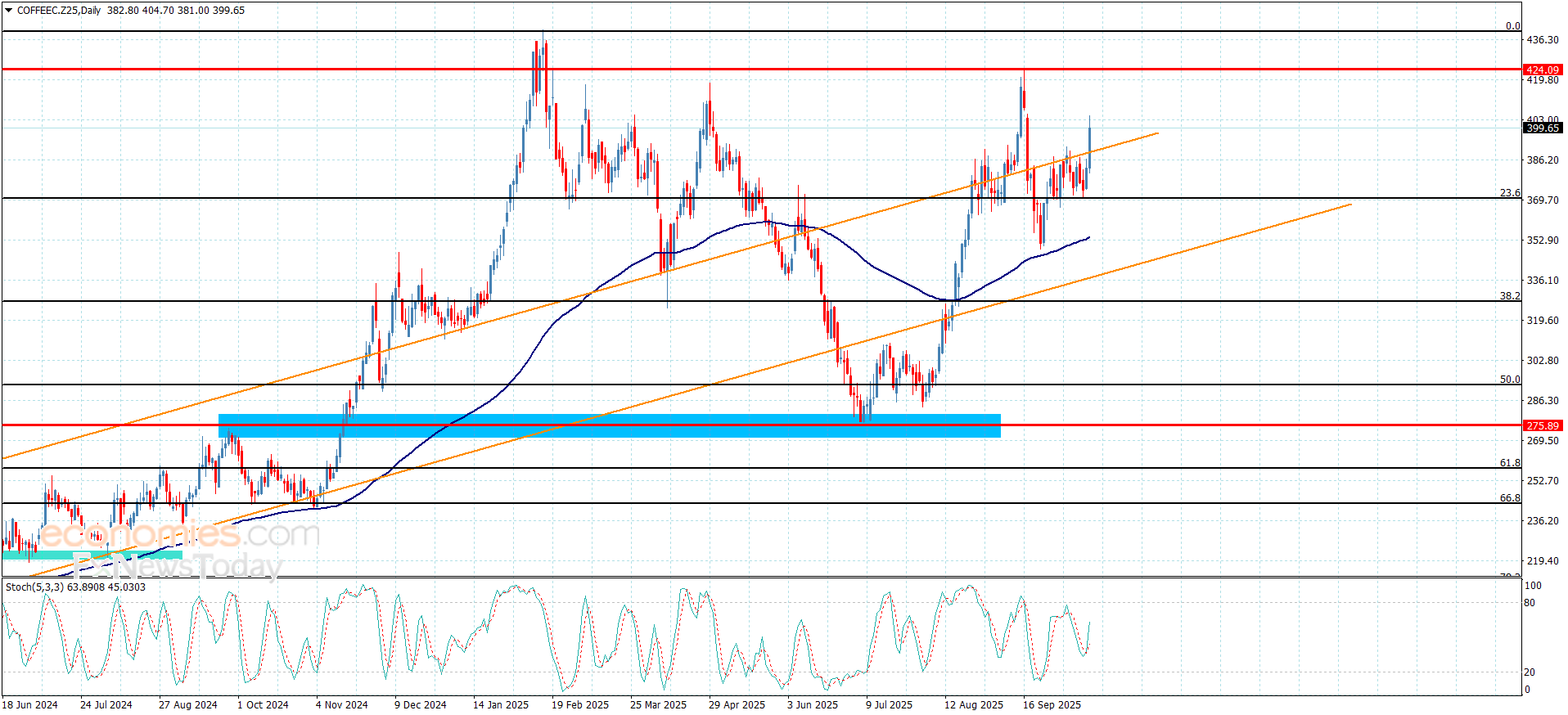
Coffee price took advantage of the support level stability at 371.00, to begin activating with the main indicators, forming strong bullish rally to surpass the initial resistance at 390.25, achieving new gains by its stability near 400.00.
The continuation of the positive pressure makes us prefer more of the bullish attempts, to wait for reaching 414.25 level, then attempts to press on the recently achieved top at 424.00.
The expected trading range for today is between 382.00 and 414.25
Trend forecast: Bullish
Gold keeps on making higher highs on the daily time frame, sitting close to fresh record highs below $4,200 early Wednesday.
Markets continue to witness dip-buying on every pullback in Gold so far this week, as buyers remain undeterred by the bullish sentiment on global stocks.
The latest leg up in Gold seems to be sponsored by the renewed trade tensions between the United States (US) and China after US President Donald Trump posted on social media late Tuesday that he was considering terminating business with China having to do with cooking oil, and other elements of trade, as retribution.
Meanwhile, both sides began charging tit-for-tat port fees on Tuesday, per Reuters. This followed Trump’s retaliatory threats to slap 100% tariffs on Chinese imports as the trade war escalated after China tightened controls on its rare earth exports last week.
US-Sino trade worries combined with persistent bets for two interest rate cuts by the US Federal Reserve (Fed) render negative for the US Dollar (USD), benefiting the non-yielding bright metal.
Despite Fed Chair Jerome Powell’s prudent remarks on Tuesday, markets continue to price in over 90% probabilities for the October and the December monetary policy meetings, the CME Group’s FedWatch Tool shows.
Powell noted that the overall US economy “may be on a somewhat firmer trajectory than expected,” while also cautioning that “there is no risk-free path for policy as we navigate the tension between our employment and inflation goals.”
Further, the USD also feels the heat from a stronger Yuan (CNY) fix by the People’s Bank of China (PBOC), which surprised markets.
On Wednesday, the People’s Bank of China (PBOC) set the USD/CNY central rate at 7.0995 compared to the previous day’s fix of 7.1021 and 7.1281 Reuters estimate.
All eyes now remain on a bunch of Fed speakers for fresh policy cues amid a lack of high-impact US economic releases.
Additionally, the broad market sentiment and US-China trade updates will continue to play a pivotal role in the Gold price action going forward.
The daily chart shows that the 14-day Relative Strength Index (RSI) is inching further into the extreme overbought zone, currently near 84, suggesting that a pullback remains in the offing.
Meanwhile, Gold buyers are once again challenging the upper boundary of the month-long rising channel, now at $4,184.
Buyers must find acceptance above the topside hurdle of the channel on a daily candlestick basis to resume the record-setting rally beyond the $4,200 round level.
The $4,250 psychological level will be next on tap for Gold optimists.
On the contrary, sellers could fall back toward the $4,100 round level in case Gold faces rejection at the above-mentioned channel resistance.
The next crucial support is seen at the lower boundary of the rising channel at $4,036.
A sustained move below the channel support would confirm a pattern breakdown, fuelling further correction toward the $3,950 psychological mark.
Gold has played a key role in human’s history as it has been widely used as a store of value and medium of exchange. Currently, apart from its shine and usage for jewelry, the precious metal is widely seen as a safe-haven asset, meaning that it is considered a good investment during turbulent times. Gold is also widely seen as a hedge against inflation and against depreciating currencies as it doesn’t rely on any specific issuer or government.
Central banks are the biggest Gold holders. In their aim to support their currencies in turbulent times, central banks tend to diversify their reserves and buy Gold to improve the perceived strength of the economy and the currency. High Gold reserves can be a source of trust for a country’s solvency. Central banks added 1,136 tonnes of Gold worth around $70 billion to their reserves in 2022, according to data from the World Gold Council. This is the highest yearly purchase since records began. Central banks from emerging economies such as China, India and Turkey are quickly increasing their Gold reserves.
Gold has an inverse correlation with the US Dollar and US Treasuries, which are both major reserve and safe-haven assets. When the Dollar depreciates, Gold tends to rise, enabling investors and central banks to diversify their assets in turbulent times. Gold is also inversely correlated with risk assets. A rally in the stock market tends to weaken Gold price, while sell-offs in riskier markets tend to favor the precious metal.
The price can move due to a wide range of factors. Geopolitical instability or fears of a deep recession can quickly make Gold price escalate due to its safe-haven status. As a yield-less asset, Gold tends to rise with lower interest rates, while higher cost of money usually weighs down on the yellow metal. Still, most moves depend on how the US Dollar (USD) behaves as the asset is priced in dollars (XAU/USD). A strong Dollar tends to keep the price of Gold controlled, whereas a weaker Dollar is likely to push Gold prices up.
The EURJPY pair continued providing temporary trading, affected by the stability of the barrier at 177.05 to reach 175.95 again, to announce delaying the bullish attack in the current period.
Stochastic reach below 50 level might force the price to provide more of the corrective trading, to test the extra support at 175.20 to confirm monitoring the price behavior, as monitoring the price behavior is important due to the importance of the support by detecting the expected targets in the near and medium period trading.
The expected trading range for today is between 175.20 and 176.50
Trend forecast: Fluctuated within the bullish track
The day’s high aligned precisely with the upper parallel trendline of a long-term rising channel, with the lower channel line connecting the September 2018 swing low and the upper parallel touching the July 2011 swing high. This alignment suggests the market recognizes the line as potential dynamic resistance. But what happens next will be key.
The Relative Strength Index (RSI) reflects overbought conditions, approaching extreme levels, which could preclude consolidation or retracement. Monday’s breakout above a near-term rising channel, following consolidation near its upper boundary, demonstrates robust momentum. Yesterday’s wide-range green candle and close near the high reinforce this bullish behavior, though such trend extensions carry the risk of a blow-off top.
Should the top channel line assert resistance, an initial sign of weakness would emerge on a decline below today’s low of $4,090. The 10-day moving average at $3,983 serves as key near-term support, consistently effective since its reclaim on August 22. This level warrants monitoring for signs of buyer defense on approach. A decisive break below $3,983 would target the 20-day average at $3,870, indicating a deeper pullback.
A confirmed breakout above $4,180 would position gold for higher targets, though the rising nature of the top channel line means prices could advance further while remaining near or below resistance. The overall structure supports continued upside potential until confirmed weakness appears. Today’s close will provide clarity on momentum sustainability, with the 10-day average as a critical benchmark for the trend’s health.
For a look at all of today’s economic events, check out our economic calendar.
Spot Gold reached $4,179.76 a troy ounce on Tuesday, a fresh record high. The XAU/USD pair currently hovers in the 4,140 region, holding on to solid intraday gains amid risk aversion taking over financial boards. Concerns revolve around the United States (US), as on the one hand, the federal government remains shut down amid the lack of funding. On the other hand, fresh trade tensions between the US and China seem to have been interrupted, and threats of reciprocal levies resumed.
The US Dollar (USD) was able to advance throughout the first half of the day, but not versus the bright metal. It changed course after Wall Street’s opening, as US indexes trade in positive territory, shrugging off concerns and limiting Gold’s gains.
Meanwhile, Federal Reserve (Fed) Chairman Jerome Powell spoke about the economic outlook and monetary policy at the National Association for Business Economics (NABE) conference in Philadelphia, adding to the USD weakness in the American session.
Among other things, Powell noted that right now there is no risk-free path for monetary policy and that decisions will be driven by data and risk assessments. Additionally, he said that there is a risk that the slow pass-through of tariffs starts to look like persistent inflation, and that the labour market has demonstrated significant downside risk.
The XAU/USD pair is extremely overbought in the daily chart, but still bullish. Technical indicators maintain their strong upward slopes within overbought levels, without signs of exhaustion. At the same time, the pair advances far beyond bullish moving averages, which reflect the ongoing persistent demand. The 20 Simple Moving Average (SMA) currently stands at $3,863.90.
In the near term, and according to the 4-hour chart, XAU/USD has scope to extend its advance. The pair met intraday buyers in the $4,090 area, while developing above all bullish moving averages. At the same time, the Momentum indicator resumed its advance after correcting extreme readings, while the Relative Strength Index (RSI) indicator currently consolidates around 66, also supporting the bullish case.
Support levels: 4,123.20 4,090.00 4,078.10
Resistance levels: 4,155.30 4,180.00 4,200.00