The main tag of Gold Price Articles.
You can use the search box below to find what you need.
[wd_asp id=1]
The main tag of Gold Price Articles.
You can use the search box below to find what you need.
[wd_asp id=1]
Gold (XAU/USD) retreats slightly following an Asian session move higher to the $4,525 area, or a fresh all-time peak, though the downside remains limited amid a supportive fundamental backdrop. The US Dollar (USD) selling bias remains unabated on the back of dovish Federal Reserve (Fed) expectations, which continues to act as a tailwind for the non-yielding yellow metal. Apart from this, geopolitical uncertainties turn out to be another factor driving safe-haven flows towards the bullion.
The USD Index (DXY), which tracks the Greenback against a basket of currencies, prolongs its weekly downtrend for the third straight day and drops to a fresh low since early October amid rising bets for further policy easing by the US central bank. The US Consumer Price Index (CPI) was surprisingly soft in November. Furthermore, signs of a cooling US labor market reinforced market expectations that the Fed will lower borrowing costs two more times in 2026. Adding to this, US President Donald Trump publicly stated his expectation for the next Fed Chair to lower interest rates during periods of strong market performance and even when the economy is performing well. This overshadows the upbeat US GDP growth figures and continues to undermine the USD, benefiting the Gold price.
A delayed report published by the US Bureau of Economic Analysis showed on Tuesday that the economy expanded by a 4.3% annualized pace during the July-September period amid resilient consumer and business spending. The reading was stronger than consensus estimates and higher than the 3.8% rise recorded in the previous quarter. The market reaction, however, turns out to be muted as the longest-ever US government shutdown is expected to weigh on fourth-quarter growth. Separately, the US Census Bureau reported that Durable Goods Orders declined 2.2% in October, following the 0.7% increase in the previous month and worse than 1.5% fall anticipated. Moreover, a sharp fall in the consumer confidence index in December suggests that households are becoming more cautious about the future.
This, in turn, favors the USD bears, which should continue to support the XAU/USD pair. Moreover, tensions linked to the United States’ actions against vessels carrying Venezuelan oil, escalating the Russia-Ukraine war, and a potential new Israel-Iran conflict validate the near positive outlook for the safe-haven Gold. That said, the upbeat market mood holds back traders from placing fresh bullish bets around the precious metal amid the year-end thin liquidity. Market participants now look forward to the release of the usual US Weekly Initial Jobless Claims data for some impetus later during the North American session. Nevertheless, the fundamental backdrop suggests that the path of least resistance for the bullion remains to the upside, and any meaningful corrective pullback could be seen as a buying opportunity.
The overnight breakout through a nearly two-month-old ascending trend-channel resistance and a subsequent strength beyond the $4,500 psychological mark could be seen as a fresh trigger for the XAU/USD bulls. Adding to this, the Moving Average Convergence Divergence (MACD) line stands above the Signal line and above zero, while an expanding positive histogram suggests strengthening bullish momentum.
However, the Relative Strength Index (RSI) is flagging overstretched conditions even as buyers retain control. Should gains stall, the channel’s lower boundary at $4,203.35 acts as key support, while maintaining a positive MACD profile, and an RSI easing toward 70 would help reset conditions for trend continuation. Nevertheless, a pause would not derail the broader advance as the outlook remains positive following the breakout.
(The technical analysis of this story was written with the help of an AI tool)
Updated: 23.12.2025 — 5:04
Natural gas markets are closing in on year-end with a familiar mix of winter weather risk, record LNG pull, and stubbornly strong production—but on Tuesday, December 23, 2025, the bullish forces briefly overwhelmed the bears.
In the U.S., Henry Hub front-month futures surged into the mid-$4s per million British thermal units (mmBtu), after trading swung from an early single-digit gain to a double-digit move later in the day. Reuters pricing showed the front month around $4.41/mmBtu on the session, up sharply on the day with an intraday range roughly $3.94–$4.45. [1]
Across the Atlantic, benchmark Dutch TTF gas eased below €28/MWh in thin pre-holiday trading, with Norway and LNG supply cushioning the market even as temperatures are expected to turn colder in parts of Europe. [2]
Below is a detailed roundup of the key news, forecasts, and market analysis shaping natural gas on 23.12.2025—and the catalysts traders are watching next.
Early Tuesday, U.S. natural gas futures pushed higher as flows to LNG export plants hit fresh highs and forecasters upgraded the next two weeks’ demand outlook.
Reuters reporting cited record-level feedgas flows and an improved demand projection from LSEG. In morning trade, the January NYMEX contract was up around 4% and trading near $4.105/mmBtu, supported by expectations that gas demand (including exports) could rise from roughly 127.9 bcfd this week to about 136.0 bcfd over the next two weeks. [3]
That demand uplift matters because the U.S. gas market is increasingly balanced at the margin by export pull, not just domestic heating loads.
Later in the session, market commentary pointed to a classic year-end dynamic: thinner liquidity, more stop-driven moves, and fast-changing weather runs.
A separate market analysis described a late-day surge, with January futures trading around $4.370/mmBtu and up more than 10% at one point, as record LNG demand collided with colder revisions in parts of the U.S. outlook. [4]
While forecasts still include warmer-than-normal periods (a bearish signal for heating demand), traders are increasingly sensitive to any model shift that reintroduces cold into the highly populated U.S. East—because that’s where residential and commercial demand can spike quickly.
The most important U.S. gas storyline on December 23 is simple: LNG export demand remains near full throttle.
Reuters-linked reporting said LNG feedgas was on track to reach about 18.6 bcfd on Tuesday (a record area), supported by higher intake at major facilities including Cameron, Freeport, and Calcasieu Pass. [5]
This isn’t a short-term quirk. The EIA’s most recent weekly market update highlighted just how large U.S. LNG logistics have become, noting that 33 LNG vessels departed U.S. ports in a single week (Dec. 11–17) with a combined carrying capacity of 126 Bcf. [6]
Why it matters for price: When LNG feedgas stays elevated, it reduces the market’s ability to “relax” even during mild weather breaks—because export terminals keep pulling molecules regardless of whether Chicago or New York is having a warm spell.
Even as prices spiked Tuesday, the supply side continues to impose a ceiling on sustained upside.
Reuters-cited figures put Lower 48 output around 111.1 bcfd in December—an all-time high area—illustrating that U.S. producers and infrastructure are still delivering large volumes into the system. [7]
That supply strength is showing up in storage resilience as well:
This combination—very strong exports and very strong production—is why the market can rally sharply on weather risk, but also why those rallies can struggle to hold if the cold fails to materialize.
European gas prices stayed relatively contained on December 23, even as the market monitored colder conditions.
A Reuters-sourced European market report showed:
The same report pegged EU storage at 67.24% full, a key benchmark because Europe’s winter price sensitivity rises sharply when inventories fall. [10]
An Engie market note cited in the report suggested fundamentals were currently bearish, but warned that risk factors—particularly on the U.S. supply side—could still flip sentiment if prices keep falling. [11]
And with Europe entering winter with lower storage than recent years, an S&P Global LNG analyst quoted in the report said buyers may be compelled to increase LNG procurement in January and February. [12]
Norway remains Europe’s largest natural gas supplier, and on December 23 Reuters reported that Norwegian oil and gas output in November beat official forecasts, with gas output slightly down year-on-year but above forecast. [13]
Steady Norwegian flows—plus LNG arrivals—help explain why TTF can remain subdued even with winter weather risk in the background.
One of the most consequential geopolitical gas headlines on December 23 came from Iraq.
Reuters reported that Iraq’s electricity ministry said gas supplies from Iran have been halted, and the disruption knocked an estimated 4,000–4,500 megawatts out of Iraq’s power system. [14]
While this is primarily a regional power-generation story (and not a direct “global price setter” like U.S. LNG or TTF), it underscores how quickly gas-linked power systems can become fragile when pipeline supplies are interrupted—especially in peak-demand periods.
In Asia, Reuters reported Myanmar is expected to resume LNG imports next year after receiving a partial cargo last month—ending a more than four-year hiatus. [15]
Key details from the report:
In pure volume terms, Myanmar is not big enough to move global LNG pricing alone—but it’s another sign that LNG-to-power can re-emerge quickly when domestic gas declines or power shortages bite.
Reuters reported that U.S. drillers added rigs for the first time in three weeks, with the total rig count rising to 545, while gas rigs held at 127. [17]
The same report highlighted that the EIA expects natural gas production to grow, helped by a sharp rebound in spot prices during 2025—an incentive that can translate into more drilling activity if producers believe higher prices will stick. [18]
In another major policy development dated December 23, reporting in Australia said the government’s new gas reservation scheme will require LNG exporters from 2027 to reserve 15–25% of output for domestic use (roughly 200–350 petajoules annually), with analysts flagging uneven impacts across exporters. [19]
This is a longer-dated policy lever, but markets pay attention because restrictions on export flexibility can reshape contract behavior, upstream investment decisions, and eventually regional LNG availability.
Reuters-linked reporting also noted that the Trump administration suspended leases for several large offshore wind projects under construction off the U.S. East Coast—an action that could increase reliance on gas-fired generation if renewable build-out slows. [20]
For natural gas, the key takeaway is not “one project,” but the direction of travel: power-sector demand can shift materially if policy changes alter the generation mix.
Here are the market indicators most likely to set direction after the December 23 move:
Looking beyond the immediate weather/LNG headlines, longer-horizon analysis still points to a potential loosening of global LNG balances in 2026 as new supply ramps—an anchor that can temper longer-dated price expectations even when near-term volatility spikes. [25]
Natural gas on 23.12.2025 was a textbook example of a market being pulled in opposite directions:
For now, the market’s center of gravity remains LNG: as long as U.S. export pull stays near record levels, even mild weather can have a harder time pushing prices down for long—but with production this strong, sustaining rallies still requires the weather to cooperate. [26]
1. jp.reuters.com, 2. www.hellenicshippingnews.com, 3. www.bairdmaritime.com, 4. www.fxempire.com, 5. www.bairdmaritime.com, 6. www.eia.gov, 7. www.bairdmaritime.com, 8. www.eia.gov, 9. www.hellenicshippingnews.com, 10. www.hellenicshippingnews.com, 11. www.hellenicshippingnews.com, 12. www.hellenicshippingnews.com, 13. www.reuters.com, 14. www.reuters.com, 15. www.reuters.com, 16. www.reuters.com, 17. www.reuters.com, 18. www.reuters.com, 19. www.theaustralian.com.au, 20. www.bairdmaritime.com, 21. www.bairdmaritime.com, 22. www.bairdmaritime.com, 23. www.eia.gov, 24. www.hellenicshippingnews.com, 25. www.reuters.com, 26. www.bairdmaritime.com
Silver is ending December 23, 2025 with a bang. The white metal has pushed through the long-watched $70-per-ounce threshold for the first time and extended the rally into fresh record territory above $71, powered by a potent mix of industrial demand, investment buying, tighter inventories, a softer U.S. dollar, and rate-cut expectations. [1]
Around the late New York session—closest available spot snapshots ahead of this 5:03 PM ET update—major pricing feeds showed spot silver near $71.4–$71.5/oz, up more than 3% on the day, after trading a wide intraday range. [2]
In the latest visible spot snapshots on Tuesday:
Those late-session levels followed a dramatic intraday progression that traders will remember: silver was already printing records in early trade, then breached $70, and later accelerated to new highs as the day unfolded. [5]
Silver’s surge wasn’t a single spike—it was a day-long storyline:
In other words, the market didn’t just test $70—it cleared it, then built above it, which is often what separates a “headline pop” from a more durable trend.
Tuesday’s rally is being explained by a rare alignment of bullish inputs—some structural, some macro, and some driven by year-end positioning.
Reuters quoted metals strategist Peter Grant (Zaner Metals) pointing to a market that has been in deficit for five years, with increasing industrial demand adding to the bid. [9]
That matters because silver is not only a precious metal—it’s also a critical industrial input used across electronics and energy-related applications. When investors decide they want “hard-asset protection” at the same time industry needs supply, the squeeze can become self-reinforcing.
Reuters also highlighted strong industrial and investment demand alongside tightening inventories as key supports. [10]
This is the kind of backdrop that can turn dips into quick rebounds: if the market believes available supply is shrinking, sellers become more cautious, and buyers become more aggressive on pullbacks.
Precious metals often respond to shifts in real yields and the U.S. dollar. Reuters noted that expectations of further U.S. rate cuts were helping propel the complex, and that a weaker dollar makes dollar-priced metals more attractive for overseas buyers. [11]
Silver doesn’t always trade like pure “risk-off” gold—but in big macro moments, it can pick up a safety bid too. Reuters linked today’s move to simmering geopolitical tensions and highlighted fresh U.S.–Venezuela friction as part of the broader risk backdrop feeding safe-haven demand. [12]
With silver printing record highs, the conversation has quickly shifted from “can it break $70?” to “how far can this run—and how violent could the pullbacks be?”
Reuters reported that silver’s next target is $75/oz, according to Peter Grant—while cautioning that year-end profit-taking could trigger a pullback. [13]
That “$75” level is now emerging as a widely repeated upside reference point because it sits above today’s breakout zone and gives the rally a clear, simple target for momentum traders.
FXStreet’s technical view on Dec 23 acknowledged that silver remains in a strong uptrend, but flagged overbought RSI conditions as a reason bulls may pause before adding fresh risk. Importantly, FXStreet added that any meaningful corrective drop could still be seen as a buying opportunity, with downside potentially limited. [14]
FXEmpire struck a more cautious near-term tone, noting silver hit a record around $70.68 before pulling back on profit-taking into the holiday period. FXEmpire also tied some pressure to strong U.S. GDP data (4.3%) and rising Treasury yields, which can reduce appetite for non-yielding metals if markets rethink how quickly the Fed will cut. [15]
Taken together, the day’s forecasts paint a fairly classic late-year setup:
Even for readers who don’t trade, a few technical “zones” matter because they often influence headlines, investor psychology, and the pace of moves:
If silver remains above $70 on follow-through days, the narrative stays “breakout and hold.” If it slips back below, the narrative can quickly turn into “failed breakout,” even if the bigger trend remains bullish.
Reuters noted silver is up dramatically year-to-date—147% in 2025 in its late-day report—underscoring just how powerful this move has been. [19]
That scale of annual gain is why forecasts have become more polarized:
With Christmas-week liquidity in play, a handful of inputs could have an outsized impact on silver pricing in the next sessions:
Bottom line (Dec 23, 2025): Silver’s breakout above $70 has turned into a full-throttle record run above $71, with analysts now openly discussing $75—but multiple research notes warn that thin holiday trading and profit-taking could still produce sudden pullbacks even inside a bullish trend. [26]
1. www.reuters.com, 2. www.kitco.com, 3. www.investing.com, 4. www.kitco.com, 5. www.reuters.com, 6. www.reuters.com, 7. www.reuters.com, 8. www.reuters.com, 9. www.reuters.com, 10. www.reuters.com, 11. www.reuters.com, 12. www.reuters.com, 13. www.reuters.com, 14. www.fxstreet.com, 15. www.fxempire.com, 16. www.reuters.com, 17. www.reuters.com, 18. www.reuters.com, 19. www.reuters.com, 20. www.reuters.com, 21. www.fxempire.com, 22. www.reuters.com, 23. www.fxempire.com, 24. www.reuters.com, 25. www.reuters.com, 26. www.reuters.com
Today’s bull breakout further confirms strength of the counter-trend rally. It looks poised to test resistance near the 50-day average, now at $59.13. Until proven otherwise, some degree of resistance can be anticipated. Since the area near the 50-day average reversed the bull reversal from the October swing low, it was confirmed several times as a dynamic resistance area, most recently the December lower swing high at $60.56.
Since the average identifies an area of possible resistance, the 12-day high at $59.22 can be included in the price zone as well, along with a 78.6% Fibonacci retracement level at $59.37. Together, these indicators show a price zone from around $59.13 to $59.37 where the current bounce could stop and reverse – or breakthrough.
A sustained recapture of the $60.56 lower swing high from early December would be needed to show a reversal of the trend on the daily chart. However, a one-week bullish reversal triggered this week from a bullish hammer candle pattern. The weekly breakout will confirm if this week ends above last week’s high of $57.82. Nevertheless, the reversal of the lower swing high is needed to satisfy the internal downtrend that began from the June spike high at $78.44.
The series of lower swing highs from that peak suggests at least another pullback from resistance near the top of the short-term decline bounded by a dashed falling trendline. Despite recent signs of strength, demand will need to remain strong enough to advance further and then break out through a resistance zone and remain in a bullish technical position. That would be difficult without another dip, even if to generate a higher swing low rather than another test of this month’s lows.
Crude oil’s counter-trend rally has gained traction with the 20-day reclaim and weekly reversal signal, but the $59.13–$59.37 confluence looms as the decisive test. Clearance and hold above the 50-day average shifts the daily structure to short-term bullish; rejection there favors another leg lower within the larger downtrend from June.
For a look at all of today’s economic events, check out our economic calendar.
Gold price soared to a fresh all-time high on Tuesday, trading at $4,497 a troy ounce during European trading hours as market players kept dropping the US Dollar (USD). The bright metal also found favor in Middle East tensions, following weekend headlines indicating Israel is considering resuming its war with Iran.
The USD, however, found some near-term footing at the beginning of the American session after the release of mixed United States (US) data. The ADP Employment Change 4-week average showed that the private sector added an average of 11,500 jobs per week, in the week ending December 6, slightly below the previous 16,250 but still positive. Additionally, the Q3 Gross Domestic Product (GDP) reported annualized growth of 4.3% in the three months to September, well above the previous 3.8% and the expected 3.3%. On a negative note, the GDP Price Index, a measure of inflation, jumped from 2.1% to 3.7%.
The country also reported that Durable Goods Orders fell 2.2% in October, a worsening from the 0.7% advance posted in September. Finally, CB Consumer Confidence in December edged lower for the fifth consecutive month, declining to 89.1 from 92.9 in November.
Most countries celebrate Christmas, which means there won’t be any macroeconomic releases to worry about in the coming days. Japan is the only exception, releasing some interesting figures, including Tokyo Consumer Price Index (CPI) data, next Friday.
The XAU/USD fell towards the $4,450 region with the headlines, but resumed its advance after the dust settled, and trades around $4,480 at the time of writing.
Technically, the 4-hour chart shows XAU/USD trades at $4,474.84, holding on to modest intraday gains. The 20-, 100-, and 200-period Simple Moving Averages (SMAs) are bullish, with the price holding above all three, usually indicating that bulls maintain the lead. The 20 SMA near $4,398.04 offers nearby dynamic support. At the same time, the Momentum indicator eased but holds well above its midline, while the Relative Strength Index (RSI) indicator stands at 70. With the Momentum still positive and the RSI stretched, consolidation could precede another leg higher. A sustained push from current levels would extend the uptrend, while a pullback that holds above the cited SMAs would keep the bullish structure intact.
In the daily chart, XAU/USD trades far above an ascending 20-day SMA, with the latter developing above the 100- and 200-day SMAs. Price holds above all three, with the 20-day SMA at $4,267.83 providing nearby support and the 100-day SMA at $3,891.93 anchoring the trend. Finally, the Momentum indicator advances above its midline, while the RSI indicator at 80 barely decelerated its advance.
(The technical analysis of this story was written with the help of an AI tool)
Natural gas markets are ending the year in classic winter fashion: price swings driven less by what’s happening today than by what weather models might show next week.
On Tuesday, December 23, U.S. Henry Hub futures rebounded from recent weakness as record LNG export demand and a higher near-term consumption outlook helped offset a major bearish force—forecasts calling for warmer-than-normal temperatures into early January. [1]
Across the Atlantic, European benchmark prices moved the other direction. Dutch and British gas contracts slipped as traders digested weather forecasts pointing to a quicker end to a cold spell and weighed still-stable supply and LNG availability into January. [2]
Below is a complete, publication-ready rundown of the key news, forecasts, and market drivers shaping natural gas today.
U.S. (Henry Hub / NYMEX front month)
Europe (TTF / U.K. front month)
Asia (JKM as a global LNG marker)
The most important bullish headline in today’s U.S. market is straightforward: LNG export terminals are pulling record volumes of natural gas from the U.S. grid.
Reuters reporting cited:
In other words, even when domestic weather turns less supportive, export pull is creating a floor under demand—and traders are reacting.
Reuters also cited LSEG projections showing average demand across the Lower 48 (including exports) rising from about 127.9 Bcf/d this week to 136.0 Bcf/d over the next two weeks—an upward revision versus Monday’s outlook. [11]
That forecast shift matters because winter gas pricing is often determined at the margin: a few Bcf/d up or down can translate into sharp moves in futures when storage and weather risks are priced in.
Even with stronger LNG flows, the market is still fighting the same near-term problem: mild temperature outlooks reduce heating demand.
Reuters cited meteorologists calling for the U.S. to remain mostly warmer than normal through January 7, keeping heating-related consumption lower than typical for late December and early January. [12]
This push-pull—record exports vs. warm forecasts—is the core tension in natural gas today.
The other reason today’s rebound hasn’t turned into a runaway rally is supply.
Reuters cited LSEG estimates showing Lower 48 U.S. natural gas output at a record 111.1 Bcf/d in December, beating November’s record pace. [13]
High production changes the psychology of winter trading:
This is one reason the market can rally on demand revisions and export strength while still staying vulnerable to any fresh wave of “warmth-added” model runs.
One underappreciated catalyst in today’s Reuters reporting: U.S. policy news that could affect power generation.
Reuters cited that the Trump administration suspended leases for five large offshore wind projects under construction off the U.S. East Coast, citing national security concerns. The report added that reduced renewable generation expectations could mean greater reliance on natural gas-fired electricity. [14]
This is not an immediate “tomorrow morning” demand shock, but it’s a meaningful narrative tailwind for natural gas: when reliability concerns rise, gas often regains strategic importance in grid planning.
European gas pricing today is being pulled by weather expectations and the pace of winter storage drawdowns.
Reuters reporting (via LSEG data) showed:
On the fundamentals, Europe is not flashing the panic signals seen in past winters:
Bottom line: Europe’s market tone today looks more like managed winter balancing than crisis bidding—and that helps cap global LNG spillover into U.S. pricing.
Two LNG trade developments worth watching beyond day-to-day futures moves:
Reuters cited Kpler expectations that Myanmar will resume LNG imports next year, after a more than four-year hiatus (following partial cargo delivery last month). [20]
Myanmar won’t move global prices alone, but it’s a reminder that LNG demand growth increasingly comes from smaller, price-sensitive buyers—which can matter in tight winters and shoulder seasons.
Australia’s government has announced a new gas reservation approach beginning in 2027 that would require LNG exporters to set aside 15–25% of production for domestic use—designed to prevent shortages and reduce local price pressure. [21]
RBC analysis reported by The Australian described Santos-led GLNG as particularly exposed due to its supply profile and reliance on third-party gas versus peers. [22]
This is not an immediate December 2025 price mover—but in LNG, policy direction becomes today’s forward curve, influencing investment, contracting behavior, and long-term supply expectations.
With Christmas week liquidity and weather volatility, the next several sessions are likely to hinge on three catalysts:
1. www.bairdmaritime.com, 2. www.worldenergynews.com, 3. www.wsj.com, 4. www.bairdmaritime.com, 5. markets.businessinsider.com, 6. markets.ft.com, 7. www.worldenergynews.com, 8. www.investing.com, 9. www.bairdmaritime.com, 10. www.bairdmaritime.com, 11. www.bairdmaritime.com, 12. www.bairdmaritime.com, 13. www.bairdmaritime.com, 14. www.bairdmaritime.com, 15. www.worldenergynews.com, 16. www.worldenergynews.com, 17. www.worldenergynews.com, 18. www.worldenergynews.com, 19. www.worldenergynews.com, 20. www.bairdmaritime.com, 21. www.theaustralian.com.au, 22. www.theaustralian.com.au, 23. www.bairdmaritime.com, 24. www.bairdmaritime.com, 25. www.worldenergynews.com
HP Inc. (HPQ) declined in its latest intraday trading, under continued negative pressure as it trades below its 50-day SMA, reinforcing the stability and dominance of the main downward trend on the medium term, especially with its movement along a downward-sloping trend line. In addition, negative signals continue to emerge from momentum indicators, despite their arrival at extremely oversold levels.
Therefore we expect the stock price to decline in its upcoming trading, as long as it remains below the key resistance level at $25.95, targeting the pivotal support level at $22.25.
Today’s price forecast: Bearish
Important DisclaimersFXEmpire is owned and operated by Empire Media Network LTD., Company Registration Number 514641786, registered at 7 Jabotinsky Road, Ramat Gan 5252007, Israel. The content provided on this website includes general news and publications, our personal analysis and opinions, and materials provided by third parties. This content is intended for educational and research purposes only. It does not constitute, and should not be interpreted as, a recommendation or advice to take any action, including making any investment or purchasing any product. Before making any financial decision, you should conduct your own due diligence, exercise your own discretion, and consult with competent advisors. The content on this website is not personally directed to you, and we do not take into account your individual financial situation or needs. The information contained on this website is not necessarily provided in real time, nor is it guaranteed to be accurate. Prices displayed may be provided by market makers and not by exchanges. Any trading or other financial decision you make is entirely your own responsibility, and you must not rely solely on any information provided through the website. FXEmpire does not provide any warranty regarding the accuracy, completeness, or reliability of any information contained on the website and shall bear no responsibility for any trading losses you may incur as a result of using such information. The website may include advertisements and other promotional content. FXEmpire may receive compensation from third parties in connection with such content. FXEmpire does not endorse, recommend, or assume responsibility for the use of any third-party services or websites. Empire Media Network LTD., its employees, officers, subsidiaries, and affiliates shall not be liable for any loss or damage resulting from your use of the website or reliance on the information provided herein.Risk DisclaimersThis website contains information about cryptocurrencies, contracts for difference (CFDs), and other financial instruments, as well as about brokers, exchanges, and other entities trading in such instruments. Both cryptocurrencies and CFDs are complex instruments and involve a high risk of losing money. You should carefully consider whether you understand how these instruments work and whether you can afford to take the high risk of losing your money. FX Empire encourages you to conduct your own research before making any investment decision and to avoid investing in any financial instrument unless you fully understand how it works and the risks involved.
The EURJPY pair reached the main target at 184.90, forming a strong barrier to begin forming bearish corrective waves, to settle near 183.75, announcing the beginning of gathering some gains in the current period trading.
Stochastic is approaching 20 level, to increase the negative pressure, which makes us prefer more corrective trading that might target 183.30 level, reaching key support at 182.80, while stepping above 184.10 again and providing positive close will reinforce the chances of forming new bullish waves, to repeat the pressure on the mentioned barrier.
The expected trading range for today is between 183.30 and 184.10
Trend forecast: Bearish
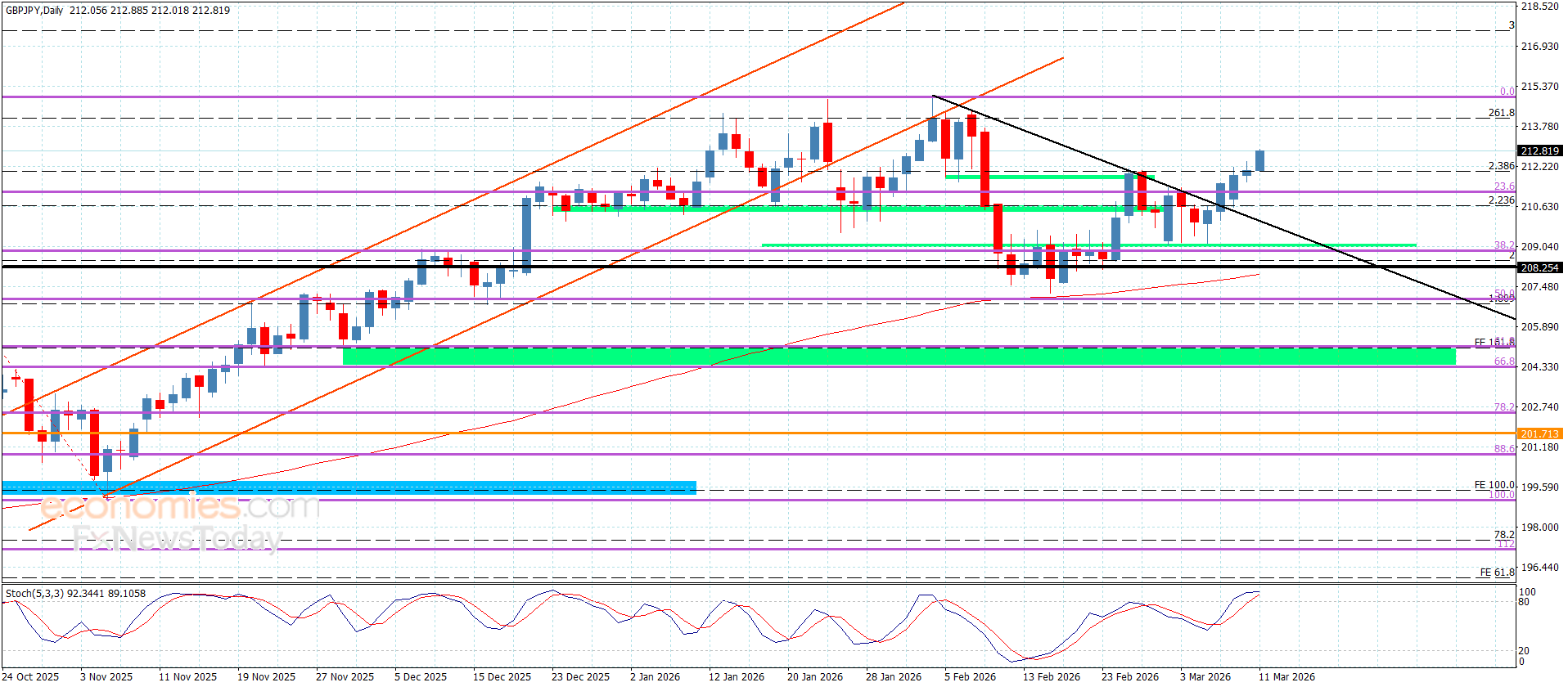
The GBPJPY pair ended its last bullish rally by hitting 211.60 level, to achieve the extra suggested target in the previous report, then begin gathering some gains by forming corrective decline and its stability near 210.50.
By the above image, we notice the stability of the price within the main bullish channel’s levels by forming extra support at 209.75 level, which might help to end the temporary negative pressures, to wait for gathering extra bullish momentum to renew the bullish attempts and reaching new bullish stations in the near period by its rally towards 211.95 reaching 212.55 resistance.
The expected trading range for today is between 209.75 and 211.60
Trend forecast: Fluctuated