The main tag of Gold Today Price Articles.
You can use the search box below to find what you need.
[wd_asp id=1]
The main tag of Gold Today Price Articles.
You can use the search box below to find what you need.
[wd_asp id=1]
XAU/USD consolidates gains after flirting with the $4,000 mark on Tuesday, as global political uncertainty fuels demand for the safe-haven metal. Gold traded as high as $3,991.08 early in the American session, retreating modestly afterwards.
There were no new developments that pushed Gold higher, but continued political uncertainty. On the one hand, the United States (US) government shutdown continues, following yet another failed Senate vote on a funding bill on Monday.
Other than that, several Federal Reserve (Fed) officials hit the wires. Bank of Minneapolis President Neel Kashkari cautioned that it’s still too soon to be able to tell if tariff-led inflation will be sticky or not. Also, Board of Governors member Stephen Miran noted that monetary policy should be forward-looking, given the lags of policy impact, adding that most of the economic uncertainty has been lifted. Finally, he added his best attempt at a real neutral rate estimate is 0.5%, far below the current 4.0% 4.25% range.
The Federal Open Market Committee (FOMC) will release the Minutes of the September meeting on Wednesday, with the document expected to shed some light on policymakers’ thinking.
XAU/USD is up for a third consecutive day, and technically bullish despite extreme overbought conditions. In the daily chart, the Relative Strength Index (RSI) indicator continues to advance at 85, while the Momentum indicator aims north almost vertically, far above its midline. At the same time, the pair develops above all bullish moving averages, with the 20 Simple Moving Average (SMA) currently at $3,763.
The 4-hour chart shows that XAU/USD could extend its advance, as technical indicators turned flat after correcting extreme conditions, now consolidating in overbought territory. As is the case in other time frames, the pair develops above all bullish moving averages, which reflects buyers’ dominance, regardless of overbought conditions.
Support levels: 3,958.40 3,946.50 3,927.70
Resistance levels: 3,991.10 4,005.00 4,020.00
The gold market has reached a watershed moment, with XAU/USD blasting through the $4,000 per ounce barrier for the first time in recorded history. On Tuesday, gold futures traded at $4,005.80, up 0.53%, while spot gold in New York hovered around $3,960.60 per troy ounce. The metal has gained an extraordinary 51% year-to-date, driven by the weakening U.S. dollar, accelerating geopolitical instability, and a growing shift away from yield-based assets as central banks pivot toward easing. Investors are turning back to the one asset that thrives when conventional markets falter — and this time, the move carries both institutional and geopolitical weight.
The Federal Reserve’s policy shift remains the most powerful catalyst behind gold’s meteoric rise. After cutting rates in September for the first time this year, reducing the federal funds rate to 4.00%–4.25%, markets now price in two additional reductions before year-end. That policy softening has undercut the appeal of short-term Treasuries and boosted non-yielding gold’s relative attractiveness. Traders are assigning a 92.5% probability to another rate cut at the October 29 Fed meeting, as confirmed by CME FedWatch data. The government shutdown has delayed critical indicators like nonfarm payrolls and inflation data, effectively leaving the Fed “flying blind” into its next decision. This absence of visibility amplifies investor anxiety and strengthens gold’s safe-haven bid.
The prolonged U.S. government shutdown, now stretching into its second week, has paralyzed key economic functions and deepened uncertainty across markets. At the same time, renewed trade tensions — stoked by President Trump’s tariff threats against Europe and Canada — have injected fresh instability into global supply chains. These crosscurrents have fueled capital rotation into gold, with investors seeking insulation from policy risk. The Dollar Index (DXY) is down 10% year-to-date, removing one of gold’s last technical barriers. As Peter Grant of Zaner Metals observed, “safe-haven flows are dominating the metals complex, with little sign of resolution on the fiscal front.”
The rally’s foundation lies in relentless central bank accumulation. According to Goldman Sachs, emerging-market banks continue to diversify away from U.S. Treasuries amid sanctions risk and reserve realignment. The bank forecasts average central bank purchases of 80 tons in 2025 and 70 tons in 2026, marking one of the strongest multiyear accumulation phases in modern history. China remains the single largest buyer, with total holdings exceeding 2,245 tons, while Turkey and India follow with renewed monthly additions. These steady inflows provide a structural base of demand that has proven immune to speculative swings.
Parallel to central bank accumulation, Western investment funds are driving a powerful resurgence in gold-backed ETFs. ETF holdings jumped by $26 billion last quarter, led by U.S. and European vehicles. This “sticky” institutional demand, as Goldman Sachs calls it, has elevated the starting point for gold pricing models, reinforcing support above $3,900. The World Gold Council confirmed that total ETF holdings now stand at their highest level since 2020, with September alone registering 13 new all-time highs in daily spot pricing. Analysts note that private portfolio diversification — rather than speculative trading — is now the dominant source of inflows.
Goldman Sachs lifted its December 2026 gold forecast from $4,300 to $4,900, projecting a sustained 23% climb from current levels. The upward revision cites resilient central bank accumulation, persistent geopolitical stress, and falling U.S. real yields. Analysts led by Lina Thomas highlighted that “the risks remain skewed to the upside as private-sector diversification into the relatively small gold market could further lift ETF demand.” With rates expected to fall 100 basis points by mid-2026, Goldman estimates that declining yields alone could add five percentage points to price appreciation.
From a technical perspective, the gold chart has entered a parabolic phase. Weekly price action has now printed eight consecutive bullish candles, pushing RSI indicators into the overbought zone for the fourth time this year. Resistance sits at $4,096, corresponding to the 78.6% Fibonacci extension, while the nearest support levels are $3,866 and $3,783. The 9-day moving average at $3,629 has held as an unbroken trendline throughout Q3. Analysts warn of potential consolidation if prices fail to maintain momentum above the psychological $4,000 level, but the broader trend remains steeply upward.
Hedge fund titan Ray Dalio, founder of Bridgewater Associates, reaffirmed his stance that investors should hold at least 15% of their portfolios in gold, calling debt instruments “a poor store of wealth.” Speaking at the Greenwich Economic Forum, Dalio compared today’s macro environment to the 1970s — an era of fiscal expansion, inflation volatility, and geopolitical conflict that propelled gold more than 850% between 1970 and 1980. Institutional commentary aligns with his view: Bank of America acknowledged potential “uptrend exhaustion,” but maintains gold’s role as a stabilizer amid “unquantifiable global risk.”
Long-term data from Yahoo Finance shows that gold has surged 591% since February 2001, with the most recent leg of the rally reflecting a similar setup to historical inflation cycles. The 2001–2025 bull phase parallels the 1970–1980 pattern in both pace and structure, featuring prolonged monetary easing, deficits, and rising commodity correlations. The metal’s all-time gain of 51% in 2025 alone marks its strongest annual performance since 1979, when gold soared 125% amid double-digit inflation.
While momentum remains firmly bullish, analysts caution that short-term traders face elevated price risk when buying near record highs. Commodities portfolio manager Thomas Winmill of Midas Funds labeled gold’s surge as “speculative but rational,” noting that macroeconomic conditions justify the premium. He warned that “a 5–7% correction is plausible” should profit-taking emerge, but stressed that “there’s no technical evidence of reversal.” Volatility in gold options has jumped 12% this week, reflecting the crowded positioning near $4,000. Yet unlike prior rallies driven by retail speculation, this one is built on balance-sheet allocation and sovereign diversification.
With gold consolidating near $3,996.70 as of mid-session Tuesday, traders now target $4,100 as the next psychological milestone. Market positioning across futures and ETFs indicates a continuation pattern rather than a climax. The Federal Reserve’s policy path, combined with global currency instability, points to sustained upside for the remainder of 2025. Technical support remains robust at $3,783, suggesting buyers will defend dips aggressively.
The data is unequivocal: gold’s record-breaking breakout above $4,000 is not a speculative anomaly but a reflection of profound macroeconomic realignment. With rate cuts imminent, central banks diversifying reserves, and the dollar structurally weaker, gold’s trajectory favors continued strength. TradingNews Verdict: XAU/USD – Strong Buy, with a 12-month target of $4,250 and extended range potential toward $4,900 by 2026. The metal remains the single most effective hedge in an era defined by political risk, monetary easing, and asset inflation.
In April 2010, just before the Deepwater Horizon explosion in the Gulf of Mexico, the BP (LSE:BP.) share price was close to 650p, around 50% more than it is today (2 October). Eleven workers tragically lost their lives on the rig and it’s been estimated that the disaster has cost the energy giant around $65bn in fines, compensation and clean-up costs.
Since then, the group’s stock market valuation has ebbed and flowed in line with the price of oil. Most notably, the pandemic saw energy prices plummet as global demand fell sharply. And after Russia invaded Ukraine in February 2022, Brent crude spiked and then steadily climbed higher.
Over the past 15 years, there have been numerous peaks and troughs as oil traders respond to various economic and political uncertainties.
Oil price trends are important because the majority of BP’s income is earned from the sale of the commodity. This means the group’s cash flow’s heavily influenced by the price of ‘black gold’.
As a shareholder in the group, I was particularly interested in one forecast I recently came across. Gov Capital has created an algorithm that considers “volume changes, price changes, market cycles [and] similar commodities” to come up with a five-year Brent crude forecast of $177.
If correct, it would be 20% more than its all-time high of $147.50 achieved in July 2008. And I reckon BP’s annual operating cash flow would be close to $60bn. This is based on data from 2018-2024, which shows a 96% relationship between the price of Brent crude and the cash generated by the group.
| Year | Brent crude ($ per barrel) | Net cash from operating activities ($bn) |
|---|---|---|
| 2018 | 71.34 | 22.9 |
| 2019 | 64.30 | 25.8 |
| 2020 | 41.96 | 12.2 |
| 2021 | 70.86 | 23.6 |
| 2022 | 100.3 | 40.9 |
| 2023 | 82.49 | 32.0 |
| 2024 | 80.52 | 27.3 |
If a price of $177 was realised in 2030, I think the group’s share price would easily double.
However, the forecast comes with two warnings. Firstly, it’s very much an outlier. And secondly, as Gov Capital admits, it shouldn’t be used for investment decisions. That’s because it’s impossible to accurately predict future oil prices. There are too many random factors involved to make the exercise worthwhile.
But it is useful to consider long-term trends. As we move towards a cleaner world, demand for hydrocarbons will inevitably fall. This should put downwards pressure on prices. However, energy markets are very different to others. OPEC+ is a legal cartel – accounting for around 60% of global output — that seeks to restrict supply to keep prices up. In my opinion, the producers have the upper hand, certainly in the short term.
To help improve earnings, the group’s planning to cut costs. A major shareholder is piling on the pressure for it to become more efficient. BP also wants to increase output. This has been helped by recent news of its largest oil and gas discovery this century, off the coast of Brazil. Raising production and reducing costs are two ways of achieving some protection from lower oil prices.
In addition, those looking for passive income might be tempted by its current dividend yield of 5.5%. Of course, there can be no guarantees when it comes to shareholder returns.
For these reasons, I believe BP’s a stock that investors could consider. Although, anyone taking a stake needs to be aware of the volatile nature of the group’s earnings as well as the operational challenges the industry faces.
Tuesday, October 7, 2025. Gold Forecast and Analysis of the price of gold XAU/USD today
Today’s Gold Analysis Overview:
Today’s Gold Trading Signals:
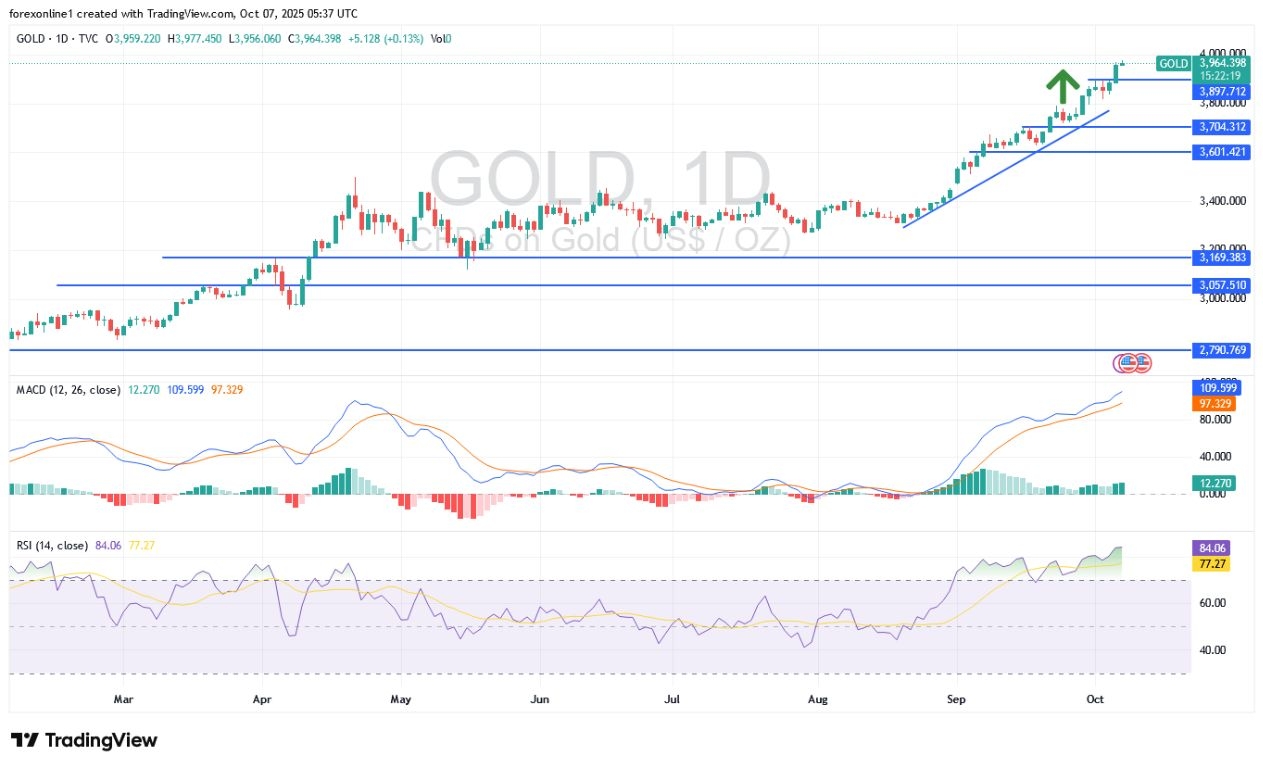
The continued weakness in investor sentiment amid the US government shutdown is increasing demand for gold as a safe haven. According to gold trading platforms, the gold price index rose today, Tuesday, October 7, 2025, to the $3977 per ounce resistance level—the highest in the history of the gold price—and is the closest point to testing the historical resistance of $4000 per ounce, which commodity market experts have increasingly predicted is imminent.
Meanwhile, the gold trading market remains strongly supported for an uptrend. Obviously, this comes as the US government shutdown enters its seventh day with no resolution in sight. According to currency market trades, the US Dollar Index (DXY) rose by 0.2% to 98.34. The US government closure has exacerbated uncertainty in financial markets, leading to the delay of US economic data crucial for the Federal Reserve’s decision-making process.
However, traders still expect two additional US interest rate cuts this year. Meanwhile, political tensions in France and ongoing geopolitical risks continue to boost demand for safe havens, with gold being among the most important.
Regarding the future of gold prices in the coming months, Goldman Sachs raised its December 2026 gold price forecast to $4,900 per ounce from $4,300 previously, citing inflows into exchange-traded funds and purchases from global central banks.

Dear TradersUp trader, the gold trend will remain strongly bullish for a longer period of time, and therefore, the strategy of buying gold on every sharp price pullback remains the best approach.
During today’s trading session on Tuesday, via stock trading platforms, US S&P 500 futures fell by 0.2%, and Dow Jones Industrial Average futures fell by 0.2%. Futures changes do not necessarily predict price movements after the opening bell.
In European markets, the STOXX Europe 600 index was flat in morning trading. According to share prices, Bridgepoint Group shares rose 4.3% and Skanska Ceres B shares rose 4.2%. In contrast, B&M European Value Retail shares lost 13.8%, and Naturgy Energy Group shares fell 3.6%. The UK’s FTSE 100 index rose 0.1%. Other European stocks were mixed, with France’s CAC 40 remaining flat and Germany’s DAX rising 0.1%.
In commodity markets, Brent crude prices rose 0.2% to $65.61 per barrel, and West Texas Intermediate crude prices rose 0.2% to $61.81 per barrel. The European benchmark natural gas price, the Dutch TTF futures contract, rose 1.3% to €33.53 per megawatt-hour.
On the bond front, the yield on the 10-year German Treasury bond rose by one basis point to 2.734% from 2.723%, and the yield on the 10-year US Treasury bond rose by one basis point to 4.167% from 4.152%. Also, Bond prices and yields move in opposite directions.
Ready to trade our Gold price forecast? We’ve made a list of the best Gold trading platforms worth trading with.
Silver price (XAG/USD) retreats after reaching the new 14-year high of $48.77 reached in the previous session, trading around $47.90 per troy ounce during the early European hours on Tuesday. The technical analysis of the daily chart timeframe suggests the price of the precious metal moves upwards within an ascending channel pattern, strengthening the bullish bias.
Additionally, the XAG/USD pair is positioned above the nine-day Exponential Moving Average (EMA), indicating that short-term price momentum is stronger. However, the 14-day Relative Strength Index (RSI) remains above the 70 level, suggesting that the Silver price is trading within overbought territory and a potential for a downward correction.
On the upside, the XAG/USD pair may test the psychological level of $48.00, followed by the all-time high of $48.77. A break above this level would support the Silver price to test the upper boundary of the ascending channel at $49.40. A break above the channel would strengthen the bullish bias and support the pair to approach the psychological level of $50.00.
The primary support lies at the nine-day EMA of $47.00. A break below this level would dampen the short-term price momentum and prompt the Silver price navigate the region around the ascending channel’s lower boundary at $44.10. Further declines below the channel would dampen the bullish bias and put downward pressure on the XAG/USD pair to reach the 50-day EMA of $42.13.
Silver is a precious metal highly traded among investors. It has been historically used as a store of value and a medium of exchange. Although less popular than Gold, traders may turn to Silver to diversify their investment portfolio, for its intrinsic value or as a potential hedge during high-inflation periods. Investors can buy physical Silver, in coins or in bars, or trade it through vehicles such as Exchange Traded Funds, which track its price on international markets.
Silver prices can move due to a wide range of factors. Geopolitical instability or fears of a deep recession can make Silver price escalate due to its safe-haven status, although to a lesser extent than Gold’s. As a yieldless asset, Silver tends to rise with lower interest rates. Its moves also depend on how the US Dollar (USD) behaves as the asset is priced in dollars (XAG/USD). A strong Dollar tends to keep the price of Silver at bay, whereas a weaker Dollar is likely to propel prices up. Other factors such as investment demand, mining supply – Silver is much more abundant than Gold – and recycling rates can also affect prices.
Silver is widely used in industry, particularly in sectors such as electronics or solar energy, as it has one of the highest electric conductivity of all metals – more than Copper and Gold. A surge in demand can increase prices, while a decline tends to lower them. Dynamics in the US, Chinese and Indian economies can also contribute to price swings: for the US and particularly China, their big industrial sectors use Silver in various processes; in India, consumers’ demand for the precious metal for jewellery also plays a key role in setting prices.
Silver prices tend to follow Gold’s moves. When Gold prices rise, Silver typically follows suit, as their status as safe-haven assets is similar. The Gold/Silver ratio, which shows the number of ounces of Silver needed to equal the value of one ounce of Gold, may help to determine the relative valuation between both metals. Some investors may consider a high ratio as an indicator that Silver is undervalued, or Gold is overvalued. On the contrary, a low ratio might suggest that Gold is undervalued relative to Silver.
The EURJPY pair kept its positive stability above 175.20 level, confirming its surrender to the bullish bias dominance, to rally towards 176.30, which forces it to form an intraday rebound to gather more positive momentum for today.
Stochastic rally above 50 level will provide new chance for recording extra gains, to expect its rally towards 176.95, as surpassing this barrier will extend the trading towards the next target at 177.45, while the price decline below 175.20 and providing negative close might force it to form bearish corrective trading before reaching any suggested target.
The expected trading range for today is between 175.40 and 176.95
Trend forecast: Bullish
The (Brent) price rose in its last trading on the intraday basis, amid the stability of its trading above the critical support of $64.95, attempting to correct the main bearish trend on the short-term basis, amid the continuation of the negative pressure due to its trading below EMA50, reducing the chances for a sustainable recovery in the upcoming period, especially with the beginning of the negative signs appearance on the relative strength indicators, after reaching overbought levels, exaggeratedly compared to the price movement, forming negative divergence that intensifies the negative pressure around the price.
Get high-accuracy trading signals delivered directly to your Telegram. Subscribe to specialized packages tailored for the world’s top markets:
Full VIP signals performance report for Sept 29 – Oct 3, 2025:
Gold holds the latest uptick to a new all-time high near $3,980 in Tuesday’s Asian trades, as buyers still keep their sights on the key $4,000 barrier.
Gold buyers refuse to give up yet even as the US Dollar (USD) sustains the previous turnaround so far this Tuesday.
The Greenback’s strength on the back of the recent sell-off in the Euro (EUR) and the Japanese Yen (JPY), led by the political jolts in France and Japan, continues to cap Gold’s upside.
However, the fundamental backdrop remains supportive of the traditional safe-haven and non-interest-bearing Gold.
The US shutdown extends as the Democrat law to reopen the government failed for the 5th time in the Senate on Monday, as the sticking point continues to remain health care subsidies.
Meanwhile, concerns over a lack of official US economic data publication and increased bets of two Federal Reserve (Fed) interest rate cuts this year keep boosting the demand for the bright metal.
Additionally, sustained Gold buying by global central banks also continues to power the Gold record rally.
The latest data compiled by the World Gold Council (WGC) showed that the central bank Gold buying rebounded in August, citing a 15-tonne increase to the global gold reserves.
According to the People’s Bank of China (PBOC) reported earlier on, China’s Gold holdings totalled 74.06 million fine troy ounces at the end of September, up from 74.02 million in the previous month, as the central bank expanded bullion purchases for the 11th straight month.
Therefore, Gold remains a ‘buy on pullbacks’ trade, in the absence of any bearish factors as such.
Traders will continue to monitor speeches from Fed officials for fresh insights on the US economy and the Fed’s path forward on interest rates.
As observed on the four-hour chart, the 14-day Relative Strength Index (RSI) is easing from the overbought region, currently near 70.50, suggesting that any pullback could be quickly bought into.
Buyers look to conquer the $3,980 psychological barrier on the way to the $4,000 mark.
Conversely, if a pullback gathers steam, Gold could test the initial support at $3,897, the 21-Simple Moving Average (SMA), below which the 50-SMA at $3,845 could be attacked.
A firm break below that latter will expose the 100-SMA at $3,772.
Gold has played a key role in human’s history as it has been widely used as a store of value and medium of exchange. Currently, apart from its shine and usage for jewelry, the precious metal is widely seen as a safe-haven asset, meaning that it is considered a good investment during turbulent times. Gold is also widely seen as a hedge against inflation and against depreciating currencies as it doesn’t rely on any specific issuer or government.
Central banks are the biggest Gold holders. In their aim to support their currencies in turbulent times, central banks tend to diversify their reserves and buy Gold to improve the perceived strength of the economy and the currency. High Gold reserves can be a source of trust for a country’s solvency. Central banks added 1,136 tonnes of Gold worth around $70 billion to their reserves in 2022, according to data from the World Gold Council. This is the highest yearly purchase since records began. Central banks from emerging economies such as China, India and Turkey are quickly increasing their Gold reserves.
Gold has an inverse correlation with the US Dollar and US Treasuries, which are both major reserve and safe-haven assets. When the Dollar depreciates, Gold tends to rise, enabling investors and central banks to diversify their assets in turbulent times. Gold is also inversely correlated with risk assets. A rally in the stock market tends to weaken Gold price, while sell-offs in riskier markets tend to favor the precious metal.
The price can move due to a wide range of factors. Geopolitical instability or fears of a deep recession can quickly make Gold price escalate due to its safe-haven status. As a yield-less asset, Gold tends to rise with lower interest rates, while higher cost of money usually weighs down on the yellow metal. Still, most moves depend on how the US Dollar (USD) behaves as the asset is priced in dollars (XAU/USD). A strong Dollar tends to keep the price of Gold controlled, whereas a weaker Dollar is likely to push Gold prices up.
Important DisclaimersThe content provided on the website includes general news and publications, our personal analysis and opinions, and contents provided by third parties, which are intended for educational and research purposes only. It does not constitute, and should not be read as, any recommendation or advice to take any action whatsoever, including to make any investment or buy any product. When making any financial decision, you should perform your own due diligence checks, apply your own discretion and consult your competent advisors. The content of the website is not personally directed to you, and we does not take into account your financial situation or needs.The information contained in this website is not necessarily provided in real-time nor is it necessarily accurate. Prices provided herein may be provided by market makers and not by exchanges.Any trading or other financial decision you make shall be at your full responsibility, and you must not rely on any information provided through the website. FX Empire does not provide any warranty regarding any of the information contained in the website, and shall bear no responsibility for any trading losses you might incur as a result of using any information contained in the website.The website may include advertisements and other promotional contents, and FX Empire may receive compensation from third parties in connection with the content. FX Empire does not endorse any third party or recommends using any third party’s services, and does not assume responsibility for your use of any such third party’s website or services.FX Empire and its employees, officers, subsidiaries and associates, are not liable nor shall they be held liable for any loss or damage resulting from your use of the website or reliance on the information provided on this website.Risk DisclaimersThis website includes information about cryptocurrencies, contracts for difference (CFDs) and other financial instruments, and about brokers, exchanges and other entities trading in such instruments. Both cryptocurrencies and CFDs are complex instruments and come with a high risk of losing money. You should carefully consider whether you understand how these instruments work and whether you can afford to take the high risk of losing your money.FX Empire encourages you to perform your own research before making any investment decision, and to avoid investing in any financial instrument which you do not fully understand how it works and what are the risks involved.
If I had shown you this chart unlabelled, one would be forgiven for thinking this was the five-minute chart, especially considering the past eight candles or so.
While sustained upside, as shown above, is rare on the weekly chart, gold bulls will undoubtedly be pleased with recent performance, with price action virtually parabolic.
Having broken out of an upwards channel, with the upper boundary held around $3,602, what followed was an explosive move to the upside, marking fresh all-time highs.
While no candlestick structure to the upside could otherwise offer resistance, traders should be aware that a short-term correction remains possible, with the RSI reporting gold pricing as ‘overbought’ for the fourth time this year.
Otherwise, should price stage a move higher, we can expect some profit-taking at the key level of $4,000.