The main tag of Gold Today Price Articles.
You can use the search box below to find what you need.
[wd_asp id=1]
The main tag of Gold Today Price Articles.
You can use the search box below to find what you need.
[wd_asp id=1]
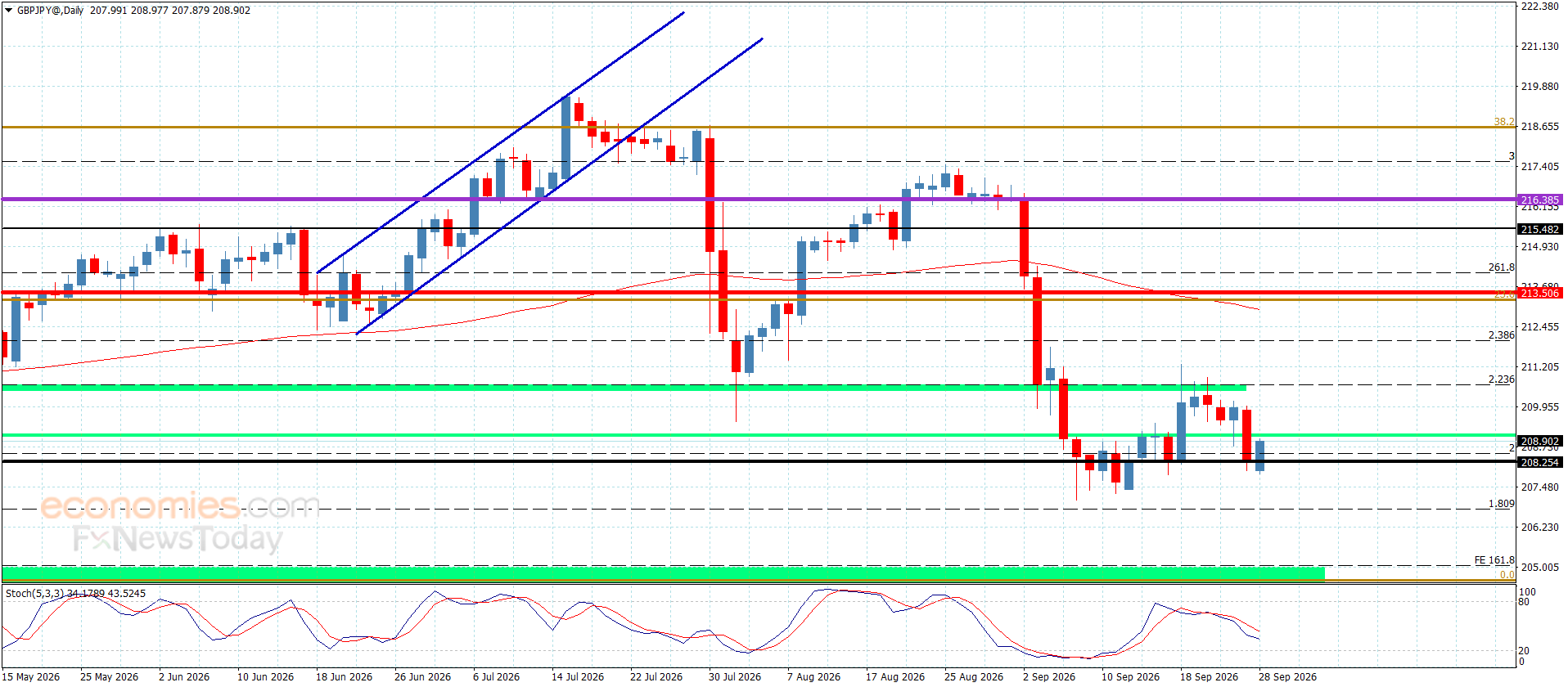
GBPJPY achieved the initially suggested bearish targets during Friday’s trading, reaching 208.00 before forming some sideways trading as the 208.10 level continues to act as important support against further declines.
We recommend waiting for confirmation of the break, with a negative close below 208.10. This would strengthen the chances of targeting additional bearish levels, starting at 206.80 and extending toward 205.00 over the medium term. Meanwhile, the risk of a trend reversal and the beginning of a bullish move would require a strong positive surge that enables the price to stabilize above 210.45.
The expected trading range for today is between 207.00 and 209.30
Trend forecast: Bearish
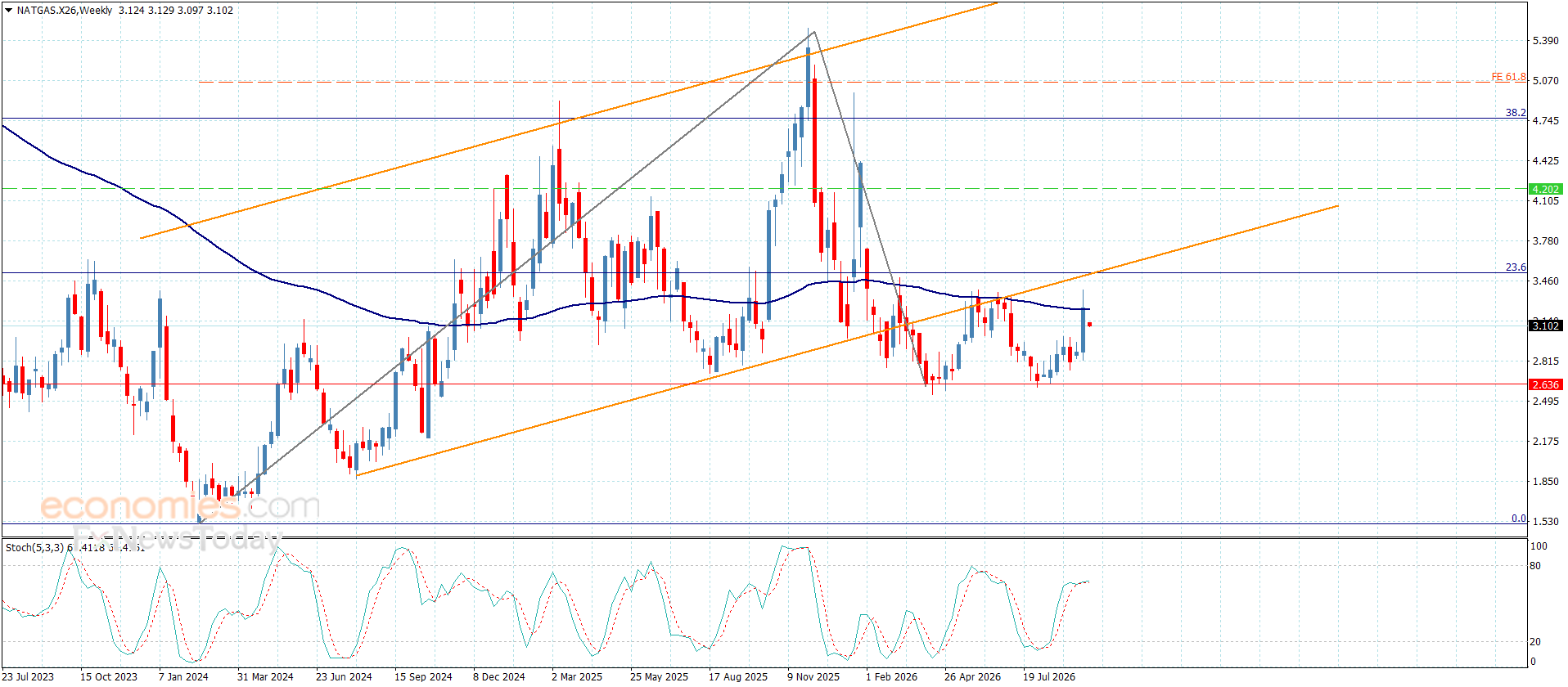
Natural gas opened this morning’s trading with a brief bearish gap, slipping toward $3.100 as the 55-period moving average forms additional resistance around $3.240.
The current pullback poses no threat to the bullish trend, given the overall stability above the pivotal support at $2.620, in addition to the $2.830 level forming additional support for the current trading. Therefore, we will continue to wait for the price to gather positive momentum, enabling it to break above the 55-period moving average and then attempt to reach the next bullish target around $3.520.
The expected trading range for today is between $3.000 and $3.320.
Trend forecast: Volatile within the bullish trend
According to the latest IndexBox report on the global Caffeine Free Decaf Coffee market, the market enters 2026 with broader demand fundamentals, more disciplined procurement behavior, and a more regionally diversified supply architecture.
The global caffeine free decaf coffee market is undergoing a structural transformation, moving from a niche, medically oriented category to a dynamic, benefit-driven segment of the broader coffee market. Historically constrained by taste perceptions and limited innovation, the category is now benefiting from advances in decaffeination technology, rising health consciousness, and the growing popularity of evening and social coffee occasions. The market is bifurcating into a high-volume mainstream segment, increasingly dominated by private label, and a premium specialty segment characterized by single-origin beans, chemical-free processing claims, and functional benefits.
This bifurcation creates distinct strategic imperatives for brand owners, retailers, and investors. The forecast period 2026-2035 anticipates a compound annual growth rate (CAGR) of 5.8%, with the market index reaching 176 by 2035 (2025=100). Growth will be underpinned by premiumization in mature markets, expanding consumption in emerging economies, and the proliferation of e-commerce and subscription models that facilitate discovery and repeat purchase. However, challenges persist, including supply chain bottlenecks at the decaffeination stage, intense price competition from private label, and the need to overcome residual taste stigma.
This report provides a comprehensive analysis of the market’s size, segmentation, competitive landscape, and future outlook, offering actionable insights for stakeholders across the value chain.
The baseline scenario for the global caffeine free decaf coffee market projects a 5.8% CAGR from 2026 to 2035, culminating in a market index of 176 (2025=100). This outlook assumes a continuation of current trends: steady premiumization in North America and Europe, rapid adoption in Asia-Pacific’s urban centers, and gradual modernization of traditional trade in Latin America and the Middle East & Africa. The market’s expansion will be primarily volume-driven in emerging markets and value-driven in developed ones, where consumers increasingly trade up to specialty decaf products.
Key to this scenario is the ongoing innovation in decaffeination processes, such as Swiss Water and CO2 methods, which address taste and safety concerns, thereby attracting new consumers. E-commerce and subscription channels are expected to outpace traditional retail, enhancing accessibility and brand discovery. However, the baseline also incorporates moderate headwinds: private label pressure on national brands, volatile green coffee prices, and regulatory scrutiny on processing aids. The market is anticipated to remain highly fragmented, with opportunities for both large multinationals and agile challengers.
By 2035, the category is expected to have shed much of its stigma, becoming a mainstream choice for health-conscious coffee drinkers.
The household/retail sector remains the dominant end-use channel for caffeine free decaf coffee, accounting for the majority of global consumption. Demand is driven by consumers seeking to enjoy coffee at home without caffeine’s stimulant effects, particularly in the evening or for health reasons. In mature markets like North America and Europe, growth is fueled by premiumization: shoppers are trading up to single-origin, chemical-free decaf beans and ground coffee, often at a 200-300% premium over mainstream private label. This trend is supported by the proliferation of e-commerce and subscription services that offer convenience and access to niche brands.
In emerging markets, the household sector is expanding as urbanization and rising incomes make coffee more accessible, though price sensitivity remains high. Through 2035, the sector will benefit from innovations in packaging and format, such as compostable pods and ready-to-drink decaf, as well as clean-label claims. However, private label penetration will continue to pressure national brands, forcing them to differentiate through storytelling and quality. Key demand indicators include retail sales value, premium segment share, and e-commerce penetration. Current trend: Steady growth driven by premiumization and health trends.
Major trends: Premiumization and trade-up to specialty decaf, Growth of e-commerce and subscription models, Private label expansion in mainstream segments, Clean-label and sustainability claims gaining importance, and Convenience formats like pods and RTD gaining traction.
Representative participants: Nestlé S.A, The J.M. Smucker Company, Keurig Dr Pepper Inc, Starbucks Corporation, and Lavazza.
The foodservice and hospitality sector (HoReCa) represents a significant and growing outlet for caffeine free decaf coffee. Demand is driven by consumers who wish to enjoy coffee after meals or during social occasions without caffeine, as well as by health-conscious diners. In mature markets, restaurants and cafes are increasingly offering premium decaf options to meet customer expectations, often featuring specialty beans and artisanal preparation. This trend is particularly pronounced in urban areas where third-wave coffee culture emphasizes quality and provenance. In emerging markets, the foodservice sector is expanding rapidly due to the growth of cafe chains and Western-style dining, though decaf availability may lag.
Through 2035, the sector will benefit from the incorporation of decaf into corporate wellness programs and office coffee services, as well as the rise of decaf-specific cafe concepts. However, challenges include the need for staff training and the perception that decaf is an afterthought. Key demand indicators include foodservice coffee sales, decaf menu penetration, and the number of specialty coffee outlets. Current trend: Moderate growth, supported by expanding decaf options in cafes and restaurants.
Major trends: Premium decaf offerings in third-wave cafes, Integration into corporate wellness and office coffee, Growth of decaf-specific cafe concepts, Expansion of cafe chains in emerging markets, and Increased focus on sustainable and ethical sourcing.
Representative participants: Starbucks Corporation, Lavazza, Illycaffè S.p.A, Peet’s Coffee, and Community Coffee Company.
The online and e-commerce sector is the fastest-growing channel for caffeine free decaf coffee, albeit from a smaller base. Demand is fueled by consumers seeking convenience, access to a wider range of specialty products, and the ability to research and compare decaffeination methods. Subscription models are particularly popular, offering regular deliveries of favorite decaf brands and enabling brands to build direct relationships with consumers. This channel is instrumental for premium and niche players, who use digital platforms to tell their sourcing and processing stories, bypassing traditional retail gatekeepers.
In emerging markets, e-commerce is leapfrogging traditional retail, providing access to imported decaf products that may not be available locally. Through 2035, the sector will benefit from advances in logistics, cold-chain for ready-to-drink decaf, and personalized marketing. However, challenges include high customer acquisition costs and the need for robust fulfillment. Key demand indicators include online sales value, subscription penetration, and digital marketing effectiveness. Current trend: Rapid growth, driven by convenience and discovery of niche brands.
Major trends: Subscription models driving repeat purchase, Direct-to-consumer strategies for niche brands, Growth of online marketplaces in emerging markets, Personalization and AI-driven recommendations, and Integration with smart home devices for automatic reordering.
Representative participants: Nestlé S.A, Starbucks Corporation, Keurig Dr Pepper Inc, Swiss Water Decaffeinated Coffee Inc, and Allegro Coffee Company.
The office and institutional sector, encompassing workplaces, healthcare facilities, and educational institutions, represents a steady outlet for caffeine free decaf coffee. Demand is driven by employers and institutions aiming to provide inclusive beverage options that cater to health-conscious individuals, pregnant women, and those with caffeine sensitivity. In corporate settings, the provision of quality decaf is increasingly seen as part of a broader wellness strategy, alongside healthy snacks and fitness initiatives. Healthcare facilities often stock decaf to accommodate patients and visitors.
Through 2035, this sector is expected to grow modestly, with opportunities in office coffee services that offer premium decaf alongside regular options. However, budget constraints and the perception of decaf as a low-priority item may hinder faster adoption. Key demand indicators include office coffee service contracts, institutional procurement policies, and employee satisfaction metrics. Current trend: Stable growth, aligned with corporate wellness trends.
Major trends: Corporate wellness programs including decaf options, Growth of office coffee services with premium selections, Healthcare facilities prioritizing patient comfort, Sustainability and ethical sourcing requirements in institutional procurement, and Integration with smart vending and self-serve stations.
Representative participants: Nestlé S.A, The J.M. Smucker Company, Keurig Dr Pepper Inc, Lavazza, and Community Coffee Company.
The ‘other’ sector comprises miscellaneous channels such as travel (airlines, hotels, trains), vending machines, and specialty outlets. Demand in these channels is driven by the need for convenient, on-the-go decaf options that cater to travelers and consumers in transit. Airlines and hotels often provide decaf as part of their beverage service, though quality varies. Vending machines are increasingly offering premium decaf options, particularly in workplaces and public spaces. Through 2035, growth in this sector will be supported by the expansion of travel and tourism, as well as the upgrading of vending technology to include fresh-brewed and specialty coffee.
However, the sector faces challenges related to space, cost, and the perception of decaf as a secondary choice. Key demand indicators include travel volume, vending machine placements, and consumer satisfaction with decaf availability. Current trend: Niche growth, driven by convenience and specialty offerings.
Major trends: Premiumization of travel and hotel coffee offerings, Smart vending machines with fresh-brewed decaf, Growth of travel retail as a channel for specialty decaf, Sustainability initiatives in travel and vending, and Integration of decaf into loyalty programs and amenities.
Representative participants: Starbucks Corporation, Lavazza, Illycaffè S.p.A, Peet’s Coffee, and Eight O’Clock Coffee.
Interactive table based on the Store Companies dataset for this report.
| # | Company | Headquarters | Focus | Scale | Note |
|---|---|---|---|---|---|
| 1 | Nestlé S.A. | Vevey, Switzerland | Global food & beverage conglomerate | Global giant | Major brands: Nescafé Decaf, Nespresso Decaffeinato |
| 2 | The J.M. Smucker Company | Orrville, Ohio, USA | Packaged foods & coffee | Major multinational | Owns Folgers, Café Bustelo decaf lines |
| 3 | Kraft Heinz Company | Chicago, Illinois, USA | Food & beverage processing | Global giant | Owns Maxwell House decaf |
| 4 | Starbucks Corporation | Seattle, Washington, USA | Coffeehouse chain & CPG | Global giant | Retail & grocery decaf coffee |
| 5 | Lavazza Group | Turin, Italy | Coffee roasting & distribution | Major multinational | Premium decaf offerings |
| 6 | JDE Peet’s | Amsterdam, Netherlands | Coffee & tea company | Global giant | Owns Peet’s, Jacobs, L’Or decaf |
| 7 | Keurig Dr Pepper Inc. | Burlington, Massachusetts, USA | Beverage manufacturing | Major multinational | Decaf K-Cup pods |
| 8 | Tchibo GmbH | Hamburg, Germany | Coffee retailer & goods | Major multinational | Significant European decaf brand |
| 9 | Massimo Zanetti Beverage Group | Bologna, Italy | Coffee roasting & distribution | Large multinational | Owns Hills Bros, Chase & Sanborn decaf |
| 10 | Strauss Group Ltd. | Petah Tikva, Israel | Food & beverage | Large multinational | Owns Elite brand decaf coffee |
| 11 | Melitta Group | Minden, Germany | Coffee & coffee filters | Large multinational | Major decaf brand in Europe & Americas |
| 12 | illycaffè S.p.A. | Trieste, Italy | Premium coffee roasting | Large multinational | Premium decaffeinated coffee |
| 13 | Cafés Novell | Barcelona, Spain | Coffee roaster & distributor | Significant regional | Specialty & decaf focus in Spain |
| 14 | Alois Dallmayr KG | Munich, Germany | Coffee roaster & delicatessen | Significant regional | Premium decaf brand in DACH |
| 15 | Eight O’Clock Coffee | Suffern, New York, USA | Coffee roaster & brand | National (USA) | Long-standing decaf offering |
| 16 | Community Coffee | Baton Rouge, Louisiana, USA | Coffee roaster & retailer | National (USA) | Strong regional brand with decaf |
| 17 | Cameron’s Coffee | Shakopee, Minnesota, USA | Specialty coffee roaster | National (USA) | Specialty & organic decaf options |
| 18 | Swiss Water Decaffeinated Coffee Co. | Burnaby, BC, Canada | Decaffeination processor & brand | Specialized multinational | Key decaf process provider & own brand |
| 19 | Volcafe (Volcafe Ltd) | Winterthur, Switzerland | Coffee trader & processor | Global trader | Decaf green coffee sourcing & supply |
| 20 | ECOM Agroindustrial Corp. Ltd. | Lausanne, Switzerland | Agricultural commodity trader | Global trader | Major decaf green coffee supply chain |
| 21 | S&D Coffee & Tea | Concord, North Carolina, USA | Coffee & tea manufacturer | Large national | Foodservice & private label decaf |
| 22 | Westrock Coffee Company | Little Rock, Arkansas, USA | Coffee & tea sourcing/roasting | Large multinational | Extensive private label decaf |
| 23 | Private Label Manufacturers | Various | Retailer-owned brands | Collectively massive | Supermarket & club store decaf lines |
| 24 | Mount Hagen | Remscheid, Germany | Organic & fair trade coffee | Significant regional | Organic freeze-dried decaf instant |
| 25 | Café Direct | London, UK | Fair trade coffee & tea | Significant regional | Fair trade & organic decaf offerings |
Asia-Pacific is the largest and fastest-growing regional market for caffeine free decaf coffee, driven by urbanization, rising incomes, and increasing coffee culture. China and Japan are key markets, with Japan having a mature decaf segment and China showing rapid adoption. E-commerce is a major channel, and local players are emerging. Direction: Growing.
North America is a mature but growing market, with premiumization and health trends driving demand. The U.S. is the largest market, where decaf is increasingly seen as a lifestyle choice rather than a medical necessity. Private label is strong, but specialty brands are thriving. Direction: Growing.
Europe is a mature market with a strong coffee culture and growing demand for decaf, particularly in Western Europe. Germany, the UK, and France are key markets. Sustainability and ethical sourcing are important drivers, and e-commerce is expanding. Eastern Europe shows potential for growth. Direction: Growing.
Latin America is a growing market, with Brazil and Mexico leading consumption. While traditional coffee is dominant, decaf is gaining traction among health-conscious urban consumers. The region is also a major producer of green coffee, but decaffeination capacity is limited, leading to imports of processed decaf. Direction: Growing.
The Middle East & Africa is a smaller but emerging market for decaf coffee, with growth driven by urbanization and exposure to Western coffee trends. The UAE and South Africa are key markets. Challenges include limited availability and high prices, but e-commerce is helping to bridge the gap. Direction: Growing.
In the baseline scenario, IndexBox estimates a 5.8% compound annual growth rate for the global caffeine free decaf coffee market over 2026-2035, bringing the market index to roughly 176 by 2035 (2025=100).
Note: indexed curves are used to compare medium-term scenario trajectories when full absolute volumes are not publicly disclosed.
For full methodological details and benchmark tables, see the latest IndexBox Caffeine Free Decaf Coffee market report.
Gold is trading at about $4,182. I’m looking at the 2-hour chart and the drop below the support at $4,199 stands out. Prior to this, Gold had also broken down from the support range at $4,244 to $4,257. The more recent candles are below both the 20 and 50 moving averages, and also the downsloping trendline.
There is support at $4,173. Breaking below that would make the next support at $4,152 and then $4,128 and $4,100 coming into play. The resistance at $4,199 is the first of the range, with the next at $4,225, $4,244, and $4,257.
Natural Gas (NATGAS) Moved Sharply on Sep 7: Inventories, the Dollar, or Geopolitics?
• Natural gas futures advanced due to projected above-average late-summer temperatures.
• LNG feedgas intake rebounded strongly, driven by firm international winter demand.
• Technical indicators show a MACD buy signal and overbought Williams %R conditions.
TradingKeyMon, Sep 7
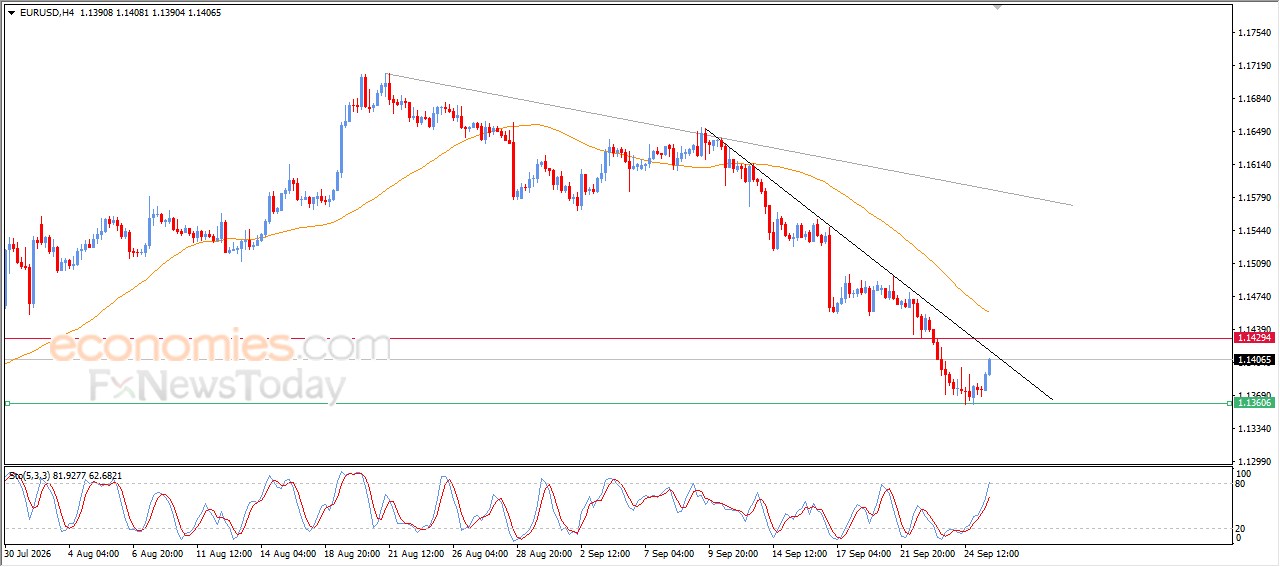
The EURUSD price rose in its latest intraday trading, benefiting from the emergence of the positive signals from the relative strength indicators, attempting to recover some of its previous losses, amid the dominance of the main bearish trend on the short-term basis, with its trading alongside minor trend line that supports this path, besides the continued negative pressure due to its trading below EMA50, which represents a dynamic resistance that reduces the chances of a full recovery on the near-term basis, especially with the relative strength indicators entering exaggerated overbought levels compared to the price move, indicating a quick pullback for the positive momentum.
Today’s platinum prices in Arcot are ₹54,600 (10g), ₹5,46,000 (100g),
and ₹54,60,000 (1kg). Throughout September, rates moved considerably. The highest
value for 100g was ₹5,76,000, and the lowest
₹5,25,300. For 1kg, prices were within
₹52,53,000 to ₹57,60,000.
A variety of factors drive platinum prices, such as production volumes, demand trends,
and global political developments. The metal’s industrial role, especially in cars and
electronics, adds pressure. Currency fluctuations, notably involving the US dollar, as
well as inflation and central bank policy, also steer market movements.
The article covers the following subjects:
Consider long positions from corrections above 88.00 with a target of 115.50–125.50.
Breakout and consolidation below 88.00 will allow the asset to continue declining to the levels of 79.30–67.00.
On the weekly chart, a descending correction has likely finished developing as the second wave of larger degree (2) and an ascending third wave (3) is forming. On the daily chart, apparently, the first wave of smaller degree 1 of (3) has formed, a local correction has been completed as wave 2 of (3), the third wave 3 of (3) is unfolding, and wave i of 3 continues to form. Wave (iii) of i is forming on the H4 chart, within which wave v of (iii) is unfolding. If the presumption is correct, WTI will continue to rise to 115.50–125.50. The level of 88.00 is critical in this scenario as a breakout below it will enable the asset to continue declining to the levels of 79.30–67.00.
This forecast is based on the Elliott Wave Theory. When developing trading strategies, it is essential to consider fundamental factors, as the market situation can change at any time.
The content of this article reflects the author’s opinion and does not necessarily reflect the official position of LiteFinance broker. The material published on this page is provided for informational purposes only and should not be considered as the provision of investment advice for the purposes of Directive 2014/65/EU.
According to copyright law, this article is considered intellectual property, which includes a prohibition on copying and distributing it without consent.
The article covers the following subjects:
Consider long positions from corrections above 3,960.00 with a target of 4,900.00–5,610.00.
Breakout and consolidation below 3,960.00 will allow the asset to continue declining to the levels of 3,720.00–3,290.62.
An ascending third wave of larger degree (3) is presumably developing on the weekly chart. Within it, a descending correction has been completed as the fourth wave of smaller degree 4 of (3). Apparently, the fifth wave 5 of (3) has started developing on the daily chart, with wave i of 5 forming as its part. The H4 chart shows that wave (iii) of i of 5 has formed, a local correction is complete as wave (iv) of i, and wave (v) of i has likely started unfolding. If the presumption is correct, XAU/USD will continue to rise to 4,900.00–5,610.00. The level of 3,960.00 is critical in this scenario as a breakout below it will enable the asset to continue declining to the levels of 3,720.00–3,290.62.
This forecast is based on the Elliott Wave Theory. When developing trading strategies, it is essential to consider fundamental factors, as the market situation can change at any time.
The content of this article reflects the author’s opinion and does not necessarily reflect the official position of LiteFinance broker. The material published on this page is provided for informational purposes only and should not be considered as the provision of investment advice for the purposes of Directive 2014/65/EU.
According to copyright law, this article is considered intellectual property, which includes a prohibition on copying and distributing it without consent.
In Finland, the cost of a grocery basket is forecast by the research organization Pellervo Economic Research (PTT) to increase by an average of 1.5% in 2026 and 2.5% in 2027. YLE News reported this, citing PTT calculations.
PTT expects the price of coffee to rise somewhat compared with its current level. Senior agricultural economist Päivi Kujala noted that there is no upward price pressure this year, but the risks concern next year.
The El Niño weather phenomenon may affect coffee harvests in Africa and South America. If drought reduces the harvest, coffee prices will rise, Kujala explained. In Finland, coffee had become more expensive for several years, with prices peaking in 2025, when they rose by almost one-third compared with 2024. Prices later stabilized, so a similarly sharp increase is not currently forecast.
More current news is available on the UA.News Telegram channel Telegram.
According to PTT’s assessment, beef prices in Finland will remain high but will not rise further. Due to the high cost of beef, consumers are more often choosing chicken and pork; analysts expect this trend to continue.
Kujala said there had been pressure to raise beef producers’ prices in order to offset rising production costs. At the same time, PTT forecasts that both producer prices and retail prices will remain at their current levels. Food prices are also partly affected by the war in the Middle East, which raises the cost of energy and fertilizers and, accordingly, food production costs.
Read us on

Download our app