The main tag of Gold Today Price Articles.
You can use the search box below to find what you need.
[wd_asp id=1]
The main tag of Gold Today Price Articles.
You can use the search box below to find what you need.
[wd_asp id=1]
The (Brent) price settled low in its last intraday trading, attempting to break the critical support level at 66.00, amid the dominance of the main bearish trend and its trading alongside a minor bias line on the short-term basis, showing the strength of this trend and its dominance, especially with the continuation of the negative pressure that comes from its trading below EMA50, with the emergence of the negative signals on the (RSI), after reaching overbought levels.
Get high-accuracy trading signals delivered directly to your Telegram. Subscribe to specialized packages tailored for the world’s top markets:
To view the full performance report for this week, visit the following link:
The GBPJPY pair took advantage of the positive factors that ae represented by the positive momentum from the main indicators and forming a new support at 197.45 level, forming a new bullish rally on Friday by achieving the target at 198.85, to face strong challenge by forming extra barriers by 66%Fibonacci correction level.
Stepping above the current barrier is required to resume the bullish attempts, besides providing positive close to reinforce the chances of reaching extra positive stations that might begin at 200.45, while the failure to breach will push it to renew the bearish correctional attempts, which forces it to reach 61.8%Fibonacci correction level at 197.45, and breaking it will extend the losses in the near period to 196.55 and 195.60.
The expected trading range for today is between 198.25 and 200.40
Trend forecast: Bullish
The Gold price (XAU/USD) attracts some sellers to near $3,390 during the early Asian session on Monday. The precious metal drifts lower amid a modest recovery in the US Dollar (USD). Traders brace for the release of the US inflation report, which is due later on Tuesday.
A firmer Greenback and a broader risk-on sentiment undermine the USD-denominated commodity price, capping the price below the key psychological barrier at $3,400. Nonetheless, rising bets for a September rate cut by the US Federal Reserve (Fed) could provide some support to the non-yielding yellow metal.
Fed Governor Michelle Bowman said on Saturday that recent weak job data underscores her concerns about labor market fragility and strengthens her confidence in her projection that three interest-rate cuts will likely be appropriate in 2025. Traders are now pricing in nearly an 89% chance of a Fed rate reduction in September, with at least two rate cuts priced in by the end of the year.
Additionally, the People’s Bank of China (PBOC) added gold to its reserves in July, its ninth consecutive month of purchases, official data showed on Thursday. This headline might contribute to the precious metal’s upside. “Continued purchases by one of the world’s largest central banks signal strong underlying demand for gold,” said Zain Vawda, analyst at MarketPulse by OANDA.
Gold has played a key role in human’s history as it has been widely used as a store of value and medium of exchange. Currently, apart from its shine and usage for jewelry, the precious metal is widely seen as a safe-haven asset, meaning that it is considered a good investment during turbulent times. Gold is also widely seen as a hedge against inflation and against depreciating currencies as it doesn’t rely on any specific issuer or government.
Central banks are the biggest Gold holders. In their aim to support their currencies in turbulent times, central banks tend to diversify their reserves and buy Gold to improve the perceived strength of the economy and the currency. High Gold reserves can be a source of trust for a country’s solvency. Central banks added 1,136 tonnes of Gold worth around $70 billion to their reserves in 2022, according to data from the World Gold Council. This is the highest yearly purchase since records began. Central banks from emerging economies such as China, India and Turkey are quickly increasing their Gold reserves.
Gold has an inverse correlation with the US Dollar and US Treasuries, which are both major reserve and safe-haven assets. When the Dollar depreciates, Gold tends to rise, enabling investors and central banks to diversify their assets in turbulent times. Gold is also inversely correlated with risk assets. A rally in the stock market tends to weaken Gold price, while sell-offs in riskier markets tend to favor the precious metal.
The price can move due to a wide range of factors. Geopolitical instability or fears of a deep recession can quickly make Gold price escalate due to its safe-haven status. As a yield-less asset, Gold tends to rise with lower interest rates, while higher cost of money usually weighs down on the yellow metal. Still, most moves depend on how the US Dollar (USD) behaves as the asset is priced in dollars (XAU/USD). A strong Dollar tends to keep the price of Gold controlled, whereas a weaker Dollar is likely to push Gold prices up.
Silver Price advances for the fourth time in the week, poised to end above $38.00 a troy ounce and close to weekly highs of $38.50 as traders prepare for the weekend. Broad US Dollar weakness across the board and increasing bets that the Federal Reserve might reduce rates at the September meeting, supported the grey metal advance.
XAG/USD trades with daily gains of 0.24%, set to end the week up by more than 3.50%.
XAG/USD sits $1.50 shy of resting the yearly high after retreating below the 20-day Simple Moving Average (SMA) to test the 50-day SMA at 36.20 on July 31.
Since then, Silver has rallied more than 6%, sparked by the formation of a ‘bullish harami,’ confirmed by the crucial breach of the July 31 high of $37.26. The grey metal climbed sharply and cleared the 20-day SMA at $38.06, further cementing its upward bias.
However, buyers need to breach the $39.00 so they can test the YTD high of $39.52, before challenging $40.00. On the flip side, although momentum is bullish, confirmed by price action and the Relative Strength Index (RSI), traders could not price out a reversal.
If Silver dives below the 20-day SMA and $38.00, then sellers could pile on to push prices toward $37.00, aimed to test the 50-day SMA at $36.85.
Silver is a precious metal highly traded among investors. It has been historically used as a store of value and a medium of exchange. Although less popular than Gold, traders may turn to Silver to diversify their investment portfolio, for its intrinsic value or as a potential hedge during high-inflation periods. Investors can buy physical Silver, in coins or in bars, or trade it through vehicles such as Exchange Traded Funds, which track its price on international markets.
Silver prices can move due to a wide range of factors. Geopolitical instability or fears of a deep recession can make Silver price escalate due to its safe-haven status, although to a lesser extent than Gold’s. As a yieldless asset, Silver tends to rise with lower interest rates. Its moves also depend on how the US Dollar (USD) behaves as the asset is priced in dollars (XAG/USD). A strong Dollar tends to keep the price of Silver at bay, whereas a weaker Dollar is likely to propel prices up. Other factors such as investment demand, mining supply – Silver is much more abundant than Gold – and recycling rates can also affect prices.
Silver is widely used in industry, particularly in sectors such as electronics or solar energy, as it has one of the highest electric conductivity of all metals – more than Copper and Gold. A surge in demand can increase prices, while a decline tends to lower them. Dynamics in the US, Chinese and Indian economies can also contribute to price swings: for the US and particularly China, their big industrial sectors use Silver in various processes; in India, consumers’ demand for the precious metal for jewellery also plays a key role in setting prices.
Silver prices tend to follow Gold’s moves. When Gold prices rise, Silver typically follows suit, as their status as safe-haven assets is similar. The Gold/Silver ratio, which shows the number of ounces of Silver needed to equal the value of one ounce of Gold, may help to determine the relative valuation between both metals. Some investors may consider a high ratio as an indicator that Silver is undervalued, or Gold is overvalued. On the contrary, a low ratio might suggest that Gold is undervalued relative to Silver.
Friday’s advance to $3,409 positions gold near the top of its symmetrical triangle, formed after a robust rally from the April swing low. The rise from that low to the April high and record high of $3,500, was a $543 move (18.4%). It showcased accelerated bullish momentum before consolidating.
A weekly close above $3,409 would reinforce this strength, keeping the breakout scenario alive. However, failure to sustain above the triangle’s upper trendline could trigger a pullback to test support, maintaining the pattern’s integrity for now. Given the long-term bull trend, the most likely resolution is an eventual upside breakout.
The $3,439 level is critical resistance for a triangle breakout, potentially opening the door to a test of the record high at $3,500. A sustained move above $3,500 could drive gold to new trend highs, with a measured move from the July swing low of $3,268 projecting a target of $3,811. Alternatively, using the triangle’s height, a breakout could aim for $3,623.
On the downside, a pullback to the triangle’s lower trendline or support near the 20-day and 50-day moving averages ($3,355 and $3,350, respectively) remains possible. These levels, coinciding with the July low, form a key support zone to watch, plus of course the lower boundary line of the triangle.
Traders should focus on the $3,439 resistance level for breakout confirmation. A decisive close above this level signals bullish continuation, targeting $3,500 and potentially $3,623–$3,811, offering swing traders attractive entries. Conversely, a rejection at the triangle’s upper trendline could lead to a pullback toward $3,353–$3,347, where aggressive traders might seek buying opportunities. Short-term traders could fade a failed breakout if prices retreat below $3,409. With gold approaching this critical juncture, the next few sessions will determine whether it breaks out to new highs or consolidates further within the triangle pattern.
For a look at all of today’s economic events, check out our economic calendar.
Silver (XAG/USD) is trading higher on Friday and on track for a 3.5% weekly rally from $31.20 lows, but the precious metal is struggling to find acceptance in the upper range of the $38.00s, which might lead to some bearish correction.
The Fundamental background remains favourable, with recent US data putting pressure on the US Dollar to lower interest rates, but comments from St Louis Fed President Raphael Bostic warning about the inflationary impact of Trump’s tariffs have eased hopes of a September cut, providing some support to the US Dollar.
Beyond that, news reports by Bloomberg suggesting that Fed Governor Christopher Waller might have convinced Trump’s team to be the best candidate to replace Jerome Powell as Fed Chairman have been welcomed by the market, providing some support to the US Dollar.
On the other hand, rumours that Stephen Miran will fill Adriana Kugler’s vacancy in the Fed’s Government Board are seen as a move to increase the doves’ side, aiming to bend the bank’s stance towards a more accommodative monetary policy.
On the macroeconomic front, US Jobless claims rose twice as expected in the last week of July, showing a 226,000 reading from the previous week’s 218,000 claims. These readings exceed investors’ expectations of a moderate increase, to 221,000, and add to the evidence of a weakening labour market.
The US Dollar Index, which measures the Greenback against a basket of the most traded currencies, has depreciated more than 2% from Friday’s highs, but a potential double bottom, at the 98.00 area, and a bullish divergence suggest the possibility of some recovery, which would increase bearish pressure on precious metals.
(This story was corrected on August 8 22, at 08:18 GMT to say that $38.50 is a resistance level, and not support, as previously stated.)
Silver is a precious metal highly traded among investors. It has been historically used as a store of value and a medium of exchange. Although less popular than Gold, traders may turn to Silver to diversify their investment portfolio, for its intrinsic value or as a potential hedge during high-inflation periods. Investors can buy physical Silver, in coins or in bars, or trade it through vehicles such as Exchange Traded Funds, which track its price on international markets.
Silver prices can move due to a wide range of factors. Geopolitical instability or fears of a deep recession can make Silver price escalate due to its safe-haven status, although to a lesser extent than Gold’s. As a yieldless asset, Silver tends to rise with lower interest rates. Its moves also depend on how the US Dollar (USD) behaves as the asset is priced in dollars (XAG/USD). A strong Dollar tends to keep the price of Silver at bay, whereas a weaker Dollar is likely to propel prices up. Other factors such as investment demand, mining supply – Silver is much more abundant than Gold – and recycling rates can also affect prices.
Silver is widely used in industry, particularly in sectors such as electronics or solar energy, as it has one of the highest electric conductivity of all metals – more than Copper and Gold. A surge in demand can increase prices, while a decline tends to lower them. Dynamics in the US, Chinese and Indian economies can also contribute to price swings: for the US and particularly China, their big industrial sectors use Silver in various processes; in India, consumers’ demand for the precious metal for jewellery also plays a key role in setting prices.
Silver prices tend to follow Gold’s moves. When Gold prices rise, Silver typically follows suit, as their status as safe-haven assets is similar. The Gold/Silver ratio, which shows the number of ounces of Silver needed to equal the value of one ounce of Gold, may help to determine the relative valuation between both metals. Some investors may consider a high ratio as an indicator that Silver is undervalued, or Gold is overvalued. On the contrary, a low ratio might suggest that Gold is undervalued relative to Silver.
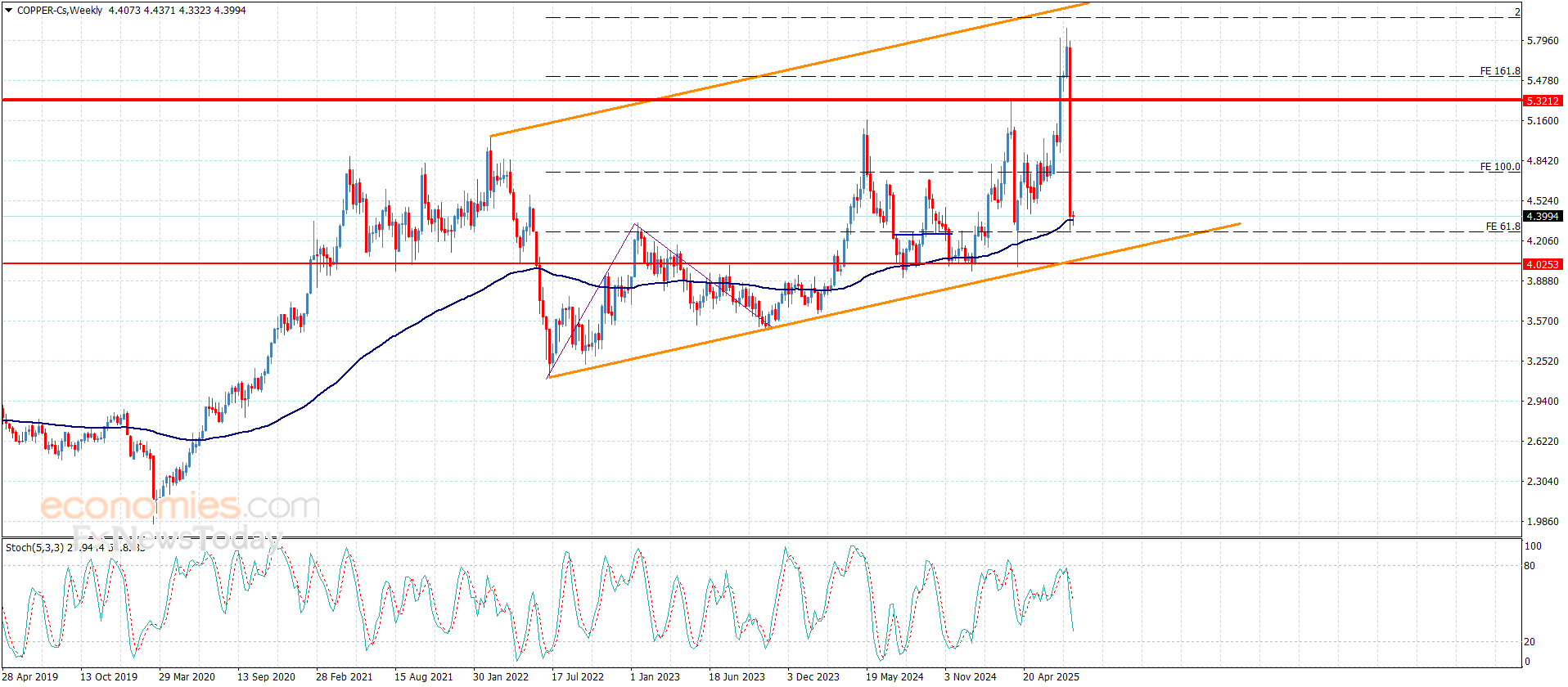
Despite the weakness of copper price’s last trading and its repeated fluctuation near the moving average 55 at $4.4000 level, the overall positive stability within the bullish channel’s levels and by the stability of the extra support near $4.2600, these factors support our bullish suggestion, to keep gathering extra positive momentum, then begin targeting positive stations by $4.6300 and $4.7500.
The risk of changing the main trend by breaking the main support at $4.0500, which forces it to suffer big losses by reaching $3.8700.
The expected trading range for today is between $4.2600 and $4.6300
Trend forecast: Bullish
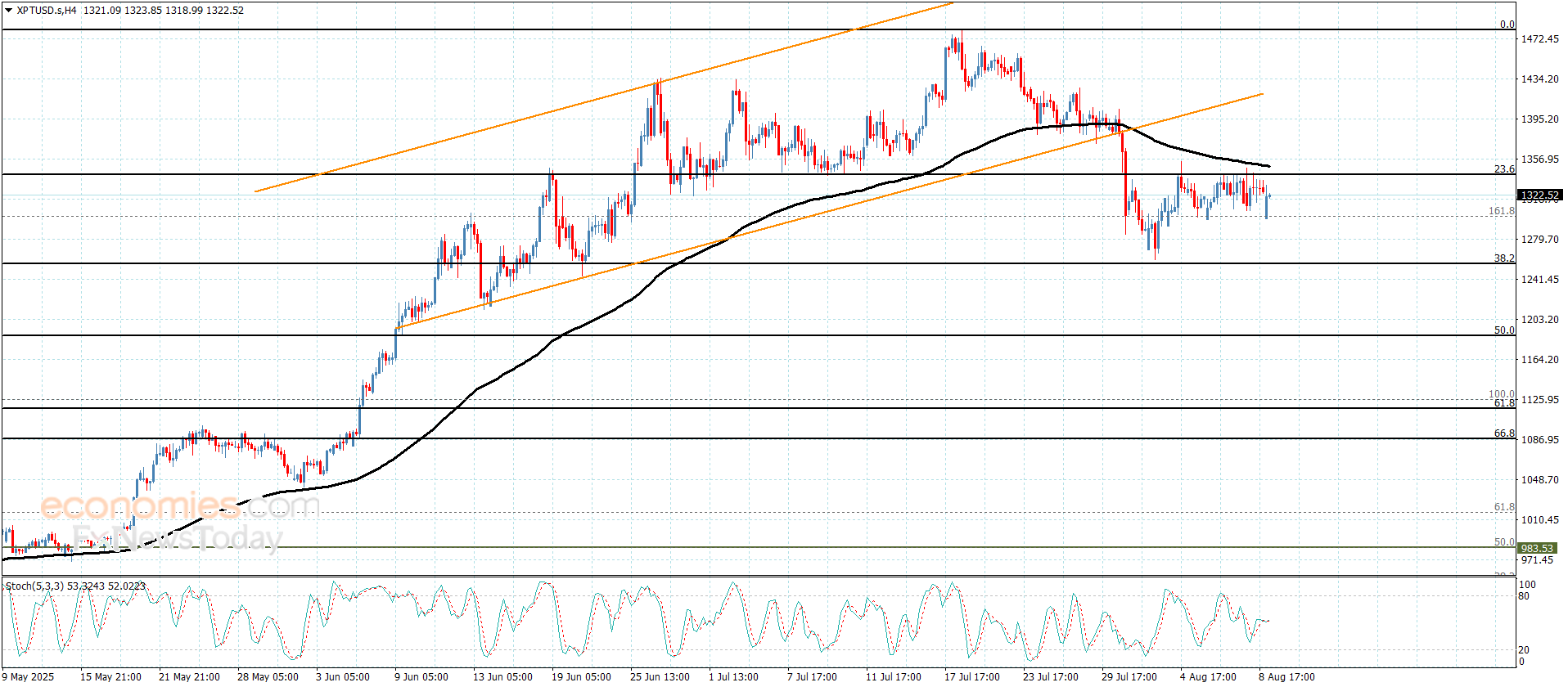
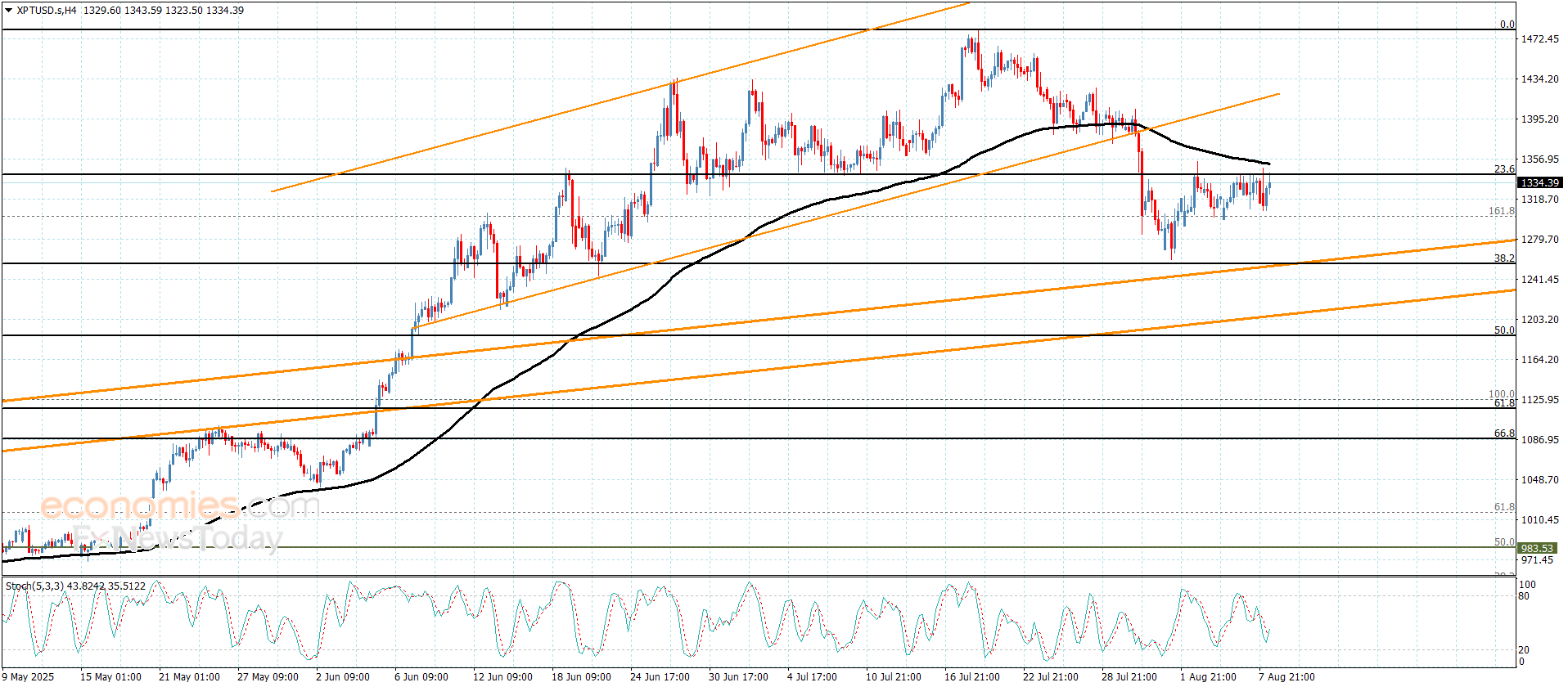
Platinum price began gathering positive momentum by stochastic stability above 20 level, to notice attacking the barrier at $1342.00, which forms a key for regaining the bullish bias of the current trading.
The contradiction between the moving average 55 with the attempt of regaining the bullish bias makes us monitor the price behavior and wait for the next close to confirm the expected trend of the upcoming trading, as breaching the barrier and holding above $1355.00 will reinforce the chances for achieving several gains that might begin at $1375.00 and $1415.00, while the breach will motivate the bearish correctional track, and there are chance for declining towards $1290.00.
The expected trading range for today is between $1325 and $1342.00
Trend forecast: Neutral
The EURJPY pair leaned clearly above the extra support at 170.45, activating with the main indicators, achieving some gains by its fluctuation above the intraday barrier at 171.90.
Noting that the stability of the trading above 171.90 level is important, to reinforce the chances for resuming the bullish attack, to expect the extension of the trading towards 172.65, then targeting the bullish channel’s resistance at 173.80, while the return below 171.90 will force it to form new bearish correctional trading before resuming the suggested targets.
The expected trading range for today is between 171.45 and 172.65
Trend forecast: Bullish
The current advance in the price of gold, beginning from the November swing low, shows an acceleration of bullish momentum. This can be seen by the rising slope of the trendlines. That may put the trend at greater risk as momentum becomes less sustainable, but the weekly chart shows the strong trend is intact. The recent decline that generated a new swing low at $3,268 found support and rallied from the 20-Week MA. That was the first test of support at that weekly moving average and gold responded in bullish fashion. A weekly bullish reversal triggered this week, and it will be confirmed on a weekly basis by a weekly close above last week’s high of $3,363.
An upside breakout of the triangle is indicated on a decisive rally above the recent swing high at $3,439. That would open the door to a challenge of the trend high at $3,500 and the potential for new record highs. However, given the distance to the apex of the triangle, consolidation could continue before a sustained breakout is attempted.
At the time, a vertical line on the chart shows August 21. That is a visual approximately of when 75% of the triangle has been filled. Typically, a breakout of a triangle will occur before that point is reached. And concurrently, the integrity of the pattern begins to weaken and therefore the potential response to a breakout, either up or down.
A key potential support area to watch would be around the 20-Day and 50-Day MA, currently at $3,353 and $3,347, respectively. Also, consider the possibility of a false breakdown through the bottom boundary line and then a quick recovery and rally.
For a look at all of today’s economic events, check out our economic calendar.