The main tag of Gold Today Price Articles.
You can use the search box below to find what you need.
[wd_asp id=1]
The main tag of Gold Today Price Articles.
You can use the search box below to find what you need.
[wd_asp id=1]
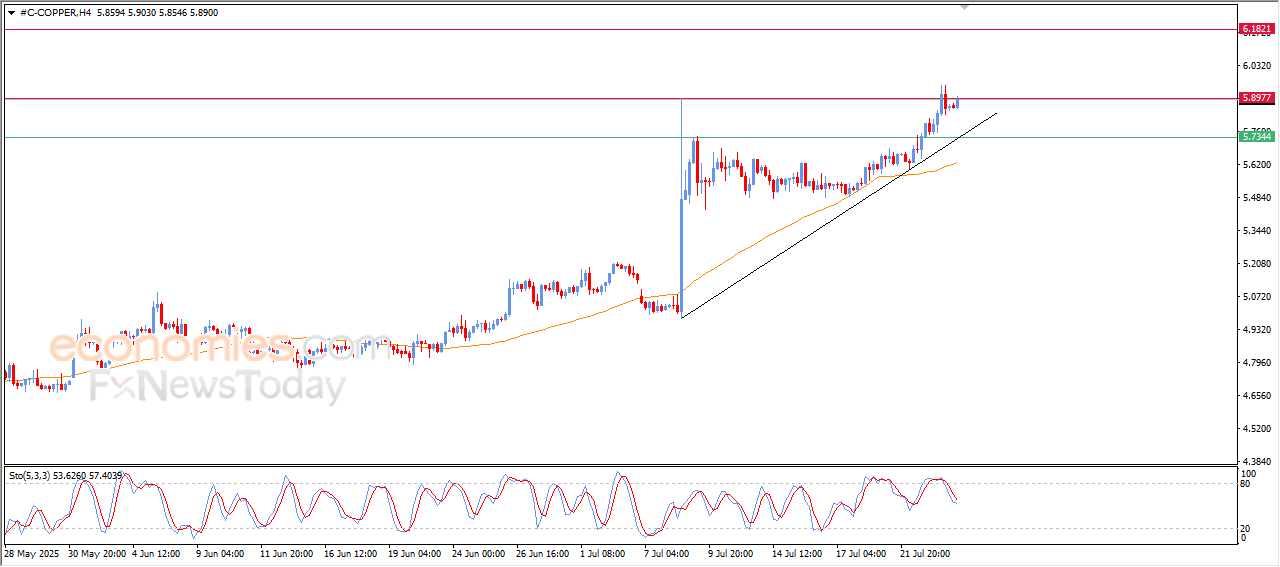
Copper price soars high in its last intraday trading, to reach the critical resistance at $5.89, which represents our yesterday’s target amid the dominance of the main bullish trend on the short-term basis and its trading alongside a supportive minor bias line for the trend, taking advantage of the dynamic support that is represented by its trading above EMA50, this rise came after the success in offloading its overbought condition on the (RSI), opening the way for achieving more gains.
Therefore, our expectations suggest a rise in (copper) price in its upcoming intraday trading, especially when breaching the mentioned resistance at $5.89, to target the next resistance level at $6.1820.
The expected trading range for today is between $5.7344 and $6.0500
Trend forecast: Bullish
High-accuracy trading signals delivered directly to your Telegram. Subscribe to specialized packages tailored for the world’s most important markets – all powered by BestTradingSignal.com .
The longer the subscription, the greater the savings and the more value you get.
Weekly performance report available here: Trading Signal Results – Week of July 14–18, 2025
Global markets witnessed steady growth in Copper Sulphate Prices, with notable surges in the USA, China, and South Africa. Our latest Copper Sulphate Price Trend Report offers in-depth analysis, forecast insights, historical trends, and an updated price chart to support smarter procurement decisions. Stay ahead with accurate data and market direction.
The Copper Sulphate Price Trend Report for Q2 2025 reflects dynamic pricing shifts across major global regions, influenced by industrial activity, agricultural demand, and market logistics. This report covers a deep dive into Copper Sulphate Prices, analyzing trends, historical data, and forecasting upcoming movements with a clear view of the Copper Sulphate price chart, index movements, and market forces.
Copper Sulphate Price Trend Analysis
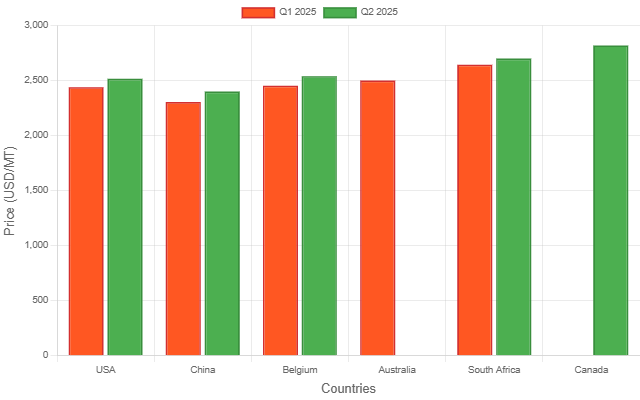
During the second quarter of 2025, Copper Sulphate Prices exhibited moderate increases in key global markets. The USA saw prices reach US$ 2516/MT, while China recorded US$ 2400/MT, showing steady domestic consumption. Belgium and Canada followed similar upward trajectories, indicating strong European and North American demand recovery.
This trend aligns with rising industrial usage and stable agricultural applications, especially in fertilizers and fungicides.
Get Real-Time Price Analysis: https://www.imarcgroup.com/copper-sulphate-pricing-report/requestsample
Copper Sulphate Price Forecast 2025
The Copper Sulphate future price is expected to remain firm in the short term due to persistent demand and limited inventory buildup. With increasing consumption from the agriculture and electronics sectors, the price of Copper Sulphate may continue on a gradual upward trend throughout the latter half of 2025.
However, macroeconomic uncertainties and trade route fluctuations could impact the forecast in select regions. Stakeholders are advised to monitor inventory levels and input costs closely.
Copper Sulphate Price Chart & Index
The Copper Sulphate price index in Q2 2025 reveals moderate yet consistent growth compared to Q1. The Copper Sulphate price chart reflects this increase across regions, notably in North America and South Africa, where industrial rebound and logistics optimization supported the trend.
The global average also rose slightly, indicating broader market strength. Users can access region-specific pricing and historical indices through our full pricing platform.
Copper Sulphate Price Historical Analysis Data
A comparative analysis of the Copper Sulphate price history from 2024 to 2025 reveals a steady recovery in prices after a subdued demand in late 2023. In 2024, prices fluctuated amid input volatility, while in 2025, the market showed stabilization and growth.
This consistency highlights the resilience of Copper Sulphate across industrial applications, especially in mining, printing, and agriculture.
Copper Sulphate Price Comparison : Q1 vs Q2 2025
Across Q1 and Q2 2025, Copper Sulphate Prices in key regions recorded incremental increases. The USA, China, Belgium, and South Africa all experienced percentage gains in pricing due to stronger demand and slightly tightened supply chains. This upward shift is expected to continue if seasonal demand persists in Q3.
Price Trends and Regional Variations
North America: The Copper Sulphate Prices in the USA and Canada rose due to higher agricultural usage and a resurgence in chemical production.
Asia Pacific: China witnessed a moderate increase driven by localized manufacturing growth and post-holiday agricultural activity.
Global: Europe and Africa, particularly Belgium and South Africa, saw significant price action due to export orders and seasonal demand spikes.
Factors Influencing Copper Sulphate Prices
Specific Future Trends and Outlooks
Near Term: Slight upward momentum expected due to seasonal planting and steady industrial activity.
Long Term: By early 2026, prices may stabilize with increased global supply unless disrupted by major geopolitical or energy factors.
Historical Trends
Recent Copper Sulphate Price Trends and Market Activity
In Q2 2025, global Copper Sulphate Prices rose consistently across all key markets. This was attributed to improved logistics, resumed mining operations, and bulk procurement by fertilizer manufacturers. Additionally, new environmental regulations in some countries have led to changes in sourcing patterns, further shaping pricing.
List of Major Copper Sulphate Suppliers
These companies serve as primary suppliers across various continents, catering to both agricultural and industrial segments.
News & Recent Development
Browse Here More Other Related Reports:
· Phosphoric Acid Price Trend Report
· Acetic Acid Price Trend Report
· Ammonium Perchlorate Price Trend Report
· Boric Acid Price Trend Report
About Us:
IMARC Group is a global management consulting firm that provides a comprehensive suite of services to support market entry and expansion efforts. The company offers detailed market assessments, feasibility studies, regulatory approvals and licensing support, and pricing analysis, including spot pricing and regional price trends. Its expertise spans demand-supply analysis alongside regional insights covering Asia-Pacific, Europe, North America, Latin America, and the Middle East and Africa. IMARC also specializes in competitive landscape evaluations, profiling key market players, and conducting research into market drivers, restraints, and opportunities. IMARC’s data-driven approach helps businesses navigate complex markets with precision and confidence.
Contact us:
IMARC Group
134 N 4th St. Brooklyn, NY 11249, USA
Email: sales@imarcgroup.com
Tel No: (D) +91 120 433 0800
United States: +1-631-791-1145
Silver price (XAG/USD) extends its losses for the second successive session, trading around $39.10 per troy ounce during the Asian hours on Thursday. The price of Silver struggles due to weakened safe-haven demand, driven by the optimism over further trade deals between the US and key partners.
The Financial Times reported that the European Union (EU) and the United States (US) are closing in on a deal that would impose 15% tariffs on EU goods imported into the US. Additionally, US President Donald Trump announced on Tuesday a major tariff deal with Japan, which includes a 15% tariff on Japanese exports.
However, some caution remained amid ongoing threats of 15% to 50% tariffs on countries such as South Korea and India, which are still negotiating deals. Traders also await clarity on talks with China, with Treasury Secretary Bessent scheduled to meet Chinese officials in the week ahead. On the monetary policy front, markets are focused on next week’s Federal Reserve meeting, where rates are expected to be kept on hold, with potential cuts anticipated in October.
However, the safe-haven demand for Silver could also be dampened due to easing concerns over the Federal Reserve’s (Fed) independence. US Treasury Secretary Scott Bessent said late Thursday that a nominee for the next Federal Reserve Chair is likely to be announced in December or January. Bessent emphasized that there is “no rush” to select a successor to current Fed Chair Jerome Powell.
Silver is a precious metal highly traded among investors. It has been historically used as a store of value and a medium of exchange. Although less popular than Gold, traders may turn to Silver to diversify their investment portfolio, for its intrinsic value or as a potential hedge during high-inflation periods. Investors can buy physical Silver, in coins or in bars, or trade it through vehicles such as Exchange Traded Funds, which track its price on international markets.
Silver prices can move due to a wide range of factors. Geopolitical instability or fears of a deep recession can make Silver price escalate due to its safe-haven status, although to a lesser extent than Gold’s. As a yieldless asset, Silver tends to rise with lower interest rates. Its moves also depend on how the US Dollar (USD) behaves as the asset is priced in dollars (XAG/USD). A strong Dollar tends to keep the price of Silver at bay, whereas a weaker Dollar is likely to propel prices up. Other factors such as investment demand, mining supply – Silver is much more abundant than Gold – and recycling rates can also affect prices.
Silver is widely used in industry, particularly in sectors such as electronics or solar energy, as it has one of the highest electric conductivity of all metals – more than Copper and Gold. A surge in demand can increase prices, while a decline tends to lower them. Dynamics in the US, Chinese and Indian economies can also contribute to price swings: for the US and particularly China, their big industrial sectors use Silver in various processes; in India, consumers’ demand for the precious metal for jewellery also plays a key role in setting prices.
Silver prices tend to follow Gold’s moves. When Gold prices rise, Silver typically follows suit, as their status as safe-haven assets is similar. The Gold/Silver ratio, which shows the number of ounces of Silver needed to equal the value of one ounce of Gold, may help to determine the relative valuation between both metals. Some investors may consider a high ratio as an indicator that Silver is undervalued, or Gold is overvalued. On the contrary, a low ratio might suggest that Gold is undervalued relative to Silver.
Today’s price action does not confirm the bull pennant breakout. It shows a potential failure. However, it may have just been an early signal and it will be followed by another attempt after a rest. Nonetheless, trading continues near the lows of the day currently and gold will close below the top trendline and possibly below yesterday’s low, which would be another sign of weakness. In either case, it looks like gold may trade within the pennant pattern for a bit longer before another bull breakout is attempted.
The top of the recent 18-day range at $3,377 and down to approximately $3,366, was previously resistance near the top of the recent bottom range and therefore presents a potential support zone. Further down is the 20-Day MA at $3,340. The day prior to this week’s two-day rally a retest of support at the 20-Day line occurred. And since the 20-Day MA is close to the 50-Day MA, now at $3,335.
As the apex of the pennant triangle is approached, the chance for a bull breakout or bearish failure increases. The weekly chart is supportive of an upside breakout. Even without the pennant pattern, a weekly bullish signal was triggered this week as a higher high and higher low for the week was established this week. A weekly closing price above last week’s high of $3,377 will confirm the weekly trend continuation signal.
For a look at all of today’s economic events, check out our economic calendar.
There are two primary lower support zones indicated on the chart. Given the bearish signal today it looks like the next lower target zone could be reached soon. A long-term uptrend line is approaching fast. In addition, an anchored volume weighted average price (AVWAP) line (light blue) begun from the 2024 trend is about to converge with the trendline. Notice that the AVWAP is approaching a convergence with the rising trendline. Together, those two lines present a potentially significant support zone. Currently, the AVWAP is around $2.97.
A successful test of that AVWAP line occurred in April as a price was rejected to the upside after finding support at the line. That led to a sharp bullish reversal. Two indicators pointing to a potentially similar support area increase its significance and potential for a clear reaction. If natural gas forms a low near potential support lines, a higher swing low will result, and a bullish trend structure is retained.
Nevertheless, there is also the possibility that support around the trendline and AVWAP line fail to hold. In that case the swing low from April $2.86 would be the next lower target and it could be broken. From the low at $2.86 to a 78.6% Fibonacci retracement at $2.80 mark the next lower potential support zone.
Bearish momentum looks to be intensifying and that could lead to a break below the AVWAP and trendline. However, keep in mind that bearish momentum will eventually run out of steam. If a drop below a key support area occurs but it is then relatively quickly recovered, that will be a sign of demand returning to the market for natural gas.
For a look at all of today’s economic events, check out our economic calendar.
Chile, the world’s leading copper supplier, has revised its copper price forecast upward for 2025. The government now projects an average price of $4.28 per pound, representing an increase from its previous estimate of $4.26 per pound. This adjustment reflects ongoing market dynamics and global demand patterns affecting the red metal.
Finance Minister Mario Marcel presented this updated outlook to Congress on July 23, 2025, highlighting how shifting market fundamentals continue to support stronger pricing despite operational challenges at key mining assets.
The government’s willingness to revise its forecast upward, even marginally, signals confidence in copper’s fundamental outlook despite operational challenges in the domestic mining sector.
During his congressional presentation, Finance Minister Marcel specifically highlighted production issues at the Collahuasi mine as a significant concern affecting the mining sector’s contribution to economic growth. This major copper operation, jointly operated by Glencore and Anglo American, has experienced a notable decline in output in recent months.
The mine, located in Chile’s copper-rich northern region, ranks among the world’s largest copper operations with historical production exceeding 565,000 tonnes annually. Its strategic importance to both the companies and Chile’s economy makes any production disruption particularly significant.
Industry analysts note that water management has been an ongoing challenge at Collahuasi, with previous disruptions in 2021 linked to water scarcity issues. The high-altitude operation faces unique operational challenges that can impact production efficiency and recovery rates.
The United States has announced 50% tariffs on copper imports scheduled to take effect on August 1, 2025. According to Codelco’s chairperson (Chile’s state mining company and the world’s largest copper producer), these tariffs have already influenced record copper prices in the US market and contributed to global price volatility.
“We’re seeing unprecedented price differentials developing between regional markets,” noted Codelco’s chair during recent commentary on market conditions. “The anticipated US tariffs impact on copper are creating significant distortions in traditional trading patterns.”
The tariff announcement is particularly consequential given that Chile supplied approximately 42% of U.S. copper imports in 2024, making it the largest supplier to the American market.
The tariffs represent part of a broader trade policy shift that has already begun reshaping global metals markets, with producers increasingly looking to diversify customer bases to mitigate concentration risk.
Despite the production issues at Collahuasi and broader mining sector headwinds, Chile has maintained its official GDP growth estimate at 2.5% for 2025. This stability in the forecast suggests that other economic sectors have successfully compensated for the mining sector’s underperformance.
“Non-mining GDP has compensated for a drop in the mining sector’s contribution,” Minister Marcel explained to legislators, highlighting the economy’s increasing diversification beyond its traditional resource extraction base.
| Economic Indicator | 2025 Forecast | Change from Previous Estimate |
|---|---|---|
| GDP Growth | 2.5% | Unchanged |
| Average Copper Price | $4.28/lb | Increased from $4.26/lb |
| 2026 Copper Price Forecast | $4.30/lb | Unchanged |
| Inflation Outlook | Maintained | Unchanged |
| Non-Mining GDP | Outperforming | Compensating for mining sector |
The resilience of Chile’s economic forecast despite mining challenges demonstrates the country’s partially successful efforts to diversify its economic base beyond its traditional reliance on copper exports, which have historically accounted for over 40% of export revenues.
The specific mention of Collahuasi’s production challenges by Chile’s Finance Minister underscores the mine’s significance to the national economy. As one of the world’s largest copper operations, its performance directly affects export revenues, tax receipts, and employment in the mining sector.
Located in the Tarapacá region, Collahuasi employs over 5,200 workers directly and supports thousands more indirectly through its supply chain, making it a critical economic engine for northern Chile. The operation has historically contributed significantly to regional development through both direct employment and community investment programs.
According to industry analysts, each percentage point decline in Collahuasi’s production equates to approximately $45-60 million in reduced export value at current prices, highlighting the material economic impact of operational disruptions.
Chile’s finance ministry has maintained its copper price forecast for 2026 at $4.30 per pound, suggesting expectations of continued strong pricing beyond the current year. This outlook reflects structural market factors including persistent supply constraints, growing demand from energy transition sectors, and limited new project development.
Copper’s critical role in electrification has cemented its status as an essential energy transition metal. Electric vehicles require approximately three times more copper than internal combustion vehicles, while renewable energy infrastructure demands significantly higher copper intensity than traditional power generation.
The lack of significant new copper projects entering production in the medium term creates a structural support for prices, as existing mines face declining grades and increased production costs.
The Codelco chairperson specifically cited “global uncertainty” as a driver of price volatility in copper markets. This uncertainty stems from multiple factors including escalating trade tensions, shifting monetary policy expectations, and evolving energy transition timelines.
Copper’s unique position as both an industrial metal and financial asset makes it particularly susceptible to macroeconomic sentiment shifts. The metal often trades on expectations of future economic activity, creating price movements that sometimes precede actual changes in physical demand.
“Copper markets are experiencing unprecedented uncertainty as both traditional industrial demand signals and emerging energy transition requirements compete for attention from investors and operators,” notes the Codelco chair. “This creates both challenges and opportunities for major producers.”
The intersection of these uncertainty factors has contributed to copper’s price volatility despite its strong fundamental outlook, creating tactical trading opportunities alongside long-term investment potential.
For investors and market participants tracking Chile’s copper sector, several key indicators warrant close attention in the coming months as the situation evolves. These metrics provide insight into both near-term price movements and longer-term structural trends.
Chile’s position as the world’s largest copper producer means developments in its mining sector often have outsized effects on global markets. The country’s sliding-scale royalty system (currently 0-8% based on price levels) remains under review, with potential implications for investment and production economics.
Production recovery timeline at Collahuasi
Government policy developments
Export and production metrics
Sustainability performance indicators
Operational updates from major producers
Investors should particularly focus on Collahuasi’s recovery trajectory, as its production volumes significantly influence Chile’s overall copper output and export capacity. Additionally, tracking the global copper production forecast provides essential context for understanding supply dynamics.
Chile has revised its copper price forecast to $4.28 per pound for 2025, up from the previous estimate of $4.26 per pound. This adjustment was announced by Finance Minister Mario Marcel on July 23, 2025, and reflects current copper price predictions from industry experts.
The Collahuasi mine, operated by Glencore and Anglo American, has been specifically identified as experiencing a notable decline in production output. This high-altitude operation ranks among the world’s largest copper mines.
Chile has maintained its 2.5% GDP growth forecast for 2025 despite mining sector challenges, as non-mining sectors have compensated for the reduced mining contribution. This demonstrates the economy’s increasing diversification.
The 50% tariff on copper imports to the United States is scheduled to take effect on August 1, 2025. These tariffs have already influenced pricing patterns and trading relationships in anticipation of implementation, as reported by Reuters.
Chile’s finance ministry maintains its copper price forecast for 2026 at $4.30 per pound, reflecting expectations of continued strong market fundamentals beyond the current year.
Major mines like Collahuasi directly impact export revenues, tax receipts, and regional employment. The Finance Minister’s specific mention of Collahuasi demonstrates how individual operations can have material effects on national economic performance.
Another important trend to watch is the development of the Argentina copper system, which could potentially impact the regional supply dynamics over the coming years.
Disclaimer: This article contains forward-looking statements regarding copper prices, production levels, and economic impacts. These projections involve inherent uncertainties, and actual outcomes may differ from forecasts. Investors should conduct their own research before making investment decisions based on this information.
Discovery Alert’s proprietary Discovery IQ model delivers instant notifications on significant ASX copper discoveries, transforming complex mineral data into actionable investment insights before the broader market catches on. Explore our dedicated discoveries page to see how early detection of mineral discoveries can lead to exceptional investment returns.
Important DisclaimersThe content provided on the website includes general news and publications, our personal analysis and opinions, and contents provided by third parties, which are intended for educational and research purposes only. It does not constitute, and should not be read as, any recommendation or advice to take any action whatsoever, including to make any investment or buy any product. When making any financial decision, you should perform your own due diligence checks, apply your own discretion and consult your competent advisors. The content of the website is not personally directed to you, and we does not take into account your financial situation or needs.The information contained in this website is not necessarily provided in real-time nor is it necessarily accurate. Prices provided herein may be provided by market makers and not by exchanges.Any trading or other financial decision you make shall be at your full responsibility, and you must not rely on any information provided through the website. FX Empire does not provide any warranty regarding any of the information contained in the website, and shall bear no responsibility for any trading losses you might incur as a result of using any information contained in the website.The website may include advertisements and other promotional contents, and FX Empire may receive compensation from third parties in connection with the content. FX Empire does not endorse any third party or recommends using any third party’s services, and does not assume responsibility for your use of any such third party’s website or services.FX Empire and its employees, officers, subsidiaries and associates, are not liable nor shall they be held liable for any loss or damage resulting from your use of the website or reliance on the information provided on this website.Risk DisclaimersThis website includes information about cryptocurrencies, contracts for difference (CFDs) and other financial instruments, and about brokers, exchanges and other entities trading in such instruments. Both cryptocurrencies and CFDs are complex instruments and come with a high risk of losing money. You should carefully consider whether you understand how these instruments work and whether you can afford to take the high risk of losing your money.FX Empire encourages you to perform your own research before making any investment decision, and to avoid investing in any financial instrument which you do not fully understand how it works and what are the risks involved.
Important DisclaimersThe content provided on the website includes general news and publications, our personal analysis and opinions, and contents provided by third parties, which are intended for educational and research purposes only. It does not constitute, and should not be read as, any recommendation or advice to take any action whatsoever, including to make any investment or buy any product. When making any financial decision, you should perform your own due diligence checks, apply your own discretion and consult your competent advisors. The content of the website is not personally directed to you, and we does not take into account your financial situation or needs.The information contained in this website is not necessarily provided in real-time nor is it necessarily accurate. Prices provided herein may be provided by market makers and not by exchanges.Any trading or other financial decision you make shall be at your full responsibility, and you must not rely on any information provided through the website. FX Empire does not provide any warranty regarding any of the information contained in the website, and shall bear no responsibility for any trading losses you might incur as a result of using any information contained in the website.The website may include advertisements and other promotional contents, and FX Empire may receive compensation from third parties in connection with the content. FX Empire does not endorse any third party or recommends using any third party’s services, and does not assume responsibility for your use of any such third party’s website or services.FX Empire and its employees, officers, subsidiaries and associates, are not liable nor shall they be held liable for any loss or damage resulting from your use of the website or reliance on the information provided on this website.Risk DisclaimersThis website includes information about cryptocurrencies, contracts for difference (CFDs) and other financial instruments, and about brokers, exchanges and other entities trading in such instruments. Both cryptocurrencies and CFDs are complex instruments and come with a high risk of losing money. You should carefully consider whether you understand how these instruments work and whether you can afford to take the high risk of losing your money.FX Empire encourages you to perform your own research before making any investment decision, and to avoid investing in any financial instrument which you do not fully understand how it works and what are the risks involved.
So, what I mean by that is we have divergence. This is a market that’s overdone. And I think we are getting close to the idea of perhaps being extraordinarily overbought and this divergence could lead to something rather ugly. That ugliness would probably be somewhat short-term. So, I am watching the $1,400 level because if I think if we drop down below there, we could have a little bit more significant drop perhaps to the $1,250 level. Now, if you don’t trade platinum, that’s fine, but this will have a knock-on effect in the metals markets. So that is worth paying attention to as well.

If we continue to go higher and break above the $1,500 level, then it could be worth getting long and trying to aim for the $1,600 level as platinum does have a history of just grinding forever in one direction or one range or whatever. So, it’s an interesting market. It is one that I think you should pay attention to. It’s a great market to trade. It’s very stable, as you can see. Maybe not as exciting as some of the other ones, but you know, sometimes you need a market that’s a little bit more technically driven. So, watch this chart. It’s very interesting at the moment. 1500 of course is a major resistance barrier. But if we break down below the $1400 level, then we could see a bit more of a drop.
Ready to trade our daily Forex analysis? We’ve made a list of the best forex demo accounts worth trading with.
Christopher Lewis has been trading Forex and has over 20 years experience in financial markets. Chris has been a regular contributor to Daily Forex since the early days of the site. He writes about Forex for several online publications, including FX Empire, Investing.com, and his own site, aptly named The Trader Guy. Chris favours technical analysis methods to identify his trades and likes to trade equity indices and commodities as well as Forex. He favours a longer-term trading style, and his trades often last for days or weeks.
The U.S.-Japan deal includes 15% reciprocal tariffs and expanded market access for U.S. exports, ranging from autos and agricultural goods to rice. “The announcement defused immediate trade tensions and improved the global risk tone,” analysts at ING wrote, adding that precious metals came under pressure as capital rotated into equities and riskier assets.
At the same time, the U.S. dollar staged a mild recovery, bouncing from a two-week low. Although the rebound in the greenback was modest, it was enough to trigger profit-taking in gold, which had surged over 4% in the past five trading days. Technical traders noted the move as a corrective pullback rather than a trend reversal, citing persistent uncertainty in the Fed’s rate path.
While the Trump-Japan deal improved sentiment, uncertainty over Federal Reserve policy continues to cloud the macro outlook. President Trump has renewed calls for lower rates and publicly questioned Fed Chair Jerome Powell’s leadership. Meanwhile, Treasury Secretary Scott Bessent has requested a review of central bank operations, sparking concerns about institutional independence.
“Political interference in monetary policy is unsettling for markets,” said Michael Saunders, a senior FX strategist. “That ambiguity around future rate decisions is preventing a full dollar recovery, thereby cushioning the downside in gold.”
Lower interest rate expectations tend to support gold, which offers no yield but benefits from a weaker dollar environment.
Later today, traders will scrutinize the U.S. Existing Home Sales report, followed by global flash PMI releases, which could influence economic sentiment and precious metals direction.