The main tag of Gold Today Price Articles.
You can use the search box below to find what you need.
[wd_asp id=1]
The main tag of Gold Today Price Articles.
You can use the search box below to find what you need.
[wd_asp id=1]
The average price of oil per barrel in 2025 is projected at $68.6, while the price of 1,000 cubic meters of gas is forecasted at $399, the Governor of the Central Bank of Azerbaijan, Taleh Kazimov, said during a press conference on the parameters of the interest rate corridor, APA reports.
He noted that by the end of this year, the current account surplus is expected to form around $3.6–4 billion.
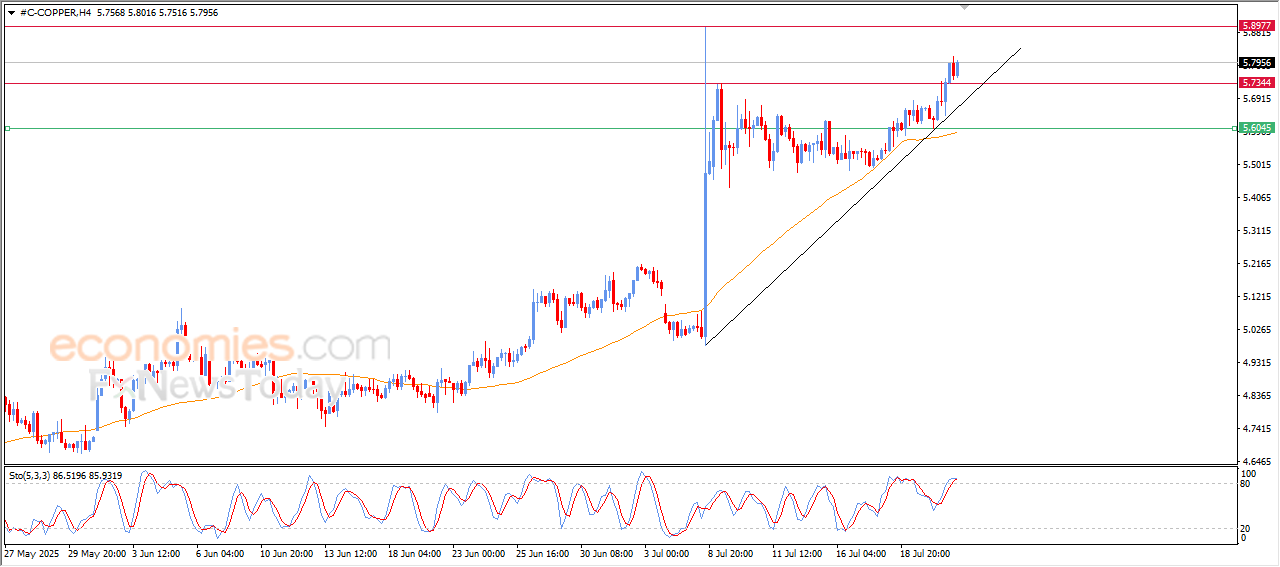
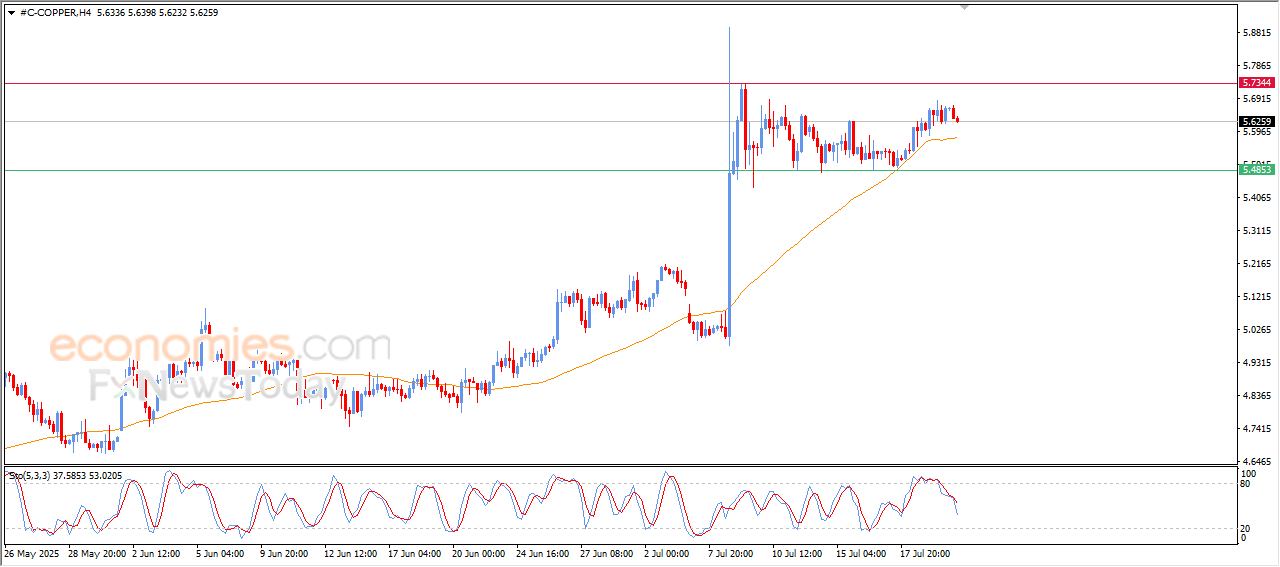
Copper price witnessed a strong rise in its last intraday trading, to breach the key resistance at $5.73, amid the dominance of the main bullish trend on the short-term basis and its trading alongside a minor bias line, with the continuation of the dynamic support that is represented by its trading above EMA50, reinforcing the stability of this bullish track, especially with the emergence of the positive signals on the (RSI), despite reaching overbought areas.
Therefore, our expectations suggest a rise in (copper) price in its upcoming intraday trading, if it settles above $5.73, to target the critical resistance level at $5.89.
The expected trading range for today is between $5.65 and $5.89
Trend forecast: Bullish
High-accuracy trading signals delivered directly to your Telegram. Subscribe to specialized packages tailored for the world’s most important markets – all powered by BestTradingSignal.com .
The longer the subscription, the greater the savings and the more value you get.
Weekly performance report available here: Trading Signal Results – Week of July 14–18, 2025
Gold price is reversing from over one-month highs of $3,403 reached in early Asia on Tuesday as buyers take a breather, awaiting clarity on potential US trade deals before the August 1 deadline.
The latest retracement in Gold price could be attributed to a bout of profit-taking after Monday’s nearly 1.5% rally and ahead of key earnings results from America’s tech giant – Alphabet Inc, this Wednesday.
A pause in the US Dollar (USD) and US Treasury bond yields sell-off also weighs on the Greenback-priced bright metal.
The fate of Gold price hinges on the USD’s performance, in the face of US President Donald Trump’s tariff talks.
Mounting uncertainty over US trade deals with Japan and the European Union (EU) weighed heavily on the Greenback at the start of the week on Monday, as it revived US economic growth concerns.
Citing some sources. the Wall Street Journal (WSJ) reported on Monday that “US officials have informed the EU’s trade chief that President Trump is likely to demand further concessions in ongoing trade talks, including a higher baseline tariff of 15% or more on most European goods, a significant increase from the previously discussed 10%.”
EU diplomats noted that the bloc is exploring a broader set of possible countermeasures against the US as doubts over a likely deal rise.
Meanwhile, Japanese political instability cast clouds on a likely US-Japan trade deal before the August 1 deadline.
Additionally, the US currency also felt the heat of the falling US Treasury bond yields amid persistent worries over the Federal Reserve’s (Fed) independence amid Trump’s repeated calls for Fed Chair Jerome Powell’s resignation.
The record rally on Wall Street indices also diminished the safe-haven appeal of the USD and the attractiveness of the yields, helping Gold price extend Friday’s gains.
As observed on the daily chart, Gold price closed Monday above the 23.6% Fibonacci Retracement (Fibo) level of the April record rally at $3,377.
Meanwhile, the yellow metal holds its position well above all major Simple Moving Averages (SMA) as the 14-day Relative Strength Index (RSI) stays comfortably above the midline, despite the latest downtick.
The technical setup, therefore, appears in favor of Gold buyers, with acceptance above the $3,400 mark needed to take on the static resistance at around $3,440.
Conversely, if the correction extends, Gold price could test the previous resistance-turned-support at $3,377, below which the $3,330 area could lend some support. That zone is the confluence of the 21-day SMA and the 50-day SMA.
Sellers must find a strong foothold below that demand area to test the 38.2% Fibo level of the same rally at $3,297 before targeting the July low of $3,283.
Gold has played a key role in human’s history as it has been widely used as a store of value and medium of exchange. Currently, apart from its shine and usage for jewelry, the precious metal is widely seen as a safe-haven asset, meaning that it is considered a good investment during turbulent times. Gold is also widely seen as a hedge against inflation and against depreciating currencies as it doesn’t rely on any specific issuer or government.
Central banks are the biggest Gold holders. In their aim to support their currencies in turbulent times, central banks tend to diversify their reserves and buy Gold to improve the perceived strength of the economy and the currency. High Gold reserves can be a source of trust for a country’s solvency. Central banks added 1,136 tonnes of Gold worth around $70 billion to their reserves in 2022, according to data from the World Gold Council. This is the highest yearly purchase since records began. Central banks from emerging economies such as China, India and Turkey are quickly increasing their Gold reserves.
Gold has an inverse correlation with the US Dollar and US Treasuries, which are both major reserve and safe-haven assets. When the Dollar depreciates, Gold tends to rise, enabling investors and central banks to diversify their assets in turbulent times. Gold is also inversely correlated with risk assets. A rally in the stock market tends to weaken Gold price, while sell-offs in riskier markets tend to favor the precious metal.
The price can move due to a wide range of factors. Geopolitical instability or fears of a deep recession can quickly make Gold price escalate due to its safe-haven status. As a yield-less asset, Gold tends to rise with lower interest rates, while higher cost of money usually weighs down on the yellow metal. Still, most moves depend on how the US Dollar (USD) behaves as the asset is priced in dollars (XAU/USD). A strong Dollar tends to keep the price of Gold controlled, whereas a weaker Dollar is likely to push Gold prices up.
Traders pulled risk off the table following a cooler shift in U.S. weather models. While much of the southern two-thirds of the country remains hot, with highs in the 90s and low 100s, updated GFS and EC models showed a net reduction of five cooling degree days (CDDs) over the weekend.
Temperatures in the Northeast and Midwest are now expected to moderate from late July into early August, with Vaisala projecting an active storm track that could cap cooling demand during July 31–August 4.
Another pressure point for prices is the ongoing softness in LNG exports. U.S. LNG net flows on Monday totaled 14.9 bcf/day, down 4.9% week-on-week, according to BNEF. This drop coincides with signs of stronger supply. U.S. dry gas production reached 107.4 bcf/day to start the week—up 4.8% year-on-year—while rig activity hit a 17-month high of 117, per Baker Hughes.
Last week’s EIA storage report added to the bearish tone. Inventories rose by 46 bcf for the week ending July 11, slightly above consensus and the five-year average of +41 bcf. U.S. gas inventories now sit 6.2% above their five-year seasonal average, despite being 4.9% lower year-on-year.
Meanwhile, electricity demand offers limited support: U.S. power output rose just 1.1% y/y in the latest weekly report, a modest lift relative to expectations for peak summer cooling demand.
Natural gas price settled on slight gain in its last intraday trading, attempting to recover some of its previous losses, and it attempts to offload some of its clear oversold conditions on the (RSI), especially with the beginning of the emergence of the positive signals, amid the dominance of the main bearish trend on the short-term, and its affection by exiting bullish correctional channel’s range on the short-term basis, with the continuation of the negative pressure due to its trading below EMA50.
Therefore, our expectations suggest natural gas price decline in its upcoming intraday trading, if the resistance settles at $3.40, to target the initial support level at 43.25 preparing to break it.
The expected trading range for today is between $3.20 and $3.40
Trend forecast: Bearish
High-Accuracy Trading Signals – Provided by BestTradingSignal.com
Subscribe now to professional, carefully structured packages covering major global markets. Receive signals directly via Telegram from our expert team.
The longer your subscription, the bigger the discount and the better the rate.
See the full results here: Trading Signal Results by BestTradingSignal.com; Week of July 14–18, 2025
Silver (XAG/USD) starts the week on firmer ground after a mild pullback last week. As of now, the metal is trading near $38.50 during the early American trading hours on Monday, just shy of the multi-year high of $39.13 set on July 14. Although the recent rally has lost some momentum, technical indicators are turning bullish again across both short-term and longer-term charts.
The rebound is also supported by a softer US Dollar, which is trading under pressure on Monday amid easing Treasury yields and cautious risk sentiment.
On the hourly chart, Silver is showing signs of renewed strength after forming a local bottom near $37.50, following a break above a descending trendline. The spot price now holds above both the 50- and 21-period Exponential Moving Averages (EMAs). Both moving averages are sloping slightly upward and acting as dynamic intraday support, indicating fresh buying interest.
Momentum is also firming up. The Relative Strength Index (RSI) has climbed into the overbought zone near 70, reflecting strong bullish momentum. While slightly stretched, the setup remains constructive as long as the RSI holds above 60. Meanwhile, the Average Directional Index (ADX) is pointing north currently at 20, hinting at a possible strengthening in trend momentum. However, a confirmed breakout above the $38.80-$39.00 resistance band could quickly ignite a stronger directional push.
Key short-term levels:
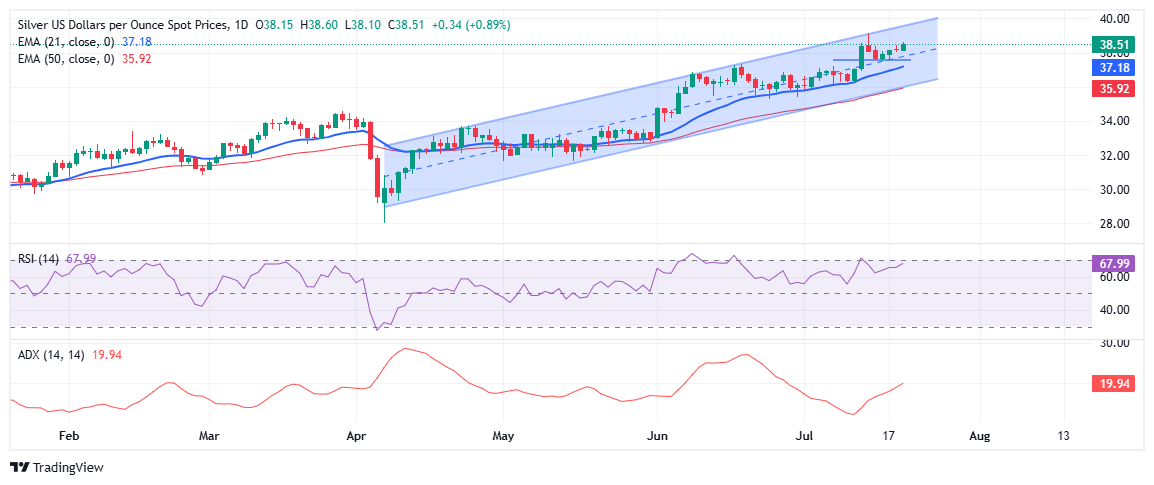
Zooming out to the daily chart, Silver remains firmly embedded in an uptrend, supported by a clearly defined ascending channel that has held since early April. The recent rally to $39.13 shows strong buying interest in Silver, supported by ongoing economic uncertainty and global tensions.
Despite last week’s modest pullback from multi-year highs, the broader structure remains intact. Silver continues to trade comfortably above the 21-day EMA at $37.18 and the 50-day EMA at $35.92—both serving as solid dynamic support and aligning with the lower boundary of the rising channel.
The RSI is nearing the overbought level, currently at 68, indicating buyers are gaining strength. Meanwhile, the ADX has increased to 20.00, showing that the trend is in its early stages. As long as Silver holds above the $37.00-$37.50 region, the broader bullish bias remains intact. A decisive breakout above $39.13 could pave the way for a run toward the key psychological barrier at $40.00.
Silver is a precious metal highly traded among investors. It has been historically used as a store of value and a medium of exchange. Although less popular than Gold, traders may turn to Silver to diversify their investment portfolio, for its intrinsic value or as a potential hedge during high-inflation periods. Investors can buy physical Silver, in coins or in bars, or trade it through vehicles such as Exchange Traded Funds, which track its price on international markets.
Silver prices can move due to a wide range of factors. Geopolitical instability or fears of a deep recession can make Silver price escalate due to its safe-haven status, although to a lesser extent than Gold’s. As a yieldless asset, Silver tends to rise with lower interest rates. Its moves also depend on how the US Dollar (USD) behaves as the asset is priced in dollars (XAG/USD). A strong Dollar tends to keep the price of Silver at bay, whereas a weaker Dollar is likely to propel prices up. Other factors such as investment demand, mining supply – Silver is much more abundant than Gold – and recycling rates can also affect prices.
Silver is widely used in industry, particularly in sectors such as electronics or solar energy, as it has one of the highest electric conductivity of all metals – more than Copper and Gold. A surge in demand can increase prices, while a decline tends to lower them. Dynamics in the US, Chinese and Indian economies can also contribute to price swings: for the US and particularly China, their big industrial sectors use Silver in various processes; in India, consumers’ demand for the precious metal for jewellery also plays a key role in setting prices.
Silver prices tend to follow Gold’s moves. When Gold prices rise, Silver typically follows suit, as their status as safe-haven assets is similar. The Gold/Silver ratio, which shows the number of ounces of Silver needed to equal the value of one ounce of Gold, may help to determine the relative valuation between both metals. Some investors may consider a high ratio as an indicator that Silver is undervalued, or Gold is overvalued. On the contrary, a low ratio might suggest that Gold is undervalued relative to Silver.
Spot Gold surged in the European session Monday, flirting with the $3,400 level after Wall Street’s opening. The strong momentum in the bright metal comes from the broad US Dollar’s (USD) weakness, as the American currency keeps suffering from fiscal and political woes.
Trade-related tensions took centre stage in the absence of relevant data, with the focus particularly in negotiations between the United States (US) and the European Union (EU). Undergoing negotiations between the two economies is not enough to pause threats and retaliatory measures announcements. On the one hand, the White House noted that the deadline, set for August 1, will not be changed, while a base tariffs could be set at 30%. The EU, in the meantime, announced it’s studying retaliatory levies, should the US moves forward.
Other than that, Republican House Anna Paulina Luna is referring Federal Reserve (Fed) Chairman Jerome Powell to the Department of Justice (DOJ) for criminal charges, accusing him of perjury on two occasions. Additionally, Treasury Secretary Scott Bessent proposed a review of the whole Fed. “What we need to do is examine the entire Federal Reserve institution and whether they have been successful,” Bessent said on Monday.
The daily chart for the XAU/USD pair shows it largely recovered above the 61.8% Fibonacci retracement of the $3,452.51 – $3,247.83 at around $3,374, opening the door for a recovery towards the top of the range. The same chart shows the pair is well above a now flat 20 Simple Moving Average (SMA), which consolidates at around $3,330, while the 100 SMA maintains its form bullish slope far below the shorter one, in line with the dominant bullish trend. Finally, technical indicators remain within positive levels with uneven upward strength, yet still suggesting higher highs ahead.
The near-term picture is supportive of another leg north, as technical indicators in the 4-hour chart reached overbought readings. The Momentum indicator maintains its almost vertical slope, while the Relative Strength Index (RSI) indicator decelerated, but keeps aiming north at around 71. At the same time, XAU/USD is far above all its moving averages, with the 100 and 200 SMA lacking directional strength, but the 20 SMA heading higher above the longer ones, skewing the risk to the upside.
Support levels: 3,390.10 3,374.50 3,350.00
Resistance levels: 3,403.20 3,417.90 3,430.35
The higher timeframe monthly chart has also turned bearish. Last week a bearish shooting star candlestick pattern triggered on the monthly chart. Given today’s bearish price action, it needs to be considered as the longer-term patterns influence the shorter. However, it is not just the one-month breakdown that is of concern. A bullish breakout of an inside month triggered the month before in June. Therefore, this month’s breakdown is also a failure of the bullish signal the month before. Failed breakouts can result in sharp moves in the opposite direction. Nonetheless, it indicates downside pressure on the price of natural gas.
For perspective, a bearish measured move (light blue) was added to the current downswing on the chart. It matches part of the prior bearish correction that began following the March trend high on a percentage basis. Moreover, the bearish correction prior to March completed after a 31.6% decline in the price of natural gas. Interestingly, the target from that measured move matches a 78.6% Fibonacci retracement level at $2.80. But for that level to be reached higher and potentially significant support would need to be broken.
If the interim May swing low at $3.10 is broken, the next lower target zone becomes more likely to be reached. That low is also a monthly low from May. There are two dynamic support lines of significance. A long-term rising trendline is in purple, and it connects to the August 2024 swing low. It represents the lower boundary area of a long-term rising trend channel.
Earlier this year resistance was seen on several occasions around the top channel line. Once there is a reversal from one side of a pattern, there is a possibility that price eventually reaches the other side. Given the second break below an internal uptrend line today, that lower line comes into focus. In addition, there is AVWAP line that is close to converging with the uptrend line.
For a look at all of today’s economic events, check out our economic calendar.
Dow Inc. (DOW) stock declined in its latest intraday trading, following a rebound from resistance at the 50-day SMA. The stock remains under the control of a prevailing downtrend, trading along a short-term descending trendline. However, a potential bullish crossover in the Relative Strength Index is beginning to emerge, which may help limit further losses.
Therefore we expect the stock to decline in upcoming sessions, as long as resistance at $31.00 holds, targeting the key support level at $25.00.
Today’s price forecast: Bearish.
Technically, the market is now testing the 50% retracement of its short-term range ($3.149 to $3.629) at $3.389. A sustained move below this key level would likely signal additional downside momentum and embolden bearish traders. For now, price action suggests a near-term correction rather than a structural breakdown, but much hinges on whether bulls defend this support area.
Supply remains robust, and with wind generation expected to remain light, gas-fired power demand is elevated. Still, the modest step back in heat intensity and the market’s inability to punch through long-term moving averages point to traders being wary of chasing higher prices, especially ahead of updated EIA storage data and further weather model revisions later in the week.
Given the inability to clear overhead resistance and the bearish revision in weekend weather forecasts, the near-term outlook for U.S. natural gas leans bearish. A decisive move below $3.389 would confirm downside momentum, potentially drawing prices back toward $3.30. Traders should watch for further updates to heat forecasts and monitor how the market reacts to the current support zone in the coming sessions.
More Information in our Economic Calendar.