The main tag of Gold Today Price Articles.
You can use the search box below to find what you need.
[wd_asp id=1]
The main tag of Gold Today Price Articles.
You can use the search box below to find what you need.
[wd_asp id=1]
The (ETHUSD) price rose in its last intraday trading, attempting to offload some of its clear oversold on the (RSI), especially with the emergence of the positive signals from there, amid the dominance of the bearish correctional trend on the short-term basis, and its trading alongside a supportive bias line for this track, with the continuation of the negative pressure that comes from its trading below EMA50, intensifying the negative pressure around the price, and prevents the price recovery on the near-term basis.
BestTradingSignal.com – Professional Trading Signals with high accuracy. Subscribe now to tailored packages for the world’s leading markets and receive signals instantly via Telegram from an expert team:
Check full VIP signals performance report for the week of August 11–15, 2025: Full Report
Important DisclaimersThe content provided on the website includes general news and publications, our personal analysis and opinions, and contents provided by third parties, which are intended for educational and research purposes only. It does not constitute, and should not be read as, any recommendation or advice to take any action whatsoever, including to make any investment or buy any product. When making any financial decision, you should perform your own due diligence checks, apply your own discretion and consult your competent advisors. The content of the website is not personally directed to you, and we does not take into account your financial situation or needs.The information contained in this website is not necessarily provided in real-time nor is it necessarily accurate. Prices provided herein may be provided by market makers and not by exchanges.Any trading or other financial decision you make shall be at your full responsibility, and you must not rely on any information provided through the website. FX Empire does not provide any warranty regarding any of the information contained in the website, and shall bear no responsibility for any trading losses you might incur as a result of using any information contained in the website.The website may include advertisements and other promotional contents, and FX Empire may receive compensation from third parties in connection with the content. FX Empire does not endorse any third party or recommends using any third party’s services, and does not assume responsibility for your use of any such third party’s website or services.FX Empire and its employees, officers, subsidiaries and associates, are not liable nor shall they be held liable for any loss or damage resulting from your use of the website or reliance on the information provided on this website.Risk DisclaimersThis website includes information about cryptocurrencies, contracts for difference (CFDs) and other financial instruments, and about brokers, exchanges and other entities trading in such instruments. Both cryptocurrencies and CFDs are complex instruments and come with a high risk of losing money. You should carefully consider whether you understand how these instruments work and whether you can afford to take the high risk of losing your money.FX Empire encourages you to perform your own research before making any investment decision, and to avoid investing in any financial instrument which you do not fully understand how it works and what are the risks involved.
The wedge pattern formed within a broader consolidation formation rather than a clear uptrend, which helps explain the muted response. For the breakout to be validated, gold must show improving momentum and consistent buying interest. Otherwise, a slow drift higher could indicate the move was a false signal. Key resistance remains nearby, and failure to build on Thursday’s advance would leave gold vulnerable to renewed selling pressure.
A larger symmetrical triangle continues to frame the technical outlook, reflecting narrowing volatility as prices compress toward the apex. A decisive breakout above $3,435 would confirm the next bullish phase, while an earlier indication of strength could be seen on a move through $3,409. Adding to this structure is a rising ABCD pattern, with its 100% projection targeting $3,452 — just above the triangle’s bullish trigger zone. A breakout above these levels would mark a significant continuation of the broader uptrend.
On the broader monthly timeframe, August marks the fourth consecutive month where gold has traded within April’s wide range, when prices peaked near $3,500. Three of those months formed inside bars, highlighting reduced volatility and persistent indecision. Notably, closing prices for the past four months have clustered tightly between $3,288 and $3,303.
This narrow band has acted as a base of support, and a decisive monthly close above it would carry some technical weight. Such a move would align with the potential for an upside breakout from the ongoing triangle pattern, setting the stage for a test of higher resistance levels into September.
For a look at all of today’s economic events, check out our economic calendar.
The next critical zone lies near $2.96–$2.97, where multiple indicators converge, including the 20-Day moving average and a long-term anchored volume-weighted average price (AVWAP) level. The AVWAP has historically acted as support and resistance since October, reinforcing this area as a potential barrier. Importantly, this zone will only become relevant if prices break decisively above Thursday’s $2.85 high, confirming a bullish wedge breakout. Until then, momentum toward $2.97 remains conditional.
Thursday’s high also coincided with resistance at April’s swing low (now resistance) and the upper boundary of a small falling wedge pattern. A decisive move above $2.85 would trigger a bullish breakout signal, initially projecting toward $3.15, the beginning of the wedge formation. Without that breakout, price is likely to remain contained below the wedge and 20-Day moving average and facing further selling pressure.
The current setup shows natural gas attempting to stabilize after recent weakness, but upside momentum is limited until the wedge breakout occurs. A move above $2.85 is required to shift short-term momentum toward higher targets. If that level fails to hold, price may remain in the current consolidation, with the wedge and AVWAP acting as key reference points for resistance. If the trend low of $2.73 is broken, then next downside target $2.63.
For a look at all of today’s economic events, check out our economic calendar.
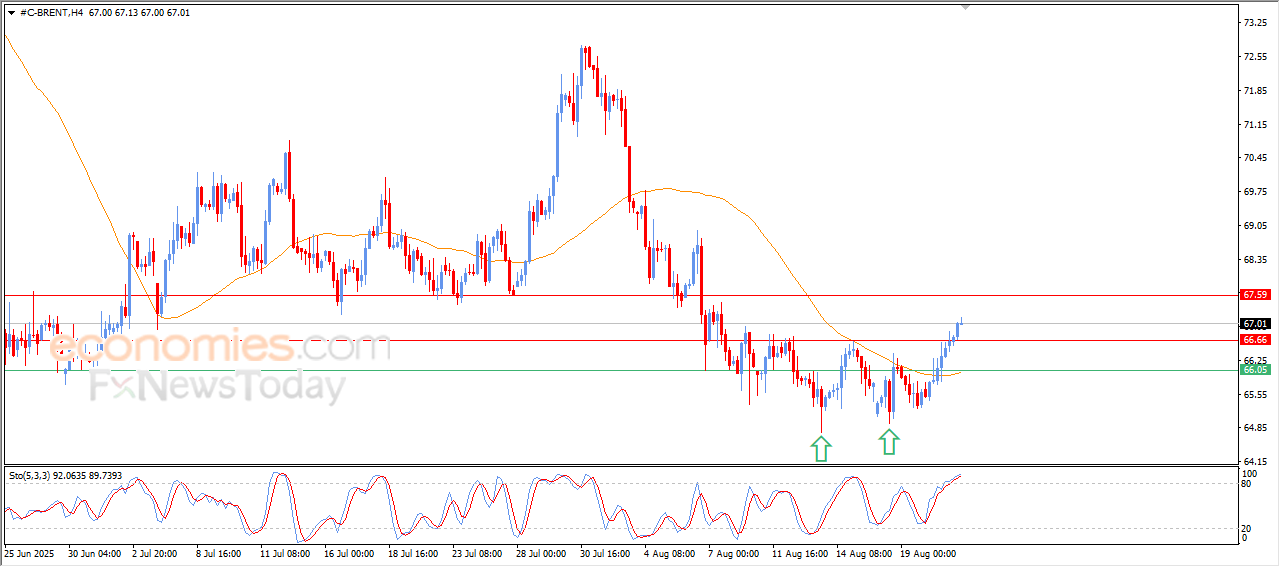
The price of (Brent) expanded its gains in its last intraday trading, breaching the key resistance level at $66.65, this level represents a neckline of a positive technical formation on the short-term basis, represented by the double bottom pattern, to confirm its momentum to resume the correctional rise on the short-term basis, especially with the continuation of the positive pressure that comes from its trading above EMA50, with the emergence of the positive signals on the (RSI), despite reaching overbought levels.
Therefore, our expectations suggest a rise in (Brent) price in its last trading on the intraday levels, if it settles above $66.65, to target the initial resistance levels at $67.60.
Expected trading range for today: Between the support at $66.35 and resistance at $67.60.
Today’s forecast: Bullish
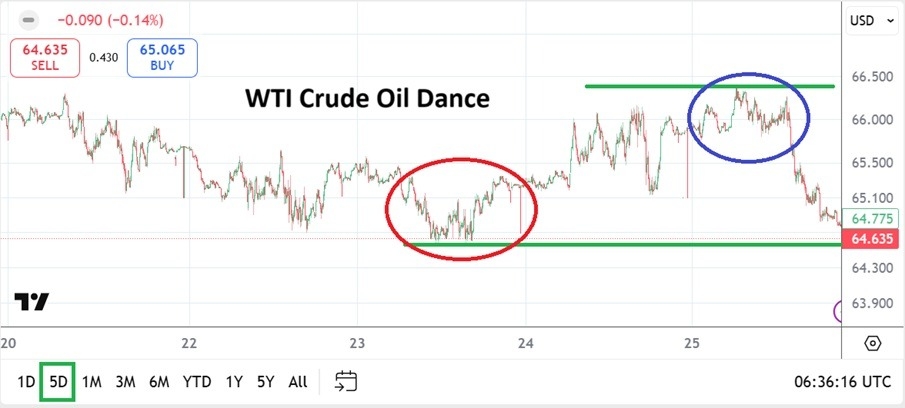
Now that WTI Crude Oil sits near 64.640 and is very close to technical support levels seen the past few weeks, questions will certainly be considered by some traders. The volatile dance of WTI Crude Oil seen the past handful of days is now resting upon values essentially seen on the 3rd, 7th, 16th and 23rd of July, and in practically all those cases the commodity jumped higher.

Those technical considerations doesn’t mean that support will hold when trading in WTI Crude Oil starts tomorrow. Day traders are offered no guarantees that large players will do as they have done the past few weeks and launch the commodity towards the 65.000 price range again. WTI Crude Oil did trade below its current threshold from the first week of April until the first week of June. Fundamentally production and supply of WTI Crude Oil remains consistently good.
There are a couple of interesting risks approaching financial markets this week. The U.S Federal Reserve’s interest rate policy will be released this coming Wednesday. On Friday the White House will sound the tariff alarm bells once again too. These events will affect behavioral sentiment in WTI Crude Oil, perhaps not a lot, but perhaps enough to make a difference in the near-term price.
WTI Crude Oil has found its lower price realm seen via three month technical charts once again. Will the commodity be able to sustain the lower depths or will support levels being tested ignite another reversal upwards? Day traders experienced a rather volatile dance last week and intriguingly the price of WTI Crude Oil although showing a rush upwards on early Friday was not able to sustain much consistency above the 66.150 mark.
After trading 66.000 USD rather well the past weeks and challenging the 67.000 ratio regularly, WTI Crude Oil failed to accomplish this price level this past week. Speculators may suspect that behavioral sentiment has shifted again, perhaps risk appetite in U.S equities is translating into another period in which lower prices will be seen in WTI Crude Oil. But perhaps this is a wrong correlation, except to say sentiment in the broad markets is producing changes in the mid-term outlooks of large players. However, risk events do pose threats this coming week. Day traders should be ready and have their risk management working if they want to pursue WTI Crude Oil near-term because challenges are ahead.
Ready to trade our weekly forecast? We’ve shortlisted the best Forex Oil trading brokers in the industry for you.
“The Fed appears to be keeping its tightening bias alive, and that makes it difficult for precious metals to build sustained momentum,” said a Singapore-based commodities strategist. The US Dollar extended gains on the hawkish tone, adding to the headwinds for metals priced in the greenback.
The metals market also absorbed geopolitical and political developments that shaped investor sentiment. Optimism surrounding potential progress in Russia-Ukraine peace efforts has eased safe-haven demand. Russian Foreign Minister Sergey Lavrov reiterated that any security arrangement would be incomplete without Moscow’s involvement, underscoring the complexity of negotiations.
Meanwhile, US domestic politics injected uncertainty into markets. Former President Trump’s demand for the resignation of Federal Reserve Governor Lisa Cook over alleged mortgage fraud has stirred debate about central bank independence.
Political instability, while weighing on the US Dollar’s long-term outlook, has provided limited support for gold and silver in the near term.
Looking ahead, investor attention is firmly on Fed Chair Jerome Powell’s upcoming remarks at the Jackson Hole Symposium. Markets expect Powell to offer critical guidance on the policy path, particularly regarding the balance between inflation risks and slowing growth.
Alongside Powell’s speech, flash PMIs, weekly jobless claims, and the Philadelphia Fed Manufacturing Index will provide essential signals on global economic momentum.
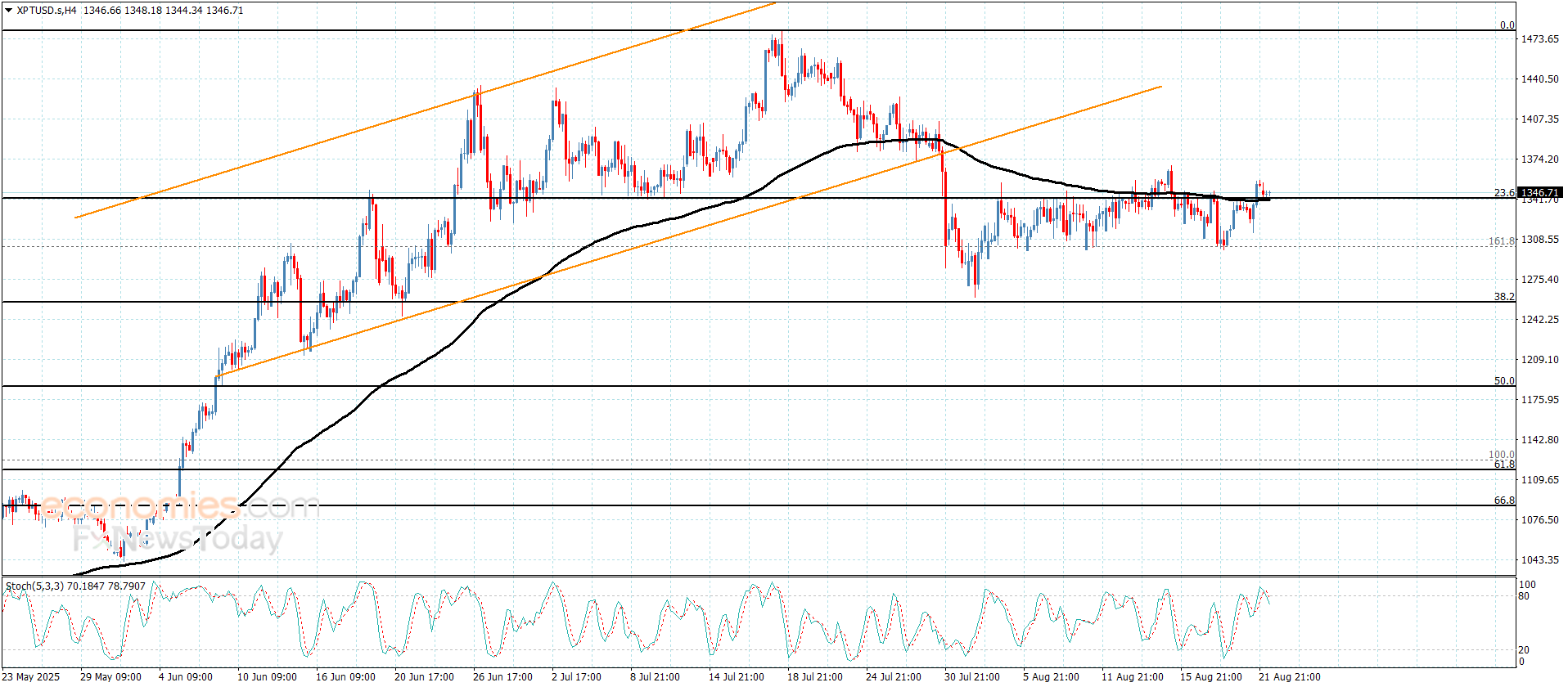
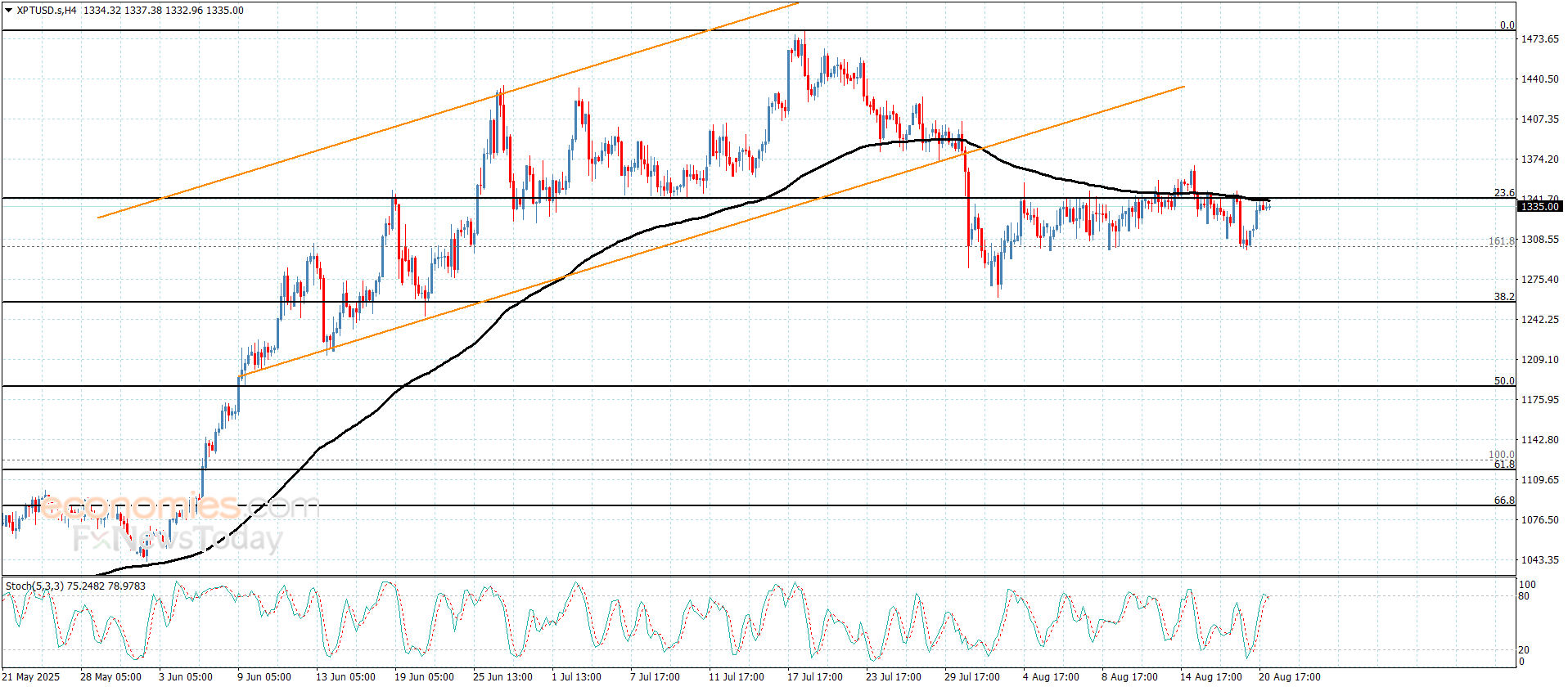
Platinum price surpassed some of the negative pressures by stochastic rally to 80 level, keeping its stability above the support of the sideways track that is represented by $1302.00, to rally to the moving average 55, which reinforces the stability of the barrier at $1342.00.
We will remain neutral, to keep waiting for surpassing one of the main levels to confirm the expected trend in the near and medium period, breaching the barrier will open the way for achieving more of the gains by the price rally to $1365.00 and $1382.00, while breaking the support and holding below it will activate bearish correctional track, and $1281.00 level represents the initial negative target for the bearish track.
The expected trading range for today is between $1302.00 and $1342.00
Trend forecast: Neutral
Wednesday’s reversal established a higher swing low, while reaffirming dynamic support at the triangle’s lower boundary line. A rally above last week’s minor swing high at $3,375 would further confirm strength, putting the upper boundary in sight. Beyond that, $3,409 presents an intermediate hurdle. A decisive breakout above $3,439, however, would clear resistance at the top boundary and signal continuation of the broader bull trend.
The consolidation has compressed price energy, building potential for an eventual surge once a breakout occurs. Any sustained upside move should be accompanied by stronger volume and signs of momentum expansion to validate a bullish continuation.
Importantly, the recent pullback found support around the long-term 20-Week moving average. That level was also tested successfully in late July, confirming its role as dynamic support. It is not unusual for price to retest such a key moving average before breaking higher. This behavior adds weight to the current rebound and strengthens the argument that gold is preparing for another leg higher if resistance is overcome.
For a look at all of today’s economic events, check out our economic calendar.
Natural gas futures NG=F are locked in a bearish setup, trading at $2.75 after multiple failed attempts to break above $2.88, the ceiling reinforced by the 100-day EMA. A descending trendline has capped every rally since late July, keeping bulls sidelined. The current structure shows price action pinned just above short-term support at $2.73, but momentum is weak — the RSI at 36.3 signals that sellers remain in control. Unless there is a rebound above $2.80–$2.83, markets face another leg down toward $2.67, with an extension to $2.61 if selling pressure accelerates.
The rejection at $3.05 earlier this week marked the neckline of a bearish reversal pattern, and the follow-through to $2.76 confirmed that control has shifted to sellers. Analysts tracking price cycles point to $2.61 as the next key station, with further downside risks toward $2.39. The trading range projected for this week is $2.61–$2.85, skewed to the downside. Negative momentum across oscillators — RSI, Stochastic, and MACD — strengthens the case for continued weakness unless a sharp volume-driven recovery develops.
Natural gas inventories remain elevated, keeping storage buffers comfortable heading into late summer. With U.S. temperatures mild, neither air-conditioning demand nor heating demand is stressing the grid. That seasonal lull has coincided with a steep drop from early August highs, as speculative longs unwind positions in the absence of strong consumption catalysts. Traders now eye the $2.50 zone as a likely point of capitulation before the market starts to turn its attention to winter heating demand. Historically, NG=F often finds a seasonal floor in the $2.40–$2.50 band before building pre-winter rallies.
The latest macro shock comes not from energy-specific data but from monetary policy fears. Ahead of Jerome Powell’s Jackson Hole speech, commodities tied to risk sentiment, including natural gas, have been pressured lower. Fears of sticky inflation — reinforced by consumer price signals and warnings from U.S. retailers like Home Depot about cost pressures — have raised the probability that the Fed delays rate cuts. For NG=F, this means speculative capital outflows as traders reduce exposure to volatile assets. In just 24 hours, natural gas lost nearly 0.73%, with the broader commodity complex in the red. If Powell signals higher-for-longer rates, expect NG=F to retest $2.61 quickly, with deeper losses possible.
While natural gas is not as directly tied to OPEC+ as crude, the broader energy complex has been dragged by production increases from OPEC+ members and Russian export flows. Oil benchmarks are down 10% month-to-date, with Brent trading at $66.44 and WTI at $62.47, and this weakness has bled into NG=F sentiment. Traders are increasingly pricing in an oversupplied global market, especially with U.S. LNG export growth failing to offset weaker domestic consumption. Until supply disruptions or unexpected geopolitical risks emerge, NG=F is vulnerable to further downside.
Despite the short-term bearish tilt, the medium-term picture for NG=F is not universally negative. If buyers can force a sustained break above $2.83, it would trigger a relief rally to $2.95, followed by a retest of $3.25 — the upper boundary that would need to be cleared to shift momentum decisively. Such a breakout would require a combination of colder-than-expected September weather forecasts and stronger LNG demand. Until then, short sellers are expected to dominate every rally, with resistance layers thick between $2.80–$2.95.
At $2.75, with clear bearish technical signals, comfortable storage, mild weather, and Powell risk looming, the bias remains bearish in the short term. NG=F is more likely to test $2.61 and even $2.39 before staging a seasonal recovery toward winter. Aggressive traders may see speculative opportunities near $2.50, historically a turnaround level, but without a confirmed catalyst, any long positions remain highly risky. Based on the current balance of evidence, NG=F aligns more with a Sell rating, with opportunistic buys only at deeper support zones closer to $2.50.