The main tag of Gold Today Price Articles.
You can use the search box below to find what you need.
[wd_asp id=1]
The main tag of Gold Today Price Articles.
You can use the search box below to find what you need.
[wd_asp id=1]
The EURJPY pair continued the rise to reach the resistance of the targeted bullish channel’s resistance at 169.70 level, which explains the direct correctional rebound towards 168.80, despite the attempts of providing mixed sideways trading, and there is a chance to activate the attempts of gathering gains by reaching 168.05.
While the price success in breaching the resistance and providing a positive close above it, will confirm its move to a new positive station, to begin recording new gains by its rally to 170.40 initially reaching the next barrier near 171.60.
The expected trading range for today is between 168.30 and 169.80
Trend forecast: Fluctuated within the bullish track
Copper price received extra positive momentum yesterday by stochastic rally to 80 level, accompanied with our bullish expectation, to notice its rally to the target at $4.8900, which forms an important barrier against resuming the bullish scenario.
The price keeps forming mixed sideways trading until achieving the current barrier, to open the way towards recording extra gains that might extend to $5.030, while the failure will increase the chances for activating the bearish correctional track, which might force it to decline towards $4.7500 reaching the extra support at $4.660 level.
The expected trading range for today is between $4.7700 and $4.9600
Trend forecast: Bullish
Copper price received extra positive momentum yesterday by stochastic rally to 80 level, accompanied with our bullish expectation, to notice its rally to the target at $4.8900, which forms an important barrier against resuming the bullish scenario.
The price keeps forming mixed sideways trading until achieving the current barrier, to open the way towards recording extra gains that might extend to $5.030, while the failure will increase the chances for activating the bearish correctional track, which might force it to decline towards $4.7500 reaching the extra support at $4.660 level.
The expected trading range for today is between $4.7700 and $4.9600
Trend forecast: Bullish
Gold price is off the nine-day low, attempting a tepid recovery early Tuesday amid a positive shift in risk sentiment and the ongoing US Dollar (USD) correction.
Gold price has managed to defend critical support levels so far, as it remains on the back foot for the third consecutive day.
The Iran-Israel ceasefire announcement by US President Donald Trump and later by Iranian Foreign Minister Abbas Araghchi added to the bearish momentum in the traditional safe-haven Gold price.
Further, the sharp retracement in Oil prices also contributed to the extra losses in Gold price as weakening black gold reduced its appeal as an inflation hedge.
However, the bright metal found buyers at lower levels amid the ceasefire-led diminishing haven demand for the USD.
Meanwhile, reviving expectations surrounding a US Federal Reserve (Fed) interest rate cut in July also acts as a headwind for the Greenback, supporting the non-yielding Gold price.
Fed Governor Michelle Bowman joined her colleague Christopher Waller in advocating the next rate cut as early as July. Bowman said on Monday, “open to cutting rates as soon as the July FOMC meeting if inflation pressures stay contained.”
Waller noted on Friday, “Fed is in a position to cut the policy rate as early as July.”
Markets are now pricing in a 21% probability that the Fed will lower rates next month as against a 14.5% chance seen last Friday, according to the CME Group’s Fed WatchTool.
Looking ahead, all eyes now remain on Fed Chairman Jerome Powell’s two-day congressional testimony, starting Tuesday for fresh hints on the timings of the next rate cut.
Besides, markets will continue to pay close attention to the Iran-Israel conflict as to whether the ceasefire is maintained. Israeli Military continues to report ballistic missiles launched on Israel from Iran.
Any re-escalation in the Middle East conflict will once again propel the US Dollar at the expense of the Gold price.
The daily chart shows that Gold price is struggling at around the 21-day Simple Moving Average (SMA) at $3,352 on its recovery from nine-day lows of $3,333.
The yellow metal rebounded from just above the 50-day SMA key support at $3,324.
The 14-day Relative Strength Index (RSI) has turned lower, inching closer to the midline. The leading indicator currently trades near 52.
As it still defends the midline, Gold buyers remain hopeful but yearn for acceptance above the 21-day SMA, followed by the 23.6% Fibonacci Retracement (Fibo) level of the April record rally at $3,377.
The next topside target is seen at $3,400, above which the static resistance at $3,440 will be tested.
A failure to resist above the 21-day SMA on a daily closing basis will attack the 50-day SMA at $3,324, below which the 38.2% Fibo level at $3,297 will be targeted.
Federal Reserve Chair Jerome Powell testifies before Congress, providing a broad overview of the economy and monetary policy. Powell’s prepared remarks are published ahead of the appearance on Capitol Hill.
Next release:
Tue Jun 24, 2025 14:00
Frequency:
Irregular
Consensus:
–
Previous:
–
Source:
Federal Reserve
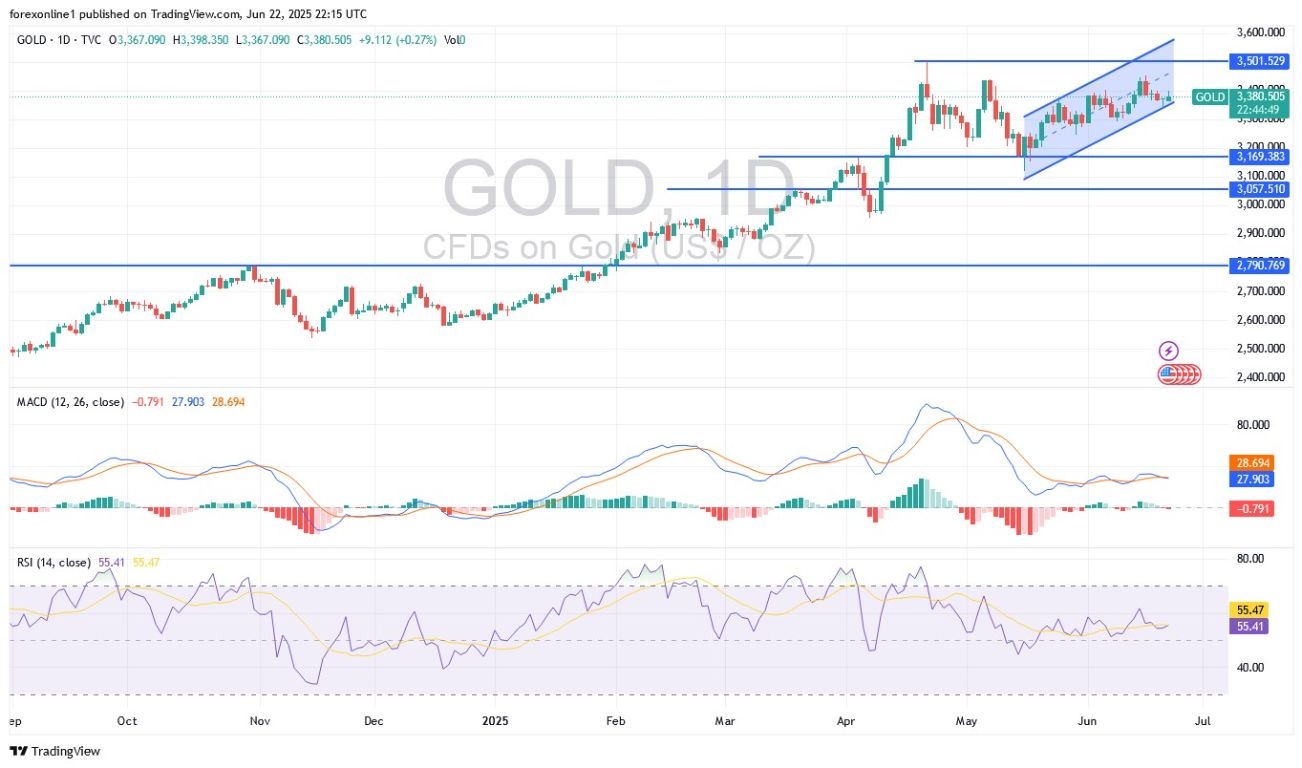
The selling pressure that gold prices experienced last week, which pushed them down to the $3340 per ounce support level before closing the week stable around the $3367 per ounce resistance, has not derailed gold’s upward trajectory. As mentioned before, the $3300 per ounce resistance will remain a strong catalyst for bulls to advance technically.
According to gold analysts’ forecasts, spot gold prices are expected to see a sharp increase due to escalating geopolitical tensions in the Middle East, ignited by news of a US airstrike on Iranian nuclear facilities. This development is driving strong demand for safe-haven gold bullion. Consequently, analysts now expect gold prices to range between $3500 and $3700 per ounce, as investors hedge against geopolitical instability and inflation risks.
On the other hand, there is a catalyst for the gold market. Global central bank reserves continue to accumulate. According to the World Gold Council, central banks added a total of 290 metric tons in the first quarter of 2025, the strongest first quarter on record. This follows record annual purchases in 2022, 2023, and 2024, driven by purchases from China, India, and other emerging economies seeking to reduce their dependence on the US dollar.

We still advise following the strategy of buying gold on every dip, but without taking risks and distributing entry percentages across multiple trades from different areas.
According to performance across gold trading platforms, gold prices have gained over 25% so far in 2025, underscoring growing investor demand for precious metals amidst increasing uncertainty. Overall, gold remains the world’s second-largest reserve asset, serving as a safe haven for over $21 trillion. Under current conditions, gold is expected to see a sharp rise. While gold benefits from its safe-haven appeal, silver – 60% of whose demand is linked to the industrial and renewable sectors – may lag. Analysts warn that a worsening conflict could raise recession fears, putting pressure on silver in the medium term.
In this regard, Goldman Sachs has reaffirmed its structurally optimistic forecasts for the future path of gold prices, citing strong demand from global central banks as a key factor in raising the gold-to-silver ratio. The bank does not expect silver to match gold’s pace and anticipates gold to outperform. Goldman Sachs’ base forecast predicts gold reaching $3700 per ounce by the end of 2025 and the $4000 per ounce resistance level by mid-2026.
In a recessionary scenario, accelerated ETF inflows could push gold to $3880 by the end of 2025. Under extreme risk conditions – such as concerns about the Federal Reserve’s independence or shifts in US Federal Reserve policy – gold prices could surge to $4500.
Ready to trade our Gold daily analysis and predictions? We’ve made a list of the best Gold trading platforms worth trading with.
Spot Gold trades around $3,900, nearing its early peak at $3,397.33 in the mid-American session. The bright metal gapped north at the weekly opening amid the escalation of the Iran-Israel crisis after the involvement of the United States (US). President Donald Trump announced on Saturday that his country successfully destroyed Iranian nuclear facilities in three locations, Fordow, Natanz and Isfahan, pushing investors into safety.
The US Dollar (USD) found some near-term demand during European trading hours, resulting in XAU/USD pulling back sharply towards the $3340 region. Still, the American opening brought another round of risk aversion, amid market talks indicating Iran launched a missile attack on US military bases in Doha, Qatar.
Meanwhile, speculative interest read beyond encouraging US data. S&P Global reported higher-than-anticipated preliminary June Purchasing Managers’ Indexes (PMIs). The manufacturing index posted 52, matching the May reading but above the expected 51. The Services PMI eased from the previous 53.7 to 53.1, which is above the anticipated 52.9. As a result, the Composite PMI printed at 52, slightly above the 51 expected.
Middle East headlines will likely overshadow everything else in the upcoming days, although it is worth mentioning that US Federal Reserve (Fed) Chairman Jerome Powell is due to testify about the Semiannual Monetary Policy Report before Congress on Tuesday. Given the recent developments, there are rising odds that Powell will be asked to explain what the Fed plans to do if tariffs come into effect and the Middle East conflict escalates.
The daily chart for XAU/USD shows it bounced sharply from a directionless 20 Simple Moving Average (SMA), which, anyway, develops far above bullish 100 and 200 SMAs. The shorter moving average currently provides dynamic support at around $3,352.70. Other than that, technical indicators bounced from around their midlines, but lack enough strength to support another leg north.
In the near term, and according to the 4-hour chart, XAU/USD is losing its bullish impetus. The pair is developing above all its moving averages, which lack clear directional strength. Technical indicators in the meantime, turned flat after crossing their midlines into positive territory.
Support levels: 3,366.10 3,352.70 3,340.20
Resistance levels: 3,406.90 3,414.60 3,431.10
Natural gas price activated the bearish correctional track after recording $4.160 level, affected by stochastic exit from the overbought level, activating the attempts of gathering gains by reaching $3.900.
Depending on forming extra support at $3.830 level, to reduce the risk of suffering extra losses, to keep waiting for gathering the positive momentum, which allows it to renew the bullish attempts and reaching $4.050 and $4.220.
The expected trading range for today is between $3.850 and $4.050
Trend forecast: Bullish
Less than two weeks ago, the U.S. was discussing a new nuclear deal with Iran, the International Energy Agency was forecasting an oil market oversupply, and commodity analysts were reiterating their expectations of an average Brent price around $60. Now, Brent is heading towards $80.
And it may be just the beginning.
Oil prices rose after Israel started bombing Iran, which was little surprise, and then they stopped rising as traders saw there was no direct threat of supply disruption. The wild card this time turned out to be President Trump. In a matter of days, Trump first imposed new sanctions on Iran, which made most market players think he’d stick with non-violent methods of dealmaking. Then, on Saturday, the United States bombed Iran’s nuclear facilities—and Iran said it’s shutting the Strait of Hormuz.
Interestingly, the early reactions from Middle Eastern stock markets were rather optimistic, at least according to a Reuters report that came out Sunday. The report said trader behavior suggested most expected a “benign outcome” of the bombing campaign. The report also quoted traders as saying they expected a selloff today and a run on safe haven assets such as the U.S. dollar.
Also on Sunday, Iran’s Press TV reported that the country’s parliament had approved the move to close the Strait of Hormuz in retaliation for the U.S. attack on the nuclear sites—for which the Interntional Atomic Energy Agency had said did not feature weapons-grade uranium but U.S. intelligence has disputed this.
The threat of Iran closing off the chokepoint that handles a third of global maritime oil trade, amounting to over 20 million barrels daily, has been there forever. Until now, however, Iran had never moved to actually close it, which highlights the special nature of this latest Middle Eastern war. The final decision is not hard to predict. And this means that Brent at $80 is only the beginning.
Goldman Sachs already threw its latest oil price forecast out the window, now expecting Brent at $110 per barrel in case of a Hormuz shutdown, noting this scenario could materialize if oil flows via the strait were halved for a month. ING, for its part, wrote that “an effective blocking of the Hormuz would lead to a dramatic shift in the outlook for oil, pushing the market into deep deficit”—again, days after all forecasts appeared in agreement that the market for crude oil is oversupplied, including ING’s own outlook.
It appears, then, that the oil market’s balance is a fragile thing. It can so easily be tipped into a deficit—even with the U.S. Fifth Fleet stationed in Bahrain, and ready to respond to any move by Iran to close off the Strait of Hormuz, as already pointed out by commentators such as Reuters’ Ron Bousso. There have been disruptions to the flow of oil via the Strait of Hormuz before, but they have never lasted long, Bousso pointed out, adding that war-driven oil price rallies never last long.
Of course, this would depend on one’s interpretation of “long”. In 2022, oil soared for months, which, at least in Europe, did not really feel like a very short time. And this time, there is also LNG to consider. Most of Qatar’s LNG flows pass via the Strait of Hormuz. If Iran mines the chokepoint, LNG prices will surge as well—whether for weeks or months, but they will surge. This is very bad news for countries that need to refill their wintertime reserve—which is most of them.
Some point out OPEC’s spare capacity as a guarantee for market stability. The problem with that spare capacity is that, as ING pointed out in its Sunday note, most of it is in the Persian Gulf, which makes it unusable in case of fighting in the area, which is what is going to happen if Iran shuts off the Strait of Hormuz and the U.S. Fifth Fleet responds. This, in turn, means that prices may rise and stay high for a while yet. This is inconvenient for the U.S., as suggested by reports that Secretary of State Marco Rubio had approached China to try and “dissuade” Iran from shutting off Hormuz, noting Iran itself was heavily dependent on oil exports via that chokepoint.
However, Iran has been loading tankers like there’s no tomorrow in the past week or so. Iran, in other words, has been preparing for a certain eventuality involving a disruption to oil exports. Granted, it won’t be able to keep going for very long without oil exports, but, as all those commentators say, a Hormuz blockade would not last very long—unless it somehow does, because right now, all bets seem to be off when it comes to the Middle East. There is only one thing that is certain: the oil market is not oversupplied, and Brent is not going to average $60 this year.
By Irina Slav for Oilprice.com
More Top Reads From Oilprice.com
Important DisclaimersThe content provided on the website includes general news and publications, our personal analysis and opinions, and contents provided by third parties, which are intended for educational and research purposes only. It does not constitute, and should not be read as, any recommendation or advice to take any action whatsoever, including to make any investment or buy any product. When making any financial decision, you should perform your own due diligence checks, apply your own discretion and consult your competent advisors. The content of the website is not personally directed to you, and we does not take into account your financial situation or needs.The information contained in this website is not necessarily provided in real-time nor is it necessarily accurate. Prices provided herein may be provided by market makers and not by exchanges.Any trading or other financial decision you make shall be at your full responsibility, and you must not rely on any information provided through the website. FX Empire does not provide any warranty regarding any of the information contained in the website, and shall bear no responsibility for any trading losses you might incur as a result of using any information contained in the website.The website may include advertisements and other promotional contents, and FX Empire may receive compensation from third parties in connection with the content. FX Empire does not endorse any third party or recommends using any third party’s services, and does not assume responsibility for your use of any such third party’s website or services.FX Empire and its employees, officers, subsidiaries and associates, are not liable nor shall they be held liable for any loss or damage resulting from your use of the website or reliance on the information provided on this website.Risk DisclaimersThis website includes information about cryptocurrencies, contracts for difference (CFDs) and other financial instruments, and about brokers, exchanges and other entities trading in such instruments. Both cryptocurrencies and CFDs are complex instruments and come with a high risk of losing money. You should carefully consider whether you understand how these instruments work and whether you can afford to take the high risk of losing your money.FX Empire encourages you to perform your own research before making any investment decision, and to avoid investing in any financial instrument which you do not fully understand how it works and what are the risks involved.
Natural gas price activated the bearish correctional track after recording $4.160 level, affected by stochastic exit from the overbought level, activating the attempts of gathering gains by reaching $3.900.
Depending on forming extra support at $3.830 level, to reduce the risk of suffering extra losses, to keep waiting for gathering the positive momentum, which allows it to renew the bullish attempts and reaching $4.050 and $4.220.
The expected trading range for today is between $3.850 and $4.050
Trend forecast: Bullish