The main tag of Gold Today Price Articles.
You can use the search box below to find what you need.
[wd_asp id=1]
The main tag of Gold Today Price Articles.
You can use the search box below to find what you need.
[wd_asp id=1]
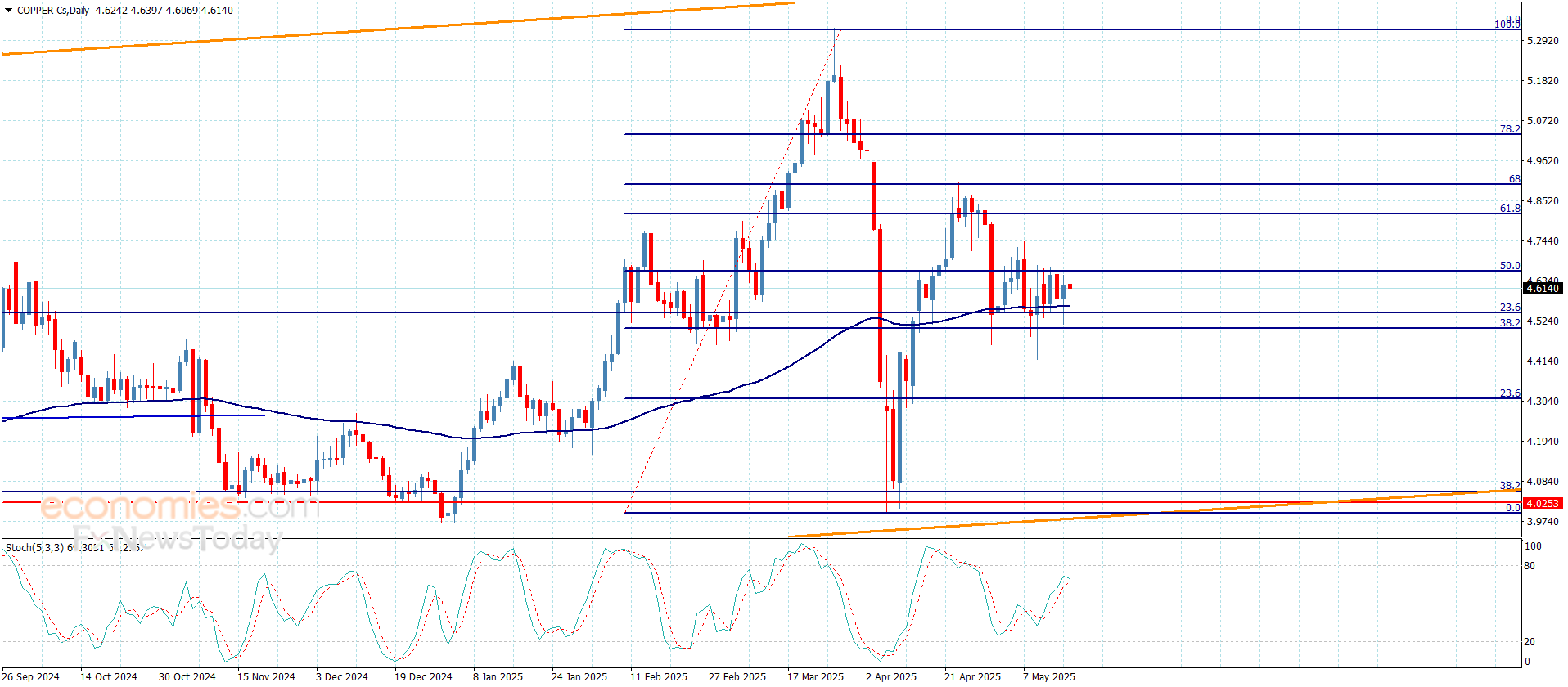
No news for Copper price until this moment by its repeated sideways fluctuation near $4.6200 level, attempting to settle below the initial barrier at $4.6600, reinforcing the chances for activating the suggested negative scenario, reminding you that the initial targets are located near $4.4500 and $4.3100 level.
Note that regaining the bullish bias requires forming strong bullish waves, to surpass the resistance at $4.9100, and holding above it to open the way towards achieving big gains that might begin at $5.0300.
The expected trading range for today is between $4.4500 and $4.6800
Trend forecast: Bearish
Do you need help in trading decisions? Do you want to learn how to start trading?
Join Economies.com VIP Club and benefit from over 15 years of market analysis expertise and get:
Special Offer: Subscribe to the Economies.com VIP channel and get also a free subscription to a trusted trading signals channel provided by Best Trading Signal.
Silver (XAG/USD) is pulling back from its recent gains seen in the previous session, hovering around $32.50 during Friday’s Asian trading hours. The metal is under pressure, possibly due to a Financial Times report indicating that the Trump administration plans to add several Chinese semiconductor companies to its export blacklist, known as the “entity list.” Silver’s growing connection to the chipmaking industry—owing to its essential role in electronics and semiconductor production—is amplifying the market’s sensitivity to such developments.
Meanwhile, safe-haven demand for precious metals, including Silver, has softened amid signs of easing global trade tensions. The US and China have reportedly reached a preliminary agreement to significantly reduce tariffs. According to the proposed deal, the US would lower tariffs on Chinese imports from 145% to 30%, while China would cut its tariffs on US goods from 125% to 10%. This breakthrough is viewed as a positive move toward de-escalating trade frictions between the two economic powerhouses.
Despite the recent pullback, Silver’s downside may be limited as the US Dollar (USD) weakens following economic data that increased expectations of potential Federal Reserve (Fed) rate cuts in the near term. Lower US interest rates generally support Silver prices, as they reduce the opportunity cost of holding non-yielding assets like precious metals.
However, Fed Chair Jerome Powell warned that inflation may become more unpredictable due to more frequent supply shocks, which could complicate the Fed’s efforts to maintain price stability moving forward.
Silver is a precious metal highly traded among investors. It has been historically used as a store of value and a medium of exchange. Although less popular than Gold, traders may turn to Silver to diversify their investment portfolio, for its intrinsic value or as a potential hedge during high-inflation periods. Investors can buy physical Silver, in coins or in bars, or trade it through vehicles such as Exchange Traded Funds, which track its price on international markets.
Silver prices can move due to a wide range of factors. Geopolitical instability or fears of a deep recession can make Silver price escalate due to its safe-haven status, although to a lesser extent than Gold’s. As a yieldless asset, Silver tends to rise with lower interest rates. Its moves also depend on how the US Dollar (USD) behaves as the asset is priced in dollars (XAG/USD). A strong Dollar tends to keep the price of Silver at bay, whereas a weaker Dollar is likely to propel prices up. Other factors such as investment demand, mining supply – Silver is much more abundant than Gold – and recycling rates can also affect prices.
Silver is widely used in industry, particularly in sectors such as electronics or solar energy, as it has one of the highest electric conductivity of all metals – more than Copper and Gold. A surge in demand can increase prices, while a decline tends to lower them. Dynamics in the US, Chinese and Indian economies can also contribute to price swings: for the US and particularly China, their big industrial sectors use Silver in various processes; in India, consumers’ demand for the precious metal for jewellery also plays a key role in setting prices.
Silver prices tend to follow Gold’s moves. When Gold prices rise, Silver typically follows suit, as their status as safe-haven assets is similar. The Gold/Silver ratio, which shows the number of ounces of Silver needed to equal the value of one ounce of Gold, may help to determine the relative valuation between both metals. Some investors may consider a high ratio as an indicator that Silver is undervalued, or Gold is overvalued. On the contrary, a low ratio might suggest that Gold is undervalued relative to Silver.
Other than a daily close above yesterday’s high, signs of aggressive buying are illustrated in the tail on today’s candle pattern, the rise above the open price following a bearish decline, and sustained buying pressure heading into the close. That shows strength that should be carried into the next two or three sessions.
Once dynamic support for the trend is successfully tested as support and followed by bullish signs, there is the potential for the bull trend to keep going. But today’s decline had additional significance as a standard falling ABCD pattern completed near the lows of the day. Overall, there looks like there is the potential for choppy movement within a two-week range from last week’s high of $3,439 to this week’s low of $3,121.
Dynamic support continues with the 50-Day MA, while the 20-Day MA is now at $3,308 and shows a top dynamic resistance level. It will likely be more useful than the lower swing high, which is a bit higher. So, the 20-Day line provides a top price level where if it is exceeded demand may continue to improve and eventually challenge resistance around the recent lower swing high. In the near-term a rise above Wednesday’s high of $3,257 shows strength and would increase the chance for a rise into the 20-Day line.
For a look at all of today’s economic events, check out our economic calendar.
There are several short-term bearish signs in recent price action. The dip below the $3.42 higher swing low earlier today triggered a bearish reversal of the short-term uptrend. Yesterday’s low hit support at the 38.2% Fibonacci retracement and stopped, before closing the session there. That level was busted earlier today. Also, the light blue line on the chart shows price levels from the anchored volume weighted average price line (AVWAP). It had been acting as support since the recent swing low but that changed when Wednesday’s session closed below the line for the first time.
Let’s consider the head and shoulder pattern that formed at the most recent top and the behavior of the price of natural gas since then. Following a drop below support at the neckline of the formation the price of natural gas will establish a counter-trend rally to test prior support levels as resistance. The neckline of the pattern is one significant area to consider.
The recent short-term trend high of $3.73 from Monday completed a successful test of resistance around the neckline. And the price area around the neckline was also marked by several other indicators, including a 61.8% Fibonacci retracement, the 50-Day MA, and an AVWAP line from the peak in March. Other than a quick rebound following the initial breakdown of the topping pattern, the recent advance was really the first bullish counter-trend rally. If that is the case, then the current decline could surprise to the downside.
If the 50% retracement fails to reverse the slide, the 61.8% Fibonacci retracement at $3.23 becomes the next lower target. Notice that the dark blue 200-Day MA is rising and heading towards the 61.8% level. Together, they could create something of a magnet for price. However, a sustained decline below the 50% retracement would happen first, and there is a risk of that now.
For a look at all of today’s economic events, check out our economic calendar.
Spot Gold is in a better shape in the American session on Thursday, rising beyond the $3,200 mark after falling to a five-week low of $3,120.83 during London trading hours. Fading optimism about a potential United States (US)- China trade deal brought demand for safety back to the table.
Concerns arose on news coming from Japan early in Asia, indicating the US is considering revising its trade agreement with Japan. Market talks suggest the US is asking for additional concessions on agriculture and livestock products, something Japan is unwilling to grant, risking a deadlock in negotiations.
On a positive note, encouraging US data limited the US Dollar (USD) decline. The country unveiled the April Producer Price Index (PPI), which fell by 0.5% in the month, while the annual figure came in at 2.4%, both below expectations and March levels. Also, Initial Jobless Claims for the week ended May 10 matched expectations, up by 229K. Retail Sales were up 0.1% in April, slightly better than the 0% anticipated by market participants.
On a negative note, Capacity Utilisation stood at 77.7% in April, slightly below the expected and previous 77.8%, while Industrial Production in the same month stayed pat vs a 0.2% advance anticipated by market players.
Meanwhile, US indexes trade mixed, with the Nasdaq Composite struggling to overcome its daily opening, the Dow Jones Industrial Average trimming part of its recent losses and the S&P 500 extending its recent advance.
Friday will bring little of relevance, with the focus on the preliminary estimate of the US Michigan Consumer Sentiment Index for May.
Technically, the daily chart shows that XAU/USD trades in the green, yet also that it posted a lower low and a lower high. At the same time, the 20 Simple Moving Average (SMA) turns modestly lower around the $3,305 level, while the 100 and 200 SMAs maintain their upward slopes far below the current level. Finally, technical indicators aim higher, but remain below their previous intraday highs and within negative levels, suggesting buying is still tepid.
The near-term picture shows buyers are piling up, but still lack full conviction. The pair is currently pressuring from below a flat 20 SMA, while the longer moving averages are pretty much flat above the shorter one. Technical indicators, in the meantime, head firmly north, yet remain within negative levels.
Support levels: 3,198.30 3,173.80 3,158.40
Resistance levels: 3,215.80 3,232.10 3,245.70
Silver prices are recovering from earlier lows, supported by renewed demand at technical support levels.
At the time of writing, XAG/USD is up 0.90% on the day, trading near $32.53, after briefly dipping below the 100-day Simple Moving Average (SMA) at $31.90.
The advance reflects increased buying interest, although the broader market remains consolidative. Investors continue to weigh mixed United States (US) economic data and evolving expectations around Federal Reserve (Fed) policy, leaving Silver confined within a well-defined trading range.
On the daily chart, the current candlestick features a small real body near the top of a long lower wick — a classic sign of intraday bearish pressure that was ultimately rejected.
Buyers stepped in at the 100-day SMA, pushing prices back toward the session’s opening level. While this does not confirm a bullish reversal, it highlights strong demand at lower levels. The candle represents a defensive stance by buyers rather than a clear trend change. However, with the trading day still in progress, a confirmed close is needed to validate the move.
Silver remains constrained between the 100-day SMA at $31.90 and the 50-day SMA at $32.76, with additional resistance at the psychological $33.00 level. Immediate support aligns with the 61.8% Fibonacci retracement of the March–April rally, near the $32.00 mark. The Relative Strength Index (RSI) on the daily chart stands at 47.68, indicating a neutral momentum profile.
Silver (XAG/USD) daily chart
On the weekly timeframe, Silver appears to be forming a bullish harami pattern — a smaller bullish candle developing within the body of last week’s larger bearish candle. This configuration often signals a potential loss of bearish momentum, particularly when it occurs near established support levels. In this case, Silver is holding above the 23.6% Fibonacci retracement of the 2024 advance, located at $31.81.
Silver (XAG/USD) weekly chart

The 10-week and 50-week SMAs, positioned at $32.57 and $30.95, respectively, are gradually converging, indicating a tightening technical structure. The Relative Strength Index (RSI) on the weekly chart is at 52.75, reflecting a mildly bullish bias but no strong momentum either way. A sustained breakout above $33.69 or a confirmed close below $31.80 would likely determine the next directional move for Silver.
Silver is a precious metal highly traded among investors. It has been historically used as a store of value and a medium of exchange. Although less popular than Gold, traders may turn to Silver to diversify their investment portfolio, for its intrinsic value or as a potential hedge during high-inflation periods. Investors can buy physical Silver, in coins or in bars, or trade it through vehicles such as Exchange Traded Funds, which track its price on international markets.
Silver prices can move due to a wide range of factors. Geopolitical instability or fears of a deep recession can make Silver price escalate due to its safe-haven status, although to a lesser extent than Gold’s. As a yieldless asset, Silver tends to rise with lower interest rates. Its moves also depend on how the US Dollar (USD) behaves as the asset is priced in dollars (XAG/USD). A strong Dollar tends to keep the price of Silver at bay, whereas a weaker Dollar is likely to propel prices up. Other factors such as investment demand, mining supply – Silver is much more abundant than Gold – and recycling rates can also affect prices.
Silver is widely used in industry, particularly in sectors such as electronics or solar energy, as it has one of the highest electric conductivity of all metals – more than Copper and Gold. A surge in demand can increase prices, while a decline tends to lower them. Dynamics in the US, Chinese and Indian economies can also contribute to price swings: for the US and particularly China, their big industrial sectors use Silver in various processes; in India, consumers’ demand for the precious metal for jewellery also plays a key role in setting prices.
Silver prices tend to follow Gold’s moves. When Gold prices rise, Silver typically follows suit, as their status as safe-haven assets is similar. The Gold/Silver ratio, which shows the number of ounces of Silver needed to equal the value of one ounce of Gold, may help to determine the relative valuation between both metals. Some investors may consider a high ratio as an indicator that Silver is undervalued, or Gold is overvalued. On the contrary, a low ratio might suggest that Gold is undervalued relative to Silver.
Spot gold steadied after hitting its lowest level since April 10, supported by technical buying and a weaker U.S. dollar. The metal bounced near long-standing trendline support around $3,130, in place since the start of 2025. The dollar index (.DXY) slipped 0.3% to 100.81, making gold more attractive for holders of other currencies. However, despite Thursday’s dip, the index is on track for a modest weekly gain, though it remains down nearly 7% in 2025.
Markets are awaiting several key U.S. economic reports, including the producer price index, retail sales, and weekly jobless claims. These could influence rate expectations heading into the second half of 2025. Tuesday’s CPI data came in softer than expected, with core inflation rising only 0.2% in April. Fed Chair Jerome Powell is also scheduled to speak later Thursday, and traders will be parsing his comments for any hints on the Fed’s policy stance. Markets are still pricing in 50 basis points of cuts by year-end, likely starting in October.
Gold’s appeal as a safe haven has eased somewhat after the U.S. and China agreed to pause most tariffs for 90 days. While this de-escalated trade tensions, it also reduced immediate hedging demand for bullion. The drop in safe-haven flows, combined with higher Treasury yields earlier in the week, pressured gold lower before Thursday’s stabilization.
Silver price (XAG/USD) bounces back to near $32.00 during European trading hours on Thursday after sliding to near the monthly low around $31.65 earlier in the day. The outlook of the Silver price remains bearish as trade relations between the United States (US) and China have improved further.
During European trading hours, US Treasury Secretary Scott Bessent signaled more talks with China to avoid trade tensions. “We are going into a series of negotiations with China to prevent escalation again,” Bessent said.
Meanwhile, Beijing also appears to be making efforts to improve relations with the US. On Wednesday, the Chinese Commerce Ministry suspended non-tariff measures taken against 45 US entities in the wake of an agreement between Washington and Beijing for a 90-day pause in the trade war in which they lowered tariffs by 115%.
Waning US-China trade tensions have forced investors to reassess the global economic outlook. Theoretically, an improvement in the global economy reduces demand for safe-haven assets, such as Silver.
Meanwhile, investors await Federal Reserve (Fed) Chair Jerome Powell’s speech, which is scheduled in the North American session. Investors would look cues for any change in the Fed’s stance towards the monetary policy outlook after the temporary US-China trade truce and soft US Consumer Price Index (CPI) data for April.
The Silver price could face more pressure if Fed Powell guides that interest rates should remain where they are in the face of economic uncertainty due to new economic policies by US President Donald Trump. Fed’s higher for longer interest rates bode poorly for non-yielding assets, such as Silver.
Silver price trades in a Descending Triangle formation on a four-hour timeframe. The chart pattern reflects indecisiveness among market participants. The near-term trend of the white metal is bearish as it trades below the 20-period Exponential Moving Average (EMA), which is around $32.70.
The 14-period Relative Strength Index (RSI) wobbles around 40.00. A fresh bearish momentum would trigger if the RSI falls below the 40.00 level.
Looking up, the March 28 high of $34.60 will act as key resistance for the metal. On the downside, the April 11 low of $30.90 will be the key support zone.
Silver is a precious metal highly traded among investors. It has been historically used as a store of value and a medium of exchange. Although less popular than Gold, traders may turn to Silver to diversify their investment portfolio, for its intrinsic value or as a potential hedge during high-inflation periods. Investors can buy physical Silver, in coins or in bars, or trade it through vehicles such as Exchange Traded Funds, which track its price on international markets.
Silver prices can move due to a wide range of factors. Geopolitical instability or fears of a deep recession can make Silver price escalate due to its safe-haven status, although to a lesser extent than Gold’s. As a yieldless asset, Silver tends to rise with lower interest rates. Its moves also depend on how the US Dollar (USD) behaves as the asset is priced in dollars (XAG/USD). A strong Dollar tends to keep the price of Silver at bay, whereas a weaker Dollar is likely to propel prices up. Other factors such as investment demand, mining supply – Silver is much more abundant than Gold – and recycling rates can also affect prices.
Silver is widely used in industry, particularly in sectors such as electronics or solar energy, as it has one of the highest electric conductivity of all metals – more than Copper and Gold. A surge in demand can increase prices, while a decline tends to lower them. Dynamics in the US, Chinese and Indian economies can also contribute to price swings: for the US and particularly China, their big industrial sectors use Silver in various processes; in India, consumers’ demand for the precious metal for jewellery also plays a key role in setting prices.
Silver prices tend to follow Gold’s moves. When Gold prices rise, Silver typically follows suit, as their status as safe-haven assets is similar. The Gold/Silver ratio, which shows the number of ounces of Silver needed to equal the value of one ounce of Gold, may help to determine the relative valuation between both metals. Some investors may consider a high ratio as an indicator that Silver is undervalued, or Gold is overvalued. On the contrary, a low ratio might suggest that Gold is undervalued relative to Silver.
The EURJPY pair is affected by the negative pressures, due to its repeated stability below the resistance at 164.90, forming several bearish waves, approaching from the initial support at 163.35 level.
The suggested scenario depends on the stability of the current support, to expect activating the bullish track, which might target 164.20 and 164.90 level gradually, while breaking the support and holding below it will increase the chances for resuming the decline, and 162.40 level represents the next target of the bearish track.
The expected trading range for today is between 163.30 and 164.90
Trend forecast: Bullish
Do you need help in trading decisions? Do you want to learn how to start trading?
Join Economies.com VIP Club and benefit from over 15 years of market analysis expertise and get:
Special Offer: Subscribe to the Economies.com VIP channel and get also a free subscription to a trusted trading signals channel provided by Best Trading Signal.
Copper price confirmed the continuation of the bearish scenario by providing a new negative close yesterday below $4.6600, which represents an extra barrier to its stability near 50% Fibonacci correction level.
Note that gathering the negative momentum in the current period is important to ease the mission of pressing on the barrier at $4.5000 level, and breaking it will open the way towards targeting negative stations, which might extend to $4.4500 and $4.3100.
The expected trading range for today is between $4.4500 and $4.6600
Trend forecast: Bearish
Do you need help in trading decisions? Do you want to learn how to start trading?
Join Economies.com VIP Club and benefit from over 15 years of market analysis expertise and get:
Special Offer: Subscribe to the Economies.com VIP channel and get also a free subscription to a trusted trading signals channel provided by Best Trading Signal.