The main tag of Gold Today Price Articles.
You can use the search box below to find what you need.
[wd_asp id=1]
The main tag of Gold Today Price Articles.
You can use the search box below to find what you need.
[wd_asp id=1]
The GBPJPY pair failed to confirm breaching the barrier at 191.55 yesterday, affected by the moving average 55 above it, which forces it to form sideways trading, to be confined between this barrier and the support level at 190.50.
Monitoring the price behavior and waiting for its rally above the barrier, to increase the efficiency of the bullish track, targeting 192.40 level, reaching the next target near 193.15, while reaching below the support will cancel the positive suggestion to force the price suffer several losses, starting at 189.70 and 188.60.
The expected trading range for today is between 190.50 and 191.55
Trend forecast: Sideways
Do you need help in trading decisions? Do you want to learn how to start trading?
Join Economies.com VIP Club and benefit from over 15 years of market analysis expertise and get:
Special Offer: Subscribe to the Economies.com VIP channel and get also a free subscription to a trusted trading signals channel provided by Best Trading Signal.
Copper price continued providing sideways trading, to keep the negative stability below the barrier at $4.9100, which forms a main factor that confirms the suggested bearish scenario, note that gathering the negative momentum is important to begin targeting negative stations that are located near $4.6600 and $4.5600.
Noting that the price rally above the current barrier and holding above it, will confirm the negative attack, which provides chances for recording extra gains by its rally towards $4.9600 and $5.0400.
The expected trading range for today is between $4.6600 and $4.8400
Trend forecast: Bearish
Do you need help in trading decisions? Do you want to learn how to start trading?
Join Economies.com VIP Club and benefit from over 15 years of market analysis expertise and get:
Special Offer: Subscribe to the Economies.com VIP channel and get also a free subscription to a trusted trading signals channel provided by Best Trading Signal.
The Gold price (XAU/USD) loses ground to around $3,335 during the early Asian session on Tuesday. The yellow metal edges lower amid a modest rebound of the US Dollar (USD) and a softening in tensions between the United States and China.
China exempted some US imports from its 125% tariffs on Friday, raising hopes that the trade war between the US and China is nearing an end, although China quickly knocked down US President Donald Trump’s assertion that negotiations between the two countries were underway.
US Treasury Secretary Scott Bessent said on Monday that the US government is in contact with China but that it’s up to Beijing to take the first step in de-escalating the tariff fight with the US due to the imbalance of trade between the two nations. The easing fears of trade tension between the world’s two largest economies reduce demand for traditional safe-haven assets like gold. Additionally, a stronger Greenback added further headwinds for the precious metal.
“Comments last week from the White House have fueled optimism that a US-China trade deal may eventuate, which has caused safe-haven demand for assets such as gold to subside,” said Tim Waterer, Chief Market Analyst at KCM Trade.
On the other hand, rising expectations that the Federal Reserve (Fed) will resume its rate-cutting cycle in the June meeting could lift the non-yielding Gold price. Meanwhile, the Fed remains in blackout mode ahead of its Federal Open Market Committee (FOMC) meeting on May 7.
Traders will keep an eye on the preliminary US Q1 GDP report and April employment data this week, as it might offer some hints about the Fed’s next policy decisions and the US economic outlook. The expectation for April is that the US economy will add 135,000 jobs and the Unemployment Rate will remain at 4.2%. If the reports show a weaker-than-expected outcome, this could drag the Greenback lower and boost the USD-denominated commodity price in the near term.
Gold has played a key role in human’s history as it has been widely used as a store of value and medium of exchange. Currently, apart from its shine and usage for jewelry, the precious metal is widely seen as a safe-haven asset, meaning that it is considered a good investment during turbulent times. Gold is also widely seen as a hedge against inflation and against depreciating currencies as it doesn’t rely on any specific issuer or government.
Central banks are the biggest Gold holders. In their aim to support their currencies in turbulent times, central banks tend to diversify their reserves and buy Gold to improve the perceived strength of the economy and the currency. High Gold reserves can be a source of trust for a country’s solvency. Central banks added 1,136 tonnes of Gold worth around $70 billion to their reserves in 2022, according to data from the World Gold Council. This is the highest yearly purchase since records began. Central banks from emerging economies such as China, India and Turkey are quickly increasing their Gold reserves.
Gold has an inverse correlation with the US Dollar and US Treasuries, which are both major reserve and safe-haven assets. When the Dollar depreciates, Gold tends to rise, enabling investors and central banks to diversify their assets in turbulent times. Gold is also inversely correlated with risk assets. A rally in the stock market tends to weaken Gold price, while sell-offs in riskier markets tend to favor the precious metal.
The price can move due to a wide range of factors. Geopolitical instability or fears of a deep recession can quickly make Gold price escalate due to its safe-haven status. As a yield-less asset, Gold tends to rise with lower interest rates, while higher cost of money usually weighs down on the yellow metal. Still, most moves depend on how the US Dollar (USD) behaves as the asset is priced in dollars (XAU/USD). A strong Dollar tends to keep the price of Gold controlled, whereas a weaker Dollar is likely to push Gold prices up.
Cisco Systems’ stock price extended the gains in latest intraday levels, boosted by positive signals from the Stochastic, however, it reached overbought levels, indicating the weakness of that positive momentum, especially amid the dominance of the downward correctional trend in the short term, with negative pressure due to trading below the 50-day SMA.
Therefore we expect the price to decline and target the support of $52.00, provided the resistance of $58.45 holds on.
Today’s price forecast: Bearish
Do you need help in trading decisions? Do you want to learn how to start trading?
Join Economies.com VIP Club and benefit from over 15 years of market analysis expertise and get:
Special Offer: Subscribe to the Economies.com VIP channel and get also a free subscription to a trusted trading signals channel provided by Best Trading Signal.
Gold price changed course in the American session on Monday, and trades around $3,330, recovering nicely from an intraday low of $3,268.03. In the absence of relevant macroeconomic data, investors kept focusing on trade developments. Mixed headlines on United States-China trade talks spurred some concerns after a quiet start to the day, as cautious optimism led the Asian and European sessions, weighing on US Dollar (USD) demand.
The White House hinted at trade talks with its Asian counterpart last week, but Beijing stated on Monday that President Xi Jinping has not spoken with his United States (US) counterpart, Donald Trump. Meanwhile, Trump said that there are no red lines that would make him ease tariffs. “It always affects you a little bit,” Trump noted when asked about the potential impact on the USD, stocks, or even economic progress.
At the time being, Wall Street struggles to retain the green, with the Dow Jones Industrial Average (DJIA) being the best performer and the Nasdaq Composite being the worst.
Other than that, investors await first-tier data from major economies scheduled for later this week. Most figures will be released on Wednesday, with growth updates from Germany, the Eurozone (EU), the US and Canada. Meanwhile, Australia, Germany and the EU will post inflation updates. The cherry on the top will be US employment-related data, including different reports ahead of the Nonfarm Payrolls report scheduled for Friday.
The XAU/USD pair trimmed early losses, but so far, it’s unable to recover its bullish stance. The daily chart for the pair shows it is hovering around its opening, while the risk remains skewed to the upside, given that it keeps developing above all bullish moving averages. The same chart shows a strong floor in the $3,260 region, as buyers surged around it in the last four trading days. Finally, technical indicators stand well above their midlines, albeit only the Momentum indicator aims north. The Relative Strength Index (RSI) indicator consolidates around 62, as XAU/USD can not extend gains beyond its recent range’s top in the $3,370/80 region.
The near-term picture is neutral-to-bullish. The 4-hour chart shows XAU/USD is currently battling to overcome a directionless 20 Simple Moving Average (SMA), while the 100 and 200 SMAs keep heading higher, over $100 below the current level. Technical indicators, in the meantime, advance, yet within negative levels and with limited upward strength.
Support levels: 3,314.50 3,301.40 3,288.70
Resistance levels: 3,344.60 3,358.10 3,370.00
Natural gas futures have now fallen for ten straight sessions, weighed down by mild spring temperatures and sluggish demand typical of the shoulder season.
Production remains stubbornly high, with Lower 48 dry gas output at 104.4 Bcf/day on Friday, up 3.8% year-over-year, according to BNEF. In contrast, Lower 48 gas demand was only 66.8 Bcf/day, down 7% from a year ago.
LNG exports were also lighter, with flows at 15.3 Bcf/day, a 3% week-over-week decline. These supply-demand imbalances continue to erode price support.
The EIA reported an 88 Bcf storage build for the week ending April 18, exceeding expectations of 75 Bcf and topping the five-year average build of 58 Bcf. Total working gas in storage now stands at 1,934 Bcf, 44 Bcf below the five-year average but still within the historical range.
Despite a tighter year-over-year supply picture—storage levels are down 20.2% versus last year—the higher-than-expected injection and ongoing mild weather are keeping pressure on futures.
Gold prices are hovering near $3,297, defending the rising trendline and major support zone around $3,270, where a triple-bottom structure is forming. The pivot point sits around $3,269, offering critical near-term support. Immediate resistance stands at $3,369, followed by $3,434, and the next key target at $3,500.
A breakdown below $3,270 could open the door toward $3,196 and potentially $3,152. The 50 EMA at $3,323 and the 200 EMA at $3,242 are important trend guides—price action currently dances between them.
A clean bullish reaction above $3,323 would strengthen the short-term outlook, while a failure to hold $3,270 may shift momentum back to sellers.
The EURJPY pair provided positive signal on Friday by forming a strong bullish rally, achieving 163.75, which forces it to fluctuate below 163.25 level, due to the contradiction between the main indicators by stochastic exit from the overbought level.
The price might be forced to provide more of the mixed trading, but its success in taking advantage of forming extra support at 162.40 might assist renewing the bullish attempts, to wait for confirming breaching 163.25 to increase the chances for recording new gains by its rally towards 164.20 reaching the next target near 164.90.
The expected trading range for today is between 162.50 and 164.25
Trend forecast: Bullish by confirming the breach
Do you need help in trading decisions? Do you want to learn how to start trading?
Join Economies.com VIP Club and benefit from over 15 years of market analysis expertise and get:
Special Offer: Subscribe to the Economies.com VIP channel and get also a free subscription to a trusted trading signals channel provided by Best Trading Signal.
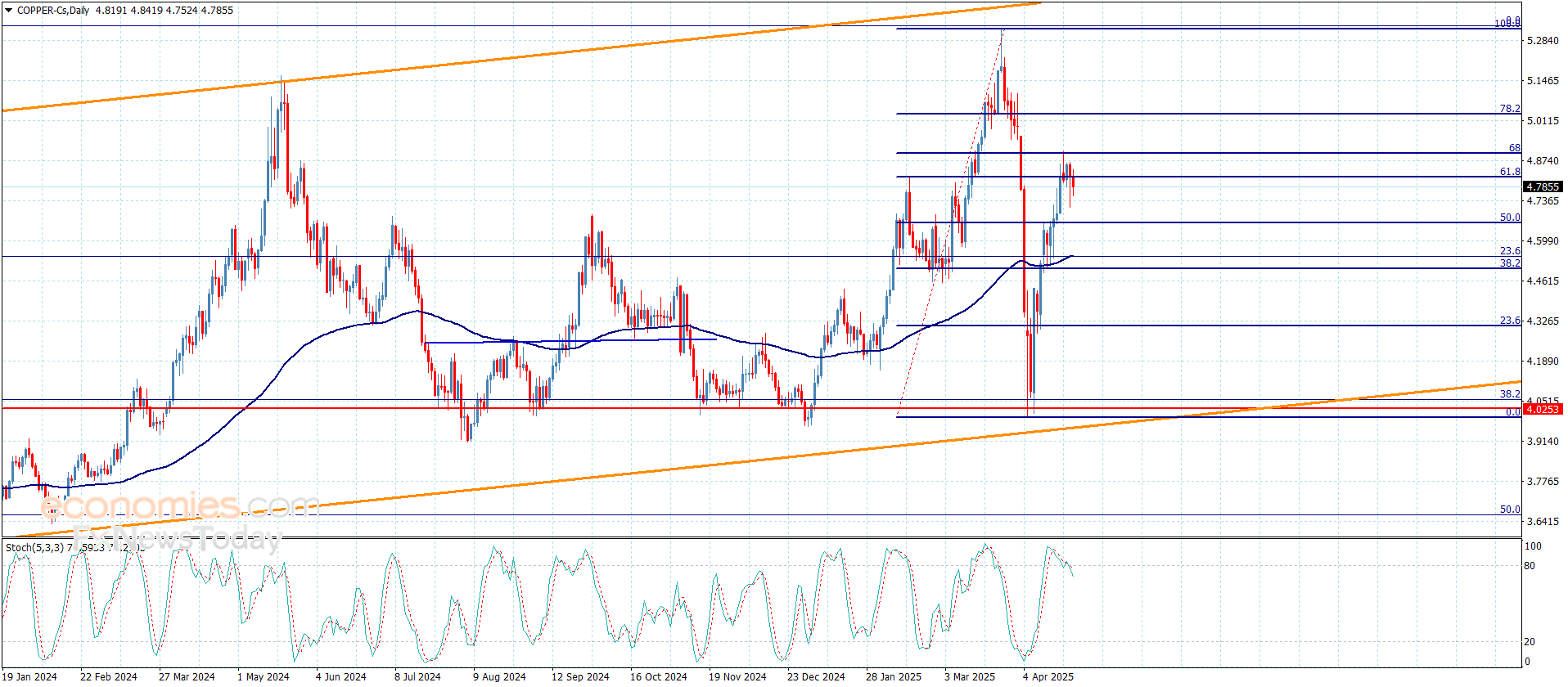
Copper price provided slow trading recently, due to the contradiction between the main indicators, to delay the negative attack and settles near $4.7500 level, reminding you that the bearish scenario will remain valid by the continuation of forming main barrier at $4.9100 against the current trading, which increases the chances for forming bearish waves to press on 50%Fibonacci correction level at $4.6600, and breaking it will extend the losses towards $4.5600, to face the moving average55.
The price rally above the mentioned barrier and holding above it, will confirming delaying the negative attack, and provide chances for recording some extra gains before reaching the previously waited negative targets.
The expected trading range for today is between $4.6600 and $4.8400
Trend forecast: Bearish
Do you need help in trading decisions? Do you want to learn how to start trading?
Join Economies.com VIP Club and benefit from over 15 years of market analysis expertise and get:
Special Offer: Subscribe to the Economies.com VIP channel and get also a free subscription to a trusted trading signals channel provided by Best Trading Signal.
Copper price provided slow trading recently, due to the contradiction between the main indicators, to delay the negative attack and settles near $4.7500 level, reminding you that the bearish scenario will remain valid by the continuation of forming main barrier at $4.9100 against the current trading, which increases the chances for forming bearish waves to press on 50%Fibonacci correction level at $4.6600, and breaking it will extend the losses towards $4.5600, to face the moving average55.
The price rally above the mentioned barrier and holding above it, will confirming delaying the negative attack, and provide chances for recording some extra gains before reaching the previously waited negative targets.
The expected trading range for today is between $4.6600 and $4.8400
Trend forecast: Bearish
Do you need help in trading decisions? Do you want to learn how to start trading?
Join Economies.com VIP Club and benefit from over 15 years of market analysis expertise and get:
Special Offer: Subscribe to the Economies.com VIP channel and get also a free subscription to a trusted trading signals channel provided by Best Trading Signal.