The main tag of Gold Today Price Articles.
You can use the search box below to find what you need.
[wd_asp id=1]
The main tag of Gold Today Price Articles.
You can use the search box below to find what you need.
[wd_asp id=1]
A better market mood weighs on the US Dollar (USD), yet that same positive mood maintains Gold’s gains limited.
Spot Gold consolidates just below $3,000 a troy ounce on Monday, recovering the ground shed on Friday. A better market mood weighs on the US Dollar (USD), yet that same positive mood maintains Gold’s gains limited. Exacerbating range trading, the United States (US) Federal Reserve (Fed) is set to announce its decision on monetary policy next Wednesday.
The Fed is widely anticipated to keep the benchmark interest rate on hold at 4.25%-4.50% amid the uncertainty surrounding US President Donald Trump’s trade war and its impact on the economic performance of the world’s largest economy. However, the central bank will also release the Summary of Economic Projections (SEP) or dot-plot, a document providing a fresh view of the overall state of the American economy alongside officials’ aims at interest rate moves. Finally, Chairman Jerome Powell will deliver a press conference to explain policymakers’ reasoning beyond the announcement.
In the meantime, softer-than-anticipated US data further weighs on the USD. The country released the New York Empire State Manufacturing Index, which fell to -20 in March, much worse than the -1.9 expected and the previous 5.7. The US also reported that Retail Sales were up 0.2% in February, below the 0.7% advance expected although better than the -1.2% posted in January.
The XAU/USD pair consolidates near record highs, and the daily chart shows that buyers paused but did not give up. The pair stands well above a bullish 20 Simple Moving Average (SMA), which advances far above the 100 and 200 SMAs. Technical indicators, in the meantime, eased from extreme overbought levels and stabilized well above their midlines, suggesting sellers are nowhere to be found.
The near-term picture is bullish. Technical indicators in the 4-hour chart resumed their advances with uneven strength yet well into positive territory. Furthermore, XAU/USD trades above bullish moving averages, with the 20 SMA currently providing dynamic support at around $2,925.80.
Support levels:2,978.40 2,962.10 2,946.80
Resistance levels: 3,010.00 3,025.00 3,040.00
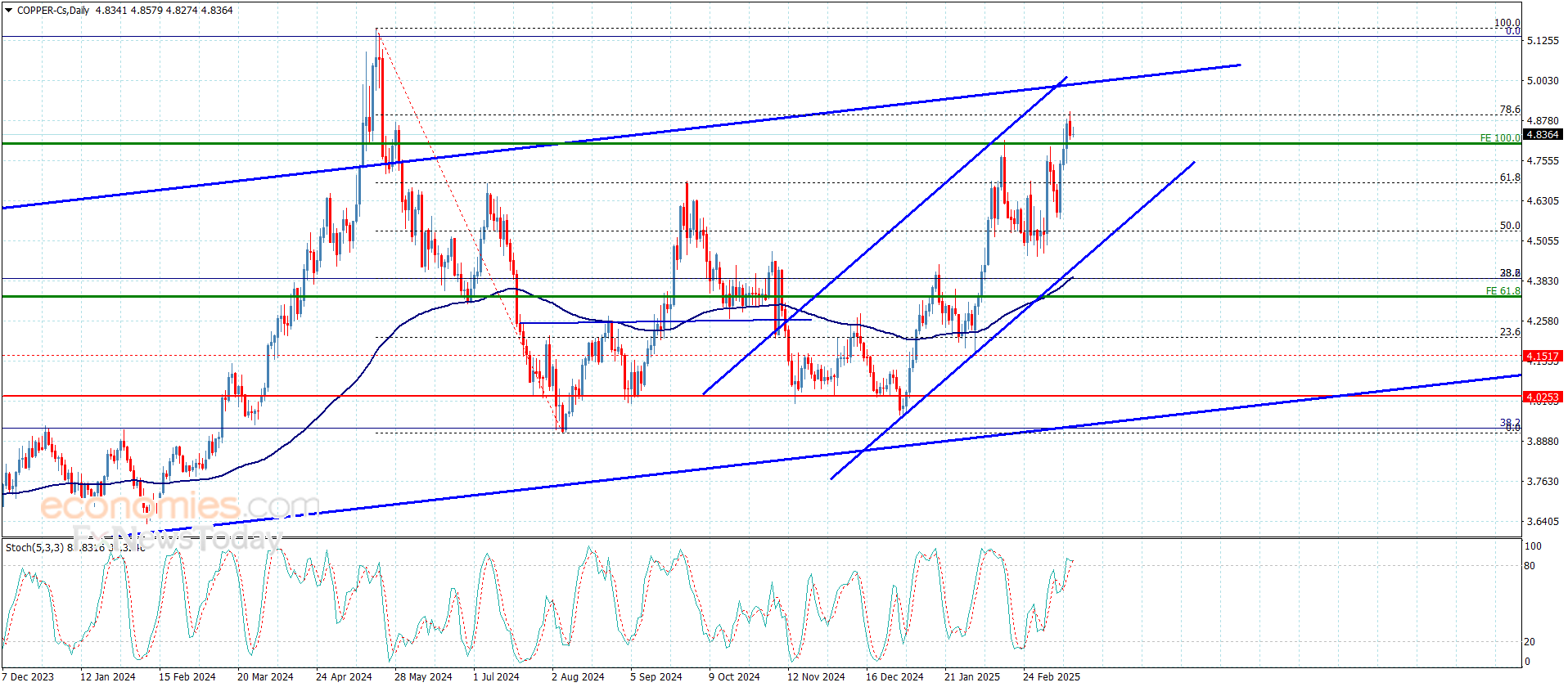
Notice that the price zone around the 20-Day MA and internal uptrend line trend indicators were successfully tested today as resistance following a breakdown below those lines last week. This is typical behavior of price in a developing downtrend. Prior support is tested as resistance before a continuation of the bearish decline. There has been one downswing since the new trend high of $4.90 was reached last week. A swing low was established at last Thursday’s low of $3.96 and today’s high generated a possible lower swing high. If there is a decline below last Thursday’s low of $3.95, a second leg down will be indicated.
Since the 20-Day MA failed to hold as support, the 50-Day MA, currently at $3.84, becomes a potential target. Moreover, the uptrend that began from the recent $2.99 swing low shows a bearish reversal if the higher swing low of $3.74 from March 3 is exceeded to the downside. Similarly, since the internal uptrend line was broken and it marks support for a trend with a relatively steep angle, the next lower trendline becomes a potential target. Keep in mind that both the dynamic 50-Day line and next lower trendline are rising. Despite the potential for further downside in prices, the market for natural gas will provide clues based on how it behaves around particular price levels of support and resistance.
If the 20-Day MA and trendline continue to show an area of resistance, the current bearish pullback can be expected to continue, or a consolidation phase exhibiting downward pressure may form. Although there were signs of brief strength over the past few days as natural gas traded above the 20-Day line and trendline, on each of the prior three days the closing price for the day was below the lines.
For a look at all of today’s economic events, check out our economic calendar.
Intraday Movement:
Bitcoin’s price has slightly retreated in recent intraday trading, relying on support from its 50-period simple moving average.
This move appears aimed at gaining some positive momentum to sustain the ascending corrective wave dominating its short-term trading, supported by a series of positive RSI signals after previously reaching extreme oversold levels.
Outlook:
We anticipate that Bitcoin’s price will resume its upward movement in upcoming sessions, provided that the near support at $81,970.00 holds firm.
With this support intact, our price target extends to $87,000.
To get our more detailed analysis and 100% accurate signals provided by Best Trading Signal, subscribe to Economies.com VIP Club through the link below!
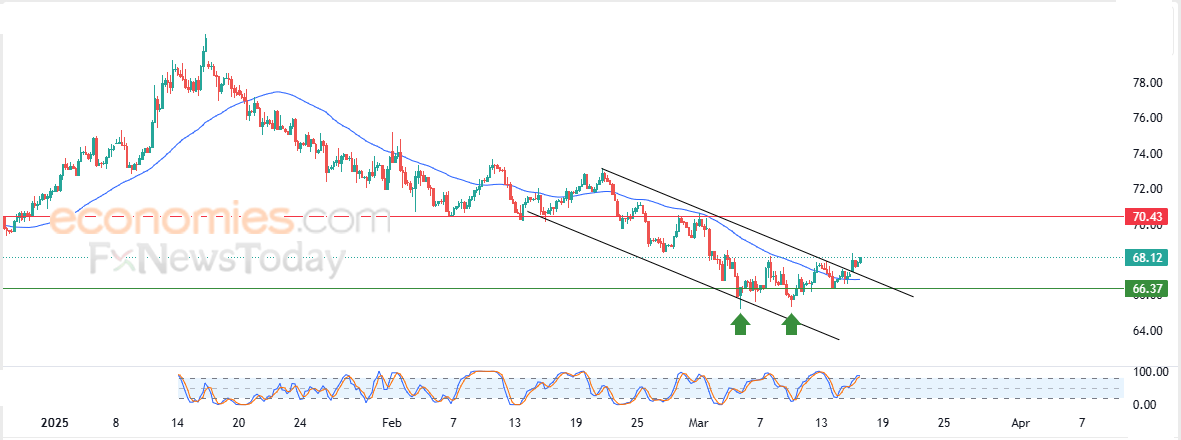
April WTI crude oil (CLJ25) today is up +0.21 (+0.31%), and April RBOB gasoline (RBJ25) is up +0.236 (+1.10%).
Crude oil prices today climbed to a 1-1/2 week high and are mildly higher. Today’s dollar weakness is bullish for crude prices. Crude is also climbing on heightened geopolitical risks in the Middle East that could lead to a disruption of crude supplies from the region after the US launched strikes against Houthi Rebels in Yemen for attacking shipping in the Red Sea. Gains in crude are limited by hopes for a ceasefire in Ukraine, with President Trump set to speak with Russian President Putin this week as Mr. Trump pushes for an end to the three-year conflict.
Commodity Bulletin: From crude oil to coffee, this FREE newsletter is for industry pros and rookies alike
Crude prices are finding support today from rising tensions in the Middle East, which could lead to disruption of supplies from the region. The US launched weekend strikes on Yemen’s Houthi rebels, and Defense Secretary Hegseth said strikes will be “unrelenting” until the group stops attacking vessels in the Red Sea.
Today’s global economic news was mixed for crude prices. On the positive side, China Feb industrial production rose +5.9% year-to-date, stronger than expectations of +5.3% year-to-date. Also, China Feb retail sales rose +4.0% year-to-date, stronger than expectations of +3.8% year-to-date. Conversely, US Feb retail sales rose +0.2% m/m, weaker than expectations of +0.6% m/m. Also, the US Mar Empire manufacturing survey of general business conditions fell -25.7 to a 14-month low of -20.0, weaker than expectations of -1.9. In addition, the US Mar NAHB housing market index unexpectedly fell -3 to a 7-month low of 39, weaker than expectations of no change at 42.
A bearish factor for crude was Sunday’s action by Goldman Sachs to cut its year-end WTI crude price forecast to $67 a barrel from $72 and lower its 2025 global oil demand forecast by 18% to 900,000 bpd, citing a slowing global economy from tariffs and the OPEC+ plan to increase production.
On the bearish side of oil prices, the markets remain concerned that US tariffs and retaliatory tariffs will curb global growth and undercut energy demand.
Ramped-up Russian oil exports are negative for crude prices after data compiled by Bloomberg from analytics firm Vortexa showed Russian Feb oil products exports reached a 1-year high of 2.5 million bpd.
Crude prices were undercut when OPEC+ said on March 3 that it would restart some halted crude output in April, adding 138,000 bpd to global supplies. That is the first of a series of monthly hikes to reverse the 2-year-long production cut, which will gradually restore a total of 2.2 million bpd. OPEC+ had previously planned to restore production between January and late 2025, but now that production cut won’t be fully restored until September 2026. OPEC Feb crude production rose +320,000 bpd to a 14-month high of 27.35 million bpd.
In a supportive factor for crude oil prices, the US on January 10 imposed new sanctions on Russia’s oil industry that could curb global oil supplies. The measures targeted Gazprom Neft and Surgutneftgas, which exported about 970,000 bpd of Russian crude in the first 10 months of 2024, accounting for about 30% of its tanker flow, according to Bloomberg data. The US also targeted insurers and traders linked to hundreds of tanker cargoes. Weekly vessel-tracking data from Bloomberg showed Russian crude exports fell by -45,000 bpd to 3.48 million bpd in the week to March 9.
Crude oil demand in China has weakened and is a bearish factor for oil prices. According to Chinese customs data, China’s 2024 crude imports fell -1.9% y/y to 553 MMT. China is the world’s biggest crude importer.
A decline in crude oil held worldwide on tankers is bullish for oil prices. Vortexa reported today that crude oil stored on tankers that have been stationary for at least seven days fell by -20% w/w to 60.89 million bbl in the week ended March 14.
Last Wednesday’s EIA report showed that (1) US crude oil inventories as of March 7 were -5.1% below the seasonal 5-year average, (2) gasoline inventories were +1.3% above the seasonal 5-year average, and (3) distillate inventories were -4.8% below the 5-year seasonal average. US crude oil production in the week ending March 7 rose +0.5% w/w to 13.575 million bpd, modestly below the record high of 13.631 million bpd from the week of December 6.
Baker Hughes reported last Friday that active US oil rigs in the week ending March 14 rose +1 rig to 487 rigs, mildly above the 3-year low of 472 rigs posted on January 24. The number of US oil rigs has fallen over the past two years from the 4-1/2 year high of 627 rigs posted in December 2022.
On the date of publication, Rich Asplund did not have (either directly or indirectly) positions in any of the securities mentioned in this article. All information and data in this article is solely for informational purposes. For more information please view the Barchart Disclosure Policyhere.
More news from Barchart
Intraday Trading:
Gold is currently trading within a narrow range of sideways movements at intraday levels.
It is aiming to build positive momentum that could help it surpass the psychological barrier at $3,000, a level it touched during last Friday’s session.
The price also managed to shake off the bullish exhaustion, as indicated by the RSI signals.
Next Price Target:
The next target is set at $3,055, according to the short-term symmetrical triangle pattern.
This target comes amid strong control by the primary uptrend and price trading in line with the trendline.
Positive Scenario:
The bullish scenario hinges on the price remaining above the support level at $2,950.
A break below this level could trigger downward pressure and potentially initiate a corrective wave that may take some time to unfold.
To get our more detailed analysis and 100% accurate signals provided by Best Trading Signal, subscribe to Economies.com VIP Club through the link below!
Intraday Trading:
Gold is currently trading within a narrow range of sideways movements at intraday levels.
It is aiming to build positive momentum that could help it surpass the psychological barrier at $3,000, a level it touched during last Friday’s session.
The price also managed to shake off the bullish exhaustion, as indicated by the RSI signals.
Next Price Target:
The next target is set at $3,055, according to the short-term symmetrical triangle pattern.
This target comes amid strong control by the primary uptrend and price trading in line with the trendline.
Positive Scenario:
The bullish scenario hinges on the price remaining above the support level at $2,950.
A break below this level could trigger downward pressure and potentially initiate a corrective wave that may take some time to unfold.
To get our more detailed analysis and 100% accurate signals provided by Best Trading Signal, subscribe to Economies.com VIP Club through the link below!
Important DisclaimersThe content provided on the website includes general news and publications, our personal analysis and opinions, and contents provided by third parties, which are intended for educational and research purposes only. It does not constitute, and should not be read as, any recommendation or advice to take any action whatsoever, including to make any investment or buy any product. When making any financial decision, you should perform your own due diligence checks, apply your own discretion and consult your competent advisors. The content of the website is not personally directed to you, and we does not take into account your financial situation or needs.The information contained in this website is not necessarily provided in real-time nor is it necessarily accurate. Prices provided herein may be provided by market makers and not by exchanges.Any trading or other financial decision you make shall be at your full responsibility, and you must not rely on any information provided through the website. FX Empire does not provide any warranty regarding any of the information contained in the website, and shall bear no responsibility for any trading losses you might incur as a result of using any information contained in the website.The website may include advertisements and other promotional contents, and FX Empire may receive compensation from third parties in connection with the content. FX Empire does not endorse any third party or recommends using any third party’s services, and does not assume responsibility for your use of any such third party’s website or services.FX Empire and its employees, officers, subsidiaries and associates, are not liable nor shall they be held liable for any loss or damage resulting from your use of the website or reliance on the information provided on this website.Risk DisclaimersThis website includes information about cryptocurrencies, contracts for difference (CFDs) and other financial instruments, and about brokers, exchanges and other entities trading in such instruments. Both cryptocurrencies and CFDs are complex instruments and come with a high risk of losing money. You should carefully consider whether you understand how these instruments work and whether you can afford to take the high risk of losing your money.FX Empire encourages you to perform your own research before making any investment decision, and to avoid investing in any financial instrument which you do not fully understand how it works and what are the risks involved.
The Silver price (XAG/USD) edges lower to around $33.80 after reaching its highest level since October 31, 2024, during the Asian trading hours on Monday. Nonetheless, the potential downside for the white metal seems limited due to the economic uncertainty over the impact of a global trade war and a softer Greenback.
The escalating trade war between the US and many of its largest trading partners has raised concerns about the impact on economies across the world. This, in turn, might boost the safe-haven asset like the Silver. Last week, US President Donald Trump threatened a 200% tariff on any alcohol coming to the US from the European Union (EU). Trump has also raised levies on Chinese imports into the US to at least 20%.
Additionally, supply deficits and growing industrial demand could act as strong tailwinds for the white metal. According to the global investment firm WisdomTree, investors hold a significant portion of it and expect higher prices to encourage sales. Industrial demand for silver has reached all-time highs, owing to its use in photovoltaic applications, 5G technology, and automotive electronics.
Silver traders will keep an eye on the US Retail Sales report for February, which is expected to grow by 0.7% MoM. In case of a stronger-than-expected outcome, this could lift the US Dollar (USD) and weigh on the USD-denominated commodity price in the near term.
Silver is a precious metal highly traded among investors. It has been historically used as a store of value and a medium of exchange. Although less popular than Gold, traders may turn to Silver to diversify their investment portfolio, for its intrinsic value or as a potential hedge during high-inflation periods. Investors can buy physical Silver, in coins or in bars, or trade it through vehicles such as Exchange Traded Funds, which track its price on international markets.
Silver prices can move due to a wide range of factors. Geopolitical instability or fears of a deep recession can make Silver price escalate due to its safe-haven status, although to a lesser extent than Gold’s. As a yieldless asset, Silver tends to rise with lower interest rates. Its moves also depend on how the US Dollar (USD) behaves as the asset is priced in dollars (XAG/USD). A strong Dollar tends to keep the price of Silver at bay, whereas a weaker Dollar is likely to propel prices up. Other factors such as investment demand, mining supply – Silver is much more abundant than Gold – and recycling rates can also affect prices.
Silver is widely used in industry, particularly in sectors such as electronics or solar energy, as it has one of the highest electric conductivity of all metals – more than Copper and Gold. A surge in demand can increase prices, while a decline tends to lower them. Dynamics in the US, Chinese and Indian economies can also contribute to price swings: for the US and particularly China, their big industrial sectors use Silver in various processes; in India, consumers’ demand for the precious metal for jewellery also plays a key role in setting prices.
Silver prices tend to follow Gold’s moves. When Gold prices rise, Silver typically follows suit, as their status as safe-haven assets is similar. The Gold/Silver ratio, which shows the number of ounces of Silver needed to equal the value of one ounce of Gold, may help to determine the relative valuation between both metals. Some investors may consider a high ratio as an indicator that Silver is undervalued, or Gold is overvalued. On the contrary, a low ratio might suggest that Gold is undervalued relative to Silver.
Gold price is trading better bid below the historic high of $3,005 reached last Friday. The upside potential in Gold price remains intact amid favorable fundamental and technical factors.
On the fundamental front, US President Donald Trump sparked global trade war and its impact on the US economic prospects, latest geopolitical tensions and the increased odds that the US Federal Reserve (Fed) will stick to its easing cycle continue to underpin the safe-haven appeal of the Gold price while remaining a drag on the US Dollar (USD).
Over the weekend, geopolitical tensions escalated between the US and Yemen after the US launched airstrikes on large-scale strikes on Yemen, targeting the Iran-backed militant group – Houthis. In response, Houthis attacked US vessels in the Red Sea, which Trump vowed to stop, warning that “hell will rain down” on the Houthis if they continue.
Meanwhile, Israeli military strikes killed at least 15 Palestinians in the Gaza Strip over the past 24 hours. Additionally, Trump’s envoy Steve Witkoff said on Sunday that he expected the US President to speak with Russian President Vladimir Putin this week after the Kremlin supported the 30-day cease-fire with Ukraine.
Gold price also find support from the latest measures launched by China on Sunday to boost consumption and raise incomes. China is the world’s top Gold consumer. Further, mostly upbeat Chinese activity data for the January and February period also helps keep Gold price afloat.
However, it remains to be seen if Gold price sees a fresh leg higher as the US Retail Sales data will likely provide fresh hints on the state of the US economy, driving the next direction in the USD.
That said, Gold traders will refrain from placing fresh bets on the bright metal ahead of Wednesday’s Fed policy announcements and the updated economic projections.
Gold price remains exposed to upside risks following the upside break of an ascending triangle formation last Thursday.
Gold buyers need acceptance above the $3,000 psychological barrier to extend the record rally toward the $3,050 mark.
The 14-day Relative Strength Index (RSI) sits just beneath the overbought region, which is currently near 67, keeping buyers hopeful.
Therefore, any retracement in Gold price will likely be considered a good dip buying opportunity.
On a corrective downside, Gold price could challenge the previous triangle resistance-turned-support at $2,956, below which the 21-day Simple Moving Average (SMA) at $2,923 will be tested.
The last line of defense for buyers is at the triangle support line, pegged at $2,906.
The Retail Sales data, released by the US Census Bureau on a monthly basis, measures the value in total receipts of retail and food stores in the United States. Retail Sales measure the change in the total value of goods sold at the retail level during a year. Retail Sales data is widely followed as an indicator of consumer spending, which is a major driver of the US economy. A result higher than expected is typically viewed as positive or bullish for the USD, whereas a lower than expected result is considered negative or bearish for the USD.
Next release: Mon Mar 17, 2025 12:30
Frequency: Monthly
Consensus: –
Previous: 4.2%
Source: US Census Bureau
Gold price (XAU/USD) remains strong near $2,985 after retracing from an all-time high of $3,005 during the early Asian session on Monday. The softer US Dollar (USD) and economic uncertainty over the impact of a global trade war provide some support to the precious metal. Traders await the US February Retail Sales data, which is due later on Monday.
The escalating trade war between the US and many of its major trading partners has rattled financial markets and prompted fears about the impact on economies across the world. On Thursday, US President Donald Trump threatened to impose a 200% tariff on wine, cognac and other alcohol imports from Europe.
This measure came in response to the EU plan to impose tariffs on American whiskey and other products in April, which itself is a reaction to Trump’s 25% duties on steel and aluminum imports that took effect on Wednesday.
Additionally, the softer Greenback after the weaker-than-expected US economic data contributes to the Gold’s upside. The preliminary reading of the University of Michigan (UoM) Consumer Sentiment Index showed that the index reached its lowest since November 2022, falling to 57.9 from 64.7 in the previous reading. This reading came in below the market consensus of 63.1.
The Houthis stated on Sunday that they launched an attack on the USS Harry S Truman aircraft carrier and its supporting vessels in the northern Red Sea, using 18 ballistic and cruise missiles as well as drones. “In a backdrop of geopolitical uncertainty and ongoing tariff changes, appetite for gold remains strong,” said Suki Cooper, a precious metals analyst at Standard Chartered.
However, any positive developments or easing fears of Russia and Ukraine conflicts might drag the Gold price lower. Last week, the United States and Ukraine decided to propose a 30-day ceasefire to Russia. Trump’s envoy Steve Witkoff said on Sunday that he expected Trump to speak with Russian President Vladimir Putin this week, saying that Putin “accepts the philosophy” of Trump’s ceasefire and peace terms.
Gold has played a key role in human’s history as it has been widely used as a store of value and medium of exchange. Currently, apart from its shine and usage for jewelry, the precious metal is widely seen as a safe-haven asset, meaning that it is considered a good investment during turbulent times. Gold is also widely seen as a hedge against inflation and against depreciating currencies as it doesn’t rely on any specific issuer or government.
Central banks are the biggest Gold holders. In their aim to support their currencies in turbulent times, central banks tend to diversify their reserves and buy Gold to improve the perceived strength of the economy and the currency. High Gold reserves can be a source of trust for a country’s solvency. Central banks added 1,136 tonnes of Gold worth around $70 billion to their reserves in 2022, according to data from the World Gold Council. This is the highest yearly purchase since records began. Central banks from emerging economies such as China, India and Turkey are quickly increasing their Gold reserves.
Gold has an inverse correlation with the US Dollar and US Treasuries, which are both major reserve and safe-haven assets. When the Dollar depreciates, Gold tends to rise, enabling investors and central banks to diversify their assets in turbulent times. Gold is also inversely correlated with risk assets. A rally in the stock market tends to weaken Gold price, while sell-offs in riskier markets tend to favor the precious metal.
The price can move due to a wide range of factors. Geopolitical instability or fears of a deep recession can quickly make Gold price escalate due to its safe-haven status. As a yield-less asset, Gold tends to rise with lower interest rates, while higher cost of money usually weighs down on the yellow metal. Still, most moves depend on how the US Dollar (USD) behaves as the asset is priced in dollars (XAU/USD). A strong Dollar tends to keep the price of Gold controlled, whereas a weaker Dollar is likely to push Gold prices up.