The main tag of Gold Today Price Articles.
You can use the search box below to find what you need.
[wd_asp id=1]
The main tag of Gold Today Price Articles.
You can use the search box below to find what you need.
[wd_asp id=1]
Spot Gold consolidated in the $2,910 region for most of this Thursday, attracting buyers on an intraday dip to $2,891.27. Financial markets kept swinging at the pace of sentiment, with prevalent demand for safety maintaining the bright metal afloat.
Concerns revolve around United States (US) government tariff plans. President Donald Trump kick-started his mandate by announcing massive levies on most trading partners, rolling 25% taxes on Canadian and Mexican imports on Tuesday, only to delay such levies on automakers for one month on Wednesday.
Additionally, Trump said on Thursday, “After speaking with President Claudia Sheinbaum of Mexico, I have agreed that Mexico will not be required to pay Tariffs on anything that falls under the USMCA Agreement. This Agreement is until April 2nd. I did this as an accommodation and out of respect for President Sheinbaum. “
The back and forth does not overshadow the fact that the trade war is in full fashion, and hence, concerns about the economic performance of the world’s largest economy. Speculative interest considers that Trump’s plans pose a downward risk to growth and an upward risk to inflation, resulting in a weakening Greenback.
Meanwhile, US employment-related data came in mixed. On the one hand, weekly unemployment claims fell in the last week of February, while Q4 Unit Labor Costs declined to 2.2% from 3% in the previous quarter. On the other hand, US-based employers last month announced plans to slash 172,017 jobs, a 103% increase from January and the highest February total since 2009, according to the Challenger Job Cuts report.
The US will release the February Nonfarm Payrolls report on Friday. The country is expected to have added 160K new jobs in the month, while the Unemployment Rate is foreseen steady at 4%.
The daily chart for the XAU/USD pair shows is little changed for a second consecutive day, yet at the same time, it posted a lower high and a lower low, which skews the risk to the downside. However, the same chart shows that intraday dips below a bullish 20 Simple Moving Average (SMA) quickly attract buyers. Technical indicators, in the meantime, remain within positive levels, although with uneven strength.
The near-term picture shows buyers battling to retain control. The XAU/USD pair is currently developing above all its moving averages, although a flat 100 SMA stands at $2,911.50. The 20 SMA, in the meantime, advances below the longer one. Finally, technical indicators diverge around their midlines, with the Momentum indicator aiming lower yet the Relative Strength Index (RSI) advancing. The bearish potential remains limited, with dips likely to keep attracting buyers.
Support levels: 2,911.50 2,894.25 2,876.90
Resistance levels: 2,927.90 2,941.40 2,956.10
This does tend to be a very volatile time, but because of this, I want to take my time and see a nice surge lower to get involved in a short position. As far as buying is concerned, if it wasn’t for the seasonality, that would obviously be the trade here. But the last thing I want to do is be the last buyer of natural gas for the season.
The risk to reward ratio just is not that appealing to me right now. So as much as it pains me to not participate in what’s been such a strong three days, the reality is the move I’m looking for is a lot bigger than this. So, we’ll have to wait and see, but right now we’re still just flirting with that top and we’ll have to see if we can break through it. If we do, it could open up a move to the $5 level, which, quite frankly, I hope it does, because I can short it from a higher level at that point, as soon as we start to price in the warmer weather.
For a look at all of today’s economic events, check out our economic calendar.
Polygon’s currency price (MATICUSDT) inched lower in the intraday levels, confirming the breach of the pivotal support of $0.286, amid the dominance of the main downward trend in the medium term, while trading alongside the secondary short-term trend line, with negative pressure from trading below the 50-day SMA, coupled with negative signals from the RSI.
Therefore we expect the price to decline and target the support of $0.149, provided it settles firmly below the resistance of $0.286.
Trend forecast for today: Bearish
Gold price is sitting at one-week highs near $2,930 early Thursday, consolidating a three-day recovery while aiming for a retest of lifetime highs of $2,956 ahead of mid-tier US economic data releases.
Gold price has entered a brief phase of upside consolidation as buyers take a breather before the next leg higher. The buying interest around the bright metal remains unabated amid sustained US Dollar (USD) weakness as increased odds of further interest rate cuts by the Federal Reserve (Fed) due to US economic slowdown concerns.
US President Donald Trump’s tariff war is expected to increase inflation, rekindling stagflation fears.
Even though Trump announced a one-month pause on the auto tariffs while considering agricultural exemptions on Canada and Mexico, the USD sellers refuse to give up amid a recent series of dismal US economic data and a relentless surge in the EUR/USD pair.
Data released by the ADP Research showed on Wednesday that the US private sector added 77K jobs in February after creating 186K jobs in January. The data missed the expectations of 140K by a wide margin. However, the Institute for Supply Management (ISM) Services PMI rose to 53.5 in February, exceeding forecasts for 52.6. The ISM Services Employment Index jumped to 53.9 in February from 52.3 in January.
The Euro (EUR) jumped to a four-month high against the USD, tracking the rally in the German bund yields after German political parties agreed on a massive spending plan to support the Eurozone’s biggest economy. Surging German bund yields drove global yields higher, including the US Treasury bond yields, capping the Gold price recovery.
Gold traders now eagerly await Friday’s Nonfarm Payrolls (NFP) data to assess the Fed’s easing trajectory amid growing trade tensions between the US and its trading partners.
In the meantime, the mid-tier US Jobless Claims data and further developments on the tariffs front by the Trump administration will be closely followed for any impact on the USD performance and the Gold price action.
The upcoming European Central Bank (ECB) policy decision could curb the EUR/USD rally, fuelling a fresh US Dollar rebound. In such a scenario, Gold price could see a corrective move lower, which could also be seen as a profit-taking decline ahead of the all-important US payrolls data on Friday.
The short-term technical outlook for Gold price remains more or less the same as long as it defends the 21-day Simple Moving Average (SMA) of $2,906.
The uptrend could regain traction only on acceptance above the $2,930 static resistance on a daily candlestick closing basis.
The Relative Strength Index (RSI) has turned slightly lower but holds well above the 50 level, suggesting that the bullish potential remains in place.
If the February 26 high of $2,930 is taken out sustainably, the next topside barriers are at an all-time high of $2,956 and the $2,970 round level.
If sellers fight back control, immediate support is seen at the 21-day SMA at $2,906, below which the $2,850 psychological barrier will be challenged.
The $2,835 demand area will then come into play.
(This story was corrected on March 6 at 07:30 GMT to say that “Gold price defends 21-day SMA at $2,906, not $2,903.7 )
Gold has played a key role in human’s history as it has been widely used as a store of value and medium of exchange. Currently, apart from its shine and usage for jewelry, the precious metal is widely seen as a safe-haven asset, meaning that it is considered a good investment during turbulent times. Gold is also widely seen as a hedge against inflation and against depreciating currencies as it doesn’t rely on any specific issuer or government.
Central banks are the biggest Gold holders. In their aim to support their currencies in turbulent times, central banks tend to diversify their reserves and buy Gold to improve the perceived strength of the economy and the currency. High Gold reserves can be a source of trust for a country’s solvency. Central banks added 1,136 tonnes of Gold worth around $70 billion to their reserves in 2022, according to data from the World Gold Council. This is the highest yearly purchase since records began. Central banks from emerging economies such as China, India and Turkey are quickly increasing their Gold reserves.
Gold has an inverse correlation with the US Dollar and US Treasuries, which are both major reserve and safe-haven assets. When the Dollar depreciates, Gold tends to rise, enabling investors and central banks to diversify their assets in turbulent times. Gold is also inversely correlated with risk assets. A rally in the stock market tends to weaken Gold price, while sell-offs in riskier markets tend to favor the precious metal.
The price can move due to a wide range of factors. Geopolitical instability or fears of a deep recession can quickly make Gold price escalate due to its safe-haven status. As a yield-less asset, Gold tends to rise with lower interest rates, while higher cost of money usually weighs down on the yellow metal. Still, most moves depend on how the US Dollar (USD) behaves as the asset is priced in dollars (XAU/USD). A strong Dollar tends to keep the price of Gold controlled, whereas a weaker Dollar is likely to push Gold prices up.
Copper price confirmed its surrender to the previously suggested positivity by settling within the bullish channel frequently and surpassing 4.6800$ barrier now, to notice the beginning of recording the positive targets by touching 4.7800$ now.
The continuous positive momentum provided by the major indicators will increase the efficiency of the bullish track, to expect attacking 4.8100$ recorded high soon, while surpassing it will start targeting new positive stations by rallying towards 4.9100$ and face the bullish channel’s resistance line.
The expected trading range for today is between 4.6800$ and 4.9100$
Trend forecast: Bullish
Silver (XAG/USD) attracts some sellers during the Asian session on Thursday and erodes a part of its weekly gains registered over the past three days. The white metal currently trades above mid-$32.00s, down 0.35% for the day, though the near-term bias seems tilted in favor of bullish traders and supports prospects for a further appreciating move.
From a technical perspective, the XAG/USD showed some resilience below the 100-day Exponential Moving Average (EMA) last Friday. Moreover, oscillators on the daily chart have again started gaining positive traction on the daily chart and validate the near-term constructive outlook for the commodity. Hence, a subsequent strength towards the $33.00 mark, en route to the February monthly swing high, around the $33.40 area, looks like a distinct possibility.
The next relevant hurdle is pegged near the $33.60-$33.70 region, above which the XAG/USD could aim to reclaim the $34.00 round figure and climb further towards the $34.50-$34.55 zone. The momentum could extend further towards the highest level since October 2012, closer to the $35.00 psychological mark touched in October 2024.
On the flip side, the $32.30-$32.25 horizontal resistance breakpoint now seems to protect the immediate downside ahead of the $32.00 mark. This is followed by the $31.80 support, below which the XAG/USD could fall to the $31.25-$31.20 region before dropping to the 100-day EMA, currently pegged near the $31.10-$31.00 area. Some follow-through selling below last week’s swing low, around the $30.80 area, would shift the bias in favor of bearish traders.
Silver is a precious metal highly traded among investors. It has been historically used as a store of value and a medium of exchange. Although less popular than Gold, traders may turn to Silver to diversify their investment portfolio, for its intrinsic value or as a potential hedge during high-inflation periods. Investors can buy physical Silver, in coins or in bars, or trade it through vehicles such as Exchange Traded Funds, which track its price on international markets.
Silver prices can move due to a wide range of factors. Geopolitical instability or fears of a deep recession can make Silver price escalate due to its safe-haven status, although to a lesser extent than Gold’s. As a yieldless asset, Silver tends to rise with lower interest rates. Its moves also depend on how the US Dollar (USD) behaves as the asset is priced in dollars (XAG/USD). A strong Dollar tends to keep the price of Silver at bay, whereas a weaker Dollar is likely to propel prices up. Other factors such as investment demand, mining supply – Silver is much more abundant than Gold – and recycling rates can also affect prices.
Silver is widely used in industry, particularly in sectors such as electronics or solar energy, as it has one of the highest electric conductivity of all metals – more than Copper and Gold. A surge in demand can increase prices, while a decline tends to lower them. Dynamics in the US, Chinese and Indian economies can also contribute to price swings: for the US and particularly China, their big industrial sectors use Silver in various processes; in India, consumers’ demand for the precious metal for jewellery also plays a key role in setting prices.
Silver prices tend to follow Gold’s moves. When Gold prices rise, Silver typically follows suit, as their status as safe-haven assets is similar. The Gold/Silver ratio, which shows the number of ounces of Silver needed to equal the value of one ounce of Gold, may help to determine the relative valuation between both metals. Some investors may consider a high ratio as an indicator that Silver is undervalued, or Gold is overvalued. On the contrary, a low ratio might suggest that Gold is undervalued relative to Silver.
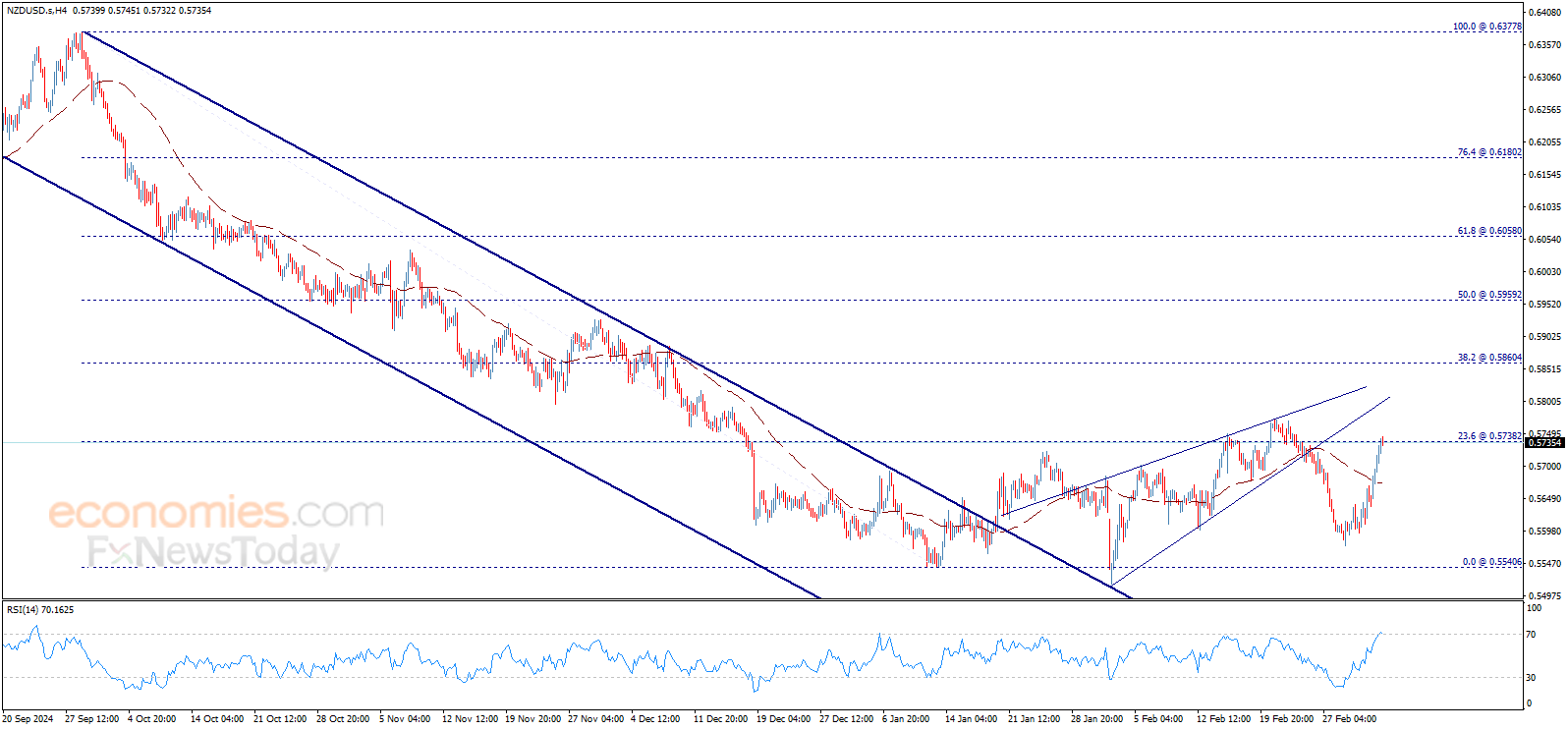
The NZDUSD price provided clear positive trades yesterday, as it breached 0.5655$ level to reach the key resistance 0.5738$ and settle around it, to hint the attempt to return to the correctional bullish track, but we notice that the RSI lost its positive momentum and might push the price to decline again.
To get our more detailed analysis and 100% accurate signals provided by Best Trading Signal, subscribe to Economies.com VIP Club through the link below!
Oil prices will likely remain around current levels or even lower this year, analysts and economists in the monthly Reuters poll said last week.
Sufficient oil supply and spare capacity within the OPEC+ group will be enough to keep prices in the low $70s per barrel, the experts said.
Supply shocks would be balanced out with the 5 million barrels per day (bpd) of spare capacity that OPEC+ currently has, mostly within the Middle Eastern producers in OPEC.
Major trade and geopolitical developments since last week are likely to put additional downward pressure on oil prices—the tariffs on Canada and Mexico and the higher tariff on Chinese imports into the U.S., and the possibility of some eased sanctions on Russia.
The four dozen analysts participating in the Reuters poll last week saw Brent Crude prices averaging $74.63 per barrel in 2025, slightly higher compared to the forecast of $74.57 in January. For WTI Crude, analysts expect an average 2025 price of $70.66 per barrel, up from $70.40 in January.
At the time the survey was carried out, oil prices were more or less trading around these levels.
But early this week, oil slumped after the Trump Administration confirmed that tariffs on Canada and Mexico are going ahead as planned on March 4, and the tariff on Chinese goods is lifted to 20% from 10%. Canada and Mexico tariffs are at 25%, with Canadian energy facing a lower, 10%, import tariff.
Economic Fallout from Tariffs
On the first trading day of March, major Wall Street indexes turned sharply lower after the Trump Administration announced that the tariffs on Canada and Mexico, and higher levies on China are going into effect on Tuesday.
The S&P 500 index fell by nearly 2% for the steepest one-day drop so far this year. The broad-based index has erased nearly all the 6% gain since Election Day and is now only 1% higher compared to early November when President Donald Trump was elected. The Dow Jones Industrial Average (DJIA) slumped by 1.5%, and the Nasdaq composite dipped by 2.6%.
The rally in the weeks since November has been largely due to hopes that the Trump Administration would boost U.S. businesses and the economy.
But tariffs could undermine the growth plans of many businesses, and the economy is likely to slow down, analysts say.
A weakening economy, the world’s largest at that, could dampen oil demand in the U.S. and globally—that’s why the market hasn’t been very bullish about oil prices in recent weeks.
Some estimates have even started to point to the U.S. economy contracting in the first quarter. The GDPNow model of Atlanta Fed, not an official forecast but a running estimate of real GDP growth based on available economic data, shows a forecast of real annual GDP growth for Q1 at a negative -2.8% on March 3, down from a -1.5% forecast on February 28. The estimate was revised down after releases from the US Census Bureau and the Institute for Supply Management. The GDPNow forecast of first-quarter real personal consumption expenditures growth and real private fixed investment growth fell from 1.3% and 3.5%, respectively, to 0.0% and 0.1%.
Supply and Demand Uncertainties
Amid all the tariff noise, forecasters have not downgraded—yet—their estimates of global oil demand growth this year. Demand is generally expected to rise by between 1 million bpd and 1.4 million bpd, with OPEC being the most bullish with 1.4 million bpd growth projection for both 2025 and 2026.
The “healthier oil market outlook”, OPEC said on Monday, allowed the OPEC+ producers to “proceed with a gradual and flexible return of the 2.2 mbd voluntary adjustments starting on 1st April, 2025, while remaining adaptable to evolving conditions.”
Initially, OPEC+ will return 138,000 bpd to the market in April, the group confirmed this week, but noted that the increase may be paused or reversed subject to market conditions.
The gradual return of OPEC+ supply and the expected non-OPEC+ output growth this year are set to keep oil from price spikes, analysts say.
The U.S. “maximum pressure” campaign on Iran with the goal to reduce Iranian oil exports to zero could be offset by lower demand growth in case of economic downturn and potential easing of some U.S. sanctions on Russia as the Trump Administration pivoted from supporting Ukraine to siding with Moscow about possible pathways to end the war.
Risk-Off Oil Market Sentiment
With all the unknowns about the tariff fallout on economies and oil trade flows due to sanctions being tightened on some and eased on others, money managers and other hedge funds are currently in a risk-off mood and are dumping bullish positions in the two most traded petroleum futures contracts, Brent and WTI.
In the week to February 25, selling of crude oil was “particularly aggressive,” Ole Hansen, Head of Commodity Strategy at Saxo Bank, said on Monday in a commentary on the latest Commitment of Traders report.
The U.S. benchmark contract, WTI Crude, saw the biggest selling spree, not only in the latest reporting week, but also in the past five weeks.
The net long position – the difference between bullish and bearish bets – in WTI slumped to the lowest level in nearly 15 years, at 67,600 contracts at end-February, down from 250,000 contracts hedge funds held as of January 21.
“During this five-week period, the combined net long in WTI (CME and ICE) and Brent has almost halved to 260k contracts, as the technical outlook continued to deteriorate amid worries about a global trade war’s impact on demand and OPEC+ considers when to start tapering production cuts,” Hansen said.
By Tsvetana Paraskova for Oilprice.com
More Top Reads From Oilprice.com
XAU/USD trades near a fresh weekly high of $2,929.65, with higher highs in sight. The bright metal benefited from the broad US Dollar’s (USD) weakness, the latter affected by tepid United States (US) data and President Donald Trump’s massive tariffs on trade partners.
President Trump addressed Congress late on Tuesday and played down the potential negative effects of his latest round of tariffs. “. There’ll be a little disturbance, but we’re okay with that. It won’t be much,” Trump said, adding that reciprocal tariffs on trading partners will come into effect on April 2
Still, US Commerce Secretary Howard Lutnick suggested Trump’s administration may reduce or even roll back tariffs on the two neighbouring countries, spurring risk appetite throughout the first half of the day and harming the USD.
The Greenback fell further after the release of the US ADP Employment Change report, showing that the private sector added 77K new positions in February, much worse than the previous 183K or the expected 140K. The ISM Services Purchasing Managers’ Index (PMI), on the other contrary, jumped to 53.5 in February from 52.8 in the previous month while surpassing expectations of 52.6.
The focus now shifts to the European Central Bank (ECB) expected to deliver another 25 basis points (bps) interest rates cut when it announces its decision on monetary policy on Thursday. Other than that, investors will keep an eye on trade-war developments.
The daily chart for XAU/USD shows it trades around its daily opening, while an intraday dip was quickly reverted, suggesting buyers are taking advantage of dips. The same chart shows Gold develops above all its moving averages, with a flat 20 Simple Moving Average (SMA) providing near-term support at around $2,906.25. Technical indicators, in the meantime, have turned directionless, with the Momentum indicator stuck around its 100 level.
The near-term picture shows the risk skews to the upside. In the 4-hour chart, the XAU/USD pair is holding at the upper end of its recent range while advancing above all its moving averages. A bullish 20 SMA provides intraday support in the $2,890 area while advancing below a still flat 100 SMA. Finally, technical indicators turned firmly north within positive levels, reflecting persistent buying interest.
Support levels: 2,894.25 2,876.90 2,858.70
Resistance levels: 2,927.90 2,941.40 2,956.10
If the $4.55 price level is exceeded, then natural gas could reach the next higher target zone around $4.70 to $4.72. Subsequently, the 38.2% Fibonacci retracement of the full decline that began from the 2022 peak of $10.03 is at $4.77. Since that measurement is based on a long-term pattern, it is potentially significant with a good chance that strong resistance might be seen there.
The advance from the late-January swing low of $2.99 is in its second leg up following a clear test of support on Monday at the day’s low of $3.74. That low generated a higher swing low. There is the confluence of several indicators identifying the $3.74 price zone as potentially significant support. Given the sharp advance since that swing low. Including a breakout to a new trend high yesterday, natural gas seems to be indicating it may go higher and possibly break out to a new trend high.
When adding a rising ABCD pattern (purple) to the current advance, it shows a potential initial target at the 78.6% extension of $4.93. Whether it is reached or not, the ABCD pattern shows the potential for higher prices. Possible targets from the ABCD pattern are identified when there is price symmetry between the CD leg of the pattern and the AB leg, or a harmonic relationship between the two swings. The targets identify potential resistance levels.
Alternatively, a decline below today’s low of $4.23 will show short-term weakness that could lead to a lower pullback to test support levels. Tuesday’s low at $4.06 could see support and if it fails, a test of the 20-Day MA at $3.88 currently, becomes possible.
For a look at all of today’s economic events, check out our economic calendar.