The main tag of Gold Today Price Articles.
You can use the search box below to find what you need.
[wd_asp id=1]
The main tag of Gold Today Price Articles.
You can use the search box below to find what you need.
[wd_asp id=1]
Morgan Stanley expects Brent Crude prices to average $70 per barrel in the second half of 2025, up from a $66-$68 a barrel range expected previously, after OPEC+ delayed the beginning of its production increase and slowed the pace of the output hikes into 2026.
The OPEC+ alliance decided on Thursday to delay the start of the easing of the 2.2 million barrels per day (bpd) cuts to April 2025, from January 2025. The group also extended the period in which it would unwind all these cuts until September 2026.
The delay and the slower ramp-up in OPEC+’s oil production increases mean that the market would see a smaller surplus than expected, Morgan Stanley analysts wrote in a note, as carried by Reuters.
Excluding the three OPEC members exempted from the cuts (Iran, Libya, and Venezuela), the other nine OPEC producers are now expected to pump 400,000 bpd less in 2025, the bank said. It also lowered its projection of the combined output of the nine OPEC producers by 700,000 bpd by the fourth quarter of 2025.
“In aggregate, this reduces our estimated surplus in 2025 from 1.3 to 0.8 million bpd in our total liquids balance, and from 0.7 to 0.3 million bpd in our crude-only balance,” Morgan Stanley said.
Early on Friday, oil prices were on track to book a weekly loss, as prices have been little moved since the OPEC+ decision on Thursday.
The three-month delay to the start of the easing of the production cuts was expected by the market. The slower pace of planned increases in output and kicking the can down the road may reduce the previously expected market surplus, but it is also an indication that OPEC+ is aware that demand isn’t strong enough to absorb the reversal of all the cuts throughout 2025.
By Charles Kennedy for Oilprice.com
Silver (XAG/USD) rally from last week’s lows near $30.00 has been capped at the top of the last two week’s horizontal channel, at 31.15, with investors awaiting the release of November’s US employment data.
The US economy is expected to have created 200,000 new jobs in the month, while the unemployment rate ticked up to 4.2%. This latter data and softer wage inflation are likely to keep hopes of December rate cuts alive.
On Thursday, the weekly jobless claims showed a larger-than-expected increase in the last week of November. This, coupled with below-consensus ADP employment figures seen on Wednesday, has cast some doubt about the NFP reading and increased pressure on the USD.
The technical picture shows the bullish momentum losing steam, with the 4-hour RSI turning down towards the 50 level and bulls capped below the mentioned $31.45. Above here, the next target is the November, 7 high, at 32.15. Supports are $30.90 and $30.45 (Dec 5 and 4 lows respectively)
Silver is a precious metal highly traded among investors. It has been historically used as a store of value and a medium of exchange. Although less popular than Gold, traders may turn to Silver to diversify their investment portfolio, for its intrinsic value or as a potential hedge during high-inflation periods. Investors can buy physical Silver, in coins or in bars, or trade it through vehicles such as Exchange Traded Funds, which track its price on international markets.
Silver prices can move due to a wide range of factors. Geopolitical instability or fears of a deep recession can make Silver price escalate due to its safe-haven status, although to a lesser extent than Gold’s. As a yieldless asset, Silver tends to rise with lower interest rates. Its moves also depend on how the US Dollar (USD) behaves as the asset is priced in dollars (XAG/USD). A strong Dollar tends to keep the price of Silver at bay, whereas a weaker Dollar is likely to propel prices up. Other factors such as investment demand, mining supply – Silver is much more abundant than Gold – and recycling rates can also affect prices.
Silver is widely used in industry, particularly in sectors such as electronics or solar energy, as it has one of the highest electric conductivity of all metals – more than Copper and Gold. A surge in demand can increase prices, while a decline tends to lower them. Dynamics in the US, Chinese and Indian economies can also contribute to price swings: for the US and particularly China, their big industrial sectors use Silver in various processes; in India, consumers’ demand for the precious metal for jewellery also plays a key role in setting prices.
Silver prices tend to follow Gold’s moves. When Gold prices rise, Silver typically follows suit, as their status as safe-haven assets is similar. The Gold/Silver ratio, which shows the number of ounces of Silver needed to equal the value of one ounce of Gold, may help to determine the relative valuation between both metals. Some investors may consider a high ratio as an indicator that Silver is undervalued, or Gold is overvalued. On the contrary, a low ratio might suggest that Gold is undervalued relative to Silver.
Coffee price today, date December 5, 2024 on the market world, at 4:30 am updated on the Vietnam Commodity Exchange MXV (world coffee prices are continuously updated by MXV, matching with world exchanges, the only channel in Vietnam that continuously updates and links with world exchanges).
At the end of the trading session, the price of Robusta coffee on the London floor at 4:30 a.m. on December 5, 2024 increased again, increasing from 144 – 161 USD/ton, fluctuating from 4.423 – 4.779 USD/ton. Specifically, the monthly delivery term January 2025 was 4.770 USD/ton (up 144 USD/ton); the monthly delivery term March 2025 was 4.751 USD/ton (up 147 USD/ton); the monthly delivery term May 2025 was 4.702 USD/ton (up 158 USD/ton) and the monthly delivery term July 2025 was 4.638 USD/ton (up 161 USD/ton).
Similarly, the price of Arabica coffee in New York this morning December 5, 2024 rebounded, with green dominating, increasing by 7.15 – 8.20 cents/lb. Specifically, the monthly delivery term March 2025 was 303.70 cents/lb; the monthly delivery term May 2025 was 301.75 cents/lb; the monthly delivery term July 2025 was 297.25 cents/lb and the monthly delivery term September 2025 was 292.20 cents/lb (down 19.70 cents/lb).
At the end of the trading session, on the morning of December 5, 2024, the price of Brazilian Arabica coffee continued to increase and decrease mixedly across delivery terms, ranging from 358.75 – 383.75 USD/ton. Specifically, the monthly delivery term December 2024 was 377.50 USD/ton; the monthly delivery term March 2025 was 379.50 USD/ton; the monthly delivery term May 2025 was 374.95 USD/ton and the monthly delivery term July 2025 was 368.85 USD/ton.
Domestic coffee prices were updated at 4:30 a.m. on December 5, 2024 as follows: Domestic coffee prices continued to decrease, down about 1.000 VND/kg. Currently, the average purchase price in the Central Highlands provinces is at 108.200 VND/kg.
Specifically, the coffee purchase price in the province Gia Lai at 108.000 VND/kg (down 1.000 VND/kg compared to the previous trading session). Coffee purchasing price in the province Dak Nong at about 108.500 VND/kg.
Price of green coffee beans (coffee beans, fresh coffee beans) in the province Lam Dong In districts such as Bao Loc, Di Linh, Lam Ha, coffee is purchased at 107.000 VND/kg.
Coffee price today (date 5/12) in the province Dak LakIn Cu M’gar district, coffee is purchased at 108.000 VND/kg, and in Ea H’leo district, Buon Ho town, it is purchased at 107.900 VND/kg.
| Coffee price tomorrow December 6, 2024 |
On 5/12, domestic coffee prices increased sharply again in the context of recovering world coffee prices; the weakening of the USD has promoted some short-covering activities in the coffee futures market.
In addition, dry weather in Brazil has caused the market to continue to worry about coffee production in the world’s largest coffee exporting country.
In Vietnam, rains are continuing in some areas of the Central Highlands, disrupting farmers’ coffee harvest. This concern has prompted investors to enter the derivatives market with strong buying power.
Adverse weather not only affects harvesting activities but also causes problems in the logistics chain, leading to the possibility that the supply of new crop coffee from Vietnam to the international market will be lower and slower than usual.
According to experts, coffee prices will continue to fluctuate in the coming time. However, concerns about reduced output in coffee-producing countries due to unfavorable weather; interest rate adjustments by the FED, and the delay in the implementation of the EU Deforestation Regulation (EUDR)… mean that in the long term, coffee prices are likely to stabilize and increase again.
Sources: https://congthuong.vn/du-bao-gia-ca-phe-ngay-mai-6122024-gia-ca-phe-on-dinh-va-tang-tro-lai-362691.html
Silver (XAG/USD) rally from last week’s lows near $30.00 has been capped at the top of the last two week’s horizontal channel, at 31.15, with investors awaiting the release of November’s US employment data.
The US economy is expected to have created 200,000 new jobs in the month, while the unemployment rate ticked up to 4.2%. This latter data and softer wage inflation are likely to keep hopes of December rate cuts alive.
On Thursday, the weekly jobless claims showed a larger-than-expected increase in the last week of November. This, coupled with below-consensus ADP employment figures seen on Wednesday, has cast some doubt about the NFP reading and increased pressure on the USD.
The technical picture shows the bullish momentum losing steam, with the 4-hour RSI turning down towards the 50 level and bulls capped below the mentioned $31.45. Above here, the next target is the November, 7 high, at 32.15. Supports are $30.90 and $30.45 (Dec 5 and 4 lows respectively)
Silver is a precious metal highly traded among investors. It has been historically used as a store of value and a medium of exchange. Although less popular than Gold, traders may turn to Silver to diversify their investment portfolio, for its intrinsic value or as a potential hedge during high-inflation periods. Investors can buy physical Silver, in coins or in bars, or trade it through vehicles such as Exchange Traded Funds, which track its price on international markets.
Silver prices can move due to a wide range of factors. Geopolitical instability or fears of a deep recession can make Silver price escalate due to its safe-haven status, although to a lesser extent than Gold’s. As a yieldless asset, Silver tends to rise with lower interest rates. Its moves also depend on how the US Dollar (USD) behaves as the asset is priced in dollars (XAG/USD). A strong Dollar tends to keep the price of Silver at bay, whereas a weaker Dollar is likely to propel prices up. Other factors such as investment demand, mining supply – Silver is much more abundant than Gold – and recycling rates can also affect prices.
Silver is widely used in industry, particularly in sectors such as electronics or solar energy, as it has one of the highest electric conductivity of all metals – more than Copper and Gold. A surge in demand can increase prices, while a decline tends to lower them. Dynamics in the US, Chinese and Indian economies can also contribute to price swings: for the US and particularly China, their big industrial sectors use Silver in various processes; in India, consumers’ demand for the precious metal for jewellery also plays a key role in setting prices.
Silver prices tend to follow Gold’s moves. When Gold prices rise, Silver typically follows suit, as their status as safe-haven assets is similar. The Gold/Silver ratio, which shows the number of ounces of Silver needed to equal the value of one ounce of Gold, may help to determine the relative valuation between both metals. Some investors may consider a high ratio as an indicator that Silver is undervalued, or Gold is overvalued. On the contrary, a low ratio might suggest that Gold is undervalued relative to Silver.
Gold’s price extends the previous decline to reach a fresh eight-day low near $2,615 early Friday. Gold traders now look forward to the all-important Nonfarm Payrolls (NFP) data for fresh impetus.
In the lead-up to the US NFP showdown, the US Dollar (USD) has found fresh demand amid a slight deterioration in risk sentiment and profit-taking.
Investors’ sentiment sags on lingering political tensions in South Korea as the main opposition Democratic Party announced an impeachment motion against President Yoon Suk Yeol will be put to a vote on Saturday, per Asia News.
Further, Yonhap carried headlines citing South Korea’s opposition parties saying lawmakers were on standby after receiving many reports for another martial law declaration.
Additionally, persistent worries over China’s economic slowdown and US-Sino trade war undermine the broader market sentiment. Traders are cautious already and resort to repositioning before the US labor data due later in American trading.
Economists expect the US economy to have added 200K jobs in November after creating a meagre 12K jobs in October in the face of hurricanes and the Boeing strike.
If the headline NFP figure comes in below 200K, it would suggest a continued cool down in the US labor market, calling for further rate cuts by the Fed beyond December. The dovish narrative is set to bode well for the non-interest-bearing Gold price at the expense of the USD.
On the other hand, a strong NFP print is likely to strengthen the recent speculation that the Fed could pause its rate-cutting cycle after the expected rate reduction in December. The CME Group’s FedWatch Tool shows that the chances of the Fed lowering rates by 25 basis points (bps) later this month stand at about 70%, slightly down from 75% a day ago.
On Thursday, Gold price snapped its recovery momentum and returned to the red despite the sell-off in the US Dollar and the US Treasury bond yields. The disappointing US weekly Jobless Claims data failed to lift the sentiment around Gold price.
Initial claims for state unemployment benefits rose 9,000 to a seasonally adjusted 224,000 for the week ended Nov. 30, the Labor Department said. Markets had forecast 215,000 claims for the latest week.
The daily chart shows that Gold’s price has broken the recent range to the downside as the 14-day Relative Strength Index (RSI) turns lower below the midline.
Adding credence to the renewed decline in Gold price, the previous week’s Bear Cross continues to act as a headwind.
A daily candlestick closing below the critical short-term 21-day Simple Moving Average (SMA) at $2,631 will likely strengthen the downside.
The next support aligns at the previous week’s low of $2,605, below which the 100-day SMA at $2,583 will be the line in the sand for Gold buyers.
On the flip side, recapturing the 50-day SMA resistance at $2,668 on a sustained basis is critical for buyers to negate the near-term bearish bias.
The next relevant resistance is seen at $2,700, above which the November 25 high of $2,721 will be tested.
The Nonfarm Payrolls release presents the number of new jobs created in the US during the previous month in all non-agricultural businesses; it is released by the US Bureau of Labor Statistics (BLS). The monthly changes in payrolls can be extremely volatile. The number is also subject to strong reviews, which can also trigger volatility in the Forex board. Generally speaking, a high reading is seen as bullish for the US Dollar (USD), while a low reading is seen as bearish, although previous months’ reviews and the Unemployment Rate are as relevant as the headline figure. The market’s reaction, therefore, depends on how the market assesses all the data contained in the BLS report as a whole.
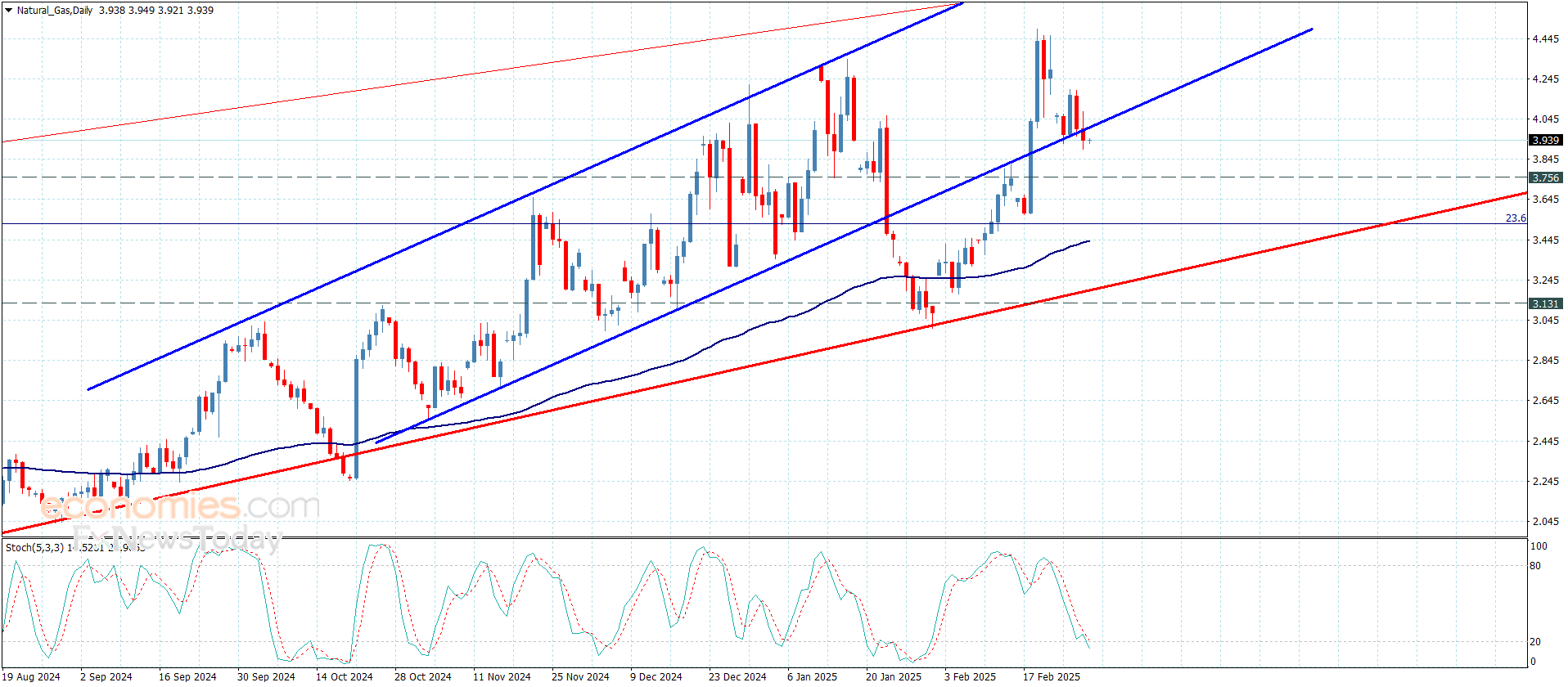
Natural gas is poised to close weak for the day, below the halfway point for the day’s trading range. And that is after a successful test of resistance at the bottom of the internal uptrend line. Along with the 20-Day MA line, the trendline identified dynamic support for the uptrend. The trendline needs to be reclaimed before natural gas has a chance to proceed higher.
Recent price action in natural gas leaves several nearby price levels to key off. There is today’s high of 3.115 and the low of 3.035. Also, the 20-Day MA is at 3.06 and the swing low is at 2.98. Today’s high and the swing low are the more critical price levels as a move through either should determine the next direction. Either natural gas continues to rally in alignment with the larger bullish trend or, the bearish correction is not over until lower price levels are tested as support.
A continuation of the rally is signaled on an advance above today’s high of 3.115. That should confirm a bullish reversal and put natural gas in a position to continue to rise and eventually test recent highs, if not break through them. If today’s high is exceeded, then a reclaim of Tuesday’s high at 3.22 will provide the next sign of strength and therefore points to a continuation higher.
On the downside, the next lower target zone is around the convergence of several price targets. There is the top boundary line of a large symmetrical triangle pattern, an extended downside target for the falling ABCD pattern at 2.90, and the 78.6% Fibonacci retracement at 2.875.
For a look at all of today’s economic events, check out our economic calendar.
Spot Gold kept trading uneventfully around the $2,650 mark throughout the first half of the day, with limited action across financial boards. The US Dollar (USD) was under pressure after the United States (US) released tepid employment-related data ahead of the release of the November Nonfarm Payrolls (NFP) report on Friday.
Initial Jobless Claims for the week ending November 29 rose to 224K, above the215K from the previous week and above the market’s expectations. Additionally, the US reported that US-based employers announced 57,727 cuts in November, a 3.8% increase from the 55,597 cuts announced one month prior, according to the Challenger Job Cuts report.
Nevertheless, the USD trimmed part of its losses and surged against Gold amid the poor performance of Wall Street. Following a mixed close among Asian and European indexes, US ones came under selling pressure right after the opening, suggesting a cautious mood.
XAU/USD nears its weekly low posted on Monday at $2,621.77, and technical readings in the daily chart suggest the pair may extend its slide, albeit a break below such a low is needed. Gold is pressuring a bearish 20 Simple Moving Average (SMA), the latter at around $2,630, while the 100 SMA turns flat at around $2,580, reflecting receding buying interest. At the same time, technical indicators turned south, although the Momentum indicator holds within positive levels while the Relative Strength Index (RSI) indicator stands at neutral levels, suggesting a limited bearish potential.
In the near term, and according to the 4-hour chart, XAU/USD is neutral-to-bearish. The pair pressures a flat 100 SMA after breaking below an also directionless 20 SMA. Technical indicators aim lower with uneven strength but gain ground below their midlines. A bearish breakout is on the cards, although it may wait until after the release of the US NFP report.
Support levels: 2,621.77 2,608.40 2,689.10
Resistance levels: 2,633.15 2,650.10 2,666.25
Gold price (XAU/USD) trades in a tight range around $2,650.00 in Thursday’s European session. The precious metal struggles for a direction as investors have sidelined ahead of the United States (US) Nonfarm Payrolls (NFP) data for November, which will be released on Friday.
The labor market data will significantly influence market expectations for the likely interest rate decision by the Federal Reserve (Fed) in its monetary policy meeting on December 18. Currently, financial market participants expect the Fed to cut interest rates by 25 basis points (bps) to 4.25%-4.50%, according to the CME FedWatch tool.
Economists expect the US economy to have added 200K fresh workers, significantly higher than 12K in October. The NFP report stated that payroll employment estimates in some industries were affected by the hurricanes last month. The Unemployment Rate is estimated to have increased to 4.2% from the former release of 4.1%. Investors will also pay close attention to the US Average Hourly Earnings data to get cues about the current status of wage growth.
The downside in the Gold price is expected to remain well-supported amid tensions between Russia and Ukraine. Historically, the appeal of the Gold price has strengthened amid heightening geopolitical tensions.
Meanwhile, the US Dollar Index (DXY), which tracks the Greenback’s value against six major currencies, ticks down to near 106.20. 10-year US Treasury yields advance to near 4.21%.
Gold price trades back and forth near the upward-sloping trendline around $2,650, which is plotted from the February low of $1,984.00 on a daily timeframe. The precious metal wobbles near the 20-day Exponential Moving Average (EMA) around $2,650.00.
The 14-day Relative Strength Index (RSI) oscillates in the 40.00-60.00 range, suggesting a sideways trend.
Looking down, the November low of $2,536.87 will be the key support for Gold price bulls. On the upside, the October high of $2,790 will act as key resistance.
Gold has played a key role in human’s history as it has been widely used as a store of value and medium of exchange. Currently, apart from its shine and usage for jewelry, the precious metal is widely seen as a safe-haven asset, meaning that it is considered a good investment during turbulent times. Gold is also widely seen as a hedge against inflation and against depreciating currencies as it doesn’t rely on any specific issuer or government.
Central banks are the biggest Gold holders. In their aim to support their currencies in turbulent times, central banks tend to diversify their reserves and buy Gold to improve the perceived strength of the economy and the currency. High Gold reserves can be a source of trust for a country’s solvency. Central banks added 1,136 tonnes of Gold worth around $70 billion to their reserves in 2022, according to data from the World Gold Council. This is the highest yearly purchase since records began. Central banks from emerging economies such as China, India and Turkey are quickly increasing their Gold reserves.
Gold has an inverse correlation with the US Dollar and US Treasuries, which are both major reserve and safe-haven assets. When the Dollar depreciates, Gold tends to rise, enabling investors and central banks to diversify their assets in turbulent times. Gold is also inversely correlated with risk assets. A rally in the stock market tends to weaken Gold price, while sell-offs in riskier markets tend to favor the precious metal.
The price can move due to a wide range of factors. Geopolitical instability or fears of a deep recession can quickly make Gold price escalate due to its safe-haven status. As a yield-less asset, Gold tends to rise with lower interest rates, while higher cost of money usually weighs down on the yellow metal. Still, most moves depend on how the US Dollar (USD) behaves as the asset is priced in dollars (XAU/USD). A strong Dollar tends to keep the price of Gold controlled, whereas a weaker Dollar is likely to push Gold prices up.
The Silver price (XAG/USD) drifts lower to around $31.20, snapping the two-day winning streak during the early European session on Thursday. The cautious stance on cutting rates by the Federal Reserve (Fed) weighs on the white metal.
Federal Chair Jerome Powell said on Wednesday that the US economy’s strength means the US central bank can afford to be a little more cautious” about decisions on rate moves. Joseph Brusuelas, chief economist at RSM US, noted that he doesn’t expect further rate cuts after the December meeting until March 2025 at the earliest.
The rising bets of less aggressive Fed rate cuts could support the Greenback and undermine the USD-denominated commodity price. The markets are now pricing in a 76% chance that the central bank would cut rates by a quarter point at its December 17-18 meeting, according to the CME FedWatch tool.
On the other hand, the silver market is expected to experience a supply deficit for the fourth consecutive year due to robust demand. This, in turn, might provide some support to the Silver price. Carsten Fritsch, a precious metals analyst at Commerzbank, said, “Silver demand for photovoltaics has more than doubled in the last three years and now almost equals the demand for bars and coins.” Fritsch added that the rising industrial demand is likely to boost physical silver demand this year, reaching its second-highest level after 2022.
Silver is a precious metal highly traded among investors. It has been historically used as a store of value and a medium of exchange. Although less popular than Gold, traders may turn to Silver to diversify their investment portfolio, for its intrinsic value or as a potential hedge during high-inflation periods. Investors can buy physical Silver, in coins or in bars, or trade it through vehicles such as Exchange Traded Funds, which track its price on international markets.
Silver prices can move due to a wide range of factors. Geopolitical instability or fears of a deep recession can make Silver price escalate due to its safe-haven status, although to a lesser extent than Gold’s. As a yieldless asset, Silver tends to rise with lower interest rates. Its moves also depend on how the US Dollar (USD) behaves as the asset is priced in dollars (XAG/USD). A strong Dollar tends to keep the price of Silver at bay, whereas a weaker Dollar is likely to propel prices up. Other factors such as investment demand, mining supply – Silver is much more abundant than Gold – and recycling rates can also affect prices.
Silver is widely used in industry, particularly in sectors such as electronics or solar energy, as it has one of the highest electric conductivity of all metals – more than Copper and Gold. A surge in demand can increase prices, while a decline tends to lower them. Dynamics in the US, Chinese and Indian economies can also contribute to price swings: for the US and particularly China, their big industrial sectors use Silver in various processes; in India, consumers’ demand for the precious metal for jewellery also plays a key role in setting prices.
Silver prices tend to follow Gold’s moves. When Gold prices rise, Silver typically follows suit, as their status as safe-haven assets is similar. The Gold/Silver ratio, which shows the number of ounces of Silver needed to equal the value of one ounce of Gold, may help to determine the relative valuation between both metals. Some investors may consider a high ratio as an indicator that Silver is undervalued, or Gold is overvalued. On the contrary, a low ratio might suggest that Gold is undervalued relative to Silver.
Gold’s price continues with its narrow range struggle at around $2,650 early Thursday, stalling Federal Reserve (Fed) Chairman Jerome Powell’s speech-led uptick. The focus now remains on the US Jobless Claims data due later in the day in the lead-up to the all-important Nonfarm Payrolls (NFP) data.
Gold buyers seem to have turned cautious yet again, as the US Dollar (USD) and US Treasury bond yields recover from the overnight slump fuelled by Powell’s optimistic comments on the US economy at the New York Times’ DealBook Summit.
Powell said in his speech that “Growth is definitely stronger than we thought, and inflation is coming a little higher,” Powell said at the event. “The good news is that we can afford to be a little more cautious as we try to find neutral,” he added, referring to the neutral interest rate.
His comments powered the Wall Street indices to fresh highs on increased ‘soft-landing’ hopes, weighing on the safe-haven US Dollar while boosting Gold price. Fed Chair Jerome Powell’s words, however, failed to alter the market’s pricing of 25 basis points (bps) interest rate cut later this month, which weighed heavily on the US Treasury bond yields across the curve, aiding the rebound in Gold price.
Markets continue pricing in a 73% probability of a Dec Fed rate reduction, the CME Group’s FedWatch Tool shows, more or less the same as a day ago.
During the first half of Wednesday’s trading, Gold price struggled amid a modest US Dollar upswing, courtesy of a risk-averse market mood on China’s economic concerns, looming US-Sino trade tensions and geopolitical risks.
Looking ahead, the broader market sentiment will play a pivotal role in the Gold price action but traders could refrain from placing fresh directional bets on the bright metal, anticipating the high-impact US labor market report on Friday. Data released by the ADP showed Wednesday that US private sector employment grew by 146,000 jobs last month, lower than the 150,000 figure that analysts expected.
Markets will also pay close attention to any developments on the global trade front and Middle East geopolitics, which could significantly impact risk sentiment and the USD-sensitive Gold price. Earlier on, an adviser to US President-elect Donald Trump said that Trump “wants to implement an Israel-Gaza cease-fire deal Gaza without delay and before January 20.”
The daily chart shows that Gold’s price remains stuck between the critical short-term 21-day Simple Moving Average (SMA) at $2,636 and the 50-day SMA at $2,669.
The 14-day Relative Strength Index (RSI) sits just beneath the 50 level, suggesting a lack of clear directional bias.
The previous week’s Bear Cross still remains a threat to Gold buyers.
Recapturing the 50-day SMA resistance at $2,669 on a daily closing basis is critical for buyers to affirm the recovery.
The next relevant resistance aligns at $2,700, above which the November 25 high of $2,721 will be tested.
Conversely, Gold sellers must find a foothold below the 21-day SMA at $2,636 to crack the $2,621 static support.
The previous week’s low of $2,605 will be the line in the sand for Gold buyers.
Gold has played a key role in human’s history as it has been widely used as a store of value and medium of exchange. Currently, apart from its shine and usage for jewelry, the precious metal is widely seen as a safe-haven asset, meaning that it is considered a good investment during turbulent times. Gold is also widely seen as a hedge against inflation and against depreciating currencies as it doesn’t rely on any specific issuer or government.
Central banks are the biggest Gold holders. In their aim to support their currencies in turbulent times, central banks tend to diversify their reserves and buy Gold to improve the perceived strength of the economy and the currency. High Gold reserves can be a source of trust for a country’s solvency. Central banks added 1,136 tonnes of Gold worth around $70 billion to their reserves in 2022, according to data from the World Gold Council. This is the highest yearly purchase since records began. Central banks from emerging economies such as China, India and Turkey are quickly increasing their Gold reserves.
Gold has an inverse correlation with the US Dollar and US Treasuries, which are both major reserve and safe-haven assets. When the Dollar depreciates, Gold tends to rise, enabling investors and central banks to diversify their assets in turbulent times. Gold is also inversely correlated with risk assets. A rally in the stock market tends to weaken Gold price, while sell-offs in riskier markets tend to favor the precious metal.
The price can move due to a wide range of factors. Geopolitical instability or fears of a deep recession can quickly make Gold price escalate due to its safe-haven status. As a yield-less asset, Gold tends to rise with lower interest rates, while higher cost of money usually weighs down on the yellow metal. Still, most moves depend on how the US Dollar (USD) behaves as the asset is priced in dollars (XAU/USD). A strong Dollar tends to keep the price of Gold controlled, whereas a weaker Dollar is likely to push Gold prices up.