The main tag of Gold Today Price Articles.
You can use the search box below to find what you need.
[wd_asp id=1]
The main tag of Gold Today Price Articles.
You can use the search box below to find what you need.
[wd_asp id=1]
Today’s bull breakout further confirms strength of the counter-trend rally. It looks poised to test resistance near the 50-day average, now at $59.13. Until proven otherwise, some degree of resistance can be anticipated. Since the area near the 50-day average reversed the bull reversal from the October swing low, it was confirmed several times as a dynamic resistance area, most recently the December lower swing high at $60.56.
Since the average identifies an area of possible resistance, the 12-day high at $59.22 can be included in the price zone as well, along with a 78.6% Fibonacci retracement level at $59.37. Together, these indicators show a price zone from around $59.13 to $59.37 where the current bounce could stop and reverse – or breakthrough.
A sustained recapture of the $60.56 lower swing high from early December would be needed to show a reversal of the trend on the daily chart. However, a one-week bullish reversal triggered this week from a bullish hammer candle pattern. The weekly breakout will confirm if this week ends above last week’s high of $57.82. Nevertheless, the reversal of the lower swing high is needed to satisfy the internal downtrend that began from the June spike high at $78.44.
The series of lower swing highs from that peak suggests at least another pullback from resistance near the top of the short-term decline bounded by a dashed falling trendline. Despite recent signs of strength, demand will need to remain strong enough to advance further and then break out through a resistance zone and remain in a bullish technical position. That would be difficult without another dip, even if to generate a higher swing low rather than another test of this month’s lows.
Crude oil’s counter-trend rally has gained traction with the 20-day reclaim and weekly reversal signal, but the $59.13–$59.37 confluence looms as the decisive test. Clearance and hold above the 50-day average shifts the daily structure to short-term bullish; rejection there favors another leg lower within the larger downtrend from June.
For a look at all of today’s economic events, check out our economic calendar.
Gold price soared to a fresh all-time high on Tuesday, trading at $4,497 a troy ounce during European trading hours as market players kept dropping the US Dollar (USD). The bright metal also found favor in Middle East tensions, following weekend headlines indicating Israel is considering resuming its war with Iran.
The USD, however, found some near-term footing at the beginning of the American session after the release of mixed United States (US) data. The ADP Employment Change 4-week average showed that the private sector added an average of 11,500 jobs per week, in the week ending December 6, slightly below the previous 16,250 but still positive. Additionally, the Q3 Gross Domestic Product (GDP) reported annualized growth of 4.3% in the three months to September, well above the previous 3.8% and the expected 3.3%. On a negative note, the GDP Price Index, a measure of inflation, jumped from 2.1% to 3.7%.
The country also reported that Durable Goods Orders fell 2.2% in October, a worsening from the 0.7% advance posted in September. Finally, CB Consumer Confidence in December edged lower for the fifth consecutive month, declining to 89.1 from 92.9 in November.
Most countries celebrate Christmas, which means there won’t be any macroeconomic releases to worry about in the coming days. Japan is the only exception, releasing some interesting figures, including Tokyo Consumer Price Index (CPI) data, next Friday.
The XAU/USD fell towards the $4,450 region with the headlines, but resumed its advance after the dust settled, and trades around $4,480 at the time of writing.
Technically, the 4-hour chart shows XAU/USD trades at $4,474.84, holding on to modest intraday gains. The 20-, 100-, and 200-period Simple Moving Averages (SMAs) are bullish, with the price holding above all three, usually indicating that bulls maintain the lead. The 20 SMA near $4,398.04 offers nearby dynamic support. At the same time, the Momentum indicator eased but holds well above its midline, while the Relative Strength Index (RSI) indicator stands at 70. With the Momentum still positive and the RSI stretched, consolidation could precede another leg higher. A sustained push from current levels would extend the uptrend, while a pullback that holds above the cited SMAs would keep the bullish structure intact.
In the daily chart, XAU/USD trades far above an ascending 20-day SMA, with the latter developing above the 100- and 200-day SMAs. Price holds above all three, with the 20-day SMA at $4,267.83 providing nearby support and the 100-day SMA at $3,891.93 anchoring the trend. Finally, the Momentum indicator advances above its midline, while the RSI indicator at 80 barely decelerated its advance.
(The technical analysis of this story was written with the help of an AI tool)
Natural gas markets are ending the year in classic winter fashion: price swings driven less by what’s happening today than by what weather models might show next week.
On Tuesday, December 23, U.S. Henry Hub futures rebounded from recent weakness as record LNG export demand and a higher near-term consumption outlook helped offset a major bearish force—forecasts calling for warmer-than-normal temperatures into early January. [1]
Across the Atlantic, European benchmark prices moved the other direction. Dutch and British gas contracts slipped as traders digested weather forecasts pointing to a quicker end to a cold spell and weighed still-stable supply and LNG availability into January. [2]
Below is a complete, publication-ready rundown of the key news, forecasts, and market drivers shaping natural gas today.
U.S. (Henry Hub / NYMEX front month)
Europe (TTF / U.K. front month)
Asia (JKM as a global LNG marker)
The most important bullish headline in today’s U.S. market is straightforward: LNG export terminals are pulling record volumes of natural gas from the U.S. grid.
Reuters reporting cited:
In other words, even when domestic weather turns less supportive, export pull is creating a floor under demand—and traders are reacting.
Reuters also cited LSEG projections showing average demand across the Lower 48 (including exports) rising from about 127.9 Bcf/d this week to 136.0 Bcf/d over the next two weeks—an upward revision versus Monday’s outlook. [11]
That forecast shift matters because winter gas pricing is often determined at the margin: a few Bcf/d up or down can translate into sharp moves in futures when storage and weather risks are priced in.
Even with stronger LNG flows, the market is still fighting the same near-term problem: mild temperature outlooks reduce heating demand.
Reuters cited meteorologists calling for the U.S. to remain mostly warmer than normal through January 7, keeping heating-related consumption lower than typical for late December and early January. [12]
This push-pull—record exports vs. warm forecasts—is the core tension in natural gas today.
The other reason today’s rebound hasn’t turned into a runaway rally is supply.
Reuters cited LSEG estimates showing Lower 48 U.S. natural gas output at a record 111.1 Bcf/d in December, beating November’s record pace. [13]
High production changes the psychology of winter trading:
This is one reason the market can rally on demand revisions and export strength while still staying vulnerable to any fresh wave of “warmth-added” model runs.
One underappreciated catalyst in today’s Reuters reporting: U.S. policy news that could affect power generation.
Reuters cited that the Trump administration suspended leases for five large offshore wind projects under construction off the U.S. East Coast, citing national security concerns. The report added that reduced renewable generation expectations could mean greater reliance on natural gas-fired electricity. [14]
This is not an immediate “tomorrow morning” demand shock, but it’s a meaningful narrative tailwind for natural gas: when reliability concerns rise, gas often regains strategic importance in grid planning.
European gas pricing today is being pulled by weather expectations and the pace of winter storage drawdowns.
Reuters reporting (via LSEG data) showed:
On the fundamentals, Europe is not flashing the panic signals seen in past winters:
Bottom line: Europe’s market tone today looks more like managed winter balancing than crisis bidding—and that helps cap global LNG spillover into U.S. pricing.
Two LNG trade developments worth watching beyond day-to-day futures moves:
Reuters cited Kpler expectations that Myanmar will resume LNG imports next year, after a more than four-year hiatus (following partial cargo delivery last month). [20]
Myanmar won’t move global prices alone, but it’s a reminder that LNG demand growth increasingly comes from smaller, price-sensitive buyers—which can matter in tight winters and shoulder seasons.
Australia’s government has announced a new gas reservation approach beginning in 2027 that would require LNG exporters to set aside 15–25% of production for domestic use—designed to prevent shortages and reduce local price pressure. [21]
RBC analysis reported by The Australian described Santos-led GLNG as particularly exposed due to its supply profile and reliance on third-party gas versus peers. [22]
This is not an immediate December 2025 price mover—but in LNG, policy direction becomes today’s forward curve, influencing investment, contracting behavior, and long-term supply expectations.
With Christmas week liquidity and weather volatility, the next several sessions are likely to hinge on three catalysts:
1. www.bairdmaritime.com, 2. www.worldenergynews.com, 3. www.wsj.com, 4. www.bairdmaritime.com, 5. markets.businessinsider.com, 6. markets.ft.com, 7. www.worldenergynews.com, 8. www.investing.com, 9. www.bairdmaritime.com, 10. www.bairdmaritime.com, 11. www.bairdmaritime.com, 12. www.bairdmaritime.com, 13. www.bairdmaritime.com, 14. www.bairdmaritime.com, 15. www.worldenergynews.com, 16. www.worldenergynews.com, 17. www.worldenergynews.com, 18. www.worldenergynews.com, 19. www.worldenergynews.com, 20. www.bairdmaritime.com, 21. www.theaustralian.com.au, 22. www.theaustralian.com.au, 23. www.bairdmaritime.com, 24. www.bairdmaritime.com, 25. www.worldenergynews.com
HP Inc. (HPQ) declined in its latest intraday trading, under continued negative pressure as it trades below its 50-day SMA, reinforcing the stability and dominance of the main downward trend on the medium term, especially with its movement along a downward-sloping trend line. In addition, negative signals continue to emerge from momentum indicators, despite their arrival at extremely oversold levels.
Therefore we expect the stock price to decline in its upcoming trading, as long as it remains below the key resistance level at $25.95, targeting the pivotal support level at $22.25.
Today’s price forecast: Bearish
Important DisclaimersFXEmpire is owned and operated by Empire Media Network LTD., Company Registration Number 514641786, registered at 7 Jabotinsky Road, Ramat Gan 5252007, Israel. The content provided on this website includes general news and publications, our personal analysis and opinions, and materials provided by third parties. This content is intended for educational and research purposes only. It does not constitute, and should not be interpreted as, a recommendation or advice to take any action, including making any investment or purchasing any product. Before making any financial decision, you should conduct your own due diligence, exercise your own discretion, and consult with competent advisors. The content on this website is not personally directed to you, and we do not take into account your individual financial situation or needs. The information contained on this website is not necessarily provided in real time, nor is it guaranteed to be accurate. Prices displayed may be provided by market makers and not by exchanges. Any trading or other financial decision you make is entirely your own responsibility, and you must not rely solely on any information provided through the website. FXEmpire does not provide any warranty regarding the accuracy, completeness, or reliability of any information contained on the website and shall bear no responsibility for any trading losses you may incur as a result of using such information. The website may include advertisements and other promotional content. FXEmpire may receive compensation from third parties in connection with such content. FXEmpire does not endorse, recommend, or assume responsibility for the use of any third-party services or websites. Empire Media Network LTD., its employees, officers, subsidiaries, and affiliates shall not be liable for any loss or damage resulting from your use of the website or reliance on the information provided herein.Risk DisclaimersThis website contains information about cryptocurrencies, contracts for difference (CFDs), and other financial instruments, as well as about brokers, exchanges, and other entities trading in such instruments. Both cryptocurrencies and CFDs are complex instruments and involve a high risk of losing money. You should carefully consider whether you understand how these instruments work and whether you can afford to take the high risk of losing your money. FX Empire encourages you to conduct your own research before making any investment decision and to avoid investing in any financial instrument unless you fully understand how it works and the risks involved.
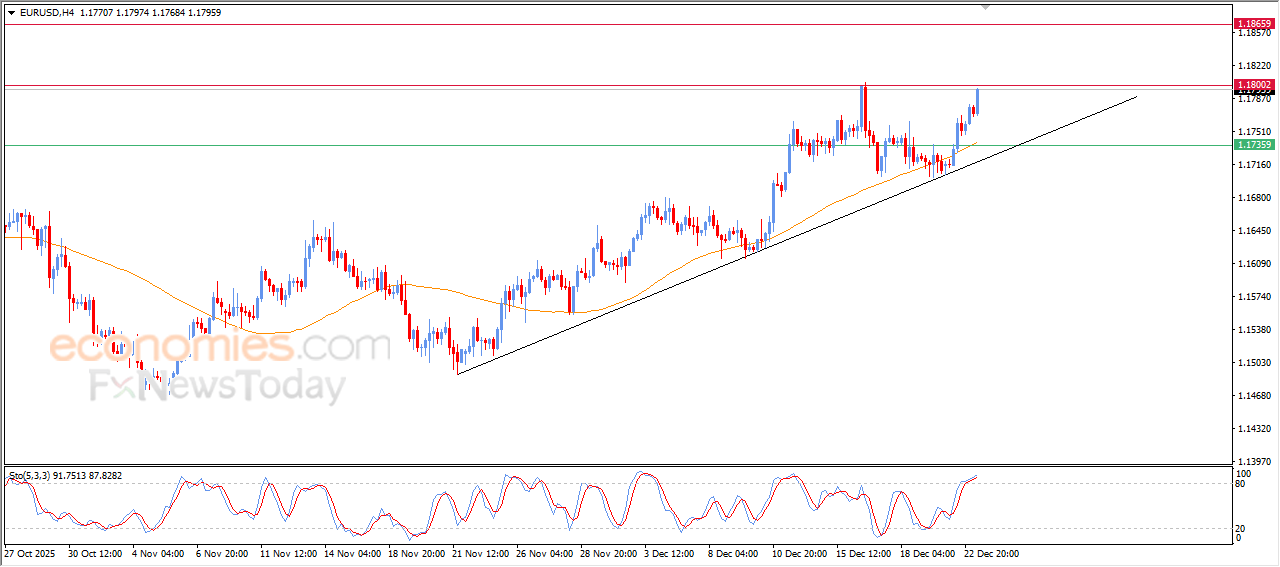
The EURJPY pair reached the main target at 184.90, forming a strong barrier to begin forming bearish corrective waves, to settle near 183.75, announcing the beginning of gathering some gains in the current period trading.
Stochastic is approaching 20 level, to increase the negative pressure, which makes us prefer more corrective trading that might target 183.30 level, reaching key support at 182.80, while stepping above 184.10 again and providing positive close will reinforce the chances of forming new bullish waves, to repeat the pressure on the mentioned barrier.
The expected trading range for today is between 183.30 and 184.10
Trend forecast: Bearish
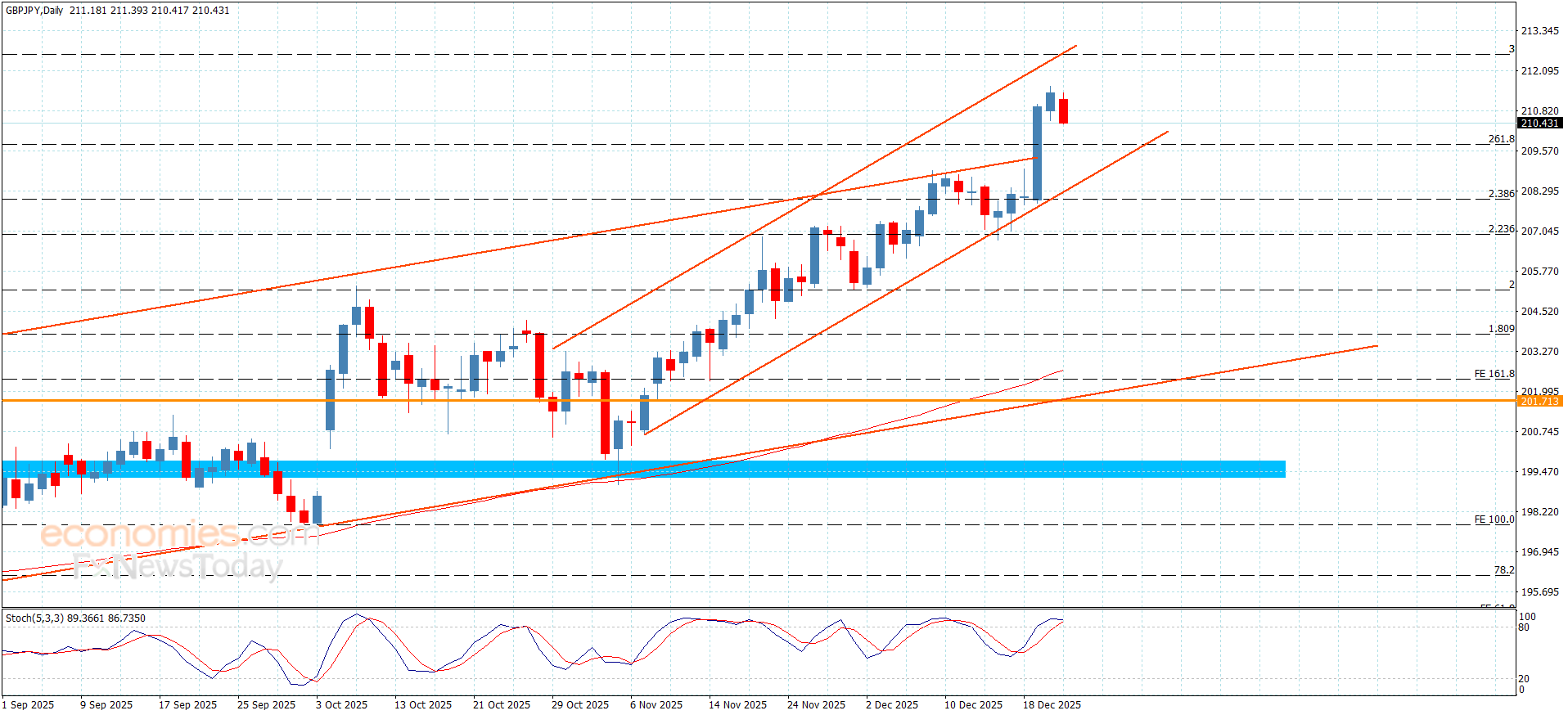
The GBPJPY pair ended its last bullish rally by hitting 211.60 level, to achieve the extra suggested target in the previous report, then begin gathering some gains by forming corrective decline and its stability near 210.50.
By the above image, we notice the stability of the price within the main bullish channel’s levels by forming extra support at 209.75 level, which might help to end the temporary negative pressures, to wait for gathering extra bullish momentum to renew the bullish attempts and reaching new bullish stations in the near period by its rally towards 211.95 reaching 212.55 resistance.
The expected trading range for today is between 209.75 and 211.60
Trend forecast: Fluctuated
Copper price provided sideways trading, keeping its stability within the bullish track by its fluctuation near$5.5000 level, due to stochastic attempt to exit the overbought level, which makes us prefer more sideways trading until it gathers the required extra positive momentum for breaching the current barrier, to reach extra stations at $5.6300 and $5.7400.
While the failure of the breach might push the price to form some corrective waves, which forces it to suffer temporary losses by targeting the initial support at $5.1300.
The expected trading range for today is between $5.3100 and $5.6300
Trend forecast: Sideways until achieving the breach
Silver price (XAG/USD) hit a fresh record high of $70.00 during the Asian hours on Tuesday, trading around $69.70 per troy ounce at the time of writing. Precious metals, including Silver receive support from safe-haven demand amid rising United States (US)–Venezuela tensions.
US President Donald Trump said on Monday that the US would keep and maybe sell the Oil it had seized off the coast of Venezuela in recent weeks. Trump added that the US would also keep the seized ships. Moreover, Ukraine continues strikes on Russian energy infrastructure, with the latest attack damaging two vessels and two piers and igniting a fire in a Black Sea coastal village.
The non-interest-bearing Silver attracts investors amid growing expectations that the Federal Reserve will continue easing policy, reinforced by President Donald Trump’s calls for lower borrowing costs.
Federal Reserve (Fed) Member of the Board of Governors Stephen Miran said in an interview on Bloomberg TV on Monday that the last few months have seen data consistent with his view of the world and that he doesn’t see a recession in the near term. Miran said that failing to ease policy would raise recession risks, adding that the need to dissent for a 50 basis points diminishes over time as rates are reduced.
Traders await the US Gross Domestic Product (GDP) Annualized for the third quarter due on Tuesday. The US economy is estimated to have expanded at an annual rate of 3.2% in Q3. It would be a slowdown from the 3.8% growth in Q2.
Silver is a precious metal highly traded among investors. It has been historically used as a store of value and a medium of exchange. Although less popular than Gold, traders may turn to Silver to diversify their investment portfolio, for its intrinsic value or as a potential hedge during high-inflation periods. Investors can buy physical Silver, in coins or in bars, or trade it through vehicles such as Exchange Traded Funds, which track its price on international markets.
Silver prices can move due to a wide range of factors. Geopolitical instability or fears of a deep recession can make Silver price escalate due to its safe-haven status, although to a lesser extent than Gold’s. As a yieldless asset, Silver tends to rise with lower interest rates. Its moves also depend on how the US Dollar (USD) behaves as the asset is priced in dollars (XAG/USD). A strong Dollar tends to keep the price of Silver at bay, whereas a weaker Dollar is likely to propel prices up. Other factors such as investment demand, mining supply – Silver is much more abundant than Gold – and recycling rates can also affect prices.
Silver is widely used in industry, particularly in sectors such as electronics or solar energy, as it has one of the highest electric conductivity of all metals – more than Copper and Gold. A surge in demand can increase prices, while a decline tends to lower them. Dynamics in the US, Chinese and Indian economies can also contribute to price swings: for the US and particularly China, their big industrial sectors use Silver in various processes; in India, consumers’ demand for the precious metal for jewellery also plays a key role in setting prices.
Silver prices tend to follow Gold’s moves. When Gold prices rise, Silver typically follows suit, as their status as safe-haven assets is similar. The Gold/Silver ratio, which shows the number of ounces of Silver needed to equal the value of one ounce of Gold, may help to determine the relative valuation between both metals. Some investors may consider a high ratio as an indicator that Silver is undervalued, or Gold is overvalued. On the contrary, a low ratio might suggest that Gold is undervalued relative to Silver.
Gold (XAU/USD) is seen building on the previous day’s strong rally of over 2% and continues scaling new all-time highs for the second consecutive day on Tuesday. The commodity climbs closer to the $4,500 psychological mark during the Asian session and remains well supported by a combination of factors. Comments from US Treasury Secretary Scott Bessent add to the uncertainty around the Federal Reserve’s (Fed) long-term policy credibility. This, along with dovish Fed expectations, exerts some follow-through pressure on the US Dollar (USD) and underpins the bullion. Adding to this, persistent geopolitical uncertainties benefit the precious metal’s safe-haven status and contribute to the strong move up.
Speaking on a podcast, Bessent opened the door to a rethink of the Fed’s inflation framework and said that he favours the idea of an inflation range rather than a fixed-point target. Bessent further suggested the new Fed chair could consider scrapping the dot plot — a move that would mark a significant shift in how the central bank communicates its policy outlook. This comes on top of expectations that the new Fed chair will slash interest rates regardless of the economic fundamentals. In fact, traders are still pricing in a greater chance of two more rate cuts by the US central bank, which drags the USD lower for the second straight day and further drives flows towards the non-yielding yellow metal.
US President Donald Trump had ordered a blockade of sanctioned oil tankers entering or leaving Venezuela to tighten the economic screws on President Nicolás Maduro. The US seized a large tanker on December 10 and intercepted a second vessel over the weekend, and was also pursuing a third tanker. This raises the risk of a further escalation of tensions in the region. Apart from this, US Vice President JD Vance said that he doesn’t have confidence that there will be a peaceful solution to a nearly four-year-old Russia-Ukraine war. Moreover, the possibility of another Israeli strike against Iran keeps geopolitical risks in play and turns out to be another factor that contributes to the XAU/USD pair’s strong positive momentum.
Meanwhile, the aforementioned supportive fundamental backdrop, to a larger extent, offsets a generally positive tone around the equity markets, suggesting that the path of least resistance for Gold remains to the upside. Traders now look to the US economic docket – featuring the delayed release of the Q3 GDP report and Durable Goods Orders later during the North American session. Apart from this, comments from influential FOMC members could drive the USD demand and produce short-term trading opportunities around the XAU/USD pair amid the year-end thin liquidity. However, extremely overbought conditions on short-term charts warrant caution for bulls before positioning for further appreciation.
The overnight breakout through the $4,375-4,380 hurdle (the previous all-time peak) and a subsequent move beyond the $4,400 mark was seen as a fresh trigger for the XAU/USD bulls. The 50-day Simple Moving Average (SMA) climbs steadily, further underscoring a firm uptrend. Price holds above the SMA, currently pegged around the $4,160 area, which should act as dynamic support. The Moving Average Convergence Divergence (MACD) line extends above the Signal line and sits in positive territory, suggesting strengthening bullish momentum. However, the Relative Strength Index (RSI) stands at 81 (overbought), which could cap gains and prompt a near-term pause.
Momentum remains strong as the uptrend is supported by the rising SMA, while the positive MACD tone reinforces buyers’ control. With the RSI stretched, a consolidation or shallow pullback could unfold, and a slide toward the rising average would not disrupt the broader bullish bias. A sustained close above support would keep the upside path intact, while any cooling of momentum would likely translate into range trading rather than a trend reversal.
(The technical analysis of this story was written with the help of an AI tool)