The main tag of Gold Today Price Articles.
You can use the search box below to find what you need.
[wd_asp id=1]
The main tag of Gold Today Price Articles.
You can use the search box below to find what you need.
[wd_asp id=1]
Gold price (XAU/USD) trades in positive territory near $4,185 during the early Asian session on Friday. The precious metal drifts higher as traders anticipate that the reopening of the US government will restore the flow of economic data and reinforce bets of further US interest rate cuts.
A record shutdown in US history ended on Thursday after Trump signed a funding bill to reopen the government. The House of Representatives approved the bill earlier Thursday in a 222-209 vote, with nearly every Republican and a handful of Democrats voting for it. The expectation that US economic data released after the end of the shutdown will reveal US labor market weakness could weigh on the US Dollar (USD) and lift the USD-denominated commodity price in the near term.
On Thursday, White House economic adviser Kevin Hassett said that the government would publish the October employment data, but without the Unemployment Rate due to the lack of a household survey that month.
On the other hand, the cautious tone from the Fed officials could undermine the yellow metal. Boston Fed President Susan Collins used cautious language to express her opinion on policy, saying that it will likely be appropriate to keep policy rates at the current level for some time to balance the inflation and employment risks in this highly uncertain environment.
Meanwhile, Atlanta Fed President Raphael Bostic on Wednesday and Cleveland Fed President Beth Hammack on Thursday have also expressed a preference for holding rates steady.
Markets are now pricing in a more than 51% chance that the Fed will cut its benchmark overnight borrowing rate by a quarter percentage point at its December meeting, down from 62.9% odds that markets priced in a day ago, according to the CME FedWatch Tool.
Gold has played a key role in human’s history as it has been widely used as a store of value and medium of exchange. Currently, apart from its shine and usage for jewelry, the precious metal is widely seen as a safe-haven asset, meaning that it is considered a good investment during turbulent times. Gold is also widely seen as a hedge against inflation and against depreciating currencies as it doesn’t rely on any specific issuer or government.
Central banks are the biggest Gold holders. In their aim to support their currencies in turbulent times, central banks tend to diversify their reserves and buy Gold to improve the perceived strength of the economy and the currency. High Gold reserves can be a source of trust for a country’s solvency. Central banks added 1,136 tonnes of Gold worth around $70 billion to their reserves in 2022, according to data from the World Gold Council. This is the highest yearly purchase since records began. Central banks from emerging economies such as China, India and Turkey are quickly increasing their Gold reserves.
Gold has an inverse correlation with the US Dollar and US Treasuries, which are both major reserve and safe-haven assets. When the Dollar depreciates, Gold tends to rise, enabling investors and central banks to diversify their assets in turbulent times. Gold is also inversely correlated with risk assets. A rally in the stock market tends to weaken Gold price, while sell-offs in riskier markets tend to favor the precious metal.
The price can move due to a wide range of factors. Geopolitical instability or fears of a deep recession can quickly make Gold price escalate due to its safe-haven status. As a yield-less asset, Gold tends to rise with lower interest rates, while higher cost of money usually weighs down on the yellow metal. Still, most moves depend on how the US Dollar (USD) behaves as the asset is priced in dollars (XAU/USD). A strong Dollar tends to keep the price of Gold controlled, whereas a weaker Dollar is likely to push Gold prices up.
Recent action has traced out a small rising parallel channel with wedge-like characteristics—potentially bearish on downside resolution. No trigger has appeared yet, but today’s peak precisely hit multiple resistance layers: the small channel top line, 175% extension of the broader rising trend channel, and 88.6% Fibonacci retracement.
This precise alignment elevates the odds of a bearish correction. Still, recognition of the 175% channel line allows for possible additional grinding higher while hugging that dynamic resistance.
Continuation beyond current levels targets the 200% projection of the rising ABCD pattern, doubling the length of the initial AB leg for the CD advance.
The 10-day average at $4.37—rising sharply—serves as the most reliable dynamic support. The small channel’s lower line and 150% extension of the larger channel provide secondary context, but the 10-day level will dictate the correction’s demand profile.
Natural gas nears completion of its fourth straight week of higher highs and higher lows, underscoring the bull trend’s persistence despite short-term extension.
Short-term overextension signals a correction of some magnitude is likely overdue, even if price sustains briefly higher. The downside risk grows, though recent bullish behavior suggests any pullback will reload for resumption.
The natural gas market has gone back and forth during the course of the trading session here on Thursday, as we are hovering around the $4.50 level. Ultimately, this is a market that I think, given enough time, will have to have some type of pullback after this shot higher, but it’s worth noting that we are trading the December contract, and that, of course, has a major influence on how the price behaves. After all, the heating demand in the Northeastern part of the United States, as well as Northern Europe, will be picking up during December, so it does make sense that we have a little bit of elevated pricing at the moment.
The question at this point is going to be whether or not we can continue to see this type of momentum or if we get some type of pullback. I suspect that a pullback at this point in time ends up being a buying opportunity, especially if we can get down to somewhere close to the $4 level. I do not like the idea of trying to chase the market all the way up here. Ultimately, this is a scenario where you’re looking for value. You just don’t have it after this type of run, but clearly this is a one-way trade. You should not be trying to short this market, trying to pick a top. I can’t think of a worse trade out there at the moment.
Goldman Sachs Group, Inc (GS) surged higher in its latest intraday trading, successfully breaking above the key resistance level of $816.12. The stock continues to receive positive support from trading above its 50-day simple moving average, within a short-term uptrend and along an ascending support line. In addition, positive signals are appearing on the relative strength indicators, despite remaining in overbought territory.
Therefore, we expect the stock price to rise in its upcoming trading sessions, particularly as long as it remains above $816.12, targeting the first resistance level at $880.75.
Today’s price forecast: Bullish.
Gold price peaked on Thursday at $4,245 a troy ounce, a fresh three-week high, but it trimmed part of its intraday gains and currently hovers around $4,200. The XAU/USD pair surged throughout the first half of the day, amid the US Dollar (USD) edging sharply lower on the back of headlines indicating that the United States (US) government had resumed its activities after passing a funding bill that will cover the period until January 30.
Optimism eased during European trading hours, pushing XAU/USD below the $4,200 mark. However, the soft tone of Wall Street, hinting at fresh market concerns, helped the bright metal recover some ground.
US indexes turned south with the Dow Jones Industrial Average retreating from fresh record highs, down roughly 400 points at the time of writing. The heavy tech-weighted Nasdaq Composite is the worst performer, down 1.76% amid weakness among tech shares, amid worries about those being overvalued.
Other than that, market participants are concerned about the upcoming flood of US economic data after a forty-three-day silence, and the potential impact of such figures on the December Federal Reserve (Fed) monetary policy decision. Odds for a December interest rate cut fell after Chair Jerome Powell noted that the movement should not be taken for granted, following the October meeting. According to the CME FedWatch Tool, the odds for a December cut stand at 53.6%, while those for a no-change outcome account for 46.4%.
The XAU/USD pair trades at $4,207.20, and the 4-hour chart shows fading upward strength, although a well-limited downward scope. The 20-period Simple Moving Average (SMA) stands at $4,164, providing dynamic support as it rises above the 100- and 200-period SMAs, with all three indicators sloping higher, in line with the dominant bullish trend. At the same time, the Momentum indicator fades above its 100 line, while the Relative Strength Index (RSI) indicator eases from overbought readings, but still stands at 66, in line with buyers’ dominance. Trend-following bias would remain intact while the metal respects the rising 20-period SMA, with pullbacks expected to be shallow if buyers defend that zone.
In the daily chart, XAU/USD is developing above all its moving averages, with a flat 20-day SMA holding above the bullish 100- and 200-day SMAs. The mentioned 20-day SMA provides support at $4,076. At the same time, the Momentum indicator holds above its midline, but aims marginally higher, while the RSI indicator flattens around 64. Buyers should retain control as long as the 20-day SMA holds, with scope to extend its advance towards the $4,300 threshold once the price surpasses the intraday high at $4,245.
(The technical analysis of this story was written with the help of an AI tool)
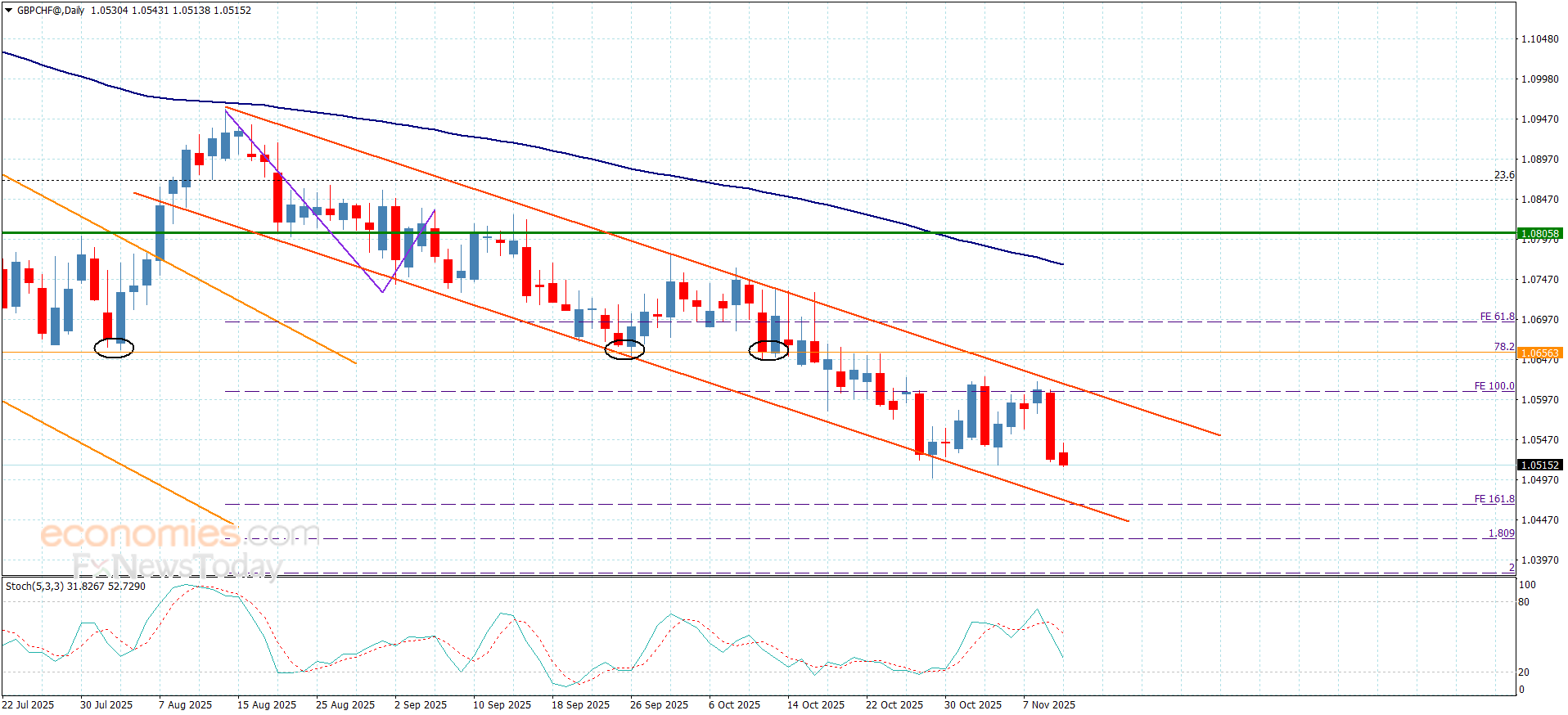
The GBPCHF ended the bullish corrective rebound by providing new close below the minor bearish channel’s resistance at 1.0620, forming sharp decline and its stability near 1.0515, confirming the stability of the previously suggested bearish scenario.
Note that the beginning of providing extra negative momentum by stochastic reaching below 50 level will increase the chances of resuming the negative attack, to keep waiting for targeting 1.0475 level reaching 161.8%Fibonacci extension level at 1.0455, to face the support of the bearish channel as appears in the above image.
The expected trading range for today is between 1.0560 and 1.0475
Trend forecast: Bearish
The (Brent) price settled with sharp losses in its last intraday trading, affected by the negative pressure due to its trading below EMA50, and the dominance of the main bullish trend on the short-term basis, to break the key support at $62.75, intensifying the negative pressure on the price, on the other hand, we notice the emergence of positive overlapping signals on the relative strength indicators, after reaching oversold levels, which might reduce its upcoming losses.
Get high-accuracy trading signals delivered directly to your Telegram. Subscribe to specialized packages tailored for the world’s top markets:
Full VIP signals performance report for 20-31, October 2025:
Gold is trading close to three-week highs early Thursday, challenging offers near the $4,200 level.
Despite the retreat, Gold remains the most sought after investment asset so far this week.
Concerns prevail over the health of the United States (US) economy in the face of uncertainty over data publication, even as the government is set to reopen after the House of Representatives voted 222-209 to end the record shutdown.
This comes after White House Press Secretary Karoline Leavitt said Wednesday, the federal jobs and inflation reports for October may never get calculated and released due to the shutdown.
Meanwhile, several economists believe that the missed September data will be published as early as next week, while urging the US Labor Department to prioritize November employment, CPI data post-shutdown, per Reuters.
The lack of clarity on the resumption of the statistics prompts markets to trade cautiously, lending some support to safe-haven US Dollar (USD), in turn, capping the Gold price upside.
However, any pullback in Gold will likely be short-lived as markets continue to predict an 25 basis points (bps) interest rate cut by the US Federal Reserve (Fed) next month, according to 80% of economists polled by Reuters.
Looking ahead, Gold traders will continue to closely scrutinize speeches from Fed officials as the central bank appears divided on the next rate move amid weakening labor market conditions and the inflation dilemma.
As observed on the daily chart, the 14-day Relative Strength Index (RSI) is hold firm near 64, as of writing.
The leading indicator, thus, suggests that upside risks remain intact for Gold.
Buyers need a daily candlestick closing above the $4,200 mark to accelerate further toward the $4,250 psychological level.
Acceptance above the latter will open the door for a retest of the record high at $4,382.
Alternatively, any pullback will likely find support at the previous resistance of $4,129, the 23.6% Fibonacci Retracement level of the parabolic rise to the record high that began on August 19.
The next downside target is seen at the 21-day Simple Moving Average (SMA) of $4,087, below which the $4,050 psychological level will be challenged.
The 10-day average has climbed sharply to $4.31, now above the lows of the past seven sessions. This elevated dynamic line suggests any near-term pullback may stay shallow and recover quickly, while a decisive break below it would signal meaningful short-term weakening.
A drop beneath the seven-day low of $4.18 would further confirm bearish pressure. Should the 10-day fail, the 38.2% Fibonacci retracement at $3.94 aligns with the original top channel line as the next major support zone. The rising 20-day average, soon to surpass that channel line and approach the $3.94 area, may add confluence.
Strength persists despite multiple overhead hurdles, including the 78.6% Fibonacci retracement at $4.41, the cleared 150% channel extension, and now the emerging test of the 175% channel line. Natural gas continues to absorb supply while pushing higher.
This marks the fourth straight week of higher weekly highs and lows. Over the past eight sessions, bullish momentum has moderated into a small rising consolidation channel—defined by a newly drawn lower boundary line tracking recent price action. Sustained trade above the 10-day average can extend this pattern.
To maintain upside potential and realistically challenge the 2025 $4.90 peak, bullish momentum must accelerate. Failure to do so heightens pullback risk within the current tight structure.
Natural gas remains in a bullish posture as long as the 10-day average at $4.31 and rising consolidation channel hold. A close above $4.58 would target the 175% channel extension and keep $4.90 viable. Any decisive drop below $4.31–$4.18 opens the path to $3.94 support; the 20-day average will provide the next critical decision point on deeper correction.
Spot Gold flirts with the $4,200 level in the American session on Wednesday, as demand for the US Dollar (USD) continues to lose steam. The Greenback managed to post some modest intraday gains against the bright metal at the beginning of the day, but quickly changed course despite a generalized better market mood.
On the one hand, financial markets anticipate that the United States (US) will end the funding stalemate as soon as this week, as the House of Representatives is due to vote on the Senate funding bill before the day is over. After that, it would only be pending US President Donald Trump’s signature to become a law.
On the other hand, Asian and European indexes traded with a better tone amid a bounce in the tech sector, although US ones remain mixed, with only the Dow Jones Industrial Average posting record highs at the time of writing.
It is worth noting that the US government reopening will bring back official data, critical ahead of the Federal Reserve (Fed) December monetary policy decision. In previous shutdowns, data releases began five working days after the federal reopening, which means the upcoming week could be quite busy.
XAU/USD trades at $4,204.20, and the 4-hour chart shows it’s up for the day. The 20-period Simple Moving Average (SMA) climbs above the 100- and 200-period SMAs, while price holds above all three, keeping the near-term tone positive. The 100-period SMA flattens after a prior slide, and the 200-period SMA rises, reinforcing bullish pressure. At the same time, the Momentum indicator resumed its advance above its 100 line, while the Relative Strength Index (RSI) indicator stands at 72 , partially losing its bullish strength.
Bulls remain in control as the short-term trend rises and dips stay supported by the moving averages. A pullback would find deeper support at the 200-period SMA near $4,042.81 and the 100-period SMA at $4,035.33. A break under the $4,042.81–$4,035.33 area would deny the bullish potential.
In the daily chart, the 20-day SMA stands above the 100- and 200-day measures, with the longer SMAs rising while the 20-day flattens. XAU/USD holds above all of them, which keeps the risk skewed to the upside. Technical indicators, in the meantime, hint at mounting upward pressure, as the Momentum and the RSI advance within positive levels.
(The technical analysis of this story was written with the help of an AI tool)