The main tag of Gold Today Price Articles.
You can use the search box below to find what you need.
[wd_asp id=1]
The main tag of Gold Today Price Articles.
You can use the search box below to find what you need.
[wd_asp id=1]
October’s double top stalled at a rising channel level, extended by 25% to capture that advance. Today’s push above $3.55 shows minor bullish strength, but a close above $3.46 and $3.45 is needed to confirm the breakout. Without it, the second-day surge fades. Clearing the $3.59 swing high (B) would spark a bullish reversal, building on the rally from the $2.89 swing low (C).
A $3.59 breakout targets the 25% extended channel top, with a rising ABCD pattern pointing to $3.71 as the initial harmonic goal. The $3.57 high completed a 61.8% Fibonacci retracement, so surpassing $3.59 would eye the 78.6% level at $3.82 for further upside. Recent channel tests suggest another approach is plausible before the rally exhausts.
The 20-day moving average at $3.25 anchors key dynamic support. Staying above it preserves the near-term bullish bias, even if today’s close weakens. A drop below signals caution, but the structure favors buyers if this floor holds.
The $3.46-$3.45 zone is pivotal – close above to lock in strength and aim for $3.59, or below to test $3.25. Today’s close decides: $3.59 opens $3.71 and $3.82, but a failed breakout keeps sellers active. Momentum tilts upward if support stands—watch the triggers for the next swing.
For a look at all of today’s economic events, check out our economic calendar.
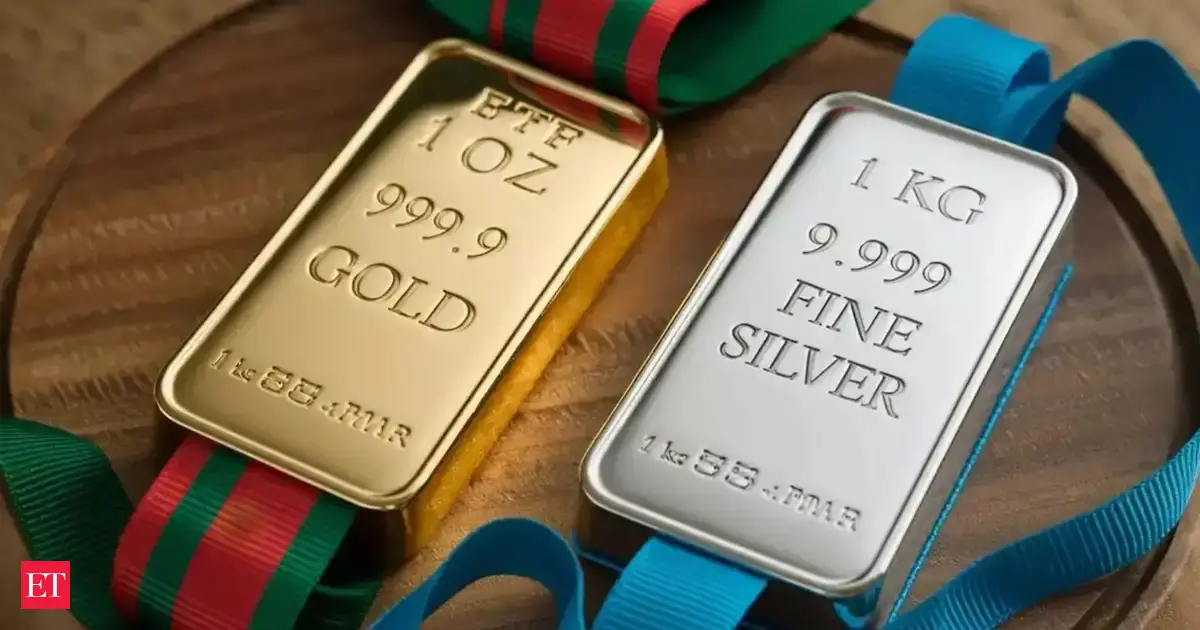
Gold, silver, platinum, and palladium prices fell on Wednesday after a steep decline in the previous session. Spot gold was down 1.4% at $4,067.31 per ounce as of 0941 GMT. Earlier, it had risen to $4,161.17. U.S. gold futures for December delivery fell 0.7% to $4,081.30 per ounce.
The U.S. dollar index hovered near a one-week high. A stronger dollar makes bullion more expensive for international buyers. Gold prices dropped 5.3% on Tuesday after a record high of $4,381.21. Prices are up 54% this year due to geopolitical and economic uncertainty, expectations of U.S. rate cuts, and strong ETF inflows.
Ricardo Evangelista, analyst at ActivTrades, said traders booked profits after recent gains pushed gold into overbought territory. On the technical side, gold is supported by the 21-day moving average at $4,005. Investors are waiting for the U.S. Consumer Price Index (CPI) report on Friday. Gold benefits from low interest rates because it is a non-yielding asset.
A Reuters poll of economists suggests the Federal Reserve may cut its key interest rate by 25 basis points next week and again in December.
Meanwhile, a planned summit between U.S. President Donald Trump and Russian President Vladimir Putin was postponed. Uncertainty remains over a possible meeting between Trump and Chinese President Xi Jinping. StoneX analyst Rhona O’Connell said any dips could trigger fresh buying interest due to ongoing global uncertainties.
Spot silver fell 0.9% to $48.28 per ounce after a 7.1% drop on Tuesday. In the U.S. market, silver slumped 8% on October 21, the sharpest one-day fall since 2021. Prices are down nearly 12% from their lifetime high of $54.47 per ounce. Analysts attribute the decline to a stronger U.S. dollar, delayed rate cut expectations, and lower industrial demand.
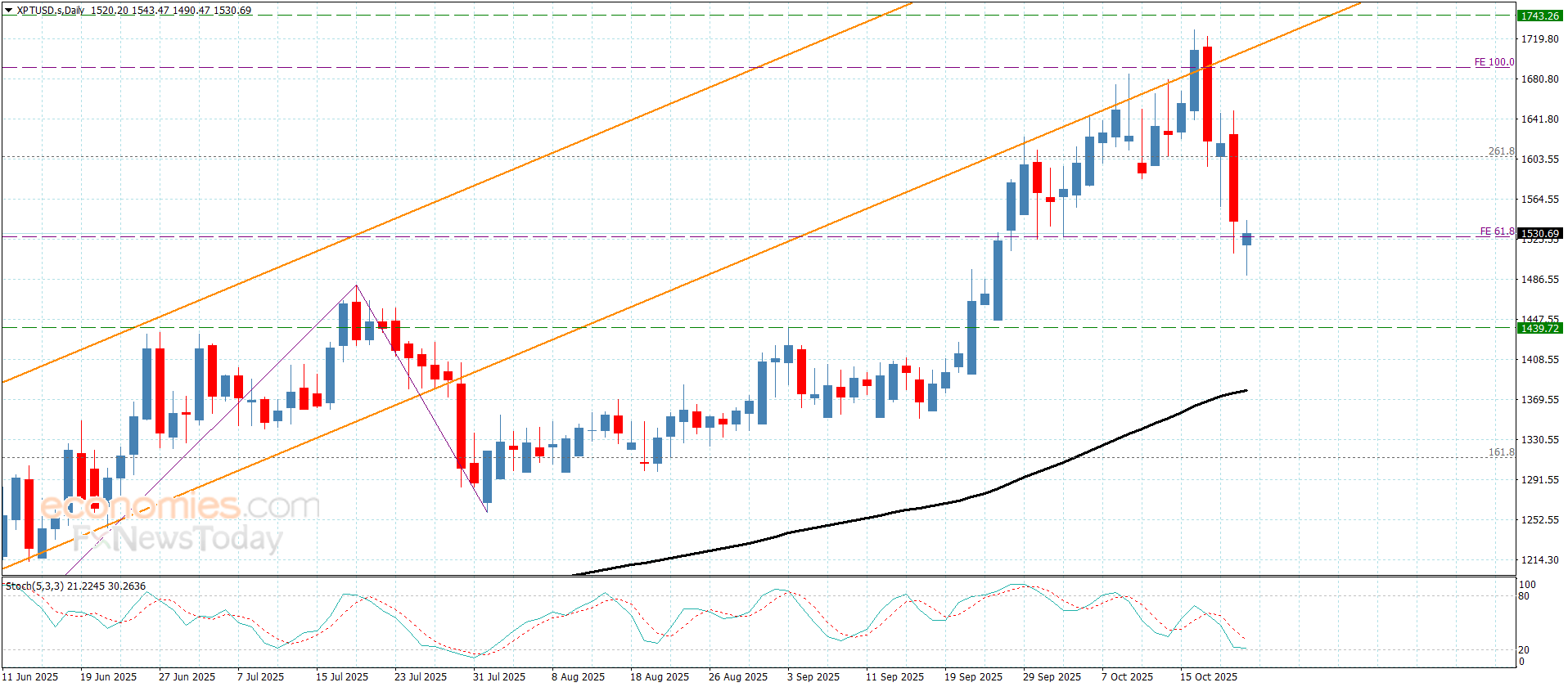
Platinum fell 0.1% to $1,549.53 per ounce. Palladium dropped 1% to $1,394.52 per ounce. Analysts suggest both metals may see fluctuations as markets respond to global economic and geopolitical factors.
Gold futures dropped 0.5% to $4,087.70 per ounce, while spot gold retreated 4% to $4,088.45. ING analysts said profit-taking was the main reason after recent overbought conditions. Easing tensions between the U.S. and China also contributed to the sharp fall, but traders remain cautious ahead of delayed U.S. inflation data and upcoming trade talks involving the U.S., China, and India.
Gold remains up 56% year-to-date. Citigroup downgraded its outlook from “overweight” to a cautious stance due to excessive long positions. Analysts said gold may consolidate around $4,000 per ounce in coming weeks. Long-term fundamentals remain strong because of inflation concerns, central bank buying, and geopolitical tensions.
Oil prices rose on Wednesday due to supply concerns and optimism around U.S.–China trade talks. Brent crude futures gained 1.5% to $62.21 per barrel, and West Texas Intermediate rose 1.6% to $58.12.
Sterling fell 0.3% to $1.3331 after flat inflation data. The U.S. dollar index remained steady at 98.95. FTSE 100 was up 0.6% at 9,486 points.
Why did gold, silver, platinum, and palladium prices fall today?
Prices fell due to profit booking by investors, a stronger U.S. dollar, and easing geopolitical tensions, which reduced immediate buying demand in global markets.
What is the outlook for gold and silver in the near future?
Analysts expect volatility but long-term support from inflation concerns, central bank buying, and geopolitical risks, keeping demand for gold and silver stable.

Brent crude futures rose 1.5% to $62.21 per barrel. West Texas Intermediate (WTI) futures gained 1.6% to $58.12 per barrel. These gains followed a recovery from a five-month low on Monday. Oversupply concerns and weak demand had pressured prices earlier in the week.
Geopolitical tensions contributed to supply-side risks. Reports indicate the planned summit between US President Donald Trump and Russian President Vladimir Putin has been postponed. Traders also responded to Western pressure on Asian buyers to reduce Russian crude purchases. This increased concerns about possible disruptions.
Mukesh Sahdev, CEO of XAnalysts, said, “Despite bearish sentiment from oversupply and weak demand, supply disruption risks in Russia, Venezuela, Colombia, and the Middle East prevent oil prices from staying below $60.”
Venezuela remains a focus of geopolitical tension. UN experts condemned recent US military actions in international waters as “extrajudicial executions” and a dangerous escalation.
US and Chinese officials are scheduled to meet in Malaysia this week to discuss economic disputes. Trump expressed optimism on Monday about a fair trade deal with Chinese President Xi Jinping during a planned meeting in South Korea next week. ING commodities strategists noted, “Trump’s trade negotiation comments and the cancellation of the Trump–Putin summit are likely supporting the market.”
Oil markets also reacted to US inventory data. Figures from the American Petroleum Institute showed a decline in crude, gasoline, and distillate stocks last week. This added support to prices.
Sterling fell 0.3% to $1.3331 after inflation data remained flat for the third consecutive month. The pound reached a two-week low against the dollar, down from $1.34 on Tuesday. Traders expect the Bank of England may cut interest rates later this year.
The US dollar index remained steady at 98.95. The pound also edged lower against the euro, trading at €1.1485.
In equities, the FTSE 100 rose 0.6% on Wednesday morning to 9,486 points, showing a positive start alongside oil gains.
Q1: Why did oil price today increase?
A1: Oil price today rose due to supply concerns, geopolitical tensions, US–China trade optimism, and plans to refill US strategic petroleum reserves.
Q2: What are the Brent and WTI crude prices today?
A2: Brent crude reached $62.21 per barrel, and WTI crude hit $58.12 per barrel as of Wednesday morning.
Brent crude futures rose 1.5% to $62.21 per barrel. West Texas Intermediate (WTI) futures gained 1.6% to $58.12 per barrel. These gains followed a recovery from a five-month low on Monday. Oversupply concerns and weak demand had pressured prices earlier in the week.
Geopolitical tensions contributed to supply-side risks. Reports indicate the planned summit between US President Donald Trump and Russian President Vladimir Putin has been postponed. Traders also responded to Western pressure on Asian buyers to reduce Russian crude purchases. This increased concerns about possible disruptions.
Mukesh Sahdev, CEO of XAnalysts, said, “Despite bearish sentiment from oversupply and weak demand, supply disruption risks in Russia, Venezuela, Colombia, and the Middle East prevent oil prices from staying below $60.”
Venezuela remains a focus of geopolitical tension. UN experts condemned recent US military actions in international waters as “extrajudicial executions” and a dangerous escalation.
US and Chinese officials are scheduled to meet in Malaysia this week to discuss economic disputes. Trump expressed optimism on Monday about a fair trade deal with Chinese President Xi Jinping during a planned meeting in South Korea next week. ING commodities strategists noted, “Trump’s trade negotiation comments and the cancellation of the Trump–Putin summit are likely supporting the market.”
Oil markets also reacted to US inventory data. Figures from the American Petroleum Institute showed a decline in crude, gasoline, and distillate stocks last week. This added support to prices.
Sterling fell 0.3% to $1.3331 after inflation data remained flat for the third consecutive month. The pound reached a two-week low against the dollar, down from $1.34 on Tuesday. Traders expect the Bank of England may cut interest rates later this year.
The US dollar index remained steady at 98.95. The pound also edged lower against the euro, trading at €1.1485.
In equities, the FTSE 100 rose 0.6% on Wednesday morning to 9,486 points, showing a positive start alongside oil gains.
Q1: Why did oil price today increase?
A1: Oil price today rose due to supply concerns, geopolitical tensions, US–China trade optimism, and plans to refill US strategic petroleum reserves.
Q2: What are the Brent and WTI crude prices today?
A2: Brent crude reached $62.21 per barrel, and WTI crude hit $58.12 per barrel as of Wednesday morning.
Gold bounced up after reaching the target of a Double Top pattern, at $4,005 on Tuesday, but upside attempts have been halted way below previous support, at $4,185, which leaves the immediate bearish trend intact and the $4,000 support area at a short distance.
The announcement that US President Trump will meet its Chinese counterpart Xi Jinping in South Korea next week and the more conciliatory tone of Trump’s latest comments towards the Asian country have boosted hopes of a trade deal, which has improved market sentiment, sending precious metals tumbling.
What goes up has to eventually come down, and Gold is no exception. The precious metal had rallied nearly 35% in the last two months and is now performing a well-awaited correction. The double top at $4,380 and Tuesday’s bearish engulfing candle in the daily chart confirm that view.
The rejection at the $4,160 on Wednesday’s early European session highlights the bearish momentum. The 4-hour RSI is low but not yet at oversold levels, and the USDollar Index is picking up, which adds pressure on the yellow metal and suggests that a retest of the $4,000 support is on the cards.
Further down, the $3945 area, where the pair found support on October 7, 9, and 10, emerges as the next target ahead of the October 2 low, at $3,845. To the upside, the intraday high at the $4,160 area and the October 17 low at $4,185 are closing the path towards the all-time high at $4,380.
Gold has played a key role in human’s history as it has been widely used as a store of value and medium of exchange. Currently, apart from its shine and usage for jewelry, the precious metal is widely seen as a safe-haven asset, meaning that it is considered a good investment during turbulent times. Gold is also widely seen as a hedge against inflation and against depreciating currencies as it doesn’t rely on any specific issuer or government.
Central banks are the biggest Gold holders. In their aim to support their currencies in turbulent times, central banks tend to diversify their reserves and buy Gold to improve the perceived strength of the economy and the currency. High Gold reserves can be a source of trust for a country’s solvency. Central banks added 1,136 tonnes of Gold worth around $70 billion to their reserves in 2022, according to data from the World Gold Council. This is the highest yearly purchase since records began. Central banks from emerging economies such as China, India and Turkey are quickly increasing their Gold reserves.
Gold has an inverse correlation with the US Dollar and US Treasuries, which are both major reserve and safe-haven assets. When the Dollar depreciates, Gold tends to rise, enabling investors and central banks to diversify their assets in turbulent times. Gold is also inversely correlated with risk assets. A rally in the stock market tends to weaken Gold price, while sell-offs in riskier markets tend to favor the precious metal.
The price can move due to a wide range of factors. Geopolitical instability or fears of a deep recession can quickly make Gold price escalate due to its safe-haven status. As a yield-less asset, Gold tends to rise with lower interest rates, while higher cost of money usually weighs down on the yellow metal. Still, most moves depend on how the US Dollar (USD) behaves as the asset is priced in dollars (XAU/USD). A strong Dollar tends to keep the price of Gold controlled, whereas a weaker Dollar is likely to push Gold prices up.
The GBPJPY pair confirmed the stability of the bullish scenario by forming a new bullish rally yesterday, achieving the initial target by hitting 203.50 level, to settle above $161.8 Fibonacci extension level at 202.50.
The continuation of providing positive momentum by the main indicators will increase the strength of the bullish track, to expect attacking the barrier at 203.95, and surpassing it will open the way for reaching new stations that might begin from 204.60 and 205.25, while changing the trend and begin the bearish corrective track requires forming sharp decline to settle below the extra support at 201.70.
The expected trading range for today is between 202.60 and 203.95
Trend forecast: Bullish
No news for copper price, to keep providing sideways trading, due to the continuation of the contradiction between the main indicators and the stability below $5.0600 barrier, to increase the chances of forming corrective trading in the near-term period.
Stochastic attempt to provide negative momentum by its exit from the overbought level that might force the price to attack the extra support at $4.7500, while achieving this breach will open the way for achieving extra gains that might begin at $5.2000.
The expected trading range for today is between $4.7500 and $5.0600
Trend forecast: Fluctuated within the bullish track
Silver price ( XAG/USD) extends the decline to around $48.10 during the early Asian session on Wednesday. The white metal remains under pressure after facing its steepest sell-off in years in the previous session as traders locked in profits.
Silver tumbled more than 8% to mark its largest daily drop since 2021, amid concerns that the recent record high in the white metal left it overvalued. Additionally, easing trade tensions between the United States (US) and China lifts the US Dollar (USD) and undermines the USD-denominated commodity price.
US President Donald Trump last week threatened a new 100% tariff on China and suggested he would skip a meeting with Chinese President Xi Jinping to be held in South Korea later this month. Trump softened his stance over the weekend, saying that high tariffs on China are unsustainable, and expressed willingness for smoother relations with China. Trump late Tuesday noted that an upcoming meeting with his Chinese counterpart would yield a “good deal” on trade.
On the other hand, the ongoing US government shutdown, geopolitical risks and the expectation of the Federal Reserve (Fed) rate cuts could boost the safe-haven assets like Silver. The US federal government shutdown has entered its fourth week with no clear end in sight, marking the third-longest funding lapse in modern history. The GOP-backed bill failed to pass the Senate for the 11th time on Monday.
Traders are currently pricing in nearly a 99% possibility that the US central bank will cut interest rates again next week, followed by another reduction in December, according to the CME FedWatch tool. Lower interest rates could reduce the opportunity cost of holding Silver, supporting the non-yielding precious metal.
Silver is a precious metal highly traded among investors. It has been historically used as a store of value and a medium of exchange. Although less popular than Gold, traders may turn to Silver to diversify their investment portfolio, for its intrinsic value or as a potential hedge during high-inflation periods. Investors can buy physical Silver, in coins or in bars, or trade it through vehicles such as Exchange Traded Funds, which track its price on international markets.
Silver prices can move due to a wide range of factors. Geopolitical instability or fears of a deep recession can make Silver price escalate due to its safe-haven status, although to a lesser extent than Gold’s. As a yieldless asset, Silver tends to rise with lower interest rates. Its moves also depend on how the US Dollar (USD) behaves as the asset is priced in dollars (XAG/USD). A strong Dollar tends to keep the price of Silver at bay, whereas a weaker Dollar is likely to propel prices up. Other factors such as investment demand, mining supply – Silver is much more abundant than Gold – and recycling rates can also affect prices.
Silver is widely used in industry, particularly in sectors such as electronics or solar energy, as it has one of the highest electric conductivity of all metals – more than Copper and Gold. A surge in demand can increase prices, while a decline tends to lower them. Dynamics in the US, Chinese and Indian economies can also contribute to price swings: for the US and particularly China, their big industrial sectors use Silver in various processes; in India, consumers’ demand for the precious metal for jewellery also plays a key role in setting prices.
Silver prices tend to follow Gold’s moves. When Gold prices rise, Silver typically follows suit, as their status as safe-haven assets is similar. The Gold/Silver ratio, which shows the number of ounces of Silver needed to equal the value of one ounce of Gold, may help to determine the relative valuation between both metals. Some investors may consider a high ratio as an indicator that Silver is undervalued, or Gold is overvalued. On the contrary, a low ratio might suggest that Gold is undervalued relative to Silver.
Gold is attempting a recovery above the $4,100 mark early Wednesday, after having reversed a further sell-off to near the key $4,000 support. Gold buyers fight back control, awaiting fresh developments on the US-China trade front.
Gold is licking its wounds following the intense volatility witnessed so far this week.
Having lost over 5% on Tuesday, Gold gave away another $125 in the early Asian trading hours, but bargain hunters quickly jumped in at lower levels, driving the bright metal back to near $4,100 threshold.
Tuesday’s $230 correction was mainly due to profit-taking as the record-setting rally was overdone. Traders resorted to cashing in on their long positions amid easing US-China trade tensions as US President Donald Trump touted a fair deal with China when he meets his counterpart Xi Jinping in South Korea next week.
Meanwhile, markets also eagerly awaited the trade discussions between US Treasury Secretary Scott Bessent and Chinese Vice Premier He Lifeng in Malaysia to de-escalate the renewed trade tensions.
The sell-off in Gold was also sparked by an intense buying wave in the US Dollar (USD), courtesy of a sharp rally in the USD/JPY pair. The Japanese Yen (JPY) faced strong headwinds after Sanae Takaichi was elected as Japan’s Prime Minister. An expansionary era in Japan is likely to return, with Takaichi at the top, which weighed on the JPY while boosting USD/JPY.
Looking ahead, all eyes remain on fresh developments surrounding the US-China trade talks, with the US government shutdown still in place and a meeting between Trump and Russian President Vladimir Putin called off.
Gold tested the critical support in the area $4,007-$3,973, where the 21-day Simple Moving Average (SMA) and the 38.2% Fibonacci Retracement level of the parabolic rise from mid-August align.
Buyers need to recapture the 23.6% Fibo support-turned-resistance at $4,129 to sustain the rebound toward all-time highs of $4,382.
Ahead of that level, the $4,300 round figure needs to be taken out.
The 14-day Relative Strength Index (RSI) has paused its pullback from the extreme overbought zone to trade near 59, as of writing.
The leading indicator suggests that the longer-term bullish potential in Gold remains intact.
On the flip side, if the aforesaid confluence support zone at around $4,000 gives way, a steeper correction could unfold toward the 50% Fibo level at $3,847.
The line in the sand for Gold buyers is seen at the 61.8% Fibo, the Golden Ratio, at $3,722. The 50-day SMA coincides at that level, making it a powerful downside cap.
This marks the third test of the 200-day average this month, with prior attempts sparking a double top and bearish correction. Today’s high also stalled at the top parallel line of a small rising trend channel, extended 25% (dashed blue line). Resistance at this confluence isn’t surprising — momentum surged from the recent $2.89 swing low, but the lower high relative to October’s earlier peaks hints at potential fatigue. A brief pullback or consolidation would be healthy if buyers aim to hold the reins.
The 20-day moving average at $3.22 stands as key dynamic support if tested, but yesterday’s bullish conviction suggests buyers could avoid this level if they maintain control. Weakness would first show on a drop below today’s $3.36 low, challenging the rally’s staying power. The lower high at $3.50, paired with the significant resistance zone, leans bearish short-term unless momentum shifts.
A decisive rally and close above $3.50 would affirm the advance, but clearing the prior $3.55 swing low adds confidence. For a true bullish reversal, prices must surpass the $3.59 swing high, igniting a third upswing in the rising channel and signaling robust demand.
The $3.47-$3.50 zone is make-or-break—clear it for bullish confirmation, or falter for a pullback to $3.22. Watch today’s close: above $3.43 keeps buyers in play, but sub-$3.36 flags weakness. The channel and 200-day line hold the keys — sustained strength needs $3.59, or consolidation may cool this hot run.
For a look at all of today’s economic events, check out our economic calendar.