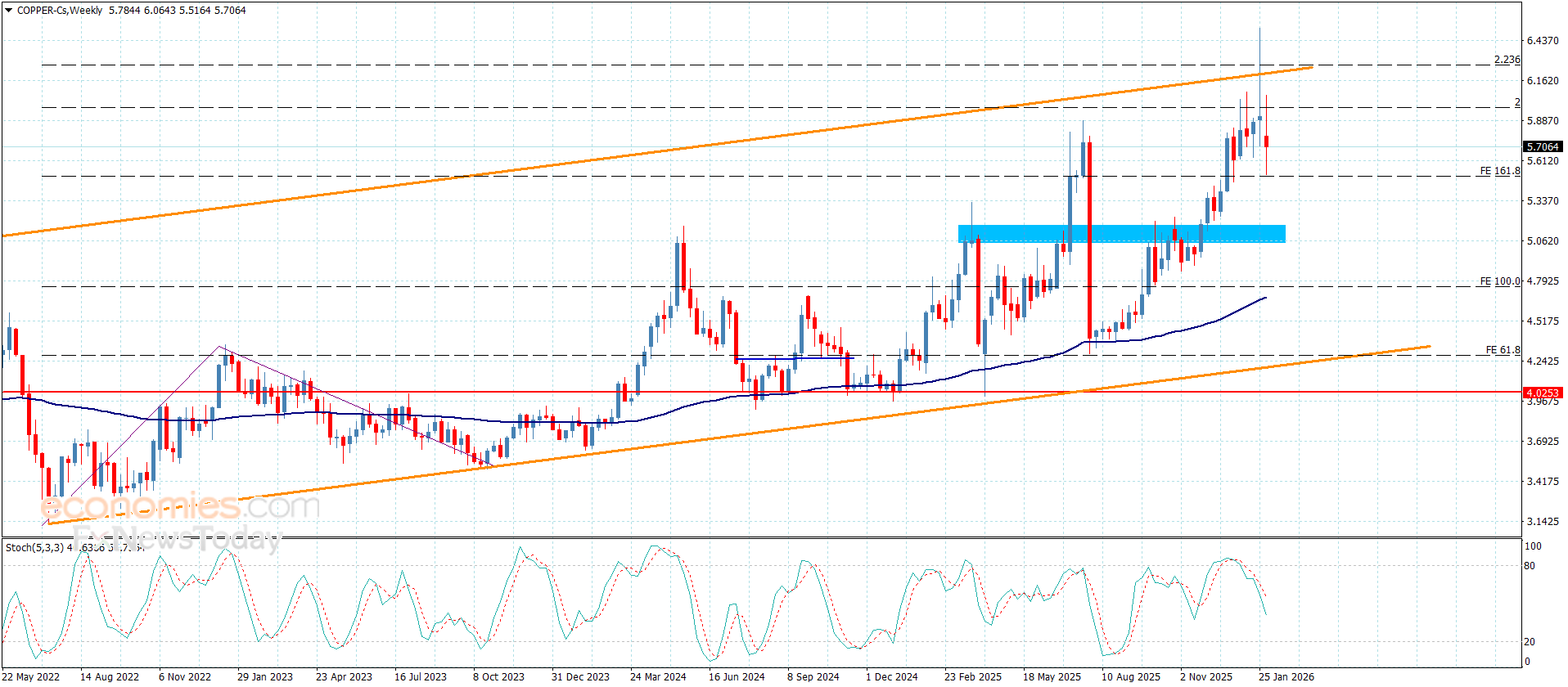
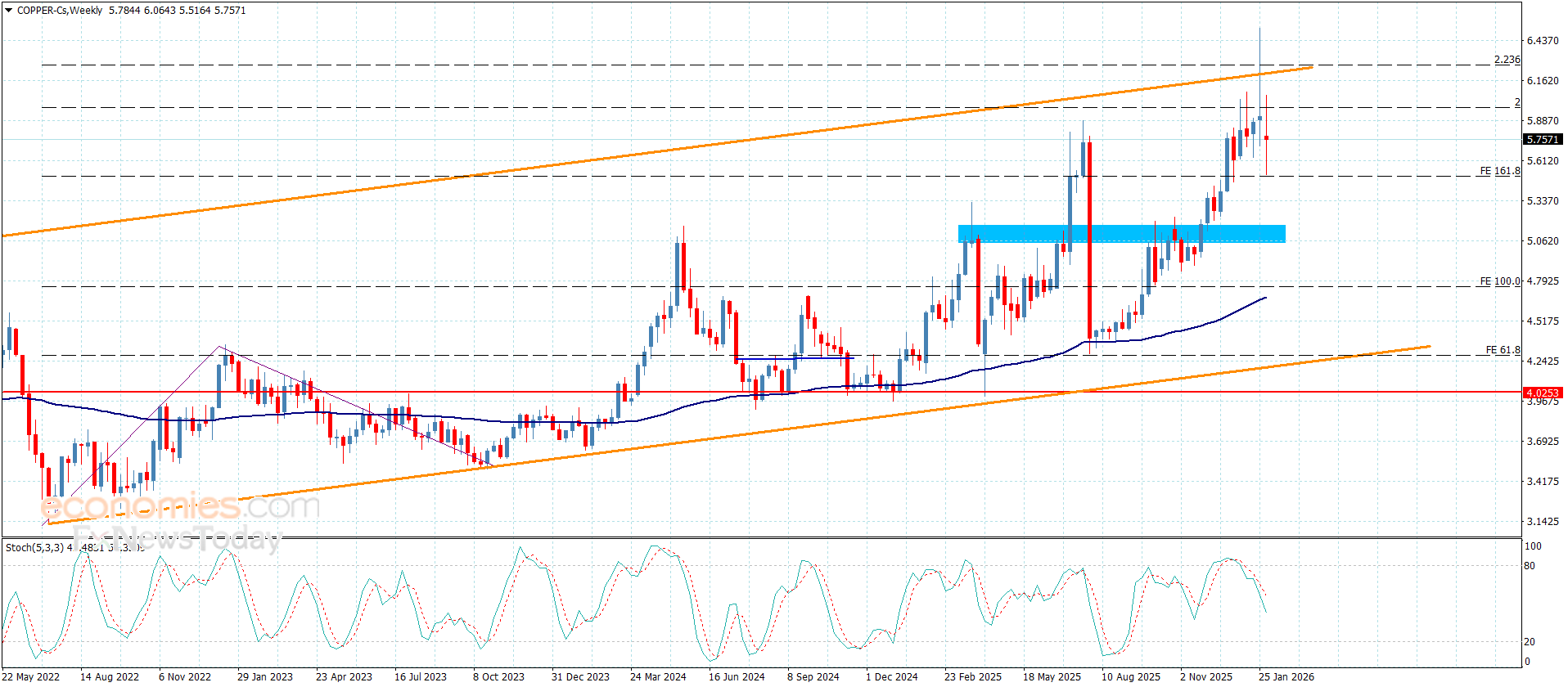
Copper price remains affected by stochastic negativity, forcing it to fluctuate below $5.7500 barrier, and begin forming bearish corrective waves by targeting $5.5500 level, approaching the waited target in our previous analysis.
Noting that the continuation of facing negative pressure might push the price to break $5.5100 support, and holding below it will confirm targeting new corrective stations that might begin at $5.4100 and $5.2800.
The expected trading range for today is between $5.5100 and $5.7800
Copper price remains affected by stochastic negativity, forcing it to fluctuate below $5.7500 barrier, and begin forming bearish corrective waves by targeting $5.5500 level, approaching the waited target in our previous analysis.
Noting that the continuation of facing negative pressure might push the price to break $5.5100 support, and holding below it will confirm targeting new corrective stations that might begin at $5.4100 and $5.2800.
The expected trading range for today is between $5.5100 and $5.7800
Silver price (XAG/USD) pares its daily losses, yet remains in the negative territory, trading around $80.50 per troy ounce during the early European hours on Thursday. Silver price plunged as much as over 16% as precious metals faced renewed selling pressure amid hawkish signals from the Federal Reserve (Fed) and easing geopolitical tensions.
Fed Governor Lisa Cook said she would not back another cut without clearer evidence that inflation is easing, stressing greater concern over stalled disinflation than labor market weakness. Investors also weighed the implications of Kevin Warsh’s nomination as Fed chair, citing his preference for a smaller balance sheet and a less aggressive approach to rate reductions.
Safe-haven demand for precious metals, including Silver, fades after Iran confirmed it would hold talks with the United States (US) in Oman on Friday. However, Silver prices gained ground on media reports suggesting the talks might collapse, but officials from both sides later said discussions would proceed as scheduled, even though the agenda remains unsettled.
Iranian Foreign Minister Abbas Araghchi said talks will be held in Oman on Friday, while a White House official confirmed continued engagement on a potential nuclear deal. Uncertainty persists over the scope, with Tehran aiming to limit discussions to its nuclear program and Washington seeking to include missiles, regional militancy, and human rights.
The dollar-denominated grey metal also fell as a stronger US Dollar (USD), driven by hawkish Fed signals and slower rate-cut expectations, weighed on the Silver price. A firmer Greenback raises Silver’s cost for non-US buyers, dampening demand, while higher US yields increase the opportunity cost of holding non-yielding metal.
Silver FAQs
Silver is a precious metal highly traded among investors. It has been historically used as a store of value and a medium of exchange. Although less popular than Gold, traders may turn to Silver to diversify their investment portfolio, for its intrinsic value or as a potential hedge during high-inflation periods. Investors can buy physical Silver, in coins or in bars, or trade it through vehicles such as Exchange Traded Funds, which track its price on international markets.
Silver prices can move due to a wide range of factors. Geopolitical instability or fears of a deep recession can make Silver price escalate due to its safe-haven status, although to a lesser extent than Gold’s. As a yieldless asset, Silver tends to rise with lower interest rates. Its moves also depend on how the US Dollar (USD) behaves as the asset is priced in dollars (XAG/USD). A strong Dollar tends to keep the price of Silver at bay, whereas a weaker Dollar is likely to propel prices up. Other factors such as investment demand, mining supply – Silver is much more abundant than Gold – and recycling rates can also affect prices.
Silver is widely used in industry, particularly in sectors such as electronics or solar energy, as it has one of the highest electric conductivity of all metals – more than Copper and Gold. A surge in demand can increase prices, while a decline tends to lower them. Dynamics in the US, Chinese and Indian economies can also contribute to price swings: for the US and particularly China, their big industrial sectors use Silver in various processes; in India, consumers’ demand for the precious metal for jewellery also plays a key role in setting prices.
Silver prices tend to follow Gold’s moves. When Gold prices rise, Silver typically follows suit, as their status as safe-haven assets is similar. The Gold/Silver ratio, which shows the number of ounces of Silver needed to equal the value of one ounce of Gold, may help to determine the relative valuation between both metals. Some investors may consider a high ratio as an indicator that Silver is undervalued, or Gold is overvalued. On the contrary, a low ratio might suggest that Gold is undervalued relative to Silver.
United States employment-related data came in worse than anticipated.
The Bureau of Labor Statistics will resume publishing first-tier data next week.
XAU/USD retains a modest bearish bias in the near-term.
Spot Gold changed direction on Thursday, trimming a good chunk of its recent gains. The XAU/USD pair trades around $4,880 in the American afternoon, after briefly surpassing the $5,000 mark during Asian trading hours. It is the third consecutive day on which the bright metal fails to sustain gains above the critical threshold, a discouraging sign for buyers.
Gold retreats despite Wall Street trading in the red, suggesting increased risk aversion. At the same time, the US Dollar (USD) maintains its positive tone, despite weak United States (US) employment-related data. Initial Jobless Claims for the week ended January 31 unexpectedly rose to 231K, while JOLTS Job Openings stood at 6.542 million on the last business day of December, down from the downwardly revised November figure of 6.928 million.
Following the latest monetary policy meeting, Federal Reserve (Fed) officials noted that “Job gains have remained low, and the unemployment rate has shown some signs of stabilization,” indicating less concern about the sector’s situation. The recently released figures are consistent with policymakers’ statements and are expected to have little impact on monetary policy in the near term.
Other than that, the US Bureau of Labor Statistics (BLS) announced that, following the partial government shutdown, it will resume releasing data. The Nonfarm Payrolls (NFP) report and Consumer Price Index (CPI) figures will be out next week.
XAU/USD short-term technical outlook
The near-term picture for XAU/USD is bearish. The 4-hour chart shows the 20-period Simple Moving Average (SMA) and the 100-period SMA converging around $4,901, providing near-term resistance. At the same time, a modestly bullish 200-period SMA acts as support at $4,673. The Momentum indicator aims lower around its midline, still neutral, while the Relative Strength Index (RSI) indicator hovers at around 46, lacking clear directional strength yet supporting the bearish case.
In the daily chart, XAU/USD trades above a bullish 20-day SMA, which continues heading higher above the 100- and 200-day ones, limiting the bearish case. The 20-day SMA at $4,846.70 and intraday dips below it continue to attract buyers. Finally, technical indicators hold above their midlines but resumed their declines, reflecting buyers’ discouragement.
(The technical analysis of this story was written with the help of an AI tool.)
The CHFJPY closed the last bullish rally by recording the main target at 202.10, facing a %261.8 Fibonacci extension level, forming strong barrier against the bullish attempts in the current period, which forces it to form some bearish corrective waves, to settle near 201.45.
Note that the continuation of the stability below the current obstacle and stochastic reaching the overbought level will increase the chances of forming new corrective waves, to target 200.75 and 200.00 level, while breaching the barrier and holding above it will confirm its readiness to record new gains that might begin at 202.80.
The expected trading range for today is between 200.75 and 202.10
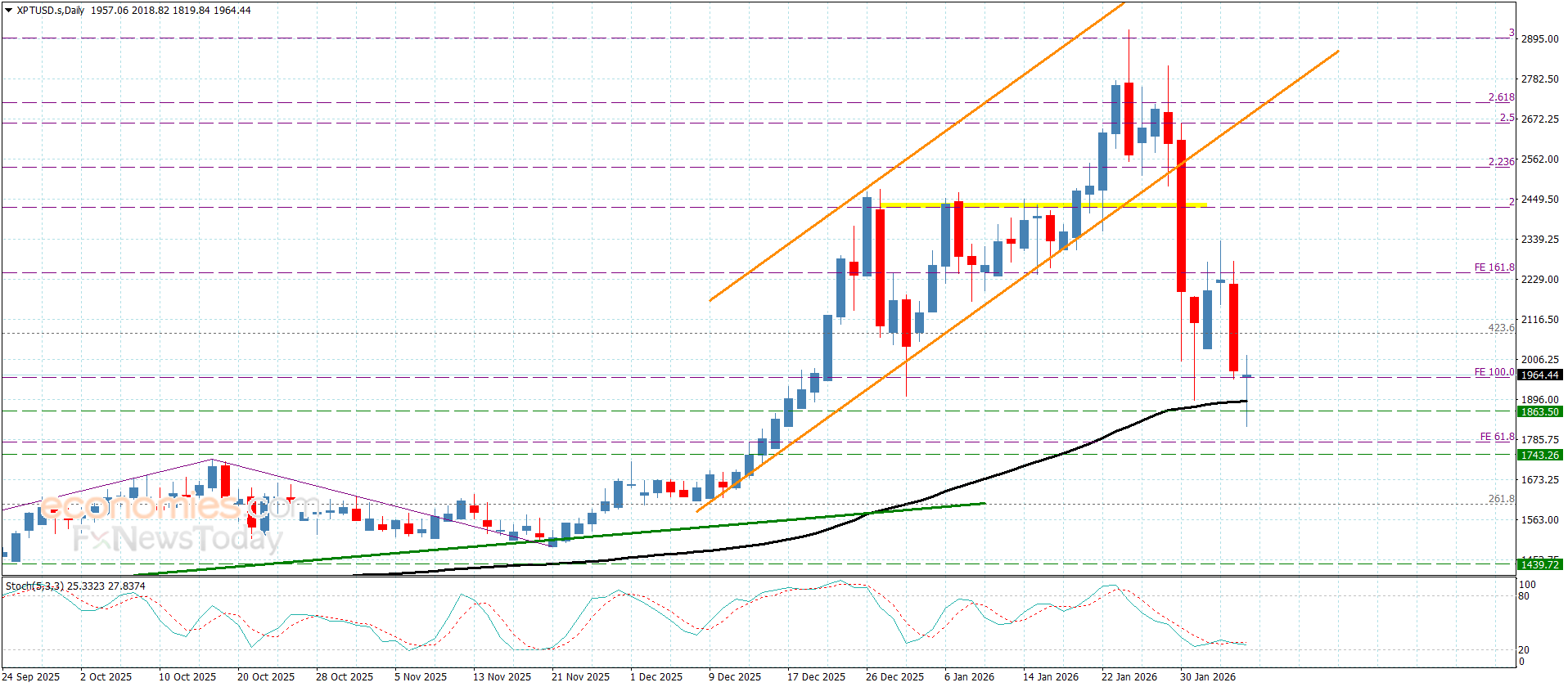
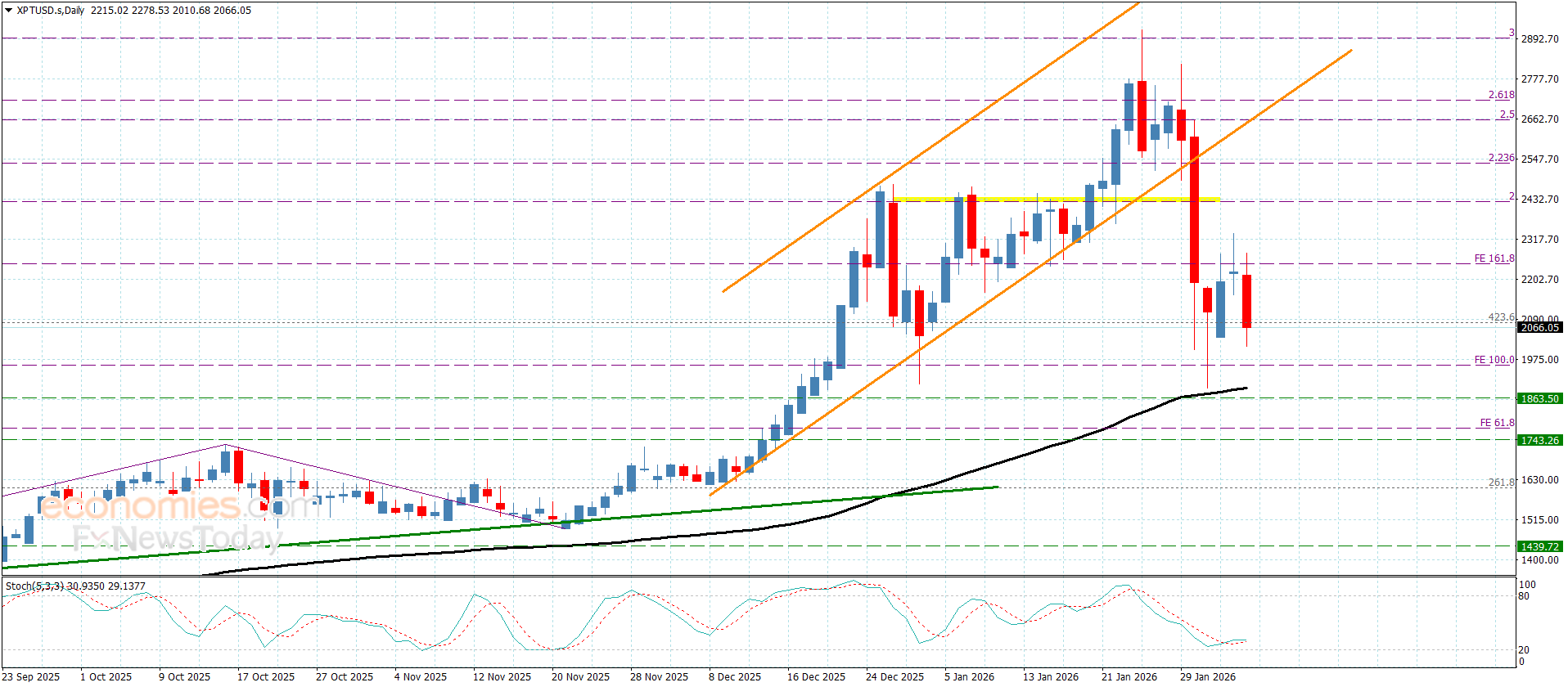
Platinum price reached $2335.00 level by its bullish rally, to approach the suggested initial target in the previous report, forcing it to form bearish corrective waves due to its neediness to the positive momentum, to settle below %161.8 Fibonacci extension level at $2245.00, to suffer some losses by reaching $2010.00.
The continuation of facing negative pressures that might force it to attack extra support at $1950.00, where breaking it will open the way for resuming the corrective decline to target $1865.00 reaching $1780.
The expected trading range for today is between $1900.00 and $2250.00
Silver price (XAG/USD) plunged over 10% after two days of gains, trading around $77.00 per troy ounce during the Asian hours on Thursday. Silver prices fall as precious metals face renewed selling pressure and increased volatility.
Dollar-denominated precious metals, including Silver lose ground amid a stronger US Dollar (USD), fueled by hawkish signals from the Federal Reserve (Fed) and expectations of a slower pace of US rate cuts.
Fed Governor Lisa Cook said she would not back another cut without clearer evidence that inflation is easing, stressing greater concern over stalled disinflation than labor market weakness.
Investors also weighed the implications of Kevin Warsh’s nomination as Fed chair, citing his preference for a smaller balance sheet and a less aggressive approach to rate reductions. Meanwhile, US President Donald Trump said he would not have nominated Warsh if he favored rate hikes. Trump further stated that there was “not much” doubt the US central bank would lower rates because “we’re way high in interest,” but now “we’re a rich country again.”
The safe-haven demand for Silver fades amid geopolitical tensions, which eased after the US and Iran are set to hold a new round of talks on Friday, though the agenda remains unclear. Tehran aims to limit discussions to its nuclear program, while Washington wants to include ballistic missiles, regional militant support, and human rights concerns.
Silver FAQs
Silver is a precious metal highly traded among investors. It has been historically used as a store of value and a medium of exchange. Although less popular than Gold, traders may turn to Silver to diversify their investment portfolio, for its intrinsic value or as a potential hedge during high-inflation periods. Investors can buy physical Silver, in coins or in bars, or trade it through vehicles such as Exchange Traded Funds, which track its price on international markets.
Silver prices can move due to a wide range of factors. Geopolitical instability or fears of a deep recession can make Silver price escalate due to its safe-haven status, although to a lesser extent than Gold’s. As a yieldless asset, Silver tends to rise with lower interest rates. Its moves also depend on how the US Dollar (USD) behaves as the asset is priced in dollars (XAG/USD). A strong Dollar tends to keep the price of Silver at bay, whereas a weaker Dollar is likely to propel prices up. Other factors such as investment demand, mining supply – Silver is much more abundant than Gold – and recycling rates can also affect prices.
Silver is widely used in industry, particularly in sectors such as electronics or solar energy, as it has one of the highest electric conductivity of all metals – more than Copper and Gold. A surge in demand can increase prices, while a decline tends to lower them. Dynamics in the US, Chinese and Indian economies can also contribute to price swings: for the US and particularly China, their big industrial sectors use Silver in various processes; in India, consumers’ demand for the precious metal for jewellery also plays a key role in setting prices.
Silver prices tend to follow Gold’s moves. When Gold prices rise, Silver typically follows suit, as their status as safe-haven assets is similar. The Gold/Silver ratio, which shows the number of ounces of Silver needed to equal the value of one ounce of Gold, may help to determine the relative valuation between both metals. Some investors may consider a high ratio as an indicator that Silver is undervalued, or Gold is overvalued. On the contrary, a low ratio might suggest that Gold is undervalued relative to Silver.
Coffee price succeeded in activating the previously suggested negative trend by reaching below 334.20 support, forming a strong decline, achieving the initial target by reaching 314.85 level.
Note that stochastic stability within the oversold level will increase the negative pressure in the current period, to form new bearish waves to reach 308.00, to press on 300.50 support to find an exit for resuming the negative trading in the upcoming period.
The expected trading range for today is between 300.50 and 325.00
Copper price announced delaying the bullish trend by providing new negative closure below $5.9700 level, affected by stochastic negativity, forming some bearish corrective waves to settle near $5.7500.
The continuation of suffering negative pressures will increase the efficiency of the bearish corrective track in the near period, which makes us prefer targeting $5.6200 level, repeating the pressure on the extra support at $5.5100, forming confirmation key for the trend of the medium trading.
The expected trading range for today is between $5.6200 and $5.9200
Gold is experiencing some volatility in Thursday’s Asian trading, moving back and forth in a roughly $200 range. Traders now look forward to the US JOLTS Job Openings data and geopolitical developments between the US and Iran for a clear directional impetus.
Gold struggles amid mixed fundamentals
Gold settled flat near $4,950 on Wednesday after witnessing two-way business. Initially, the traditional safe haven rebounded firmly to test the $5,100 level on uncertainty over the US Federal Reserve’s (Fed) potential monetary policy outlook under Kevin Warsh. The Fed concerns undermined the US Dollar (USD) across the board.
Meanwhile, rekindled geopolitical tensions in the Middle East and between Russia and Ukraine also provided a much-needed relief to Gold buyers, alongside increased concerns over the economic data disruption caused by the US partial government shutdown that ended on Tuesday.
However, the tide turned against the USD in the American session on Wednesday, following the release of the US ISM Services PMI data, which showed signs of a pick-up in inflation. Further, the tech sell-off on Wall Street gathered steam and spooked markets, as investors ran to the world’s reserve currency, the Greenback, for some solace.
The sell-off in the Japanese Yen (JPY)due to increased fiscal and political concerns boosted the USD/JPY pair, in turn, lifting the USD.
This reversal in the USD, fuelled a sharp pullback in Gold, but dip buyers once again jumped in near the $4,950 psychological level.
In Thursday’s trading so far, Gold is back in the red, having faced rejection again above the $5,000 key resistance. The USD extends its upbeat momentum, clinching fresh two-week highs against its six major currency rivals, as market mood worsens amid a global tech sell-off.
A meltdown in global providers of data analytics, professional services and software followed Anthropic’s launch of plug-ins for its Claude Cowork agent on Friday, which raised concerns about AI-fuelled disruption to those industries, per Reuters.
Looking ahead, the delayed US JOLT Job Openings Survey could help Gold buyers cut their losses, especially if the data doubles down on two Fed rate expectations for this year.
However, if the JPY extends its downward spiral against the USD, Gold could see another bout of intense selling.
Gold price technical analysis: Daily chart
The 21-, 50-, 100- and 200-day Simple Moving Averages (SMA) all rise, with the 21-day above the longer ones, underscoring a firm bullish structure. Price holds above these gauges, keeping buyers in control. The 21-day SMA at $4,827.45 offers nearby support, while the 50-day sits at $4,532.68. The Relative Strength Index (14) stands at 52.58, neutral after easing from prior extremes, indicating momentum is consolidating.
The upward alignment of the SMAs supports a buy-on-dips stance while the price holds above the short-term average. A deeper pullback would bring the 100-day SMA at $4,271.21 into view, with the 200-day at $3,821.77 underpinning the broader trend. RSI holding above the 50 midline would keep the bullish bias intact, whereas a drop back below it could open room for a broader retracement.
(The technical analysis of this story was written with the help of an AI tool.)
Economic Indicator
JOLTS Job Openings
JOLTS Job Openings is a survey done by the US Bureau of Labor Statistics to help measure job vacancies. It collects data from employers including retailers, manufacturers and different offices each month.