The main tag of Gold News Today Articles.
You can use the search box below to find what you need.
[wd_asp id=1]

24 09, 2025

XAG/USD rebounds above $44.00 near 14-year highs

By |2025-09-24T12:50:05+03:00September 24, 2025|Forex News, News|0 Comments


  • Silver price holds near Tuesday’s 14-year high of $44.47 amid rising Fed rate cut bets.
  • CME FedWatch tool indicates nearly a 93% possibility of a Fed rate cut in October.
  • Safe-haven Silver receives support from rising geopolitical tensions after NATO vowed a “robust” response to Russian airspace violations.

Silver price (XAG/USD) recovers its daily losses, trading around $44.10 per troy ounce during the European hours on Wednesday. The non-interest-bearing Silver maintains its position near a 14-year high of $44.47, which was reached on Tuesday as traders widely expect a 25-basis-point rate cut by the US Federal Reserve (Fed) at its October policy meeting.

The CME FedWatch tool suggests that money markets are currently pricing in nearly a 93% possibility of a Fed rate cut in October, up from 90% a day earlier. Traders will likely observe the upcoming US Q2 Gross Domestic Product Annualized and Personal Consumption Expenditures (PCE) Price Index data, the Federal Reserve’s preferred inflation gauge, due later in the week.

Safe-haven Silver draws buyers as geopolitical tensions rise, with NATO vowing a “robust” response to Russian airspace violations. Moreover, President Trump warned at the United Nations (UN) General Assembly on Tuesday that the United States (US) is ready to impose a “very strong round of powerful tariffs” if Russia refuses to end the war in Ukraine.

Additionally, Silver found support from strong fundamentals, with tight supply and steady demand from solar, EV, and electronics sectors underpinning prices. India’s silver imports are also set to rise in the coming months, backed by solid investment and industrial demand that has already absorbed last year’s surplus shipments.

Silver FAQs

Silver is a precious metal highly traded among investors. It has been historically used as a store of value and a medium of exchange. Although less popular than Gold, traders may turn to Silver to diversify their investment portfolio, for its intrinsic value or as a potential hedge during high-inflation periods. Investors can buy physical Silver, in coins or in bars, or trade it through vehicles such as Exchange Traded Funds, which track its price on international markets.

Silver prices can move due to a wide range of factors. Geopolitical instability or fears of a deep recession can make Silver price escalate due to its safe-haven status, although to a lesser extent than Gold’s. As a yieldless asset, Silver tends to rise with lower interest rates. Its moves also depend on how the US Dollar (USD) behaves as the asset is priced in dollars (XAG/USD). A strong Dollar tends to keep the price of Silver at bay, whereas a weaker Dollar is likely to propel prices up. Other factors such as investment demand, mining supply – Silver is much more abundant than Gold – and recycling rates can also affect prices.

Silver is widely used in industry, particularly in sectors such as electronics or solar energy, as it has one of the highest electric conductivity of all metals – more than Copper and Gold. A surge in demand can increase prices, while a decline tends to lower them. Dynamics in the US, Chinese and Indian economies can also contribute to price swings: for the US and particularly China, their big industrial sectors use Silver in various processes; in India, consumers’ demand for the precious metal for jewellery also plays a key role in setting prices.

Silver prices tend to follow Gold’s moves. When Gold prices rise, Silver typically follows suit, as their status as safe-haven assets is similar. The Gold/Silver ratio, which shows the number of ounces of Silver needed to equal the value of one ounce of Gold, may help to determine the relative valuation between both metals. Some investors may consider a high ratio as an indicator that Silver is undervalued, or Gold is overvalued. On the contrary, a low ratio might suggest that Gold is undervalued relative to Silver.


Source link

24 09, 2025

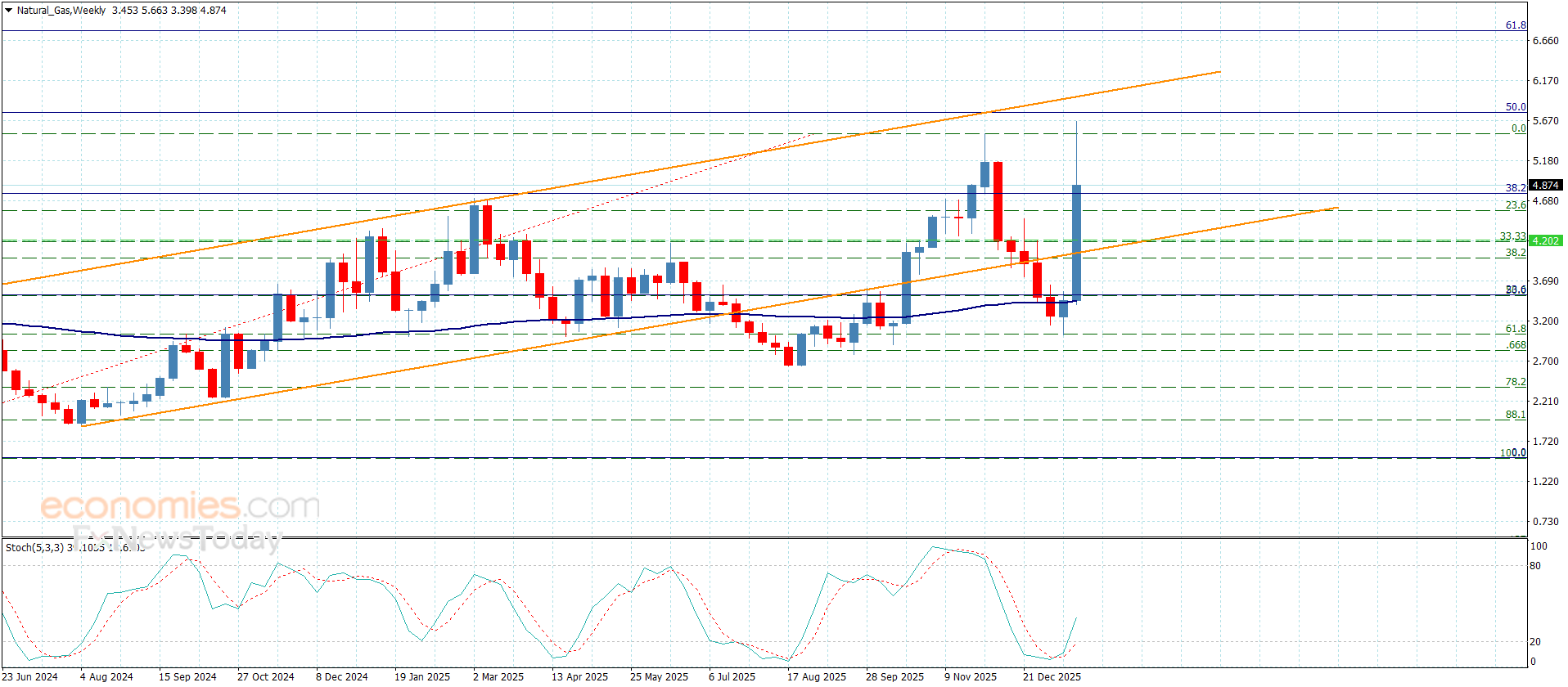
Natural gas price hits the initial target – Forecast today – 23-9-2025

By |2025-09-24T08:48:00+03:00September 24, 2025|Forex News, News|0 Comments


Despite the stability of the GBPJPY pair in the last period below the barrier at 200.45, but the continuation of the main indicators’ contradiction that pushed it to form sideways trading by its repeated stability near 199.60.


We will keep waiting for gathering the extra negative momentum, to ease the mission of forming new correctional waves, to target 198.60 level reaching the extra support at 197.80, while breaching the barrier will turn the bullish track back, to begin recording extra gains by its rally towards 200.90 and 201.55.


The expected trading range for today is between 198.60 and 200.40


Trend forecast: Bearish


Source link

24 09, 2025

NG=F at $2.85, EU €32/MWh With Traders Betting on 60% Surge

By |2025-09-24T06:46:28+03:00September 24, 2025|Forex News, News|0 Comments


Natural Gas (NG=F) Anchored at $2.85 as Market Awaits November Contract Shift

U.S. natural gas futures (NG=F) are trading near $2.852 per MMBtu, posting a 1.64% daily gain, yet the contract remains locked in a tight range as traders prepare to roll into November. Price action has been dominated by noise and compressed volatility, with the chart showing a potential retest of the $2.72 gap that formed in late summer. That level is emerging as a pivotal support zone, while resistance continues to cluster at $3.00–$3.10, reinforced by the 50-day EMA. The broader uptrend line that extends back to February 2024 has not yet been broken, maintaining a fragile bullish structure even as sellers test the lower end of the range.

European Gas Prices Hover at €32 With Heavy Storage Cushion

In Europe, Dutch TTF contracts are steady at about €32 per megawatt-hour ($37.75), underpinned by storage levels at 81.6% of capacity across the bloc. Italy’s inventories lead with 91%, France follows at 90.6%, and Germany lags with 76.4%, highlighting regional disparities but still leaving the EU in a comfortable pre-winter position. Analysts note that last winter was the coldest since the war in Ukraine began, which forced significant withdrawals. If the upcoming season mirrors those conditions, inventories could face renewed stress despite their strong starting point.

Speculation Builds on Options Market for 60% European Price Surge

Traders have begun placing bold bets on a sharp rally. Options priced for April–September 2026 settled near €50/MWh ($59), suggesting expectations of a 60% increase compared to spot pricing. Forward contracts for summer 2026 remain lower at €31/MWh ($36.57), signaling the risk premium is concentrated in the winter period. This divergence reflects the market’s view that storage, weather, and competition with Asia could force Europe into costly bidding wars just as stockpiles need to be refilled.

Policy Risks Mount With EU Ban on Russian LNG Brought Forward

The European Union has accelerated its timeline, advancing the full ban on Russian LNG imports to January 2027, one year earlier than previously scheduled. While pipeline gas through Ukraine has already been halted since January 2025, Russia continues to deliver cargoes via Arctic LNG routes, many destined for China, which has already taken six shipments this month despite sanctions pressure. This leaves Europe more reliant on alternative suppliers, particularly the U.S. and Qatar. Washington has promised to expand LNG output and send additional flows to Europe, with new capacity entering service in the next 24 months.

Asian LNG Demand Remains Quiet But Could Rebound With Winter Cold

Weak demand from Asia this summer has allowed Europe to secure an outsized share of American cargoes, cushioning its balance. However, the possibility of another harsh winter combined with an Asian demand resurgence poses a real risk of diverting flows away from Europe. Freight costs between the Gulf Coast and Asia have already risen, tightening arbitrage windows and reshaping trade routes. Should Asian utilities return aggressively, Europe may be forced to pay premiums well above current forward curves to keep inventories stable.

U.S. Demand and Supply Dynamics Show Record Highs Ahead

In the U.S., the Natural Gas Supply Association (NGSA) expects winter demand to climb to a record 115.5 Bcf/d, up 4 Bcf/d year-over-year. Supply is forecast at 108.5 Bcf/d, while Canadian imports add another 6.9 Bcf/d, leaving the market in balance for now. Storage is entering the season at a five-year high, providing a cushion against early cold spells. However, structural demand is shifting — AI data centers and LNG terminals are creating steady baseload consumption. LNG exports, already absorbing a growing share of daily output, could tighten balances further if global spreads widen during the heating season.

Technical Picture Shows Compression Before Breakout

Chart signals indicate natural gas is coiling for a move. The RSI sits near 40, reflecting weakness but also approaching oversold territory. The MACD histogram has flattened, neither confirming bearish continuation nor a bullish turn. Bollinger Bands have narrowed between $2.72 and $3.00, pointing to an imminent breakout. A decisive close below $2.72 could expose lows last seen in early 2024, while recovery above $3.00–$3.10 would open the path to $3.40, where the 200-day EMA converges. Traders see the November contract roll as the likely trigger for volatility expansion.

Energy Equities and Infrastructure Firms React to Gas Volatility

Movements in NG=F are reverberating across related equities. U.S. LNG exporters such as Cheniere Energy (NYSE:LNG) and Tellurian (NYSE:TELL) are closely tied to forward curves, while European majors like Equinor (NYSE:EQNR) benefit from volatility and arbitrage margins. U.S. midstream names with exposure to Gulf Coast export hubs are also trading with heightened correlation to gas futures. Institutional flows into energy-focused ETFs have increased, suggesting investors are positioning for stronger realized margins in 2026 as export volumes rise.

Verdict — NG=F Is a Hold as Market Trades Between $2.72 and $3.10 With Europe Betting on €50/MWh

At $2.85 per MMBtu, natural gas sits between its strongest support at $2.72 and resistance around $3.10. Europe’s spot market stability at €32/MWh masks deeper risks, as option bets are already pricing a surge toward €50/MWh by next summer. With U.S. storage levels strong, production near records, and policy tightening on Russian LNG, the backdrop suggests stability in the near term but volatility premiums growing into 2026. Given the balance of factors — high supply, record demand projections, and structural shifts from AI and LNG — the call remains Hold, with risks skewed toward upside if winter proves harsher than expected.

That’s TradingNEWS


Source link

23 09, 2025

XAU/USD record run continues, $3,800 in sight

By |2025-09-23T20:38:53+03:00September 23, 2025|Forex News, News|0 Comments


XAU/USD Current price: $3,779.62

  • China’s appearance in the bullion market boosted the bright metal.
  • US S&P Global PMIs came in line with estimates in September, according to flash estimates.
  • XAU/USD consolidates near fresh all-time highs, buying interest unabated.

Gold run to record highs continued on Tuesday, with the bright metal approaching the $3,800 threshold. A mixture of broad US Dollar (USD) weakness, geopolitical tensions, China, and a dovish Federal Reserve (Fed) maintained the bright metal on the run.

The latest catalyst for XAU/USD’s rally was news indicating that the People’s Bank of China (PBoC) is using the Shanghai Gold Exchange to buy bullion in friendly countries and store it within Chinese borders, according to people familiar with the matter.

However, the record run could also be attributed to the recently adopted Fed’s dovish stance. True, policymakers introduced some noise after the announcement, while sharing their particular perspectives. Still, Chair Powell has the last say, and he will soon be on the wires, discussing the economic outlook at the Greater Providence Chamber of Commerce Economic Outlook Luncheon in Rhode Island.

Meanwhile, mounting tensions between Russia and Ukraine add to the demand for the bright metal. Back and forth drone attacks between Moscow and Kyiv have been reported on Tuesday, as Ukrainian President Volodymyr Zelenskyy seeks the United Nations (UN) and US President Donald Trump’s help.

Other than that, S&P Global reported that business activity lost momentum in September, according to preliminary estimates. The Composite Purchasing Managers’ Index (PMI) ticked down to 53.6 from 54.6 in August. Nevertheless, expansion continued in the manufacturing and services sectors. Manufacturing output eased to 52 from the previous 53, while the services index eased to 53.9, as expected from 54.5, suggesting demand there may be easing. The modest downtick hints at easing momentum, but also indicates business remains on the growth path.

US growth will remain under the spotlight, as the country will release on Wednesday the final estimate of the Q2 Gross Domestic Product (GDP).

XAU/USD short-term technical outlook

The XAU/USD pair holds on to solid gains for a third consecutive day, trading near its recent all-time peak at $3,791.12. Technical readings in the daily chart support yet another leg north, despite overbought conditions. The Momentum indicator ticks north within positive levels, while the Relative Strength Index (RSI) indicator stabilized at around 79. As it happens lately, the bright metal keeps advancing beyond bullish moving averages, with the 20 Simple Moving Average (SMA) currently at around $3,600, while also developing far above the bullish 100 and 200 SMAs.

In the near term, and according to the 4-hour chart, XAU/USD entered a pause. The pair consolidates near its recent high as technical indicators retreat from extreme levels, while still in overbought territory. At the same time, the pair is well above all bullish moving averages. Overall, the ongoing retracement gives no sign of the bullish trend abating.

Support levels: 3,767.10 3,753.90 3.736.2

Resistance levels: 3,791.00 3,805.00 3,820.00


Source link

23 09, 2025

Copper price remains slow– Forecast today – 23-9-2025

By |2025-09-23T16:37:02+03:00September 23, 2025|Forex News, News|0 Comments


Copper price provided slow trading despite the presence of the positive factors, such as the main stability within the bullish channel’s levels by forming main support at $4.1100 level, besides the continuation of providing bullish momentum by the main indicators, specifically by forming an extra support by the moving average 55 by its stability near $4.3700.


Therefore, we will keep preferring the bullish scenario, to expect surpassing the barrier at $4.6200, to rally towards the positive stations at $4.7500 and $4.9500.


The expected trading range for today is between $4.5000 and 4.7500


Trend forecast: Bullish


Source link

23 09, 2025

XAU/USD, at fresh record highs, approaching $3,800

By |2025-09-23T14:35:40+03:00September 23, 2025|Forex News, News|0 Comments


  • Gols approaches fresh all-time highs $3,800, as the US Dollar drifts lower.
  • Investors keep pricing in two further rate cuts in 2025, which keeps US Dollar rallies limited.
  • Later today US flash PMI and Fed Powell might provide further clues about the US central bank’s rate path.

Gold continues to march higher on Tuesday, reaching fresh all-time highs and nearing $3,800 after appreciating more than $140 over the last three trading days. The US Dollar’s pullback ahead of the US PMI and Fed Powell’s speech has provided further support to the precious metals.

Investors’ expectations of further Fed rate cuts, on one side, and growing geopolitical concerns, namely the frictions between Russia and its NATO neighbours, have boosted demand for the safe-haven gold this week.

On Tuesday, a range of Fed speakers offered diverse opinions about the bank’s rate path, but futures markets continued to price in a 90% chance of a 25-basis-point cut in November and a 70% chance of another one in December. Against this backdrop, the US Dollar’s upside attempts are likely to remain subdued.

Technical Analysis: Gold is shouting for a bearish correction

The technical picture shows an overextended rally from mid-August lows. Bullion has appreciated nearly 15% ever since, and these performances, sooner than later, lead to corrections. The RSI is overbought at most timeframes, supporting that view.

On the upside, the psychological level at $3,800 might be a plausible target ahead of a healthy correction. Further up, the 261.8% Fibonacci retracement of the mid-September pullback, at $3,828, emerges as a potential target.

To the downside, immediate support is at the intraday low of $3,738 ahead of the previous record high, in the area of $3,700. Further down, the September 15 and 19 lows, around $36,30 would come into focus.

(This story was corrected on September 23 at 11.25 GMT to say that the market is pricing two further Fed rate cuts, and not rate hikes, as previously reported)

US Dollar Price Today

The table below shows the percentage change of US Dollar (USD) against listed major currencies today. US Dollar was the strongest against the Canadian Dollar.

USD EUR GBP JPY CAD AUD NZD CHF
USD 0.04% -0.13% -0.03% 0.09% -0.19% -0.04% -0.14%
EUR -0.04% -0.04% -0.05% 0.09% -0.17% -0.04% -0.12%
GBP 0.13% 0.04% 0.04% 0.14% -0.13% 0.00% -0.09%
JPY 0.03% 0.05% -0.04% 0.10% -0.12% -0.02% -0.02%
CAD -0.09% -0.09% -0.14% -0.10% -0.27% -0.13% -0.22%
AUD 0.19% 0.17% 0.13% 0.12% 0.27% 0.14% 0.12%
NZD 0.04% 0.04% -0.00% 0.02% 0.13% -0.14% -0.09%
CHF 0.14% 0.12% 0.09% 0.02% 0.22% -0.12% 0.09%

The heat map shows percentage changes of major currencies against each other. The base currency is picked from the left column, while the quote currency is picked from the top row. For example, if you pick the US Dollar from the left column and move along the horizontal line to the Japanese Yen, the percentage change displayed in the box will represent USD (base)/JPY (quote).


Source link

23 09, 2025

The GBPCHF confirms the negativity – Forecast today – 23-9-2025

By |2025-09-23T12:33:44+03:00September 23, 2025|Forex News, News|0 Comments


The GBPCHF provided several negative trading, affected by its stability below the main bearish channel’s resistance at 1.0748, suffering some losses by hitting 1.0670 level, then forming correctional trading by its stability near 1.0705.


Note that the continuation of providing positive momentum by the main indicators will increase the chances of forming new bearish waves, attempting to press on the barrier at 1.0660, and breaking it will extend the losses towards 1.0630, to face the support of bearish channel that appears in the above image.


The expected trading range for today is between 1.0720 and 1.0660


Trend forecast: Bearish


Source link

23 09, 2025

Platinum price records some gains– Forecast today – 23-9-2025

By |2025-09-23T10:32:56+03:00September 23, 2025|Forex News, News|0 Comments


Copper price provided slow trading despite the presence of the positive factors, such as the main stability within the bullish channel’s levels by forming main support at $4.1100 level, besides the continuation of providing bullish momentum by the main indicators, specifically by forming an extra support by the moving average 55 by its stability near $4.3700.


Therefore, we will keep preferring the bullish scenario, to expect surpassing the barrier at $4.6200, to rally towards the positive stations at $4.7500 and $4.9500.


The expected trading range for today is between $4.5000 and 4.7500


Trend forecast: Bullish


Source link

23 09, 2025

XAU/USD could see a profit-taking pullback ahead of US PMIs, Powell

By |2025-09-23T08:32:22+03:00September 23, 2025|Forex News, News|0 Comments


  • Gold retreats after hitting lifetime highs above $3,750 early Tuesday.
  • US Dollar consolidates the downside ahead of Fed Chair Powell’s appearance.
  • Gold’s record rally remains unabated but overbought RSI conditions on the daily chart could caution buyers.

Gold is taking a breather early Tuesday after having extended the previous upsurge to renew record highs above the $3,750 psychological level.

Gold: All eyes on Powell and geopolitics

Gold traders look to take profits off the table after a two-day relentless record rally, repositioning ahead of the top-tier S&P Global preliminary US Manufacturing and Services PMI data and the eagerly awaited speech from US Federal Reserve (Fed) Chairman Jerome Powell.

Powell is due to speak about the economic outlook at the Greater Providence Chamber of Commerce Economic Outlook Luncheon, in Rhode Island, on Tuesday.

The US business growth data and Powell’s words will be closely scrutinized for fresh hints on whether the Fed will deliver two more interest rate cuts in the remainder of this year.

This comes after the hawkish remarks from Fed officials delivered on Monday and last week’s cautious rate cut decision announced by the US central bank.

New Fed Governor Stephen Miran said on Monday that the Fed is misreading how tight it has set monetary policy and will put the job market at risk without aggressive rate cuts.

Meanwhile, Fed policymakers Raphael Bostic, Beth Hammack and Thomas Barkin maintained their cautious rhetoric on further easing amid looming upside risks to inflation.

Besides, growing expectations of further Fed rate cuts, intensifying geopolitical tensions surrounding the Russia-Ukraine conflict and rising concerns over the US fiscal debt emerge as the key factors powering Gold’s record run.

Russian military jets flew over Estonia for 12 minutes on Friday. Although Moscow denied it, US President Donald Trump has said America would come to the defence of Poland and the Baltic states if Russia were to attack.

Interestingly, in the past fortnight, Russian drones and fighter jets have entered Estonian, Polish and Romanian airspace as the Kremlin’s war on Ukraine continues.

Looking ahead, the US preliminary Manufacturing PMI is seen falling to 52 in September from 53 in August, while the Services PMI is expected to decline to 53.9 in the same period versus 54.5 previous.

Disappointing PMI readings could revive US economic concerns and ramp up the odds of further easing by the Fed, boding well for the non-interest-bearing Gold and vice-versa.

Gold price technical analysis: Daily chart

The daily chart shows that the 14-day Relative Strength Index (RSI) remains within the overbought territory, currently descending to 76.

If the pullback picks up steam, the initial support is seen at the $3,700 threshold, below which the previous day’s low of $3,684 will offer some comfort.

Further down, the $3,650 psychological barrier could come to the rescue of buyers.

Conversely, buyers need acceptance above the $3,750 region to extend the record rally toward the $3,800 round level.

Economic Indicator

S&P Global Manufacturing PMI

The S&P Global Manufacturing Purchasing Managers Index (PMI), released on a monthly basis, is a leading indicator gauging business activity in the US manufacturing sector. The data is derived from surveys of senior executives at private-sector companies from the manufacturing sector. Survey responses reflect the change, if any, in the current month compared to the previous month and can anticipate changing trends in official data series such as Gross Domestic Product (GDP), industrial production, employment and inflation. A reading above 50 indicates that the manufacturing economy is generally expanding, a bullish sign for the US Dollar (USD). Meanwhile, a reading below 50 signals that activity in the manufacturing sector is generally declining, which is seen as bearish for USD.


Read more.

Next release:
Tue Sep 23, 2025 13:45 (Prel)

Frequency:
Monthly

Consensus:
52

Previous:
53

Source:

S&P Global


Source link

23 09, 2025

Oil Prices $63 WTI, $67 Brent as Israel Strike and OPEC+ Shape Market

By |2025-09-23T06:31:45+03:00September 23, 2025|Forex News, News|0 Comments


WTI (CL=F) and Brent (BZ=F) Prices Surge on Geopolitical Shock and OPEC+ Uncertainty

Oil prices are once again reflecting the weight of geopolitics and supply-side maneuvering. WTI crude (CL=F) climbed to $63.11 per barrel, up 1.37%, while Brent (BZ=F) added 1.32% to $66.89 after Israel carried out an unprecedented strike in Doha, Qatar. The location of the strike rattled traders because Qatar is a cornerstone of the global energy network, home to one of the largest U.S. military bases, and a critical LNG exporter. Even though Qatar does not export large volumes of crude, the geopolitical symbolism triggered immediate risk premiums across energy benchmarks.

Geopolitical Escalation Drives Risk Premiums

The Israel–Qatar escalation shifted the balance of oil markets that were already contending with fragile supply outlooks. Nearly every Gulf state plays an outsized role in energy stability, and the possibility of escalation spilling into wider conflicts pushed risk hedging into oil futures. Historically, events in the Gulf region have added anywhere from $3–$7 per barrel in geopolitical premium, and traders are preparing for that scenario again.

OPEC+ Output Strategy and Saudi Pricing Tactics

Overlaying the geopolitical spike is the ongoing OPEC+ supply policy. After signaling a potential collective increase of 550,000 barrels per day for October, the group delivered just 137,000 barrels per day, managing expectations but still loosening cuts. Saudi Aramco responded by cutting its official selling price for October Asian deliveries by $1 per barrel, with Arab Light now set at a $2.20 premium over Oman/Dubai. The cut was larger than expected and highlights Riyadh’s concern about weakening Asian demand. With China’s oil stockpiling continuing but EV adoption suppressing gasoline demand growth, Saudi Arabia appears willing to trade price for market share.

Bearish Voices Emerge Amid Supply Overhang Concerns

Shipping executives, including Maersk’s oil trading head, warned at the Asia Pacific Petroleum Conference that risks lean to the downside, citing sluggish demand and excess supply from Russia and U.S. shale. Goldman Sachs flagged the possibility of a 1.9 million barrel per day surplus next year, which could drag Brent crude back to $55 per barrel. S&P Global echoed the warning, noting that OECD inventories remain 100 million barrels below the five-year average, but contango structures could widen quickly if stockbuilding accelerates.

Refinery Disruptions and Regional Supply Shocks

Complicating the balance are disruptions in Russia and Nigeria. Ukrainian drones have hit Rosneft’s key refineries, temporarily halting processing and reducing export-ready volumes. In Nigeria, unions have called for strikes at the 650,000 bpd Dangote refinery over labor disputes, threatening near-term regional fuel supply. These interruptions, although episodic, inject additional volatility into physical markets already rattled by OPEC+ decisions and Middle Eastern risks.

WTI and Brent Technical Structure

Technically, WTI crude (CL=F) is testing a double-bottom pattern near $62, with resistance layers stacking at $65 and $66. A decisive break above $66 would target $67.50–$68.00, while failure to hold $62 could drag prices toward $60. Brent (BZ=F) is moving in a similar structure, with a range defined by $65 support and $70 resistance. Both contracts are holding above immediate support levels, but momentum remains fragile, with short-covering responsible for much of the recent bounce.

Macro Backdrop and Currency Linkages

U.S. nonfarm payroll revisions, which revealed a loss of 911,000 jobs, reinforced expectations of a September Fed rate cut, sending the dollar lower and boosting commodities priced in USD. At the same time, gold surged past $3,674 per ounce, underscoring the search for havens during geopolitical stress. Oil benefitted in the short term, but the fundamental drag from weak macro data means demand forecasts may not justify sustained rallies.


China and India as Swing Buyers

China continues to stockpile crude aggressively, lifting imports since March, but the move is less about demand recovery and more about building reserves. Analysts warn Chinese demand growth could peak by 2027, with EV adoption already displacing 580,000 barrels per day of gasoline equivalent this year. India, meanwhile, is doubling down on discounted Russian barrels, defying Western pressure, and securing long-term supply contracts. These divergent strategies illustrate Asia’s outsized role in setting marginal demand, but also point to limits on upside for Brent as peak demand debates accelerate.

Verdict on Oil (CL=F, BZ=F)

Oil prices are being propped up by geopolitics rather than fundamentals. With WTI at $63.11 and Brent at $66.89, near-term rallies hinge on whether the Israel–Qatar escalation deepens or whether OPEC+ signals further restraint. Structural risks remain to the downside, with forecasts of Brent sliding back toward $55 if oversupply accelerates into 2026. The verdict for now is Hold, as short-term geopolitical premiums keep oil elevated, but long-term risk-reward tilts bearish unless demand outpaces the looming wave of supply from OPEC+, U.S. shale, and LNG expansions.

That’s TradingNEWS


Source link

Go to Top