$3,310.48 Support and 50-Day SMA Now Key Battleground
Price action is pressing against $3,310.48, a key horizontal support that aligns closely with the 50-day simple moving average at $3,314.40. This zone is a confluence of trend and structure—break it, and gold could fall toward $3,280.00 or even $3,228.38. But if bulls hold the line, it would mark a successful higher low and could reset the push toward $3,435.06 and $3,451.53.
This technical tension mirrors the market’s uncertainty about the Fed’s next move. Traders are waiting for confirmation—either a breakdown confirming near-term weakness or a bounce that keeps the broader uptrend intact.
Fed’s “Prepared to Adjust” Line Adds Fuel to Medium-Term Bull Case
While short-term upside is capped by high real interest rates, the Fed’s increasingly data-dependent tone has opened the door to a more accommodative stance if needed. The line that the Committee is “prepared to adjust” policy if risks emerge is a subtle pivot—particularly if upcoming inflation or employment data weakens.
The Fed is also continuing quantitative tightening at a cautious pace, reducing Treasuries and MBS holdings without disrupting liquidity. This careful approach helps sustain financial conditions favorable to gold and other alternative assets.
Looking 6–18 months out, the case for gold remains strong. The Fed’s balancing act between inflation control and growth support creates a scenario where any economic weakening—whether from labor market stress, softer consumer demand, or credit risks—could fast-track rate cuts. In that case, gold could break back above $3,500.00 and enter a new leg higher.
Persistent geopolitical tensions, fiscal risks, and steady central bank demand for gold further reinforce the metal’s long-term appeal.
Despite the EURNZD price stability within the bullish channel’s levels, facing difficulties in resuming the bullish attack, as it reached strong liquidity draw zones that are represented by 1.9225 level, which forces it to form an intraday negative rebound at 1.9015.
Despite forming some bullish waves this morning and reaching 1.9140 level, but its stability below 1.9225 confirms delaying the bullish attack, to expect its surrender to stochastic negativity and reaching 1.9020 followed by 1.8960, to form the waited correctional target in the near period trading.
The expected trading range for today is between 1.9020 and 1.9185
Copper price took advantage of the positive momentum that comes from stochastic approach from 80 level, forming bullish waves and attacking 61.8%Fibonacci correction level at $4.8100.
The positive factors specifically the stability of the extra support at $4.6600 will increase the chances for the trading’s rally near the target at $4.8900, reminding you that surpassing it will ease the mission of achieving extra gains that might extend to $5.0300.
The expected trading range for today is between $4.7400 and $4.8900
Platinum price succeeded in extending the gains range by surpassing the barrier at $1275.00 yesterday, to notice recording big losses by hitting $1348.00 level, facing the achieved historical top.
Notet that providing positive momentum by stochastic by its rally to 80 level might assist reinforcing the chances for targeting new historical stations that might extend to $1368.00, noting that holding above $1275.00 is important for avoiding any losses that might be caused by changing the bullish trend.
The expected trading range for today is between $1300.00 and $1368.00
Gold price attempts recovery from weekly lows near $3,360 amid light trading on Thursday.
US Dollar picks haven demand on reports that the US could strike Iran as early as this weekend.
Gold price breaches key $3,377 support on Fed’s hawkish hold but daily RSI still remains bullish.
Gold price is finding fresh buyers near the weekly low of $3,363 early Thursday amid renewed Middle East tensions, as markets look past the US Federal Reserve’s (Fed) hawkish hold policy decision.
Gold price rebounds, will it last?
Risk sentiment takes a hit in Asian trading on Thursday after several media outlets reported that US is considering an attack on Iran as early as this weekend, with US President Donald Trump particularly weighing strikes on Iran’s heavily fortified Fordow nuclear facility.
The potential involvement of the US military against Iran could deepen the Middle East conflict, translating into a wider regional war.
These reports come after Iran’s Supreme Leader Ayatollah Ali Khamenei warned on Wednesday that any military involvement by the Americans would cause “irreparable damage to them,” while refusing to surrender.
Renewed Middle East concerns sag investors’ confidence, reviving the safe-haven appeal of Gold price. However, Gold buyers seem to struggle amid resurgent demand for the US Dollar (USD) as another safety bet.
The Greenback builds on the previous day’s upswing, helped by the Fed’s patient stance and hints of higher inflation coming.
The US central bank maintained policy rates in the range of 4.25%-4.5% as widely expected while keeping the projections for two interest rate cuts this year intact.
However, it trimmed expectations for further cuts in 2026 and 2027. The Fed downgraded growth forecast while revising higher inflation outlook.
Amid persistent trade and geopolitical uncertainties, the Fed flagged upside risks to inflation, which prompted markets to perceive the decision as slightly hawkish.
The non-interest-bearing
Gold price breached the critical support at $3,377 and closed below that level on Wednesday, in the aftermath of the Fed’s decision.
Looking ahead, the Juneteenth holiday in the United States (US) could cause thin liquidity conditions, exaggerating the Gold price movement.
Traders will keep a close watch on the developments surrounding the Middle East conflict for fresh trading directives in Gold price.
Gold price technical analysis: Daily chart
Technically, the bullish bias remains intact for Gold price as the 14-day Relative Strength Index (RSI) holds above the midline, currently near 55.
Gold price needs to recapture the strong resistance now support at $3,377, the 23.6% Fibonacci Retracement (Fibo) level of the April record rally, on a sustained basis for a fresh upside.
The next relevant hurdle is aligned at the $3,400 mark, above which the static resistance at $3,440 will be tested.
Buyers will then take on the two-month highs of $3,453.
On the flip side, if Gold price fails to hold onto the rebound, sellers will likely jump back.
The immediate downside cushion is seen at the 21-day Simple Moving Average (SMA) at $3,348.
Further south, the 50-day SMA at $3,308 will be put to the test.
Gold FAQs
Gold has played a key role in human’s history as it has been widely used as a store of value and medium of exchange. Currently, apart from its shine and usage for jewelry, the precious metal is widely seen as a safe-haven asset, meaning that it is considered a good investment during turbulent times. Gold is also widely seen as a hedge against inflation and against depreciating currencies as it doesn’t rely on any specific issuer or government.
Central banks are the biggest Gold holders. In their aim to support their currencies in turbulent times, central banks tend to diversify their reserves and buy Gold to improve the perceived strength of the economy and the currency. High Gold reserves can be a source of trust for a country’s solvency. Central banks added 1,136 tonnes of Gold worth around $70 billion to their reserves in 2022, according to data from the World Gold Council. This is the highest yearly purchase since records began. Central banks from emerging economies such as China, India and Turkey are quickly increasing their Gold reserves.
Gold has an inverse correlation with the US Dollar and US Treasuries, which are both major reserve and safe-haven assets. When the Dollar depreciates, Gold tends to rise, enabling investors and central banks to diversify their assets in turbulent times. Gold is also inversely correlated with risk assets. A rally in the stock market tends to weaken Gold price, while sell-offs in riskier markets tend to favor the precious metal.
The price can move due to a wide range of factors. Geopolitical instability or fears of a deep recession can quickly make Gold price escalate due to its safe-haven status. As a yield-less asset, Gold tends to rise with lower interest rates, while higher cost of money usually weighs down on the yellow metal. Still, most moves depend on how the US Dollar (USD) behaves as the asset is priced in dollars (XAU/USD). A strong Dollar tends to keep the price of Gold controlled, whereas a weaker Dollar is likely to push Gold prices up.
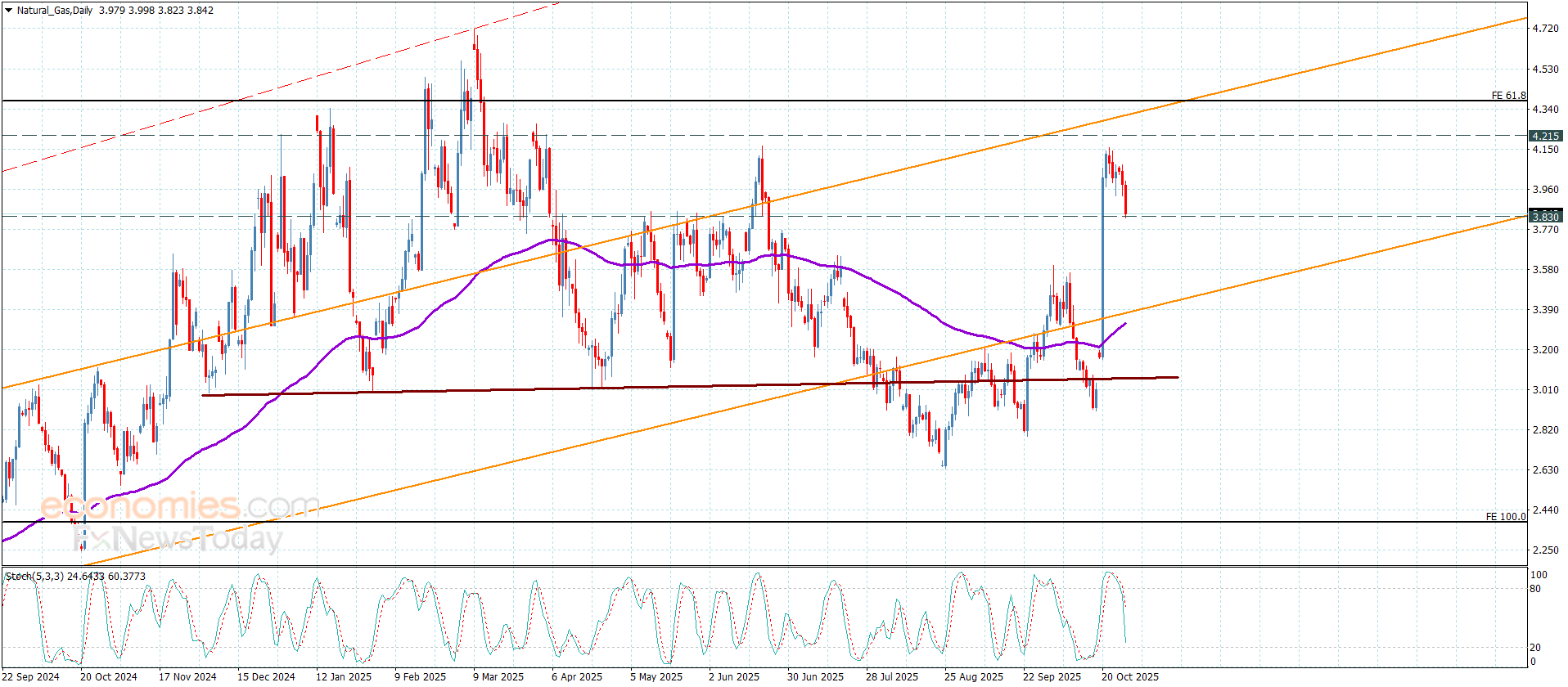
So far, bullish momentum has improved following the breakout as indicated by the long green candles the past two days. The next target zone is rapidly coming into sight, ranging from $4.08 to $4.17. It includes the completion of two rising ABCD patterns and a 61.8% Fibonacci retracement. Nonetheless, a more significant price level is up at $4.25, as it is a lower swing high that established the right shoulder of a recent head and shoulders topping pattern.
Reclaiming that price level would trigger a bullish reversal signal as the price structure of the prior downtrend would be violated. A daily close above $4.25 would increase the chance of natural gas rising above $4.90, the 2025 high. If that price level can be exceeded, then there are two measurements pointing to a price zone from $4.35 to $4.37, as the next target.
Channel Points to Higher Targets
A rising parallel trend channel is shown on the chart with the low of channel established from two recent swing lows (A, C). Since natural gas has been rising from the lower channel line, there is the potential that it could eventually reach the top line before the current portion of rally is complete. That possibility increases the chance that the $4.35 price zone might be reached, as well as the 78.6% retracement at $4.46. Notice that the lower target would be hit before natural gas reached the top channel line.
Weekly 200 Moving Average Breakout
It is also interesting to note that the long-term 200-Week MA, now at $3.93, was reclaimed this week. Since the bearish trigger in early-April, natural gas has traded below the 200-Week line. There was an attempt to hold a breakout above that line starting in December, but it failed and led to the recent bearish correction. Prior to December, natural gas traded below the 200-Week line since January 2023. So, another reclaim could set the stage for a successful breakout.
For a look at all of today’s economic events, check out our economic calendar.
Global trade tensions and the Middle East crisis underpin the bright metal.
The looming Federal Reserve announcement is likely to rock the US Dollar.
XAU/USD extends its consolidative phase ahead of $3,400 with the risk tilt to the upside.
Spot Gold hovers around $3,390 a troy ounce on Wednesday, unable to attract speculative interest ahead of the United States (US) Federal Reserve (Fed) monetary policy announcement.
Still, the bright metal remains afloat amid global tensions. Concerns revolve around trade talks and the Middle East crisis, with no progress at any front. On the one hand, US President Donald Trump “complained” about tough negotiations with the European Union and Japan. On the other hand, tit-for-tat missile attacks between Iran and Israel entered their sixth consecutive day, with no signs of de-escalation.
The Fed is widely anticipated to keep interest rates on hold, with the focus on the Summary of Economic Projections (SEP) and Chairman Jerome Powell’s press conference. Policymakers will deliver fresh growth, inflation and employment expectations, alongside their estimate on future interest rate cuts. Currently, the latest SEP indicates that Fed officials are still aiming for two cuts in 2025. Any change in such perspective could have a wild impact on the US Dollar (USD).
XAU/USD short-term technical outlook
The daily chart for the XAU/USD pair shows it failed to attract investors for a second day in a row. Also, technical indicators remain well above their midlines, although without directional strength. Finally, XAU/USD develops above all its moving averages, with the 20 Simple Moving Average (SMA) heading marginally higher at around $3,347.10 while holding far above bullish 100 and 200 SMAs.
The near-term picture is neutral. In the 4-hour chart, technical indicators turned marginally higher yet mixed at around their midlines, unable to confirm a leg north. At the same time, XAU/USD develops below a mildly bearish 20 SMA, while the longer moving averages aim modestly higher, well below the current level.
The EURJPY pair recorded some extra gains by hitting 167.60 level, which forces it to form a temporary correctional rebound, affected by a stochastic attempt to exit the overbought level, providing chances for catching its breath and gathering the gains by reaching 166.70.
The price keeps providing mixed trading, but its repeated stability within the bullish channel’s levels and forming extra support at 166.00 level, so these factors make us keep the main bullish suggestion, which might target 168.00 level in the near period trading reaching the resistance level at 168.90.
The expected trading range for today is between 165.95 and 167.45
Trend forecast: Fluctuated within the bullish track
Silver breaks above $36.90 and resumes its broader positive trend. Precious metals rally on safe-haven demand amid geopolitical tensions. XAG/USD’s next resistance area is now at $37.85.
Silver (XAG/USD) broke above the top of a descending channel from early-June highs, favoured by higher safe-haven demand on risk-off markets, and has confirmed a bullish flag.
The fundamental context remains supportive with safe assets favoured as the war between Israel and Iran extends, with the US President Trump tempted to jump in and turn it into a regional conflict of unforeseeable consequences. Precious metals are likely to remain buoyant until geopolitical tensions ease.
The focus today is on the Federal Reserve, which is highly likely to keep interest rates on hold but will release fresh economic and interest rate projections that may have a significant impact on the US Dollar.
XAG/USD: The next resistance is at $37.85
From a technical perspective, the 4-hour chart shows that the pair ended its correction from June 9 highs on Tuesday, breaking above the $36.90 level and resuming the broader bullish trend
The next resistance level is now at the 161.8% Fibonacci extension of the June 9 to June 11 correction is at $37.85. Above here, the next target is the area between the 261.8% extension of the mentioned range, at $39.35, and the Bullish Flag’s measured target, at $39.55.
The 4-Hour RSI is reaching overbought levels, which might lead to some consolidation or a correction. The previous resistance, at $36.90, and the reverse trendline, now at $36.50, are likely to act as support.
XAG/USD 4-Hour Chart
Silver FAQs
Silver is a precious metal highly traded among investors. It has been historically used as a store of value and a medium of exchange. Although less popular than Gold, traders may turn to Silver to diversify their investment portfolio, for its intrinsic value or as a potential hedge during high-inflation periods. Investors can buy physical Silver, in coins or in bars, or trade it through vehicles such as Exchange Traded Funds, which track its price on international markets.
Silver prices can move due to a wide range of factors. Geopolitical instability or fears of a deep recession can make Silver price escalate due to its safe-haven status, although to a lesser extent than Gold’s. As a yieldless asset, Silver tends to rise with lower interest rates. Its moves also depend on how the US Dollar (USD) behaves as the asset is priced in dollars (XAG/USD). A strong Dollar tends to keep the price of Silver at bay, whereas a weaker Dollar is likely to propel prices up. Other factors such as investment demand, mining supply – Silver is much more abundant than Gold – and recycling rates can also affect prices.
Silver is widely used in industry, particularly in sectors such as electronics or solar energy, as it has one of the highest electric conductivity of all metals – more than Copper and Gold. A surge in demand can increase prices, while a decline tends to lower them. Dynamics in the US, Chinese and Indian economies can also contribute to price swings: for the US and particularly China, their big industrial sectors use Silver in various processes; in India, consumers’ demand for the precious metal for jewellery also plays a key role in setting prices.
Silver prices tend to follow Gold’s moves. When Gold prices rise, Silver typically follows suit, as their status as safe-haven assets is similar. The Gold/Silver ratio, which shows the number of ounces of Silver needed to equal the value of one ounce of Gold, may help to determine the relative valuation between both metals. Some investors may consider a high ratio as an indicator that Silver is undervalued, or Gold is overvalued. On the contrary, a low ratio might suggest that Gold is undervalued relative to Silver.
Silver (XAG/USD), meanwhile, held firmer, trading at $37.24 after touching an intraday high of $37.26. The white metal continues to benefit from robust industrial demand and remains supported by persistent safe-haven flows, particularly as rate expectations soften.
Fed Policy Outlook Takes Center Stage Amid Weak Data
Traders are focused on the Fed’s policy announcement later today, especially after a string of disappointing economic releases. U.S. retail sales dropped 0.9% month-over-month in May, while industrial production contracted 0.2%, marking its second decline in three months. Year-over-year retail sales slowed to 3.3%, down from April’s 5.0%.
According to the CME FedWatch Tool, markets are now pricing in roughly 44 basis points of rate cuts by the end of 2025. The 10-year U.S. Treasury yield fell to 4.403%, while real yields dropped five basis points to 2.103%, reflecting growing expectations of monetary easing.
Central Banks Remain Bullish on Gold Reserves
In the longer term, gold remains supported by structural demand. The World Gold Council’s latest survey revealed that 95% of central banks plan to increase their gold reserves within the next 12 months. This trend reinforces a stable demand floor for bullion, especially as global interest in de-dollarization grows.
Additionally, despite the short-term headwinds, analysts at Goldman Sachs reaffirmed their forecast for gold to reach $3,700/oz by year-end and $4,000 by mid-2026, driven by central bank buying and lower real interest rates.
As the Federal Reserve prepares to signal its outlook, investors are bracing for volatility. But for now, gold and silver continue to walk the fine line between policy signals and geopolitical noise.