Heading into next week, if today’s low is broken then the 20-Day line may fail as well on the way to a test of support around the longer term and more significant 200-Day MA, now at $3.45. Notice that the 20-Day MA (purple) is declining towards the 200-Day line. So, the potential drop below the 20-Day MA, if it does occur, is lessened the closer the two lines become.
Trendline Shows Resistance
When considering the rising dashed trendline that was previously the lower line of a rising trend channel, the line has indicated an area of resistance for the past four days. The line previously represented dynamic support and now resistance around the line has been confirmed. Despite several attempts to break above the line, there has not been a daily close above it. Since it is acting as resistance following a seven-day advance, a period of consolidation or a deeper pullback could follow.
Weekly Breakout Confirms Above $3.47
A weekly bull breakout triggered this week on a rally above last week’s high of $3.47. Therefore, the week is set to end with a higher weekly high and higher weekly low. The breakout will be confirmed on a weekly basis with a closing price today above last week’s high. Once the weekly breakout confirms, natural gas should see at least one higher weekly high and low as a continuation, if not more. It is also interesting to note that this week’s low was within the top third of last week’s price. That by itself is a sign of strength. But confirmation of that weekly breakout will be key the weekly closing price could be below the midpoint of the week’s range. That would be a bearish indication.
For a look at all of today’s economic events, check out our economic calendar.
Silver (XAG/USD) is holding firm near $38.00 after hitting a 14-year high earlier this week.
The metal remains supported by an ascending channel on daily and weekly charts.
RSI and ADX on the daily chart are turning higher, signaling a possible return in bullish momentum.
Silver (XAG/USD) is treading water on Friday, with spot prices hovering near $38.25 after marking a fresh 14-year high of $39.13 earlier this week. The metal continues to draw support from a firmly bullish structure, trading within a well-defined ascending channel on both the daily and weekly charts. While momentum has cooled slightly near multi-year highs, the broader technical outlook remains positive, with prices still comfortably positioned above key short-term moving averages.
The 21-day EMA at $37.05 continues to provide dynamic support, while the 50-day EMA near $35.82 offers a solid cushion for any deeper pullbacks.
Although price is consolidating just below the $38.50-$39.00 resistance zone, momentum indicators are beginning to turn higher again. The Relative Strength Index (RSI) eased slightly after nearing overbought territory earlier in the week when Silver hit its 14-year high. However, it has started to slope upward again, currently hovering around 66, pointing to a potential revival in buying interest.
The Average Directional Index (ADX) on the daily chart is also beginning to pick up, suggesting that trend strength may be strengthening after a brief slowdown. These developments indicate that the recent consolidation may be a healthy pause within the broader uptrend, rather than a signal of exhaustion.
Immediate support is seen around $37.00 round number, aligning with the 21-day EMA and marking a key line in the sand for bulls. A break below this level could trigger a deeper pullback, exposing the next support at $35.50, followed by a stronger demand zone near $34.50. On the upside, a sustained move above $39.13 would likely attract fresh buying interest, opening the door for a push toward the psychological $40.00 level and potentially higher.
Silver FAQs
Silver is a precious metal highly traded among investors. It has been historically used as a store of value and a medium of exchange. Although less popular than Gold, traders may turn to Silver to diversify their investment portfolio, for its intrinsic value or as a potential hedge during high-inflation periods. Investors can buy physical Silver, in coins or in bars, or trade it through vehicles such as Exchange Traded Funds, which track its price on international markets.
Silver prices can move due to a wide range of factors. Geopolitical instability or fears of a deep recession can make Silver price escalate due to its safe-haven status, although to a lesser extent than Gold’s. As a yieldless asset, Silver tends to rise with lower interest rates. Its moves also depend on how the US Dollar (USD) behaves as the asset is priced in dollars (XAG/USD). A strong Dollar tends to keep the price of Silver at bay, whereas a weaker Dollar is likely to propel prices up. Other factors such as investment demand, mining supply – Silver is much more abundant than Gold – and recycling rates can also affect prices.
Silver is widely used in industry, particularly in sectors such as electronics or solar energy, as it has one of the highest electric conductivity of all metals – more than Copper and Gold. A surge in demand can increase prices, while a decline tends to lower them. Dynamics in the US, Chinese and Indian economies can also contribute to price swings: for the US and particularly China, their big industrial sectors use Silver in various processes; in India, consumers’ demand for the precious metal for jewellery also plays a key role in setting prices.
Silver prices tend to follow Gold’s moves. When Gold prices rise, Silver typically follows suit, as their status as safe-haven assets is similar. The Gold/Silver ratio, which shows the number of ounces of Silver needed to equal the value of one ounce of Gold, may help to determine the relative valuation between both metals. Some investors may consider a high ratio as an indicator that Silver is undervalued, or Gold is overvalued. On the contrary, a low ratio might suggest that Gold is undervalued relative to Silver.
There are also questions about whether or not Russian gas will ever come back online on the continent. And this may, in the future at least, open up the possibility of higher prices in the off season, if you will, making natural gas extraordinarily supported. That being said, we also have to think about AI and electricity and things like that. So longer term, we may see a little bit of a change in the way the market works at this time of year.
Regardless, and thinking well past all of that, I look at this as a market that you’re still fading rallies in, at least for a couple of months. If we were to break above the previous uptrend line, then we could go looking to the $3.75 level and then possibly $4, which is the top of the overall range. On the downside, the $3.20 level is a potential target. After that, we could look at the $3 level. We’re essentially in the middle of the range, but it does look like we’re getting a bit tired, so I think more downward than upward pressure is present.
For a look at all of today’s economic events, check out our economic calendar.
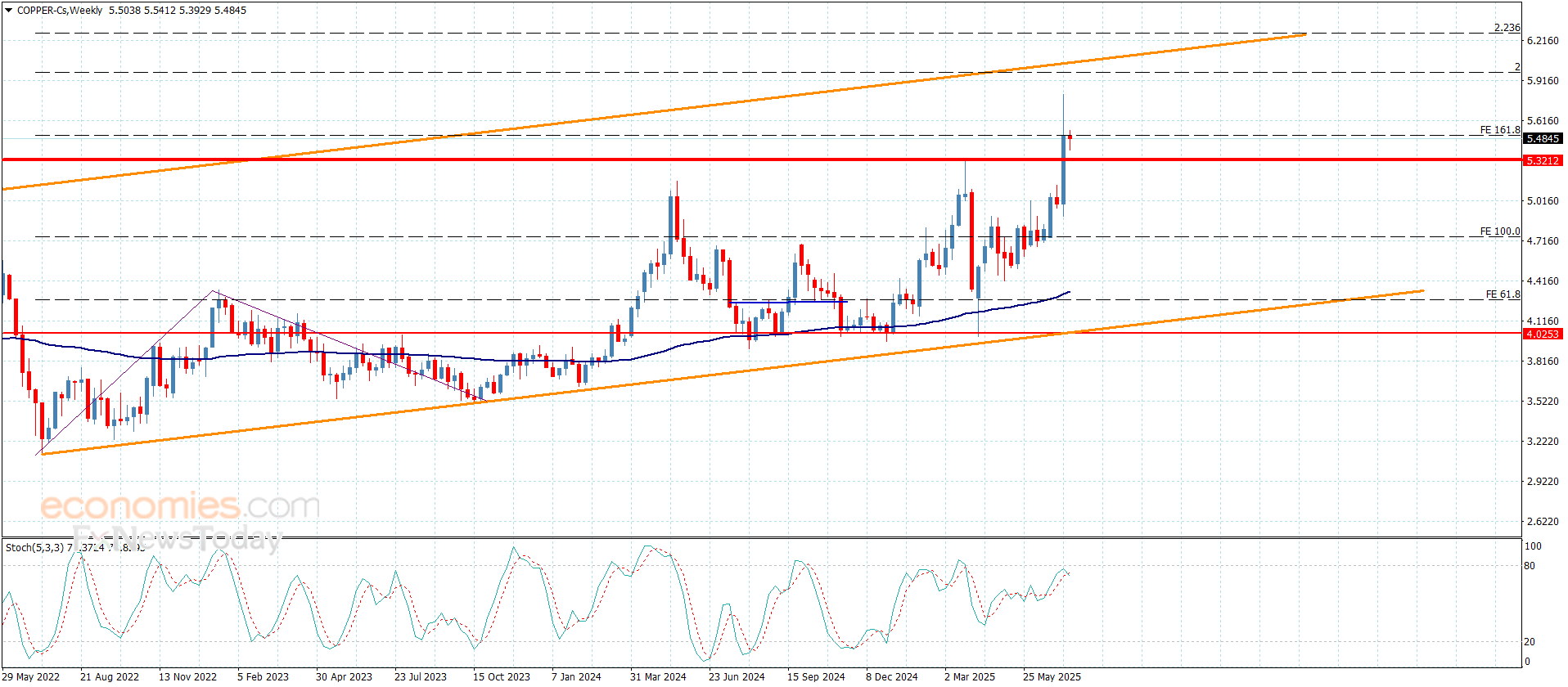
Despite the weakness of copper price trading, its success in holding above support level at $5.3200 reinforces the chances of renewing the bullish rally, by the attempt to provide clear pressures on the barrier at $5.5100.
We recommend waiting to breach the current barrier to open the way towards achieving several gains, which might begin at $5.6700 and $5.9700, while the decline below the support will cancel the bullish suggestion in the near trading, which forces it to suffer some losses by reaching $5.1500 and $4.9800.
The expected trading range for today is between $5.4200 and $5.6700
Despite the weakness of copper price trading, its success in holding above support level at $5.3200 reinforces the chances of renewing the bullish rally, by the attempt to provide clear pressures on the barrier at $5.5100.
We recommend waiting to breach the current barrier to open the way towards achieving several gains, which might begin at $5.6700 and $5.9700, while the decline below the support will cancel the bullish suggestion in the near trading, which forces it to suffer some losses by reaching $5.1500 and $4.9800.
The expected trading range for today is between $5.4200 and $5.6700
Silver extends gains for the third day in a row, buoyed by US Dollar weakness.
Upbeat US corporate earnings and dovish Fedspeak are weighing on the safe-haven US Dollar.
XAG/USD corrective reversal has been capped above previous highs, at the $37.55 area.
Silver (XAG/USD) is rallying for the third consecutive day on Friday, with bulls testing July 15 highs of 38.40 at the time of writing, as the US Dollar falls alongside US Treasury yields amid higher risk appetite.
Corporate earnings reports from Netflix, the Chipmaker TSMC, PepsiCo, and United Airlines, among others, beat market expectations on Thursday, boosting demand for equities and risk-sensitive assets to the detriment of safe havens like the US Dollar.
These reports, coupled with dovish comments from Fed Governour Christopher Waller, who maintained that the bank should cut interest rates in July, citing downside risks for the labour market and economic growth, are contributing to keeping the US Dollar on the defensive on Friday.
Technical Analysis: Correcting lower within a broader bullish trend
From a technical perspective, the pair´s corrective reversal from long-term highs above $39.00 has been capped above the reverse trendline of a previous bullish channel, and the pair is trading higher again.
Bulls are testing the 15 July high at $38.40, with the 4-hour RSI steady at levels above 50, which suggests that further appreciation is likely. A confirmation above that level brings the July 14 high, at $39.15, to the focus. A rejection from current levels, on the contrary, might find support at the mentioned trendline, now at $37.8, ahead of the July 15, 16, and 17 lows, at $37,60. Below here, the 50% Fibonacci retracement of the June-July rally, and the July 6 low, at $37.25, might attract selling pressure.
Silver FAQs
Silver is a precious metal highly traded among investors. It has been historically used as a store of value and a medium of exchange. Although less popular than Gold, traders may turn to Silver to diversify their investment portfolio, for its intrinsic value or as a potential hedge during high-inflation periods. Investors can buy physical Silver, in coins or in bars, or trade it through vehicles such as Exchange Traded Funds, which track its price on international markets.
Silver prices can move due to a wide range of factors. Geopolitical instability or fears of a deep recession can make Silver price escalate due to its safe-haven status, although to a lesser extent than Gold’s. As a yieldless asset, Silver tends to rise with lower interest rates. Its moves also depend on how the US Dollar (USD) behaves as the asset is priced in dollars (XAG/USD). A strong Dollar tends to keep the price of Silver at bay, whereas a weaker Dollar is likely to propel prices up. Other factors such as investment demand, mining supply – Silver is much more abundant than Gold – and recycling rates can also affect prices.
Silver is widely used in industry, particularly in sectors such as electronics or solar energy, as it has one of the highest electric conductivity of all metals – more than Copper and Gold. A surge in demand can increase prices, while a decline tends to lower them. Dynamics in the US, Chinese and Indian economies can also contribute to price swings: for the US and particularly China, their big industrial sectors use Silver in various processes; in India, consumers’ demand for the precious metal for jewellery also plays a key role in setting prices.
Silver prices tend to follow Gold’s moves. When Gold prices rise, Silver typically follows suit, as their status as safe-haven assets is similar. The Gold/Silver ratio, which shows the number of ounces of Silver needed to equal the value of one ounce of Gold, may help to determine the relative valuation between both metals. Some investors may consider a high ratio as an indicator that Silver is undervalued, or Gold is overvalued. On the contrary, a low ratio might suggest that Gold is undervalued relative to Silver.
The EURJPY pair kept its stability above the breached bullish channel’s resistance, which forms an extra support at 172.10, forming a new bullish rally and its fluctuation near 173.00 level.
Note that monitoring the price behavior after achieving the target at 173.40, due to the continuation of stochastic contradiction by its fluctuations below 80 level, and surpassing this level is important to reinforce the chances for resuming the bullish attack and reaching new positive stations that might extend to 173.85 and 174.40, while activating the bearish correctional track requires a sharp decline to settle below 172.00.
The expected trading range for today is between 172.10 and 173.85.
Today’s behavior shows improving demand for gold and possibly the completion of another test of the lower uptrend line across the bottom of a developing bull pennant pattern. Therefore, the short-term pullback is likely complete. A daily close above the 20-Day MA will confirm strength indicated by the reclaim of the 20-Day line.
Moreover, the day is set to end with a potentially bullish hammer candlestick pattern. Although it is not distinct at the bottom of a downtrend, it does provide another piece of bullish evidence. Also, the one-day pattern, which indicates an intraday bullish reversal, can be used to alert a short-term bullish indication on a rise above the high for the day, currently at $3,352.
Potential Bull Pennant Breakout
It is important to understand however, that a hammer breakout would be happening inside a five-day price range, which may impact the response. On Wednesday, gold triggered an upside breakout of a 16-day relatively tight price range and reached a new high for the range at $3,377. The breakout failed to follow through and led to the drop to a six-day low of $3,310 today.
That high was a three-week high. So, a breakout above $3,377 will confirm a multi-week bull breakout. Of course, this would be a bullish sign and put gold in site of the top line at the top of the pennant pattern. That could lead to the pennant triggering an upside-breakout, or a consolidation of some degree first.
Weekly Trend Improves
With Wednesday’s rally a higher weekly high was established, and a higher low will be completed today. This is the second week for the pattern, and it shows improving demand. Although a break above the top trendline triggers the pennant, a more significant signal would be above the lower swing high at $3,451. An initial upside target is at $3,578, indicated by a rising ABCD pattern.
For a look at all of today’s economic events, check out our economic calendar.
Forecast models remain in alignment on increasingly hot conditions for the second half of July, particularly across the eastern two-thirds of the U.S. NatGasWeather noted that the next five days will carry solid demand due to widespread heat, while days 6–15 show a “decisively hotter” outlook.
Temperatures are expected to surge into the 90s along the East Coast and hit triple digits in California and the Southwest, with modest cooling only in the northern third of the country.
These heat-driven forecasts are boosting near-term demand expectations for electricity generation, increasing the call on gas-fired power.
On Wednesday, August Nymex natural gas settled up $0.028 (+0.79%) at a new two-week high. The rally has been fueled by stronger air conditioning load and steady LNG exports, which climbed slightly to 15.1 bcf/day, according to BNEF.
Can Traders Trust the EIA Storage Signal This Week?
Attention is now turning to Thursday’s EIA storage report for the week ended July 11, which is expected to show a +45 bcf injection—above the five-year average of +41 bcf.
However, analysts are treating the print as “tricky,” factoring in distortions from the Fourth of July holiday and weaker wind generation. Last week’s inventory build of +53 bcf was bullish, falling below expectations and aligning with seasonal norms.
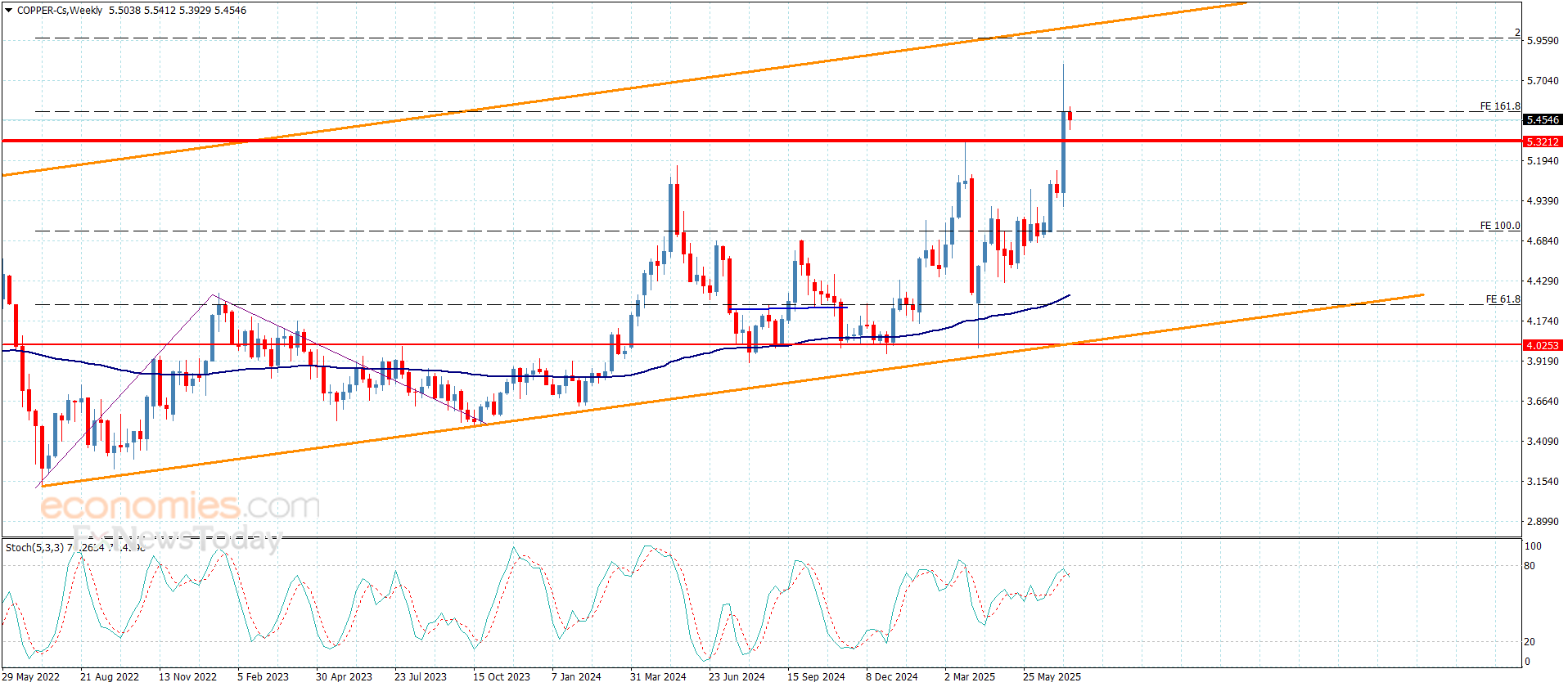
No news for copper price, it remains confined between $5.3200 support and $5.5100 level which represents an extra barrier against the bullish attempts, and the contradiction between the main indicators confirming delaying the bullish attempts, to recommend neutrality and wait for surpassing these levels to detect the expected targets in the near trading.
Trading success in surpassing the barrier and holding above it will reinforce the dominance of the bullish bias, which might target $5.6700, while breaking the support will force it to form bearish correctional waves, to expect reaching $5.1500 and $4.9800.
The expected trading range for today is between $5.3100 and $5.5100