The main tag of Gold News Today Articles.
You can use the search box below to find what you need.
[wd_asp id=1]

11 09, 2024

XAU/USD buyers try their luck again heading into US inflation showdown

By |2024-09-11T10:59:09+03:00September 11, 2024|Forex News, News|0 Comments


  • Gold price preserves recent gains above $2,500 on US CPI inflation day.
  • The US Dollar tracks USD/JPY sell-off amid weak US Treasury bond yields and risk-off flows.
  • Gold buyers look to retest record highs at $2,532 after defending 21-day SMA. The daily RSI stays bullish.

Gold price is consolidating a two-day uptrend above $2,500 in Wednesday’s Asian trading. Gold buyers take a breather, with the next directional move likely triggered by the critical US Consumer Price Index (CPI) data due later this Wednesday.

Gold price risks a big reaction to US CPI data

Gold traders have tuned on the sidelines, refraining from placing fresh bets before the US inflation test, which could confirm the size of the US Federal Reserve (Fed) interest rate cut next week. The data is critical to determining the next direction in Gold price, as it hangs close to the record high of $2,532 set on August 20.

US CPI is seen rising 2.6% YoY in August after recording a 2.9% increase in July. The core CPI inflation is expected to hold steady at 3.2% YoY in the same period. Meanwhile, the monthly headline and core CPIs are set to rise 0.2%, at the same pace as seen previously.

An upside surprise to the annual and monthly inflation readings could trigger a fresh US Dollar recovery at the expense of the Gold price, washing out expectations of an outsized Fed rate cut. Conversely, a softer-than-expected headline and core annual CPI data could revive 50 basis points (bps) Fed rate reduction bets, slamming the US Dollar (USD) while propelling Gold price to fresh lifetime highs.

Markets are currently pricing in a 33% chance of a 50 bps rate cut move while the odds of a 25 bps rate cut stand at 67%, the CME Group’s FedWatch Tool shows.

In the lead-up to the US CPI showdown, Gold price stays supported by renewed selling in the US Dollar, courtesy of the steep USD/JPY sell-off. The Japanese Yen spiked to fresh eight-month highs against the USD near 141.50 after the hawkish remarks from Bank of Japan (BoJ) board member Junko Nagakawa. The policymaker signaled the bank’s readiness to hike rates further, highlighting the policy divergence between the Fed and the BoJ.

Meanwhile, the first US Presidential debate between former President Donald Trump and Democratic nominee Kamala Harris in Pennsylvania failed to have any significant impact on the financial markets, as investors traded with caution and scurried to the safety of the US government bonds. This weighed negatively on the US Treasury bond yields, allowing Gold price to stay on the front foot.

Gold price technical analysis: Daily chart

Nothing seems to have changed for Gold price from a short-term technical perspective. Buyers continue to stay hopeful as Gold price managed to close above the 21-day Simple Moving Average (SMA), now at $2,503, for the second day in a row on Tuesday.  

The 14-day Relative Strength Index (RSI) points higher once again while well above the 50 level, justifying the bullish potential.

Gold buyers now aim for a sustained breakthrough the record high of $2,532, above which the $2,550 psychological level will come into play.

If Gold price faces rejection once again near the $2,530 supply zone, a correction would ensue, with a daily closing below the 21-day SMA at $2,503 needed to negate the bullish outlook in the near term.

A breach of the latter will challenge the previous week’s low of $2,472, followed by the symmetrical triangle resistance-turned-support at $2,462.   

Economic Indicator

Consumer Price Index (YoY)

Inflationary or deflationary tendencies are measured by periodically summing the prices of a basket of representative goods and services and presenting the data as The Consumer Price Index (CPI). CPI data is compiled on a monthly basis and released by the US Department of Labor Statistics. The YoY reading compares the prices of goods in the reference month to the same month a year earlier.The CPI is a key indicator to measure inflation and changes in purchasing trends. Generally speaking, a high reading is seen as bullish for the US Dollar (USD), while a low reading is seen as bearish.

Read more.


Source link

11 09, 2024

Is Copper A Winning or Losing Bet Right Now?

By |2024-09-11T08:58:29+03:00September 11, 2024|Forex News, News|0 Comments


The red-hot copper rally has cooled off in recent weeks, with prices pulling back from their May all-time high to close below $9,000/t. Just like in the oil markets, sentiment in copper markets has weakened, driven by weak U.S. manufacturing and labor market data, soft China data, and a sizable build in LME inventories. 

Last week, Goldman Sachs downgraded its copper price forecast, due to weakening demand from China. GS now sees copper prices averaging $10,100 per metric ton in 2025, a sharp reduction from its previous forecast of $15,000. Further, Australian mining giant BHP Group (NYSE:BHP) recently downgraded its forecast for China’s copper demand amid concerns about the country’s economic recovery. 

Thankfully for the bulls, the long-term copper outlook remains robust. A couple of months ago, Swiss multinational commodity trading company Trafigura predicted that EVs, Artificial Intelligence (AI), power infrastructure, and automation boom will drive at least 10 million metric tons of additional copper demand by 2035, According to Graeme Train, Trafigura’s head of metals analysis, one third of the 10 million tons of new demand will come from the electric vehicle sector, “A third is electricity generation, transmission and distribution, and the rest is for things like automation, manufacturing capex and cooling systems within data centers,” he said. 

Saad Rahim, Trafigura’s chief economist, has projected that AI alone has the potential to add one million tonnes per annum of copper demand by 2030.

Related: Rystad: Germany Set to Generate 80% of Its Electricity With Renewables by 2030

Jeff Currie, Chief Strategy Officer at The Carlyle Group and former Global Head of Commodities Research at Goldman Sachs, has declared that copper is the new oil and the best trade he has seen in his career. The analyst has pointed out that copper has long been touted as a big winner from the world’s drive towards electrification including electric vehicles and huge grid upgrades. At the same time, Currie notes that it takes years for new copper mining capacity to actually come onstream. However, copper prices have, unexpectedly, pulled back sharply several times over the past two years. Currie says this has created a mismatch between short-term prices and long-term supply, making copper his highest-conviction trade ever.

Meanwhile, a recent study, published by the International Energy Forum (IEF) says the EV revolution alone will drive enough copper demand to outstrip supply in the next couple of decades. According to IEF, current projections show that copper production will increase 82% to hit a massive 37.1 million tonnes by 2050; however, supply will need to increase by an extra 55% to power an all-EV global fleet– equating to the establishment of 194 new mines or six each year till 2050. With an estimated 6.66bn tonnes of global copper resources identified, copper scarcity is not the main issue here, rather than the fact that it takes ~23 years to turn a copper discovery into a functioning mine. The lengthy development time suggests the world is facing a near-impossible task to develop enough mines to meet demand in the available timeframe.

Source: Mining.com

The report, however, notes that if copper recycling remains constant at its 2018 level rather than increasing as assumed, 43 new mines will need to come online every year, with the copper demand gap clocking in at 8.1 million tonnes in 2035 and 9.6 million tonnes in 2040.

It is worth noting that the study used the same methods to arrive at this dire picture as the one used by American geologist M. King Hubbert to accurately predict 30 years of U.S. oil production. However, Hubbert’s model broke when technologies such as hydraulic fracturing, directional drilling and Enhanced Oil Recovery (EOR) made it possible to produce natural gas and crude oil from shale and expanded the hydrocarbon resource. This offers the world a narrow window to expedite the process of bringing new copper mines online.

Hybrids A Potential Solution

IEF has also offered another way to ditch efforts to replace fossil fuel-powered vehicles with all-electric vehicles and instead replace them with hybrids.

There is remarkably little difference between the amount of copper needed to manufacture hybrid electric rather than ICE vehicles,” with the researchers pointing out that hybrid electric vehicles require 29 kg of copper compared to 24 kg for an ICE (internal combustible engine) vehicle.  “It would therefore be judicious to aim for a transition to the 100% manufacture of hybrid electric vehicles by 2035, rather than transitioning to the 100% manufacture of battery electric vehicles, which require 60 kg. The copper required for this transition is only slightly above baseline and does not require major grid improvements,” the report’s authors said. 

Fossil fuel investors will no doubt be pleased to know that hybrids remain incredibly popular in this age where pure EVs have become dominant, a full 25 years since Toyota Motor Corp. (NYSE:TM) launched the Prius. Nearly 3 million hybrid EVs were sold in 2022, good for nearly 30% of all EVs sold. Hybrids remain popular because they make considerable savings on gas and cut their carbon footprint without the attendant charging anxiety that comes with pure EVs. 

In a hybrid car, there is an ICE component and an electric motor, with battery-stored energy. However, a hybrid can’t be plugged in to charge. Instead, it is charged by the regenerative braking of the internal combustion engine. The extra power provided by the electric motor can potentially allow for a smaller engine, adding some environmental benefits. The battery can also power auxiliary loads and reduce engine idling when stopped, according to the Alternative Fuels Data Center.  

By Alex Kimani for Oilprice.com

More Top Reads From Oilprice.com

  • Russia Is Losing Its Grip on Central Asia
  • Saudi Arabia Cuts Oil Prices
  • Permian Basin Gas Pipeline Capacity Set to Increase with New Projects

Read this article on OilPrice.com

This story originally appeared on Oilprice.com


Source link

11 09, 2024

XAG/USD holds ground near $28.00 due to rising odds of Fed rate cuts

By |2024-09-11T06:57:19+03:00September 11, 2024|Forex News, News|0 Comments


  • Silver price appreciates as weak US labor data raises the odds of a Fed rate cut at its September meeting.
  • CME FedWatch Tool suggests fully pricing in at least a 25 basis point Fed rate cut in September.
  • Chicago Fed President Goolsbee stated that Fed officials are starting to align with the broader market’s sentiment of rate adjustment.

Silver price (XAG/USD) inches higher to near $28.00 per troy ounce during the Asian session on Monday. The non-yielding assets like Silver gains ground as weak US jobs data increase the likelihood of a 25 basis-point rate cut by the Federal Reserve (Fed) at its September meeting.

The US Bureau of Labor Statistics (BLS) reported that Nonfarm Payrolls (NFP) added 142,000 jobs in August, below the forecast of 160,000 but an improvement from July’s downwardly revised figure of 89,000. Meanwhile, the Unemployment Rate fell to 4.2%, as expected, down from 4.3% in the previous month.

Lower interest rates tend to benefit Silver by reducing the opportunity cost of holding non-yield-bearing bullion assets.  According to the CME FedWatch Tool, markets are fully anticipating at least a 25 basis point (bps) rate cut by the Federal Reserve at its September meeting.

Additionally, Chicago Fed President Austan Goolsbee remarked on Friday that Fed officials are starting to align with the broader market’s sentiment that a policy rate adjustment by the US central bank is imminent, according to CNBC.

FXStreet’s FedTracker, which uses a custom AI model to evaluate Fed officials’ speeches on a dovish-to-hawkish scale from 0 to 10, rated Goolsbee’s comments as dovish, assigning them a score of 3.2.

The potential gains for Silver might be limited due to safe-haven flows, given the recent easing of geopolitical tensions in the Middle East. Israeli forces have withdrawn from Jenin, according to Reuters citing the Palestine news agency WAFA.

Silver FAQs

Silver is a precious metal highly traded among investors. It has been historically used as a store of value and a medium of exchange. Although less popular than Gold, traders may turn to Silver to diversify their investment portfolio, for its intrinsic value or as a potential hedge during high-inflation periods. Investors can buy physical Silver, in coins or in bars, or trade it through vehicles such as Exchange Traded Funds, which track its price on international markets.

Silver prices can move due to a wide range of factors. Geopolitical instability or fears of a deep recession can make Silver price escalate due to its safe-haven status, although to a lesser extent than Gold’s. As a yieldless asset, Silver tends to rise with lower interest rates. Its moves also depend on how the US Dollar (USD) behaves as the asset is priced in dollars (XAG/USD). A strong Dollar tends to keep the price of Silver at bay, whereas a weaker Dollar is likely to propel prices up. Other factors such as investment demand, mining supply – Silver is much more abundant than Gold – and recycling rates can also affect prices.

Silver is widely used in industry, particularly in sectors such as electronics or solar energy, as it has one of the highest electric conductivity of all metals – more than Copper and Gold. A surge in demand can increase prices, while a decline tends to lower them. Dynamics in the US, Chinese and Indian economies can also contribute to price swings: for the US and particularly China, their big industrial sectors use Silver in various processes; in India, consumers’ demand for the precious metal for jewellery also plays a key role in setting prices.

Silver prices tend to follow Gold’s moves. When Gold prices rise, Silver typically follows suit, as their status as safe-haven assets is similar. The Gold/Silver ratio, which shows the number of ounces of Silver needed to equal the value of one ounce of Gold, may help to determine the relative valuation between both metals. Some investors may consider a high ratio as an indicator that Silver is undervalued, or Gold is overvalued. On the contrary, a low ratio might suggest that Gold is undervalued relative to Silver.


Source link

11 09, 2024

Oil settles near 3-year low on weak demand outlook

By |2024-09-11T04:56:39+03:00September 11, 2024|Forex News, News|0 Comments


  • Brent futures settle below $70 for first time since December 2021
  • OPEC revises down world oil demand for 2024, 2025
  • Tropical Storm Francine causes offshore production shut-ins
  • Investors await EIA weekly oil stock data at 10:30 a.m. EDT (1430 GMT) on Wednesday

HOUSTON, Sept 10 (Reuters) – Global oil benchmark Brent crude futures settled at their lowest level since December 2021 on Tuesday, after OPEC+ revised down its demand forecast for this year and 2025, offsetting supply concerns from Tropical Storm Francine.

Brent crude futures settled down $2.65, or 3.69%, at $69.19 a barrel. U.S. West Texas Intermediate (WTI) crude settled down $2.96, or 4.31%, to $65.75 a barrel.

Both benchmarks dropped by more than $3 during the session, after each rose by about 1% on Monday. WTI crude futures fell more than 5% on Tuesday, hitting their lowest levels since May 2023.

On Tuesday, the Organization of the Petroleum Exporting Countries (OPEC) in a monthly report said world oil demand would rise by 2.03 million barrels per day (bpd) in 2024, down from last month’s forecast for growth of 2.11 million bpd.

Until last month, OPEC had kept the forecast unchanged since it was first made in July 2023.

OPEC also cut its 2025 global demand growth estimate to 1.74 million bpd from 1.78 million bpd. Prices slid on the weakening global demand prospects and expectations of oil oversupply.

Separately, the U.S. Energy Information Administration (EIA) on Tuesday said global oil demand is set to grow to a bigger record this year while output growth will be smaller than prior forecasts.

Global oil demand is expected to average around 103.1 million barrels per day this year, the EIA said, some 200,000 bpd higher than its previous forecast of 102.9 million bpd.

Oil prices remained depressed after the EIA forecast release, as concerns about China continued to weigh on prices.

Data released on Tuesday showed China’s exports grew in August at their fastest in nearly 1-1/2 years, but imports disappointed with domestic demand depressed.
Meanwhile, Asian refiners’ margins fell to their lowest seasonal level since 2020 last week on rising supplies of diesel and gasoline.

“There’s almost no oil demand growth in the advanced economies this year. Fiscal stimulus in China has not boosted the construction sector; that’s one big reason Chinese demand for diesel is shrinking,” said Clay Seigle, an oil market strategist.

Investors are increasingly pricing in a slowing global economy, according to Phil Flynn, a senior analyst at Price Futures Group.

Energy stocks were the biggest loser among the S&P 500 sectors on Tuesday. Hess (HES.N), opens new tab, Chevron (CVX.N), opens new tab, Occidental Petroleum (OXY.N), opens new tab, Halliburton (HAL.N), opens new tab, SLB (SLB.N), opens new tab, Ovintiv (OVV.N), opens new tab, Devon Energy (DVN.N), opens new tab, all set new intraday 52-week lows on Tuesday.

STORM HITS U.S. OUTPUT

Meanwhile, Tropical Storm Francine barrelled across the Gulf of Mexico driving operators to shut in around a quarter of offshore crude production, the U.S. Bureau of Safety and Environmental Enforcement said on Tuesday.

The U.S. Gulf of Mexico accounts for about 15% of all domestic oil production and 2% of natural gas output, according to federal data.

The storm was on track to become a hurricane on Tuesday, the U.S. National Hurricane Center said.

Exxon Mobil (XOM.N), opens new tab, Shell (SHEL.L), opens new tab and Chevron (CVX.N), opens new tab have removed offshore staff and halted some Gulf of Mexico oil and gas operations.

So far, production shut-ins have failed to offset weak demand sentiment and support prices, analysts said.

Meanwhile, U.S. crude oil and gasoline inventories fell while distillates rose last week, according to market sources citing American Petroleum Institute figures on Tuesday.

The API figures showed crude stocks fell by 2.793 million barrels in the week ended Sept. 6, the sources said, speaking on condition of anonymity. Gasoline inventories fell by 513,000 barrels, and distillates rose by 191,000 barrels.

Investors await weekly oil stock data from the EIA, published at 10:30 a.m. EDT (1430 GMT) on Wednesday.

Sign up here.

Reporting by Georgina McCartney in Houston, Ahmad Ghaddar in London
Additional reporting by Katya Golubkova in Tokyo, Florence Tan in Singapore and Arunima Kumar in Bengaluru
Editing by Emelia Sithole-Matarise, Nick Zieminski and Matthew Lewis

Our Standards: The Thomson Reuters Trust Principles., opens new tab

Purchase Licensing Rights


Source link

11 09, 2024

XAU/USD holds modest intraday gains above $2,510

By |2024-09-11T02:55:25+03:00September 11, 2024|Forex News, News|0 Comments


XAU/USD Current price: $2,514.13

  • Upcoming first-tier events in the United States and central banks’ announcements spur caution.
  • US Treasury yields touched fresh one-year lows and aim to extend their slides.
  • XAU/USD consolidates gains above $2,500 with a neutral technical stance.

Gold extended its recovery on Tuesday, trading around $2,513 a troy ounce mid-US session. Financial markets turned risk-averse ahead of first-tier events, resulting in a firmer US Dollar against major rivals except for safe-haven ones. Gold, the Swiss Franc and the Japanese Yen post modest advances vs the American currency as Wall Street dipped.

There has not been a specific catalyst for the souring mood, but caution ahead of the release of the United States (US) Consumer Price Index (CPI) on Wednesday and the European Central Bank (ECB) monetary policy decision on Thursday. About the first, market players are expecting easing price pressures, yet inflation holds above the Federal Reserve (Fed) goal of around 2%. Nevertheless, the Fed is scheduled to announce its decision on monetary policy next week and most likely trim interest rates by 25 basis points (bps).

Meanwhile, US Treasury yields retreat. The 10-year note offers 3.66% after bottoming at 3.64%, a fresh 52-week low. The same happens with the 2-year note, now yielding 3.62% after bottoming at 3.59%.

XAU/USD short-term technical outlook  

The daily chart for XAU/USD offers a neutral-to-bullish stance, with the pair still meeting intraday buyers around a bullish 20 Simple Moving Average (SMA). Technical indicators, in the meantime, lack directional strength, with the Momentum indicator stuck around its 100 line and the Relative Strength Index (RSI) indicator consolidating at around 58. Finally, the 100 and 200 SMAs keep grinding higher, far below the current level, limiting the bearish potential in the wider perspective.

For the near term, the 4-hour chart offers a neutral stance. XAU/USD trades above its 20 and 100 SMAs, while the 200 SMA advances far below the current level. Technical indicators have turned flat, reflecting the absence of directional conviction, although the fact that the RSI indicator stands at 56 suggests bears have no interest in Gold.

Support levels: 2,507.60 2,489.60 2,475.70  

Resistance levels:  2,519.75 2,531.60 2,545.00 


Source link

11 09, 2024

Natural Gas Price Forecast: Rallies Towards Bullish Breakout, Testing 200-Day MA

By |2024-09-11T00:54:53+03:00September 11, 2024|Forex News, News|0 Comments


Second Rise Above 200-Day Moving Average

Last week natural gas exceeded the 200-Day MA and closed above it for the first time in 10 weeks. That set the stage for further strengthening. Another breakout above the 200-Day, now at 2.25, that is retained, prepares natural gas for a breakout from a bullish double bottom pattern. Notice that today’s advance exceeded the 200-Day line but at the time of this writing, natural gas is trading below the line and not on track to close above it.

Waiting Breakout of Double Bottom

A bull breakout of a double bottom pattern will trigger on a decisive rally above 2.30. That will also confirm a bull continuation of the developing uptrend as a violation of the 2.30 swing high presents a higher swing high and that goes with an uptrend. Also, the purple 20-Day MA is close to crossing above the orange 50-Day MA. A bullish crossover of the 20-Day line above the 50-Day line will confirm underlying strength in the price of natural gas and supports the likelihood of a rise to higher targets in the near term.

Pattern Points to 2.72

Following a double bottom breakout natural gas heads towards the target from measuring the pattern at 2.72. And eventually it may be heading towards a potential test of resistance around the downtrend line. The line is close to the 78.6% retracement level at 2.89. It marks the second higher potential target price zone following a breakout of the double bottom pattern. The first resistance zone following an upside breakout is likely from 2.47 to 2.52, consisting of a prior interim swing low and the 50% retracement, respectively.

For a look at all of today’s economic events, check out our economic calendar.


Source link

10 09, 2024

Oil Prices Drop 4.5% On Record-Bearish Sentiment from Money Managers

By |2024-09-10T22:53:56+03:00September 10, 2024|Forex News, News|0 Comments


WTI crude futures fell 4.5% on Tuesday morning as hedge funds and money managers continued to sour on crude oil.

Bearish Sentiment on Oil Still Yet to Hit Bottom

– Hedge funds and other money managers have turned the most bearish on crude ever since the CFTC started to publish information on market positioning, with Brent and WTI net longs totaling a mere 139,242 lots in the week ended September 3.  

– As the oil market gathered in Singapore this week for the annual Appec conference, Trafigura head of oil trading Ben Luckock said oil would dip into the 60s soon, depressed by weakening demand in China. 

– US investment Citi lowered its 2025 price forecast to a mere 60 per barrel, prompting a general downward revision of outlooks as Morgan Stanley and the Bank of America both slashed its expectations to $75 per barrel.

– Crude oil futures could potentially flip into contango over the upcoming period as the ICE Brent 36-month spread between the November 2024 and November 2027 contracts shrank to a mere $2 per barrel, down from $9 per barrel a month ago.

Market Movers

– A blaze at Mexico’s largest refinery, the 330,000 b/d Salina Cruz refinery operated by national oil company Pemex, killed two workers as a fire broke out after a truck bumped into refinery waste that surfaced after rain overflowed the sewers. 

– Canada’s pipeline operator Pembina Pipeline (TSO:PPL) agreed to buy infrastructure assets in Alberta’s Montney basin from oil producer Veren for $300 million, in yet another instance of M&A in the midstream segment. 

– US oil major ExxonMobil (NYSE:XOM) has reportedly renounced on the idea of buying half of Galp Energia’s (ELI:GALP) stake in the allegedly huge Mopane offshore discovery in Namibia, potentially wielding 10 billion barrels of oil equivalent. 

Tuesday, September 10, 2024

Not even a forming hurricane in the US Gulf of Mexico could halt the decline in oil prices, with ICE Brent dipping below $70 per barrel and marking the lowest level it has been since late 2021. Defying OPEC+’s postponement of output increases and the Libyan oil embargo, oil prices continue to edge lower on fears of oversupply and an ever-weakening Chinese outlook.

OPEC Lowers Its Demand Growth Outlook. Amidst plunging oil prices, OPEC cut its forecast for global oil demand growth in both 2024 and 2025, revising this year’s outlook to a still very ambitious 2.03 million b/d whilst cutting next year’s number marginally lower to 1.74 million b/d.

Storm Francine Triggers Gulf Evacuations. UK-based energy major Shell (LON:SHEL) has paused drilling operations at its Perdido and Whale offshore platforms in the Gulf of Mexico as Tropical Storm Francine, the sixth named storm of the 2024 hurricane season, is headed towards Texas. 

New Regulations Jeopardize US Gulf Production. The American Petroleum Institute warned the US Department of Commerce that if it does not act quickly to publish a new assessment on how to protect endangered species in the Gulf of Mexico, all offshore oil and gas operations could be disrupted. 

Central Europe Exhales Amidst New Deal on Ukraine Transit. Hungary’s oil company MOL said it reached a deal to ensure the continued supply of Russian oil via the Druzhba pipeline that transits Ukraine, changing the delivery point from its own border to the Belarus-Ukraine border. 

Biden Administration Expedites SPR Repurchases. Having purchased 2.5 million barrels of US crude last month for delivery to Bryan Mound in January-March, the US Energy Department bought another 3.4 million barrels to be delivered in the same months at the same time, boosting the pace of SPR replenishment. 

Russia’s Grey Tankers Ignore Danish Pilots. Oil tankers carrying Russian oil as part of its so-called shadow fleet are increasingly refusing to use the service of Danish pilots as they navigate their ships through the Danish straits, increasing the risks of oil spills amidst strong currents and varying depths. 

India Doubles Down on Coal Plants. India’s state-owned coal producer Coal India (NSE:COALINDIA) is planning to invest $8 billion to build coal-fired power plants next to its mines, adding at least 4.7 GW of generation over the next six years as part of a giant 88 GW capacity buildout. 

Italy Revisits Its Nuclear Strategy. Italy is looking to reverse its ban on nuclear power production and is mulling the creation of a new company to build smaller modular nuclear reactors, to be led by the state power market champion Enel (BMI:ENEI), expecting to pass it in Parliament next year. 

UAE Signs Another Major LNG Term Deal. ADNOC, the national oil company of the UAE, has agreed to a 15-year term deal with India’s leading oil firm IOC (NSE:IOC) to supply up to 1 million metric tonnes of LNG per year from 2028, the seventh term contract that it allocated to future buyers. 

China Launches Anti-Dumping Probe into Canola. Chinese authorities have announced the launch of a one-year anti-dumping investigation into the imports of canola from Canada, with rapeseed becoming Beijing’s tit-for-tat response to Ottawa’s 100% on Chinese-made EVs and other products. 

Qatar Names Flagship LNG Carrier After Rex Tillerson. Qatar’s national energy company QatarEnergy has unveiled its first LNG carrier to be built by the Chinese Hudong-Zhonghua shipyard for its upcoming North Field expansion, naming it after former Exxon CEO Rex Tillerson. 

Ecopetrol Implodes on CrownRock Deal Fallout. Two independent directors have resigned from the board of Colombian oil producer Ecopetrol (NYSE:EC), dissatisfied with the company’s decision not to take a 30% stake in CrownRock Energy as part of Occidental’s (NYSE:OXY) $12 billion takeover. 

India Launches New LNG Truck Policy. Mirroring China’s large-scale conversion of diesel trucks to LNG, India announced a draft scheme to convert one-third of its existing heavy-duty vehicle fleet over the next five years, however, the lack of a nationwide retail network and high costs could derail that vision.

By Tom Kool for Oilprice.com

More Top Reads From Oilprice.com


Source link

10 09, 2024

Oil Prices Fall 3% Without Real Change in Fundamentals

By |2024-09-10T20:52:28+03:00September 10, 2024|Forex News, News|0 Comments


  • WTI crude fell 3.78% to $66.11 per barrel on Tuesday morning.
  • Brent fell back below $70 per barrel for the first time since 2021.
  • Fundamentals have not changed to warrant a big price dip.

Oil prices fell again on Tuesday—by more than 3% on the day—indicating a dramatic shift in fundamentals or some geopolitical tension in the oil-rich Middle East. Only neither of those things has happened—at least not today.

By 10:30am EDT on Tuesday, the price for a barrel of Brent crude oil had fallen by $2.33 (-3.24%) to $69.51—the lowest price in years. WTI crude had fallen by $2.60 (-3.78%) per barrel to $66.11.

But fundamentals have not changed to warrant such a price dip. The API hasn’t issued any figures, nor has the EIA. The world’s largest oil consumer, the United States hasn’t released any significant economic data, for better or for worse.

The only relevant data marker that was released today is customs data about China’s exports, published by Reuters, which grew at a quick pace in August as manufacturers moved to get under the wire of upcoming tariffs. China’s imports, however, were a disappointment, rising only 0.5% instead of the 2% that was anticipated, and a lower growth than in the month prior.

Later today, the American Petroleum Institute will offer its estimate of crude oil and crude oil products inventory movements in the United States. Tomorrow, the Energy Information Administration will offer its estimate of the same.

Brent crude is now trading down $4 from this same time last week, with WTI trading down $4 week over week.

Earlier this week, Morgan Stanley reduced its forecast for Brent crude for the second time in two weeks, now expecting an average of $75 per barrel in Q4—a serious downgrade from its August predictions for Q4 of $80, comparing the trend in Brent prices to “other periods with considerable demand weakness.”

By Julianne Geiger for Oilprice.com

More Top Reads From Oilprice.com

Back to homepage


Source link

10 09, 2024

Cochilco lowers 2024 average copper price forecast

By |2024-09-10T18:51:47+03:00September 10, 2024|Forex News, News|0 Comments


The 2024 adjustment, Cochilco said in a report, was related to “macroeconomic weakness in the main consuming countries” and “the postponement of the start of the monetary policy rate reduction cycle in the United States”.

The commission also cited “geopolitical uncertainty and the accumulation of inventories in the Asian market,” but noted prices would remain above $4.00 per pound – a key level it expects to be maintained over the next decade.

Cochilco also said that Chile’s copper production is expected to increase by 3% in 2024 from the previous year to 5.41 million metric tons, short of the previously estimated 5.5 million tons.

In 2025, production would grow 6% to 5.7 million tons, Cochilco added. The Andean country is the world’s largest copper producer.

The commission added that the refined copper market is anticipated to be roughly balanced in 2024 and 2025.

“It is estimated to be in a slight deficit in 2024, with 12,000 tons, and surplus in 2025, with 13,000 tons,” markets coordinator Victor Garay said. “This forecast implies a relevant change from the previous estimate, when a deficit was foreseen.”

(Reporting by Fabian Andres Cambero; Writing by Natalia Siniawski; Editing by Gabriel Araujo)


Source link

10 09, 2024

Crude Oil Forecast Today – 10/09: WTI Seeks Support (Chart)

By |2024-09-10T12:46:44+03:00September 10, 2024|Forex News, News|0 Comments


  • The West Texas Intermediate Crude Oil market has seen a bit of a drop, only to turn around and show signs of life again.
  • By doing so, it shows that there is at least some fight left in the market, despite the fact that we have been falling quite rapidly over the last couple of weeks.

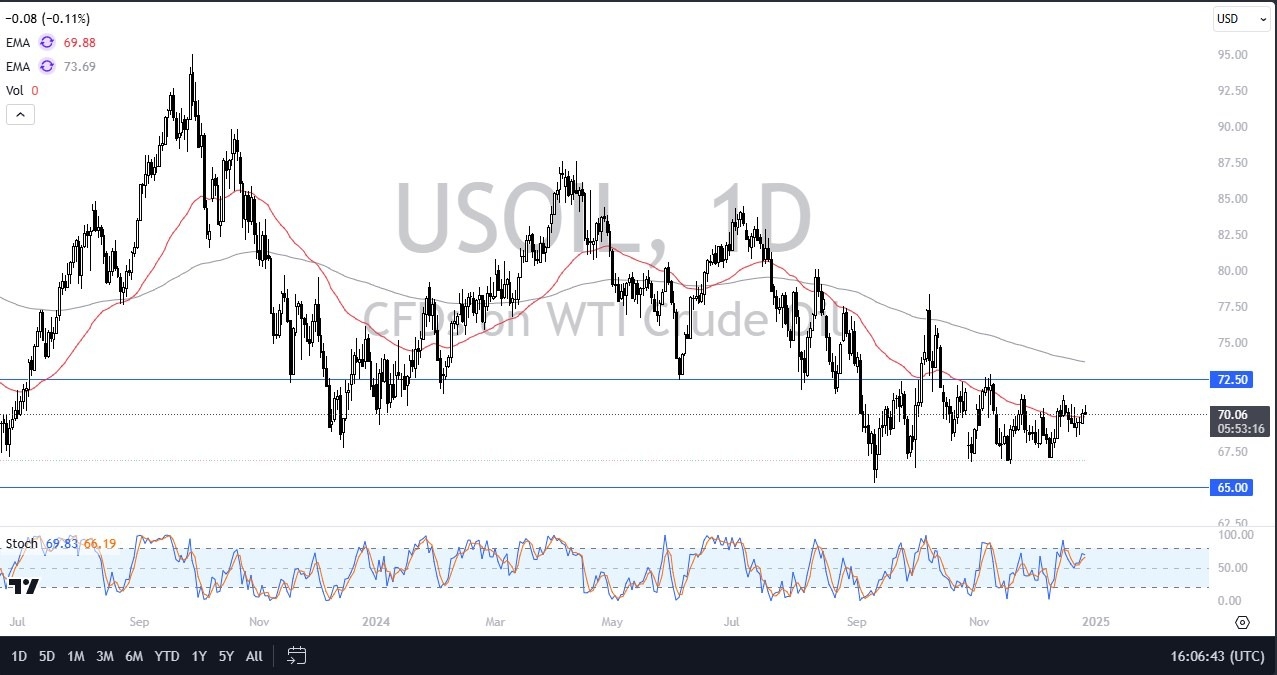
I believe at this point in time the Crude Oil market is going to continue to pay close attention to the $68 region, as it is an area that has been important and significant support in the past. Rally and from here would be expected due to the fact that we are so oversold, but the real question will be asked about whether or not we can get above the $72.50 level, as it is an area that a lot of people have paid close attention to in the past, and I think ultimately, we’ve got a scenario where people will be waiting to see whether or not the previous support should then offer significant resistance in a phenomenon known as “market memory.”

Global economy

Keep in mind that the global economy looks precarious at best, and I think a lot of people are going to keep an eye on crude oil as a way to express what they believe when it comes to global growth. After all, oil is essentially the “lifeblood” of the global markets, so if there is a significant drop in economic growth, that means there will be a significant drop in crude oil. That’s essentially what’s been going on for the last couple of weeks, and now the question will be whether or not we see any follow through.

If we were to break down below the lows of the last couple of days, we could see oil really start to drop drastically. On the other hand, I think we got a situation where we are trying to find the floor, and therefore it could be choppy and noisy over the next couple of sessions.

Ready to trade the daily Forex forecast? Here’s a list of some of the best Oil trading platforms to check out. 


Source link

Go to Top