Silver drops 1.38% to $26.59, pressured by strong US Dollar.
Key support levels at $26.51 and $26.06 eyed amid bearish momentum.
Reclaiming $27 could push silver to test resistance at $27.56 and $28.00.
Silver’s price extended its losses for the third straight day and stayed below $27.00 amid increasing geopolitical fears spurred by the Middle East conflict. Despite that, the grey metal failed to gain traction, capped by the rise of US Treasury yields and a strong US Dollar. The XAG/USD trades at $26.59, down 1.38%.
XAG/USD Price Forecast: Technical outlook
Silver’s struggle to remain above $27.00 could pave the way for a deeper pullback and test key support levels. Momentum favors sellers, as the Relative Strength Index (RSI) remains in bearish territory.
The XAG/USD first support would be the August 5 low of $26.51, followed by the 200-day moving average (DMA) at $26.06. Once those levels are surpassed, the next demand zone will be the March 27 pivot low at $24.33.
Conversely, if XAG/USD makes a U-turn and buyers reclaim $27.00, this can pave the way to test the August 6 peak at $27.56. Once hurdle, the next resistance would be the $28.00 mark ahead of the August 5 high at $28.67.
XAG/USD Price Action – Daily Chart
Silver FAQs
Silver is a precious metal highly traded among investors. It has been historically used as a store of value and a medium of exchange. Although less popular than Gold, traders may turn to Silver to diversify their investment portfolio, for its intrinsic value or as a potential hedge during high-inflation periods. Investors can buy physical Silver, in coins or in bars, or trade it through vehicles such as Exchange Traded Funds, which track its price on international markets.
Silver prices can move due to a wide range of factors. Geopolitical instability or fears of a deep recession can make Silver price escalate due to its safe-haven status, although to a lesser extent than Gold’s. As a yieldless asset, Silver tends to rise with lower interest rates. Its moves also depend on how the US Dollar (USD) behaves as the asset is priced in dollars (XAG/USD). A strong Dollar tends to keep the price of Silver at bay, whereas a weaker Dollar is likely to propel prices up. Other factors such as investment demand, mining supply – Silver is much more abundant than Gold – and recycling rates can also affect prices.
Silver is widely used in industry, particularly in sectors such as electronics or solar energy, as it has one of the highest electric conductivity of all metals – more than Copper and Gold. A surge in demand can increase prices, while a decline tends to lower them. Dynamics in the US, Chinese and Indian economies can also contribute to price swings: for the US and particularly China, their big industrial sectors use Silver in various processes; in India, consumers’ demand for the precious metal for jewellery also plays a key role in setting prices.
Silver prices tend to follow Gold’s moves. When Gold prices rise, Silver typically follows suit, as their status as safe-haven assets is similar. The Gold/Silver ratio, which shows the number of ounces of Silver needed to equal the value of one ounce of Gold, may help to determine the relative valuation between both metals. Some investors may consider a high ratio as an indicator that Silver is undervalued, or Gold is overvalued. On the contrary, a low ratio might suggest that Gold is undervalued relative to Silver.
Oil prices climbed in Asian trade on Thursday due to a significant drop in U.S. inventories, which raised hopes for sustained demand in the world’s largest fuel consumer. Bargain buying helped oil prices rebound from multi-month lows, but the rally is losing momentum.
Negative economic data from China, particularly regarding crude imports, has stymied further gains. Both oil contracts have faced sharp losses recently due to fears of a potential U.S. recession impacting demand.
Financial markets looking more stable after BOJ Governor Shinichi Uchida´s comments.
Federal Reserve’s future actions still under investors’ scrutiny.
XAU/USD remains below $2,400 but lacks clear directional strength.
Spot Gold stabilized just below the $2,400 mark, with the US Dollar out of investors’ radar amid a better market mood. The Greenback eased unevenly across the FX board, appreciating only against safe-haven JPY and CHF. XAU/USD, in the meantime, trades near its daily opening at $2,390.34.
Most of the market’s relief came from Asia. Bank of Japan (BoJ) Deputy Governor Shinichi Uchida hit the wires and said the BoJ would not raise interest rates if global markets remained unstable, cooling down the chance of a near-term hike. The news put a halt to the Japanese Yen (JPY) rally, as the currency soared after the BoJ hiked rates last week by 15 basis points (bps), while Governor Kazuo Ueda stated afterwards that interest rates are still at a “very low” level. Even further, government bond yields extended their weekly recovery after plummeting to multi-year lows earlier in the month.
Data-wise, the calendar had nothing relevant to offer, with speculative interest still focusing on what policymakers could do next. The US Federal Reserve (Fed) is also in the eye of the storm, as concerns about economic growth triggered by the latest macroeconomic data spurred speculation that the central bank may trim interest rates before the next monetary policy meeting scheduled for September.
XAU/USD short-term technical outlook
In such a scenario, Gold will likely remain strong as uncertainty usually fuels demand for the safe-haven metal. XAU/USD dailt chart shows technical indicators have pared losses and turned marginally higher, within neutral or negative levels, limiting the bullish potential in the upcoming sessions. Even further, the pair develops below a bullish 20 Simple Moving Average (SMA), which currently extends its advance above the 38.2% Fibonacci retracement of the June/July rally at $2,411.20, an immediate resistance level. Finally, the longer moving averages keep advancing far below the current price, supporting the long-term bullish stance.
In the near term, XAU/USD is neutral. The 4-hour chart shows a bearish 20 SMA keeps heading south below the current level after crossing below a flat 100 SMA. The 200 SMA, in the meantime, provides dynamic support at around $2,385.00. Finally, technical indicators have bounced from their recent lows but turned flat within neutral levels, somehow suggesting absent buying interest as per XAU/USD holding just below their midlines.
Things have taken a bad turn for the Middle East. Asia, by far the largest demand hub for Saudi Arabia, Iraq or the United Arab Emirates, seems to be going through the same stage of weakness that Europe and the United States were in the spring. Not buying enough, depleting crude inventories and generally expecting flat prices to drop lower before they come back. Perhaps there is no better example of this than China, a country that was supposed to lead summer demand recovery yet ended up buying the least crude this year as its maritime imports dropped to 10 million b/d. Such a general trend of weaker demand and sluggish physical activity inevitably impacted the Middle Eastern futures market, with the Dubai cash-to-futures spread shedding 60 cents per barrel compared to May and averaging only $0.95 per barrel. Seeing that refinery margins have been struggling to move any higher – to be fair they did not decline either – the market was preparing for a substantial price cut for August-loading cargoes across the Middle East.
Chart 1. Saudi Aramco’s Official Selling Prices for Asian Cargoes (vs Oman/Dubai average).
Source: Saudi Aramco.
Saudi Aramco did exactly what was expected. Having already cut formula prices for July cargoes, it lowered Asian OSPs across the board. The lighter Arab Extra Light and Arab Light were slashed by 60 cents per barrel, whilst the heavier grades Arab Medium and Arab Heavy saw an even bigger downward correction, by 70 cents per barrel. With this, Asian formula prices were basically back to May pricing levels, with Arab Light trading at a $1.80 per barrel premium to Oman/Dubai and Arab Medium set $1.25 per barrel higher than the benchmark. The lower pricing was in great measure brought about by very low nominations from term buyers. Total volumes departing for China in June averaged only 1.15 million b/d, the lowest monthly nomination since the first full-impact COVID-19 month of March 2020, whilst India hit a three-year low with a mere 530,000 b/d of June loadings. Even though both countries lifted more in July, the sentiment remained weak and Saudi Aramco needed to react.
Chart 2. Formula prices of Saudi cargoes bound for Northwest Europe by selected grades (vs ICE Brent).
Source: Saudi Aramco.
Compared to Asia which did not really experience notable weakness in buying up until June this year, Europe was already one phase ahead – it saw an all-round collapse of differentials earlier and was rebounding strongly into the summer. Saudi Aramco lifted its Europe-bound August formula prices by a hefty (and uniform) 90 cents per barrel. By not cutting when regional differentials were collapsing and hiking when conditions were ripe, Aramco managed to bring its European OSPs to the highest level since December 2023. Arab Light is at a $4 per barrel premium to ICE Brent, and even Arab Heavy is trading at a premium to the European futures benchmark. That would seem extraordinary in the spring months, but it has gone down well for the summer. In fact, according to market reports all the European term deal holders nominated full monthly amounts for August, suggesting that even despite high prices demand for medium sour crude remains high.
Chart 3. Kuwait Export Blend official selling prices into Asia, compared with Arab Medium and Iranian Heavy (vs Oman/Dubai average).
Source: KPC.
Kuwait doesn’t necessarily share the concerns and qualms of Saudi Arabia, after all the main reason why the country’s exports have been going down so heavily in the past years stems from its own refining. Not only is the 615,000 b/d Al Zour refinery firing on all cylinders, the 230,000 b/d Duqm refinery in Oman that the Kuwaiti state oil company co-operates has reached full production capacity, too. Depending equally on South Korea, China, and Vietnam as its key contractual partners, KPC nevertheless followed Saudi Aramco’s suit and slashed the Asian formula prices for Kuwait Export crude by 70 cents per barrel, taking it to a $1.25 per barrel premium over the Oman/Dubai average. Even the extra light KSLC grade, relatively minor in terms of volumes as KPC has been loading an average of three tankers per month, was cut by 60 cents per barrel vs the July OSP, fully in line with Arab Extra Light.
In the meantime, Kuwait has registered probably one of the largest oil discoveries of past years, claiming that the offshore al-Nokhatha field contains some 2.1 billion barrels of light oil and 5.1 trillion cubic feet of natural gas. As Kuwait has allocated a $300 billion upstream investment budget for its production capacity increases but genuinely lacked any high-impact greenfield project to work on, the field might be a game-changer for the Middle Eastern country’s long-term target of increasing crude production capacity to 4 million b/d.
Chart 4. ADNOC Official Selling Prices for 2017-2024 (set outright, here vs Dubai).
Source: ADNOC.
As has become customary, the national oil company of Abu Dhabi ADNOC is the one to start the price-setting spree in the Middle East and for August (once again), the news weren’t particularly upbeat. They weren’t bad either as the monthly average of Murban traded on the IFAD exchange amounted to $82.52 per barrel, down $1.41 per barrel compared to July’s price. Although Murban is still assessed slightly above Dubai swaps, it is nowhere near as spectacular as it used to be a year or two years ago. The pricing plight of Murban is largely driven by there being significantly more of it in the market as exports of the light sour grades jumped to 1.3-1.4 million b/d since the beginning of this year and have stayed high since. ADNOC’s refinery flexibility project that aimed to send heavier grades into the domestic refining system has finally come to a close, albeit at the expense of Murban’s past premiums. The UAE’s oil champion has also brought Upper Zakum (UZ), the country’s answer to Saudi Arabia’s Arab Light, to parity with Murban after it traded at slight premia to Murban over several months, but seeing weaker demand for UZ in Dubai trades, ADNOC decided to react.
ADNOC is increasingly diversifying its portfolio into gas. In fact, the largest announcement coming out of the Emirates in July was linked to its planned 9.6 mtpa Ruwais LNG export terminal. Western oil majors TotalEnergies, Shell, BP as well as Japan’s Mitsui have all taken 10% equity stakes, with Shell and Mitsui also signing long-term supply agreements. Following ADNOC’s natural gas-focused acquisitions in Mozambique this May and the mulled purchase of Australia’s upstream firm Santos, gas seems to be at the forefront of the UAE’s strategic growth.
Chart 5. Iraqi Official Selling Prices for Asia-bound cargoes (vs Oman/Dubai).
Source: SOMO.
Sticking to its course of mirroring Saudi Aramco’s pricing changes but keeping its grades comparatively cheaper, Iraq has also committed to a cut of 70 cents per barrel for its flagship grade Basrah Medium. For August-loading cargoes, the price will be coming in at a slight discount to Oman/Dubai, just $0.10 per barrel lower than the average of the two benchmarks. In contrast to Saudi Arabia, Iraqi exports weren’t really impacted by lower demand, if anything seaborne flows in May were the highest in five years according to Kpler data, even though since then Iraq has mended its ways and lowered exports to 3.35 million b/d (down about 200,000 b/d month-over-month). As the strength of Dated Brent has preferentially benefited Iraqi formula prices that are linked to the physical benchmark – Saudi Arabia is pricing its barrels based on ICE Brent – the increases carried out by the state oil marketing company SOMO for Europe-bound cargoes were much smaller than Aramco’s. Basrah Medium was hiked by 45 cents per barrel from July to a -$2.40 per barrel discount to Dated, whilst the heavier Basrah Heavy grade saw an uplift of 60 cents per barrel to a -$4.95 per barrel discount.
Chart 6. Iraqi official selling prices in Europe (vs Dated Brent).
Source: SOMO.
Whilst SOMO still sets formula prices for the Kirkuk grade which has historically been sourced from Kurdish-origin production, the deadlock around halted pipeline supplies along the Kirkuk-Ceyhan pipeline remains just as difficult to resolve as it was a year ago. Nevertheless, Kurdish production keeps on increasing with every month, aggravating Baghdad’s woes in meeting its OPEC+ production target. Even though SOMO reports production of 3.83 million b/d in the regions controlled by Baghdad, substantially below the 4 million b/d target, there might be an additional 350,000 b/d produced in Kurdistan. At least half of the Kurdish output is smuggled into the neighboring countries of Turkey and Iran, ultimately making it close to impossible for federal authorities in Iraq to control the rampant trade.
Chart 7. Iranian Official Selling Prices for Asia-bound cargoes (vs Oman/Dubai average).
Source: NIOC.
The election of former health minister Masoud Pezeshkian in the second round of Iran’s presidential elections held on 5 July was hardly a transformative event for the country’s oil industry. There is no discussion of easing sanctions on Tehran – if anything, Donald Trump’s potential re-election would worsen that squeeze – and for as long as Chinese buyers are still buying Iranian crude, Iran will just stick to relying on its key importer. That is not to say Tehran would not seek some form of de-escalation, and the recent release of the Chevron-chartered Advantage Sweet tanker as well as the Iraqi Basrah cargo that was sailing towards Turkey when it was seized by Iran’s navy in January. Iran’s pricing policy remains a largely academic exercise as delivered prices to China are significantly below the formula prices that the country’s state oil firm NIOC publishes, dropping as low as -$7 or -$8 per barrel to Brent futures. Yet in doing so, Iran has remained consistent and followed the line toed by Saudi Aramco. NIOC cut its Asian August formula prices by 50-70 cents per barrel, lowering the nominal value of Iran Light to a $2.10 per barrel premium against the Oman/Dubai average.
JDE Peet’s Jacobs coffee. Credit: Tricky_Shark / Shutterstock.com
Netherlands coffee and tea group JDE Peet’s has raised its full year forecast as it looks to increase pricing amidst ongoing “volatility” in green bean coffee prices.
In its latest half year results, the group raised its total company full year performance from mid-single-digit growth to a forecasted increase in organic adjusted EBIT of “around” 10%.
The coffee roaster and supplier’s organic sales growth is now expected to be in the higher end of its medium range of 3-5%. It was previously in the lower end.
In its half year results for 2024 for the six months ended 30 June, JDE Peet’s posted revenue of €4.2bn ($4.6bn), increasing 3.6% organically year on year and 5.6% on a reported basis. The group booked a profit increase of 86.5% to €360m.
“Given our strong performance in the first half, and our expectations for the remainder of the year – including the ongoing inflation and volatility in green coffee prices, along with the additional pricing that this will require – we are confident in raising our full-year outlook across top-line, profitability and cash flow,” JDE Peet’s interim CEO Luc Vandevelde said.
Robusta coffee bean prices in the second half of JDE Peet’s financial year were up by 54% on the year prior, while Arabica was up 13%.
Access the most comprehensive Company Profiles
on the market, powered by GlobalData. Save hours of research. Gain competitive edge.
Company Profile – free
sample
Your download email will arrive shortly
We are confident about the
unique
quality of our Company Profiles. However, we want you to make the most
beneficial
decision for your business, so we offer a free sample that you can download by
submitting the below form
By GlobalData
Speaking to investors on an earnings call last week, Vandevelde explained that the company would look to increase prices to defend its future gross profits.
He said: “The green coffee inflation of the last quarters will hit our P&L [profit and loss] in the coming quarters and thus inevitably [requires] additional price increases and continued cost discipline which I think are essential in protecting our gross profit so we can ensure that we can maintain the right investment levels behind our brands, products, channels, which is crucial for driving growth and shareholder value, both short-term and long-term.”
He added: “The negotiations are actually ongoing right now. We seem to be getting better reception this time around than we did on previous occasions. Actually the first quarter of this year was hit by some retailer retaliation, as we call it, but that levelled out quite nicely in the second quarter.”
A report from GlobalData, Just Drinks’ parent company, showed coffee futures prices surged in March and early April, with cheaper Robusta beans closing as high as $3,700 per tonne and more premium Arabica hitting $2.10 per pound, the highest level in over a year and a half.
Weather condition concerns in the key coffee growing regions of Vietnam and Brazil are driving the surge in prices, alongside the impact of ongoing conflicts in Ukraine and Gaza.
More recent analysis from the data analytics and consulting group suggested that prices stablised in June but are still “at still-high levels”. It said the supply of Arabica beans was in “surplus”, although “another Robusta deficit” looked likely.
In March, JDE Peet’s announced the departure of its 2020 CEO appointment, Fabien Simon. No reasons were given for the change at the top of the business.
Vandevelde was the former Marks and Spencer chairman and CEO and is now a lead independent director at JDE Peet’s. He took over the CEO role on an interim basis while the company looks for a permanent replacement for Simon.
JDE Peet’s has said the search for its CEO successor is still on going. Vandevelde added that the company had brought candidates down to a “very short” list.
“The search and selection process is progressing very well and I do intend to contract my successor before the end of the year,” Vandevelde said.
When asked by an analyst if he was on that short list Vandevelde responded: “I’m really thoroughly enjoying the role of CEO, but I’ve learned in life not to climb the same mountain too many times. So I’ll be very happy to hand over to my successor.”
Sign up for our daily news round-up!
Give your business an edge with our leading industry insights.
Oil prices are expected to drop to the mid-$70s next year amid a surplus on the market, according to Morgan Stanley.
Currently, the oil market is tight and warrants the $80s per barrel price range, but with seasonal demand starting to abate in the fourth quarter, market balances are set to return, the investment bank said in a note carried by Reuters on Monday.
In the fourth quarter of 2024, the market would be balanced “when seasonal demand tailwinds abate and both OPEC and non-OPEC supply return to growth,” Morgan Stanley’s analysts wrote.
Next year, the market will even tip into a surplus amid rising supply from both OPEC+ and non-OPEC+ producers, the bank’s commodity strategists reckon.
According to the bank, global refinery runs will hit their 2024 peak in August and are not expected to reach this level again until July next year.
That’s why Morgan Stanley expects Brent Crude prices to drop from current levels to the mid $70s to high $70s per barrel range in 2025.
Early on Monday, Brent Crude prices were up by 0.52% at $83.07, while the U.S. benchmark, WTI Crude, was trading 0.49% higher at $80.46.
Morgan Stanley reiterated in the note its price forecast of $86 per barrel Brent oil for the third quarter of 2024.
Goldman Sachs has also recently reaffirmed its outlook from June that
Brent crude prices are set to rise to $86 per barrel this summer amid strong consumer demand which will put the market into a sizeable deficit in the third quarter.
The Joint Ministerial Monitoring Committee (JMMC), the OPEC+ panel monitoring the oil market, is not expected to recommend in August any changes to the current production policy plan of the group, OPEC+ delegates told Bloomberg last week.
When the panel meets again on August 1, the meeting is expected to be a routine one, and no recommendations on oil production policy – other than the OPEC+ group has already announced – are expected to be issued, according to Bloomberg’s anonymous sources among the OPEC+ delegates.
Gold price remains in the red below $2,400 early Wednesday, as markets stabilize.
The US Dollar picks up fresh bids on the USD/JPY upsurge and the US Treasury bond yields upswing.
Gold price teases a symmetrical triangle breakdown on the daily chart.
Gold price is extending its losing momentum into the fifth straight day on Wednesday, approaching the weekly low of $2,364 amid a broadly firmer US Dollar (USD) and an uptick in the US Treasury bond yields.
The US Dollar has come under renewed buying pressure, courtesy of the latest leg higher in the USD/JPY pair and renewed upside in the US Treasury bond yields. Markets appear to have stabilized after the recent turmoil, reducing the haven demand for the US government bonds while lifting the US Treasury bond yields higher across the curve.
The US S&P 500 futures, a risk barometer, reversed early losses to trade 0.55% higher on the day. Meanwhile, Asian markets advance, led by a 4% rally in the Japanese equity indices.
The surge in the Japanese stock markets could be attributed to a fresh sell-off in the Yen after dovish remarks from the Bank of Japan (BoJ) Deputy Governor Shinichi Uchida. Uchida said that the bank “won’t raise rates further if markets are unstable”, adding that it is “appropriate to adjust the degree of monetary easing.”
With the Japanese Yen under fresh downward pressure, USD/JPY spiked nearly 200 pips to 147.50, driving the US Dollar Index higher in tandem. This, in turn, remains a drag on the USD-denominated Gold price even as markets continue to price in aggressive interest-rate cut by the US Federal Reserve (Fed) this year.
Markets are now wagering a 70% chance of the Fed cutting rates by 50 bps in September, the CME Group’s FedWatch tool showed, compared with an 85% chance a day earlier, with major brokerages also anticipating a large rate cut in the next meeting, per Reuters.
Looking ahead, Gold price will remain at the mercy of the risk trends, the USD/JPY moves driven Greenback price action and the expectations surrounding the Fed easing, in the absence of any top-tier US economic data releases. Further, traders will pay close attention to any updates on the geopolitical front, especially with the looming risks of an Iran-Israel war.
Following recent days of volatility on US economic slowdown concerns, the sentiment on Wall Street will also play a pivot role in influencing the value of the US Dollar and Gold price going forward.
Gold price technical analysis: Daily chart
As observed on the daily chart, Gold price finally yielded a daily candlestick closing below the key 21-day Simple Moving Average (SMA) support, then at $2,411.
The decisive break of the latter triggered a renewed downside for Gold price, with the key leading indicator, the 14-day Relative Strength Index (RSI), swinging back into bearish territory. The RSI is currently trading below 50, at 47.50.
With sellers commanding the game, Gold price is set to chart a downside break from a seven-week-old symmetrical triangle formation should the rising trendline support at $2,378 give way on a sustained basis.
If the triangle breakdown is confirmed, the immediate support would be seen at the 50-day SMA of $2,368, below which the $2,350 psychological level will get tested.
Further south, the 100-day SMA at $2,344 could act as a tough nut to crack for Gold sellers.
On the flip side, Gold price needs to recapture $2,400 on a potential rebound, above which the 21-day SMA support-turned-resistance, now at $2,415 will come into the picture.
The next relevant upside target is aligned at static resistance at $2,425.
Gold FAQs
Gold has played a key role in human’s history as it has been widely used as a store of value and medium of exchange. Currently, apart from its shine and usage for jewelry, the precious metal is widely seen as a safe-haven asset, meaning that it is considered a good investment during turbulent times. Gold is also widely seen as a hedge against inflation and against depreciating currencies as it doesn’t rely on any specific issuer or government.
Central banks are the biggest Gold holders. In their aim to support their currencies in turbulent times, central banks tend to diversify their reserves and buy Gold to improve the perceived strength of the economy and the currency. High Gold reserves can be a source of trust for a country’s solvency. Central banks added 1,136 tonnes of Gold worth around $70 billion to their reserves in 2022, according to data from the World Gold Council. This is the highest yearly purchase since records began. Central banks from emerging economies such as China, India and Turkey are quickly increasing their Gold reserves.
Gold has an inverse correlation with the US Dollar and US Treasuries, which are both major reserve and safe-haven assets. When the Dollar depreciates, Gold tends to rise, enabling investors and central banks to diversify their assets in turbulent times. Gold is also inversely correlated with risk assets. A rally in the stock market tends to weaken Gold price, while sell-offs in riskier markets tend to favor the precious metal.
The price can move due to a wide range of factors. Geopolitical instability or fears of a deep recession can quickly make Gold price escalate due to its safe-haven status. As a yield-less asset, Gold tends to rise with lower interest rates, while higher cost of money usually weighs down on the yellow metal. Still, most moves depend on how the US Dollar (USD) behaves as the asset is priced in dollars (XAU/USD). A strong Dollar tends to keep the price of Gold controlled, whereas a weaker Dollar is likely to push Gold prices up.
U.S. inflation data, showing a monthly decline for the first time in four years, provided support for oil prices.
OPEC’s latest monthly report reaffirmed its expectations of strong demand for crude, anticipating growth of 2.25 million barrels daily for 2024.
OPEC may consider rolling back some production cuts to prevent a significant deficit in the second half of the year.
Crude oil prices were set for a weekly decline despite earlier gains made largely on the back of economic data.
The latest update that caused the benchmarks to climb higher was U.S. inflation data, which showed a monthly decline for June—the first in four years. On an annual basis, however, inflation was up by 3%.
The news of the monthly decline supported prices, with Brent regaining territory to top $85 per barrel after it slipped below this level earlier in the week on CPI data from China where the decline in consumer prices was seen by analysts as a negative rather than a positive, and a potential sign of weaker oil demand in the coming months.
The monthly CPI dip also fueled hopes of an interest rate cut, which has been in the focus of oil traders’ attention for months.
“Cooling US inflation numbers may support the case for the Fed to kickstart its policy easing process earlier rather than later, but it also adds to the series of downside surprises in U.S. economic data, which points to a clear weakening of the US economy,” IG market strategist Yeap Jun Rong told Reuters.
Oil also received some support from OPEC’s latest monthly report, in which the cartel reiterated its expectations of strong demand for crude, seeing growth at some 2.25 million barrels daily for this year.
“Expected strong mobility and air travel in the Northern Hemisphere during the summer driving/holiday season is anticipated to bolster demand for transportation fuels and drive growth in the United States,” OPEC wrote.
If this does pan out, OPEC may decide to go ahead with the rollback of some of its production cuts to avoid what ING’s Warren Patterson called “a large deficit” in a recent second-half forecast. If it doesn’t, however, OPEC will likely stick to its production controls.
The U.S. Energy Information Administration (EIA) has raised its forecast for crude oil demand in the United States, according to the agency’s Short-Term Energy Outlook released today—although its price outlook for this year and next has been revised down.
The EIA now sees U.S. petroleum and other liquid fuels consumption averaging 20.5 million barrels per day in 2024—that’s up from the agency’s forecast in July of 20.4 million bpd.
Globally, the EIA left its total world consumption of crude oil and liquid fuels unchanged at 102.9 million bpd for 2024, revising its 2025 global fuels consumption slightly downward to 104.5 million bpd from 104.7 million bpd. These figures represent growth of 1.1 million bpd this year, and 1.6 million bpd next year.
For Brent pricing, the EIA reduced its forecast for this year and next, lowering its projections by $2 per barrel to $84 per barrel for the full year 2024. For next year, the EIA also revised its forecast down by $2 per barrel to an average of $86 for the full year.
While prices have been recently on a downward trend and the full-year 2024 guidance has been reduced, the EIA continues to expect crude oil prices to rise in the second half of 2024. The Brent spot price ended July at $81 per barrel, the EIA said, but averaged $85 per barrel for the month. The EIA sees Brent returning to between $85 per barrel and $90 per barrel by the end of the year.
The EIA sees these prices rising as we head into the latter part of the year on the back of global crude oil inventories decreasing by 800,000 bpd in the second half.
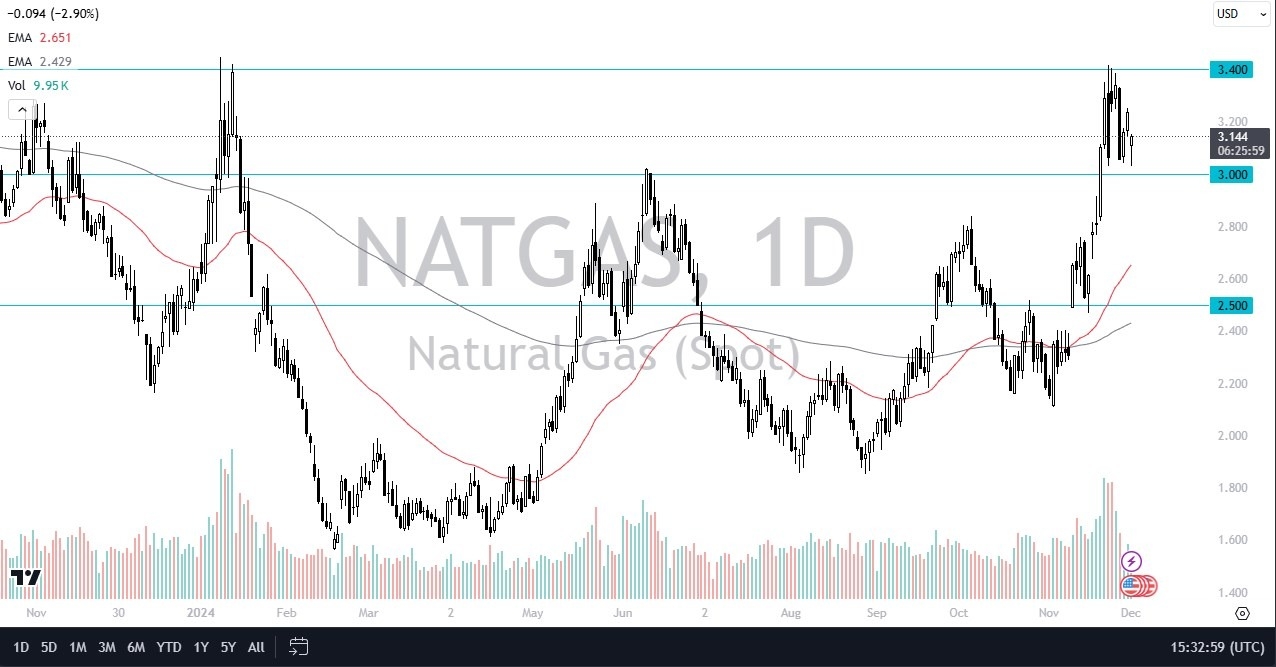
Initial resistance levels start with the 20-Day MA at 2.11. However, the most recent interim swing high of 2.15 carries greater significance as it makes up part of the downtrend price structure of lower swing highs. A rise above 2.15 opens the door to the next higher interim swing high of 2.27. Once there is a rise above daily close above the 20-Day MA natural gas will be showing indications of a bullish reversal. Further signs of strength will then be needed.
Potential Bullish Falling Wedge
An enhanced view is provided once a falling bullish wedge is identified on the chart. The pattern is bordered by two orange trendlines. It is a bullish pattern as it shows sellers becoming exhausted, which creates space for buyers to take back control. Nonetheless, a breakout trigger would be needed. That is provided on a rise above the top boundary line of the pattern. There are a couple things to be aware of regarding this pattern in natural gas. First, a bullish breakout should be accompanied by strong bullish momentum. Enough to quickly break above the 20-Day line.
Also, the wedge pattern may not be done forming. There may be more of the pattern to complete before a bullish breakout is ready to trigger. If so, natural gas could fall to its next lower target zone that begins at 1.85 yet maintain the parameters of the falling wedge. The lower target zone is identified down to 1.80. If today’s bullish reversal fails before another bullish reversal is triggered, then natural gas is likely heading to the lower price zone before the correction is over.
For a look at all of today’s economic events, check out our economic calendar.